
St. Clair Juvenile
St. Clair Juvenile
Jail Phone Number
417-646-8591St. Clair County Inmate Search: Arrests, Custody and Family Help
To find someone arrested in St. Clair County, call the Sheriff at 417-646-8591 and ask where the person is currently held. Have the full legal name, date of birth, approximate arrest time and arresting agency ready. Ask whether booking is complete and what identifier family should use.
Confirm the actual detention facility before visiting, sending mail or paying for a service. A court case, an old mugshot or an older jail listing does not establish present custody. If the Sheriff has no record yet, ask the arresting police department where the person was taken.
The Sheriff's published contact address is 360 Chestnut Street, Osceola, MO 64776. The questions below explain mugshots, warrants, calls, visits, mail and local police contacts. Our Bail guide explains release, and our Court guide helps with the St. Clair County case and hearing location.
Read inmate search answers
 Read inmate search answers
1. How do I find someone arrested in St. Clair County?
Call the Sheriff at 417-646-8591 and give the full legal name, date of birth, approximate arrest time and arresting agency if known. Ask whether booking is complete, where the person is physically held and what booking identifier family should use. The Sheriff's published contact address is 360 Chestnut Street, Osceola, MO 64776.
Confirm custody directly rather than relying on a court case, old photograph or a search result naming a county jail. Ask for the receiving facility's phone and current family-contact instructions. A missing online name does not prove release or establish that the person was never arrested.
↑ Back to the question list2. What if the arrest just happened and the Sheriff has no record?
Ask the arresting department where the person was taken and whether transport, processing or hospital care is involved. Give the agency the arrest location and approximate time. Keep the incident number and receiving-facility details so family can follow up without starting the search again.
For an Appleton City Police arrest, contact 114 East Fourth Street, Appleton City, MO 64724, 660-910-1005. Ask the department that actually handled the arrest; do not assume every incident in the area was a county deputy's case.
↑ Back to the question list3. Should I travel to Osceola or another jail?
The Sheriff's published address is 360 Chestnut Street, Osceola, MO 64776, 417-646-8591. Call before traveling and ask whether the person is there or at a different detention facility. An office address, a past housing arrangement and an individual's current location are different facts.
If another jail holds the person, get its name, phone and booking identifier and use that facility's visiting, mail and account instructions. A housing move does not by itself establish that the criminal case changed counties. Keep the detention contact and court contact separately.
↑ Back to the question list4. Where can I ask for a mugshot or arrest report?
Ask the Sheriff at 417-646-8591 about an available county booking photograph or report and its records procedure. For a city police report, ask the department that handled the incident about its own records process. A booking photo may be held by the receiving jail while the incident report belongs to the arresting agency.
Keep the incident date and report number if available and ask about public access, identification and copying requirements before ordering. Do not assume a photograph is online or that a third-party copy is current. A mugshot records a booking, not a conviction, and does not establish present custody after a later release.
↑ Back to the question list5. How can I receive release or transfer notices?
Use MOVANS to locate a participating agency's matching record and register. Missouri changed local jail notifications in May 2026. Earlier local jail subscribers need a new registration, and the replacement sends text or email rather than the former phone or VINELink app notices.
Help is available at 573-526-1929. Keep contact information current. Confirm a reported move or release with staff before arranging pickup or paying a different facility. A custody notice does not replace keeping track of the next court date.
↑ Back to the question list6. How do I find out whether bond has been set?
Ask the Sheriff at 417-646-8591 for the current release order, permitted bond type, amount and any other holds. For a St. Clair County court entry, contact the criminal clerk at 417-646-2226. Ask which office accepts the particular payment before buying a money order or hiring an agent.
The St. Clair County Bail guide explains cash, surety bonds and requests for conditions the defendant can meet. A zero or missing amount in an old listing is not a release promise. Phone credit, commissary support and bond are separate payments.
↑ Back to the question list7. How do I find the case and next court date?
Search Missouri Case.net by case number or name and match St. Clair County and the person. Review recent docket entries and hearing information. Bates County and Henry County share the 27th Circuit, so the circuit number alone does not identify the correct file. A booking allegation may differ from the eventual court charge.
The Circuit Clerk is at 655 Second Street, Osceola, MO 64776, 417-646-2226. Staff explain records and procedures; counsel explains legal consequences. The Court guide also covers municipal case and hearing-location questions.
↑ Back to the question list8. How can my relative apply for a public defender?
The Harrisonville public defender office serving St. Clair County is at 502 Westchester Avenue, Harrisonville, MO 64701, 816-380-3160. Use the application for services and ask how the defendant can apply from jail. The program reviews finances and qualifying state charges; ordinary municipal, traffic, civil and family matters are excluded.
Have the state case number and next hearing date ready. Family can help gather information, but an application does not automatically appoint a lawyer or postpone court. Federal and other proceedings use their own representation process.
↑ Back to the question list9. How do I arrange a video visit?
The Sheriff’s jail page says ordinary in-person family visits are generally not allowed. It provides video contact through the housing kiosks or tablets and describes an appointment-based room at the jail for free video visits. Attorney and other privileged visits use separate arrangements.
Call 417-646-8591 to confirm current approval, scheduling, identification and the appropriate service before paying or traveling. Off-site sessions can have charges. Follow the rules for conduct and recording; a family visit is not confidential legal contact. Our visitation information helps with preparation.
↑ Back to the question list10. How can I add commissary money?
The Sheriff identifies the lobby kiosk and Inmate Canteen for inmate-account deposits. Confirm the correct facility and inmate and review the current fees and limits before submitting. The jail does not accept mailed money orders, checks or cash for commissary deposits.
Keep the receipt and ask about ordering and refund handling after release or transfer. An inmate-account deposit does not by itself post a court bond. Call 417-646-8591 if the account or payment purpose is unclear, and review our commissary information before relying on an older service listing.
↑ Back to the question list11. How do I receive calls or electronic messages?
The Sheriff’s jail rules describe outgoing calls using the inmate’s account and dayroom kiosks or tablets for electronic contact. Ask staff which current provider and account type family should use. Confirm the facility and inmate before funding a service and review prices and restrictions.
Call 417-646-8591 with urgent health or safety information rather than waiting for an ordinary message. Routine jail calls do not bring an inmate to the phone. Legal contact should use counsel’s approved confidential procedure. Our phone information helps with preparation, but current facility instructions determine the available service.
↑ Back to the question list12. What personal mail may I send?
The jail’s published rules require ordinary personal correspondence to be on postcards no larger than 4.25 by 6 inches. Include your name and return address and the inmate’s full name. Ask staff for the current delivery address and required identifier before mailing; the Sheriff publishes P.O. Box 546, Osceola, MO 64776 as its mailing contact.
Legal correspondence and approved exceptions follow separate procedures. Do not send a package, money or photographs without checking the current rules and any required approval. Call 417-646-8591 and review the official jail instructions and our mail information before sending.
↑ Back to the question list13. Can I deliver medication or collect belongings?
Ask the Sheriff at 417-646-8591 which agency holds the person's property, whether the inmate must authorize pickup and what identification is needed. Confirm the counter and time before traveling. Evidence held by an arresting department can follow a different process from personal belongings inventoried at booking.
For medication or medical equipment, ask the receiving jail's medical staff for current instructions before bringing anything. Keep inventories and receipts and ask about collection deadlines after release or transfer. Do not assume one agency returns every item held in the case.
↑ Back to the question list14. How do I report an urgent medical or mental-health concern?
Call 417-646-8591 and ask for the actual receiving jail or responsible staff. State the urgent concern first, including withdrawal, self-harm risk or an essential treatment interruption. Give the full legal name and birth date and ask how medical staff can receive pharmacy and treatment information securely.
Family can provide important information even when privacy rules limit what staff disclose back. Do not wait for an ordinary message or a future visit to report an immediate concern. If the person moves, obtain the new facility's medical contact. For an emergency outside custody, call 911.
↑ Back to the question list15. How can I check a St. Clair County arrest warrant?
Search the correct St. Clair County file on Missouri Case.net and call the criminal clerk at 417-646-2226. The office is at 655 Second Street, Osceola, MO 64776, about unclear entries. A missing public result does not prove that no warrant exists. Ask the Sheriff at 417-646-8591 about its current inquiry and surrender procedure, and discuss the proper court response with counsel. Keep any order resolving the warrant. Do not assume a private payment to an unknown caller cancels it or that paying one bond resolves every separate order.
↑ Back to the question list16. Could someone be at a different county jail or a city jail?
Ask the Sheriff or arresting department which facility actually received the person and whether a different county's order or a housing move is involved. A family address in St. Clair County does not identify the current jail. An Osceola, Appleton City or other city police arrest does not by itself establish a separate operating city jail.
Once staff identify the destination, use the Missouri jail directory or the receiving jail's official contact. Confirm custody before paying or visiting. Keep the receiving jail's booking identifier and the court case number separately because detention and filing court can be in different counties.
↑ Back to the question list17. Where do I look after a federal arrest?
St. Clair County is in the Western Division of the U.S. District Court for the Western District of Missouri. The Charles Evans Whittaker U.S. Courthouse is at 400 East Ninth Street, Kansas City, MO 64106, 816-512-5000. Follow the hearing notice for the exact location and courtroom.
Ask federal counsel or the responsible agency for a newly arrested person's actual detention facility. The BOP locator helps with federal corrections records but may not locate every pretrial detainee. Contract-jail housing does not make the case a county prosecution, and a state bond payment does not decide federal release.
↑ Back to the question list18. How can I locate someone taken into ICE custody?
Use the ICE Online Detainee Locator with the identifying information it requests. A Form I-247A detainer requests a hold of up to 48 hours after they would otherwise be released. A lawyer should explain how that request and any other custody orders affect the person.
ICE's Kansas City office is at 11125 North Ambassador Drive, Suite 100, Kansas City, MO 64153, 816-880-5000. Ask the responsible agency about the receiving facility after pickup. Immigration photographs and documents follow ICE's records procedure, separately from local mugshot requests.
↑ Back to the question list19. How do I search after a Missouri prison transfer?
Use the Missouri DOC offender search with a name or DOC number. Read the status and any listed institution because probation and parole records can appear too. Keep the DOC identifier and sentencing case number together.
When the destination is confirmed, use that institution's mail, phone, visiting and deposit instructions. A county account is not automatically usable at a state prison. The Missouri prison directory helps with the institution, while a very recent transfer may still require staff confirmation.
↑ Back to the question list20. How can a parent locate a detained child?
Call the Circuit Clerk at 417-646-2226, 655 Second Street, Osceola, MO 64776, and ask for juvenile case assistance. Ask for the assigned officer, actual placement, lawyer, next hearing and approved parent contact. An adult custody search does not provide a complete juvenile search.
Staff may need to verify identity and relationship before discussing protected information. A courthouse or police-office address is not proof of the child’s detention location. Obtain the receiving facility’s visitor instructions before traveling and give urgent medical or safety information to responsible staff promptly.
↑ Back to the question list21. Which agency can help with an arrest or report?
St. Clair County Jail: 360 Chestnut Street, Osceola, MO 64776; 417-646-8591. Sheriff administration: 417-646-2565; 24-hour nonemergency contact 417-646-2579. Ask jail staff about custody and the arresting agency about its incident report.
Appleton City Police: 114 East Fourth Street, Appleton City, MO 64724; 660-910-1005. Osceola city contact: City Hall, 210 Olive Street, Osceola, MO 64776; 417-646-8421. The city office can direct a city records inquiry; it is not a separate verified jail desk.
For Lowry City, Collins, Roscoe or an uncertain location, ask the Sheriff which agency handled the incident and where the person was delivered. Keep the incident number, booking identifier and court case number separately. Call 911 for emergencies and use the nonemergency contacts for routine questions.
↑ Back to the question listSt. Clair County Bail and Bond: Helping a Relative Get Released
To help someone get released on a St. Clair County case, confirm the bond order, permitted payment type and other holds before paying. Call the Sheriff at 417-646-8591 to ask where the person is held and which office receives the particular bond. The questions below explain payment, surety contracts and requests for conditions the defendant can meet.
The Circuit Clerk is at 655 Second Street, Osceola, MO 64776, 417-646-2226. A judge decides release conditions; jail staff carry out the order. Keep the current court order, case number and booking identifier together before arranging payment.
The Sheriff's contact address is 360 Chestnut Street, Osceola, MO 64776. Confirm the actual detention and payment location before traveling, especially if another county is involved. Our Inmate Search guide helps locate someone, the Court guide explains hearings, and the Missouri Bail guide covers statewide release rules.
1. Where do I start if I need to post bond?
Call the Sheriff at 417-646-8591 and ask for current custody, actual housing, the release order, permitted bond type and any other holds. The Sheriff's published contact address is 360 Chestnut Street, Osceola, MO 64776. Ask which office receives payment for the particular case before traveling or sending money.
2. Which office can explain the court's order?
The Circuit Clerk is at 655 Second Street, Osceola, MO 64776, 417-646-2226. Ask which order is current, what it allows and which office receives the payment. Staff explain procedure, while counsel advises the defendant about legal choices.
3. How do I confirm the person is still in custody?
Call 417-646-8591 and provide the full legal name, date of birth and arrest details if known. Ask for the booking identifier and actual detention facility. A court file or old photograph does not establish present custody. The Inmate Search guide explains further checks and family contact.
4. What should I ask before spending money?
Ask which case the payment covers, the exact amount and permitted type, the current payment location and method, and whether another hold would prevent release. Keep the booking and case numbers separate. Money for commissary or video contact is not a bond payment.
5. Why might a person have no bond amount yet?
The person may be in booking, awaiting a charging decision or waiting for the judge's order. Missouri § 544.170 generally requires discharge within 24 hours after warrantless arrest unless a charge and warrant provide continued custody as stated there. Another lawful basis for detention may apply. Ask counsel about the facts rather than assuming automatic release.
6. Which court decides release on a state charge?
St. Clair County shares the 27th Judicial Circuit with Bates County and Henry County. The judge handling the case decides release terms; jail staff carry out the order. A cashier cannot reduce the amount. Check the county and case number before choosing a receiving court or jail office.
7. Does every case require cash bail?
No. Missouri Rule 33.01 calls for an individual assessment of appearance and safety, considering nonmonetary conditions before financial ones when appropriate and taking ability to pay into account. Detention is possible when legal requirements are met. The Missouri Bail guide explains the statewide rules.
8. What does release on recognizance mean?
The defendant promises in writing to appear and obey the order, potentially without an upfront deposit. There may still be restrictions on contact, travel, alcohol, weapons or reporting. Read the actual conditions before making family or work plans. Recognizance does not dismiss the charge.
9. What kinds of bond might be permitted?
The order may allow full cash, an authorized percentage deposit, a licensed surety or approved property security, or release on a promise with conditions. Ask which alternatives are written into the order. A court-authorized 10% deposit is different from a commercial premium, and neither is available automatically.
10. When can an unaffordable condition be reviewed?
Counsel can ask about release review and modification under Rules 33.05 and 33.06. Explain what cannot be met and provide financial, housing and appearance information. Ask about the scheduled hearing rather than assuming a weekend arrest has a fixed outcome. The present order remains in force unless changed.
11. What should I check before hiring a bail agent?
Check the Missouri license and get a written contract showing the premium, collateral, payment terms and co-signer obligations. Ask what happens if the person misses court or the surety surrenders them. A service fee generally is not refundable court cash. Do not sign based only on a quoted percentage.
12. Can a home or land be used for bond?
The court must authorize and approve property security. Ask which ownership, lien and valuation documents are needed. Understand the risk of forfeiture before pledging a home or farm. A relative's willingness to help does not require the judge to accept the proposed property.
13. What should I bring to post an approved bond?
Bring identification, the defendant's full name and the booking or case number. First confirm the receiving office, street address, available hours and accepted payment. Get a receipt naming the payer and case. Ask how payment confirmation and the release order reach the jail.
14. Can I use a card or pay bond online?
Ask jail or court staff about that specific order and provider. A website accepting commissary money, phone credit or fines is not automatically a bond service. Confirm the payee and fee before entering card details. Do not buy a money order until the receiving office confirms the method.
15. Who can post money for a family member?
An adult payer should be at least 18 and bring government-issued identification. Ask about additional requirements for this bond. Check the depositor name on the receipt and ask how an eventual refund is issued. Private arrangements among relatives do not automatically alter the court record.
16. How long will release take after payment?
The receiving office must process payment and release authority, and jail staff must address other lawful holds. Ask what remains before arranging pickup. There is no release-time guarantee for every case. A receipt does not prove that discharge is finished; confirm the pickup location with staff.
17. How can relatives living elsewhere help?
Start with the actual detention facility, case number and current release order. Ask the receiving office what a payer living elsewhere must do before sending funds. Family can help contact counsel and organize records without promising a release time or signing an agent's contract before reading it.
18. What if a traveler is arrested in St. Clair County?
Ask which agency made the arrest, which facility received the person and which county filed the charge. Tell counsel about out-of-town housing, work and transportation needs. A lawyer can request workable conditions. Returning home does not excuse a required hearing or travel restriction.
19. What should I ask after a lake or campground arrest?
Get the exact location, arresting agency, receiving facility and case number. The name of a nearby town or recreation area is not enough to identify the court. Confirm which order and payment office apply before sending money, and explain travel needs to counsel.
20. Can another county prevent release?
A separate valid warrant or hold may remain after the local bond is satisfied. Ask which county and case need action and whether a transfer is expected. One receipt covers the stated order, not every other matter. Have the lawyer review the remaining basis for custody.
21. What if an out-of-state warrant is found?
It can create a separate hold and extradition proceeding. Ask which state and agency requested custody and notify counsel. The defendant should understand the consequences before signing a waiver. Paying a local bond does not resolve the other state's court order.
22. How do probation, parole or immigration matters affect release?
Ask staff to identify every separate basis for custody. Another supervising agency or court may need to act. An ICE detainer requests a hold of up to 48 hours after they would otherwise be released. Counsel should review the actual request and orders; the criminal bond does not decide an immigration case.
23. Where do Osceola ordinance cases go?
For an Osceola, Appleton City or other ordinance ticket, read the municipal division named on the citation and ask the Circuit Clerk at 417-646-2226 to identify the case and current hearing location. Osceola City Hall is at 210 Olive Street, Osceola, MO 64776, 417-646-8421. Do not assume the city office and hearing room are the same location. Ask the court to identify the order and whether a proposed payment is bond or a fine involving a plea.
24. What paperwork should the family keep?
Save the full release order, receipt and next court notice. Check dates, restrictions, case number and payer details. Make copies available to the defendant and lawyer. Update contact information as required. A reminder from a relative helps, but the defendant remains responsible for compliance.
25. What if the release order is unclear or difficult to follow?
Ask counsel before acting on a guess. Work, childcare, housing or treatment needs may support a request for change, but the judge must approve it. A protected person's invitation does not cancel a no-contact order. Violations can lead to a warrant, stricter conditions or detention.
26. Can an agent return the defendant to custody?
A surety may have surrender rights and duties under Missouri law and the contract. Ask counsel and the agent which procedure applies and whether a new order is needed. Review additional charges in writing. Surrender does not end the criminal prosecution or cancel its hearings.
27. What information helps a request for different conditions?
Give counsel a realistic account of income, necessary expenses, housing, work, treatment and transportation to court. Explain the particular condition that cannot be met and propose an alternative. The court decides the request; submitting it alone does not lower the amount or excuse the existing terms.
28. How do I check the most recent bond entry?
Find the correct St. Clair County file on Missouri Case.net. Other counties share the 27th Circuit, so match the county and case number. Read later entries that may replace an older amount. Ask the clerk or lawyer to explain any uncertainty before paying based on a docket screenshot.
29. How can I check whether cash bond is refundable?
Call the Circuit Clerk at 417-646-2226 with the receipt and case number. Ask whether the court released the deposit, who is recorded to receive it and whether lawful deductions apply. Keep the mailing address current. Do not assume full repayment or a fixed date before processing is complete.
31. Does dismissal mean the person leaves immediately?
Ask the lawyer what the dismissal changes and whether any other cases remain. The jail needs appropriate release authority and may still have a separate lawful hold. Check bond discharge and refund paperwork separately. One closed case does not establish that every warrant or order has ended.
32. What should someone do after missing a hearing?
Contact the lawyer promptly and explain the reason. The court may issue a warrant and begin forfeiture. Ask which filing or appearance is needed; a relative's call does not automatically excuse the absence. A commercial contract may also expose a co-signer to costs.
33. Do children use adult bond procedures?
Juvenile matters generally have different detention and release rules. Ask the Circuit Clerk at 417-646-2226 for the juvenile office. A parent needs the child's actual placement, assigned officer, lawyer and next hearing. Do not assume a child is in the adult jail or send adult bond funds without directions.
34. Who helps someone who cannot afford a lawyer?
The Harrisonville public defender office serving St. Clair County is at 502 Westchester Avenue, Harrisonville, MO 64701, 816-380-3160. Use the application for services and ask how the defendant can apply from jail. The program reviews finances and qualifying state charges; ordinary municipal, traffic, civil and family matters are excluded.
35. Who decides release on a federal charge?
St. Clair County is in the Western Division of the U.S. District Court for the Western District of Missouri. The Charles Evans Whittaker U.S. Courthouse is at 400 East Ninth Street, Kansas City, MO 64106, 816-512-5000. Follow the hearing notice for the exact location and courtroom. Follow federal counsel's directions; paying a state bond does not satisfy a separate federal order.
36. Can the defendant travel to work after release?
Read the actual travel and reporting terms before crossing a restricted boundary or leaving Missouri. Counsel can request approval or a modification if work requires travel. Explain the schedule and route and obtain required permission. Employment alone does not change a release condition.
37. What if the case involves an order of protection?
Read both the protective order and criminal release conditions with counsel. They may restrict direct contact, messages, third-party contact or access to a shared home. Arrange housing and any permitted property pickup without violating the order. A private agreement between the people involved does not change the court's terms.
38. What should a family do after a holiday arrest?
Call 417-646-8591 to ask whether an existing warrant or order already sets release conditions and where an authorized payment is accepted. If terms have not been entered, ask counsel about the initial appearance and review. Do not rely on an assumed holiday delay or a promise that staff can set a bond themselves.
39. What is the final check before traveling to Osceola?
Confirm custody, the current amount and permitted bond type, other holds, the payment counter and accepted method at 417-646-8591. Bring identification and the booking number. For court records call 417-646-2226. Our Court guide explains the next hearing after release.
St. Clair County Court Guide: Case Searches, Locations and Family Help
For St. Clair County criminal court information, call the Circuit Clerk at 417-646-2226. The office is at 655 Second Street, Osceola, MO 64776. Search Missouri Case.net for public case records and hearing entries. Match the county, case number and division before deciding where to appear.
For an ordinance case, read the municipal division on the ticket and confirm the hearing location with its clerk. A city office address does not establish the courtroom. St. Clair County shares the 27th Judicial Circuit with Bates County and Henry County. The court named on the notice determines where the defendant must attend.
For custody and the actual detention facility, call the Sheriff at 417-646-8591. The Sheriff's contact address is 360 Chestnut Street, Osceola, MO 64776; a jail address is not a substitute for a hearing location. Our Inmate Search guide helps locate someone, and our Bail guide explains release.
1. Which court handles a St. Clair County criminal case?
St. Clair County shares the 27th Judicial Circuit with Bates County and Henry County. The Circuit Clerk is at 655 Second Street, Osceola, MO 64776, 417-646-2226. Circuit and associate circuit proceedings are parts of Missouri's trial-court system. Read the notice for the assigned division, judge and courtroom.
Associate circuit judges handle many misdemeanors and early felony matters. An ordinance case can belong to a municipal division. The prosecutor represents the government; a defendant needs separate defense counsel. Clerk staff help explain records and procedures but cannot advise a defendant how to plead.
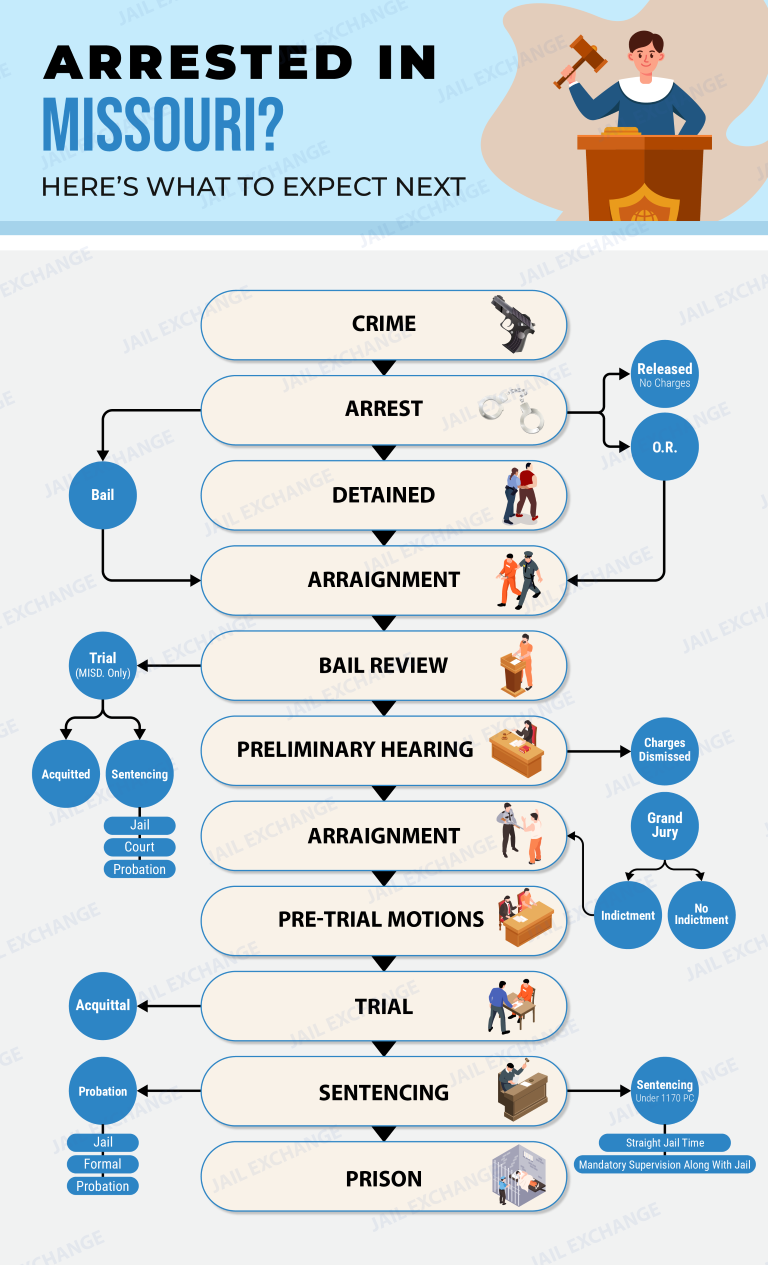
2. What should a family expect after an arrest in St. Clair County?
The arresting agency may take a person to the local jail for processing, including identification, inventory of property, and a health review.
Release may be on a promise to appear, with supervision, or under a secured bond ordered by a judge.
The first court hearing deals with the accusation, the person’s rights, and whether release is allowed while the case is pending. A judge can set restrictions on contact, travel, weapons, or reporting. Failing to return to court may result in a warrant and new consequences.
For a worried family, the useful facts are the person’s complete name, date of birth, booking agency, whether a bond was ordered, and the next hearing date. A jail phone operator cannot give legal advice and a bond amount should not be mistaken for a criminal fine.
3. How are misdemeanors handled in St. Clair County?
For a minor state charge, an arrest is possible, but the case may start with paperwork and a court appearance instead.
At an arraignment or initial court date, the accused learns the charge and can enter an authorized plea. The prosecutor and defense may exchange information or discuss an agreement. If there is no agreement, the court schedules a contested hearing or trial.
Missouri law, § 558.011, permits at most one year for a Class A misdemeanor, six months for Class B, and 15 days for Class C. Under § 558.002, ordinary maximum fines are $2,000, $1,000, and $750 respectively, unless a more specific rule controls.
A judge can consider probation or a suspended sentence when allowed. A traffic ticket or city ordinance charge may follow its own fine schedule; it should not automatically be treated as a Class A misdemeanor.
4. What happens when the charge is a felony in St. Clair County?
The prosecutor may seek an indictment from a grand jury. A case may also proceed through an information after the legally required steps.
A felony allegation can first appear before an associate circuit judge to address counsel, bond, and probable cause.
A judge deciding probable cause is not deciding whether the defendant is guilty. If charges go forward, both sides have opportunities for motions, disclosure of evidence, and plea discussions. A criminal conviction at trial requires proof beyond a reasonable doubt.
Counsel matters early: statements, searches, identification issues, and detention orders can shape the defense. A plea may avoid trial but can also create a lasting record or prison sentence, so the person should understand the terms before agreeing.
5. How does the court handle a serious violent felony in St. Clair County?
A major violent prosecution may need forensic testing, expert witnesses, and several pretrial hearings.
Serious violent accusations usually bring closer attention to release conditions and victim safety.
Missouri defines “dangerous felonies” by statute. Certain convictions carry an 85% minimum service requirement before parole eligibility. That is not a rule for every charge involving violence; it depends on the precise conviction and statute.
In homicide and other extremely serious cases, the lawyer may address expert evidence, mental-state disputes, and sentencing issues long before trial. Families should not assume that a high bond means guilt or that a dismissed charge guarantees immediate release when other warrants exist.
6. What happens if someone under 18 is accused in St. Clair County?
A child may be released to family with rules to follow, supervised at home, or held in an authorized youth facility when legally justified.
A youth accused of wrongdoing generally goes through the circuit court’s juvenile division, not the adult criminal calendar.
The juvenile division considers the child’s age, the allegation, family situation, and safety needs. A formal petition, if filed, is different from an adult criminal information or indictment. Some youth matters may be diverted from full court processing.
Parents or guardians should ask who is assigned to the child, where the youth is being held if detained, and when the next hearing will occur. Transfer to adult criminal court is possible only under specific legal procedures; it is not automatic for every serious accusation.
7. What are the jail terms, prison sentences and fines in St. Clair County?
A defendant may face a fine, probation, a suspended sentence, jail or prison depending on what is proven and the law that applies.
- Class A felony: 10–30 years or life.
- Class B felony: 5–15 years.
- Class C felony: 3–10 years.
- Class D felony: up to 7 years.
- Class E felony: up to 4 years.
- Class A misdemeanor: up to one year; normally up to $2,000 fine.
- Class B misdemeanor: up to six months; normally up to $1,000 fine.
- Class C misdemeanor: up to 15 days; normally up to $750 fine.
- Class D misdemeanor: no ordinary jail term; normally up to $500 fine.
Missouri Revised Statutes §§ 558.011 and 558.002 set these general ranges and fines. Standard felony fines can reach $10,000 for Classes C, D, or E. Some individual crimes have different rules, special minimums, or sentencing enhancements. A prior felony can also affect the authorized punishment.
For Class D or E felonies, Missouri law can permit a special county-jail term of up to one year instead of a longer state prison term. Probation, treatment court, and suspended sentences are possible in eligible cases; none is promised simply because a person has no record.
Parole eligibility is not the same as an automatic release date. The date can change with the charge, sentencing law, and Department of Corrections decisions. These figures state the general law in force in October 2026, not legislation scheduled to take effect in 2028.
What changes under Missouri sentencing law on January 1, 2028?
For families in St. Clair County, the difference between current law and the scheduled 2028 law matters. Missouri Revised Statutes § 558.011 has a new version scheduled to take effect January 1, 2028. The percentages below describe when someone may first qualify for parole consideration, not a promised release date. They do not replace special rules that demand a longer time in prison.
- Class A felony: 10 to 30 years or life; generally 70% of the sentence before parole eligibility.
- Class B felony: 5 to 15 years; generally 50% before parole eligibility.
- Class C felony: 3 to 10 years; generally 30% for a first conviction, 35% for a second and 50% for a third or later conviction. Certain offenses requiring sex-offender registration carry 40%.
- Class D felony: up to 7 years; generally 20% for a first conviction, 25% for a second and 50% for a third or later conviction. Certain registrable offenses carry 25%.
- Class E felony: up to 4 years; generally 15% for a first conviction, 20% for a second and 50% for a third or later conviction. Certain registrable offenses carry 25%.
- Dangerous felonies: the law requires 85% of the sentence before parole eligibility.
For Class A and B felonies and certain crimes requiring sex-offender registration committed on or after January 1, 2028, the law also removes eligibility for conditional release. Parole and conditional release are not the same. Whether the new law applies to a particular person depends on the offense date, the final charges, earlier convictions and other sentencing laws. Until the effective date, the existing statute remains controlling. Source: Missouri Revised Statutes § 558.011.
8. Which federal court handles charges from St. Clair County?
St. Clair County is in the Western Division of the U.S. District Court for the Western District of Missouri. The Charles Evans Whittaker U.S. Courthouse is at 400 East Ninth Street, Kansas City, MO 64106, 816-512-5000. Follow the hearing notice for the exact location and courtroom.
Federal charges require a basis in federal law, such as qualifying firearms, bank robbery, fraud or interstate drug offenses. A state accusation does not become federal simply because someone crosses a county line. Federal authorities decide federal release. Pretrial detainees can be held in contract jails and may not immediately appear in the BOP locator.
9. How do I find the case number and next hearing?
Search Missouri Case.net by name or case number and match St. Clair County and the person. Read recent docket entries and hearing information. Bates County and Henry County share the 27th Circuit, so the circuit number alone does not establish the right file.
Call 417-646-2226 if the notice and online entry are unclear. A new or restricted matter may not be publicly visible. Counsel explains the legal effect of a court entry.
10. How do I find the court for a city ticket?
For an Osceola, Appleton City or other ordinance ticket, read the municipal division named on the citation and ask the Circuit Clerk at 417-646-2226 to identify the case and current hearing location. Osceola City Hall is at 210 Olive Street, Osceola, MO 64776, 417-646-8421. Do not assume the city office and hearing room are the same location.
A city officer can issue a state charge or an ordinance allegation. The department alone does not establish the case type. Keep the ticket and read the named court, response instructions and next date before paying or traveling. A fine involving a plea is different from posting bond.
11. How can someone apply for a public defender?
The Harrisonville public defender office serving St. Clair County is at 502 Westchester Avenue, Harrisonville, MO 64701, 816-380-3160. Use the application for services and ask how the defendant can apply from jail. The program reviews finances and qualifying state charges; ordinary municipal, traffic, civil and family matters are excluded.
Family can help gather financial and case information, but an application does not automatically appoint a lawyer or postpone a hearing. Give staff the next court date. Ask the appropriate court about representation for a proceeding outside the state program.
12. Does detention in another county move the St. Clair County case?
A detention location and a filing court are different things. Ask the Sheriff for the actual jail and counsel or the clerk for the active court file. Housing elsewhere does not by itself establish that the case moved; a change of venue is a separate court matter.
Use 417-646-8591 for custody questions and 417-646-2226 for a St. Clair County criminal file. Keep the receiving jail's booking identifier and court case number separately. Do not choose a hearing location from a jail address alone.
13. How can I check a warrant or missed hearing?
Search the correct St. Clair County file on Missouri Case.net and call the criminal clerk at 417-646-2226. The office is at 655 Second Street, Osceola, MO 64776, about unclear entries. A missing public result does not prove that no warrant exists. Ask the Sheriff at 417-646-8591 about its current inquiry and surrender procedure, and discuss the proper court response with counsel. Keep any order resolving the warrant. Do not assume a private payment to an unknown caller cancels it or that paying one bond resolves every separate order.
14. How can relatives help prepare for a hearing?
Keep the current notice, case number, lawyer's contact and release conditions together. Confirm the courthouse entrance, courtroom and security rules and arrange a reliable ride. Tell counsel promptly about a medical, work or transportation problem affecting attendance.
Our Bail guide explains release conditions and requests for change. A relative's call does not excuse a hearing. Respect contact restrictions while helping; a protected person's invitation does not cancel a court order.
Information for this service is currently unavailable.
Information for this service is currently unavailable.
Information for this service is currently unavailable.

CIDNET Phone Calling enables incarcerated individuals to place outbound voice calls from housing-unit wall phones or handheld tablets directly to approved cell phones and landlines. Because jail phone systems cannot accept incoming calls, setting up a CIDNET account and purchasing Data Points ensures outbound calls connect immediately without wireless carrier collect blocks.
Important: Mobile Networks Block Inmate Calls Without Data Points
Wireless cellular carriers automatically block collect calls originating from jail telecommunications systems. While some traditional landline telephone providers may support monthly operator billing, mobile smartphones and VoIP numbers require an active prepaid CIDNET balance, which you can verify with your provider. If you do not register your 10-digit number online and purchase Data Points immediately, your loved one will hear an automated operator recording stating that your phone number cannot accept calls.
Step-by-Step Instructions to Set Up and Fund Voice Calling
- Go to customer.cidnet.net or launch the CIDNET Customer mobile app.
- Register your account using the primary 10-digit telephone number where you want to receive calls.
- Upload your driver's license or state ID for identity verification.
- Select the detention center where the inmate is held and link them to your contact profile.
- Purchase Data Points using a debit or credit card to cover per-minute calling rates.
- Confirm your mobile phone allows calls from automated or unknown correctional numbers and does not send them to spam.
What the Inmate Needs to Do
The inmate approaches a pod wall phone or opens the phone app on their tablet, enters their assigned inmate PIN, and dials your 10-digit number. CIDNET's automated system verifies that your account has sufficient Data Points and connects the call once you accept the automated prompt. All non-privileged conversations are recorded and monitored by the facility.
Official Provider: CIDNET Customer Portal | Encartele Corporate
Customer Service Telephone: 1-888-984-1903
Support Hours: Monday – Friday, 8:00 AM – 5:00 PM CST
Supported Languages: English and Spanish
Other Services Provided by CIDNET
In addition to Phone Calling, CIDNET operates messaging and video visitation services:
- Data Points (Unified Funding): Purchase the central credits used to pay for telephone talk time.
• Learn more on our website: CIDNET Data Points Guide | • Visit official vendor page: Buy CIDNET Data - Remote Video Visitation: Schedule and join live video visits from home using your computer or smartphone.
• Learn more on our website: CIDNET Video Visits Guide | • Visit official vendor page: CIDNET Video Visitation - Inmate Messaging & Digital Mail: Send text messages and digital photo attachments directly to an inmate's terminal.
• Learn more on our website: CIDNET Messaging Guide | • Visit official vendor page: CIDNET Messaging Portal
Information for this service is currently unavailable.
Information for this service is currently unavailable.