
St. Louis City Justice Center
St. Louis City Justice Center
City Justice Center
314-621-5848St. Louis City Inmate Search: Arrests, Custody and Family Help
To find someone arrested in St. Louis City, use the official city inmate locator and enter the exact first and last name. Call the City Justice Center at 314-621-5848 if you need to confirm custody or the result is unclear. Have the person’s date of birth ready.
A missing name can mean police processing or transport is still underway, the recorded name differs, or the person has been released. The city directs families who believe someone remains in police custody to Prisoner Processing at 314-241-8339. Ask for the receiving facility and Inmate Master Number.
The City Justice Center is at 200 South Tucker Boulevard, St. Louis, MO 63102. St. Louis City and St. Louis County have separate jails, courts and searches. The questions below help with mugshots, warrants, visits, calls and family support; our Bail guide explains release and our Court guide helps with case searches and hearing locations.
Read inmate search answers
 Read inmate search answers
1. How do I use the official St. Louis City inmate locator?
Open the city’s Locate a St. Louis City Inmate page. Its instructions require the exact first and last name. Match the birth year and listed facility before relying on a result; the city describes name, birth year, race, sex and facility in the results.
If the name is absent, check the spelling and call 314-621-5848. A recent arrest may still be in police processing, transport or another facility. Keep the Inmate Master Number, often called IMN, for family-service questions. The city locator and St. Louis County’s locator are separate searches.
↑ Back to the question list2. What if the arrest just happened and Corrections has no record?
Ask the arresting department where the person was taken and whether transport, processing or hospital care is involved. Give the agency the arrest location and approximate time. Keep the incident number and receiving-facility details so family can follow up without starting the search again.
If the person is missing from the city locator but may still be in police custody, the city directs families to Prisoner Processing at 314-241-8339. Ask the department that actually handled the arrest; do not assume every incident in the area was a county deputy's case.
↑ Back to the question list3. Should I travel to St. Louis City or another jail?
Corrections lists its address as 200 South Tucker Boulevard, St. Louis, MO 63102, 314-621-5848. Call before traveling and ask whether the person is there or at a different detention facility. An office address, a past housing arrangement and an individual's current location are different facts.
If another jail holds the person, get its name, phone and booking identifier and use that facility's visiting, mail and account instructions. A housing move does not by itself establish that the criminal case changed counties. Keep the detention contact and court contact separately.
↑ Back to the question list4. Where can I ask for a mugshot or arrest report?
Ask Corrections at 314-621-5848 about an available county booking photograph or report and its records procedure. For a city police incident report, ask the department that handled the arrest about its records procedure. A booking photo may be held by the receiving jail while the incident report belongs to the arresting agency.
Keep the incident date and report number if available and ask about public access, identification and copying requirements before ordering. Do not assume a photograph is online or that a third-party copy is current. A mugshot records a booking, not a conviction, and does not establish present custody after a later release.
↑ Back to the question list5. How can I receive release or transfer notices?
Use MOVANS to locate a participating agency's matching record and register. Missouri changed local jail notifications in May 2026. Earlier local jail subscribers need a new registration, and the replacement sends text or email rather than the former phone or VINELink app notices.
Help is available at 573-526-1929. Keep contact information current. Confirm a reported move or release with staff before arranging pickup or paying a different facility. A custody notice does not replace keeping track of the next court date.
↑ Back to the question list6. How do I find out whether bond has been set?
The city lists 314-622-3231 for municipal bond amounts and 314-641-8214 for state bond amounts. Ask which charge, order and counter apply before traveling or paying. A municipal fine, phone deposit and court bond are different transactions.
The St. Louis City Bail guide explains the next questions: permitted bond type, other holds, required identification, current payment method and release processing. An online booking entry does not guarantee discharge. Keep the court case number and the jail’s IMN separately.
↑ Back to the question list7. How do I find the case and next court date?
Search Missouri Case.net by case number or name and match St. Louis City and the person. Review recent docket entries and hearing information. Select the City of St. Louis rather than St. Louis County and match the defendant and case number. A booking allegation may differ from the eventual court charge.
The listed criminal-records office is at 10 North Tucker Boulevard, first floor, St. Louis, MO 63101, 314-622-4433. Staff explain records and procedures; counsel explains legal consequences. The Court guide also covers St. Louis City Municipal Court, which is a separate location.
↑ Back to the question list8. How can my relative apply for a public defender?
The St. Louis City public defender office is in the Mel Carnahan Courthouse at 1114 Market Street, Suite 602, St. Louis, MO 63101, 314-340-7625. Use the application for services and ask how the defendant can apply from jail. The program reviews finances and qualifying state charges; ordinary municipal, traffic, civil and family matters are excluded.
Have the state case number and next hearing date ready. Family can help gather information, but an application does not automatically appoint a lawyer or postpone court. Federal and other proceedings use their own representation process.
↑ Back to the question list9. How do I arrange an approved visit?
The city’s posted process begins with a Visitor Request Form sent by the inmate to a chosen visitor. Complete and return it, then confirm approval with the caseworker. Do not travel assuming a submitted form is an approved appointment. Adults and accompanying children must meet the current visitor rules.
Call 314-621-5848 and ask for the person’s caseworker; the directory lists visiting information at extension 1042. Confirm the schedule, identification, dress and arrival time. The inmate arranges the approved session. Our visitation information helps with preparation, and the city’s current instructions govern entry.
↑ Back to the question list10. How do I add commissary money?
The city identifies Correct Solutions Group for online deposits and lists separate lobby kiosks for commissary and telephone accounts. Obtain the Inmate Master Number before paying. Its instructions say to add leading zeros so the commissary IMN entry contains eight digits.
Check the current fee, facility and account type and keep the receipt. The city page contains inconsistent mailed-money-order wording, so ask the inmate funds office at 314-621-5848, extension 1065, before mailing a payment. An account deposit does not post bond or necessarily fund calls. Review our commissary information before purchasing.
↑ Back to the question list11. How do I receive calls or resolve a phone-account problem?
The city’s money instructions identify Correct Solutions Group and 877-618-3516 for inmate telephone accounts. Confirm the person’s IMN, facility and correct account before funding it. Commissary and telephone deposits use separate options.
Corrections directory lists inmate telephone-system questions at 314-621-5848, extension 1062. Give urgent health or safety information directly to staff rather than waiting for an ordinary message. Calls may be monitored; counsel should arrange approved confidential legal contact. Our phone information helps with preparation.
↑ Back to the question list12. Where should I send a letter or photograph?
Call 314-621-5848 to identify the actual detention facility, then obtain its current personal-mail destination and required inmate identifier. Corrections lists its contact address as 200 South Tucker Boulevard, St. Louis, MO 63102, but a contact office is not automatically the right inmate-mail destination. A receiving jail may use a separate processor.
Include your full name and return address and follow the receiving jail's rules for paper, photographs and enclosures. Legal mail, subscriptions and packages may have different instructions. Do not send cash or assume a parcel is accepted. Review the mail information and recheck the address after a move.
↑ Back to the question list13. Can I deliver medication or collect belongings?
Ask Corrections at 314-621-5848 which agency holds the person's property, whether the inmate must authorize pickup and what identification is needed. Confirm the counter and time before traveling. Evidence held by an arresting department can follow a different process from personal belongings inventoried at booking.
For medication or medical equipment, ask the receiving jail's medical staff for current instructions before bringing anything. Keep inventories and receipts and ask about collection deadlines after release or transfer. Do not assume one agency returns every item held in the case.
↑ Back to the question list14. How do I report an urgent medical or mental-health concern?
Call 314-621-5848 and ask for the actual receiving jail or responsible staff. State the urgent concern first, including withdrawal, self-harm risk or an essential treatment interruption. Give the full legal name and birth date and ask how medical staff can receive pharmacy and treatment information securely.
Family can provide important information even when privacy rules limit what staff disclose back. Do not wait for an ordinary message or a future visit to report an immediate concern. If the person moves, obtain the new facility's medical contact. For an emergency outside custody, call 911.
↑ Back to the question list15. How can I check a St. Louis City arrest warrant?
Search the correct St. Louis City file on Missouri Case.net and call the criminal clerk at 314-622-4433. The listed criminal-records office is at 10 North Tucker Boulevard, first floor, St. Louis, MO 63101, about unclear entries. A missing public result does not prove that no warrant exists. Ask Corrections at 314-621-5848 about its current inquiry and surrender procedure, and discuss the proper court response with counsel. Keep any order resolving the warrant. Do not assume a private payment to an unknown caller cancels it or that paying one bond resolves every separate order.
↑ Back to the question list16. Could the person be in St. Louis County or another jail?
Yes. St. Louis City and St. Louis County are separate jurisdictions. An arrest in a county municipality, a different warrant or a housing transfer can require another facility search. Ask the arresting unit or Corrections to identify the actual receiving jail rather than choosing by a St. Louis mailing address.
Use the Missouri jail directory once you know the destination. Ask the receiving facility about its own mail, visiting, phone and payment procedures. The city’s inmate locator and 22nd Circuit case search do not replace a county search or establish that someone is housed in Clayton.
↑ Back to the question list17. Where do I look after a federal arrest?
St. Louis City is in the Eastern Division of the U.S. District Court for the Eastern District of Missouri. Follow the federal hearing notice for the courthouse and courtroom. Federal counsel or the clerk can explain where a particular proceeding will be held; a state courthouse address does not establish the location of a federal hearing.
Ask federal counsel or the responsible agency for a newly arrested person's actual detention facility. The BOP locator helps with federal corrections records but may not locate every pretrial detainee. Contract-jail housing does not make the case a county prosecution, and a state bond payment does not decide federal release.
↑ Back to the question list18. How can I locate someone taken into ICE custody?
Use the ICE Online Detainee Locator with the identifying information it requests. A Form I-247A detainer requests a hold of up to 48 hours after they would otherwise be released. A lawyer should explain how that request and any other custody orders affect the person.
ICE's St. Louis office is at 1222 Spruce Street, Room 1.100, St. Louis, MO 63103, 314-244-9787. Ask the responsible agency about the receiving facility after pickup. Immigration photographs and documents follow ICE's records procedure, separately from local mugshot requests.
↑ Back to the question list19. How do I search after a Missouri prison transfer?
Use the Missouri DOC offender search with a name or DOC number. Read the status and any listed institution because probation and parole records can appear too. Keep the DOC identifier and sentencing case number together.
When the destination is confirmed, use that institution's mail, phone, visiting and deposit instructions. A county account is not automatically usable at a state prison. The Missouri prison directory helps with the institution, while a very recent transfer may still require staff confirmation.
↑ Back to the question list20. How can a parent locate a detained child?
Ask the 22nd Circuit about the assigned juvenile officer, actual placement, lawyer, next hearing and approved parent contact. The adult City Justice Center locator is not a complete juvenile custody search. The St. Louis City Juvenile Detention Center is at 3847 Enright Avenue, St. Louis, MO 63108, a different location from the adult jail.
If you are unsure which court handled the matter, start with 314-622-4433 for the appropriate juvenile contact rather than assuming the adult release office can answer every juvenile question. Staff may need to verify your identity and relationship. Give urgent medical or safety information to the staff responsible for the child’s actual placement.
↑ Back to the question list21. Which agency should I call after a city arrest?
City Justice Center: 200 South Tucker Boulevard, St. Louis, MO 63102; 314-621-5848. For intake, the city lists extension 2247. SLMPD Prisoner Processing: 314-241-8339, for someone believed to remain in police custody and missing from the city locator.
St. Louis Metropolitan Police: city directory address 1915 Olive Street, St. Louis, MO 63103; nonemergency 314-231-1212. Ask which unit handled the arrest and where the person was delivered. A police headquarters address is not proof of the person’s housing location.
An arrest in Clayton, Florissant or another St. Louis County municipality can involve a different jail and the 21st Circuit. A city mailing address alone does not settle the jurisdiction. Keep the arrest location, incident number, booking identifier and court case number together and call 911 for emergencies.
↑ Back to the question listSt. Louis City Bail and Bond: Helping a Relative Get Released
To help someone get released on a St. Louis City case, confirm the bond order, permitted payment type and other holds before paying. Call Corrections at 314-621-5848 to ask where the person is held and which office receives the particular bond. The questions below explain payment, surety contracts and requests for conditions the defendant can meet.
The Circuit Clerk is at 10 North Tucker Boulevard, first floor, St. Louis, MO 63101, 314-622-4433. A judge decides release conditions; jail staff carry out the order. Keep the current court order, case number and booking identifier together before arranging payment.
Corrections lists its contact address as 200 South Tucker Boulevard, St. Louis, MO 63102. Confirm the actual detention and payment location before traveling, especially if another county is involved. Our Inmate Search guide helps locate someone, the Court guide explains hearings, and the Missouri Bail guide covers statewide release rules.
1. Where do I start if I need to post bond?
Call Corrections at 314-621-5848 and ask for current custody, actual housing, the release order, permitted bond type and any other holds. Corrections lists its contact address as 200 South Tucker Boulevard, St. Louis, MO 63102. Ask which office receives payment for the particular case before traveling or sending money.
2. Which office can explain the court's order?
The Circuit Clerk is at 10 North Tucker Boulevard, first floor, St. Louis, MO 63101, 314-622-4433. Ask which order is current, what it allows and which office receives the payment. Staff explain procedure, while counsel advises the defendant about legal choices.
3. How do I confirm the person is still in custody?
Call 314-621-5848 and provide the full legal name, date of birth and arrest details if known. Ask for the booking identifier and actual detention facility. A court file or old photograph does not establish present custody. The Inmate Search guide explains further checks and family contact.
4. What should I ask before spending money?
Ask which case the payment covers, the exact amount and permitted type, the current payment location and method, and whether another hold would prevent release. Keep the booking and case numbers separate. Money for commissary or video contact is not a bond payment.
5. Why might a person have no bond amount yet?
The person may be in booking, awaiting a charging decision or waiting for the judge's order. Missouri § 544.170 generally requires discharge within 24 hours after warrantless arrest unless a charge and warrant provide continued custody as stated there. Another lawful basis for detention may apply. Ask counsel about the facts rather than assuming automatic release.
6. Which court decides release on a state charge?
St. Louis City forms the 22nd Judicial Circuit. St. Louis County uses the separate 21st Circuit. The judge handling the case decides release conditions; Corrections carries out the order. Confirm the filing jurisdiction and case number before choosing a payment office.
7. Does every case require cash bail?
No. Missouri Rule 33.01 calls for an individual assessment of appearance and safety, considering nonmonetary conditions before financial ones when appropriate and taking ability to pay into account. Detention is possible when legal requirements are met. The Missouri Bail guide explains the statewide rules.
8. What does release on recognizance mean?
The defendant promises in writing to appear and obey the order, potentially without an upfront deposit. There may still be restrictions on contact, travel, alcohol, weapons or reporting. Read the actual conditions before making family or work plans. Recognizance does not dismiss the charge.
9. What kinds of bond might be permitted?
The order may allow full cash, an authorized percentage deposit, a licensed surety or approved property security, or release on a promise with conditions. Ask which alternatives are written into the order. A court-authorized 10% deposit is different from a commercial premium, and neither is available automatically.
10. When can an unaffordable condition be reviewed?
Counsel can ask about release review and modification under Rules 33.05 and 33.06. Explain what cannot be met and provide financial, housing and appearance information. Ask about the scheduled hearing rather than assuming a weekend arrest has a fixed outcome. The present order remains in force unless changed.
11. What should I check before hiring a bail agent?
Check the Missouri license and get a written contract showing the premium, collateral, payment terms and co-signer obligations. Ask what happens if the person misses court or the surety surrenders them. A service fee generally is not refundable court cash. Do not sign based only on a quoted percentage.
12. Can a home or land be used for bond?
The court must authorize and approve property security. Ask which ownership, lien and valuation documents are needed. Understand the risk of forfeiture before pledging a home or farm. A relative's willingness to help does not require the judge to accept the proposed property.
13. Where should I go to post a St. Louis City bond?
First confirm whether the order is municipal or state: the city lists 314-622-3231 for municipal amounts and 314-641-8214 for state amounts. Prisoner Processing is 314-241-8339 for someone still in police custody. The receiving window depends on the case and processing stage; confirm the exact building, floor and current hours before traveling.
14. Can I post bond online or by card?
The city’s published bond service page specifies in-person cash payment. Confirm the exact current amount and receiving office before leaving. Its online inmate-account service concerns family support and does not establish an online bond option. Ask the court about the particular order rather than sending money to an unrelated provider.
15. Who can post money for a family member?
An adult payer should be at least 18 and bring government-issued identification. Ask about additional requirements for this bond. Check the depositor name on the receipt and ask how an eventual refund is issued. Private arrangements among relatives do not automatically alter the court record.
16. How long will release take after payment?
The receiving office must process payment and release authority, and jail staff must address other lawful holds. Ask what remains before arranging pickup. There is no release-time guarantee for every case. A receipt does not prove that discharge is finished; confirm the pickup location with staff.
17. How can relatives living elsewhere help?
Start with the actual detention facility, case number and current release order. Ask the receiving office what a payer living elsewhere must do before sending funds. Family can help contact counsel and organize records without promising a release time or signing an agent's contract before reading it.
18. What if a traveler is arrested in St. Louis City?
Ask which agency made the arrest, which facility received the person and which county filed the charge. Tell counsel about out-of-town housing, work and transportation needs. A lawyer can request workable conditions. Returning home does not excuse a required hearing or travel restriction.
19. What should I ask after a lake or campground arrest?
Get the exact location, arresting agency, receiving facility and case number. The name of a nearby town or recreation area is not enough to identify the court. Confirm which order and payment office apply before sending money, and explain travel needs to counsel.
20. Can another county prevent release?
A separate valid warrant or hold may remain after the local bond is satisfied. Ask which county and case need action and whether a transfer is expected. One receipt covers the stated order, not every other matter. Have the lawyer review the remaining basis for custody.
21. What if an out-of-state warrant is found?
It can create a separate hold and extradition proceeding. Ask which state and agency requested custody and notify counsel. The defendant should understand the consequences before signing a waiver. Paying a local bond does not resolve the other state's court order.
22. How do probation, parole or immigration matters affect release?
Ask staff to identify every separate basis for custody. Another supervising agency or court may need to act. An ICE detainer requests a hold of up to 48 hours after they would otherwise be released. Counsel should review the actual request and orders; the criminal bond does not decide an immigration case.
23. Where do St. Louis City ordinance cases go?
St. Louis City Municipal Court is at 1520 Market Street, Suite 1120, St. Louis, MO 63103, 314-622-3231. Search Case.net under City of St. Louis – 22nd Judicial Circuit, with St. Louis City Municipal and Traffic/Municipal filters when appropriate. The city says Municourt.net is no longer its case-search service. A city ordinance case and a state criminal case use different processes. Ask the court to identify the order and whether a proposed payment is bond or a fine involving a plea.
24. What paperwork should the family keep?
Save the full release order, receipt and next court notice. Check dates, restrictions, case number and payer details. Make copies available to the defendant and lawyer. Update contact information as required. A reminder from a relative helps, but the defendant remains responsible for compliance.
25. What if the release order is unclear or difficult to follow?
Ask counsel before acting on a guess. Work, childcare, housing or treatment needs may support a request for change, but the judge must approve it. A protected person's invitation does not cancel a no-contact order. Violations can lead to a warrant, stricter conditions or detention.
26. Can an agent return the defendant to custody?
A surety may have surrender rights and duties under Missouri law and the contract. Ask counsel and the agent which procedure applies and whether a new order is needed. Review additional charges in writing. Surrender does not end the criminal prosecution or cancel its hearings.
27. What information helps a request for different conditions?
Give counsel a realistic account of income, necessary expenses, housing, work, treatment and transportation to court. Explain the particular condition that cannot be met and propose an alternative. The court decides the request; submitting it alone does not lower the amount or excuse the existing terms.
28. How do I check the most recent bond entry?
Find the correct St. Louis City file on Missouri Case.net. Other counties share the 22nd Circuit, so match the county and case number. Read later entries that may replace an older amount. Ask the clerk or lawyer to explain any uncertainty before paying based on a docket screenshot.
29. How can I check whether cash bond is refundable?
Call the Circuit Clerk at 314-622-4433 with the receipt and case number. Ask whether the court released the deposit, who is recorded to receive it and whether lawful deductions apply. Keep the mailing address current. Do not assume full repayment or a fixed date before processing is complete.
31. Does dismissal mean the person leaves immediately?
Ask the lawyer what the dismissal changes and whether any other cases remain. The jail needs appropriate release authority and may still have a separate lawful hold. Check bond discharge and refund paperwork separately. One closed case does not establish that every warrant or order has ended.
32. What should someone do after missing a hearing?
Contact the lawyer promptly and explain the reason. The court may issue a warrant and begin forfeiture. Ask which filing or appearance is needed; a relative's call does not automatically excuse the absence. A commercial contract may also expose a co-signer to costs.
33. Do children use adult bond procedures?
Juvenile matters generally have different detention and release rules. Ask the Circuit Clerk at 314-622-4433 for the juvenile office. A parent needs the child's actual placement, assigned officer, lawyer and next hearing. Do not assume a child is in the adult jail or send adult bond funds without directions.
34. Who helps someone who cannot afford a lawyer?
The St. Louis City public defender office is in the Mel Carnahan Courthouse at 1114 Market Street, Suite 602, St. Louis, MO 63101, 314-340-7625. Use the application for services and ask how the defendant can apply from jail. The program reviews finances and qualifying state charges; ordinary municipal, traffic, civil and family matters are excluded.
35. Who decides release on a federal charge?
St. Louis City is in the Eastern Division of the U.S. District Court for the Eastern District of Missouri. Follow the federal hearing notice for the courthouse and courtroom. Federal counsel or the clerk can explain where a particular proceeding will be held; a state courthouse address does not establish the location of a federal hearing. Follow federal counsel's directions; paying a state bond does not satisfy a separate federal order.
36. Can the defendant travel to work after release?
Read the actual travel and reporting terms before crossing a restricted boundary or leaving Missouri. Counsel can request approval or a modification if work requires travel. Explain the schedule and route and obtain required permission. Employment alone does not change a release condition.
37. What if the case involves an order of protection?
Read both the protective order and criminal release conditions with counsel. They may restrict direct contact, messages, third-party contact or access to a shared home. Arrange housing and any permitted property pickup without violating the order. A private agreement between the people involved does not change the court's terms.
38. What should I do after an evening or holiday arrest?
Ask whether the person remains in police processing or has entered Corrections custody. Call Prisoner Processing at 314-241-8339, municipal bond at 314-622-3231 or state bond at 314-641-8214 as appropriate. The city lists different windows and hours by stage and charge; confirm the current receiving counter before traveling.
39. What is the final check before traveling to St. Louis City?
Confirm custody, the current amount and permitted bond type, other holds, the payment counter and accepted method at 314-621-5848. Bring identification and the booking number. For court records call 314-622-4433. Our Court guide explains the next hearing after release.

First, find out if a person is being held on bond by calling either:
City Justice Center
Phone: (314) 621-5848
or
Medium Security Institution
Phone: (314) 389-4790
Second, find out the bond amount by determining if the individual is held on:
- City Charges call (314) 622-3231
- State Charges call (314) 641-8214
Note: To find out the amount of the bond provide first and last name and date of birth of the person needing the bond.
*For Arrestees who are in police custody, confined 24 hours or less, bond may be posted 24 hours a day at:
1st Floor of the City Justice Center(CJC), 200 South Tucker Boulevard, St. Louis, Missouri 63102
Hours: 24/7
Phone: 314-241-8339
Pay the Bond at the Bond Commissioner's Office located at the City Justice Center for arrestees still in the police custody, incarcerated for less then 24hrs. The Police Bond Window only accepts St. Louis City ordinance warrants and fugitive warrants up to a misdemeanor.
*For Inmates confined at CJC or MSI for less than 24 hours, bond may be posted at:
The Carnahan Courthouse Room 108, 114 Market Street, St. Louis, MO 63103
Hours: Monday-Friday, 8:30am-5pm
Phone: 314-622-3340
or
The 2nd Floor of the City Justice Center (CJC), 200 South Tucker Boulevard, St. Louis, Missouri 63102
Hours: Monday-Friday, 5pm-midnight.
Open 24/7 on Court Holidays, Saturday and Sunday
Phone: 314-641-8214
*For Inmates confined at CJC or MSI and incarcerated for more than 24 hours, bond may be posted at:
Municipal Courthouse, 1520 Market Suite #1120, Saint Louis, MO 63103
Hours: Monday-Friday 8:30 a.m. - 4:30 p.m.
Phone: (314) 622-4941
Note: The Court Bond Window only accepts traffic warrants.
Family visits at the downtown St. Louis City Justice Center
To confirm that someone is held at the downtown City Justice Center, call 314-621-5848. The facility is at 200 South Tucker Boulevard, St. Louis, MO 63102. The former Hall Street Annex is not a visit location.
Schedule: One one-hour social visit per week is allowed, with appointments offered daily from 9 a.m. to 9 p.m. Central. The person in custody must request the date and time from their housing unit officer at least two days in advance. People in disciplinary segregation are not eligible for social visits.
- The person in custody mails a Visitor Request Form to each chosen visitor, up to five. Complete yours and mail it to the City Justice Center at the South Tucker address.
- The city checks applicants for active warrants and release from a correctional institution in the previous 180 days. If you are on probation or parole, the city requires handwritten approval from your supervising officer.
- Call 314-621-5848 with the person’s name and ask for their caseworker to confirm approval. Children must be accompanied and supervised by an approved adult.
- Arrive 15 minutes early to register. Late arrivals are turned away. Wear closed-toe shoes; leave bags and anything intended for the person in custody at home. The city bars tank tops, hoodies, and jackets in the visiting area, requires at least knee-length dresses, and allows headwear only for religious reasons.

JailATM Video Visitation allows families to conduct scheduled face-to-face video visits with incarcerated loved ones from home. Using an internet-connected personal computer equipped with a webcam or a compatible mobile device, visitors can join live video calls without traveling to the detention center.
Important: Advance Registration and Visitor Clearance Required
Detention centers do not permit unscheduled or unverified video sessions. Correctional facilities require prospective visitors to submit government-issued photo identification and receive administrative clearance before booking an appointment, an approval process that can take up to 48 hours depending on facility staffing. You should verify your visitor approval status with the facility prior to scheduling. If you do not register well in advance, you will miss your loved one's scheduled visiting window for the week.
Step-by-Step Instructions to Register and Schedule a Video Visit
- Visit deposits.jailatm.com/webdeposits/ and sign into your account.
- Register your visitor profile and upload a clear photograph of your government-issued ID (driver's license or passport) for facility background review.
- Wait for email notification confirming facility visitor approval.
- Select Video Visitation, choose the detention facility, and select the inmate.
- Browse the available schedule calendar, select an open time slot, and pay the visitation fee using a credit or debit card.
- Log into the website 10 minutes prior to the start time on a device with a functioning camera, microphone, and reliable high-speed internet connection.
What the Inmate Needs to Do
The inmate receives a visitation notification on their housing unit JailATM kiosk. At the appointed time, they log in with their PIN and sit before the terminal. Inmates and visitors must strictly observe jail dress and conduct rules; sessions are monitored by staff and will terminate immediately upon any violation.
Official Provider: JailATM Official Website
Customer Service Telephone: 1-877-810-0614
Support Hours: Monday – Friday, 8:00 AM – 5:00 PM CST
Supported Languages: English and Spanish
Other Services Provided by JailATM
In addition to Remote Video Visitation, JailATM provides several other communication, financial, and commissary services at participating facilities:
- Inmate Trust & Commissary Money Deposits: Send money directly into an inmate's jail trust account for independent commissary spending.
• Learn more on our website: Inmate Trust Deposits Guide | • Visit official vendor page: JailATM Trust Deposits - Commissary Gift Packs & Store Ordering: Order pre-approved snack boxes, food packages, and clothing directly to the jail.
• Learn more on our website: Commissary Orders Guide | • Visit official vendor page: JailATM Store Orders - Digital Messaging & Picture Sharing: Send electronic messages and photos directly to an inmate's housing unit kiosk.
• Learn more on our website: Digital Messaging Guide | • Visit official vendor page: JailATM Messaging
St. Louis City Court Guide: Case Searches, Locations and Family Help
For St. Louis City criminal court information, call the Circuit Clerk at 314-622-4433. The listed criminal-records office is at 10 North Tucker Boulevard, first floor, St. Louis, MO 63101. Search Missouri Case.net for public case records and hearing entries. Match the county, case number and division before deciding where to appear.
The Municipal Court is at 1520 Market Street, Suite 1120, St. Louis, MO 63103, 314-622-3231. St. Louis City forms the 22nd Judicial Circuit; St. Louis County is a separate jurisdiction in the 21st Circuit. The court named on the notice determines where the defendant must attend.
For custody and the actual detention facility, call Corrections at 314-621-5848. Corrections lists its contact address as 200 South Tucker Boulevard, St. Louis, MO 63102; a jail address is not a substitute for a hearing location. Our Inmate Search guide helps locate someone, and our Bail guide explains release.
1. Which court handles a St. Louis City criminal case?
St. Louis City forms the 22nd Judicial Circuit; St. Louis County is a separate jurisdiction in the 21st Circuit. The listed criminal-records office is at 10 North Tucker Boulevard, first floor, St. Louis, MO 63101, 314-622-4433. Circuit and associate circuit proceedings are parts of Missouri's trial-court system. Read the notice for the assigned division, judge and courtroom.
Associate circuit judges handle many misdemeanors and early felony matters. An ordinance case can belong to a municipal division. The prosecutor represents the government; a defendant needs separate defense counsel. Clerk staff help explain records and procedures but cannot advise a defendant how to plead.
2. What should a family expect after an arrest in St. Louis City?
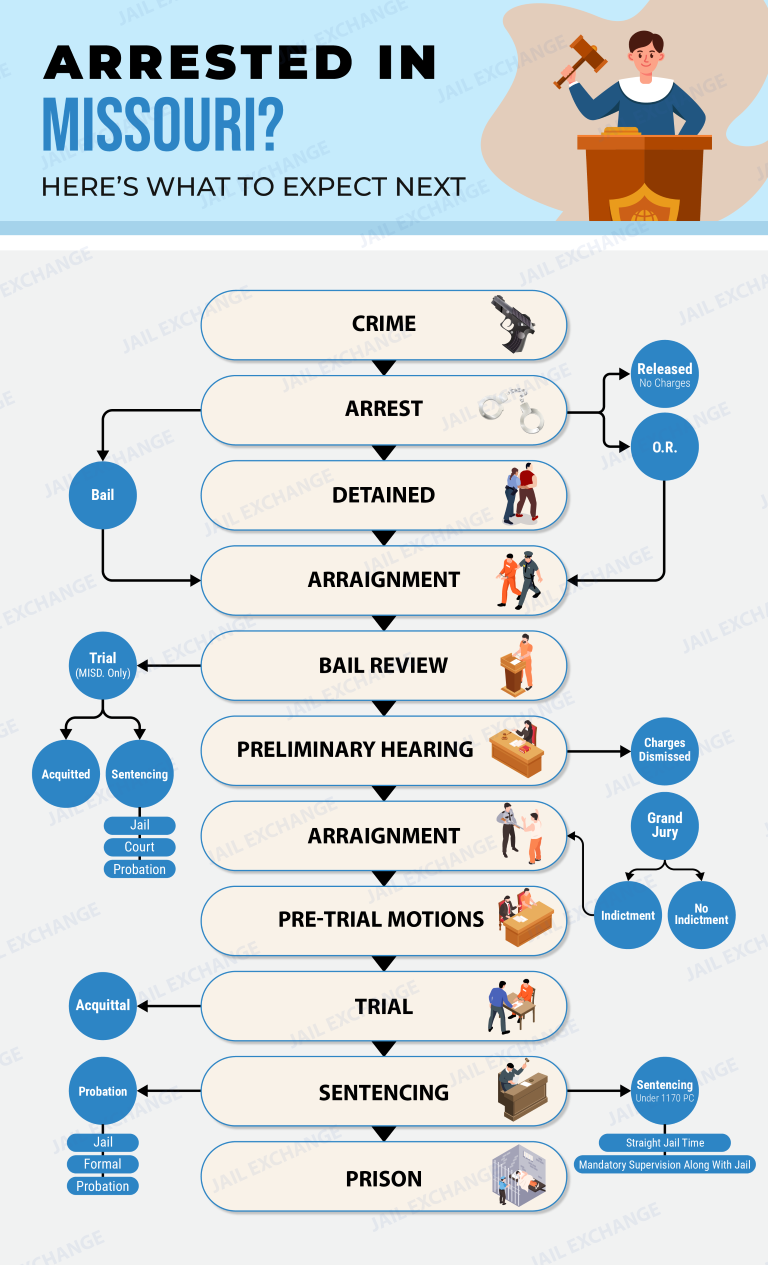
A booking officer records identifying information, checks outstanding warrants, takes photographs and fingerprints, and completes intake screening.
Families should distinguish the amount named in a bond order from the fee a private surety may charge; commercial bonding is permitted in Missouri.
The first court hearing deals with the accusation, the person’s rights, and whether release is allowed while the case is pending. A judge can set restrictions on contact, travel, weapons, or reporting. Failing to return to court may result in a warrant and new consequences.
For a worried family, the useful facts are the person’s complete name, date of birth, booking agency, whether a bond was ordered, and the next hearing date. A jail phone operator cannot give legal advice and a bond amount should not be mistaken for a criminal fine.
3. How are misdemeanors handled in St. Louis City?
Many lower-level prosecutions begin with a citation; the person then appears at the date set by the court.
At an arraignment or initial court date, the accused learns the charge and can enter an authorized plea. The prosecutor and defense may exchange information or discuss an agreement. If there is no agreement, the court schedules a contested hearing or trial.
Missouri law, § 558.011, permits at most one year for a Class A misdemeanor, six months for Class B, and 15 days for Class C. Under § 558.002, ordinary maximum fines are $2,000, $1,000, and $750 respectively, unless a more specific rule controls.
A judge can consider probation or a suspended sentence when allowed. A traffic ticket or city ordinance charge may follow its own fine schedule; it should not automatically be treated as a Class A misdemeanor.
4. What happens when the charge is a felony in St. Louis City?
In more serious prosecutions, a preliminary hearing tests whether enough evidence exists to continue; it does not decide guilt.
After the charging stage, the court schedules arraignment, evidence exchange, motions, plea discussions, and, where necessary, trial.
A judge deciding probable cause is not deciding whether the defendant is guilty. If charges go forward, both sides have opportunities for motions, disclosure of evidence, and plea discussions. A criminal conviction at trial requires proof beyond a reasonable doubt.
Counsel matters early: statements, searches, identification issues, and detention orders can shape the defense. A plea may avoid trial but can also create a lasting record or prison sentence, so the person should understand the terms before agreeing.
5. How does the court handle a serious violent felony in St. Louis City?
Charges involving homicide, forcible violence, or weapons can lead to longer detention disputes and more complicated hearings.
The person accused is presumed innocent; judges still consider safety and flight risk at pretrial proceedings.
Missouri defines “dangerous felonies” by statute. Certain convictions carry an 85% minimum service requirement before parole eligibility. That is not a rule for every charge involving violence; it depends on the precise conviction and statute.
In homicide and other extremely serious cases, the lawyer may address expert evidence, mental-state disputes, and sentencing issues long before trial. Families should not assume that a high bond means guilt or that a dismissed charge guarantees immediate release when other warrants exist.
6. What happens if someone under 18 is accused in St. Louis City?
In juvenile proceedings, the court considers whether the allegation is true and what intervention protects the child and community.
Juvenile cases often involve a deputy juvenile officer, the child’s guardian, and attorneys, with records handled differently from adult case files.
The juvenile division considers the child’s age, the allegation, family situation, and safety needs. A formal petition, if filed, is different from an adult criminal information or indictment. Some youth matters may be diverted from full court processing.
Parents or guardians should ask who is assigned to the child, where the youth is being held if detained, and when the next hearing will occur. Transfer to adult criminal court is possible only under specific legal procedures; it is not automatic for every serious accusation.
7. What are the jail terms, prison sentences and fines in St. Louis City?
Do not read a statutory maximum as a prediction of what an individual will receive.
- Class A felony: 10–30 years or life.
- Class B felony: 5–15 years.
- Class C felony: 3–10 years.
- Class D felony: up to 7 years.
- Class E felony: up to 4 years.
- Class A misdemeanor: up to one year; normally up to $2,000 fine.
- Class B misdemeanor: up to six months; normally up to $1,000 fine.
- Class C misdemeanor: up to 15 days; normally up to $750 fine.
- Class D misdemeanor: no ordinary jail term; normally up to $500 fine.
Missouri Revised Statutes §§ 558.011 and 558.002 set these general ranges and fines. Standard felony fines can reach $10,000 for Classes C, D, or E. Some individual crimes have different rules, special minimums, or sentencing enhancements. A prior felony can also affect the authorized punishment.
For Class D or E felonies, Missouri law can permit a special county-jail term of up to one year instead of a longer state prison term. Probation, treatment court, and suspended sentences are possible in eligible cases; none is promised simply because a person has no record.
Parole eligibility is not the same as an automatic release date. The date can change with the charge, sentencing law, and Department of Corrections decisions. These figures state the general law in force in October 2026, not legislation scheduled to take effect in 2028.
What changes under Missouri sentencing law on January 1, 2028?
For families in St. Louis City, the difference between current law and the scheduled 2028 law matters. Missouri Revised Statutes § 558.011 has a new version scheduled to take effect January 1, 2028. The percentages below describe when someone may first qualify for parole consideration, not a promised release date. They do not replace special rules that demand a longer time in prison.
- Class A felony: 10 to 30 years or life; generally 70% of the sentence before parole eligibility.
- Class B felony: 5 to 15 years; generally 50% before parole eligibility.
- Class C felony: 3 to 10 years; generally 30% for a first conviction, 35% for a second and 50% for a third or later conviction. Certain offenses requiring sex-offender registration carry 40%.
- Class D felony: up to 7 years; generally 20% for a first conviction, 25% for a second and 50% for a third or later conviction. Certain registrable offenses carry 25%.
- Class E felony: up to 4 years; generally 15% for a first conviction, 20% for a second and 50% for a third or later conviction. Certain registrable offenses carry 25%.
- Dangerous felonies: the law requires 85% of the sentence before parole eligibility.
For Class A and B felonies and certain crimes requiring sex-offender registration committed on or after January 1, 2028, the law also removes eligibility for conditional release. Parole and conditional release are not the same. Whether the new law applies to a particular person depends on the offense date, the final charges, earlier convictions and other sentencing laws. Until the effective date, the existing statute remains controlling. Source: Missouri Revised Statutes § 558.011.
8. Which federal court handles charges from St. Louis City?
St. Louis City is in the Eastern Division of the U.S. District Court for the Eastern District of Missouri. Follow the federal hearing notice for the courthouse and courtroom. Federal counsel or the clerk can explain where a particular proceeding will be held; a state courthouse address does not establish the location of a federal hearing.
Federal charges require a basis in federal law, such as qualifying firearms, bank robbery, fraud or interstate drug offenses. A state accusation does not become federal simply because someone crosses a county line. Federal authorities decide federal release. Pretrial detainees can be held in contract jails and may not immediately appear in the BOP locator.
9. How do I find the case number and next hearing?
Search Missouri Case.net by name or case number and match St. Louis City and the person. Read recent docket entries and hearing information. Select the City of St. Louis rather than St. Louis County and match the defendant and case number.
Call 314-622-4433 if the notice and online entry are unclear. A new or restricted matter may not be publicly visible. Counsel explains the legal effect of a court entry.
10. Where do I find a St. Louis City municipal case?
St. Louis City Municipal Court is at 1520 Market Street, Suite 1120, St. Louis, MO 63103, 314-622-3231. Search Case.net under City of St. Louis – 22nd Judicial Circuit, with St. Louis City Municipal and Traffic/Municipal filters when appropriate. The city says Municourt.net is no longer its case-search service. A city ordinance case and a state criminal case use different processes.
A city officer can issue a state charge or an ordinance allegation. The department alone does not establish the case type. Keep the ticket and read the named court, response instructions and next date before paying or traveling. A fine involving a plea is different from posting bond.
11. How can someone apply for a public defender?
The St. Louis City public defender office is in the Mel Carnahan Courthouse at 1114 Market Street, Suite 602, St. Louis, MO 63101, 314-340-7625. Use the application for services and ask how the defendant can apply from jail. The program reviews finances and qualifying state charges; ordinary municipal, traffic, civil and family matters are excluded.
Family can help gather financial and case information, but an application does not automatically appoint a lawyer or postpone a hearing. Give staff the next court date. Ask the appropriate court about representation for a proceeding outside the state program.
12. Does detention in another county move the St. Louis City case?
A detention location and a filing court are different things. Ask Corrections for the actual jail and counsel or the clerk for the active court file. Housing elsewhere does not by itself establish that the case moved; a change of venue is a separate court matter.
Use 314-621-5848 for custody questions and 314-622-4433 for a St. Louis City criminal file. Keep the receiving jail's booking identifier and court case number separately. Do not choose a hearing location from a jail address alone.
13. How can I check a warrant or missed hearing?
Search the correct St. Louis City file on Missouri Case.net and call the criminal clerk at 314-622-4433. The listed criminal-records office is at 10 North Tucker Boulevard, first floor, St. Louis, MO 63101, about unclear entries. A missing public result does not prove that no warrant exists. Ask Corrections at 314-621-5848 about its current inquiry and surrender procedure, and discuss the proper court response with counsel. Keep any order resolving the warrant. Do not assume a private payment to an unknown caller cancels it or that paying one bond resolves every separate order.
14. How can relatives help prepare for a hearing?
Keep the current notice, case number, lawyer's contact and release conditions together. Confirm the courthouse entrance, courtroom and security rules and arrange a reliable ride. Tell counsel promptly about a medical, work or transportation problem affecting attendance.
Our Bail guide explains release conditions and requests for change. A relative's call does not excuse a hearing. Respect contact restrictions while helping; a protected person's invitation does not cancel a court order.
Information for this service is currently unavailable.

Access Secure Deposits (Smart Deposit) allows families and friends to securely transfer money directly into an incarcerated person's jail trust account using a debit or credit card. Deposited funds become immediately available for your loved one to purchase essential hygiene goods, over-the-counter medication, food items, and writing materials from the facility commissary.
Important: Inmate Banking Policies Vary by Facility
Once a person is booked and moved to a cell, facilities do not always allow cash drop-offs or phone payments directly to the jail. Some might and you should confirm this by calling the facility and asking. But if you do not register online and fund your loved one's trust account immediately, they may be forced to wait days or weeks for standard paper processing, leaving them without essential soap, clean undergarments, basic medical sundries or snacks.
Step-by-Step Instructions to Register and Access Service
- Obtain the inmate's legal first and last name, date of birth, and official six- to ten-digit Booking or Inmate ID number.
- Visit the official Access Corrections portal at www.accesscorrections.com or download the Access Corrections mobile app.
- Select the state and the exact detention facility or county jail where the inmate is currently housed.
- Add the inmate as a contact and confirm their identity from the facility roster.
- Enter your debit or credit card billing information, choose your deposit amount, review the facility processing fee, and submit your payment.
- Save and print your transaction confirmation number for verification.
What the Inmate Needs to Do
The inmate does not need internet access to receive your deposit. Once approved, the funds post directly to their facility account balance. The inmate can verify their balance at the dayroom kiosk or on their trust statement and start ordering items on the next designated commissary day.
Official Provider: Access Corrections / Keefe Group Official Website
Customer Service Telephone: 1-866-345-1884
Support Hours: 24/7/365
Supported Languages: English and Spanish
Other Services Provided by Access Corrections / Keefe Group
In addition to Access Secure Deposits (Trust Money), Access Corrections / Keefe Group provides several other communication, financial, and visitation services at participating correctional facilities:
- Digital Messaging & Photos: Send digital letters and pictures straight to the inmate's kiosk or tablet.
• Learn more on our website: Digital Messaging & Photos Guide | • Visit official vendor page: Access Corrections / Keefe Group Digital Messaging & Photos - Commissary Care Packages: Order pre-approved food boxes, thermal clothes, and snack bundles directly to the jail.
• Learn more on our website: Commissary Care Packages Guide | • Visit official vendor page: Access Corrections / Keefe Group Commissary Care Packages
Deposit Money for an Inmate in the St. Louis City Justice Center
Every deposit for someone at the St. Louis City Justice Center, 200 South Tucker Boulevard, needs their Inmate Master Number (IMN). To get it, call 314-621-5848, press 1 and give the person's full name; have their date of birth ready too. For commissary, add zeros to the front until it is 8 digits (12345 becomes 00012345).
- Online: Make an account at Correct Solutions Group. Money shows up right away.
- By phone: Call 877-618-3516.
- Lobby kiosks: The main lobby has one kiosk for commissary and a separate one for the phone account. Each kiosk deposit has a $3.00 fee taken out of the amount.
- By mail: Only U.S. Postal Service money orders. Mail to St. Louis City Jail, Attention: Business Office, 200 S. Tucker Blvd., St. Louis, MO 63102. They take about 1 to 2 days. The jail chooses not to publish who to make the money order out to. The only way to get it is to call the facility at 314-621-5848.
The Division of Corrections does not take cash, personal checks or cashier's checks for inmate accounts.
The St. Louis City Justice Center at 200 South Tucker Boulevard downtown is the City of St. Louis Division of Corrections' jail, a six-story building that opened in 2002. It is now the city's only jail, since the old Workhouse on Hall Street closed. Letters are paper mail sent to the Justice Center itself, with an attention line for the inmate.
Letters, legal mail, publications and money orders:
Inmate's Full Name & Inmate Master Number
St. Louis City Justice Center
200 South Tucker Blvd
St. Louis, MO 63102
- Attention line: Under the jail's name, write "Attn:" followed by the inmate's name and their inmate master number. Find the number with the St. Louis City inmate locator or call 314-621-5848, press 1, and give the inmate's name.
- Nothing dropped off: No one may bring any item in for a Justice Center inmate, so use the mail or approved vendors.
- Your address on the envelope: Put your full name and mailing address in the top left corner, or the letter may be destroyed.
- Ink and extras: Use only blue or black ink on Justice Center mail. Markers, crayons, colored ink, lipstick, perfume, drawings, glitter and confetti all break the rules.
- Greeting cards: A plain card without music is acceptable.
- Books, papers and magazines: Order them new and have the publisher or a store ship them to Tucker Boulevard. Staff discard books that are extremely violent, pornographic or obscene, and keep back any magazine showing weapons, profanity or adult material.
- Money orders: Only U.S. Postal Service money orders, mailed to the Justice Center address marked "Attention: Business Office." Make it out to the inmate's full name and write their inmate master number on it. If you are unsure, call 314-621-5848 to confirm. Posting takes one to two days.
- Faster deposits: Cash and personal or cashier's checks are not accepted. You can send money online or by phone, or use the kiosks in the main lobby, which charge a $3 fee. For commissary deposits, pad the master number with zeros to eight digits (12345 becomes 00012345).
- Not allowed to write: Co-defendants, people held in any jail or prison, and anyone with a no-contact order against them.
Mail is handed out Monday through Friday, and staff check every piece for contraband.

Correct Solutions Group provides inmate telecommunication platforms allowing incarcerated individuals to place outbound calls from housing pods to friends and family. Because correctional facilities do not accept incoming calls, setting up a prepaid telephone account unblocks your number and provides the credits needed to connect live calls.
Important: Wireless Carriers Restrict Inmate Calls by Default
Major mobile telephone providers do not permit standard collect calls from correctional facilities. While some landlines may accept direct billing, mobile phones and internet-based lines require a funded prepaid account, which you can verify by checking with your provider. If you do not register online and fund an account right away, incoming calls from your loved one will automatically fail to ring through to your phone.
Step-by-Step Instructions to Register and Fund a Phone Account
- Visit www.correctsolutionsgroup.com or call customer support at 1-877-618-3516.
- Create an account using the primary 10-digit telephone number you want your loved one to call.
- Select the state and correctional facility where the inmate is detained.
- Link the inmate to your calling profile by providing their full legal name and booking ID number.
- Select a prepaid deposit amount and complete payment with a debit or credit card.
- Check your cell phone settings to ensure unknown or automated correctional numbers are not sent directly to spam.
What the Inmate Needs to Do
The inmate dials your 10-digit number from any dayroom phone and enters their assigned PIN. The automated system verifies that your phone number has an active prepaid balance and prompts you to accept the call. All non-privileged conversations are subject to recording and monitoring.
Official Provider: Correct Solutions Group Official Website
Customer Service Telephone: 1-877-618-3516
Support Hours: Monday – Friday, 8:00 AM – 5:00 PM CST
Supported Languages: English and Spanish
Other Services Provided by Correct Solutions Group
In addition to Inmate Calling Accounts, Correct Solutions Group handles commissary services at participating facilities:
- Commissary Package Ordering: Purchase pre-approved snack boxes, food packages, and hygiene items delivered directly to the jail.
• Learn more on our website: Commissary Ordering Guide | • Visit official vendor page: Correct Solutions Group Commissary Ordering
JailATM Digital Messaging allows friends and family to exchange electronic letters and family photos directly with an incarcerated individual through housing unit kiosks. Messages and approved digital attachments clear facility screening in hours, eliminating the lengthy transit delays associated with traditional postal mail.
Important: Electronic Mail Screening and Rules Vary
Inmates cannot receive incoming phone calls, and traditional postal mail rules differ across correctional agencies. While some facilities still allow regular handwritten letters, many jails have transitioned to digital-only mail scanning or restrict postal delivery, which you can verify by checking facility rules. If you do not register online and purchase messaging credits immediately, your loved one may face lengthy periods without direct written contact from family.
Step-by-Step Instructions to Register and Send Messages
- Go to deposits.jailatm.com/webdeposits/ and sign in or create a user profile.
- Select Messaging from the available services dashboard.
- Select your state and facility, then search for the inmate using their full legal name or booking ID.
- Purchase messaging credits using a major debit or credit card.
- Compose your message in the text editor and attach approved JPEG photos if permitted by facility guidelines.
- Submit your message to the facility's screening queue.
What the Inmate Needs to Do
All electronic correspondence is screened by facility staff before delivery. Once approved, the message arrives in the inmate's inbox on their housing unit JailATM kiosk. The inmate logs in with their PIN, opens the message, views any attached photos, and types an electronic reply using their available credits.
Official Provider: JailATM Official Website
Customer Service Telephone: 1-877-810-0614
Support Hours: Monday – Friday, 8:00 AM – 5:00 PM CST
Supported Languages: English and Spanish
Other Services Provided by JailATM
In addition to Digital Messaging & Picture Sharing, JailATM provides several other communication, financial, and visitation services at participating facilities:
- Inmate Trust & Commissary Money Deposits: Send money directly into an inmate's jail trust account for independent commissary spending.
• Learn more on our website: Inmate Trust Deposits Guide | • Visit official vendor page: JailATM Trust Deposits - Commissary Gift Packs & Store Ordering: Order pre-approved snack boxes, food packages, and clothing directly to the jail.
• Learn more on our website: Commissary Orders Guide | • Visit official vendor page: JailATM Store Orders - Remote Video Visitation: Schedule and join live video visits from home using your computer or smartphone.
• Learn more on our website: Video Visitation Guide | • Visit official vendor page: JailATM Video Visits
JailATM (operated by Tech Friends, Inc.) provides secure handheld tablets to incarcerated individuals in county detention facilities. Operating on an encrypted facility network, these tablets give inmates access to digital messaging, scanned mail review, video calls, institutional requests, educational materials, and entertainment options directly from their housing pods.
Important: Tablet Hardware Deployment and Rental Rules Vary
Detention centers do not manage tablet distribution identically. While some agencies issue individual personal tablets to every detainee at booking, others utilize shared pod docking stations or restrict tablet use to specific dayroom hours, which you should confirm with the facility directly. Although core educational and legal resources are generally provided free of charge, sending messages, listening to music, or making phone calls from the tablet requires an active balance funded by outside contacts.
Step-by-Step Instructions to Support and Fund JailATM Tablets
- Confirm that JailATM / Tech Friends tablets are active at your loved one's specific detention facility.
- Navigate to deposits.jailatm.com/webdeposits/ on your computer or mobile device.
- Sign into your verified user profile and link the inmate's legal name and booking ID number.
- Select Tablet Funds or Inmate Trust Deposits from your services dashboard.
- Specify your deposit amount, review convenience fees, and enter your credit or debit card billing details.
- Submit payment, save your confirmation receipt, and notify your loved one that funds have posted to their account.
What the Inmate Needs to Do
The inmate unlocks their assigned tablet using their unique inmate PIN or biometric scan. Their available balance appears on the screen, allowing them to download music, read scanned correspondence, write messages, and participate in scheduled video visits. Devices are returned to charging carts during facility quiet hours and shift counts.
Official Provider: JailATM Official Website
Customer Service Telephone: 1-877-810-0614
Support Hours: Monday – Friday, 8:00 AM – 5:00 PM CST
Supported Languages: English and Spanish
Other Services Provided by JailATM
In addition to Tablet Services, JailATM provides several other communication, financial, and store services:
- Inmate Trust & Commissary Money Deposits: Send money directly into an inmate's jail trust account for independent commissary spending.
• Learn more on our website: Inmate Trust Deposits Guide | • Visit official vendor page: JailATM Trust Deposits - Commissary Gift Packs & Store Ordering: Order pre-approved snack boxes, food packages, and clothing directly to the jail.
• Learn more on our website: Commissary Orders Guide | • Visit official vendor page: JailATM Store Orders - Digital Messaging & Picture Sharing: Send electronic messages and photos directly to an inmate's kiosk or tablet.
• Learn more on our website: Digital Messaging Guide | • Visit official vendor page: JailATM Messaging - Remote Video Visitation: Schedule and join live video visits from home using your computer or smartphone.
• Learn more on our website: Video Visitation Guide | • Visit official vendor page: JailATM Video Visits
St. Louis City County Jails
St. Louis City City Jails
St. Louis City Juvenile Facilities
- City Justice Center: 314-621-5848
- Bonds - City Charges: 314-621-5848 ext.1037
- Bonds - County Jail: 314-615-5080
- Bonds - State Charges: 314-622-4440
- City Inmate Info: 314-621-5848 ext. 1035
- City Justice Annex (MSI): 314-389-4790 ext. 8400
- City Justice Center (CJC): 314-621-5848 ext. 2000
- City Justice Ctr - Visitation: 314-621-5848 ext. 1043
- City Juvenile Court: 314-552-2000
- City Juvenile Detention: 314-552-2293
- County Drug Court: 314-615-2678
- County Juvenile Court: 314-615-4400
- County Juvenile Detention: 314-615-2996
- County Probation: 314-615-4770
- County Prosecutor: 314-615-2600
- Crime Tips: 866-371-8477
- Public Defender: 314-340-7625
- Reentry Resources: 314-534-0022
- St. Louis City Counselor: 314-657-1844
- St. Louis City Criminal Court: 314-622-4433
- St. Louis City Police: 314-231-1212
- St. Louis City Sheriff: 314-622-4851
- St. Louis County Criminal Court: 314-615-8029
- St. Louis County Police: 314-889-2341
- St. Louis Federal Court: 314-244-7900
- Victims Help: 314-622-4373
At times this facility may also house inmates arrested in the following counties: St. Louis County and St. Louis City.