Carter County Sheriff's Office Criminal Court Process
Criminal Court Process for Carter County Montana
Carter County Criminal Court: Cases, Hearings and Court Offices
No jail operates in Carter County, so an adult arrested here waits for court in a jail outside the county. Likely spots are the jails in Baker, Miles City or Broadus, and the Sheriff's Office can tell you which. This page walks through the courthouse at 214 East Park Street, Ekalaka, MT 59324, and every step from first hearing to sentence.
For a quick look at who is held, use the official inmate search. Our Inmates in Custody page goes deeper into the arrest, covering who sits behind bars, recent bookings, booking photos, the charges, warrants, property pickup and free lawyers.
Call the Sheriff's Office at 406-775-8743 to find out the person's jail and the day they face a judge. For misdemeanors, Justice Court can give dates at 406-775-8754; for felonies, try the District Court clerk at 406-775-8714. Our bail page covers release money, and both courts sit in the Ekalaka courthouse.
1. Small crime or felony: where does a Carter County case go?
Montana sorts criminal cases by how much punishment they can bring:
- Justice Court takes misdemeanors from anywhere in the county. That includes most traffic crimes, minor thefts and hunting or fishing cases. Its limit is half a year of jail time or a $500 fine, though it splits larger misdemeanors with District Court (MCA 3-10-303).
- Ekalaka City Court takes town ordinance cases (MCA 3-11-103). Here the justice of the peace sits as city judge too.
- District Court takes every felony, which is any charge where a conviction could mean over a year inside a state prison (MCA 45-2-101).
- Youth Court belongs to the district judge and covers anyone younger than 18.
Most felonies open in Justice Court. The judge there handles the opening steps, including bail, before District Court takes the case.
↑ Back to the question list2. What offices are in the Carter County Courthouse?
The courthouse at 214 East Park Street, Ekalaka, MT 59324 holds the courts, the prosecutor and the Sheriff's Office under one roof. Use the right mailbox number when you write.
- Justice Court: P.O. Box 72, 406-775-8754, email carterjusticecourt@mt.gov. Open Monday to Friday, 8:00 a.m. to 5:00 p.m.
- Clerk of District Court: P.O. Box 322, 406-775-8714, email clerkofcourt.carter@mt.gov. Open weekdays 8:00 a.m. to noon and 1:00 to 5:00 p.m. The clerk's office has a fee schedule for copies and filings.
- County Attorney: P.O. Box 353, 406-775-8853.
- Sheriff's Office: P.O. Box 315, 406-775-8743. Open weekdays 8:00 a.m. to 5:00 p.m.
3. Does Ekalaka have a city court?
Yes, though it shares a judge and an office with the Justice Court. The state court directory lists the post as "Justice of Peace / City Judge," at the courthouse on Park Street with the phone number 406-775-8754. Ekalaka is the county's lone incorporated town, with about 398 people in a 2025 Census estimate.
The town has no police force. Instead it has an agreement with the county, and deputies enforce the law inside town limits. Town Hall is at 103 N. Main Street, Ekalaka, MT 59324, 406-775-8731, open Monday through Thursday from 8:00 a.m. to noon.
Cases from Alzada, the far south of the county or anywhere outside town go to the Justice Court.
↑ Back to the question list4. How does the 16th Judicial District work?
Carter is one of seven counties in the 16th Judicial District. The others are Custer, Fallon, Garfield, Powder River, Rosebud and Treasure. The district has two judges:
- One judge covers Custer and Powder River counties.
- The other covers Carter, Fallon, Garfield, Rosebud and Treasure counties.
Because one judge rides a circuit across five counties, felony hearings here happen on set days. The clerk's page says law and motion day is the second Tuesday of each month. Call the clerk at 406-775-8714 for the date of a given hearing.
↑ Back to the question list5. Where does the defendant stay while the case is open?
The county has no cells of its own, so a person held before trial stays in a jail in another county. The likely ones are in Baker, Miles City and Broadus. Phone the Sheriff's Office at 406-775-8743 to learn which one.
Distance matters for court. Montana allows a first appearance and a bail hearing by two-way video, as long as the judge and the defendant can see and hear each other and the defendant can speak privately with a lawyer (MCA 46-7-101; MCA 46-9-206). An arraignment may also be done by video if neither side objects and the court agrees (MCA 46-12-201). A judge can still order the person brought to the courtroom.
↑ Back to the question list6. What will the judge tell them at the first hearing?
The law says the person must see a judge "without unnecessary delay" (MCA 46-7-101). At that hearing the judge must explain several things (MCA 46-7-102):
- each charge that has been filed
- the right to a lawyer, including a free one for someone who can't pay
- how release before trial generally works
- that they may keep silent, and their words could be used against them later
- that a conviction can take away the right to own guns
- if a felony complaint was filed, that a judge can be asked to check for probable cause
The same hearing settles whether the person can go home, and on what terms (MCA 46-9-109).
↑ Back to the question list7. What path does a misdemeanor take in Justice Court?
The County Attorney files most misdemeanor charges in Justice Court. The defendant then answers the charge. Saying not guilty puts the case on the trial calendar, and either the prosecutor or the defendant may ask for a six-person jury (MCA 46-17-201).
Once a plea is entered, the state has 6 months to start the trial. If it doesn't, and the delay wasn't the defendant's request, the court must throw the case out unless there is good cause (MCA 46-13-401). Some penalties set by law:
- A first DUI carries a jail term from one day up to half a year, and a fine of $600 to $1,000 (MCA 61-8-1007)
- Stealing property worth $1,500 or less: up to 6 months and a fine up to $1,500 (MCA 45-6-301)
- First-time assault on a spouse, ex or relative: jail from 24 hours up to a full year, and a fine between $100 and $1,000 (MCA 45-5-206)
- A misdemeanor with no listed penalty: up to 6 months and $500 (MCA 46-18-212)
Judges can put off imposing a misdemeanor sentence for as long as one year. If every condition is met, the judge may dismiss the charge, and the records then turn confidential (MCA 46-18-204).
↑ Back to the question list8. Can a Justice Court verdict be appealed?
It can. A defendant who loses at trial has only 10 days from the judgment to file a notice of appeal (MCA 46-17-311). What comes next depends on how the court keeps its records:
- If the lower court doesn't keep a formal record, the case starts over in District Court with a brand new trial, possibly before six jurors.
- If it does keep one, the district judge looks over what was recorded rather than starting fresh.
Ask the Justice Court at 406-775-8754 which kind of appeal applies, and get a lawyer's help right away, since 10 days goes fast.
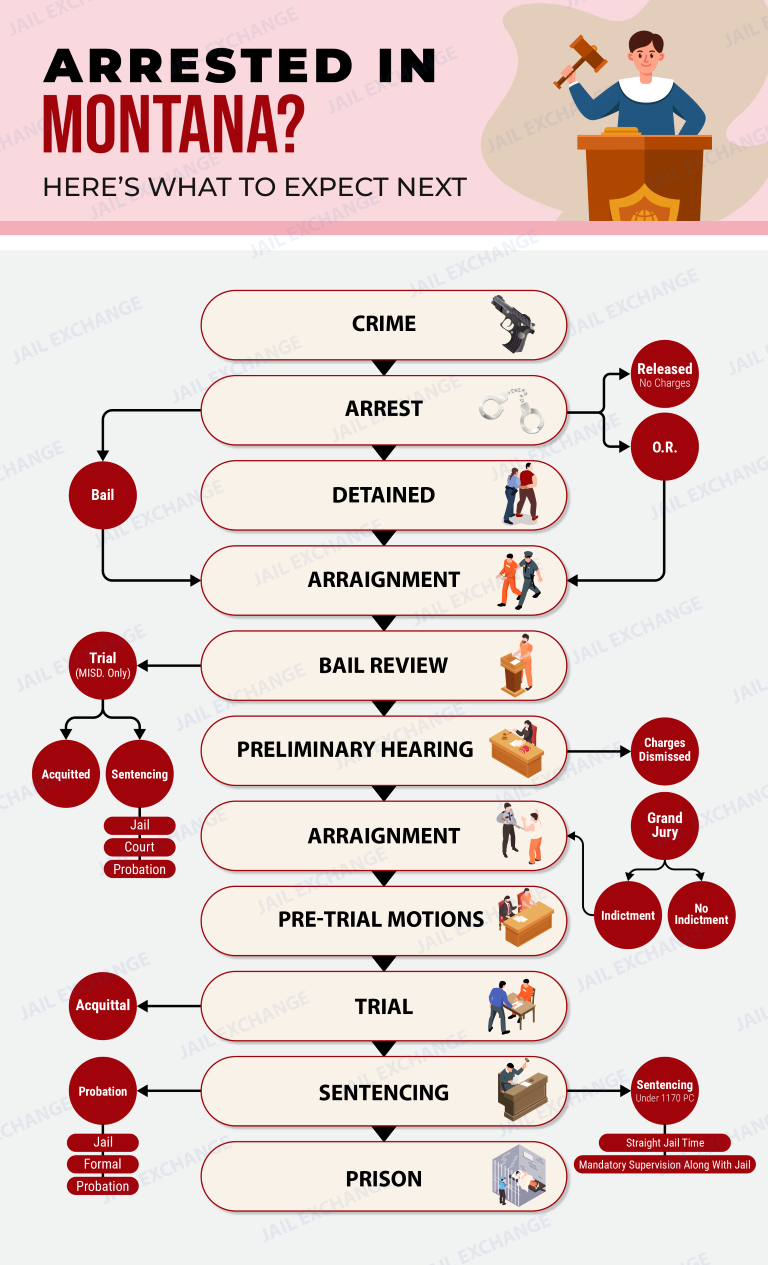
↑ Back to the question list9. What are the steps in a Carter County felony case?
A felony usually goes like this:
- Opening hearing. The Justice Court explains the charge and sets bail.
- Probable cause. A preliminary hearing in Justice Court tests the evidence (MCA 46-10-105). Or the County Attorney goes straight to the district judge for permission to file the formal felony charge, called an information (MCA 46-11-201).
- Arraignment in District Court. The defendant gets a copy of the charges and enters a plea (MCA 46-12-201).
- Trial before 12 jurors unless both sides agree in writing to skip a jury (MCA 46-16-110). All 12 must agree on the verdict.
- Sentencing. The judge imposes a penalty once guilt is admitted or proven.
Montana also allows a grand jury of 11 people, but a judge calls one only when it is needed. Unless another law sets the penalty, the most a felony can bring is 10 years in prison plus a fine as high as $50,000 (MCA 46-18-213). For a first charge of having illegal drugs, the law presumes the sentence will be deferred (MCA 45-9-102).
↑ Back to the question list10. Are violent charges handled more strictly?
Yes, at several points along the way:
- Arrest. When police are called to a home by a partner or family member, an arrest is the preferred response if someone is hurt or a weapon was used. If both people fought, officers arrest only the main aggressor (MCA 46-6-311).
- No-contact order. An order issued at arrest may bar the accused from coming within 1,500 feet of the victim. It runs for three days, or ends sooner at the first court date (MCA 45-5-209).
- Bail. Partner assault, strangling a partner, stalking and protective order cases can't be bailed off a schedule. A judge must see the person first (MCA 46-9-302).
- Release notice. The jail must tell the alleged victim as soon as it can when the person gets out (MCA 46-9-108).
- Repeat cases. A third partner assault can bring up to 5 years (MCA 45-5-206). Someone already convicted of a felony is not eligible for a deferred sentence on a new one (MCA 46-18-201).
11. Who prosecutes, and who defends?
The County Attorney's Office brings state charges in both Justice Court and District Court. It works from the courthouse. Letters go to P.O. Box 353, Ekalaka, MT 59324, and the phone is 406-775-8853. When a county attorney has a conflict, the Attorney General's Prosecution Services Bureau can step in, 406-444-2026.
Montana's public defender system handles felony charges, misdemeanors with possible jail time and youth matters. Two Region 3 offices are closest to the county:
- Miles City: 515 Main St, Miles City, MT 59301, 406-851-7080
- Glendive: 100 1/2 S. Merrill, Suite 3, Glendive, MT 59330, 406-987-6010
When the regular office can't take a case, the Conflict Defender Division's Region C office in Billings may, at 406-247-4857. Apply through the public defender intake form. The court decides who qualifies (MCA 47-1-111).
↑ Back to the question list12. Where can I search for a case file or hearing date?
The Clerk of District Court's page points people to Montana's public court portals for scheduled court dates. Both are free and can be searched by name or case number:
- The limited court portal, which covers Justice Court and town cases
- The District Court portal, which covers felony files
Cases about minors and sealed files are left out of both. For a Justice Court date, call 406-775-8754. For a District Court date, call the clerk at 406-775-8714. Have the defendant's full name and birthday ready so staff can pull the file faster.
↑ Back to the question list13. Is a warrant out, and what clears it?
The Sheriff's Office serves warrants everywhere in the county, Ekalaka included. To ask whether one is out, call 406-775-8743 on a weekday. Charges already filed can be found by name on two state portals, one for limited courts and one for District Court. People wanted by the state for escaping or fleeing parole or probation are flagged on the Montana offender search. Getting a lawyer involved early is the safest way to clear one. Then call the court that signed it about getting a fresh court date, or arrange with the Sheriff's Office to turn yourself in. Felony warrant questions can also go to the district court clerk, 406-775-8714.
↑ Back to the question list14. What changes when the charge is federal?
Federal crimes from the county go to the Billings Division of the federal court. Its clerk works at 2601 2nd Avenue North, Suite 1200, Billings, MT 59101, 406-247-7000, weekdays from 8:00 a.m. to 5:00 p.m.
- At the first appearance, a federal judge rules on detention, meaning jail or release while the case is pending (18 U.S.C. 3142).
- Federal prisoners are kept and moved by the U.S. Marshals Service. Its Montana office is at 2601 2nd Avenue North, Suite 2300, Billings, MT 59101, 406-200-6004.
- A pretrial officer in Suite 1300 of the Billings courthouse gathers background for the judge, 406-657-6287.
- Find case papers on PACER. After a sentence, use the Federal Bureau of Prisons inmate locator.
15. What role does an ICE detainer play?
A detainer doesn't pause or end the state case. What it changes is the day of release. ICE uses Form I-247A to ask the jail to keep the person for up to 48 hours after they would otherwise be released, so its officers can take custody (8 CFR 287.7(d)).
- When a detainer arrives, Montana officers must arrest the person on it. They also have to tell the person why (MCA 27-16-801).
- Believable papers showing U.S. citizenship or lawful status end that duty.
- A 2025 state law lets an officer who has lawfully stopped someone make a reasonable effort to learn their immigration status (MCA 46-5-401).
- Montana's ICE cases are run from the Salt Lake City Field Office, 2975 Decker Lake Drive, Suite 100, West Valley City, UT 84119, 801-736-1200. Its Billings check-in office serves this county, 406-247-4083.
- Look the person up on the ICE Online Detainee Locator.
16. Where would a Carter County prison sentence be served?
Once a judge commits someone to state custody, the Montana Department of Corrections takes over. Until state staff assess them, they wait in a county jail. After that comes placement: community supervision, treatment, a prerelease center or prison.
- Follow their location and status on the DOC offender search.
- Read our Montana state prisons guide for contact details at each site.
- The Board of Pardons and Parole decides on parole. It sits at 1002 Hollenbeck Road, Deer Lodge, MT 59722, 406-846-1404.
17. How does Youth Court treat teens from Carter County?
Charges against anyone under 18 are filed in Youth Court, part of the district judge's work (MCA 41-5-203). Youth files are kept off the public court portals. For minor alcohol, tobacco and gambling cases, the Justice Court can also act (MCA 41-5-203).
- Once locked up, a youth is owed a probable cause hearing within one day, with weekends and legal holidays skipped in the count (MCA 41-5-332).
- For a handful of grave charges, such as homicide, prosecutors may ask to move a youth who is at least 12 into adult court (MCA 41-5-206).
- No one younger than 16 may be housed in a state prison.
Juvenile probation for the whole district uses one number, 406-874-3418. Parents can call it to locate the child and learn the hearing time. Youths committed to the state for the long term go to the Pine Hills facility, which the state runs in Miles City.
↑ Back to the question list18. What help can a crime victim get?
Start with the County Attorney's Office at 406-775-8853. Ask who will keep you informed as the case moves.
- Victims get a say. If someone was hurt or threatened, or the charge is a felony, the prosecutor must first get the victim's views before any plea bargain. The same goes for dropping the case or letting the accused out (MCA 46-24-104).
- The state's compensation program for crime victims covers costs up to $25,000. Report the crime within 72 hours and apply within a year. Call 800-498-6455.
- When the offender is a state felony offender, VINE sends free alerts about custody and release. Sign up on VINELink or at 800-456-3076.
- The Department of Corrections victim information line is 888-223-6332.