
Chouteau County Detention Center
Chouteau County Detention Center
Jail Phone Number
406-622-3660Chouteau County Inmate Search: Who Is in the Fort Benton Jail
Adults arrested here, whether by deputies, state troopers or another agency, are usually booked into the Chouteau County Detention Center. It is inside the Law Enforcement Facility at 1215 Washington St, Fort Benton, MT 59442, which also houses the county's 911 dispatch. Below we explain the roster, the holds and how to reach someone inside.
Open the Sheriff's Inmate Population PDF to see who is held. Each line lists the booking date and time, the name, the age and the hold reasons, such as a charge, a warrant or a hold for another agency. Check the print date at the top, because a new booking or release may come after it.
For the latest word, ring the jail at 406-622-3660. Have the full name and birth date ready, and ask about charges, bail and the coming court date. Families can read about getting someone out on the bail page, while the court page lays out each hearing at the Franklin Street courthouse.
Read inmate search answers
 Read inmate search answers
1. How do I search the Chouteau County jail roster?
Since a 2022 state report counted 28 beds, the list is short and quick to read. Try these steps:
- Go to the Sheriff's page and open the Inmate Population list. It opens as a PDF.
- Look at the printed date and time near the top.
- Names run last name first. Use your phone's or browser's find tool to jump to the last name.
- Read the hold reasons on that line. They may show a charge and law number, a warrant, or a hold for the state or another county.
- Note the booking date, since staff can use it to pull up the right file.
Still no luck? Call Detention Center staff at 406-622-3660.
↑ Back to the question list2. Why might the person be missing from the list?
Names drop off, or don't appear yet, for a few common reasons:
- The list predates the arrest. Check the print date against the day they were picked up.
- They are already out. They may have posted bail or been released by a judge.
- They were taken elsewhere. A hold may have sent them to another county, the state or federal custody.
- The spelling is off. Try a middle name, a nickname or a former last name.
- They are under 18. Teens go to a youth detention center, not this jail.
- Tribal police arrested them. See the tribal question below.
The quickest answer comes from the jail at 406-622-3660. The Sheriff's dispatch line is 406-622-5451.
↑ Back to the question list3. Why are some people on the list held for other agencies?
The Fort Benton jail holds people for other agencies too, so not everyone on the list was arrested here:
- State corrections. The list has shown Department of Corrections holds, such as people waiting on a parole or probation matter.
- Other counties. It has also shown a person held for the Hill County Sheriff's Office.
- Federal prisoners. The U.S. Marshals Service has an agreement with the county to keep federal prisoners here.
If your loved one is held for someone else, that agency decides most next steps. Ask jail staff at 406-622-3660 who placed the hold and how to reach them.
↑ Back to the question list4. Could a nearby jail be holding them instead?
Adults arrested here normally stay in Fort Benton. An arrest close to a neighboring county, or a transfer, could put them in one of these:
- Hill County Detention Center, Havre. Sheriff's Office: 1452 2nd Street West, Havre, MT 59501, 406-265-2512 (ask for detention).
- Cascade County Detention Facility, 3800 Ulm N Frontage Road, Great Falls, MT 59404. Sheriff's Office: 406-454-6820.
- Fergus County Detention Center, Lewistown. Sheriff's Office: 121 8th Avenue South, Lewistown, MT 59457, 406-535-3415.
- Pondera County detention center, Conrad. Sheriff's Office: 20 4th Avenue SW, Suite 109, Conrad, MT 59425, 406-271-4060.
5. What if Chippewa Cree police made the arrest?
Some of the Rocky Boy's Reservation lies in this county, and the rest is in Hill County. Chippewa Cree Law Enforcement Services, the tribe's own police, patrols it. A person arrested there by tribal police may not go to the county jail at all, and the case may stay in tribal court.
- Rocky Boy Law Enforcement, 6742 Upper Box Elder Road, Box Elder, MT 59521. Dispatch: 406-395-4130. Office: 406-395-4513.
- Major crimes on the reservation are usually federal. The FBI leads those cases, and they are charged in Great Falls.
Call tribal dispatch first to learn where the person is held and which court has the case.
↑ Back to the question list6. Can I get a mugshot or booking photo?
The Inmate Population PDF lists names, ages and hold reasons. Booking photos come by request from the Sheriff's Office. Montana counts daily jail rosters, bail records and booking photos as public information (MCA 44-5-103). Phone 406-622-5451 to learn how to ask for one.
- When ICE holds the person, use the ICE records request page to seek a photo.
- Federal agencies rarely hand out booking photos. The U.S. Marshals Service sometimes does, for instance while hunting a fugitive.
7. How can I hear about a release or a transfer?
For the Fort Benton jail, your best bet is a call to staff at 406-622-3660, plus checking the Inmate Population list often.
- VINE sends free phone, text or email alerts. In Montana it follows adults with felony sentences who are supervised by the Department of Corrections, like people in prison or on parole. Registration happens on VINELink or at 800-456-3076, day or night. Nobody is signed up for you.
- Some victims get a call. If a person charged with partner assault, strangling, stalking or breaking a protection order makes bail, the alleged victim hears from the jail right away (MCA 46-9-108).
8. How does release work after a Chouteau County arrest?
The first hearing usually happens in Justice Court, in the courthouse basement at 1308 Franklin Street, Fort Benton, MT 59442, 406-622-5502. The judge must pick the lightest conditions likely to get the person back to court.
- Many misdemeanors have a suggested amount on the state's bond schedule.
- Felonies carry no listed amount, so the judge sets one.
- Assault on a partner or family member, stalking and protection order cases must go to a judge before any release.
- A warrant from another county or state blocks local bail.
Our bail page has the money side: amounts, payments and bondsmen.
↑ Back to the question list9. Where can I see the charges against them?
The hold reasons on the Inmate Population list are the first clue. Many lines show the offense along with a Montana law number. Type that number into the free Montana Code Annotated to read the law itself.
After the prosecutor files, the full charge sits in the court record. Use the limited court portal for misdemeanors. Use the District Court portal for felonies. Charging decisions belong to the County Attorney's Office (1308 Franklin Street, Fort Benton, MT 59442), 406-622-3246.
↑ Back to the question list10. Who pays for a lawyer if the family can't?
The judge explains at the first hearing that a lawyer can be appointed. A person who can't pay may ask for a public defender. Montana's statewide agency covers felony charges, jailable misdemeanors and youth cases.
- Office that serves this area: 109 2nd St. W., Havre, MT 59501, northwest door, 406-265-2199
- Apply on the public defender website. Have recent pay stubs and bank statements ready.
Some families pay for a private attorney instead. Lawyers and clergy see clients at the jail by appointment, and they may be searched before and after a contact visit.
↑ Back to the question list11. When can I visit the Fort Benton jail?
Family visits happen Wednesdays and Saturdays from 1:00 to 3:00 p.m. Each visit lasts 20 minutes. Keep these rules in mind:
- No more than two people may visit an inmate at the same time.
- Visitors over 18 must show ID.
- Visitors under 18 may come only with an adult.
- Lawyers, clergy and other professionals set up visits by appointment.
Call 406-622-3660 before you drive in to ask about dress rules and what you can bring. For more tips, read our visiting guide.
↑ Back to the question list12. How can family fund a jail account?
Money in a jail account can pay for snacks, hygiene items and phone time. Ask Detention Center staff at 406-622-3660 which deposit methods work right now and whether there are limits or fees.
The jail's list of items allowed in the mail includes money orders and cash. A money order is safer, since it can be traced if lost. Our guide to sending money covers common methods. What the money can buy is covered in our commissary guide.
↑ Back to the question list13. Can they call home or send messages?
The jail decides how calls are made and what they cost. Phone 406-622-3660 and ask how to set up calls from your loved one, the price per call, and whether tablets, messages or video visits exist there. Also ask if calls are recorded.
Talk about the case only with the lawyer. More help: our jail phone guide, plus our page on inmate email and messages.
↑ Back to the question list14. What can I mail to a Chouteau County inmate?
Address letters like this:
Inmate Name
Chouteau County Detention Center
P.O. Box 459, Fort Benton, MT 59442
The jail accepts only these items:
- letters on regular copy paper, loose-leaf paper or notebook paper
- photocopies of drawings or pictures
- standard photographs
- money orders and cash
Anything else comes back as undeliverable. Put your return address on the envelope. More mail advice is in our mail guide.
↑ Back to the question list15. Where are their belongings kept?
Items taken at booking, like a wallet, keys or a phone, stay at the jail until release. To collect them for the person, call 406-622-3660 on a weekday. Find out if a signed note from the person is needed, when to come, and what ID to bring. The pickup point is the Law Enforcement Facility at 1215 Washington St, Fort Benton, MT 59442.
↑ Back to the question list16. Who handles medical care for someone in the jail?
The Sheriff's Office is responsible for people in its jail. Call the jail at once at 406-622-3660 if the person is ill, injured or needs daily medicine. Give the name of each drug, the dose, and the doctor's name and phone number.
For an emergency, call 911. If you are worried about suicide or a mental health crisis, say so clearly at the start of the call.
↑ Back to the question list17. Could there be a warrant for them in Chouteau County?
Deputies handle warrants in every part of the county, towns too. To ask about one, call dispatch at 406-622-5451. On the reservation, tribal warrants go through Rocky Boy Law Enforcement dispatch, 406-395-4130. Court cases tied to a warrant can turn up on the state's limited court portal or its District Court portal. Montana's offender search lists escape and absconder status for people the Department of Corrections is looking for. A person with a warrant should talk to a lawyer first. After that, they can turn themselves in at 1215 Washington St, Fort Benton, MT 59442, or contact the court that issued it to reschedule. For felony warrants, the district clerk is at 406-622-5024.
↑ Back to the question list18. Who knows the date of the next hearing?
Each court keeps its own calendar:
- Justice Court, which also hears city cases from Fort Benton and Big Sandy: courthouse basement, 1308 Franklin Street, Fort Benton, MT 59442, 406-622-5502, weekdays 8:30 a.m. to 5:00 p.m.
- Clerk of District Court, for felonies: second floor of the same courthouse, 406-622-5024.
You can also look the person up by name on the two state court portals. Each stage is laid out on our court page.
↑ Back to the question list19. Is the charge federal?
Federal charges here are filed in Great Falls, at the Missouri River Federal Courthouse, 125 Central Avenue West, Suite 110, Great Falls, MT 59404, 406-727-1922.
- At the first federal court date, a judge holds a detention hearing to decide on jail or home until trial (18 U.S.C. 3142).
- The U.S. Marshals Service keeps custody before trial. It has an agreement to house federal prisoners in the Fort Benton jail, among other places. Call its Montana office at 406-200-6004 to ask where the person is.
- Follow the case on PACER.
- After sentencing, use the Federal Bureau of Prisons inmate locator with a name or register number.
20. What happens if ICE places a hold?
An immigration hold usually follows these steps:
- First, ICE sends Form I-247A, a request that the jail keep the person.
- The jail may keep the person up to 48 hours after they would otherwise be released. Montana officers have to follow the detainer unless the person offers solid papers proving citizenship or legal status (MCA 27-16-801).
- Agents collect the person after that. Montana cases fall under the Salt Lake City Field Office, 2975 Decker Lake Drive, Suite 100, West Valley City, UT 84119, 801-736-1200.
- Search the ICE Online Detainee Locator by full name plus birth country, or by A-number. When a search comes up empty, ICE says to phone the field office.
21. How can I find someone moved to state prison?
Someone sentenced to the state often waits in the county jail while the Department of Corrections sizes up where they belong. The state search may list them during that wait.
- Use the Montana offender search by name or DOC number. It lists the person's location and status.
- Visiting and mail rules for each prison: see our Montana state prisons guide.
- The Department of Corrections main office is at 5 S Last Chance Gulch Street, Helena, MT 59620, 406-444-3930.
22. Where do Chouteau County youths go if they are held?
Teens are not kept in the adult jail. State law allows only very short holds there, and the youth must be separated from adults so they can't see or hear each other (MCA 41-5-349). A youth who needs secure detention is sent to the Cascade County Juvenile Detention Center at 1600 26th Street S, Great Falls, MT 59405, 406-454-6930.
- Within 24 hours of being detained, a youth gets a probable cause hearing. Weekends and holidays are skipped in the count (MCA 41-5-332).
- Youth Court cases stay off the public court portals.
- The Clerk of District Court, 406-622-5024, has hearing dates for parents.
23. Which police agencies make arrests in Chouteau County?
The Census Bureau counted about 5,865 residents in its July 1, 2025 estimate. These agencies make arrests here:
- Chouteau County Sheriff's Office, 1215 Washington St, Fort Benton, MT 59442. Non-emergency dispatch: 406-622-5451. Deputies cover Fort Benton, Big Sandy, Geraldine, Carter, Floweree, Highwood, Loma and Square Butte. The towns rely on the Sheriff for police work.
- Montana Highway Patrol, 18 Trooper Drive, Boulder, MT 59632, 24-hour dispatch 855-647-3777
- Rocky Boy Law Enforcement (Chippewa Cree Tribe), 6742 Upper Box Elder Road, Box Elder, MT 59521, dispatch 406-395-4130
- FBI, which leads major crime cases on the reservation
- Upper Missouri River Breaks National Monument, run by the Bureau of Land Management. Its interpretive center is at 701 7th Street, Fort Benton, MT 59442, 406-622-4000.
Chouteau County Bail: How to Get Someone Out of Jail
When someone is arrested in Fort Benton, Big Sandy, Geraldine, Loma or the farm country around them, adults go to the Chouteau County Detention Center. Its home is the Law Enforcement Facility at 1215 Washington St, Fort Benton, MT 59442. Below, learn who decides bail here, the kinds of bail (cash, an agent's bond or a signed promise), rough amounts and where to post it.
The Sheriff's Inmate Population list is a PDF naming everyone locked up in Fort Benton. Our Jail Roster page is where the questions about the arrest and custody get answered. Turn there for locating the person, warrants, mugshots, charges, recent bookings, free public defenders and collecting property.
Then ring jail staff at 406-622-3660. Ask if your loved one is booked, whether a judge has set bail and when the first hearing is. Every step of a Chouteau County case is on our court page.
1. Who decides bail once someone is arrested in Chouteau County?
Only a judge can set it. Under Montana law, police must bring the person "without unnecessary delay" before the nearest judge who is on hand (MCA 46-7-101). That judge rules on jail or release at the first hearing, right then (MCA 46-9-109).
Here, that is nearly always the justice of the peace. Justice Court sits in the courthouse basement at 1308 Franklin Street, Fort Benton, MT 59442, 406-622-5502. The same judge and the same number handle city court cases from Fort Benton and Big Sandy. The hearing may be held in the courtroom or by live video from the jail (MCA 46-9-206).
When a felony climbs to District Court, the old bail carries over. The district judge may then change it: higher, lower or a different type (MCA 46-9-201).
↑ Back to the question list2. What release options can the judge choose from?
Montana tells judges to pick the lightest terms that will still bring the person to each hearing (MCA 46-9-108). Here are the choices:
- Own recognizance. A written promise to appear. Nobody pays (MCA 46-9-111).
- Release with rules. Home, but with limits. A judge might order sobriety, no guns, a set curfew or staying clear of the alleged victim.
- Cash. Every dollar is paid to the court, which holds it until the case wraps up.
- Bond from an agent. A licensed agent backs the whole sum, and you pay the agent a fee.
- Land. Montana property with enough equity, free of loans, can be pledged (MCA 46-9-401).
- Two co-signers. The person and two people with enough means sign a written undertaking.
- A driver's license. Some traffic cases let the license stand in for money.
For felony stalking, a repeat partner assault and a few other charges, an ankle monitor is the starting point when the county has one.
↑ Back to the question list3. What does bail usually cost for local charges?
A guide called the Recommended Bond Schedule comes from the Montana Supreme Court for justice and city courts. Judges may go above or below it. Its dollar figures already have the state surcharges built in. A few lines from the January 2026 version:
- Simple assault that hurts someone: $585 (must appear)
- Giving alcohol to anyone under 21: $535 (must appear)
- Truancy, or skipping school: $135 (must appear)
- Second unlawful gambling count in 5 years: $750
- Felonies such as deliberate homicide: "no bond," which leaves the number to the judge
Certain charges can't be bailed off any schedule: assault on a partner or relative, strangling a partner, stalking, and ignoring a protection order or no contact order. For those, the person stays until a judge sees them (MCA 46-9-302). For the figure in an actual case, ring Justice Court at 406-622-5502 on a weekday.
↑ Back to the question list4. Can I pay bail at the Fort Benton jail?
The Detention Center sits at 1215 Washington St, Fort Benton, MT 59442. A deputy or jailer may accept bail on a judge's behalf if the sum is on a posted schedule or written on the warrant, and must hand you a signed receipt (MCA 46-9-302). Work through this list:
- Phone the jail at 406-622-3660 before you leave home.
- Spell the person's name and give their birth date. Ask for the amount and the charge it goes with.
- Ask which payment types the jail accepts today and what name goes on a money order.
- Ask whether the charge needs a judge's OK before any payment, as partner assault cases do.
- Bring a photo ID. Pay the exact sum and keep the receipt.
While you are on the phone, ask whether some other hold would keep them there after you pay.
↑ Back to the question list5. Can bail be paid at a Chouteau County court?
Yes, for bail taken from a judge's posted schedule. Montana's court rules allow payment at the court in office hours on any day it is open, and the schedule must hang in the court office.
- Justice Court (which also serves as Fort Benton and Big Sandy city court): courthouse basement, 1308 Franklin Street, Fort Benton, MT 59442, 406-622-5502, weekdays 8:30 a.m. to 5:00 p.m.
- Clerk of District Court (felonies): second floor, 1308 Franklin Street, Fort Benton, MT 59442, 406-622-5024, weekdays 8:30 a.m. to 5:00 p.m.
Call ahead with three questions: how much, what payment the clerk takes, and whether paying at the court gets the person out of jail right away.
↑ Back to the question list6. What payment works, and can bail be paid online?
Bring exact cash or a money order, since those rarely cause trouble. Personal checks and cards may not work, so phone first.
The Justice Court page has a "Pay Fees Online" button that opens CitePay, a payment service the court uses for fees and fines. Since the page describes it for fees, ask the court at 406-622-5502 whether your bail can go through it before you try.
For bail paid at the jail itself, ask Detention Center staff at 406-622-3660 what they take that day.
↑ Back to the question list7. How do bondsmen operate in Montana?
The legal name for a bondsman in Montana is "surety bail bond insurance producer." Licenses come from the Commissioner of Securities and Insurance (MCA 33-17-1601). Keep these points in mind:
- The fee you pay is the agent's to keep, even when the case ends well. In return, the agent stands behind the full bail.
- Many agents want collateral too, such as a truck title. Get it in writing when that comes back to you.
- If your loved one misses court, the agent has the power to arrest them. Except in an emergency, the agent must first alert local police or the sheriff (MCA 46-6-508).
- A bond from an agent covers court appearances only. The court can't take fines or restitution out of it (MCA 46-9-503).
- Look the agent up on the national insurance license lookup before signing.
8. What else can keep them inside once bail is paid?
Each bail covers one case. Ask the jail about these first:
- A warrant out of another place. Local judges can't grant bail on another jurisdiction's warrant (MCA 46-9-201).
- Being brought back from another state. The judge who issued that warrant must see them first (MCA 46-9-105).
- A corrections hold. The Fort Benton jail keeps some people for the state Department of Corrections, often over probation or parole.
- A neighbor county's hold. The jail list has included people held for Hill County.
- A second case. Every open case may carry a separate bail.
- A federal or immigration hold. Those two are explained lower on this page.
Before you hand over money, call 406-622-3660 and have staff read you each hold.
↑ Back to the question list9. Does every case get a bail amount?
Almost every case does. Montana's constitution guarantees bail in all cases but one: a crime punishable by death, where "the proof is evident or the presumption great" (Mont. Const. art. II, sec. 21). It also bans excessive bail (Mont. Const. art. II, sec. 22).
Still, a judge may order someone held until trial when probable cause shows that no safeguards would make them return (MCA 46-9-106). Things the judge considers: the charge, prior convictions, any history of running, risk to others and how rooted the person is here. A scored risk report may help (MCA 46-9-109).
The state's side at a bail hearing is argued by the County Attorney's Office, in the courthouse at 1308 Franklin Street, Fort Benton, MT 59442, 406-622-3246.
↑ Back to the question list10. How do we ask for a lower bail amount?
Both the defense and the prosecutor may ask the judge to raise or cut bail, change its terms or switch its type, as long as the other side is warned ahead of time (MCA 46-9-311). A family can help like this:
- Have the defense lawyer file a written motion with the court handling the case.
- Collect pay stubs, a lease or deed, proof of local family, and an honest figure for what you can pay. State law requires bail that is not oppressive and that fits the person's finances (MCA 46-9-301).
- Offer terms that answer the judge's concern, like staying sober or checking in.
On a Justice Court case, phone 406-622-5502 to learn how such a hearing is scheduled. On a District Court case, phone the clerk at 406-622-5024.
↑ Back to the question list11. How does a Chouteau County defendant get a public defender?
At the first appearance, the judge must explain that the person may have a lawyer (MCA 46-7-102). Montana has one statewide public defender agency. It handles felonies, misdemeanors where jail is possible, and youth court.
Someone counts as unable to pay if household income sits at or under 133% of the poverty line, or if hiring a lawyer would cause real hardship. Having work, or having bail money, can't by itself be why help is denied (MCA 47-1-111). They fill out a sworn money form, and the judge reviews the result.
- Regional office for the county: Office of State Public Defender, 109 2nd St. W., Havre, MT 59501 (northwest door), 406-265-2199
- Online form: apply for a public defender
- Agency website: Montana Public Defender
12. Where do the courts that set bail meet?
Justice Court and the Clerk of District Court share the county courthouse in Fort Benton. Check the floor before you go.
- Justice Court, basement, 1308 Franklin Street, Fort Benton, MT 59442, 406-622-5502. Misdemeanors and the opening steps of felonies start here.
- Fort Benton City Court and Big Sandy City Court use that same judge and phone. Call to find out where a city case will be heard.
- Twelfth Judicial District Court (felonies) serves Chouteau, Hill and Liberty counties. Its local clerk is on the courthouse's second floor, 406-622-5024.
- Federal court, Missouri River Federal Courthouse, 125 Central Avenue West, Suite 110, Great Falls, MT 59404, 406-727-1922.
13. What if the arrest was on the Rocky Boy's Reservation?
The Rocky Boy's Reservation, home of the Chippewa Cree Tribe, takes in land in both this county and Hill County. Different rules can apply there:
- State courts have narrow power over crimes on this reservation. Tribal police patrol it, and many cases there go to tribal court.
- Major crimes are often federal. The FBI takes the lead, and the cases are filed in federal court in Great Falls.
- The court that ends up with a case depends on the place, the charge, and whether the people involved are tribal members.
To find out where someone is being held and how release works, call Rocky Boy Law Enforcement dispatch at 406-395-4130. Letters to the tribal court go to RR1 Box 544, Box Elder, MT 59521.
↑ Back to the question list14. When is bail money returned or lost?
Make every court date, and the court hands the cash back once the case is over (MCA 46-9-502). Court rules return a bond only in the name of whoever posted it, so hold on to that receipt.
Missing a date can cost the money, because the judge may order it forfeited. Written notice must reach the defendant and every surety by mail within 10 working days. If it doesn't, the bond is void (MCA 46-9-503).
- Within 90 days of a forfeiture, the person can return or show a good excuse. If so, the judge can wipe out the penalty.
- Money lost on a misdemeanor goes to the local treasury. Money lost on a felony goes to the state's general fund (MCA 46-9-511).
- The judge can also send forfeited money to a victim (MCA 46-9-512).
To get a refund started, phone whichever court took the payment, such as Justice Court at 406-622-5502.
↑ Back to the question list15. How are belongings and leftover money picked up after release?
Before the person walks out, ask about their wallet, phone, clothes and any balance left on their jail account. The Detention Center at 406-622-3660 can tell you when to come, how account money is returned and what ID to bring.
Collecting for someone who is still inside? Ask whether staff need a signed release from them. Our guide to jail accounts explains how deposits and refunds tend to work.
↑ Back to the question list16. Can someone get bail on a federal charge from Chouteau County?
Federal charges from this county are filed in the Great Falls Division of the U.S. District Court for the District of Montana. Its courtroom is in the Missouri River Federal Courthouse, 125 Central Avenue West, Suite 110, Great Falls, MT 59404, 406-727-1922, and the clerk's office is open weekdays 8:00 a.m. to 5:00 p.m.
- At the first federal hearing, the judge orders release or detention. Either side may ask for a few days' delay (18 U.S.C. 3142).
- Federal prisoners are held for the U.S. Marshals Service. It has a contract to house them in the Fort Benton jail. Its Montana office can say where someone is: 406-200-6004.
- The judge gets a background report from the federal pretrial office in Great Falls, 406-453-4461.
- After sentencing, look the person up with the Federal Bureau of Prisons inmate locator.
17. Will posting bail end an immigration hold?
No. Paying state bail leaves an ICE hold in place. The usual order of events:
- ICE (Immigration and Customs Enforcement) asks for a hold by filing Form I-247A, called a detainer.
- That lets the jail keep the person up to 48 hours after they would otherwise be released (8 CFR 287.7(d)).
- Montana requires officers to carry out the detainer and explain it. Anyone who offers believable proof of citizenship or legal status must be let go (MCA 27-16-801).
- ICE officers pick the person up. Montana falls under the Salt Lake City Field Office, 2975 Decker Lake Drive, Suite 100, West Valley City, UT 84119, 801-736-1200.
- Search the ICE Online Detainee Locator using the person's complete name and birth country, or their A-number.
18. What happens after a felony sentence to the state?
Felony terms over one year are served under the Montana Department of Corrections. Most people stay in the county jail at first, while state staff decide where they belong. Then comes a transfer to prison, prerelease or a treatment program.
- Use the Montana offender search to keep tabs on them. Type a name or the DOC number.
- Our Montana state prisons guide gives details on every facility.
- The Board of Pardons and Parole decides parole: 1002 Hollenbeck Road, Deer Lodge, MT 59722, 406-846-1404.
19. What if a Chouteau County teenager is arrested?
Montana treats everyone under 18 as a youth, and their cases normally go to Youth Court, which District Court judges run (MCA 41-5-203). Teens who are held go to a youth center in Great Falls: the Cascade County Juvenile Detention Center, 1600 26th Street S, Great Falls, MT 59405, 406-454-6930. That center takes youths from 12 counties in north central Montana.
- If a teen is kept in detention, a judge must hold a probable cause hearing within 24 hours. Weekends and holidays don't count (MCA 41-5-332).
- Bail is possible for a youth. The judge has to weigh what the teen and the parents can pay (MCA 41-5-323).
- Parents can learn about the case and the next hearing from the Clerk of District Court at 406-622-5024.
20. Will a Chouteau County crime victim be told about a release?
Often, yes. The jail has a duty to warn in some cases. They are hurting or choking a partner or relative, stalking, and breaking a protection order. When a person charged with one of these gets out on bail, the jail must tell the alleged victim soon (MCA 46-9-108).
In felony cases and cases with injury or threats, prosecutors must consult the victim before they agree to a release (MCA 46-24-104). The County Attorney's victim advocate is at 406-759-8255. Hi-Line's Help for Abused Spouses answers a crisis line day and night at 800-219-7336.
↑ Back to the question listWednesday and Saturday visits in Fort Benton
The Chouteau County Detention Center offers family visits on Wednesdays and Saturdays, 1 to 3 p.m. Mountain, at 1215 Washington Street, Fort Benton, MT 59442. Visits last 20 minutes and no more than two people may visit at one time.
The Sheriff says visitors over 18 must show ID and anyone under 18 must be supervised by an accompanying adult. Bring ID and call Detention at 406-622-3660 if you need to confirm eligibility, check-in or a schedule change.
Video: NCIC lists this facility for video and messaging. Check availability and fees before paying; the Wednesday and Saturday hours are not a home-video schedule. Attorneys and clergy must make an appointment with Detention.

NCIC Video Visitation provides a secure online platform that enables families and loved ones to conduct scheduled face-to-face video visits with incarcerated individuals from home. Using an internet-connected smartphone, tablet, or personal computer equipped with a webcam, visitors can connect directly without traveling to the facility.
Important: Advance Registration and Visitor Clearance Required
Detention centers do not permit unscheduled or unverified video sessions. Correctional facilities require prospective visitors to submit government-issued photo identification and receive administrative clearance before booking an appointment, an approval process that can take up to 48 hours depending on facility staffing. You should verify your visitor approval status with the facility prior to scheduling. If you do not register well in advance, you will miss your loved one's scheduled visiting window for the week.
Step-by-Step Instructions to Register and Schedule a Video Visit
- Visit NCIC Scheduling and sign into your account.
- Register your visitor profile and upload a clear photograph of your government-issued ID (driver's license or passport) for facility background review.
- Wait for email notification confirming facility visitor approval.
- Select Video Visitation, choose the detention facility, and select the inmate.
- Browse the available schedule calendar, select an open time slot, and pay the visitation fee using a credit or debit card.
- Log into the website or mobile app 10 minutes prior to the start time on a device with a functioning camera, microphone, and reliable high-speed internet connection.
What the Inmate Needs to Do
The inmate receives a visitation notification on their housing unit video kiosk or terminal. At the appointed time, they log in with their PIN and sit before the terminal. Inmates and visitors must strictly observe jail dress and conduct rules; sessions are monitored by staff and will terminate immediately upon any violation.
Official Provider: NCIC Official Website
Customer Service Telephone: 1-800-943-2189
Support Hours: 24 hours a day, 7 days a week, 365 days a year
Supported Languages: English and Spanish
Other Services Provided by NCIC Inmate Communications
In addition to Remote Video Visitation, NCIC provides calling and digital messaging services at participating facilities:
- Prepaid Phone Calling Accounts: Prepay for phone calling credits so your loved one can call your telephone directly.
• Learn more on our website: Prepaid Calling Accounts Guide | • Visit official vendor page: NCIC Prepaid Calling - Inmate Messaging Services: Send electronic messages and photos directly to an inmate's housing unit terminal.
• Learn more on our website: Inmate Messaging Guide | • Visit official vendor page: NCIC Messaging
Chouteau County Criminal Cases: Courts, Steps and Contacts
Adults arrested in this county wait in the Chouteau County Detention Center, 1215 Washington St, Fort Benton, MT 59442. Their cases are heard in the courthouse at 1308 Franklin Street, Fort Benton, MT 59442. Below we explain Justice Court and District Court, the city courts in Fort Benton and Big Sandy, and how a case moves from charge to sentence.
The Sheriff's Inmate Population PDF shows who is in custody. Our Inmate Search page centers on arrests and custody: whether a loved one is still held, recent bookings, active warrants, the charges filed, public defenders, booking photos and the release of personal property.
Dial the jail at 406-622-3660 to check that the person is still held and which judge has the file. For hearing dates, Justice Court answers in the courthouse basement at 406-622-5502. Release steps are on our bail page.
1. Does Justice Court or District Court take the case?
Where a case lands depends on how serious it is:
- Justice Court takes county-wide misdemeanors, such as most DUIs, petty theft, traffic crimes and hunting or fishing violations. It hears crimes with a top penalty of 6 months in jail or a $500 fine. It shares bigger misdemeanors with District Court (MCA 3-10-303).
- City courts in Fort Benton and Big Sandy hear town ordinance cases and can take misdemeanors from inside town limits (MCA 3-11-103).
- District Court takes all felonies. Under state law, a felony is a crime that can be punished by more than one year in state prison (MCA 45-2-101).
- Youth Court is where the district judge hears charges against people under 18.
Most felonies still open in Justice Court. The justice of the peace handles the first hearing and bail. After that the case moves up to District Court.
↑ Back to the question list2. Where are the Chouteau County courts?
Plan on one building for most visits. Know the floor before you walk in:
- Justice Court, courthouse basement, 1308 Franklin Street, Fort Benton, MT 59442, 406-622-5502. Weekdays 8:30 a.m. to 5:00 p.m. It also hears small claims, civil cases up to $15,000 and protection orders.
- Clerk of District Court, Twelfth Judicial District, second floor, 1308 Franklin Street, Fort Benton, MT 59442, 406-622-5024. Weekdays 8:30 a.m. to 5:00 p.m. The clerk keeps criminal, civil and youth files.
- Twelfth Judicial District Court in Havre, 315 4th Street, Havre, MT 59501, 406-265-5481. The district serves Chouteau, Hill and Liberty counties, so ask the clerk here which days the judge sits locally.
3. How do the Fort Benton and Big Sandy city courts work?
Two towns have city courts, and the justice of the peace serves as judge for both. Call 406-622-5502 for either one.
- Fort Benton City Court. The city lists its court at the courthouse, 1308 Franklin Street, Fort Benton, MT 59442. A state court list gives the Law Enforcement Facility on Washington Street instead, so call before you go. City Hall is at 1204 Front St, Fort Benton, MT 59442, 406-622-5494.
- Big Sandy City Court. The state lists it in Big Sandy, MT 59520, with that same court phone. Big Sandy Town Hall is at 115 Johannes Ave, Big Sandy, MT 59520, 406-378-2350.
City courts alone handle cases under town ordinances. They can also hear state misdemeanors from inside town (MCA 3-11-102). Deputies do the police work in both towns. For a ticket written in Geraldine or out in the country, ask Justice Court which court has it.
↑ Back to the question list4. Could the Chippewa Cree tribal court take the case?
The Chippewa Cree Tribe's homeland, the Rocky Boy's Reservation, covers land in this county and in Hill County. On that land, a state court may not be the one that hears a case:
- Tribal court hears many cases that tribal police bring. Mail reaches it at RR1 Box 544, Box Elder, MT 59521. The tribe also runs adult and youth Healing to Wellness courts at 96 Clinic Road, Box Elder, MT 59521, 406-395-4735.
- Federal court handles major crimes there. The FBI investigates them, and charges are filed in Great Falls.
- State court power on this reservation is limited. Montana took no general criminal power over it, unlike the Flathead Reservation.
Who hears a case turns on where it happened, the crime, and the tribal membership of those involved. A lawyer can sort that out. Rocky Boy Law Enforcement keeps an office line at 406-395-4513.
↑ Back to the question list5. What must the judge explain at the opening hearing?
Officers are required to take the person before a judge "without unnecessary delay" (MCA 46-7-101). Here, that is usually Justice Court, either in the courtroom or over a video link. The judge has to go over these points (MCA 46-7-102):
- the charges
- the right to a lawyer, and a free one from the state for those who can't pay
- how pretrial release could work
- that silence is allowed, and words spoken may become evidence
- that a conviction may mean losing firearm rights
- with a felony complaint, a judge's review of probable cause if they ask
The same hearing settles bail or release (MCA 46-9-109).
↑ Back to the question list6. What does a misdemeanor case look like here?
Misdemeanor charges are usually brought by the County Attorney in Justice Court. At arraignment the person answers the charge. Saying not guilty sets up a trial. A six-person jury is available to both sides (MCA 46-17-201).
Once the plea is entered, the trial must start within 6 months. If it doesn't, the court must dismiss the charge. The exceptions are a delay the defense asked for or a good reason shown in court (MCA 46-13-401). Typical penalty ranges:
- First DUI: 24 hours up to 6 months in jail, plus a fine of $600 to $1,000 (MCA 61-8-1007)
- Theft worth $1,500 or less: as much as 6 months and $1,500 (MCA 45-6-301)
- A first conviction for hurting a partner or relative: no less than 24 hours and no more than a year, with a $100 to $1,000 fine (MCA 45-5-206)
- Other misdemeanors with no set penalty: as much as 6 months and $500 (MCA 46-18-212)
A misdemeanor sentence can be put off, or deferred, for up to one year. If the person keeps every rule, the charge may be thrown out at the end (MCA 46-18-204).
↑ Back to the question list7. How does a Chouteau County felony case unfold?
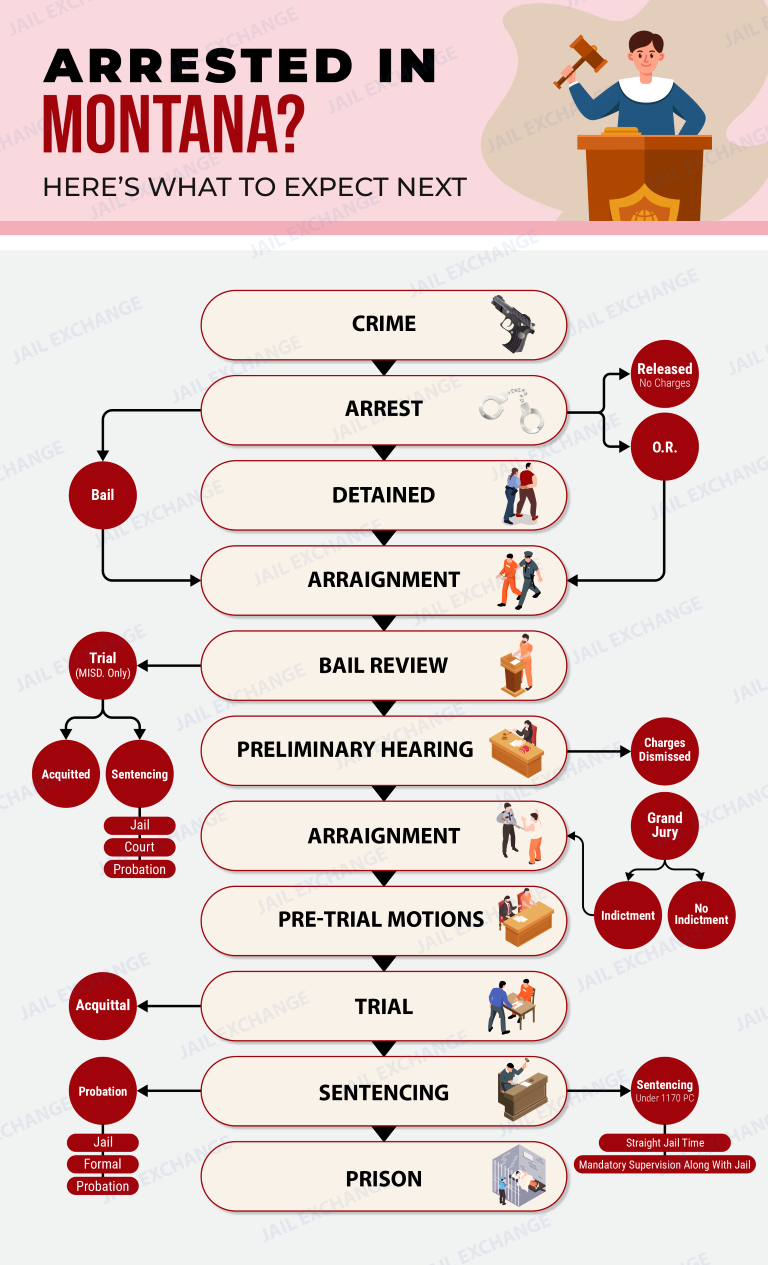
Here is the usual path for a felony:
- First appearance before the justice of the peace, who sets bail.
- Probable cause. One route is a preliminary hearing before the justice of the peace. The other is the County Attorney asking a district judge for permission to file a formal charge known as an information (MCA 46-11-201).
- Arraignment. In District Court, the charge is read and a plea is entered (MCA 46-12-201).
- Trial before a jury of 12. The verdict must be unanimous, unless both sides waive the jury in writing (MCA 46-16-110).
- Sentencing after the person pleads guilty or is found guilty.
Unless a specific law says otherwise, a felony can bring as much as 10 years in prison and a $50,000 fine (MCA 46-18-213). Felony theft, over $1,500, has the same 10-year top. Drug possession tops out at 5 years. For a first drug possession conviction, the law favors deferring the sentence (MCA 45-9-102).
↑ Back to the question list8. Are violent and family violence charges treated differently?
Yes. Expect stricter handling at several points:
- Getting out. A judge can keep someone jailed before trial if no conditions would protect others or bring them back (MCA 46-9-106).
- Partner and family cases. A person charged with assaulting or strangling a partner or family member can't be bailed out from a schedule. A third conviction for hurting a partner counts as a felony and can mean 5 years (MCA 45-5-206).
- Tracking device. When the charge is felony stalking or felony partner assault, expect an ankle monitor if the county can supply one (MCA 46-9-108).
- Warning the victim. The jail must tell the alleged victim promptly when the person is released.
- Prior felonies. Someone who already has a felony conviction can't get a deferred sentence on a new felony (MCA 46-18-201).
9. Who is on each side of a criminal case here?
The Chouteau County Attorney's Office brings felony charges in District Court and misdemeanor charges in Justice Court. It also handles Youth Court cases. Its office is in the courthouse at 1308 Franklin Street, Fort Benton, MT 59442, 406-622-3246.
The state public defender agency steps in for people who can't afford a lawyer when the charge is a felony, a misdemeanor that could mean jail, or a youth matter. Its Havre office, 109 2nd St. W., Havre, MT 59501, 406-265-2199, serves this area. Use the northwest door. If the Havre office can't take the case because of a conflict, the Conflict Defender office in Great Falls may, 406-604-7581.
Applications go through the online public defender form. Attach recent pay stubs and bank statements. The court has the last word on who qualifies (MCA 47-1-111).
↑ Back to the question list10. Where can I find case records and hearing dates?
The state judicial branch offers two free search sites. Each one searches by a person's name or by case number.
- The limited court search covers cases from Justice Court and both city courts.
- The District Court search covers felony cases.
Cases involving minors and sealed cases stay off both sites. If a case doesn't turn up, ask the court directly. Justice Court and both city courts answer at 406-622-5502. For felony hearing dates, the Clerk of District Court answers at 406-622-5024. Keep the person's full name and birth date handy.
↑ Back to the question list11. Does the Twelfth District have drug or DUI courts?
Yes. A treatment court pairs a criminal case with treatment and close check-ins. The state's directory lists two for this district, both based at 315 4th St., Havre, MT 59501:
- 12th Judicial District Drug Court (adults), 406-265-5481, extension 2357
- 12th Judicial District DUI Court, reached through the same main district court number
Whether a person can join is up to the judge and the program. Ask the defense lawyer if a treatment court fits the case.
↑ Back to the question list12. Can a Justice Court ruling be appealed?
Yes. How it works depends on whether the court records its hearings. From a justice or city court that is not a court of record, the appeal goes to District Court and the whole case is tried again, sometimes before six jurors (MCA 46-17-311). From a court of record, the appeal is decided on the record instead. Ask the court which kind it is.
The deadline is short. You have 10 days from the judgment after a trial to file the notice of appeal. Talk with a lawyer right away, and call Justice Court at 406-622-5502 to ask how to file.
↑ Back to the question list13. Is there a warrant out in Chouteau County?
Deputies serve warrants all over the county, Fort Benton and Big Sandy included. Questions about a warrant go to the Sheriff's Office dispatch line, 406-622-5451. For tribal warrants on the reservation, call Rocky Boy Law Enforcement dispatch at 406-395-4130. A case behind a warrant may appear on the Justice and city court portal or the District Court portal. The state's offender search flags escapees and absconders the Department of Corrections is seeking. Before doing anything about a warrant, call a lawyer. The usual next step is surrendering at the Detention Center, 1215 Washington St, Fort Benton, MT 59442, or asking the issuing court for a new date. The district clerk is at 406-622-5024.
↑ Back to the question list14. Which federal court hears cases from Fort Benton?
Federal crimes charged here are heard in the Great Falls Division. The court sits in the Missouri River Federal Courthouse, 125 Central Avenue West, Suite 110, Great Falls, MT 59404, 406-727-1922. The clerk works weekdays from 8:00 a.m. to 5:00 p.m.
- The first federal appearance includes a detention hearing. The judge rules there on release until trial (18 U.S.C. 3142).
- Federal defendants are held by the U.S. Marshals Service, reachable at 406-200-6004. The county jail in Fort Benton is one place it may house them.
- U.S. Probation and Pretrial Services prepares reports for the judge from 125 Central Avenue West, Great Falls, MT 59404, 406-453-4461.
- Search the case on PACER. After sentencing, the Federal Bureau of Prisons inmate locator shows where the person went.
15. Can an ICE detainer change a Chouteau County case?
The state case does not stop. What a detainer changes is the release day. ICE files Form I-247A, which asks the jail to keep the person up to 48 hours after they would otherwise be released so that agents can collect them (8 CFR 287.7(d)).
- Under Montana law, officers must act on a detainer with an arrest, and the person must be told why (MCA 27-16-801).
- Someone who shows believable papers of citizenship or lawful status may not be kept on it.
- Since 2025, officers who lawfully stop someone are allowed to ask about immigration status (MCA 46-5-401).
- After pickup, the person is under the ICE Salt Lake City Field Office, 2975 Decker Lake Drive, Suite 100, West Valley City, UT 84119, 801-736-1200.
- Locate them with the ICE Online Detainee Locator.
16. Where does someone go after a state prison sentence?
Once a judge sentences someone to the state, the Montana Department of Corrections takes charge. They often sit in the county jail first while the state reviews them. The state then chooses among prisons, prerelease centers and treatment programs.
- The state offender search shows where the person is and their status.
- Facility details, including visits and mail, are in our Montana state prisons guide.
- Parole decisions come from the Board of Pardons and Parole, 1002 Hollenbeck Road, Deer Lodge, MT 59722, 406-846-1404.
17. What happens when a teenager is charged?
Anyone under 18 is charged in Youth Court. The district judge runs it (MCA 41-5-203). The Clerk of District Court keeps the files, and the public court portals leave youth cases out.
- A teen kept in detention is owed a probable cause hearing within 24 hours. Saturdays, Sundays and holidays are not counted (MCA 41-5-332).
- Teens from this county who need secure detention go to the Cascade County Juvenile Detention Center in Great Falls, 406-454-6930.
- In a handful of very serious cases, the prosecutor may ask to send a youth 12 or older to adult court (MCA 41-5-206).
- State prison is off limits for anyone under 16.
Parents with questions about hearing dates can reach the district court clerk at 406-622-5024.
↑ Back to the question list18. What help do Chouteau County crime victims get?
The County Attorney's Office has a crime victim advocate you can call at 406-759-8255. Other help is listed below.
- Before the prosecutor drops a felony, offers a plea bargain or agrees to a release, the victim gets a say. The same goes for cases with an injury or a threat (MCA 46-24-104).
- For people sentenced to state custody, victims can sign up for free alerts through VINE at 800-456-3076 or on VINELink.
- Montana's crime victim compensation program can pay up to $25,000 in costs from a crime. Call 800-498-6455.
- Hi-Line's Help for Abused Spouses, 300 North Virginia, Ste 307, Conrad, MT 59425, offers support after abuse. Its crisis line is open 24 hours at 800-219-7336.
Buying commissary in Fort Benton
For someone held at the Chouteau County Detention Center, adding funds to their jail account is different from ordering a package. The person in custody can use available account funds to make their own purchases, subject to jail rules.
See how to add money to a Chouteau County jail account. Call the detention center at 406-622-3660 to ask when orders are taken, whether the person can place an order now, and whether the jail permits any separate family care packages.
NCIC Inmate Communications provides secure electronic banking solutions that allow family members and friends to transfer funds directly into an incarcerated person's jail trust and commissary account. Deposited funds give your loved one the financial balance needed to purchase snacks, hygiene items, correspondence materials, and over-the-counter medication from the jail commissary.
Important: Facility Deposit Rules and Window Intake Vary
Once a person is booked and moved to a housing unit, facilities do not always allow cash drop-offs or phone payments directly to the jail window. Some might and you should confirm this by calling the facility and asking. But if you do not register online and fund your loved one's trust account immediately, they may be forced to wait days or weeks for standard paper processing, leaving them without essential soap, clean undergarments, basic medical sundries or snacks.
Step-by-Step Instructions to Register and Deposit Funds
- Confirm the inmate's legal first and last name, date of birth, and assigned booking or inmate ID number.
- Navigate to account.ncic.com on your computer or mobile device.
- Click Create Account or sign into your existing profile.
- Select Inmate Trust Deposits from the service menu.
- Select the state and facility where the inmate is currently housed.
- Locate the inmate to confirm their active housing status matches the facility roster.
- Enter your deposit dollar amount, review calculated convenience fees, and enter your debit or credit card billing details.
- Submit payment and save your digital confirmation receipt for your records.
What the Inmate Needs to Do
The inmate does not need an internet account to receive funds. Once the electronic transaction clears, the balance posts directly to their facility accounting balance in the jail's internal system. The inmate can review their updated balance at a dayroom pod kiosk or on their trust sheet and place orders on their regular commissary day.
Official Provider: NCIC Official Website
Customer Service Telephone: 1-800-943-2189
Support Hours: 24 hours a day, 7 days a week, 365 days a year
Supported Languages: English and Spanish
Other Services Provided by NCIC Inmate Communications
In addition to Inmate Trust Deposits, NCIC provides several other communication, tablet, and visitation services:
- Prepaid Phone Calling Accounts: Prepay for phone calling credits so your loved one can call your telephone directly.
• Learn more on our website: Prepaid Calling Accounts Guide | • Visit official vendor page: NCIC Prepaid Calling - Inmate Tablets & Digital Media: Discover educational programs, phone access, and entertainment offered on facility tablets.
• Learn more on our website: Tablet Programs Guide | • Visit official vendor page: NCIC Tablet Services - Remote Video Visitation: Schedule and join live face-to-face video visits from your computer or smartphone.
• Learn more on our website: Video Visitation Guide | • Visit official vendor page: NCIC Video Visits - Inmate Messaging Services: Send electronic messages and photos directly to an inmate's terminal.
• Learn more on our website: Inmate Messaging Guide | • Visit official vendor page: NCIC Messaging
Deposit Money for an Inmate in the Chouteau County Detention Center
Cash in an envelope is technically allowed by the Fort Benton jail's mail rules, right alongside money orders. Pick the money order anyway: if one goes astray, it can be traced.
Mailing details for the Chouteau County Detention Center
- Pay to: the inmate, or the Chouteau County Sheriff's Office.
- Memo: inmate's name and ID number.
- Envelope: inmate's legal name, Chouteau County Detention Center, P.O. Box 459, Fort Benton, MT 59442. Send the payment by itself.
- Rejected: personal checks, plus anything missing from the approved list. Those come back marked undeliverable.
Other routes: NCIC handles online deposits and tacks on a convenience fee; have the inmate's legal name, birth date and ID number on hand to complete one. There is also a kiosk in the lobby or visiting area accepting cash or card.
The front desk at 1215 Washington St. is a question mark. The jail hasn't said if it accepts money there, or at what hours, and it also stays quiet on how unspent funds are returned upon release. Staff at 406-622-3660 answer both.
The Chouteau County Detention Center sits inside the county's law enforcement building on Washington Street in Fort Benton. Its mail comes through the county's post office box rather than the street address. The sheriff keeps a short list of what may come in an envelope, and anything else is returned to the sender as undeliverable.
All mail, including legal papers and money orders:
Inmate's Full Name & ID#
Chouteau County Detention Center
P.O. Box 459
Fort Benton, MT 59442
- Allowed in the envelope: Letters written on regular copy paper, loose-leaf paper or notebook paper, standard photographs, photocopies of drawings or pictures, and money orders.
- Everything else comes back: Books, magazines, packages and any item not on the list above are returned as undeliverable.
- Addressing: The inmate's name goes above the facility name. Put your full name and return address in the top left corner, or the letter may never be delivered.
- Drawings: Send a photocopy of a drawing, not the drawing itself, and don't draw on the envelope.
- Pen: Blue or black ink. Skip colored ink, felt markers, crayons, lipstick, perfume, glitter and confetti.
- Photos: Regular printed photographs are fine, but the jail won't take a Polaroid.
- Money by mail: The sheriff's list allows money orders and cash, but a money order is the safer choice. Name the inmate in full as the payee and add their ID number in the memo line. If you are unsure, call 406-622-3660 to confirm. You can also put money on their account online.
- Who may write: Family and friends. Inmates can't write to co-defendants, other inmates or people under a no-contact order.
- Stamps: They can't be mailed in. Inmates buy them, and those with no money get a few each week.
Before you write, check the sheriff's inmate population list to see who is held. Fort Benton staff hand out letters on weekdays.
NCIC Inmate Communications provides telecommunications services that allow incarcerated individuals to place outbound voice calls from dayroom telephones to family and friends. Because correctional facilities do not permit incoming phone calls, establishing an NCIC prepaid calling account connects calls directly to your cell phone or landline without being blocked by wireless carriers.
Important: Mobile Phones Automatically Block Inmate Calls
Cellular phone carriers automatically reject standard collect calls originating from jail phone systems. While some residential landlines might permit direct monthly billing, mobile devices and internet-based telephone lines require an active prepaid calling balance, which you can verify by checking with your provider. If you do not register online and fund an NCIC account right away, your loved one will receive an automated disconnect announcement when attempting to call your number.
Step-by-Step Instructions to Register and Fund an Account
- Visit account.ncic.com or call NCIC customer care at 1-800-943-2189.
- Click Create Account and register using the primary 10-digit telephone number where you want to receive calls.
- Select the state and correctional facility where your loved one is currently detained.
- Search for and add the inmate using their full legal name or booking ID number.
- Select your deposit dollar amount and enter your debit or credit card billing details.
- Submit payment and ensure your mobile phone settings allow calls from automated or unfamiliar correctional numbers.
What the Inmate Needs to Do
The inmate dials your 10-digit number from any dayroom telephone and keys in their assigned PIN. The automated system verifies that your phone number has an active prepaid balance and prompts you to press a digit to accept the call. All personal telephone conversations are recorded and monitored by facility staff.
Official Provider: NCIC Official Website
Customer Service Telephone: 1-800-943-2189
Support Hours: 24 hours a day, 7 days a week, 365 days a year
Supported Languages: English and Spanish
Other Services Provided by NCIC Inmate Communications
In addition to Prepaid Phone Calling, NCIC provides several other digital communication and visitation services at participating facilities:
- Remote Video Visitation: Schedule and join live face-to-face video visits from home using your computer or smartphone.
• Learn more on our website: Video Visitation Guide | • Visit official vendor page: NCIC Video Visits - Inmate Messaging Services: Send electronic messages and photos directly to an inmate's housing unit terminal.
• Learn more on our website: Inmate Messaging Guide | • Visit official vendor page: NCIC Messaging
NCIC Inmate Messaging allows friends and family members to exchange electronic text messages and digital photos directly with an incarcerated loved one. Messages are delivered electronically to housing unit terminals and tablets within hours, avoiding the lengthy transit times associated with physical postal mail.
Important: Electronic Messaging Screening Rules Differ
Inmates cannot receive incoming phone calls, and traditional postal mail rules differ across correctional agencies. While some facilities still allow regular handwritten letters, many jails have transitioned to digital-only mail scanning or restrict postal delivery, which you can verify by checking facility rules. If you do not register online and purchase messaging credits immediately, your loved one may face lengthy periods without direct written contact from family.
Step-by-Step Instructions to Register and Send Messages
- Go to account.ncic.com and sign in or create a user profile.
- Select Messaging from your dashboard options.
- Select your state and detention center, then search for the inmate using their full legal name or booking ID.
- Purchase a messaging credit bundle using a debit or credit card.
- Type your message in the composition window and attach approved JPEG photos if permitted by the facility.
- Submit your message to the facility's screening queue.
What the Inmate Needs to Do
All electronic correspondence is screened by facility staff before delivery. Once approved, messages appear in the inmate's inbox on their housing unit terminal or tablet. The inmate opens the message, reads your note, and types an electronic reply using their available credits.
Official Provider: NCIC Official Website
Customer Service Telephone: 1-800-943-2189
Support Hours: 24 hours a day, 7 days a week, 365 days a year
Supported Languages: English and Spanish
Other Services Provided by NCIC Inmate Communications
In addition to Inmate Messaging, NCIC provides calling and video visitation services at participating facilities:
- Prepaid Phone Calling Accounts: Fund a calling balance tied directly to your phone number.
• Learn more on our website: Prepaid Calling Accounts Guide | • Visit official vendor page: NCIC Prepaid Calling - Remote Video Visitation: Schedule and join live face-to-face video visits from your computer or smartphone.
• Learn more on our website: Video Visitation Guide | • Visit official vendor page: NCIC Video Visits
NCIC Inmate Communications deploys secure, corrections-grade handheld tablets to incarcerated individuals in county detention centers. Operating on a secure internal wireless network, these devices allow inmates to conduct remote video visits, make voice telephone calls, send electronic messages, stream music, read eBooks, and access self-help and educational resources directly from their housing pods.
Important: Tablet Hardware Deployment and Rental Rules Vary
Detention centers do not manage tablet distribution identically. While some agencies issue individual personal tablets to every detainee at booking, others utilize shared pod docking stations or restrict tablet use to specific dayroom hours, which you should confirm with the facility directly. Although core educational and legal resources are generally provided free of charge, sending messages, listening to music, or making phone calls from the tablet requires an active balance funded by outside contacts.
Step-by-Step Instructions to Support and Fund NCIC Tablets
- Verify that NCIC handheld tablets are active at your loved one's specific detention facility.
- Navigate to account.ncic.com on your computer or mobile device.
- Sign into your verified user account and link the inmate's legal name and booking ID number.
- Select Tablet Media / Messaging or Inmate PIN Debit to add funds to their available balance.
- Specify your deposit dollar amount, review convenience fees, and enter your credit or debit card billing details.
- Submit payment, save your confirmation receipt, and notify your loved one that their device balance is available.
What the Inmate Needs to Do
The inmate unlocks their assigned tablet using their PIN or biometric login. Their available balance appears on the screen, allowing them to download songs, read digital books, write messages, and communicate with approved family members. Devices are returned to charging carts during quiet hours and shift counts for overnight recharging.
Official Provider: NCIC Official Website
Customer Service Telephone: 1-800-943-2189
Support Hours: 24 hours a day, 7 days a week, 365 days a year
Supported Languages: English and Spanish
Other Services Provided by NCIC Inmate Communications
In addition to Tablet Services, NCIC provides several other communication, financial, and visitation options:
- Prepaid Phone Calling Accounts: Prepay for phone calling credits so your loved one can call your telephone directly.
• Learn more on our website: Prepaid Calling Accounts Guide | • Visit official vendor page: NCIC Prepaid Calling - Remote Video Visitation: Schedule and join live face-to-face video visits from your computer or smartphone.
• Learn more on our website: Video Visitation Guide | • Visit official vendor page: NCIC Video Visits - Inmate Messaging Services: Send electronic messages and photos directly to an inmate's terminal or tablet.
• Learn more on our website: Inmate Messaging Guide | • Visit official vendor page: NCIC Messaging - Inmate Trust & Commissary Money Deposits: Send canteen funds directly into an incarcerated person's jail trust account.
• Learn more on our website: Trust Deposits Guide | • Visit official vendor page: NCIC Trust Deposits
Chouteau County Juvenile Facilities
- Jail (Main): 406-622-3660
- Sheriff: 406-622-5451
The Chouteau County Detention Center serves the following cities and towns of Chouteau County: Big Sandy, Carter, Collier, Fort Benton, Geraldine, Highwood, Loma and Moccasin.