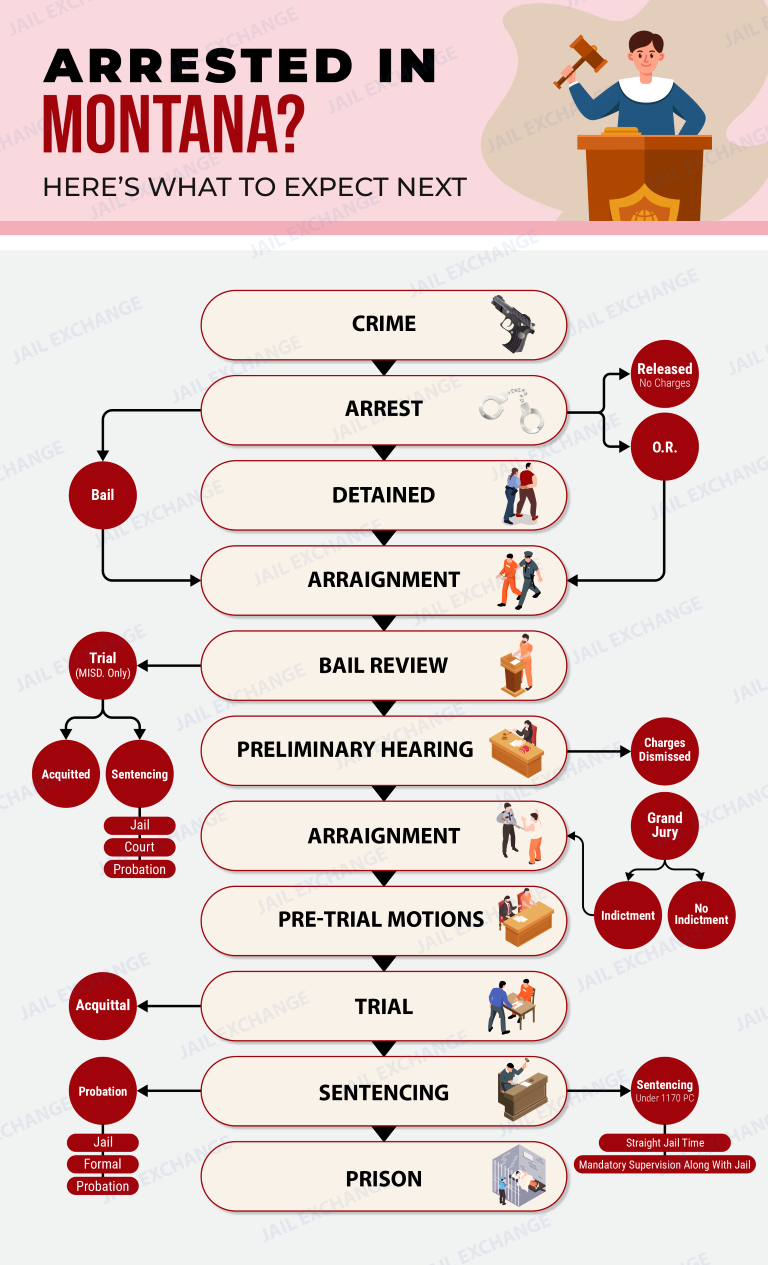
Fergus County Detention Center Criminal Court Process
Criminal Court Process for Fergus County Montana
Fergus County Criminal Courts
Adults arrested in Fergus County wait at the Fergus County Detention Center, 121 8th Avenue South, Lewistown, MT 59457. Two Lewistown courts decide nearly every criminal case here: the Justice/City Court and the Tenth Judicial District Court. This page explains which court takes which charge and what happens at each hearing.
The Sheriff's jail roster shows each person's charges, court and case number. Our Inmate Lists page is built for the custody side of an arrest. It covers who is held, recent bookings, active warrants, what the charges mean, booking photos, free lawyers and property pickup.
Dial the Sheriff's Office at 406-535-3415 to confirm the person is in the Detention Center and to learn the next court day. Misdemeanor and city dates come from Justice/City Court at 406-535-5418, and felony files sit with the district clerk at 406-535-5026. To get someone out, start with our bail page.
1. How does Montana sort criminal cases between courts?
The seriousness of the charge picks the court.
- Justice/City Court. One court wears two hats here. As the justice court, it takes misdemeanors from the whole county, such as traffic, fish and game, and alcohol cases involving minors. Its own limit is 6 months in jail or a $500 fine (MCA 3-10-303). Misdemeanors with higher fines can be filed there or in District Court. As the city court, it hears city ordinance charges (MCA 3-11-103).
- District Court. All felonies end up here. Felonies are crimes where the sentence can be death or a state prison term longer than a year (MCA 45-2-101).
- Youth Court. This branch of District Court handles charges against anyone under 18.
Most felonies start in the Justice/City Court anyway. That judge holds the first appearance, sets bail, and may hold a preliminary hearing before the case moves up.
↑ Back to the question list2. Where are the Fergus County courts, and when are they open?
Both state courts sit in Lewistown, in separate buildings.
- Clerk of District Court, Tenth Judicial District, 712 W. Main Street, Suite 303, Lewistown, MT 59457, 406-535-5026. Open 8:00 a.m. to 5:00 p.m., Monday through Friday. The clerk keeps felony files, sits in on hearings and issues court papers. A single district judge covers this county and also Judith Basin and Petroleum counties.
- Justice/City Court, County Complex, 121 8th Avenue South, Lewistown, MT 59457, 406-535-5418. Court appearances take place on weekdays from 9:00 a.m. to 4:00 p.m. Email: justicecourt.fergus@mt.gov.
The Justice/City Court shares the County Complex address with the Sheriff's Office. Bring a photo ID when you go.
↑ Back to the question list3. Is the city court separate from the Justice Court?
In daily practice, no. The state court directory lists one Justice/City Court in Lewistown, with one phone number for both kinds of cases. State reports still count each side apart. In 2025, 1,229 criminal violations were filed on the justice court side and 1,365 on the city side.
The City Attorney prosecutes city charges and can be reached at 406-535-1778. The County Attorney prosecutes county charges. City police make arrests inside city limits, and those cases are heard in this same courtroom.
↑ Back to the question list4. What about arrests in Moore, Denton, Winifred or Grass Range?
None of the four towns holds its own court. Charges from Moore, Denton, Winifred, Grass Range and the ranch country around them go to the Justice/City Court at the County Complex. Felonies from those places later move to District Court.
The town of Moore has no police department and says it is monitored by the Sheriff's Office. The Town of Moore office is at 201 W Fergus Ave, Moore, MT 59464, 406-374-2480. For an arrest anywhere outside the city, the Sheriff's Office at 406-535-3415 is the first place to call.
↑ Back to the question list5. What is said at the first court appearance?
The first appearance has to happen "without unnecessary delay" after the arrest (MCA 46-7-101). Here it nearly always takes place at the Justice/City Court, face to face or by video link from the jail. The judge must tell the person (MCA 46-7-102):
- the charges against them
- their right to a lawyer, and how one is assigned at no cost to people who qualify
- the general rules for pretrial release
- their right to refuse to make a statement, which could be used at trial
- that being convicted may take away firearm rights
- on a felony complaint, their right to a probable cause ruling from a judge
Bail or release is settled at this same hearing (MCA 46-9-109). Family members who want to watch should call the court first to ask the time.
↑ Back to the question list6. How does a Fergus County misdemeanor case move along?
For a ticket, the court date is usually about 10 days after the officer writes it. Some charges require the person to come in no matter what. At the first appearance, the person pleads guilty or not guilty. The court then sets a trial, usually about 6 to 8 weeks out. A misdemeanor jury has six people (MCA 46-17-201).
Montana gives misdemeanor cases a 6-month clock that starts at the plea. If trial hasn't begun by then, the judge must dismiss, unless the defendant caused the delay or good cause is shown (MCA 46-13-401). Penalties for some common charges:
- DUI, first offense: jail from 24 hours up to 6 months; fine $600 to $1,000 (MCA 61-8-1007)
- Theft of property worth $1,500 or less: county jail for 6 months at most, a fine of no more than $1,500, or both (MCA 45-6-301)
- Partner or family member assault, first offense: jail of 24 hours minimum and 1 year maximum; fine $100 to $1,000 (MCA 45-5-206)
- Other misdemeanors where the law names no penalty: 6 months in jail at most, $500 at most (MCA 46-18-212)
Judges can also defer a misdemeanor sentence, for a year at most (MCA 46-18-201). Follow all the terms, and the court may dismiss the charge (MCA 46-18-204). The Justice Court points out that this choice is closed to drivers who hold a commercial license.
↑ Back to the question list7. Can a Justice/City Court ruling be appealed?
Yes. State reports list both the justice court and the city court here as courts of record, which means hearings are recorded. An appeal from a court of record goes to District Court, and the district judge reviews that record instead of holding a brand new trial.
Ten days is the limit. Count from the judgment that comes after trial, and file the appeal notice inside that window (MCA 46-17-311). That goes fast, so talk to a lawyer the same week. The Justice/City Court clerk at 406-535-5418 can explain the filing steps.
↑ Back to the question list8. What steps does a felony case follow in District Court?
Felony cases follow this path:
- First appearance. Charges are read and bail is set at the Justice/City Court.
- Probable cause. A preliminary hearing in the justice court is one route (MCA 46-10-105). Another path is for the County Attorney to ask District Court, in a sworn paper, for leave to file an information. That is the formal felony charge (MCA 46-11-201).
- Arraignment. The person receives the charging papers in District Court and enters a plea (MCA 46-12-201).
- Trial. A felony jury has 12 members (MCA 46-16-110). Both sides can agree in writing to a trial by the judge alone. Jurors must all agree on the verdict.
- Sentencing. It comes after a guilty plea or after a jury finds the person guilty.
With no other limit in the statute, the top felony sentence is 10 years in prison plus a $50,000 fine (MCA 46-18-213). Theft above $1,500 shares those limits. Possession of dangerous drugs tops out at 5 years, though a first conviction is presumed to get a deferred sentence (MCA 45-9-102).
↑ Back to the question list9. Do assault and other violent charges follow stricter rules?
Yes, at several points:
- Judge first. There is no schedule bail for partner assault, partner strangulation, stalking or order violations (MCA 46-9-302).
- Standing no-contact order. Once a person is arrested for partner assault, an order can keep them 1,500 feet away. It runs for 72 hours or until the first appearance, and the judge then reviews it (MCA 45-5-209).
- Third offense. On a third conviction, partner assault is a felony carrying as much as 5 years (MCA 45-5-206).
- Monitors. Where the county can do it, felony stalking and felony partner assault come with a presumption of electronic monitoring (MCA 46-9-108).
- Victim alerts. When bail is granted in these cases, the jail must reach out to the alleged victim right away (MCA 46-9-108).
- Pretrial detention. A judge may keep a person in jail when no safeguards would work (MCA 46-9-106).
- Prior felonies. With an earlier felony on their record, a person can't have a new felony sentence deferred (MCA 46-18-201).
10. Who prosecutes Fergus County cases, and who defends them?
The County Attorney's Office brings state charges, both felonies and misdemeanors. It is at 801 W. Broadway St., Lewistown, MT 59457, 406-535-8127. If that office has a conflict, the Prosecution Services Bureau at the state Department of Justice may step in, 406-444-2026. City charges belong to the City Attorney.
For the defense, Montana's public defender agency keeps a regional office in town: Office of State Public Defender, 505 W. Main St, Lewistown, MT 59457, 406-535-3703. If the local office has a conflict of interest, a lawyer from the Conflict Defender Division in Bozeman takes over: 77 Discovery Drive, Bozeman, MT 59718, 406-577-7840. Apply with the online public defender application. The court decides who qualifies (MCA 47-1-111), and the Justice Court may order a person to repay part of the cost.
↑ Back to the question list11. How can I check a case or find the next hearing?
Montana runs two free online court portals. Search either one by name or case number:
- Courts of limited jurisdiction portal for Justice/City Court cases
- District Court portal for felony cases, which also holds the District Court's public hearing calendar
Cases about minors and sealed cases are kept off both portals. For anything you can't find, call the court. Callers should give the full legal name plus the date of birth. Felony dates come from the clerk at 406-535-5026, and Justice/City Court dates from 406-535-5418. The jail roster also lists the court and case number for each charge.
↑ Back to the question list12. How do we find out about a warrant and deal with it?
Warrant questions go to the Sheriff's Office at 406-535-3415 for the county, or to city police at 406-535-1800 inside city limits. Searching a name on Montana's District Court portal or on the limited jurisdiction court portal shows open cases. The Montana offender search marks people who have fled state probation, parole or prison as absconders or escapees. Before dealing with a warrant, get advice from a lawyer. The person can then surrender at the Detention Center, 121 8th Avenue South, Lewistown, MT 59457, or call the issuing court and request a fresh court date. For a Justice/City Court warrant, that number is 406-535-5418.
↑ Back to the question list13. What happens after a missed court date or unpaid fine?
The Justice Court sends notices for failing to appear, failing to pay and failing to comply. Each one warns that an arrest warrant may follow and that the driver's license will be suspended. Getting the license back takes a $100 reinstatement fee paid to the state's Records and Driver Control Bureau, 303 North Roberts, Helena, MT 59601, 406-444-3289. The court says no work permit is given for this kind of suspension.
- Fines and time payments can be paid by card on the Justice Court payment page, with a 5% convenience fee.
- If bail was posted, a missed date can also cost that money (MCA 46-9-503).
- Call the court at 406-535-5418 as soon as you know a date was missed.
14. Where are federal charges from Fergus County heard?
Federal crimes from this county belong to the Great Falls Division of the U.S. District Court for the District of Montana. Court business is handled at the Missouri River Federal Courthouse, 125 Central Avenue West, Suite 110, Great Falls, MT 59404, 406-727-1922, from 8:00 a.m. to 5:00 p.m. on weekdays.
- Release or detention gets decided at the first appearance, unless one side asks for a brief delay (18 U.S.C. 3142).
- Federal defendants stay under U.S. Marshals Service custody. The Marshals keep a Great Falls office in Suite 220 of that building, and the district office answers at 406-200-6004. The county also has an agreement to keep federal prisoners in the Lewistown jail.
- Reports for the judge are written by the federal probation and pretrial office in Great Falls, 406-453-4461.
- Case papers are on PACER. The Great Falls courthouse also has public computers for viewing cases.
15. Does an ICE detainer change anything in the state case?
The state case keeps going, but release can change. With Form I-247A, ICE asks the jail to keep a person up to 48 hours after they would otherwise be released, so agents can pick them up (8 CFR 287.7(d)).
- Montana officers must arrest a person in custody who is named in a detainer. They must also tell the person why (MCA 27-16-801).
- Believable proof of citizenship or lawful status ends that duty.
- Since 2025, an officer who lawfully stops a person may make a reasonable attempt to find out whether they are here legally (MCA 46-5-401).
- ICE's check-in office in Billings serves this county and 27 others: 2900 4th Avenue, Suite 205, Billings, MT 59101, 406-247-4083.
- Look for the person on the ICE Online Detainee Locator.
16. What follows a sentence to state custody?
After a felony sentence to state custody, the Montana Department of Corrections takes charge. By DOC policy, the person stays in the county jail while the Probation and Parole Bureau assesses and classifies them. Placement comes next. Options include assessment centers, prerelease centers, treatment programs and secure prisons.
- Montana State Prison, the main prison for men: 400 Conley Lake Road, Deer Lodge, MT 59722, 406-415-6126.
- Montana Women's Prison: 701 South 27th Street, Billings, MT 59101, 406-247-5100.
- The Montana offender search gives location, status and conviction details.
- Parole decisions: Board of Pardons and Parole, 1002 Hollenbeck Road, Deer Lodge, MT 59722, 406-846-1404.
17. How do youth cases work in the Tenth Judicial District?
In this district, the same judge who hears felonies also runs Youth Court (MCA 41-5-203). Youth files stay off the public portals. The state court directory lists one juvenile probation number for all three counties in the district.
- Detention for a youth triggers a quick hearing on probable cause. The clock is 24 hours, and it pauses over weekends and legal holidays (MCA 41-5-332).
- For the worst crimes, like deliberate homicide, the County Attorney may ask to file an adult case against a youth who is at least 12 (MCA 41-5-206).
- A state prison can't hold anyone younger than 16.
- Pine Hills Correctional Facility in Miles City is the only state-run long-term facility for youth offenders, ages 10 to 17.
Juvenile Probation is at 523 W Main St, Lewistown, MT 59457, 406-535-9242, on weekdays from 8:00 a.m. to 5:00 p.m., and parents should call it first.
↑ Back to the question list18. Where can crime victims in Fergus County turn for help?
A Victim/Witness Coordinator works in the County Attorney's Office. Call 406-535-8127 for help with each step.
- Before the case is dropped, settled by a plea deal, or the accused is released, the prosecutor has to hear from the victim. This covers felonies and cases with real or threatened injury (MCA 46-24-104).
- Victims can ask the County Attorney in writing for a copy of the police report.
- Free alerts about state felony offenders are on VINELink or by phone at 800-456-3076.
- Crime Victim Compensation, a payer of last resort, covers up to $25,000 in costs. Police should get the report within 72 hours. Claims are due within a year. Call 800-498-6455.
19. How do I get a police report or a criminal record?
In Montana, police reports are confidential criminal justice information. Here is who can get one in this county:
- The person charged. Their lawyer gets the reports from the County Attorney through discovery.
- A victim. Send a written request to the County Attorney.
- Anyone else. A petition must be filed with District Court.
A criminal history record is different. The state Department of Justice runs a name search called CHOPRS, which costs $20 per search and needs the full name and full birth date. Court records are on the two free portals listed in the case lookup answer.
↑ Back to the question listCriminal Court Process for Fergus County Montana
Fergus County Montana Criminal Court System - Definitions
It might be helpful to define some words that will be used on this site, when explaining the Montana, Fergus County Court System and how it works. The definitions on this site are for general information and not legal advice. It is always preferred to follow information given by your attorney or local authorities.
If you scroll down below this content, and the listing of the courts in Fergus County, you will find a simple flowchart diagram and a video that will help you visualize the stages of the Criminal Court Process.
Arrest is when Montana, Fergus County, or local police take a person into custody and start the legal process. The arrested person may or may not be immediately jailed.
In less serious crimes, the person may only be given a citation ordering that they appear in municipal or Fergus County court on a certain date. In cases involving more serious crimes, the person is usually placed in Fergus County jail until an arraignment, or a judge decides the next step.
Booking is when the sheriff or local police gather information such as the detainee’s name, address and why the person is being arrested. Booking also includes fingerprinting, criminal history, investigation and verification of identity. Bail for lower-level crimes may be set right after booking so the arrested has the opportunity to “bail or bond out” before being detained.
The prosecution, sometimes called “the government” or “the people” or “the state” is the side that press the charges and seeks punishment for the offense. These are attorneys that work for the state of Montana, Fergus County or a city or town. The prosecuting attorney for the county or the district is called the County Attorney. A U.S. Attorney prosecutes federal cases.
Jurisdiction is an important term in the court system that means whether a court has the obligation or duty or right to handle a case. For example, if you run a red light in your town or city, a municipal court would likely have jurisdiction over your case, but the next town or city over would not have jurisdiction over your case. If you attempted to flee from police when they attempted to stop you after you ran the red light, it becomes a more serious crime, and the municipal court might not have jurisdiction so you might be assigned to a higher-level court that has jurisdiction over the more serious crime. Jurisdiction varies from state to state and sometimes county to county.
Arraignment is when a judge determines whether or not the charges are supported by the prosecution’s initial evidence and tells the arrested what they are charged with, and the person says whether they are guilty or not guilty. At this time, the person is called the defendant, and the opposing side is called the prosecution. If there is reason to believe that the arrested is guilty, the judge will set bail conditions or send the defendant to jail or release them ROR (release on recognizances). An arraignment is not a trial, and the defendant is entitled to a trial within a reasonable amount of time after the arraignment.
Bail is money paid that is held by the county or municipal court to make sure that the arrested does not flee the area before their trial. Bail amounts and other conditions are determined at the arraignment. Once the case is over, the bail money is returned to the defendant. If a person does not pay bail, they remain in jail until their trial.
Bail can be denied if the court feels that the arrested would be a danger to others if released. Sometimes the court decides that there is a good chance that the arrested will show up for trial and not flee so they are released on their own promise, or recognizance without having to pay bail.
A bond proceeding is the determination of how much bail is to be paid and usually happens at the same time as an arraignment. During bond proceedings, the defendant can have an attorney present but does not have the right to an attorney. Jailors, law enforcement and prosecutors generally do not have authority to set bail. A judge or court officer in Fergus County or municipal court sets bail. Judges in Montana rely on a statewide bail schedule, which sets out a recommended range of bail amounts for different offenses. Judges can still exercise discretion in setting bail above or below the recommended range.
It is always important to have family involvement after being arrested. Not only can they make calls and communicate on your behalf (not all bond companies will accept collect calls), but family support will show the court that there are people who will make sure that the defendant makes it to court, not only for the defendant’s own good, but because they may have signed bond paperwork and responsible to pay if the defendant does not show in court. Chances of obtaining a bond from a bond company or clerk of court are better if family is involved.
(There have been phone scams to where a bond company calls and informs a person that their family member has been arrested and they ask for financial information. A bondsman will not call asking for money without involvement of the arrested.)
Montana permits five types of bonds:
• By a deposit with the court of an amount equal to the required bail of cash, stocks, bonds, certificates of deposit, or other personal property approved by the court.
• By pledging real estate situated within the state with an unencumbered equity, not exempt, owned by the defendant or sureties at a value double the amount of the required bail.
• By posting a written undertaking executed by the defendant and by two sufficient sureties.
• By posting a commercial surety bond executed by the defendant and by a qualified agent for and on behalf of the surety company.
• By posting an offender's driver's license in lieu of bail if the summons describes a violation of any offense as provided in 61-5-214 and if the offender is the holder of an unexpired driver's license.”
A criminal defense attorney (also called lawyer or counsel) is hired or retained to represent the arrested as early as possible after the arrest.
If there is a chance that the case might go to trial and the defendant cannot afford an attorney, the 6th Amendment of the U.S. Constitution requires that the court provide an attorney. This is called indigent representation and a public defender or assigned attorney would represent the defendant in all proceedings. Indigent representation is only available misdemeanor and felony cases that could result in jail time, juvenile cases and certain appeal cases.
The Montana Office of the State Public Defender manages the indigent cases. Most of Montana is served by contracted attorneys and there are full time public defenders for the more populated areas. There is a $250 fee for misdemeanor cases and an $800 fee for felony cases. That’s if the person decides to plead guilty. If instead they choose to go to trial, they “shall” pay the cost to the state for their public defender’s work throughout trial. Many times, the public defender will make a motion to the court to drop the fees.
For less serious cases or civil cases, there are pro bono volunteers who volunteer legal services for free or for a small fee. They often will hold clinics to teach people how to represent themselves in court or expunge their record which means to legally erase or eliminate a criminal or arrest record from public view. This website provides contact information for pro bono services in Montana.
Many courts will provide forms and help for people who want to represent themselves, called pro se. Here is a link for legal self-help centers.
A district court can refer to the first level of the legal system, or a minor court. District courts are located in the community. A district court can also refer to a U.S. Federal District Court that hears federal cases. There is one U.S. federal district court in Montana, with offices throughout the state. It is important that you check the address of the court you are to appear in rather than to ask someone because that person might give you directions to the wrong “district” court. Being late to court can land you in custody as well.
Pretrial proceeding is the process where both sides (prosecution and defense) gather information, interview witnesses, request records, videos etc. Pretrial proceedings also include communications with the judge assigned to the case and these appearances are either in person or by on-line conferencing. Some pretrial proceedings may not require a defendant’s appearance, allowing an attorney to appear in their place. The information that is gathered is called discovery and both sides must share the information that they have gathered. This information does not include conversations between the arrested and their attorney.
Most cases do not go to trial because both sides reach a plea deal, where both sides try to reach a reasonable punishment based on what was learned in the pretrial proceedings. A plea deal can only happen if the accused person admits they are guilty in exchange for a lighter punishment. The reason they must admit guilt is because it would not be fair to punish someone who claims they are not guilty. There are times in plea bargaining when the prosecution agrees to give a lighter sentence in exchange for information leading to the arrest of more serious criminal related to the crime.
Trial is where both sides share their information in front of a judge or a judge and jury. After listening to all the evidence, the judge or jury decides the verdict which is whether if the person is guilty or not guilty. If a court has only a judge hearing both sides, it is called a bench trial. If a jury is selected, it is called a jury trial. If the defendant is found non-guilty, they are released. If they are found to be guilty, the next step is sentencing.
Sentencing is the punishment that the judge decides the person should get. This could be jail or prison time, fines, community service, probation, or a combination.
Appeal is asking for a higher court to hear the case again at an appellate court. If the accused person thinks something went wrong at trial or has new information that was not available during the trial or that the sentence is too harsh, the defense attorney can ask for an appeal. It is not unusual for an appeal when there is a long jail sentence, but an appeal can be denied if the appellate court feels that the original trial or sentencing was fair.
In Montana, the law doesn’t lay out different classes or levels of misdemeanors. It simply lists the maximum possible sentencing penalty for each crime in the same section of code that defines the crime. In addition, it describes what constitutes criminal mischief and tells you the maximum possible fine and jail time for a conviction.
A felony crime is a more serious crime than a misdemeanor and are divided into different classes which are general guidelines and are based on the crime, prior criminal history and other factors. Examples of felony crimes are murder, rape, theft, aggravated assault, drug trafficking, kidnapping and identity theft. Just like misdemeanors, Montana doesn’t lay out different classes or levels of felonies. It simply lists the maximum possible sentencing penalty for each crime in the same section of code that defines the crime. In addition, it describes what constitutes criminal mischief and tells you the maximum possible fine and jail time for a conviction.
The Fergus County Clerk of Court is an elected official whose responsibilities for Criminal Court’s administrative issues include receiving criminal warrants, receiving bail, creating the trial schedule, receiving fees, fines and maintaining court records.
A warrant is used to get someone to appear in court or to law enforcement. There must be good reason to believe that the person is involved in a crime. The warrant gives authority to arrest the person and search for evidence for the investigation of the crime.
A criminal summons is issued to request that a person appear in court at a particular time and date. It does not involve an arrest. A traffic ticket, summary citation or lesser misdemeanor could be considered a summons if you are given a court date.
A summary citation, commonly referred to as a ticket, is a criminal summons by a law enforcement officer either in person or via mail accusing the defendant of a minor offense, stating potential fine, listing the court having jurisdiction and instructions for addressing the issue. Defendants may or may not be required to appear in court or handle the matter by entering a plea via mail.
Fines are usually paid to the District Court or clerk of court and payment methods can be found on the District Court or Fergus County County Clerk of Court website. If you do not pay your fine on time, you can lose your driver’s license, have to pay additional fees or even have a warrant for your arrest. It is important to read the instructions on the ticket issued by the police officer or court at the time of your arrest. For a parking ticket or summary citation, the fine amount and how to send payment should be on the ticket.
Montana Criminal Court System - How it Works
City courts and six Municipal courts handle violations of municipal ordinances (city laws), traffic violations, parking violations and criminal misdemeanor offenses that occur within the city or towns police jurisdiction.
Justice courts handle similar cases as municipal courts in regions that may not have municipal courts. These courts can issue search and arrest warrants for felony crimes.
Yellowstone County has both a municipal court and a justice court.
District courts will hear a misdemeanor only if it is contained within a larger case that also has felony counts. District courts process felony cases from beginning to end. They can hear appeals from the city, municipal and justice courts. Juvenile cases are heard in district court with a special court for Juvenile Justice.
Specialty courts or treatment courts are being adopted in many states as a way to handle cases that involve non-violent and first-time offender cases in a way to where the offender can retain a job or responsibilities while following specific orders of the court as returned court appearances, periodic evaluations or testing for substances. Find out more about Montana Specialty Courts.
There are no Courts of Appeals in Montana. Instead, the Montana Supreme Court can supervise cases from district courts.
The Montana Supreme Court is like our United States’ Supreme Court because it has a panel of judges that rule on matters that have to do with someone’s constitutional rights or policies and laws. The Montana State Supreme Court deals with the state constitution or laws or policies. Sometimes the Supreme Court will hear criminal cases on appeal when there is question on the state laws or procedures that lead to the appeal.
The criminal cases are usually referred from the district courts of appeal.
FEDERAL COURT
Federal Court deals with crimes involving violations of United States laws. Federal crimes include federal drug trafficking, federal tax evasion and fraud that crossed state lines and include crimes that occur on federal property as post offices or federal buildings.
Cases involving crimes that involve the FBI or DEA or Immigration agencies are federal crimes. Terrorism is a federal crime.
There are some differences in the Federal court system as compared to the Montana state court system. For example, the attorneys who work for the courts are called United States Attorneys and Federal judges are called District Court Judges (not to be confused by local state district courts).
Federal Magistrate Judges hear the case early on, but they do not decide on the cases at a trial like the Federal District Court Judges. In a federal case, a grand jury is used for indictments.
There is one U.S. Federal Judicial District in Montana.