Polson, on the south shore of Flathead Lake, is the county seat of Lake County, and the Lake County Courthouse on 4th Avenue East is where most criminal cases are filed. Misdemeanors and DUI charges are heard in the Lake County Justice Court or, for offenses inside Polson, Ronan or St. Ignatius, in that town's city court. Felony cases belong to the Twentieth Judicial District Court, whose two judges serve Lake and Sanders counties. The Lake County Attorney brings state charges, and the Sheriff operates the county jail in Polson. A large share of Lake County is inside the Flathead Reservation, homeland of the Confederated Salish and Kootenai Tribes, which affects which court hears some cases.
- Lake County Justice Court, 106 East 4th Avenue, Polson, MT 59860, (406) 883-7259
- Polson City Court, 106 East 1st Street, Polson, MT 59860, (406) 883-8219
- Ronan City Court, 207 Main Street, Ronan, MT 59864, (406) 676-0211
- St. Ignatius City Court, 12 First Avenue, P.O. Box 103, St. Ignatius, MT 59865, (406) 745-3791
- Clerk of District Court, Lake County (Twentieth Judicial District), 106 East 4th Avenue, Polson, MT 59860, (406) 883-7254
- Lake County Attorney's Office, 106 4th Avenue East, Polson, MT 59860, (406) 883-7245
- Office of the State Public Defender, Polson office, 50183 U.S. Highway 93, Polson, MT 59860, (406) 883-6080
- Lake County Sheriff's Office (operates the Lake County Jail), 106 4th Avenue East, Polson, MT 59860, (406) 883-7301
Which court hears your case. For a misdemeanor such as a first DUI, shoplifting or partner or family member assault, the court depends on where it happened and who made the arrest. Offenses inside Polson, Ronan or St. Ignatius that are cited by town police usually go to that town's city court, with the city attorney prosecuting; charges brought by sheriff's deputies or the Highway Patrol elsewhere in the county go to the Lake County Justice Court in Polson. A felony begins with a first appearance, most often in the Polson justice court, and is formally charged in the Twentieth Judicial District Court when a district judge approves the Lake County Attorney's Information. On the Flathead Reservation, many misdemeanors by tribal members are instead handled by the Confederated Salish and Kootenai Tribal Court, and some serious crimes are charged federally, as the federal section explains.
Where pretrial detainees are held. People arrested by state, county or city officers in Lake County who are not released are booked into the Lake County Jail in Polson, a facility of roughly 46 beds run by the Sheriff. A detainee remains in that jail until bail is posted, a judge orders release or the case is over, and when the jail fills, the Sheriff can board some people in other counties. Call (406) 883-7301 to confirm custody or ask how to post bail. Tribal members arrested by tribal police on tribal charges are held under the Tribes' own system.
- Misdemeanor (for example, theft, a first DUI, partner or family member assault, criminal trespass)
- Felony (for example, burglary, felony theft, drug distribution, aggravated assault)
- Violent felony (for example, deliberate homicide, sexual intercourse without consent, robbery)
- Juveniles (under 18) arrested in Lake County
- Federal cases (U.S. District Court) from Lake County
Misdemeanor (for example, theft, a first DUI, partner or family member assault, criminal trespass)
Many Lake County misdemeanors start with a ticket, not a trip to jail: the officer writes a notice to appear in justice court or a city court and the person goes home. Arrests are common for DUI on U.S. Highway 93 and for partner or family member assault. Once booked, a person may post bail according to the bail schedule, or wait in the Polson jail for the first court hearing.
First appearance. Montana law says a jailed person must see a judge promptly, which in Lake County generally means within about two days of arrest. At that hearing, the Polson-area judge goes over the charge, its top penalty and the right to a lawyer, then rules on release. That may be on recognizance, on bail posted through a commercial bondsman or in cash, or subject to rules like staying sober under the 24/7 program's twice-daily breath tests and avoiding the alleged victim.
Public defender. Anyone who faces possible jail and lacks money for a lawyer can request one on an application form. If the judge approves it, counsel is normally assigned out of the State Public Defender's Polson office, (406) 883-6080. A defender fee may be added at sentencing.
Possible penalties.
- Misdemeanor theft, for property worth $1,500 or less, can bring as much as 6 months in the county jail plus a fine reaching $1,500.
- A first partner or family member assault requires at least 24 hours in jail and allows up to a year, along with a fine somewhere from $100 to $1,000 and counseling the court orders; on the third conviction the charge becomes a felony.
- A first DUI is punishable by 24 hours to 6 months behind bars (a portion is often suspended), a fine set between $600 and $1,000, the ACT course, and six months without a regular license, sometimes softened by a probationary license. Testing at .16 or above turns the charge into aggravated DUI, with tougher punishment.
- Criminal trespass and other ordinary misdemeanors generally carry up to 6 months and a $500 fine unless the law sets a different penalty.
How cases close. A defendant may ask for a six-person jury trial. Most Lake County misdemeanors are settled with a plea, frequently paired with a deferred or suspended sentence, probation conditions or a fine. An appeal from a city or justice court that keeps no formal record is usually heard again from scratch in the Twentieth Judicial District Court. Expect most cases to finish within one to four months.
Felony (for example, burglary, felony theft, drug distribution, aggravated assault)
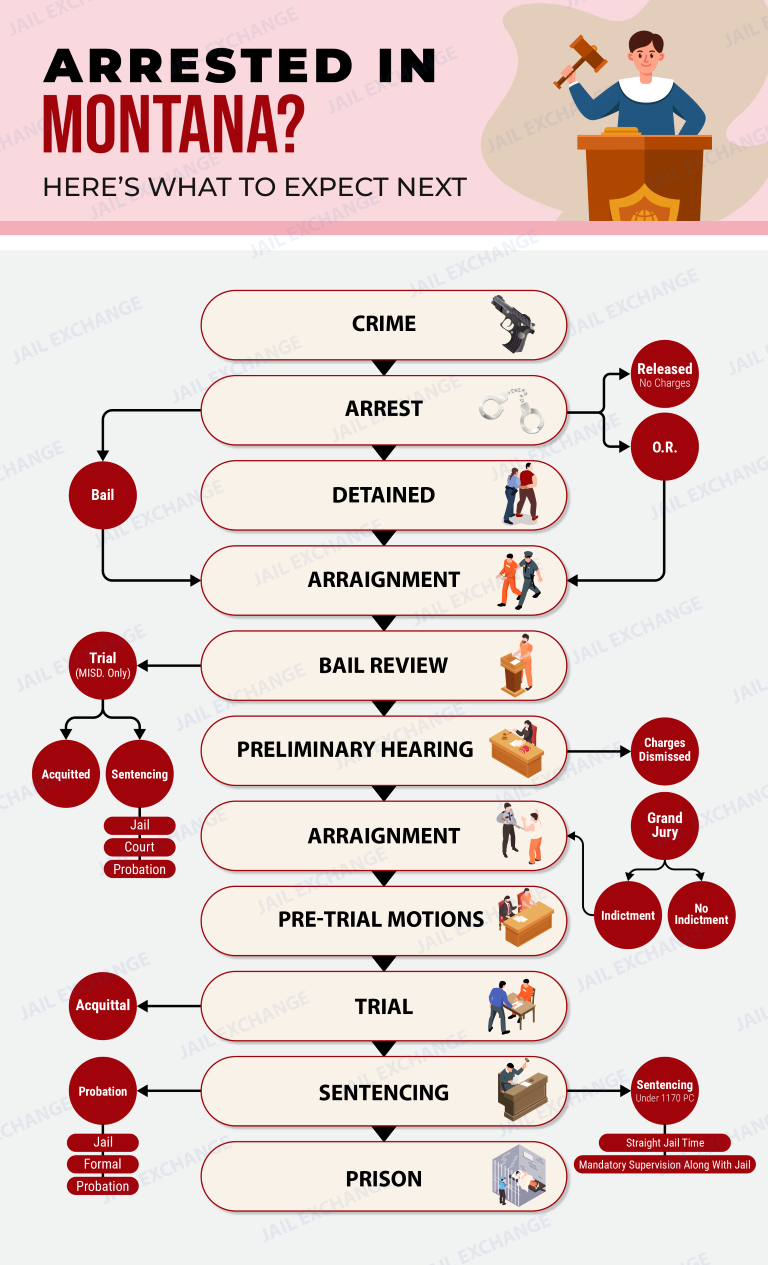
The State of Montana prosecutes most felonies on the Flathead Reservation under Public Law 280, so a felony arrest in Lake County, whether in Polson, Pablo, Ronan or Arlee, usually ends up in the Twentieth Judicial District Court. The case moves through these stages.
First, the defendant appears before a judge, usually the Lake County justice of the peace, who explains the charge, sets bail and conditions, and takes the public defender application. The defendant does not plead at this hearing.
Next, the Lake County Attorney presents a sworn affidavit and seeks permission to file an Information. A Twentieth Judicial District judge reviews the affidavit, and if it establishes probable cause, the Information is filed. Grand juries are rarely used.
At arraignment in Polson's district court, the defendant pleads and can ask to have bail reconsidered. An omnibus hearing follows to handle discovery, notice of defenses and witnesses, and deadlines for motions, such as a motion to suppress evidence from a search.
Finally, the case resolves by plea agreement, which is how most end, or by a jury trial in which all 12 jurors must agree. Courts evaluate speedy trial claims through a balancing test, and a delay beyond 200 days receives closer scrutiny. The Polson public defender office continues with eligible clients throughout.
Sentencing exposure
- Theft over $1,500: a maximum of 10 years and $50,000.
- Burglary: up to 20 years and $50,000; aggravated burglary carries up to 40 years.
- Aggravated assault: from 2 years up to 20, and a fine that may reach $50,000.
- Criminal distribution of dangerous drugs: lengthy prison exposure, especially with fentanyl, methamphetamine or a record.
Most felony sentencings follow a presentence investigation. A Twentieth District judge may hand the defendant to Corrections for placement, with the department choosing among prison, prerelease and community supervision; can order a term in a state prison; or can suspend or defer the sentence and impose probation. A first offender who completes a deferred imposition of sentence can have the felony dismissed. Parole can usually be considered once a quarter of the prison term is served. Felony cases in Lake County typically take six to twelve months.
Violent felony (for example, deliberate homicide, sexual intercourse without consent, robbery)
Violent crimes in Lake County are charged by Information in the Twentieth Judicial District Court in Polson, and a serious offense on the reservation involving a Native American may also draw federal prosecutors. Bail in these cases is usually high, and many defendants remain in the Lake County Jail until the case is resolved.
A deliberate homicide conviction in Lake County can lead to execution, a life sentence or a prison term between 10 and 100 years, although Montana's last execution was carried out in 2006. The mitigated form of deliberate homicide is punished by a term of 2 to 40 years. For sexual intercourse without consent, the penalty is life or 2 to 100 years, turning on the facts, and certain versions bring mandatory minimums. Robbery brings 2 to 40 years and fines that can reach $50,000. A weapon used in any of these crimes can mean 2 to 10 more years.
Montana statutes give victims the right to hear about upcoming proceedings and to speak before the judge imposes a sentence. The State Public Defender's Polson office, or a conflict lawyer when necessary, represents defendants who qualify. One to two years is common for these cases, and forensic or expert-heavy prosecutions can run longer.
Juveniles (under 18) arrested in Lake County
Most youth offenses in Lake County are handled by the Youth Court of the Twentieth Judicial District under the Montana Youth Court Act. Juvenile probation officers review each referral and often resolve a first or lower-level offense informally, through conditions like restitution, community service or counseling that the youth and parents agree to. A formal case begins with a Youth Court petition from the Lake County Attorney, and an eligible youth is assigned a lawyer through the State Public Defender's Polson office. Tribal youth may instead be handled by the Confederated Salish and Kootenai Tribes' juvenile court.
Lake County does not run its own youth detention center. When a young person must be held, the youth is typically transported out of county to a licensed regional juvenile facility, Missoula County's being the most likely, rather than kept in the adult jail in Polson. Within 24 hours of placement, not counting Saturdays, Sundays and holidays, a judge must hold a detention hearing.
Possible Youth Court outcomes are probation, treatment, a foster or residential placement, or a Department of Corrections commitment; boys committed to the state may end up at Pine Hills, across the state in Miles City. Adult court is limited to the most serious accusations and requires a request from the County Attorney; a 12-year-old can be moved there only for crimes like deliberate homicide, while 16- and 17-year-olds face a longer list.
Federal cases (U.S. District Court) from Lake County
Lake County is in the Missoula Division of the U.S. District Court for the District of Montana. Federal criminal cases from Polson, Ronan, St. Ignatius and the rest of the county are heard roughly 70 miles to the south, in the Russell E. Smith Courthouse on East Broadway in Missoula (street address No. 201, mail to ZIP 59807), (406) 542-7260. Appeals go to the Ninth Circuit.
The Flathead Reservation. Criminal jurisdiction on the Flathead Reservation works differently from Montana's other reservations. Because of Public Law 280, most felony prosecutions there are brought by the State of Montana, while the Confederated Salish and Kootenai Tribal Court handles many misdemeanors involving tribal members. Federal prosecutors can still bring cases involving Native American defendants or victims under federal law, and the arrangements have been the subject of ongoing negotiation among the Tribes, the State and Lake County, so the court that hears a particular case can vary.
Other routes to federal court. Drug trafficking, illegal guns, fraud and online child exploitation cases investigated by federal agents, including the FBI, DEA and ATF, regularly end up in Missoula. A case begun by Lake County deputies or tribal police can be picked up by federal prosecutors, and one act can produce both state and federal charges.
Who handles the case. Prosecutors from the U.S. Attorney's Missoula office, (406) 542-8851, bring the charges. Defendants who cannot hire counsel usually get a federal defender from the Missoula office, or a CJA panel lawyer in a conflict. Prisoners are the responsibility of the U.S. Marshals Service's Missoula office, (406) 317-0400.
The process. A Lake County federal defendant's first court date is in front of a U.S. magistrate judge. Should prosecutors seek pretrial detention, the hearing on that request generally comes within three court days, ending in either detention or release under conditions that U.S. Probation and Pretrial Services monitors; there are no bail bonds in federal court. Cases started by complaint must be taken to a grand jury and indicted within 30 days, then arraigned. The 70-day Speedy Trial Act deadline is commonly extended, and the large majority of defendants accept plea agreements; at a trial, all 12 jurors must agree. A Missoula federal judge reads a presentence report, consults the advisory guidelines and applies any mandatory minimum before sentencing. With no parole available, federal prisoners in the Bureau of Prisons complete roughly 85% or more of their sentences, followed by supervised release.
Finding someone in federal custody. Contract jails across Montana hold federal pretrial detainees, with the Marshals choosing the location, which can be a long way from Polson; the Missoula Marshals office can tell relatives where. After sentencing, search the person's name in the Bureau of Prisons inmate locator. Federal juvenile prosecutions are rare, though they can arise from reservation cases.
Treat this Lake County guide as background only, not legal advice, and jurisdiction on the Flathead Reservation can turn on facts specific to each case. If you are charged in Lake County, consult a defense lawyer or apply for a public defender through the Polson office, reachable at (406) 883-6080. The Clerk of District Court in Polson can be reached at (406) 883-7254.