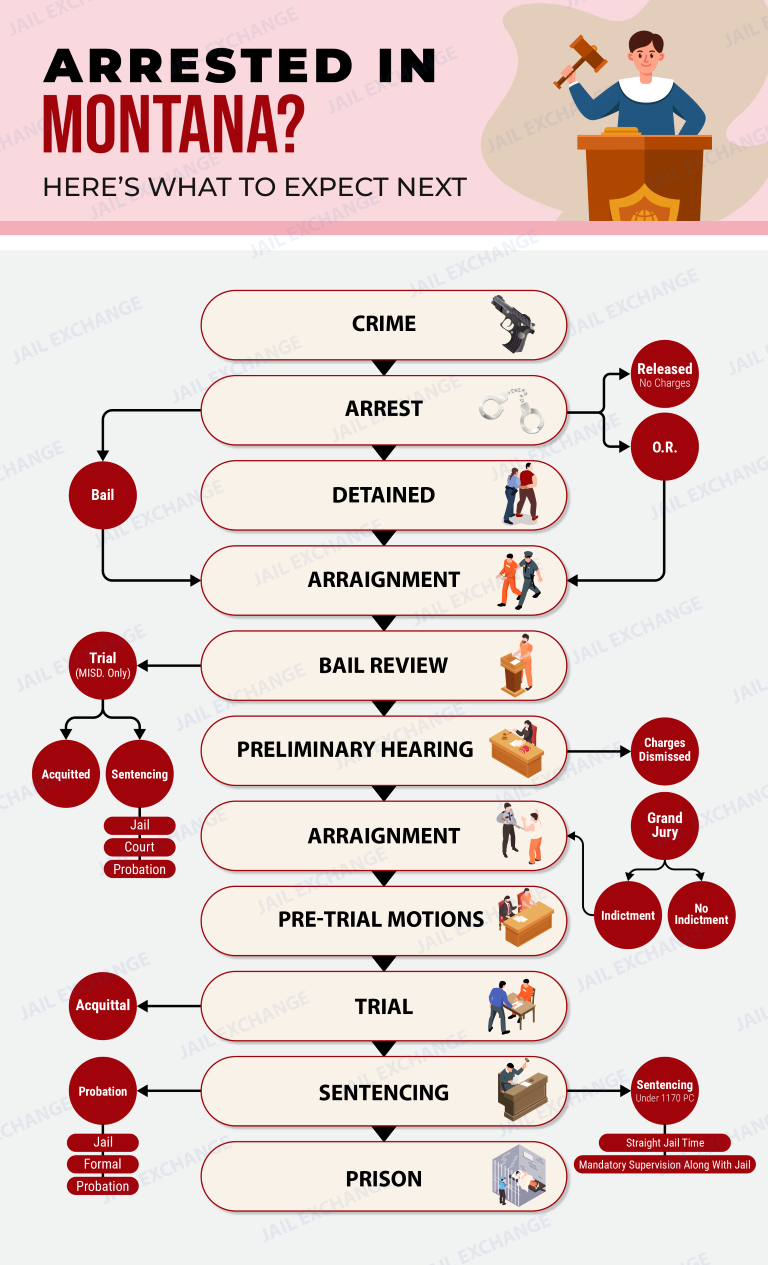
Ravalli County Detention Center Criminal Court Process
Criminal Court Process for Ravalli County Montana
Hamilton is the county seat of Ravalli County, and nearly every criminal case in the Bitterroot Valley runs through the county courthouse complex on Bedford Street there. Misdemeanors and DUIs go to Ravalli County Justice Court, or to a city court when the offense happened inside Hamilton, Stevensville or Darby, while felonies belong to the Twenty-First Judicial District Court, whose territory is Ravalli County alone. Bitterroot felonies, youth petitions and justice court misdemeanors are all charged by the elected Ravalli County Attorney. Anyone held after an arrest in the valley is booked into the Ravalli County Adult Detention Center, which the Sheriff runs on that same Bedford Street block.
- Ravalli County Justice Court, Department 1, 205 Bedford Street, Suite E, Hamilton, MT 59840, (406) 375-6755
- Ravalli County Justice Court, Department 2, 205 Bedford Street, Suite F, Hamilton, MT 59840, (406) 375-6765
- City courts in Hamilton, Stevensville and Darby hear offenses charged inside those towns
- Clerk of District Court (Twenty-First Judicial District), 205 Bedford Street, Suite D, Hamilton, MT 59840, (406) 375-6710
- Ravalli County Attorney, 205 Bedford Street, Suite C, Hamilton, MT 59840, (406) 375-6750
- Montana Office of the State Public Defender, Missoula regional office (serving Ravalli County), 610 N. Woody Street, Missoula, MT 59802, (406) 523-5140
- Ravalli County Adult Detention Center (Ravalli County Sheriff's Office), 205 Bedford Street, Suite I, Hamilton, MT 59840 (entrance on Madison), (406) 375-4080; Sheriff's Office (406) 375-4060
Which court hears your case. In Ravalli County the type of charge and the place it happened decide the courtroom. Bitterroot misdemeanors, such as shoplifting, a first DUI, a partner or family member assault charge, or criminal trespass, are filed in Ravalli County Justice Court when they happened on a county road or anywhere outside a town, and in Hamilton City Court, Stevensville City Court or Darby City Court when they happened within that town; city cases are prosecuted by the city attorney. A Ravalli felony usually opens with a hearing before one of Hamilton's two justices of the peace and climbs to the Twenty-First Judicial District Court after the County Attorney persuades a district judge in Hamilton to allow an Information. A grand jury indictment is possible in Montana but almost never used in the Bitterroot.
Where pretrial detainees are held. Someone who is arrested anywhere from Florence to West Fork and is not released is held at the Ravalli County Adult Detention Center, 205 Bedford Street, Suite I, in Hamilton, a short walk from the justice and district courtrooms. The detention center can be reached at (406) 375-4080, and it takes full cash bond payments by card; questions about a surety bond go to a commercial bondsman. People stay there until they post bail, are released by a judge, or their case ends.
- Courthouses and courtrooms in Ravalli County
- What happens after an arrest in the Bitterroot
- The Ravalli County Adult Detention Center
- Public defender in Ravalli County
- The County Attorney, plea offers and diversion
- Treatment courts and supervision options
- Misdemeanor (for example, theft, a first DUI, partner or family member assault, criminal trespass)
- Felony (for example, burglary, felony theft, drug distribution, aggravated assault)
- Violent felony (for example, deliberate homicide, sexual intercourse without consent, robbery)
- Juveniles (under 18) arrested in Ravalli County
- Federal cases (U.S. District Court) from Ravalli County
Courthouses and courtrooms in Ravalli County
Most of the county's criminal business happens inside one building complex at 205 Bedford Street in Hamilton. The suites are labeled by letter, and knowing which one you need saves a lot of walking around:
- Suites A and B, Twenty-First Judicial District Court. Two district judges sit in Hamilton, each in a numbered department. Felony arraignments, omnibus hearings, jury trials, sentencings and youth court hearings happen here.
- Suite C, Ravalli County Attorney. Deputy county attorneys handle the charging decisions and plea offers for justice court and district court.
- Suite D, Clerk of District Court. This office keeps the felony and youth court files, takes filings and can look up when a district court case is next on the calendar.
- Suites E and F, Justice Court. Ravalli County has two justices of the peace, each with a separate department and phone line, open weekdays from 9 a.m. to 5 p.m.
- Suites G and I, Sheriff's Office and Adult Detention Center. The jail's public entrance faces Madison Street.
The city courts are separate. Hamilton City Court handles misdemeanors and ordinance violations cited by Hamilton police, and the towns of Stevensville and Darby each run their own small city court. If your ticket lists a city court, contact that court, not the justice court on Bedford Street, because the two systems do not share calendars.
What happens after an arrest in the Bitterroot
An arrest might be made by a Ravalli County deputy, Hamilton or Stevensville police, the Montana Highway Patrol or a game warden, but nearly everyone taken into custody ends up at the same booking desk in Hamilton.
- Booking. Staff record identifying information, take fingerprints and a photograph, inventory property and run a records check. Someone arrested on a warrant from another county may be held for pickup.
- Bail from the schedule. Many misdemeanors carry a preset bail amount that can be posted on the spot with cash, or a Montana-licensed bondsman can be hired to post it. Partner or family member assault and some DUI arrests usually require a judge to see the person first.
- Initial appearance. Montana requires that a jailed person reach a judge "without unnecessary delay," and in Hamilton that generally happens inside about 48 hours, usually in justice court, either in person or by video from the detention center.
- Release decision. The Ravalli justice of the peace chooses among release on recognizance, a cash or surety bond, and added conditions such as staying away from an alleged victim, abstaining from alcohol, or 24/7 sobriety testing, which means twice-daily breath tests or a monitoring device.
- Next steps. Misdemeanors stay in justice or city court. A Bitterroot felony sits in justice court only until the County Attorney files papers seeking leave to charge it by Information in the Twenty-First Judicial District Court.
Families looking for someone should call the detention center at (406) 375-4080 to confirm custody and the bail amount.
The Ravalli County Adult Detention Center
The county's jail sits within the courthouse complex at 205 Bedford Street, Suite I, and is run by the Ravalli County Sheriff's Office. It holds people awaiting trial, people serving short local sentences, and people held for other agencies.
Posting bail
A full cash bond can be paid by credit or debit card through the Sheriff's online payment portal, or at the facility. For a surety bond, which costs a nonrefundable premium, families deal directly with a bondsman. Once bail is posted, the person is released with a written court date and any conditions the judge set.
Visits
The detention center offers both video visitation and scheduled in-person visits in set time blocks. Each visitor is limited to one 20-minute visit per day, visits are first come, first served, and a sign-up sheet is kept in the lobby on visiting days. Call ahead, because schedules change.
Who else may be there
Besides Ravalli County cases, the facility may hold people on state probation and parole holds or people arrested on warrants from elsewhere in Montana. Federal detainees are placed wherever the U.S. Marshals choose, which may or may not be Hamilton.
Public defender in Ravalli County
Ravalli County is part of the state public defender's Missoula region, and public defenders also work out of Hamilton. The regional office is at 610 N. Woody Street, Missoula, (406) 523-5140.
The process is straightforward. When you first appear before a Ravalli judge, explain that you cannot pay for a lawyer and want one appointed. You will fill out an application listing income, assets and household size, and if you qualify the judge orders the public defender's office to assign counsel. A Hamilton justice court case, a city court case, a felony in the Twenty-First Judicial District and a youth court case all qualify if jail is possible. At the end of the case, the judge can order a person who has the means to repay part of the cost of representation.
Bring every letter and court paper you receive to your appointed attorney, and keep your phone number and address current with the office, because missed contact is a common reason hearings go badly.
The County Attorney, plea offers and diversion
The Ravalli County Attorney's Office, Suite C on Bedford Street, (406) 375-6750, decides which charges are filed, whether a felony goes forward or is reduced, and what plea offer is made. Its deputies appear in both Ravalli County Justice Court and district court.
Prosecutors in Montana have several tools short of a conviction and prison. A deferred prosecution agreement can pause a charge while the defendant completes conditions, and a deferred imposition of sentence lets a first-time felony offender have the charge dismissed after a period of probation is completed without violations. For misdemeanors, a suspended sentence with fines, classes and a period of good behavior is the most common result. Whether any of these is offered depends on the charge, any prior record and the alleged victim's views.
The office also includes a victim-witness program. Under Montana statutes, people harmed by a Bitterroot crime are entitled to hear about major court dates and to speak before the sentence.
Treatment courts and supervision options
Montana uses treatment courts, such as drug courts, DUI courts and veterans courts, in many judicial districts. These programs replace a standard sentence with frequent court check-ins, drug and alcohol testing, counseling and graduated sanctions, and they typically last a year or more. Ask your attorney whether the Twenty-First Judicial District or a Ravalli County court currently operates one and whether your charge would qualify.
Outside a formal treatment court, judges in Hamilton commonly use conditions of release and probation that serve the same purpose:
- 24/7 sobriety testing for alcohol-related charges, paid for by the participant;
- chemical dependency evaluations and the treatment they recommend;
- anger management or batterer intervention classes in partner assault cases;
- supervision by Montana Department of Corrections probation and parole officers for felonies.
Misdemeanor (for example, theft, a first DUI, partner or family member assault, criminal trespass)
Misdemeanors are the bulk of the caseload in Ravalli County Justice Court and in the Hamilton, Stevensville and Darby city courts. Many begin with a citation and a mailed or printed court date rather than a trip to the detention center.
The first hearing
At arraignment the Bitterroot justice of the peace or city judge goes over the accusation, your rights and the worst-case penalty, then asks how you plead. Pleading not guilty puts the Ravalli case on the calendar for a pretrial conference, and a trial follows only if no deal is struck. A defendant can ask for a jury of six; otherwise the judge decides. Because most of these courts do not keep a verbatim record, a person convicted there generally can appeal to the Twenty-First Judicial District Court and get a fresh trial.
What a Ravalli County misdemeanor can cost
- Petty theft (Ravalli, $1,500 or under): the cap is half a year in the Hamilton jail plus a fine as high as $1,500, and restitution is usually ordered as well.
- First DUI in the Bitterroot: a jail range from one day up to six months (judges may suspend some of it), a $600–$1,000 fine, Montana's ACT alcohol-information class, and a six-month Ravalli-imposed loss of driving privileges, softened in many cases by a probationary permit. Ravalli prosecutors charge aggravated DUI when a test shows .16 or higher or certain refusals are involved, and the terms are stiffer.
- Partner or family member assault, first time: no less than 24 hours and as much as one year behind bars, a fine set between $100 and $1,000, and a counseling program the Bitterroot judge selects. A third conviction is a felony that goes to district court.
- Criminal trespass and similar offenses: generally up to 6 months and $500 in Ravalli County, though a few statutes set different limits.
Judges in Hamilton routinely suspend or defer much of a misdemeanor sentence in exchange for conditions. Request a public defender from the Missoula regional office, (406) 523-5140, at your first appearance if you face possible jail. In the Bitterroot most of these cases close one to four months after the citation.
Felony (for example, burglary, felony theft, drug distribution, aggravated assault)
A felony arrest in Ravalli County moves through two courts. The first appearance and bail setting usually happen in justice court in Hamilton; everything after that happens in the Twenty-First Judicial District Court.
From justice court to district court
Ravalli prosecutors ask the district court, by written motion, for permission to file an Information, attaching a sworn affidavit that lays out the evidence. A district judge reviews it and grants leave only if it shows probable cause. That paper review replaces the preliminary hearing in most Ravalli County felonies.
Arraignment and the omnibus hearing
At the Hamilton district court arraignment the accused answers the Information with a plea and the judge revisits bail. The omnibus hearing follows weeks later, and it is where the defense lists its motions, such as challenges to a search, and both sides set deadlines for evidence and witnesses. A trial date is usually set at the same time.
Plea or trial
Most felony cases in Hamilton end in a plea agreement. If the case is tried, twelve Bitterroot residents sit as jurors and every one of them must agree on the verdict. Montana courts weigh a speedy-trial complaint by balancing several factors, and once roughly 200 days have passed the judge looks harder at who caused the delay.
Possible outcomes in the Twenty-First District
- Felony theft, Ravalli County: property above $1,500 can mean up to ten Deer Lodge years and $50,000 in fines.
- Burglary, Ravalli County: as many as 20 years plus $50,000, and twice that prison ceiling, 40 years, when the burglary is aggravated.
- Aggravated assault, Ravalli County: a Bitterroot judge must pick a term between 2 and 20 years and may fine up to $50,000.
- Drug distribution, Ravalli County: exposure depends on the substance and the defendant's history and can reach very long prison terms.
A Hamilton district judge may defer imposition of sentence, suspend some or all of it, or send the person to the custody of the state corrections department, whose staff choose among prison, prerelease and community placement. A straight sentence to the men's prison at Deer Lodge or the women's prison in Billings is also possible. Parole eligibility typically comes after roughly a quarter of the term. Felony defendants qualify for the state public defender, (406) 523-5140. Bitterroot felony files usually stay open six to twelve months before a plea or verdict.
Violent felony (for example, deliberate homicide, sexual intercourse without consent, robbery)
The most serious cases filed by the Ravalli County Attorney follow the same district court path, but judges in Hamilton tend to set bail very high, so many of these defendants wait out the case in the Bedford Street detention center. Expert witnesses, forensic testing and psychological evaluations stretch the schedule.
- Deliberate homicide in Ravalli County: the court may impose death, a life term, or anywhere from 10 to 100 years. Capital punishment remains on Montana's books, yet the state's last execution was carried out in 2006.
- Mitigated deliberate homicide in Ravalli County: Hamilton juries convicting on this lesser count expose the defendant to 2–40 years.
- Sexual intercourse without consent in Ravalli County: a possible life sentence, or a Ravalli term somewhere between 2 and 100 years shaped by the victim's age, injuries and other facts; certain aggravating circumstances trigger a mandatory minimum.
- Robbery in Ravalli County: from 2 years to 40, along with a fine as large as $50,000.
- Use of a weapon: Montana's enhancement statute lets the Hamilton court stack 2–10 extra years on top.
Montana statutes guarantee Bitterroot crime victims advance word of key Hamilton hearings and the opportunity to tell the district judge how the crime affected them. The public defender assigns experienced attorneys to these cases. Expect a year to two years or more before trial or plea in the Twenty-First Judicial District.
Juveniles (under 18) arrested in Ravalli County
A youth arrested in Ravalli County is handled under the Montana Youth Court Act by the Youth Court, which is part of the Twenty-First Judicial District Court in Hamilton. The goal is rehabilitation and accountability, and proceedings are generally closed to the public.
Juvenile probation officers do the intake. For a first or minor offense they often settle the matter informally, with a written agreement calling for things like repaying the victim, volunteer work hours or counseling, and no petition is ever filed. When a formal case is needed, the Ravalli County Attorney brings a youth court petition in Hamilton, and the young person is appointed a lawyer through the public defender's Missoula regional office, (406) 523-5140.
When a Bitterroot youth has to be locked up before a hearing, deputies generally drive him or her north to a regional facility, for example Missoula County's juvenile detention facility (reachable around the clock at (406) 258-4054). The youth court must then hold a detention hearing quickly, as a rule within 24 hours, Saturdays, Sundays and legal holidays aside. Ravalli boys whom the court commits to state custody can end up at Pine Hills Youth Correctional Facility, the Department of Corrections' youth facility in Miles City.
Some cases can be moved to adult court. Montana law lets the Ravalli County Attorney ask to charge a child in district court at age 12 or older when the accusation is among the gravest, deliberate homicide for instance, and at 16 or older across a wider list of serious felonies. Those cases then proceed much like adult felonies.
Federal cases (U.S. District Court) from Ravalli County
When the United States charges a crime from the Bitterroot, the case lands in Missoula: Ravalli is one of eight western counties assigned to that federal division, which meets on East Broadway in the Russell E. Smith Courthouse, number 201 (mailing ZIP 59807); the clerk's number is (406) 542-7260. That is about an hour north of Hamilton.
How a Ravalli County matter becomes federal
National forest covers much of Ravalli County, so Forest Service law enforcement officers make some federal cases there, for example on timber, fire, resource damage or assaults on federal land. Others come from the FBI, DEA, ATF or Homeland Security Investigations: large drug distribution cases, firearm possession by someone with a felony record, child exploitation, and fraud. A case that began with a Ravalli County deputy can be adopted by federal prosecutors.
The offices involved
- Prosecutor: the Missoula branch of the U.S. Attorney's Office for Montana, (406) 542-8851.
- Defense for Bitterroot residents who cannot pay: the Missoula office of Federal Defenders of Montana, or a CJA panel lawyer when that office has a conflict.
- Custody: U.S. Marshals Service, Missoula, (406) 317-0400.
Steps in a federal case
A Hamilton-area defendant charged federally is first brought before a U.S. magistrate judge in Missoula. Should prosecutors ask that the person stay locked up, the magistrate typically takes up that request within three court days. Under federal bail law the Missoula magistrate has just two choices, and no bondsman is involved: send the Ravalli defendant home on conditions that federal pretrial officers enforce, or keep the person locked up pending trial. When the charge began as a complaint, prosecutors must secure a grand jury indictment no later than 30 days after the arrest, after which the Ravalli defendant is arraigned. The 70-day trial clock in the Speedy Trial Act is extended more often than not. Most Bitterroot federal defendants plead guilty under an agreement; if one goes to trial, twelve jurors must vote unanimously. After a probation officer writes the presentence report, the Missoula judge weighs the advisory sentencing guideline range, plus any statutory minimum, and imposes sentence. Federal parole was abolished, so a Bitterroot defendant sent to federal prison should expect to serve close to 85% of the sentence, at minimum, before a period of supervised release starts. Any appeal goes to the Ninth Circuit Court of Appeals in San Francisco.
The Missoula Marshals office decides which contract jail houses a Ravalli County federal detainee, sometimes hours away from the Bitterroot; relatives should call that office to learn the location. Once a sentence has been imposed, the Bureau of Prisons inmate locator will show which federal prison holds the Ravalli defendant. U.S. prosecutors rarely bring a case against anyone under 18.
This Ravalli County guide gives general background on Bitterroot criminal cases and should not be read as legal advice about any one person's case. A private defense lawyer can review your case, or a Hamilton judge can appoint counsel through the public defender's Missoula regional office, (406) 523-5140; the Clerk of District Court in Hamilton can be reached at (406) 375-6710.
Criminal Court Process for Ravalli County Montana
Ravalli County Montana Criminal Court System - Definitions
It might be helpful to define some words that will be used on this site, when explaining the Montana, Ravalli County Court System and how it works. The definitions on this site are for general information and not legal advice. It is always preferred to follow information given by your attorney or local authorities.
If you scroll down below this content, and the listing of the courts in Ravalli County, you will find a simple flowchart diagram and a video that will help you visualize the stages of the Criminal Court Process.
Arrest is when Montana, Ravalli County, or local police take a person into custody and start the legal process. The arrested person may or may not be immediately jailed.
In less serious crimes, the person may only be given a citation ordering that they appear in municipal or Ravalli County court on a certain date. In cases involving more serious crimes, the person is usually placed in Ravalli County jail until an arraignment, or a judge decides the next step.
Booking is when the sheriff or local police gather information such as the detainee’s name, address and why the person is being arrested. Booking also includes fingerprinting, criminal history, investigation and verification of identity. Bail for lower-level crimes may be set right after booking so the arrested has the opportunity to “bail or bond out” before being detained.
The prosecution, sometimes called “the government” or “the people” or “the state” is the side that press the charges and seeks punishment for the offense. These are attorneys that work for the state of Montana, Ravalli County or a city or town. The prosecuting attorney for the county or the district is called the County Attorney. A U.S. Attorney prosecutes federal cases.
Jurisdiction is an important term in the court system that means whether a court has the obligation or duty or right to handle a case. For example, if you run a red light in your town or city, a municipal court would likely have jurisdiction over your case, but the next town or city over would not have jurisdiction over your case. If you attempted to flee from police when they attempted to stop you after you ran the red light, it becomes a more serious crime, and the municipal court might not have jurisdiction so you might be assigned to a higher-level court that has jurisdiction over the more serious crime. Jurisdiction varies from state to state and sometimes county to county.
Arraignment is when a judge determines whether or not the charges are supported by the prosecution’s initial evidence and tells the arrested what they are charged with, and the person says whether they are guilty or not guilty. At this time, the person is called the defendant, and the opposing side is called the prosecution. If there is reason to believe that the arrested is guilty, the judge will set bail conditions or send the defendant to jail or release them ROR (release on recognizances). An arraignment is not a trial, and the defendant is entitled to a trial within a reasonable amount of time after the arraignment.
Bail is money paid that is held by the county or municipal court to make sure that the arrested does not flee the area before their trial. Bail amounts and other conditions are determined at the arraignment. Once the case is over, the bail money is returned to the defendant. If a person does not pay bail, they remain in jail until their trial.
Bail can be denied if the court feels that the arrested would be a danger to others if released. Sometimes the court decides that there is a good chance that the arrested will show up for trial and not flee so they are released on their own promise, or recognizance without having to pay bail.
A bond proceeding is the determination of how much bail is to be paid and usually happens at the same time as an arraignment. During bond proceedings, the defendant can have an attorney present but does not have the right to an attorney. Jailors, law enforcement and prosecutors generally do not have authority to set bail. A judge or court officer in Ravalli County or municipal court sets bail. Judges in Montana rely on a statewide bail schedule, which sets out a recommended range of bail amounts for different offenses. Judges can still exercise discretion in setting bail above or below the recommended range.
It is always important to have family involvement after being arrested. Not only can they make calls and communicate on your behalf (not all bond companies will accept collect calls), but family support will show the court that there are people who will make sure that the defendant makes it to court, not only for the defendant’s own good, but because they may have signed bond paperwork and responsible to pay if the defendant does not show in court. Chances of obtaining a bond from a bond company or clerk of court are better if family is involved.
(There have been phone scams to where a bond company calls and informs a person that their family member has been arrested and they ask for financial information. A bondsman will not call asking for money without involvement of the arrested.)
Montana permits five types of bonds:
• By a deposit with the court of an amount equal to the required bail of cash, stocks, bonds, certificates of deposit, or other personal property approved by the court.
• By pledging real estate situated within the state with an unencumbered equity, not exempt, owned by the defendant or sureties at a value double the amount of the required bail.
• By posting a written undertaking executed by the defendant and by two sufficient sureties.
• By posting a commercial surety bond executed by the defendant and by a qualified agent for and on behalf of the surety company.
• By posting an offender's driver's license in lieu of bail if the summons describes a violation of any offense as provided in 61-5-214 and if the offender is the holder of an unexpired driver's license.”
A criminal defense attorney (also called lawyer or counsel) is hired or retained to represent the arrested as early as possible after the arrest.
If there is a chance that the case might go to trial and the defendant cannot afford an attorney, the 6th Amendment of the U.S. Constitution requires that the court provide an attorney. This is called indigent representation and a public defender or assigned attorney would represent the defendant in all proceedings. Indigent representation is only available misdemeanor and felony cases that could result in jail time, juvenile cases and certain appeal cases.
The Montana Office of the State Public Defender manages the indigent cases. Most of Montana is served by contracted attorneys and there are full time public defenders for the more populated areas. There is a $250 fee for misdemeanor cases and an $800 fee for felony cases. That’s if the person decides to plead guilty. If instead they choose to go to trial, they “shall” pay the cost to the state for their public defender’s work throughout trial. Many times, the public defender will make a motion to the court to drop the fees.
For less serious cases or civil cases, there are pro bono volunteers who volunteer legal services for free or for a small fee. They often will hold clinics to teach people how to represent themselves in court or expunge their record which means to legally erase or eliminate a criminal or arrest record from public view. This website provides contact information for pro bono services in Montana.
Many courts will provide forms and help for people who want to represent themselves, called pro se. Here is a link for legal self-help centers.
A district court can refer to the first level of the legal system, or a minor court. District courts are located in the community. A district court can also refer to a U.S. Federal District Court that hears federal cases. There is one U.S. federal district court in Montana, with offices throughout the state. It is important that you check the address of the court you are to appear in rather than to ask someone because that person might give you directions to the wrong “district” court. Being late to court can land you in custody as well.
Pretrial proceeding is the process where both sides (prosecution and defense) gather information, interview witnesses, request records, videos etc. Pretrial proceedings also include communications with the judge assigned to the case and these appearances are either in person or by on-line conferencing. Some pretrial proceedings may not require a defendant’s appearance, allowing an attorney to appear in their place. The information that is gathered is called discovery and both sides must share the information that they have gathered. This information does not include conversations between the arrested and their attorney.
Most cases do not go to trial because both sides reach a plea deal, where both sides try to reach a reasonable punishment based on what was learned in the pretrial proceedings. A plea deal can only happen if the accused person admits they are guilty in exchange for a lighter punishment. The reason they must admit guilt is because it would not be fair to punish someone who claims they are not guilty. There are times in plea bargaining when the prosecution agrees to give a lighter sentence in exchange for information leading to the arrest of more serious criminal related to the crime.
Trial is where both sides share their information in front of a judge or a judge and jury. After listening to all the evidence, the judge or jury decides the verdict which is whether if the person is guilty or not guilty. If a court has only a judge hearing both sides, it is called a bench trial. If a jury is selected, it is called a jury trial. If the defendant is found non-guilty, they are released. If they are found to be guilty, the next step is sentencing.
Sentencing is the punishment that the judge decides the person should get. This could be jail or prison time, fines, community service, probation, or a combination.
Appeal is asking for a higher court to hear the case again at an appellate court. If the accused person thinks something went wrong at trial or has new information that was not available during the trial or that the sentence is too harsh, the defense attorney can ask for an appeal. It is not unusual for an appeal when there is a long jail sentence, but an appeal can be denied if the appellate court feels that the original trial or sentencing was fair.
In Montana, the law doesn’t lay out different classes or levels of misdemeanors. It simply lists the maximum possible sentencing penalty for each crime in the same section of code that defines the crime. In addition, it describes what constitutes criminal mischief and tells you the maximum possible fine and jail time for a conviction.
A felony crime is a more serious crime than a misdemeanor and are divided into different classes which are general guidelines and are based on the crime, prior criminal history and other factors. Examples of felony crimes are murder, rape, theft, aggravated assault, drug trafficking, kidnapping and identity theft. Just like misdemeanors, Montana doesn’t lay out different classes or levels of felonies. It simply lists the maximum possible sentencing penalty for each crime in the same section of code that defines the crime. In addition, it describes what constitutes criminal mischief and tells you the maximum possible fine and jail time for a conviction.
The Ravalli County Clerk of Court is an elected official whose responsibilities for Criminal Court’s administrative issues include receiving criminal warrants, receiving bail, creating the trial schedule, receiving fees, fines and maintaining court records.
A warrant is used to get someone to appear in court or to law enforcement. There must be good reason to believe that the person is involved in a crime. The warrant gives authority to arrest the person and search for evidence for the investigation of the crime.
A criminal summons is issued to request that a person appear in court at a particular time and date. It does not involve an arrest. A traffic ticket, summary citation or lesser misdemeanor could be considered a summons if you are given a court date.
A summary citation, commonly referred to as a ticket, is a criminal summons by a law enforcement officer either in person or via mail accusing the defendant of a minor offense, stating potential fine, listing the court having jurisdiction and instructions for addressing the issue. Defendants may or may not be required to appear in court or handle the matter by entering a plea via mail.
Fines are usually paid to the District Court or clerk of court and payment methods can be found on the District Court or Ravalli County County Clerk of Court website. If you do not pay your fine on time, you can lose your driver’s license, have to pay additional fees or even have a warrant for your arrest. It is important to read the instructions on the ticket issued by the police officer or court at the time of your arrest. For a parking ticket or summary citation, the fine amount and how to send payment should be on the ticket.
Montana Criminal Court System - How it Works
City courts and six Municipal courts handle violations of municipal ordinances (city laws), traffic violations, parking violations and criminal misdemeanor offenses that occur within the city or towns police jurisdiction.
Justice courts handle similar cases as municipal courts in regions that may not have municipal courts. These courts can issue search and arrest warrants for felony crimes.
Yellowstone County has both a municipal court and a justice court.
District courts will hear a misdemeanor only if it is contained within a larger case that also has felony counts. District courts process felony cases from beginning to end. They can hear appeals from the city, municipal and justice courts. Juvenile cases are heard in district court with a special court for Juvenile Justice.
Specialty courts or treatment courts are being adopted in many states as a way to handle cases that involve non-violent and first-time offender cases in a way to where the offender can retain a job or responsibilities while following specific orders of the court as returned court appearances, periodic evaluations or testing for substances. Find out more about Montana Specialty Courts.
There are no Courts of Appeals in Montana. Instead, the Montana Supreme Court can supervise cases from district courts.
The Montana Supreme Court is like our United States’ Supreme Court because it has a panel of judges that rule on matters that have to do with someone’s constitutional rights or policies and laws. The Montana State Supreme Court deals with the state constitution or laws or policies. Sometimes the Supreme Court will hear criminal cases on appeal when there is question on the state laws or procedures that lead to the appeal.
The criminal cases are usually referred from the district courts of appeal.
FEDERAL COURT
Federal Court deals with crimes involving violations of United States laws. Federal crimes include federal drug trafficking, federal tax evasion and fraud that crossed state lines and include crimes that occur on federal property as post offices or federal buildings.
Cases involving crimes that involve the FBI or DEA or Immigration agencies are federal crimes. Terrorism is a federal crime.
There are some differences in the Federal court system as compared to the Montana state court system. For example, the attorneys who work for the courts are called United States Attorneys and Federal judges are called District Court Judges (not to be confused by local state district courts).
Federal Magistrate Judges hear the case early on, but they do not decide on the cases at a trial like the Federal District Court Judges. In a federal case, a grand jury is used for indictments.
There is one U.S. Federal Judicial District in Montana.