
Madison County Jail
Madison County Jail
Jail Phone Number
402-454-1333Madison County Inmate Search: Finding and Contacting a Family Member
To find someone held in Madison County, begin with the Sheriff’s official inmate roster or call the jail at 402-454-1333. Check its run date and ask staff to confirm the person and current receiving facility.
The jail is attached to the courthouse at 1313 North Main Street, Madison, NE 68748. The Sheriff’s main office phone is 402-454-2110, separate from the jail inquiry line. Confirm custody and the correct service destination before visiting, sending mail or paying.
The questions below explain mugshots, warrants, calls, visits, mail, money and urgent family concerns. Our Bail guide covers release questions, while the Court guide covers Madison County case searches, clerk contacts and hearing locations.
Read inmate search answers
 Read inmate search answers
1. How do I find someone arrested in Madison County?
Open the official Madison County roster and check the run date. It includes jail ID, name, charge, disposition and bail fields, with booking and other case information. Fields may be blank or lag behind changes.
Call 402-454-1333 to confirm the person and receiving jail. A zero bail amount or empty field does not mean release is authorized. Booking is not a conviction.
2. What if I cannot find a recent arrest online?
Ask the department that made the arrest where officers took the person and whether another agency now has custody. For Madison County Jail assistance use 402-454-1333. Keep the event date, location, incident number and any brief family message available.
Booking, medical care and a transfer can make the first hours confusing. Do not infer release from a missing web entry or choose a destination simply because it is nearby. Follow the receiving agency’s information and ask for the name and phone number of any next holding facility.
3. Where is the Madison County jail, and which number should I call?
The published jail contact is 1313 North Main Street, Madison, NE 68748, 402-454-1333. Ask which jail currently holds the person. An office address, an older jail listing or a past housing agreement does not establish the individual’s current detention location.
For a visit, payment or property pickup, obtain the receiving jail’s directions, correct entrance, identification and appointment requirements. Do not treat courthouse office hours as a visiting schedule.
4. Can I see a mugshot or request an arrest report?
The official roster includes a Photo field, but it may be empty. A missing image does not establish that no booking occurred. Confirm the person and jail ID with staff.
For a mugshot or arrest report, ask the arresting agency about a public-record request, fees and restrictions. Norfolk Police records is at 402-844-2140. An image does not prove guilt, and juvenile records or defense evidence follow separate procedures.
5. How can I receive custody notifications?
Use Nebraska Victims of Crime Alert Portal (NEVCAP) to check the available registration options for the person and agency. The Nebraska Attorney General describes the service as free and confidential, with text and email notifications. Keep your registration details private and update a changed phone number or email address.
Read which events the registration covers. A notification is useful, but confirm the actual holding location with staff before driving, sending money or mailing a letter. Do not rely on a notification service as the only response to an immediate safety concern.
6. How do I find the bond amount and help with release?
Call 402-454-1333 and ask which case and order control release, the authorized bond form, the amount currently required and where payment is accepted. Ask whether another case, warrant or agency hold could prevent release after this bond is paid.
Our Madison County Bail guide explains percentage deposits and review of conditions; the Nebraska Bail guide gives statewide context. An inmate spending deposit does not pay a court bond. Save the receipt and written conditions, and get pickup instructions from staff after processing.
7. Where can I read the filed charges and court records?
Use the Nebraska Judicial Branch case-search services and match Madison County, the person and case number. Online one-time searches have a fee; the Judicial Branch also provides free courthouse-kiosk and law-library access. Check current prices and access terms before paying.
Booking information and the filed charge can differ. Read the latest docket entries and ask the clerk for the appropriate access route when a record is missing or restricted. A lawyer can explain what a charge change, dismissal or release condition means.
8. How can someone ask for a public defender?
Ask County Court at 402-454-3311, option 3, about applying for appointed counsel. The county directory lists the Public Defender at 402-454-3317. The court decides eligibility and appointment.
Give the case number, next hearing and actual jail location. A family inquiry does not appoint a lawyer or postpone a hearing. Ask how a detained applicant can submit financial information.
9. How do I arrange a visit?
The official visiting page lists onsite video visits Monday and Friday, 6–9 p.m., and Saturday and Sunday, 8:30–11 a.m., 1:30–4 p.m. and 6–9 p.m. Register at least 15 minutes before the scheduled session.
Call 402-454-1333 to confirm the person’s eligibility, session availability, ID and children’s documentation. Follow current dress and device restrictions. A transferred person follows the receiving jail’s rules.
10. How do I put money on an inmate’s account?
Ask the actual holding jail for its approved account-funding route, recipient identifier, accepted payment methods and current fees. If you do not know the receiving facility, start with the jail at 402-454-1333. Do not assume a service used by another county also applies here.
Our money page and commissary guide help distinguish spending money, goods and other purchases. A communication balance and a bond are separate transactions. Keep the receipt and recheck the receiving jail’s arrangements if the person moves.
11. How can I receive calls or send electronic messages?
Ask the holding jail at 402-454-1333 to confirm the current phone or video provider, registration route and services available for your relative. Verify the facility and recipient before adding funds. Read the current costs and protect your account details.
Our phone guide and electronic-contact page help you prepare. A paid account does not guarantee immediate contact. Ask staff separately how to report an urgent family concern and retain any service error when requesting provider support. Ordinary office calls may not be transferred to housing.
12. Where should I send a letter or photograph?
The official inmate-mail address is: inmate name, Madison County Jail, P.O. Box 209, Madison, NE 68748. Confirm the person is housed there and ask whether a jail ID or other label is required.
Check current return-address, screening, photo, publication and legal-mail instructions before sending. Do not use ordinary mail for an urgent medical or safety concern.
13. How can I collect belongings or deliver clothing?
Ask which agency holds the item and what authorization is required. Intake belongings, evidence, a vehicle and clothing needed for court may involve different employees or departments. Have the inventory or incident number ready and ask about identification, hours and appointment requirements.
Get an approved delivery list before buying clothing or bringing a bag. Permission to visit or provide a ride does not authorize collection of property or delivery of medicine. Keep the release paperwork and receipt, especially if another person collects items on the owner’s behalf.
14. How do I report medication needs or an urgent safety concern?
Call the actual holding jail promptly. For the Madison County Jail use 402-454-1333 and ask for the staff member responsible for medical or safety concerns. Identify the person clearly, explain the risk and leave a callback number. Ask how a clinician can securely supply prescriptions or relevant records.
Do not drop off medication without instructions. Staff may receive important information even when privacy limits what they can tell a relative. Keep medical details out of public posts. Call 911 for an emergency occurring outside the jail.
15. How can I check for a warrant in Madison County?
Ask the Madison County Jail at 402-454-1333 about its current warrant-verification procedure and identification requirements. A court docket may help identify an order, but an empty public search does not certify that no warrant exists.
Counsel can help identify the issuing court and the proper response to a missed hearing or surrender question. Keep separate case numbers when several counties or states are involved. Independently verify a caller’s demand for immediate payment through the published office contact, and keep any written order resolving the warrant.
16. Who can confirm the next court appearance?
Madison County Court is at 1313 North Main Street, Madison, NE 68748, 402-454-3311, option 3; mail goes to P.O. Box 230. The District Court clerk uses the same main number, extension 140, with mail to P.O. Box 249.
Specify the division and case number and confirm the hearing room and remote instructions. Release does not cancel a hearing, and a family call does not excuse attendance. Our Court guide explains records and hearings.
17. What if another jail is holding my relative?
Ask the jail at 402-454-1333 for the receiving jail, transfer time and booking number. A case filed in Madison County and detention elsewhere can involve different offices. An older agreement or past arrest report does not establish current custody.
Nearby counties include Antelope, Boone, Platte, Stanton, Wayne and Pierce. Use the Nebraska county jail directory after staff identify the receiver. Proximity or a past contract does not establish current placement. Recheck visiting, mail and account rules after a transfer.
18. Where do I look after a federal arrest?
Nebraska has one U.S. District Court district. The federal clerk’s Omaha office is at 111 South 18th Plaza, Suite 1152, Omaha, NE 68102, 402-661-7350; the Lincoln office is at 100 Centennial Mall North, Room 593, Lincoln, NE 68508, 402-437-1900. Follow the actual hearing notice.
Use the Bureau of Prisons locator for federal corrections records. A recent pretrial detainee may be in a contract jail rather than a federal prison. If the locator does not explain a recent arrest, ask the responsible federal agency or counsel about placement.
19. How can I find someone transferred to ICE?
Use the ICE detainee locator and follow its identity-search instructions. If a local jail reports an immigration transfer, ask which agency received the person and when. Do not assume that a state bond ends separate immigration proceedings.
An immigration detainer requests holding up to 48 hours after they would otherwise be released. Ask qualified counsel about the interaction of criminal and immigration matters. For agency documents, follow ICE’s records-request instructions.
20. How do I find someone in a Nebraska state prison?
Use the Nebraska Department of Correctional Services incarceration search. Compare identifying information and the reported facility, and retain the corrections number for future questions. A county booking number and a state corrections number serve different systems.
After confirming arrival, read the receiving prison’s current guidance for calls, visits, mail and money. A county visitor approval or service balance does not automatically carry over. Our Nebraska prison directory helps locate facility information.
21. How can a parent locate a detained child?
Ask Madison County Court at 402-454-3311 for the assigned juvenile-case contact. Identify yourself as the parent or guardian seeking placement, hearing and attorney information. An adult custody search does not locate every juvenile placement.
Confirm the actual housing facility through the assigned officer or attorney before traveling. A court office is not necessarily where the child stays. Ask which adults may visit and what identification or permission is needed. Keep hearing notices separate from placement and visitor instructions.
22. Which local department should I contact?
Norfolk Police is at 202 North 7th Street, Norfolk, NE 68701, 402-644-8700; its records number is 402-844-2140. Madison’s official city page lists Police at 402-454-3333; call for the correct office directions.
The county Sheriff is at 1313 North Main Street, Madison, 402-454-2110; jail inquiries use 402-454-1333. Ask the arresting agency where the person was booked. Use 911 for emergencies.
Madison County Bail and Bond: Helping a Relative Get Released
To help someone get released on a Madison County case, confirm the bond order and actual holding jail before paying. Call the jail at 402-454-1333 and ask which office can accept the particular bond and whether any other hold could prevent release.
A judge decides release conditions. Nebraska permits recognizance and other arrangements, including a percentage cash deposit when the order allows it. Read the order rather than assuming every case requires ten percent. County Court is at 402-454-3311; the District Court clerk is at 402-454-3311.
Confirm the receiving facility before traveling, mailing a letter or funding an account. Our Inmate Search guide helps locate someone, the Court guide explains hearings and records, and the Nebraska Bail guide explains statewide release rules.
1. Where do I post a Madison County bond?
The official Corrections page directs bond payments to the Madison County Sheriff’s Office and says correct change is preferred. Call the jail at 402-454-1333 to confirm the current amount, accepted method and entrance before paying.
Ask whether the bond order is in effect and whether another hold prevents release. A lobby ATM is not itself a bond-payment service, and an account deposit does not automatically pay a bond.
2. How big is the Madison County jail?
It has 120 beds and is attached to the courthouse in Madison, the county seat. Recording devices, including cell phones, are banned inside (Madison County Sheriff's Department corrections page).
3. How do I mail a letter to a Madison County inmate?
Inmate name, Madison County Jail, PO Box 209, Madison, NE 68748 (Madison County Sheriff's Department corrections page).
4. Who polices Newman Grove and Meadow Grove?
For an arrest in Newman Grove, Meadow Grove or rural Madison County, contact the Sheriff’s office on 402-454-2110. Jail inquiries go to 402-454-1333.
Ask which agency made the arrest and where officers delivered the person. Older town-service agreements do not establish current custody or release conditions. Confirm the receiving jail before traveling or paying.
5. Does a tribal service area change which court handles the case?
A tribal service area concerns access to services and does not by itself establish criminal jurisdiction over an arrest. Ask counsel which court has the case and which release order applies.
A Madison County state case, a federal case and a matter properly within tribal jurisdiction may follow different procedures. Do not assume tribal membership or residence automatically changes the court or bond rules.
6. Which court sets bond on a Madison misdemeanor?
Madison County Court in Madison. It hears misdemeanors and traffic cases, and it holds the first appearance and preliminary hearing in felony cases. Clerk: P.O. Box 230, Madison, NE 68748, 402-454-3311. The judge explains the release terms at that hearing (Neb. Rev. Stat. 29-901.06).
7. Where are Madison County felonies tried?
Madison County District Court, in the Seventh Judicial District (Neb. Rev. Stat. 24-301.02). Clerk: P.O. Box 249, Madison, NE 68748, 402-454-3311. A felony bond can be reviewed again there.
8. How is bail set after an arrest in Madison County?
A judge sets release conditions under Nebraska’s release statute, considering appearance, safety and the person’s ability to meet financial conditions. Some cases allow recognizance or nonfinancial conditions. Others require a deposit or another authorized bond form. Do not assume every amount shown online can be paid at ten percent.
Ask the jail at 402-454-1333 what the written order requires, which office accepts payment and whether any other hold prevents release. A bond schedule may apply to an eligible case, but it does not guarantee immediate release in every arrest.
9. How does the 10% deposit work for a bond set in Madison?
Nebraska has no commercial bail bondsmen. Bail is posted with the court or the jail, usually as a cash deposit. The judge sets a bond amount. You may post a deposit of up to 10% of that amount with the clerk, and never less than $25 (Neb. Rev. Stat. 29-901). On a $5,000 bond, the deposit is $500. When every court date is kept, 90% of the deposit comes back. The clerk keeps 10% of the deposit as a bond fee. That fee is 1% of the full bond, so $50 on a $5,000 bond, and you get $450 back.
These figures describe the statutory percentage appearance bond when that form is ordered. A different bond form, forfeiture or separate order can change the result. The statute directs return to the defendant. A relative supplying money should ask the clerk about ownership, paperwork and the return process before paying.
10. Does a minor charge in Madison County need money bail?
Often not. For Class IIIA, IV, and V misdemeanors and city or county ordinance violations, Nebraska says the person must be released without a money bond, unless three things are all true: the person missed court in the last six months, the judge finds release unsafe or unlikely to bring them back, and the arrest was on a warrant (Neb. Rev. Stat. 29-901). This rule does not cover partner assault or DUI charges.
11. What if a Madison County bond is too high to pay?
Under section 29-901.03, a person still detained more than 24 hours after release conditions are imposed because they cannot meet them can request review by the judicial officer who imposed them, other than a District Court judge. The review is on the first regular court day after the request. An indigent applicant is entitled to appointed counsel for that review. Ask defense counsel or the clerk how to submit the request; a family call alone does not change the bond.
12. Can a bail bondsman post bond for someone in a Madison County case?
No. Nebraska has no commercial bail bondsmen. Bail is posted with the court or the jail, usually as a deposit of 10% of the bond amount (Neb. Rev. Stat. 29-901). A judge may approve a personal surety instead. Each surety must swear to twice the bond amount and list Nebraska real estate worth that much above any debt. With the deposit, 90% of what you paid comes back.
These figures describe the statutory percentage appearance bond when that form is ordered. A different bond form, forfeiture or separate order can change the result. The statute directs return to the defendant. A relative supplying money should ask the clerk about ownership, paperwork and the return process before paying.
13. When does the Madison County clerk return the deposit?
After the person makes every required court date, the clerk returns 90% of the deposit (Neb. Rev. Stat. 29-901). If no charge is ever filed, or the charges are dropped before the court date, all of it comes back. If the judge lowers the bond after you post, the clerk refunds the extra bond fee. If the case moves to another Nebraska court, the 90% moves with it, and no new fee is charged.
These figures describe the statutory percentage appearance bond when that form is ordered. A different bond form, forfeiture or separate order can change the result. The statute directs return to the defendant. A relative supplying money should ask the clerk about ownership, paperwork and the return process before paying.
14. What happens after a missed court date in Madison?
The judge must declare the bail forfeited (Neb. Rev. Stat. 29-1106) and can issue a warrant. The court can set the forfeiture aside if justice does not require it (Neb. Rev. Stat. 29-1107). A forfeited cash deposit goes to the county treasury after court costs (Neb. Rev. Stat. 29-1108). A surety can turn the person in to the sheriff before judgment to get off the bond (Neb. Rev. Stat. 29-906).
15. How can someone apply for appointed counsel in Madison County?
Ask County Court at 402-454-3311 about applying for appointed counsel and supplying financial information. The court decides eligibility and appointment. Give the case number, next hearing and actual jail location. A family inquiry does not appoint an attorney or postpone a hearing.
16. What happens if a teenager is arrested in Madison County?
Officers must try right away to reach a parent, guardian, or relative (Neb. Rev. Stat. 43-250). Only Douglas, Lancaster, and Sarpy have separate juvenile courts. In Madison County, the County Court sits as the juvenile court. Youth cases do not use the adult bond deposit.
17. Where would a federal case from Madison be heard?
In the U.S. District Court for the District of Nebraska, which sits in Omaha, Lincoln, and North Platte. Prosecutors ask for trial in Omaha or Lincoln when they file. North Platte is used only if the court grants a motion (NECrimR 18.1). Federal judges set release terms. The county deposit rules do not apply there.
18. How can I spot a scam call about Madison bail?
Independently call the jail at 402-454-1333 or the court named on the order before paying. Confirm the case, required amount, authorized receiving office and accepted method. Nebraska’s general Judicial Branch online payment system does not accept bonds; ask staff about any separate approved local service. Do not act on demands for gift cards, cryptocurrency or transfers to a stranger’s personal account.
19. Who do I call to confirm a Madison County bond?
Call the jail at 402-454-1333 to confirm the actual holding jail. County Court is at 402-454-3311; the District Court clerk is at 402-454-3311. Ask which order controls release, what amount is required, who accepts it and whether another hold prevents release. An account deposit is not a bond payment.
Madison County Jail Inmate Visitation
Friends and Family – A published visiting schedule is not available for Madison County Jail. Call 402-454-1333 to get the days and times from staff. Hours stay unpublished when times are set per inmate or unit and when privacy and security are a concern.
How to Get the Visiting Schedule
- Write down the legal name and birthday, have your own ID ready, and include a booking number if you know it.
- Call 402-454-1333 and state your name and relationship up front, and keep the request polite and specific.
- Many facilities grant visiting only after 48 hours, and some wait as long as a week; ask when they can have visitors.
- On the call, ask what identification to bring, the dress requirements and the items you may bring, whether children may attend and what identification or paperwork they need, which days and time windows are available, and whether the visit is in person, by video, or both. Also ask for the length of time granted for a visit, how far ahead a visit must be booked, and whether visitors must be pre-approved and how to get on the list.
Common Rules for Visitors
These are limits you will often see at most jails. Confirm them for this location at 402-454-1333.
- Children sometimes need a birth certificate or proof of legal guardianship to visit the inmate.
- Do not arrive under the influence of drugs or alcohol; staff at most facilities will deny the visit.
- Plan on modest clothing. Tank tops, sleeveless shirts, short skirts or shorts, and revealing or see-through outfits, gang colors, offensive prints, hats, and sunglasses are commonly refused, and shoes are usually required.
- If children are allowed, an adult typically has to stay with them and supervise them throughout the visit.
- Once you have a visit time, arrive at least 15 minutes before the appointment; if you arrive late, the visit may be cancelled.
- Keep your behavior calm and cooperative; breaking the rules or causing a commotion can end the visit, and you can even be permanently barred from future visits.
Video or scheduled visits at Madison County Jail in Madison County, Nebraska are handled through CidNet.

CIDNET Video Visitation allows families to conduct live, face-to-face video visits with incarcerated loved ones from home. Using an internet-connected smartphone, tablet, or personal computer equipped with a webcam, visitors connect directly through housing-unit video stations or handheld tablets without traveling to the facility or waiting in jail visitor lobbies.
Important: Advance Registration and Visitor Clearance Required
Detention centers do not permit unscheduled or unverified video sessions. Correctional facilities require prospective visitors to submit government-issued photo identification and receive administrative clearance before booking an appointment, an approval process that can take up to 48 hours depending on facility staffing. You should verify your visitor approval status with the facility prior to scheduling. If you do not register well in advance, you will miss your loved one's scheduled visiting window for the week.
Step-by-Step Instructions to Register and Schedule a Video Visit
- Visit customer.cidnet.net or launch the CIDNET app.
- Register your visitor profile and upload a clear photograph of your government-issued ID and a verification photo.
- Wait for email notification confirming institutional visitor approval.
- Ensure your account has sufficient Data Points to cover the duration of the visit.
- Select Video Visitation, select the detention facility, and pick an available calendar time slot.
- Log into the website or mobile app 10 minutes prior to the start time on a device with a functioning camera, microphone, and stable high-speed internet connection.
What the Inmate Needs to Do
The inmate receives a schedule notification on their housing unit video kiosk or tablet. At the appointed time, they log in with their PIN and sit before the screen. Inmates and visitors must strictly observe jail dress and conduct rules; sessions are monitored by staff and will terminate immediately upon any violation.
Official Provider: CIDNET Customer Portal | Encartele Corporate
Customer Service Telephone: 1-888-984-1903
Support Hours: Monday – Friday, 8:00 AM – 5:00 PM CST
Supported Languages: English and Spanish
Other Services Provided by CIDNET
In addition to Remote Video Visitation, CIDNET provides several other communication channels:
- Data Points (Unified Funding): Purchase the central credits that power video visitation, calling, and messaging.
• Learn more on our website: CIDNET Data Points Guide | • Visit official vendor page: Buy CIDNET Data - Inmate Messaging & Digital Mail: Send electronic text messages and digital photo attachments directly to an inmate's terminal.
• Learn more on our website: CIDNET Messaging Guide | • Visit official vendor page: CIDNET Messaging Portal - Phone PINs & Voice Calling: Fund prepaid telephone calling so your loved one can call your mobile device.
• Learn more on our website: CIDNET Phone Calling Guide | • Visit official vendor page: CIDNET Voice Calling
Madison County Court Guide: Case Searches, Locations and Family Help
For Madison County court records and hearing information, call County Court at 402-454-3311 or the District Court clerk at 402-454-3311. County Court lists 1313 North Main Street, Madison, NE 68748 (mail: P.O. Box 230; dial option 3); the District Court clerk lists mailing address P.O. Box 249, Madison, NE 68748 (ask for extension 140). Confirm the actual hearing room before traveling.
County Court handles most misdemeanors, traffic cases and preliminary felony proceedings. District Court handles felony trials and sentencing in the Seventh Judicial District. The Nebraska Judicial Branch case-search services explain online searches and free courthouse access.
For an arrest and actual housing, call the jail at 402-454-1333. Ask which jail received the person; a court office does not confirm detention. Our Inmate Search guide helps locate someone, and our Bail guide explains release and bond.
1. Which Madison County court handles the case, and where should I call?
The more serious cases advance to District Court, where felony pleas and trials occur.
- Madison County Court: P.O. Box 230, Madison, NE 68748; 402-454-3311. This is a published mailing/contact address, not a verified courtroom entrance.
- Madison County District Court Clerk: mailing address P.O. Box 249, Madison, NE 68748 (ask for extension 140); 402-454-3311. The directory gives this as a mailing/contact address; it is not necessarily the public entrance.
Who does what?
The County Court clerk can identify county-court case dates and filings. The District Court clerk handles records for felony proceedings in that court. A sheriff or jail is a separate office; a court clerk cannot promise release or change bond. In Douglas, Lancaster and Sarpy counties, a separate Juvenile Court hears most juvenile cases.
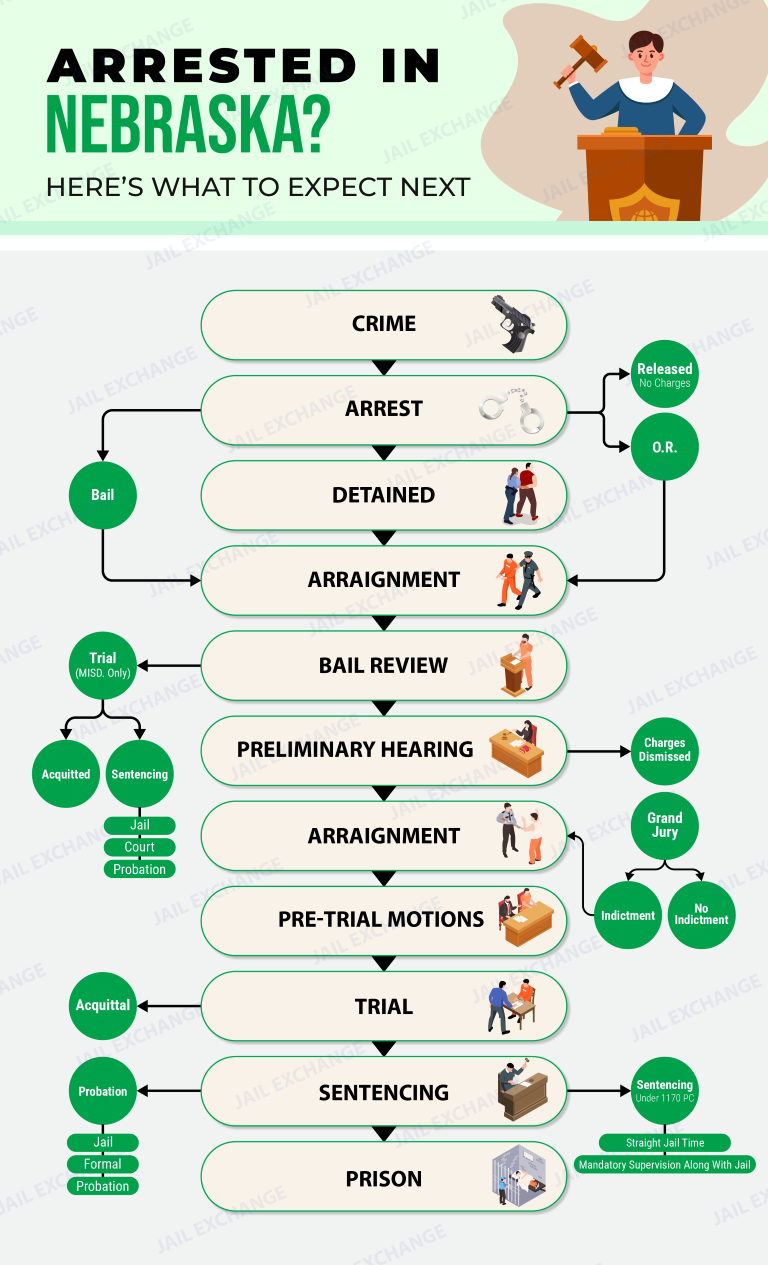
2. What happens right after someone is arrested?
Not every Madison County arrest leads to an overnight jail stay. Some people receive a citation. Those brought to a jail are searched, processed and evaluated for urgent health needs.
Bail and the first appearance
A judge or authorized judicial officer determines whether to release the person, require a bond, or impose conditions such as no contact with another person. A defendant must follow the written release order and return to court. A cash percentage, or a specific amount should never be assumed without seeing the actual bond order.
What should relatives have ready?
Keep the person's legal name and birth date, find out which jail has custody, write down the charge and next court date, and ask whether an attorney has been appointed. Medical concerns should be communicated to the detention facility directly.
3. How does a misdemeanor case move through court?
With a Madison County misdemeanor, the person usually stays in the county-court system instead of having a felony case transferred to District Court.
Possible steps before a verdict
The court may schedule discussions between the prosecutor and defense, hear motions about evidence, or set a trial. A defendant may plead guilty, plead not guilty, or make another plea allowed by law. A plea offer is optional; it is not the same as a court finding of guilt.
Penalties are based on the charge's class
- Class I misdemeanor: up to 1 year in jail, a fine up to $1,000, or both.
- Class II misdemeanor: up to 6 months in jail and/or $1,000.
- Class III misdemeanor: up to 3 months and/or $500.
- Class IIIA misdemeanor: up to 7 days and/or $500.
- Class IV misdemeanor: no jail; maximum $500 fine.
- Class V misdemeanor: no jail; maximum $100 fine.
- Class W misdemeanor: a special classification for DUI and implied-consent offenses; sentencing depends on prior convictions, testing, and court-authorized alternatives.
A class maximum is a legal ceiling, not a promise that the judge will impose it. Court costs, restitution, probation, and driving restrictions can matter too.
4. What happens if the accusation is a felony?
A felony is not ordinarily tried to completion in Madison County Court. A preliminary hearing asks whether the accusation has probable cause; it does not decide guilt.
County Court to District Court
At a preliminary hearing the state presents enough information for the judge to decide whether the felony may continue. If the judge finds probable cause, the charge is bound over to District Court. The case can also follow another lawful charging procedure. The District Court then handles arraignment, scheduling, motions, trial and sentencing.
Lawyers and a possible jury trial
A person who cannot afford counsel should ask the court about a court-appointed attorney and complete the required financial information. Felony defendants should not assume a public defender is automatically assigned. A plea can end the case without a trial. When there is a criminal jury trial, a guilty verdict must satisfy the constitutional unanimity requirement.
5. How are serious violent charges treated?
For a family confronting a Madison County homicide, sexual assault or serious weapons case, early legal representation matters because pretrial decisions may shape the entire prosecution.
Release decisions and evidence
A judge may assess public safety, risk of missing court, the charge and the facts when considering bail and conditions. Lawyers may review medical records, videos, witness statements, laboratory testing and other evidence. The court may hold hearings about what proof can be used at trial.
How serious can the punishment be?
Nebraska authorizes life imprisonment and, for Class I felonies under applicable law, the death penalty. Other violent offenses may carry long mandatory minimums. The exact penalty depends on the charged statute and any proven enhancements, not merely the label “violent.”
6. What if police arrest a child under 18?
A parent whose child is taken into custody in Madison County should ask whether the matter is in juvenile court and whether the child is being released or detained.
Which juvenile court applies?
County Court usually handles juvenile matters here, using its juvenile jurisdiction rather than treating the youth as an ordinary adult defendant. The prosecutor, court and probation staff may consider supervision, services, family involvement or placement if authorized.
Detention, hearings and records
Detaining a child is not the same as sentencing that child to prison. Youth detention and placement decisions require the proper juvenile-court process. Parents or guardians should ask about the next hearing, an attorney for the child, and contact rules. Juvenile records generally have protections that do not apply to open adult records, subject to statutory exceptions.
7. What are the actual jail, prison, and fine limits?
A Madison County judge must use the penalty law that applies to the convicted offense. Two defendants accused of similar conduct can receive different sentences because their facts and histories differ.
Actual misdemeanor maximums — Neb. Rev. Stat. § 28-106
- Class I misdemeanor: up to 1 year in jail, a fine up to $1,000, or both.
- Class II misdemeanor: up to 6 months in jail and/or $1,000.
- Class III misdemeanor: up to 3 months and/or $500.
- Class IIIA misdemeanor: up to 7 days and/or $500.
- Class IV misdemeanor: no jail; maximum $500 fine.
- Class V misdemeanor: no jail; maximum $100 fine.
- Class W misdemeanor: a special classification for DUI and implied-consent offenses; sentencing depends on prior convictions, testing, and court-authorized alternatives.
Actual felony ranges — Neb. Rev. Stat. § 28-105
- Class I: death.
- Class IA: life imprisonment.
- Class IB: 20 years to life.
- Class IC: mandatory minimum 5 years, maximum 50 years.
- Class ID: mandatory minimum 3 years, maximum 50 years.
- Class II: 1 to 50 years.
- Class IIA: up to 20 years, without a statutory minimum for the class.
- Class III: up to 4 years in prison and 2 years post-release supervision, or a fine up to $25,000, or both, subject to sentencing provisions.
- Class IIIA: up to 3 years in prison and 18 months post-release supervision, or a fine up to $10,000, or both.
- Class IV: up to 2 years in prison and 12 months post-release supervision, or a fine up to $10,000, or both.
Sentencing details families should understand
For the highest felony classes, the stated minimums may be required; for other classes the law allows different outcomes, including probation when permitted. Habitual-criminal enhancements and special offense provisions can increase the exposure. Nebraska generally places felony sentences with maximum terms of one year or more in state correctional institutions; misdemeanor jail terms ordinarily are served locally. Federal crimes have their own separate sentencing laws.
8. When is a charge federal, and where does that case go?
Being arrested in Madison County does not by itself put someone in federal court. The federal government needs a law giving it authority over the alleged offense.
Examples of federal offenses
Federal charges may involve drug distribution across state lines, certain firearm offenses, bank robbery, federal-program fraud, or crimes committed on federal land. Some behavior violates both state and federal laws, but many ordinary assaults, thefts and DUI cases remain state matters.
United States District Court for the District of Nebraska
Nebraska has one federal judicial district. Its main courthouse and federal clerk contacts are listed below. The location of a particular hearing is controlled by the case assignment and court order, not simply by the county of arrest.
- Omaha — Roman L. Hruska Federal Courthouse: 111 South 18th Plaza, Suite 1152, Omaha, NE 68102; (402) 661-7350.
- Lincoln — Robert V. Denney Federal Building: 100 Centennial Mall North, Room 593, Lincoln, NE 68508; (402) 437-1900.
- North Platte federal court sessions: Lincoln County Courthouse, 301 North Jeffers Street, North Platte, NE 69101. For federal clerk assistance use the Omaha or Lincoln clerk's number.
The federal criminal process
A federal defendant may appear before a U.S. magistrate judge for an initial hearing and a release-or-detention decision. A grand jury indictment or other lawful charging document may follow; later stages can include arraignment, evidence exchange, motions, a plea or jury trial, and sentencing under federal statutes and advisory guidelines. Federal public defenders or appointed counsel may represent those who qualify.
9. How do I search a Madison County case and confirm the next hearing?
Use the Nebraska Judicial Branch case-search services for public County Court and District Court records. Online one-time searches have a fee; free access is available at courthouse kiosks and participating law libraries. Match Madison County, the person and case number. Newly filed and restricted matters may not appear publicly.
County Court: 1313 North Main Street, Madison, NE 68748 (mail: P.O. Box 230; dial option 3), 402-454-3311. District Court clerk: mailing address P.O. Box 249, Madison, NE 68748 (ask for extension 140), 402-454-3311. Follow the hearing notice and confirm the assigned room, entrance and any remote-appearance instructions. A court contact address is not proof of where someone is held.
Information for this service is currently unavailable.

JailATM provides a secure electronic payment portal that allows friends and family members to deposit funds directly into an incarcerated person's jail trust and commissary account. Deposited money provides the financial balance needed for your loved one to purchase personal hygiene items, snacks, over-the-counter medical sundries, and correspondence supplies from the facility commissary.
Important: Facility Deposit Rules and Window Intake Vary
Once a person is booked and moved to a housing unit, facilities do not always allow cash drop-offs or phone payments directly to the jail window. Some might and you should confirm this by calling the facility and asking. But if you do not register online and fund your loved one's trust account immediately, they may be forced to wait days or weeks for standard paper processing, leaving them without essential soap, clean undergarments, basic medical sundries or snacks.
Step-by-Step Instructions to Register and Deposit Funds
- Obtain the inmate's legal first and last name, date of birth, and assigned facility booking ID number.
- Navigate to deposits.jailatm.com/webdeposits/ on your computer or mobile device.
- Click Sign In or Register to set up your verified user account using your email address and password.
- Select the state and the detention facility where the inmate is currently housed.
- Search for the inmate using their ID number or legal last name to confirm an exact roster match.
- Enter your desired deposit dollar amount and review the calculated transaction and convenience fees.
- Input your debit or credit card billing details, complete payment authorization, and save your digital receipt.
What the Inmate Needs to Do
The inmate does not need an internet account to receive funds. Once the electronic transaction clears, the balance posts directly to their jail trust ledger according to facility accounting schedules. The inmate can review their updated balance at a dayroom pod kiosk or on their weekly trust statement and place orders on their regular commissary day.
Official Provider: JailATM Official Website
Customer Service Telephone: 1-877-810-0614
Support Hours: Monday – Friday, 8:00 AM – 5:00 PM CST
Supported Languages: English and Spanish
Other Services Provided by JailATM
In addition to Trust & Commissary Money Deposits, JailATM provides several other communication, store, and visitation services at participating facilities:
- Commissary Gift Packs & Store Ordering: Order pre-approved snack boxes, food packages, and hygiene bundles sent directly to the jail.
• Learn more on our website: Commissary Gift Packs Guide | • Visit official vendor page: JailATM Store Orders - Digital Messaging & Picture Sharing: Send electronic messages and photos directly to an inmate's housing unit kiosk.
• Learn more on our website: Digital Messaging Guide | • Visit official vendor page: JailATM Messaging - Remote Video Visitation: Schedule and join live video visits from home using your computer or smartphone.
• Learn more on our website: Video Visitation Guide | • Visit official vendor page: JailATM Video Visits
Deposit Money for an Inmate in the Madison County Jail
One web address is all the Madison County Jail's own corrections page offers families: JailATM. Look the person up there, pay with a card and review the fee before confirming.
The jail adjoins the courthouse at 1313 N. Main Street in Madison. Whether it takes money orders or walk-in deposits, and what name a money order should carry, it has decided not to say publicly. The jail office at 402-454-1333 can answer; know the inmate's name and DOB before calling.
To write to someone, address the letter to the inmate by name, c/o Madison County Jail, PO Box 209, Madison, NE 68748. Leave cash out of it.
The Madison County Jail is attached to the courthouse on North Main Street in the town of Madison, and the Madison County Sheriff's Office runs it. Inmate mail goes to the jail's post office box rather than the street address. Officers open and inspect what arrives before it is delivered on weekdays.
Letters, legal papers, books and magazines:
Inmate's Full Name & Inmate ID#
Madison County Jail
PO Box 209
Madison, NE 68748
- Inmate's name and number: Start the address with the person's full name and their inmate ID number. The jail roster shows who is currently held.
- Sender's address: Write it in the top left corner. Without it, the Madison jail will most likely not deliver your letter.
- Money: Keep cash out of letters and make a deposit online instead. Bonds are posted at the sheriff's office, which has an ATM in its lobby.
- Pen color: Letters to the Madison jail should be written in blue or black ink, never crayon, felt marker or colored ink.
- Clean envelopes: Madison County refuses mail with drawings, lipstick, perfume, glitter or confetti.
- Books and periodicals: Order new copies and have the publisher mail them to the box above. Staff discard books with graphic sex or violence and keep back magazines that feature nudity, weapons or foul language.
- Cards: A plain greeting card is accepted, but a musical one is not.
- Packages: Only through the vendor on the jail's commissary list.
- Off-limits contacts: An inmate in Madison may not write to or hear from a co-defendant, someone held at another jail or prison, or a person covered by a no-contact order.
- Rule breaks: Mail that breaks the rules can be returned or destroyed, contraband may go to the sheriff or county attorney, and an inmate can lose mail privileges.
The jail also has digital messages. Recording devices, including phones used for photos or video, are banned inside the building. The jail office number is 402-454-1333.
CIDNET Phone Calling enables incarcerated individuals to place outbound voice calls from housing-unit wall phones or handheld tablets directly to approved cell phones and landlines. Because jail phone systems cannot accept incoming calls, setting up a CIDNET account and purchasing Data Points ensures outbound calls connect immediately without wireless carrier collect blocks.
Important: Mobile Networks Block Inmate Calls Without Data Points
Wireless cellular carriers automatically block collect calls originating from jail telecommunications systems. While some traditional landline telephone providers may support monthly operator billing, mobile smartphones and VoIP numbers require an active prepaid CIDNET balance, which you can verify with your provider. If you do not register your 10-digit number online and purchase Data Points immediately, your loved one will hear an automated operator recording stating that your phone number cannot accept calls.
Step-by-Step Instructions to Set Up and Fund Voice Calling
- Go to customer.cidnet.net or launch the CIDNET Customer mobile app.
- Register your account using the primary 10-digit telephone number where you want to receive calls.
- Upload your driver's license or state ID for identity verification.
- Select the detention center where the inmate is held and link them to your contact profile.
- Purchase Data Points using a debit or credit card to cover per-minute calling rates.
- Confirm your mobile phone allows calls from automated or unknown correctional numbers and does not send them to spam.
What the Inmate Needs to Do
The inmate approaches a pod wall phone or opens the phone app on their tablet, enters their assigned inmate PIN, and dials your 10-digit number. CIDNET's automated system verifies that your account has sufficient Data Points and connects the call once you accept the automated prompt. All non-privileged conversations are recorded and monitored by the facility.
Official Provider: CIDNET Customer Portal | Encartele Corporate
Customer Service Telephone: 1-888-984-1903
Support Hours: Monday – Friday, 8:00 AM – 5:00 PM CST
Supported Languages: English and Spanish
Other Services Provided by CIDNET
In addition to Phone Calling, CIDNET operates messaging and video visitation services:
- Data Points (Unified Funding): Purchase the central credits used to pay for telephone talk time.
• Learn more on our website: CIDNET Data Points Guide | • Visit official vendor page: Buy CIDNET Data - Remote Video Visitation: Schedule and join live video visits from home using your computer or smartphone.
• Learn more on our website: CIDNET Video Visits Guide | • Visit official vendor page: CIDNET Video Visitation - Inmate Messaging & Digital Mail: Send text messages and digital photo attachments directly to an inmate's terminal.
• Learn more on our website: CIDNET Messaging Guide | • Visit official vendor page: CIDNET Messaging Portal
CIDNET Inmate Messaging provides a secure digital messaging and picture-sharing service for families of incarcerated individuals. Powered by CIDNET Data Points, outside contacts can compose electronic letters and upload JPEG photographs directly through the CIDNET web app, delivering correspondence to inmate screens within hours and avoiding paper mail sorting delays.
Important: Postal Mail Transition and Screening Rules Vary
Inmates cannot receive incoming phone calls, and physical postal mail policies differ across jurisdictions. While some detention centers accept handwritten envelopes, many facilities contracting with CIDNET have prohibited physical paper mail in favor of electronic mail scanning and direct digital messaging, which you can verify by checking facility rules. If you do not register online and purchase Data Points immediately, your loved one may face lengthy periods without direct written communication from family.
Step-by-Step Instructions to Register and Message an Inmate
- Log into your account at customer.cidnet.net or launch the CIDNET app.
- Ensure your identity verification (photo ID and selfie) is approved by the facility.
- Confirm your account has an active Data Point balance; purchase additional points if needed.
- Select Messages from your navigation menu and click on your linked contact.
- Type your message in the text editor and attach clear JPEG photo files if authorized by the facility's media rules.
- Review the estimated Data Point cost for the message length and image attachments.
- Click Send to submit your transmission to the institutional mailroom screening queue.
What the Inmate Needs to Do
All messages and photographs pass through facility screening filters. Once approved, the message arrives in the inmate's inbox on their housing unit kiosk or assigned tablet. The inmate opens the message, views the images, and types a digital response, which draws against available account points.
Official Provider: CIDNET Customer Portal | Encartele Corporate
Customer Service Telephone: 1-888-984-1903
Support Hours: Monday – Friday, 8:00 AM – 5:00 PM CST
Supported Languages: English and Spanish
Other Services Provided by CIDNET
In addition to Inmate Messaging, CIDNET provides several other communication and visitation options:
- Data Points (Unified Funding): Purchase universal credits that power voice calling, messaging, and video visits.
• Learn more on our website: CIDNET Data Points Guide | • Visit official vendor page: Buy CIDNET Data - Remote Video Visitation: Schedule and join live video visits from home using your computer or smartphone.
• Learn more on our website: CIDNET Video Visits Guide | • Visit official vendor page: CIDNET Video Visitation - Phone PINs & Voice Calling: Fund outbound voice telephone calls so your loved one can call your telephone directly.
• Learn more on our website: CIDNET Phone Calling Guide | • Visit official vendor page: CIDNET Voice Calling
CIDNET provides secure handheld wireless tablets designed specifically for correctional housing units. Operating over a private, encrypted facility network, these devices allow incarcerated individuals to exchange messages, place voice calls, conduct remote video visits, read approved digital books, access law library materials, and complete rehabilitative courses directly from their cells.
Important: Tablet Hardware Deployment and Rental Rules Vary
Detention centers do not manage tablet distribution identically. While some agencies issue individual personal tablets to every detainee at booking, others utilize shared pod docking stations or restrict tablet use to specific dayroom hours, which you should confirm with the facility directly. Although core educational and legal resources are generally provided free of charge, sending messages or making calls from the tablet requires an active balance of Data Points funded by friends or family.
Step-by-Step Instructions to Support Tablet Use
- Confirm that CIDNET handheld tablets are active and deployed at your loved one's specific detention facility.
- Register your verified user account at customer.cidnet.net.
- Complete identity verification by uploading your government photo ID.
- Link the inmate to your profile and purchase a reserve of CIDNET Data Points.
- Notify your loved one that funds are available so they can open the communication apps on their tablet.
What the Inmate Needs to Do
The inmate unlocks their assigned tablet using biometric verification or their unique facility PIN. Once logged on, they can browse institutional announcements, access educational materials, or select approved outside contacts to read messages and start calls. When quiet hours begin or tablets require recharging, inmates return devices to designated pod docking carts.
Official Provider: CIDNET Customer Portal | Encartele Corporate
Customer Service Telephone: 1-888-984-1903
Support Hours: Monday – Friday, 8:00 AM – 5:00 PM CST
Supported Languages: English and Spanish
Other Services Provided by CIDNET
In addition to Inmate Tablet Services, CIDNET provides several core communication channels:
- Data Points (Unified Funding): Purchase the digital currency required to power all tablet communications.
• Learn more on our website: CIDNET Data Points Guide | • Visit official vendor page: Buy CIDNET Data - Inmate Messaging & Digital Mail: Send text messages and photos directly to an inmate's tablet screen.
• Learn more on our website: CIDNET Messaging Guide | • Visit official vendor page: CIDNET Messaging Portal - Remote Video Visitation: Conduct scheduled live video calls directly to their tablet or pod kiosk.
• Learn more on our website: CIDNET Video Visits Guide | • Visit official vendor page: CIDNET Video Visitation
Nearby counties
- Jail (Main): 402-454-1333
- Sheriff: 402-454-2110
The Madison County Jail serves the following cities and towns of Madison County: Battle Creek, Burnett, Madison, Newman Grove, Norfolk and Tilden. At times this facility may also house inmates arrested in the following counties: Burt County.