Rockingham County, which runs from the Seacoast to the Massachusetts border at Salem, keeps its county seat and its Superior Court in Brentwood. Six 10th Circuit Court district divisions, in Brentwood, Candia, Derry, Hampton, Portsmouth and Salem, hear misdemeanors and violations from the county's 37 towns and cities. Police prosecutors present most of those cases, and the elected Rockingham County Attorney prosecutes felonies. Anyone kept in custody after an arrest waits at the county's Department of Corrections jail, which is also in Brentwood.
- 10th Circuit Court – District Division – Brentwood, 10 Route 125, Brentwood, NH 03833 (Brentwood, Danville, East Kingston, Epping, Exeter, Fremont, Kensington, Kingston, Newfields, Newmarket, Newton and Stratham), 1-855-212-1234
- 10th Circuit Court – District Division – Candia, 110 Raymond Road, Candia, NH 03034 (Auburn, Candia, Deerfield, Northwood, Nottingham and Raymond; staffed on criminal hearing days, with the Derry court assisting otherwise), 1-855-212-1234
- 10th Circuit Court – District Division – Derry, 10 Courthouse Lane, Derry, NH 03038 (Derry, Londonderry, Chester and Sandown), 1-855-212-1234
- 10th Circuit Court – District Division – Hampton, 3 Timber Swamp Road, Hampton, NH 03842 (Hampton, Hampton Falls, North Hampton, South Hampton and Seabrook), 1-855-212-1234
- 10th Circuit Court – District Division – Portsmouth, 111 Parrott Avenue, Portsmouth, NH 03801 (Portsmouth, Greenland, New Castle, Newington and Rye), 1-855-212-1234
- 10th Circuit Court – District Division – Salem, 35 Geremonty Drive, Salem, NH 03079 (Salem, Windham, Atkinson, Hampstead and Plaistow, plus Pelham in Hillsborough County), 1-855-212-1234
- 10th Circuit Court – Family Division for delinquency matters, sharing the six buildings above, 1-855-212-1234
- Rockingham County Superior Court, 10 Route 125, Brentwood, NH 03833, 1-855-212-1234
- Rockingham County Attorney's Office, 10 Route 125, Brentwood, NH 03833, (603) 642-4249
- New Hampshire Public Defender – Stratham office, 142 Portsmouth Avenue, Stratham, NH 03885, (603) 778-0526
- Rockingham County Department of Corrections (the county's jail and house of correction), 99 North Road, Brentwood, NH 03833, (603) 679-2244
Which court hears your case. Rockingham County's lower-level criminal cases, from shoplifting at the Salem malls to a first DWI on Route 101, are filed in the 10th Circuit district division that serves the town of the offense, as listed above. Exeter and Stratham cases are heard in Brentwood, Londonderry cases in Derry, Seabrook cases in Hampton, Rye cases in Portsmouth and Plaistow cases in Salem. There are no separate town, city or municipal courts anywhere in the county; New Hampshire folded those into its Circuit Court, which now handles every local criminal matter through these six district divisions. Trials in the district division are decided by a judge, and a defendant facing a Class A misdemeanor who wants twelve jurors instead can transfer the case to the Rockingham County Superior Court. Felonies are filed by the County Attorney straight into that Superior Court in Brentwood, the statewide "felonies first" practice that replaced the older system of probable cause hearings in the circuit courts.
Where pretrial detainees are held. An adult arrested by one of Rockingham County's many town and city police departments, the Rockingham County Sheriff's Office or the State Police is first held at the arresting agency for booking. A person who is not released there is taken to the Rockingham County Department of Corrections at 99 North Road in Brentwood, a short distance from the Superior Court. The county Department of Corrections, not the Sheriff, operates this jail and house of corrections, while sheriff's deputies handle court transport. Families can call (603) 679-2244 to confirm custody, bail amounts, visiting rules and how to send money.
- Courthouses: the Brentwood complex and the five town courts
- After an arrest in Rockingham County
- The Rockingham County jail on North Road
- Public defender for Rockingham County
- Prosecutors and the Rockingham County diversion program
- Drug court, mental health court and the veterans track
- Misdemeanor (for example, theft, a first DWI, simple assault, criminal trespass)
- Felony (for example, burglary, felony theft, drug sales, second-degree assault)
- Violent felony (for example, murder, aggravated felonious sexual assault, armed robbery)
- Juveniles (under 18) arrested in Rockingham County
- Federal cases (U.S. District Court) from Rockingham County
Courthouses: the Brentwood complex and the five town courts
Brentwood, a small inland town between Exeter and Kingston, is the hub of Rockingham County's justice system. Several key offices share a single campus there.
- 10 Route 125, Brentwood. This courthouse is home to the Rockingham County Superior Court, where all felonies are arraigned and tried, as well as the Brentwood district and family divisions and the County Attorney's office.
- 99 North Road, Brentwood. The county jail and house of corrections is located nearby on the county complex.
- Portsmouth (111 Parrott Avenue) and Hampton (3 Timber Swamp Road). These two courts handle the Seacoast's misdemeanor docket, which rises in summer with beach-season arrests in Hampton and Seabrook.
- Derry (10 Courthouse Lane) and Salem (35 Geremonty Drive). These busy courts serve the fast-growing towns along Interstate 93 near the Massachusetts line.
- Candia (110 Raymond Road). A part-time location for the inland towns, open mainly on days when criminal hearings are scheduled.
Call the Judicial Branch's centralized line, 1-855-212-1234, to confirm a hearing, especially for Candia, whose schedule is limited. Plan for security screening at the door, and give yourself extra time if you are traveling to Brentwood from the coast or the Salem area.
After an arrest in Rockingham County
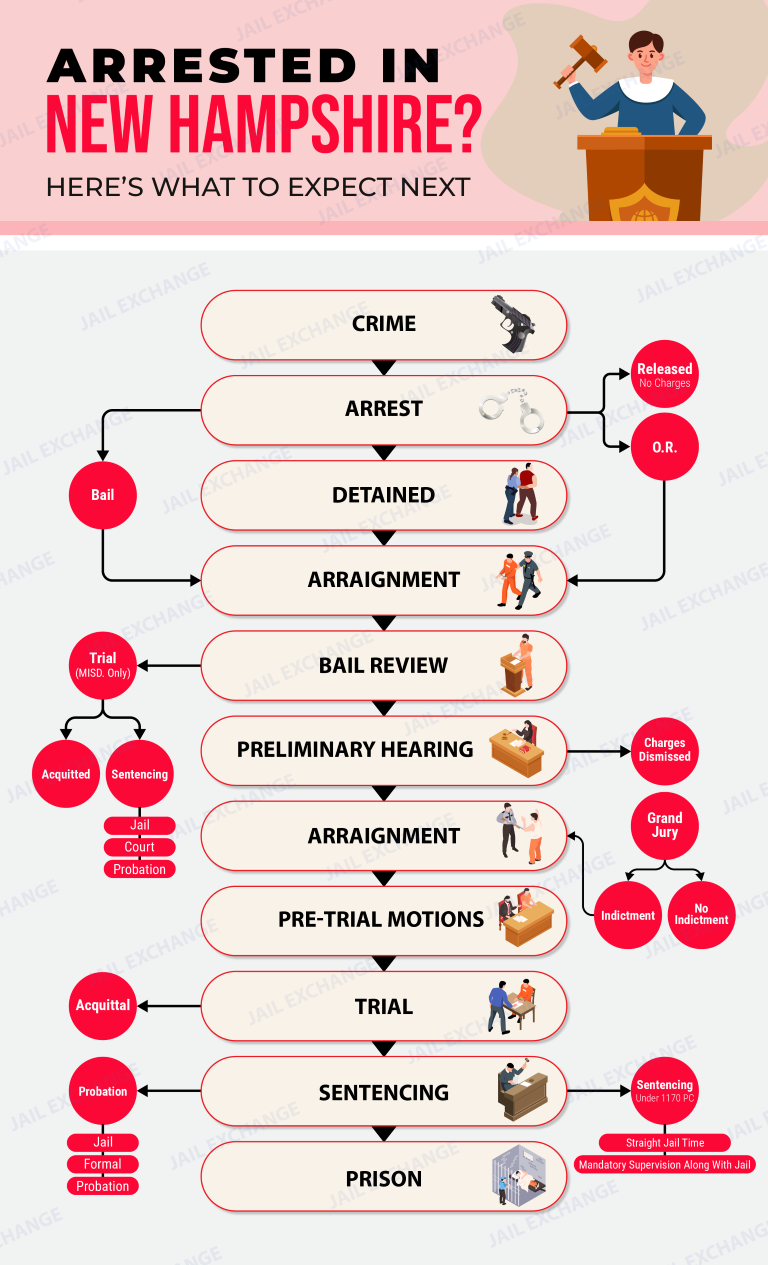
Booking
Booking takes place at the arresting department in Portsmouth, Salem, Derry, Exeter or whichever town made the arrest. Officers take fingerprints and a photo, inventory property and check for warrants. Lower-level arrests often end with release on a summons and a court date.
Release and bail
If the person is not released by the police, a bail commissioner typically decides on release, often at the station and sometimes in the middle of the night. The options run from personal recognizance with no money down to cash or a surety bond, usually paired with terms like staying away from a named person, no alcohol or drugs, or not returning to a certain residence. A defendant charged with one of several serious violent offenses cannot be released by a commissioner and must instead wait for a judge. Under House Bill 592, which took effect in September 2025, judges have broader authority to order detention, and a detained person must be brought before a judge for a bail hearing within 36 hours, excluding weekends and holidays.
Arraignment
Misdemeanor arraignments take place in the district division for the town of arrest; felony arraignments take place in the Superior Court in Brentwood. Detained defendants usually appear by video from North Road. The judge advises the person of the charges and rights, considers a request for a public defender, and may adjust bail.
What follows
From there the misdemeanor and felony tracks separate, as described in the sections below.
The Rockingham County jail on North Road
The Rockingham County Department of Corrections, 99 North Road, Brentwood, NH 03833, is the county's only adult jail. It holds pretrial defendants who have not been released, people serving county sentences, and others held on warrants or violations.
- Main number: (603) 679-2244. Staff can confirm whether someone is in custody and explain how bail is posted.
- Before visiting: visiting days, video visits, phone accounts and deposit methods are set by the department and are revised from time to time, so check the current rules before making the trip.
- Programs: the department has reported running an adult diversion program in cooperation with the County Attorney and taking part in the county's adult drug court.
- Mail: address letters with the person's full name and the facility address, and follow the jail's restrictions on what may be enclosed.
Juveniles are never placed at North Road; see the juvenile section for where detained youth are held.
Public defender for Rockingham County
Court-appointed defense for the Seacoast and the Salem–Derry area comes chiefly from the New Hampshire Public Defender's Stratham office, 142 Portsmouth Avenue, Stratham, NH 03885, (603) 778-0526. The organization is a nonprofit firm working under a contract with the state Judicial Council. Contract counsel and assigned private attorneys take cases when the public defender has a conflict or cannot accept more.
How to apply. Tell the court at your first appearance that you cannot afford a lawyer. You will be asked to complete a financial affidavit, and a judge will decide whether you qualify. Appointment is available only when the charge carries possible jail time; violations and Class B misdemeanors do not.
Cost later on. The state may seek repayment of some of the cost of appointed counsel from defendants who are able to pay, so ask your attorney about this at the start of the case.
Prosecutors and the Rockingham County diversion program
In the district divisions, misdemeanors and violations are usually presented by police prosecutors from the arresting department, whether that is Portsmouth, Salem, Derry or one of the smaller towns, which sometimes share a prosecutor. The Rockingham County Attorney, elected countywide and based at 10 Route 125 in Brentwood, (603) 642-4249, prosecutes felonies, presents cases to the grand jury and handles misdemeanor jury trials in Superior Court. The Attorney General's Office takes homicides and certain other major cases.
Diversion
Rockingham County has an adult diversion program, and county reports describe it working with the County Attorney on felony-level diversion, in addition to the local court diversion programs many towns use for juveniles and young adults. Participants complete conditions such as treatment, community service, restitution or education, and in return the charge is dismissed or not pursued. The prosecutor decides who is offered diversion, so ask your defense attorney about it early.
Rights of victims
Victims in Rockingham County cases are entitled to be told about hearings, to attend, to talk with the prosecutor before a plea is finalized, and to give a statement at sentencing. The County Attorney's victim-witness advocates assist with this.
Drug court, mental health court and the veterans track
- Rockingham County Adult Drug Court: operated in the Superior Court in Brentwood for felony defendants with a substance use disorder. The program uses intensive treatment, frequent testing and regular status hearings, with rewards for progress and swift sanctions for violations. Graduates can earn a reduced or suspended sentence.
- Mental health courts: court listings have shown mental health dockets at the Brentwood and Portsmouth district divisions for defendants whose offenses are connected to a mental illness.
- Veterans behavioral health track: the Rockingham County Superior Court has offered a track for veterans that coordinates treatment through the VA and community providers.
Admission depends on screening, the prosecutor's consent and available space. Defendants charged with serious violence or drug trafficking are often ineligible. A defense lawyer can make the referral and explain the trade-offs, since entering most of these programs requires a plea.
Misdemeanor (for example, theft, a first DWI, simple assault, criminal trespass)
Most criminal cases in Rockingham County are misdemeanors, heard in the six district divisions. The classes are:
- Class A misdemeanor: as long as 12 months in jail, with a top fine of $2,000.
- Class B misdemeanor: a fine of up to $1,200; jail is not an option.
- Violation: a fine-only, non-criminal offense, such as many first-time possession or motor vehicle charges.
From arraignment to trial
A defendant who pleads not guilty goes next to a pretrial conference and, if no agreement is reached, to a bench trial in the district division if the case is not settled. A Class A defendant may opt for a jury trial in the Superior Court in Brentwood instead.
Penalties for common charges
- Theft ($1,000 or less): ordinarily a Class A misdemeanor; a first offense commonly results in restitution, a fine and suspended jail time.
- First DWI: a Class B misdemeanor carrying a fine of $500 or more, revocation of driving privileges for nine months up to two years (a portion can be suspended once treatment is completed), and the state impaired driver intervention program. With aggravating facts, such as a test of 0.16 or above, a collision with injuries or high speed, the offense is upgraded to a Class A misdemeanor, which adds mandatory time in custody and an interlock requirement.
- Simple assault: a Class A misdemeanor in most cases, but Class B for a mutual-consent fight. If the charge involves a family member or intimate partner, a domestic violence finding can bring federal firearms consequences.
- Criminal trespass: from a violation for ignoring posted signs to a misdemeanor for unlawfully entering a structure or refusing an order to leave.
Likely outcome and timeline
Negotiated pleas, reduced charges, fines, suspended sentences and filed charges that are later dismissed all appear often. Most Rockingham County misdemeanors are finished within one to four months.
Felony (for example, burglary, felony theft, drug sales, second-degree assault)
All Rockingham County felonies are heard at the Superior Court at 10 Route 125 in Brentwood, with the County Attorney prosecuting.
- Complaint in Superior Court: after arrest, the County Attorney files a felony complaint and bail is reviewed in Brentwood.
- Grand jury or information: the case is presented to a Rockingham County grand jury for indictment, or the defendant waives indictment and is charged by information, often as part of a plea deal.
- Arraignment: the defendant enters a plea, and counsel is confirmed.
- Dispositional conference: both sides review the evidence and discuss a settlement; a large share of felonies resolve here.
- Final pretrial and trial: if the case goes to trial, twelve Rockingham County residents hear it, and the verdict must be unanimous.
- Sentencing: the judge often first orders a presentence report from the state's probation and parole officers and hears from the victim.
Penalties
State prison sentences in New Hampshire are imposed as a minimum–maximum range; parole eligibility starts at the minimum, which earned time can reduce.
- Class B felony (most burglaries, second-degree assault, and thefts above $1,000 but not over $1,500): a maximum range of 3½–7 years and a fine up to $4,000.
- Class A felony (theft of more than $1,500, armed burglary, nighttime burglary of an occupied home): a maximum range of 7½–15 years and a fine up to $4,000.
- Drug sales: penalties depend on the drug and quantity, and significant fentanyl or heroin amounts can carry up to 30 years.
Judges may also impose probation, a sentence at the North Road jail or a suspended sentence. A Rockingham County felony usually takes six to fifteen months to reach a plea or verdict.
Violent felony (for example, murder, aggravated felonious sexual assault, armed robbery)
Violent felony prosecutions in Rockingham County take the same Superior Court path, but bail is often denied and many defendants spend the whole case at the Brentwood jail. The Attorney General's Office prosecutes homicides; the County Attorney handles most other violent felonies.
Murder. A first-degree murder conviction requires life imprisonment without parole; New Hampshire has had no death penalty since 2019. Second-degree murder can be punished by life or a lengthy term of years, and manslaughter by up to 30 years.
Aggravated felonious sexual assault. Sentences commonly fall in the 10-to-20-year range, and some offenses, particularly those against young children or by repeat offenders, carry mandatory minimums.
Armed robbery. Robbery while armed with a deadly weapon is a Class A felony (up to 7½–15 years); robbery without a weapon is generally a Class B felony.
Crime victims have rights to notice, to attend, to consult and to be heard at sentencing. Because of laboratory work, experts and pretrial litigation, these cases routinely take a year or two, sometimes longer.
Juveniles (under 18) arrested in Rockingham County
Young people under 18 accused of crimes face delinquency petitions in the 10th Circuit Court – Family Division. Rockingham County's family division sits at Brentwood (10 Route 125), Candia (110 Raymond Road), Derry (10 Courthouse Lane), Hampton (3 Timber Swamp Road), Portsmouth (111 Parrott Avenue) and Salem (35 Geremonty Drive); all can be reached at 1-855-212-1234. The family division towns do not always match the district division towns, so check which location your notice names.
Intake and diversion
Juvenile Probation and Parole Officers, part of the state's DCYF (Division for Children, Youth and Families), assess each referral. Many Rockingham County towns send first-time and minor offenders to juvenile court diversion programs, and a youth who finishes the agreed service hours, repayment or counseling never faces a formal petition. Formal petitions are prosecuted by local police prosecutors or, for serious offenses, the County Attorney.
Detention
Most juveniles are released to a parent. When a judge orders a youth detained, a detention hearing is held promptly, generally within 24 hours of placement excluding weekends and holidays. New Hampshire's only secure facility for youth, the Sununu Youth Services Center in Manchester, is still in use. Its replacement, a smaller state-run facility required by a 2023 law, is being built in Rockingham County on the Hampstead Hospital campus in Hampstead; state officials reported in 2026 that youth were expected to move there in early 2027.
Possible results
A delinquency finding can lead to probation with DCYF, counseling, restitution, community service, an out-of-home placement or, in serious cases, commitment to the state facility. Youth have the right to counsel, usually from the public defender's Stratham office, and juvenile records are confidential.
Certification as an adult
A prosecutor can ask the family division to move a case to Superior Court. Generally, a youth 15 or older charged with a felony may be transferred, and the floor drops to 13 for a few grave violent crimes, murder and aggravated felonious sexual assault among them. At the transfer hearing, the judge balances how serious the charge is against the young person's history, maturity and likelihood of responding to juvenile services.
Federal cases (U.S. District Court) from Rockingham County
Common federal charges from the county
Rockingham County sits astride Interstates 93 and 95 just north of Massachusetts, and federal investigators frequently bring cases from Salem, Seabrook, Portsmouth and Derry. Typical charges include trafficking fentanyl and other opioids brought in from Massachusetts, firearms offenses such as straw purchases and possession by a prohibited person, bank and wire fraud, child exploitation and bank robbery. Homeland Security Investigations, the FBI, DEA and ATF, joined by postal inspectors and IRS agents, often build these cases together with local departments.
Where the case is heard
New Hampshire's federal district has only one courthouse for criminal trials, the Warren B. Rudman U.S. Courthouse, 55 Pleasant Street, Concord, NH 03301, about an hour's drive from most of the Seacoast. There are no divisions; jurors are summoned statewide, and appellate review belongs to the First Circuit, seated in Boston.
Who is involved
- Prosecution: U.S. Attorney's Office, 53 Pleasant Street, 4th Floor, Concord, NH 03301, (603) 225-1552.
- Appointed defense: the Federal Public Defender's Concord office, 22 Bridge Street, Concord, NH 03301, (603) 226-7360, or a CJA panel attorney when there is a conflict.
- Custody and court security: U.S. Marshals Service, 55 Pleasant Street, Room 207, Concord, NH 03301, (603) 225-1632.
How a federal case proceeds
- Initial appearance before a U.S. magistrate judge in Concord after arrest or summons.
- Detention hearing, usually within three court days if prosecutors ask for detention. The judge orders either custody or release on conditions supervised by U.S. Probation and Pretrial Services; federal court does not use bail bondsmen.
- Indictment by a federal grand jury within 30 days of arrest when the case began by complaint, then arraignment.
- Pretrial period governed by the Speedy Trial Act's 70-day limit, which is commonly extended for discovery and motions.
- Plea or trial: most defendants reach plea agreements; trials use a unanimous jury of 12.
- Sentencing after a presentence report, using the advisory U.S. Sentencing Guidelines and any mandatory minimum. With no federal parole, good-conduct credit shaves off at most about 15 percent, and supervised release begins after the prison term.
Detention and locating someone
The Marshals decide where pretrial federal defendants are housed, using contract jails in New Hampshire and nearby states, so a Rockingham County arrestee may not be held in Brentwood. Call the Marshals office for location information. After a sentence is handed down, families can track the prison assignment through the Bureau of Prisons inmate locator. Prosecutions of juveniles in federal court are rare.
This guide describes in general terms how criminal cases usually proceed through the Brentwood Superior Court and the district divisions serving Rockingham County; it is not legal advice, and statutes, court rules and local programs can change at any time. People facing charges should consult a defense lawyer or reach the New Hampshire Public Defender's Stratham office at (603) 778-0526. Court dates and locations can be confirmed by phoning 1-855-212-1234.