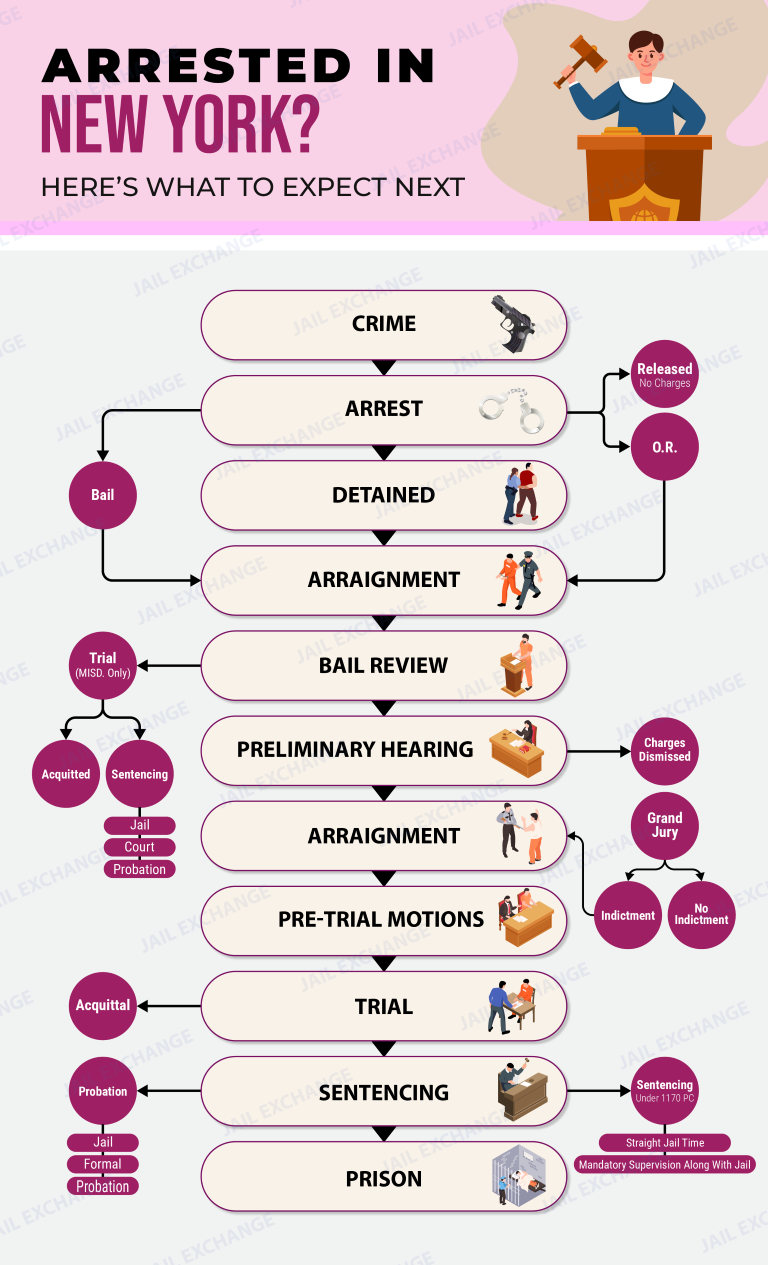
Broome County Sheriff's Correctional Facility Criminal Court Process
Criminal Court Process for Broome County New York
Broome County Criminal Court Guide
Criminal cases from every corner of this county, from Deposit to Endicott, run through New York's 6th Judicial District. Serious felony cases end up at County Court, 65 Hawley Street, Binghamton, NY 13901, where the clerk picks up at 607-240-5801 on weekdays from 8:30 a.m. to 4:30 p.m. Smaller crimes, traffic crimes and the first steps of most felonies stay closer to home, in Binghamton City Court or one of the many town and village justice courts.
To see if a person is in the jail, try the Sheriff's inmate lookup. Questions about custody belong on our Inmate Search page: who's locked up, the latest arrests, mugshots, charges, open warrants, picking up property and free defense lawyers.
Adults picked up by police are locked up at the Broome County Sheriff's Correctional Facility, 155 Lt. VanWinkle Drive, Binghamton, NY 13905. When you can't tell where someone is, call jail information at 607-778-2105. Release and payment rules are on our bail page.
1. Does a local justice or County Court get the case?
It turns on how serious the charge is. Three tiers exist under New York law:
- Felonies are the gravest crimes, and they can lead to state prison. They come in classes A through E. The longest possible terms climb with each class (Penal Law § 70.00): four years for an E, seven for a D, fifteen for a C, twenty-five for a B, and life for an A.
- Misdemeanors are lesser crimes served, if at all, in the local jail. Class A carries up to 364 days and a $1,000 fine. Class B carries up to three months and $500 (Penal Law §§ 70.15, 80.05).
- Violations are not crimes at all. The most is 15 days and $250.
City, town and village courts are the "local criminal courts." They try misdemeanors, violations and traffic cases. They also hold the opening hearings on felonies: the arraignment and the preliminary hearing. A felony that a grand jury indicts moves up to County Court, which can hear any crime in the county. Cases involving people under 18 go to the Youth Part or Family Court.
↑ Back to the question list2. Where do Broome County's main courts sit?
The higher courts cluster on Hawley Street and Court Street downtown. Most are open weekdays from 8:30 a.m. to 4:30 p.m.
- County Court, 65 Hawley Street, Binghamton, NY 13901, 607-240-5801. Felony trials, pleas and sentences happen here. Mail goes to PO Box 1766, Binghamton, NY 13902. Visitors pass through a metal detector.
- Supreme Court Clerk's Office, 92 Court Street, Binghamton, NY 13901, 607-240-5800. This is a separate building from County Court.
- Family Court, same building as County Court at 65 Hawley Street, Binghamton, NY 13901, 607-240-5799. It hears youth and family cases.
- Binghamton City Court, 5th Floor, City Hall, 38 Hawley Street, Binghamton, NY 13901, 607-240-4272. It handles city misdemeanors and violations, and its judges arraign city felony cases. A Veterans Treatment Court also meets here.
- Adult Treatment Court (drug court), 2nd floor of the Family Court building, 65 Hawley Street, Binghamton, NY 13901. It sits Tuesdays at 1:30 p.m. for nonviolent defendants whose addiction drove the crime. Ask County Court for details.
- Family Treatment Court, 65 Hawley Street, PO Box 1766, Binghamton, NY 13902, 607-251-3046.
The state also lists a Domestic Violence Court and an Integrated Domestic Violence Court for this county. The County Court clerk can say which courtroom a case is in.
↑ Back to the question list3. Which town and village courts serve Broome County?
Each of the 16 towns has a justice court, and several villages have their own. These courts handle local misdemeanors, violations and traffic cases and arraign people arrested nearby. Many meet only on certain evenings, so call before you go.
Courts whose street address is on file:
- Dickinson Town Court, 531 Old Front Street, Binghamton, NY 13905, 607-723-9403
- Endicott Village Court, 225 Jefferson Avenue, Endicott, NY 13760, 607-757-2483
- Fenton Town Court, 44 Park Street, Port Crane, NY 13833, 607-648-4801
- Johnson City Village Court, George Korutz Justice Building, 31 Avenue C, Johnson City, NY 13790, 607-798-0002. The office is open weekdays 9:00 a.m. to 3:00 p.m. Arraignments are on Wednesdays: 10:30 a.m. in the first and second weeks, 3:00 p.m. in the third and fourth.
- Maine Town Court, 12 Lewis Street, Maine, NY 13802, 607-862-3427
- Sanford Town Court, 18 Church Street, Deposit, NY 13754, 607-467-2516
- Triangle Town Court, 2612 Liberty Street, Whitney Point, NY 13862, 607-692-7013
- Union Town Court, 2nd floor, 31 Avenue C, Johnson City, NY 13790, 607-786-2965
Courts to reach by phone first:
- Towns: Barker 607-648-6961, Binghamton 607-772-0357, Chenango 607-648-8565, Colesville 607-693-1172, Conklin 607-775-5244, Kirkwood 607-775-2653, Lisle 607-849-4685, Nanticoke 607-692-4041, Vestal 607-748-1514, Windsor 607-655-1973
- Villages: Deposit 607-467-4240, Port Dickinson 607-724-1854, Whitney Point 607-692-4907
To find where these courts meet and when, search the court system's Find a Court page, or ask the County Court clerk at 607-240-5801. The county's list shows no village court for Lisle or Windsor, so call the town court there about a village case.
↑ Back to the question list4. What happens at the arraignment, the first court date?
Many people charged with lesser crimes never see a cell. Police are generally required to give them a desk appearance ticket with a court date instead (CPL 150.20). Those held in jail usually see a judge within about a day.
Arraignments here outside regular court hours take place at the jail, 155 Lt. VanWinkle Drive, Binghamton, NY 13905, under a 2019 state law for this county. Judges from local courts rotate through these sessions. Call the jail at 607-778-2105 to confirm when the next one is. The Public Defender has staff on call day and night to stand beside new arrestees.
At the arraignment:
- The person hears what they are charged with.
- A lawyer is assigned if the person can't afford one (CPL 510.10(2)).
- The judge decides release, conditions, bail or remand, and must explain why (CPL 510.10(1)).
- On a felony complaint, the DA must alert the defense before the grand jury hears it, so the person has time to testify (CPL 190.50(5)).
- The next court date is set.
5. How do misdemeanor cases, like small thefts, move through local courts?
Misdemeanors never leave the local court where police filed them, and the District Attorney's Office handles the prosecution. In order:
- Arraignment, where release gets decided.
- Discovery. The DA's evidence reaches the defense on a timer. Count 20 days from arraignment for a jailed defendant and 35 for one who is free (CPL 245.10).
- Speedy trial. A class A misdemeanor gives the DA 90 days to declare ready. A class B gives 60 (CPL 30.30(1)).
- Plea or trial. Most cases end in a plea deal or a dismissal.
Sentences can include jail, a fine, probation or a conditional discharge. Probation for a class A misdemeanor runs two or three years, and for class B one year (Penal Law § 65.00). With a conditional discharge, nobody supervises the person, but they must keep to the court's rules for one year (Penal Law § 65.05). Under the Clean Slate Act, most misdemeanor records seal themselves after three years, counted from sentencing or from release from jail (CPL 160.57).
↑ Back to the question list6. What path does a Broome County felony take?
Felonies begin in a local court on a paper called a felony complaint and later climb to County Court. The usual order:
- Arraignment in a local court or the central arraignment session at the jail.
- Preliminary hearing or grand jury. Someone in jail gets out if 120 hours go by without either one, or 144 if the stretch takes in a weekend or holiday (CPL 180.80).
- Grand jury vote. Testifying there is the defendant's choice. It takes written notice to the DA and a signed waiver of immunity (CPL 190.50(5)).
- Indictment and County Court. The case moves to 65 Hawley Street, Binghamton, NY 13901, 607-240-5801.
- Readiness. Prosecutors have six months to be ready for trial (CPL 30.30(1)).
- Plea, trial and sentence.
Class D and E felonies leave room for mercy. If the judge finds a prison term unduly harsh, local jail time capped at twelve months can be handed down instead, though not for someone with an earlier felony conviction (Penal Law § 70.00(4)). Probation for most felonies runs three to five years. When drug or alcohol addiction sits behind the crime, ask the defense lawyer about the Adult Treatment Court or judicial diversion into treatment (CPL Article 216).
↑ Back to the question list7. Does a violent felony charge change the stakes?
Yes. Penal Law § 70.02 names the violent felony offenses. For these, the judge picks one fixed prison term inside a set band:
- Class B, for example first-degree robbery or burglary: somewhere from 5 up to 25 years
- Class C, for example second-degree weapon possession: somewhere from 3.5 up to 15 years
- Class D, for example second-degree assault: somewhere from 2 up to 7 years
- Class E: somewhere from 1.5 up to 4 years
Supervision after release, called post-release supervision, comes once the prison term ends. Because these charges qualify for bail, judges can demand money or order remand (CPL 510.10(4)). For a class A felony, only a County Court judge can grant release (CPL 530.20(2)). Where the alleged victim is a relative or household member, a temporary order of protection can bar any contact while the case runs (CPL 530.12).
↑ Back to the question list8. Who argues each side when the state brings charges?
The elected District Attorney brings every state criminal case here. Its address: George Harvey Justice Building, 45 Hawley Street, PO Box 1766, Binghamton, NY 13902, 607-778-2423.
State law makes every county run a program that supplies no-cost counsel to anyone too poor to hire one (County Law § 722). This county uses two offices:
- Public Defender's Office, 607-778-2403, weekdays 8:00 a.m. to 5:00 p.m. Attorneys and investigators are on call around the clock. Its lawyers appear in all the town and village courts, at the off-hours arraignments, in city court and in the higher courts, and they also handle appeals and probation or parole violations. Call for the office address.
- Assigned Counsel Program, 607-778-3000. Private attorneys are appointed through this program whenever the Public Defender has a conflict.
Every eligible person must have a lawyer at arraignment (Executive Law § 832(4)). Being in jail creates a presumption of eligibility.
↑ Back to the question list9. Where can I track a Broome County court date?
The state's WebCrims site only covers some courts: those in New York City, Nassau and Suffolk, a handful of County Courts in other counties, and about 60 city courts. Even there, a case appears only while it's open and has a court date still coming up. County Court here is not one of those it lists, so the phone is the surest way.
- Felony cases: County Court clerk, 65 Hawley Street, Binghamton, NY 13901, 607-240-5801
- City cases: Binghamton City Court, 5th Floor, City Hall, 38 Hawley Street, Binghamton, NY 13901, 607-240-4272
- Town and village cases: call the court that has the case, using the numbers in the town and village question above
- WebCrims search, worth a try for city court cases
Give the clerk the defendant's name and birth date. A finished case won't show on WebCrims, so ask the clerk for the outcome.
↑ Back to the question list10. Could a warrant be waiting, and how is one cleared?
The Sheriff's Warrants Division serves warrants countywide at 607-778-2933 or 607-778-2923. Its warrants and Top 10 page shows the county's most wanted, and the state's list is on the New York State Police wanted page. To check a name, call the Warrants Division or ask the clerk of the court on the case. Clearing one starts with a lawyer. Together you can walk into the issuing court, or the lawyer can phone that court to set a time. Before a bench warrant goes out for a missed date, a court generally has to give 48 hours' warning (CPL 510.50). County Court's clerk is at 65 Hawley Street, Binghamton, NY 13901, 607-240-5801.
↑ Back to the question list11. Where does a federal case from the Southern Tier go?
The federal courthouse for these cases is the U.S. District Court for the Northern District of New York, Binghamton Division, 15 Henry Street, Binghamton, NY 13901, 607-773-2893. The clerk is in from 8:30 a.m. to 5:00 p.m.
- Release or detention gets settled at a hearing early in the case (18 U.S.C. 3142).
- Custody before sentencing belongs to the U.S. Marshals Service. It keeps an office at 15 Henry Street, Suite 102M, Binghamton, NY 13901, and the district office in Syracuse answers at 315-473-7601.
- Federal Pretrial Services, Binghamton: 607-773-3202
- Federal Public Defender: 4 Clinton Square, 3rd Floor, Syracuse, NY 13202, 315-701-0080
- Those sentenced to federal prison show up on the Federal Bureau of Prisons inmate locator.
12. How can an immigration detainer affect a court case?
A state case and an immigration hold run on separate tracks. The federal side, step by step:
- The Sheriff's jail receives an ICE detainer request. Its official name is Form I-247A.
- Federal rules cap that hold at up to 48 hours after they would otherwise be released (8 CFR 287.7(d)).
- ICE officers then come for the person. The ICE Buffalo Field Office is at 130 Delaware Avenue, Buffalo, NY 14202, 716-843-7600, and ICE runs the Buffalo (Batavia) Service Processing Center, 4250 Federal Drive, Batavia, NY 14020, 585-344-6500.
- Track the person through the ICE Online Detainee Locator.
State law adds limits of its own. In Wells v DeMarco (2018), the Appellate Division found New York law does not allow local officers to arrest people for civil immigration violations. Executive Law § 170-k (2026) voided 287(g) agreements statewide, with August 25, 2026 as the cutoff, and the Sheriff's Office here received the Attorney General's July 24, 2026 letter about its agreement. Civil Rights Law § 28 covers parties and witnesses on court business. Without a judge's warrant or order, no civil arrest may happen on the trip there, at court or on the way home.
↑ Back to the question list13. Where does a state prison term from County Court begin?
Sentences longer than a year are served with DOCCS, the state prison agency. Shorter sentences, up to 364 days, are done at the county jail.
The first stop after sentencing is a reception center. There the person is screened and classified, then moved to a prison matched to their security level and needs.
- Find a person on the DOCCS Incarcerated Lookup. A DIN, the state prison number, gives the quickest result.
- Our New York state prisons pages describe each prison.
14. How do teen arrests play out under Raise the Age?
Raise the Age took hold in two steps, reaching 17-year-olds on October 1, 2019, and it pulled most teen cases away from adult court.
- Ages 16 and 17, felony: the law calls this teen an "adolescent offender" (CPL 1.20(44)). Its first stop is the Youth Part, a branch of the superior court. Nonviolent felonies get moved to Family Court. To keep it, the DA must file a motion within 30 days and show the judge "extraordinary circumstances." Violent felony cases are reviewed by the sixth day after arraignment. They remain in the Youth Part only on proof of significant injury, a displayed gun or deadly weapon, or unlawful sexual conduct (CPL 722.23).
- Ages 16 and 17, misdemeanor: sent to probation intake, not adult court.
- Ages 13 to 15: can be held criminally responsible only for listed grave crimes, such as murder (CPL 1.20(42)).
- Ages 12 to 17 in Family Court: a juvenile delinquency case (Family Court Act § 301.2). Held youths must be brought to Family Court quickly: 72 hours is the outside limit, and the next court day counts if it comes first (Family Court Act § 307.3).
Teens can't be kept in an adult jail. Some defendants who were 16, 17 or 18 at the time may be granted youthful offender treatment. That finding replaces the conviction (CPL 720.10). Family Court is at 65 Hawley Street, Binghamton, NY 13901, 607-240-5799. Youth cases go to Probation's Family Services Division, reached by mail at 45 Hawley Street, PO Box 1766, Binghamton, NY 13902, or by phone at 607-778-2121.
↑ Back to the question list15. Which supports exist for Broome County crime victims?
The District Attorney's Office links victims with an advocate. Find it in the George Harvey Justice Building at 45 Hawley Street, PO Box 1766, Binghamton, NY 13902. Call 607-778-2423 and ask for victim services.
- Money for losses: the state Office of Victim Services can help pay medical bills, counseling, funeral costs and other expenses. Its help line is 800-247-8035.
- Release alerts: sign up with VINE by phone at 888-846-3469 or online at VINELink and get notice by phone, text or email when a release is logged.
- Orders of protection: when the people involved are family, a criminal judge may tell the defendant to keep away (CPL 530.12). If prosecutors drop or plea-bargain such a case, they owe the victim an effort to explain that Family Court is another path.
- State prison releases: for people in state prison, the DOCCS victim notification form brings updates on parole interviews, decisions and release dates.