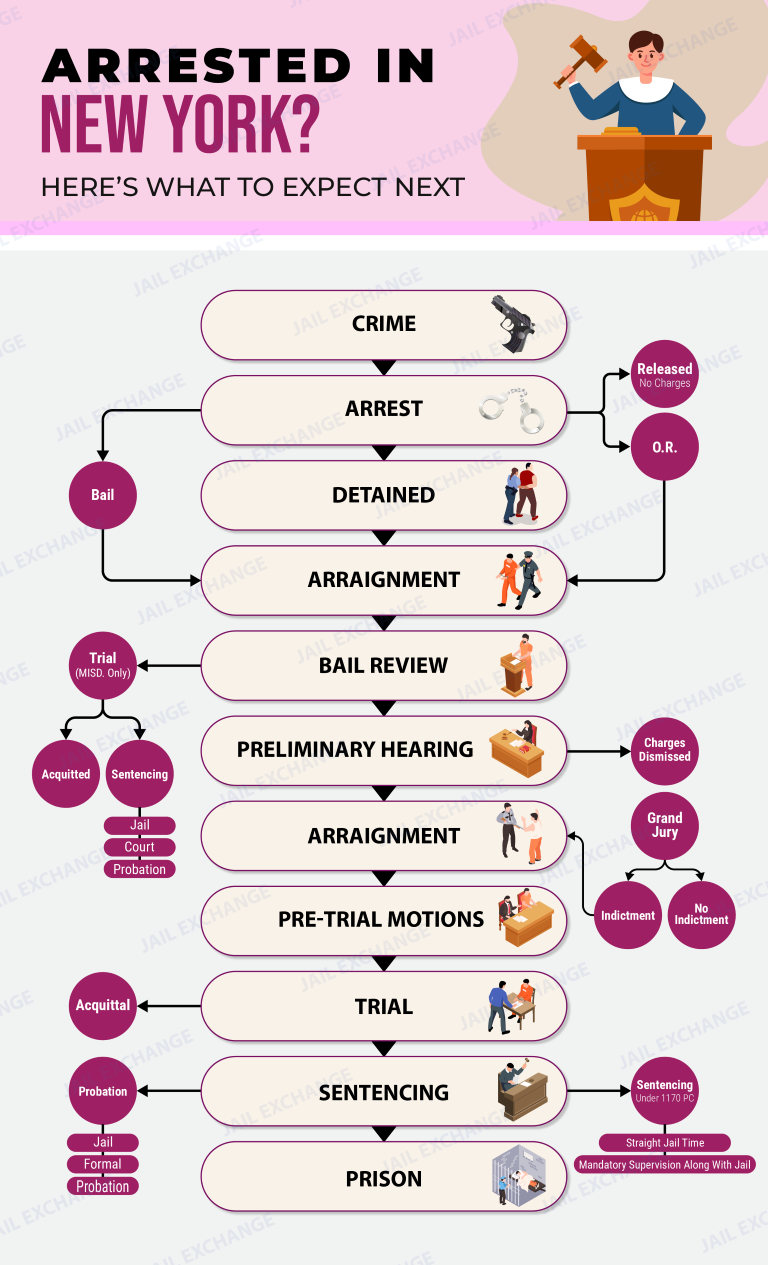
Cayuga County Jail Criminal Court Process
Criminal Court Process for Cayuga County New York
Cayuga County Criminal Court Guide
Three courts on Genesee Street in Auburn, plus a ring of town and village justices, decide criminal cases in this county. Adults awaiting trial are housed at the Cayuga County Jail, 7445 County House Road, Auburn, NY 13021. This guide covers every courthouse, how a case moves, who the lawyers are, warrants, federal and immigration holds, and teen cases.
Check the Sheriff's inmate lookup or statewide VINE to confirm someone is being held. Our Inmate Lists page digs into custody itself: new bookings, live warrants, the charges, getting belongings back, mugshots and public defenders.
Ring the jail at 315-253-2911. Ask what court the charge sits in and the person's next date there. If a judge set bail, our bail page lays out each way to pay it.
1. Misdemeanor or felony: which Cayuga County court gets the case?
Charges come in three sizes. Felonies are the heavy ones. The law ranks them by letter, A down to E, and A is the worst. A conviction can mean state prison. Misdemeanors sit lower, split into class A and class B, and a county jail term for one tops out at 364 days (Penal Law § 70.15). A violation is an offense, yet not a crime.
- City, town and village courts: these are the local courts. They hear misdemeanors, violations and traffic tickets. In felony cases they handle only the first steps, like the arraignment and an early hearing on the evidence.
- County Court: picks up a felony after a grand jury indictment. Supreme Court, in the same building, may also take felony charges.
- Family Court and the Youth Part: young people's cases, explained in the teen answer below.
These courts are part of the 7th Judicial District. An appeal goes up to the Fourth Department of the Appellate Division.
↑ Back to the question list2. Which Genesee Street buildings hold the main courts?
The county's bigger courts sit a short walk apart in downtown Auburn:
- Supreme and County Court, 152 Genesee Street, Auburn, NY 13021, 315-237-6450. Open Monday through Friday, 9 a.m. to 5 p.m. Its drug treatment court can be reached through extension 1.
- Auburn City Court, inside the Historic Old Post Office Building, 157 Genesee Street, Auburn, NY 13021, 315-237-6420. Open weekdays from 8 a.m. to 4 p.m., and home to a second drug treatment court.
- Family Court, 157 Genesee Street, Auburn, NY 13021, 315-237-6400. Weekdays 9 a.m. to 5 p.m. Phone first so you head to the right door.
Night and weekend arrests may go to the county's centralized arraignment part, listed by the courts as the "Cayuga CAP." Ask the jail where a late-night arraignment took place. Probation also staffs liaisons for a behavioral health court from 152-154 Genesee Street, Floor 3, Auburn, NY 13021, 315-294-8115.
↑ Back to the question list3. Outside the city limits, where do town and village justices sit?
Every town keeps a justice court, and a few villages run their own. These are confirmed on the Unified Court System list or a village directory:
- Brutus Town Court, 9021 North Seneca Street, Weedsport, NY 13166, 315-834-6618
- Cato Town Court, 11320 Shortcut Road, Cato, NY 13033, 315-626-6904
- Genoa Town Court, 1000 Bartnick Road, Genoa, NY 13071, 315-364-6722
- Ledyard Town Court, 1099 Poplar Ridge Road, Aurora, NY 13026, 315-364-5708
- Locke Town Court, mail to PO Box 149, Locke, NY 13092, 315-497-2932
- Montezuma Town Court, 8192 Dock Street, Montezuma, NY 13117, 315-776-9163
- Moravia Town Court, 48 West Cayuga Street, Moravia, NY 13118, 315-497-0968
- Moravia Village Court, 315-497-9295, run from the village's Justice Center, 48 West Cayuga Street, Moravia, NY 13118
- Niles Town Court, 5921 New Hope Road, Moravia, NY 13118, 315-497-0066
- Owasco Town Court, 2 Bristol Avenue, Auburn, NY 13021, 315-253-9021
- Port Byron Village Court, 52 Utica Street, Port Byron, NY 13140, 315-776-9692
- Scipio Town Court, mail to PO Box 61, Scipio Center, NY 13147, 315-364-5325
- Throop Town Court, 7471 Robinson Road, Auburn, NY 13021, 315-253-0089
The towns of Aurelius, Conquest, Fleming, Ira, Mentz, Sempronius, Sennett, Springport, Sterling, Summerhill, Venice and Victory also have town courts. The Unified Court System's court finder lists their addresses and hours. For the villages of Aurora, Cayuga, Fair Haven, Meridian, Union Springs and Weedsport, the finder shows whether a village court sits or the town court takes the case. The County Court clerk can also help at 315-237-6450.
↑ Back to the question list4. Arraignment day: what does the judge do?
Plenty of people go home from the station with a paper ticket. For most charges below a class D felony, police must give an appearance ticket with a court date. They hold the person only when an exception fits, such as an open warrant or a family-violence charge (CPL 150.20(1)).
Those who are held see a judge at arraignment, usually within about 24 hours. At that hearing:
- The judge reads out the charges.
- A lawyer stands with the person, assigned free if they can't pay (CPL 510.10(2)).
- The judge chooses among release, conditions, bail or remand, then states why on the record (CPL 510.10(1)).
- In felony cases, the prosecutor gets a turn before any release, and the judge reads the rap sheet (CPL 530.20(2)).
Felony holds carry a deadline. Release must follow unless a preliminary hearing has begun, the grand jury has voted to indict, or prosecutors show a compelling reason. The limit is 120 hours, or 144 if the span covers a Saturday, Sunday or holiday (CPL 180.80). Written notice to the District Attorney lets the accused testify before the grand jury (CPL 190.50(5)).
↑ Back to the question list5. How does a misdemeanor move in a local Cayuga County court?
Misdemeanor cases begin and end in the court where the arraignment took place. Discovery, the hand-over of evidence, has deadlines: 20 days from arraignment when the defendant sits in jail, 35 days when out (CPL 245.10(1)(a)). They must also be ready for trial on time: 90 days when the top charge can bring more than three months, 60 days for lesser misdemeanors, and 30 days for a violation (CPL 30.30(1)).
Maximum penalties under the Penal Law:
- Class A misdemeanor: a $1,000 fine at most, and jail up to 364 days (Penal Law §§ 70.15, 80.05)
- Class B misdemeanor: no more than three months, and $500 or less
- Violation: 15 days at most, and $250
- A judge may order probation instead, lasting two or three years on a class A and a single year on a class B (Penal Law § 65.00)
- Conditional discharge: release on court rules with no supervision, for one year (Penal Law § 65.05)
People whose addiction drove the offense may ask about the drug treatment court in Auburn City Court. A conviction for a violation or traffic infraction is usually sealed right away (CPL 160.55), and Clean Slate seals most misdemeanors three years after sentence or release (CPL 160.57).
↑ Back to the question list6. From felony complaint to sentence: how does the process go?
Felonies begin in a local court and finish in County Court. The usual path:
- Arraignment on the felony complaint, in City Court, a town court or the CAP.
- A first check on the evidence. If the person is held, the 120- or 144-hour window forces fast action: either a judge hears the evidence at a preliminary hearing, or grand jurors take it up (CPL 180.80).
- Indictment. Grand jurors decide whether to charge.
- A second arraignment, this time in County Court, where the person pleads.
- Discovery and motions. The prosecution has six months to declare trial readiness (CPL 30.30(1)).
- A plea bargain or a trial, and sentencing if convicted.
Prison caps under Penal Law § 70.00(2): life (class A), 25 years (B), 15 (C), seven (D), four (E). Judges may also hand down a definite term of a year or under on a class D or E felony when anything longer would be unduly harsh, though not for repeat felons (Penal Law § 70.00(4)). Fines reach $5,000 or double the gain (Penal Law § 80.00). Felony probation terms are three, four or five years long (Penal Law § 65.00(3)). Some drug-driven felonies qualify for judicial diversion into treatment (CPL Article 216), which County Court's drug treatment court handles.
↑ Back to the question list7. Violent felonies: which tougher rules apply?
Violent felonies follow their own set of rules from arrest to sentence:
- Release. These are qualifying offenses, which opens the door to bail and, for a felony, remand (CPL 510.10(4)).
- Fixed sentences. The judge picks one number of years, inside a range that climbs with the class: 1.5 to 4 years for class E at the bottom, up to 5 to 25 years for class B (Penal Law § 70.02(3)). Post-release supervision comes after (Penal Law § 70.45).
- Examples. Second-degree assault is a class D violent felony, while first-degree robbery and first-degree burglary rank as class B.
- Protection orders. In family-offense cases, a final order at sentencing can run up to eight years past a felony sentence (CPL 530.12(5)).
- Youthful offender. A young person convicted of a class A felony or an armed felony usually can't get this softer status (CPL 720.10).
- Sealing. Clean Slate skips sex offenses and most class A felonies (CPL 160.57).
8. Which Cayuga County offices prosecute and defend criminal cases?
Prosecutions here are handled by the District Attorney, an elected official, from 95 Genesee Street, Auburn, NY 13021, 315-253-1391. Its District Attorney website has office news and victim help.
If paying a lawyer is out of reach, the Assigned Counsel Program steps in, 152 Genesee Street, Floor 2, Auburn, NY 13021, 315-253-1402. It assigns private lawyers paid by the county under County Law § 722.
- Counties must make counsel available at arraignment (Executive Law § 832(4)).
- A lawyer should be assigned on request, even before the paperwork on money is done.
- Jailed people, and households under 250% of federal poverty guidelines, are presumed to qualify.
After a conviction, probation supervision runs from the Probation Department, 152-154 Genesee Street, Floor 3, Auburn, NY 13021, 315-253-1246, weekdays 8 a.m. to 5 p.m.
↑ Back to the question list9. Court dates and case status: how can families check?
WebCrims, the state's free WebCriminal search, reaches only part of the state. Its coverage is the five boroughs, Long Island's two counties, six named County Courts and roughly 60 city courts. Cases appear only while open and set for a future date. Finished, sealed and youthful offender cases drop off, and so do cases stalled on a warrant.
The phone is the surest route here. Jot the legal name and birthday on paper before you call:
- Felony after indictment: County Court, 315-237-6450
- City cases: Auburn City Court, 315-237-6420
- Town and village cases: phone that court, using the list in answer 3
Lawyers from the Assigned Counsel Program, 315-253-1402, can also tell their clients the next date.
↑ Back to the question list10. How do I check for a Cayuga County warrant and clear it?
In the towns, Sheriff's deputies carry out warrants. Inside the city, Auburn police do. To check on a warrant, the numbers are 315-253-1222 for the Sheriff's Office and 315-253-3235 for the city police command desk. Three official lists help: the weekly active warrants report on the Sheriff's Office page, the city's APD Warrant Log and the State Police wanted list. Clearing one starts with a lawyer. With that lawyer, the person can walk into the issuing court, or phone it and ask for a fresh date. Felony warrants belong to County Court, 152 Genesee Street, Auburn, NY 13021, 315-237-6450.
↑ Back to the question list11. How do federal charges from Cayuga County proceed?
Any federal charge filed here lands in the Syracuse Division of the U.S. District Court for the Northern District of New York, James Hanley Federal Building, 100 South Clinton Street, Syracuse, NY 13261, 315-234-8500. The clerk's office keeps 8:30 a.m. to 5:00 p.m. hours.
- Detention is decided right at the start of a federal case. The judge weighs the charge, the proof, the person's past and local ties, and any risk to others (18 U.S.C. 3142).
- Deputy marshals keep federal defendants locked up before trial and drive them to each hearing. The U.S. Marshals Service district office: 100 South Clinton Street, Floor 10, Syracuse, NY 13261, 315-473-7601. The Marshals also use beds at the county jail, according to the Sheriff's Custody page.
- The Federal Public Defender's office handles defense for those who can't pay, at 4 Clinton Square, Floor 3, Syracuse, NY 13202, 315-701-0080.
- In most felony cases, the judge reads a probation report before sentencing.
- Court files are on PACER. Once sentenced, use the Federal Bureau of Prisons inmate locator.
12. How can an ICE detainer affect the criminal case?
The state case itself carries on. Where a detainer bites is release day. On the federal side, expect these steps:
- ICE (Immigration and Customs Enforcement) lodges a detainer with the jail, using Form I-247A.
- That paper asks for the person to be kept up to 48 hours after they would otherwise be released (8 CFR 287.7(d)).
- ICE officers then come to collect the person. ICE's Buffalo Field Office, 130 Delaware Avenue, Buffalo, NY 14202, 716-843-7600, runs a large upstate holding site in Batavia.
- Look the person up on the ICE Online Detainee Locator.
New York sets limits. In People ex rel. Wells v DeMarco (2018), the Appellate Division ruled that no New York law gives state or local officers power over civil immigration arrests. In 2026, Executive Law § 170-k made local 287(g) agreements void and barred agreements to detain people just for civil immigration reasons. Court orders and judicial warrants are still followed. Civil Rights Law § 28 covers parties and witnesses who come to court in good faith, plus their family or household members. None of them may be civilly arrested going to, at, or coming back from court. The one exception is an arrest backed by a judge's warrant or order.
↑ Back to the question list13. Bound for a state prison term: where does the person go?
Jail sentences up to one year are served locally, on County House Road. Anything longer on a felony is a state term with the Department of Corrections and Community Supervision (DOCCS). DOCCS must pick the person up inside ten business days after the county reports them ready. Reception staff fingerprint and photograph each new arrival, run health and program checks, and assign a security level before a transfer to a long-term prison.
- Find the person with the DOCCS Incarcerated Lookup.
- Check parole status on the DOCCS parolee lookup.
- Learn about visits and mail at each facility on our New York prisons page.
14. How does Cayuga County handle charges against a teenager?
Age decides the court:
- Ages 12 to 17, most acts: Family Court, as a juvenile delinquency case (Family Court Act § 301.2).
- Ages 13 to 15, the gravest felonies: "juvenile offenders," such as for murder or armed robbery, begin in adult court (CPL 1.20(42)).
- 16 or 17, charged with a felony: called adolescent offenders, they start in the Youth Part. A violent felony is reviewed six days after arraignment, and most other felonies are moved to Family Court (CPL 722.23).
- 16 or 17, charged with a misdemeanor: probation intake handles it.
Officers must notify a parent at once. Questioning is allowed only in a room the court system has designated, or at home with a parent's consent, and it must be video recorded (Family Court Act § 305.2). A teen held before trial is placed in juvenile detention rather than the adult jail. To learn where, call the Probation Department's juvenile officer at 315-253-1689, or Family Court at 315-237-6400.
↑ Back to the question list15. Crime victims in Cayuga County: where can they turn?
The District Attorney's Crime Victim Witness Coordinator walks victims through court. Call 315-253-1494 or visit 95 Genesee Street, Auburn, NY 13021.
- Medical bills, counseling and funeral costs may be covered by the state Office of Victim Services. Call 800-247-8035.
- VINE sends custody alerts. Register at 888-846-3469 or on VINELink.
- When a family-offense case is dropped or pleaded down, prosecutors should try to let the victim know about a Family Court petition (CPL 530.12(14)).
- Crisis help: the Domestic Violence Line at 800-253-3358, the SAVAR sexual assault hotline at 315-252-2112, and the county mental health crisis line at 315-253-0341.