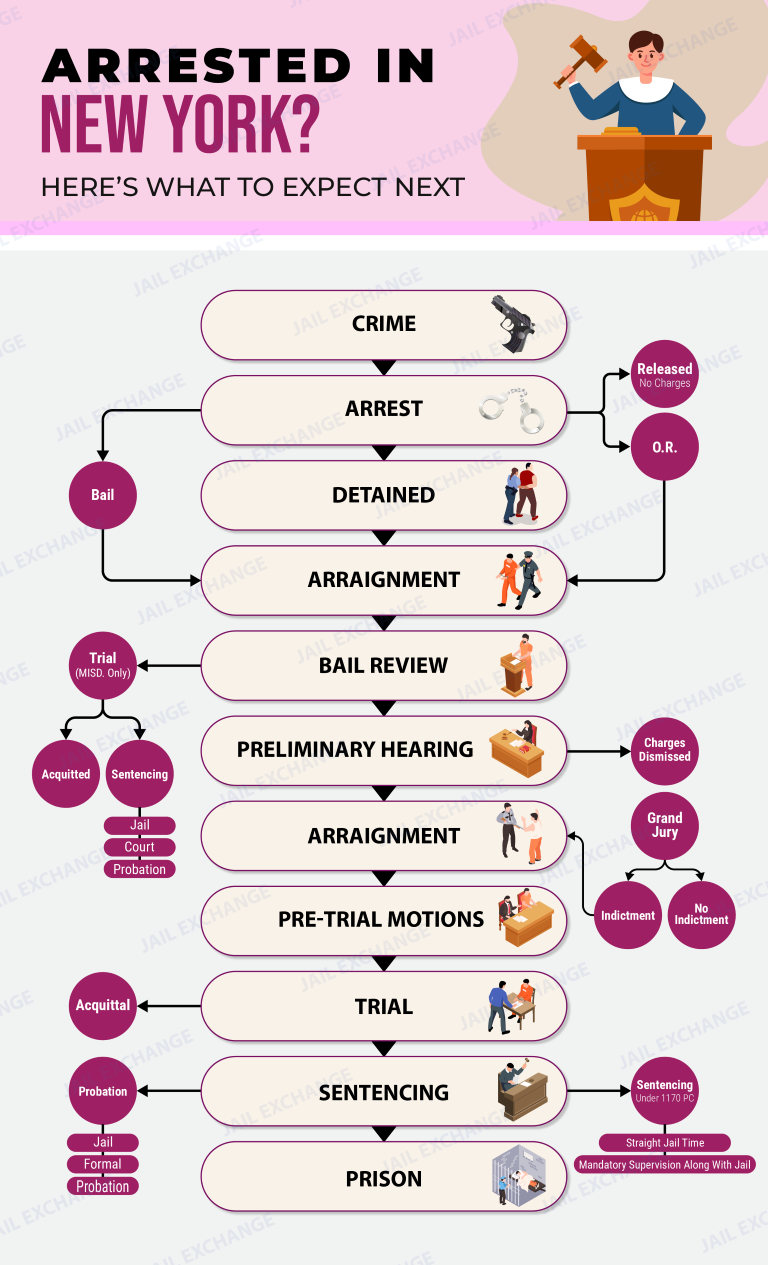
Essex County Jail Criminal Court Process
Criminal Court Process for Essex County New York
Essex County Criminal Court Guide
Defendants from this county who are not released wait at the Essex County Jail, 702 Stowersville Road, Lewis, NY 12950. Their cases open in one of 19 town and village courts. Felonies that a grand jury indicts move to County Court, 7559 Court Street, Elizabethtown, NY 12932. Below you will find every court's address, each stage of a case, and who prosecutes and defends.
The Sheriff's inmate lookup tells you whether someone is still behind bars in Lewis. Our Recent Arrests page takes on the rest of custody: current inmates, new arrests, warrants, charge details, mugshots, assigned lawyers and property pickup.
Your first call can go to the jail at 518-873-6970. Ask which court holds the case, the next court date, and whether bail was set. If your person is still locked up, our Essex bail page covers how release works.
1. Misdemeanor or felony: which courtroom gets the case?
The answer turns on how the charge is graded. New York ranks every offense. Felonies are grave crimes punishable by state prison, graded with letters from A (gravest) through E. Misdemeanors are lesser crimes punished in a local jail: as long as 364 days for class A, three months for class B (Penal Law § 70.15). Violations, like disorderly conduct, are not crimes, and 15 days is their jail limit.
- Town and village courts try misdemeanors, violations and traffic matters. Felony cases also start in these small courtrooms, where the first appearance and, if one is held, the preliminary hearing take place.
- County Court takes a felony after indictment and handles its plea, trial and sentence. Supreme Court shares the same Elizabethtown building.
- Cases against minors belong to Family Court or to County Court's Youth Part.
The county belongs to the Fourth Judicial District of the state courts. An appeal from here heads to Albany, where the Third Department of the Appellate Division sits.
↑ Back to the question list2. What sits inside the Essex County Courthouse?
One building on Court Street in the county seat holds the higher courts: the Essex County Courthouse, 7559 Court Street, Elizabethtown, NY 12932. Court mail goes to PO Box 217, Elizabethtown, NY 12932. Parking is on site or next door, and clerks keep regular business hours.
- Supreme and County Courts: 518-873-3370. The Integrated Domestic Violence Part, which hears a family's criminal and Family Court matters together, uses this line too.
- Family Court: 518-873-3320
- Surrogate's Court: 518-873-3384
- Treatment courts (Superior Court drug treatment, Family Treatment, Regional Veterans and Mental Health): 518-873-3639
- Disability access requests: 518-285-5099
- Supreme Court Law Library: 518-873-3377, weekdays 9 a.m. to 4:30 p.m.
The County Clerk keeps court records in the same building, 518-873-3600. That office is open 9 a.m. to 4:45 p.m., or 8 a.m. to 3:50 p.m. from June through August.
↑ Back to the question list3. Where does each town and village court meet?
Every one of the 18 towns keeps a justice court. Lake Placid, a village inside North Elba, has its own too. With no city in the county, there are no city courts. Sessions in these small courts happen on fixed days, often once or twice a week, so call ahead.
- Chesterfield: town offices, 1 Vine Street, Keeseville, NY 12944, 518-834-9042
- Crown Point: 2793 NYS Route 9N, Crown Point, NY 12928, 518-597-4144
- Elizabethtown: 7563 Court Street, Elizabethtown, NY 12932, 518-873-2047
- Essex: town office, 2313 Main Street, Essex, NY 12936, 518-963-4287, ext. 7
- Jay: Community Center, Au Sable Forks; mail to PO Box 730, Au Sable Forks, NY 12912, 518-647-2204, ext. 107
- Keene: Town Hall, Route 73, Keene, NY 12942, 518-576-4556
- Lewis: 8566 Route 9, Lewis, NY 12950, 518-873-3204
- Minerva: 5 Morse Memorial Highway, Minerva, NY 12851, 518-251-2019
- Moriah: 42 Park Place, Port Henry, NY 12974, 518-546-9955
- Newcomb: town offices, 5639 State Route 28N, Newcomb, NY 12852, 518-582-3211
- North Elba: 2693 Main Street, Lake Placid, NY 12946, 518-523-2141
- Lake Placid Village Court: 2693 Main Street, Lake Placid, NY 12946, 518-523-2004
- North Hudson: 2946 US Route 9, North Hudson, NY 12855, 518-532-0587
- St. Armand: town office, 1702 NYS Route 3, Bloomingdale, NY 12913, 518-891-3189, ext. 4
- Schroon: 15 Leland Avenue, Schroon Lake, NY 12870, 518-532-0569
- Ticonderoga: 132 Montcalm Street, Suite 4, Ticonderoga, NY 12883, 518-585-7141
- Westport: 22 Champlain Avenue, Westport, NY 12993, 518-962-4882
- Willsboro: 5 Farrell Road, Willsboro, NY 12996, 518-963-8668, ext. 6
- Wilmington: 7 Community Center Circle, Wilmington, NY 12997, 518-946-7174, ext. 304
Session days and hours appear in the state's listing of local justice courts.
↑ Back to the question list4. What happens at an arraignment in a town justice court?
Most arraignments happen within about 24 hours, in the local court for the town where police made the arrest. The Sheriff's 2026 arrest log shows people kept at the Lewis jail until that hearing, then often released right at court. At the hearing:
- The judge reads the charges or confirms the person has a copy.
- A lawyer stands with the person. If they can't pay, one is assigned on the spot.
- The justice rules on custody, choosing among release, conditions, bail or remand.
- For a family offense, expect the judge to consider a temporary order of protection (CPL 530.12).
Felony arraignments add two safeguards. First, there is a 120-hour clock. A person held that long on a felony complaint goes free on recognizance if, by then, no preliminary hearing has opened and the grand jury in Elizabethtown has not voted. A weekend or holiday stretches it to 144 hours (CPL 180.80). Second, a defendant who wishes to testify before the grand jury gets that chance by serving written notice on the DA first (CPL 190.50(5)).
↑ Back to the question list5. Petit larceny and other misdemeanors: how do they proceed?
From start to finish, a misdemeanor is handled by the local justice court. Discovery, the handover of the DA's evidence, is due 20 days after arraignment if the defendant sits in jail, or 35 days if they were released (CPL 245.10). Next come plea talks, motions, and a trial if the case does not settle. Speedy trial rules set the DA's deadline at 90 days when a class A misdemeanor is charged, or 60 days for class B (CPL 30.30).
Maximum penalties by class (Penal Law §§ 70.15, 80.05):
- Class A misdemeanor, such as petit larceny: jail as long as 364 days, fine as high as $1,000
- Class B misdemeanor: jail as long as three months, fine as high as $500
- Violation: jail as long as 15 days, fine as high as $250
Instead of jail, a justice may impose probation, set at two or three years for class A misdemeanors, or a conditional discharge, which is one year of staying out of trouble with no officer checking in. Some traffic tickets qualify for two programs run by the Elizabethtown prosecutor. Traffic Diversion costs $305; the charge is dropped and no points go on the license. Traffic Reduction costs $25 and cuts the points. These are not offered on misdemeanor or felony tickets.
↑ Back to the question list6. What path does an Essex County felony follow?
- Arraignment on a felony complaint in a town or village court.
- Testing the charge. Either the local justice tests the evidence, or prosecutors take the case to grand jurors in Elizabethtown.
- Indictment. If jurors vote charges, the defendant pleads to them in County Court.
- Discovery and motions. Both sides trade evidence. Felony prosecutors get six months to declare readiness (CPL 30.30).
- Resolution. Most cases end in a plea deal; the rest go to a jury. A sentencing date follows any conviction.
Maximum prison time is tied to the felony's letter grade (Penal Law § 70.00). Class A carries a possible life term. The ceiling falls to 25 years at class B, 15 at C, 7 at D and 4 at E. Felony fines reach $5,000 or twice the gain from the crime (Penal Law § 80.00). A class D or E felony can also end with a county jail term of no more than a year, if the judge decides prison would be unduly harsh. Probation on a felony is usually three to five years.
People whose addiction drove the crime may be steered into the county's Superior Court treatment court instead (CPL Article 216). Ask the program staff at 518-873-3639.
↑ Back to the question list7. What changes when the felony is violent?
Nearly every step gets tougher:
- Release. Because violent felonies are qualifying offenses, the judge can choose cash bail or remand.
- Fixed sentences. Each comes with a determinate term, one fixed number of years, and post-release supervision afterward (Penal Law § 70.02). The floor and ceiling are 5 and 25 years at class B, 3.5 and 15 at class C, 2 and 7 at class D, and 1.5 and 4 at class E.
- Examples. Robbery or burglary in the first degree sits at class B, and assault in the second degree at class D.
- Protection orders. A final felony order can last eight years beyond the sentence's maximum term (CPL 530.12).
- Records. Violent felonies cannot be sealed by later application (CPL 160.59).
Even a violent felony by a 16- or 17-year-old can be moved to Family Court. Keeping it in County Court's Youth Part takes proof of serious physical injury, a weapon displayed, or a sex crime (CPL 722.23).
↑ Back to the question list8. Who prosecutes, and who defends people short on money?
Voters choose the District Attorney, whose staff handles all criminal prosecutions here, in the smallest town court and in County Court alike. The office is in the courthouse basement, 7559 Court Street, Elizabethtown, NY 12932, 518-873-3335. Staff cannot grant adjournments; only the court can.
Each county runs its own plan for defending people who cannot pay (County Law § 722). Here there are three offices:
- Public Defender: 518-873-3880. Call for the office location and intake hours.
- Conflict Defender, used when the Public Defender's office has a conflict: 518-873-3442
- Assigned Counsel Office: PO Box 217, Elizabethtown, NY 12932, 518-873-3511, weekdays 8 a.m. to 3:30 p.m. Use the county's lawyer application.
Courts presume someone qualifies if they are locked up, or if their household earns less than 250% of the federal poverty guidelines. Any dispute goes to the judge.
↑ Back to the question list9. Who can tell me a court date for a town court case?
The state's WebCrims site lists pending criminal cases that still have a court date coming up. Its reach is limited to New York City, Nassau and Suffolk, six downstate County Courts and roughly 60 city courts. None of the North Country courts here are among them, so phone the clerk.
- Felonies after indictment: County Court clerk, 7559 Court Street, Elizabethtown, NY 12932, 518-873-3370
- Misdemeanors and new felony cases: the town or village court where the person was arraigned. The jail at 518-873-6970 can tell you which court that is.
- Court records: County Clerk, same address, 518-873-3600
Give the clerk the full name and date of birth, and a ticket or case number if one was issued. For federal cases, search PACER, which costs 10 cents a page with a $3 cap per document.
↑ Back to the question list10. Who in Lewis can say whether a warrant is out?
Warrants here are served by Sheriff's deputies, State Police troopers, and the Lake Placid, Saranac Lake and Ticonderoga police. For an answer on any open warrant, ring the Sheriff's Office in Lewis at 518-873-6970 or the clerk of the likely court. The state's State Police wanted page lists people troopers are seeking. A missed court date normally brings 48 hours' notice before any bench warrant, giving a chance to show up voluntarily (CPL 510.50). Clearing a warrant starts with a lawyer. Together you can appear before the judge who signed it, or the lawyer can call that court to reset the date. On felony warrants, contact the County Court clerk at 7559 Court Street, Elizabethtown, NY 12932, 518-873-3370.
↑ Back to the question list11. What happens to an Adirondack case in federal court?
Federal cases from Essex towns are assigned to the Malone/Plattsburgh Division of the U.S. District Court for the Northern District of New York. The Plattsburgh court is in the Gateway Building, 14 Durkee Street, Suite 360, Plattsburgh, NY 12901, 518-247-4501. Its hours vary, so call before going.
- Where the defendant waits for trial gets settled at a detention hearing the day they first see a federal judge. Postponements are short: three days for the government, five for the defense (18 U.S.C. 3142(f)).
- The judge weighs the crime, the evidence, the person's roots in the area, their record and any risk to the public (18 U.S.C. 3142(g)).
- Federal deputies of the U.S. Marshals Service keep held defendants. The Marshals run the Northern District from 100 South Clinton Street, 10th Floor, Syracuse, NY 13261, 315-473-7601.
- Defendants who cannot pay may use the Federal Public Defender, 54 State Street, Suite 310, Albany, NY 12207, 518-436-1850.
Pleas end most federal cases; over 90% of defendants plead guilty. After sentencing, the Federal Bureau of Prisons inmate locator shows the assigned prison. FCI Ray Brook, a federal prison inside this county, sits at 128 Ray Brook Road, Ray Brook, NY 12977, 518-897-4000.
↑ Back to the question list12. Does an immigration detainer pause the state charges?
No. The charges here move ahead as usual. An immigration detainer matters on release day. Here is the federal side:
- Immigration officers send Form I-247A to the Lewis jail.
- It asks for custody up to 48 hours after they would otherwise be released (8 CFR 287.7(d)), so agents can take over.
- ICE's Buffalo Field Office, 130 Delaware Avenue, Buffalo, NY 14202, 716-843-7600, runs detention upstate. Its sites include the Batavia processing center and space at the Clinton County Jail in Plattsburgh.
- The ICE Online Detainee Locator searches for people in ICE custody.
New York's own rules come next. People ex rel. Wells v DeMarco, decided in 2018, held that New York law does not let its local officers make arrests over civil immigration issues. Executive Law § 170-k, from the state budget of May 27, 2026, cancelled every 287(g) agreement in New York effective August 25, 2026. Under Civil Rights Law § 28, a civil arrest of a person traveling to or from a court date needs a judicial warrant or order. Since some pleas carry immigration risks, share any status questions with the defense lawyer early.
↑ Back to the question list13. How does an Essex County prison sentence begin?
Short sentences, up to a year, keep the person at the Lewis jail, which houses sentenced adults alongside those awaiting trial. Longer felony terms go to the state Department of Corrections and Community Supervision (DOCCS). DOCCS policy requires the state to receive each person within ten business days of being declared state ready. They pass through an intake center for testing and classification before reaching their assigned prison.
- Find the person on the DOCCS Incarcerated Lookup by last name or DIN.
- DOCCS central office: 1220 Washington Avenue, Building 4, Albany, NY 12226, 518-457-5000
- Prison-by-prison facts: our New York state prisons page.
14. Which court takes cases against minors?
New York's Raise the Age law, fully in force for 17-year-olds since October 1, 2019, keeps most teens out of adult court:
- Ages 12 to 15: Family Court hears most cases as juvenile delinquency. Some very serious crimes at 13, 14 or 15 make the youth a "juvenile offender" in the Youth Part.
- Ages 16 and 17: a felony opens in County Court's Youth Part, and a nonviolent one usually transfers to Family Court. Probation intake takes misdemeanor arrests.
Police must notify a parent and may question a child only in a room the courts approve, with the session on video (Family Court Act § 305.2). The Lewis jail accepts no one under 18. Family Court is in the courthouse, 7559 Court Street, Elizabethtown, NY 12932, 518-873-3320. Probation intake works from 702 Stowersville Road, Lewis, NY 12950, 518-873-3650, and can say where a detained youth was taken.
↑ Back to the question list15. How are Essex County crime victims helped?
The District Attorney's Office at 7559 Court Street, Elizabethtown, NY 12932, 518-873-3335, answers questions from victims about where a case stands. Ask for the staff member who works with victims.
- Orders of protection. Judges in criminal cases can bar the defendant from contact for as long as the case lasts (CPL 530.12).
- Release alerts. Register with VINE by calling 888-846-3469 or on VINELink.
- Compensation. The state Office of Victim Services can help with medical, counseling and funeral costs. Call 800-247-8035.
- Family offense cases. Should the DA decline, dismiss or plea down a family offense, staff must try to inform the victim that Family Court remains open to them.