Jefferson County Correctional Facility Criminal Court Process
Criminal Court Process for Jefferson County New York
Jefferson County Criminal Court Guide
This guide follows a Jefferson County criminal case from the first hearing to sentencing. Misdemeanors, violations and early felony steps go to Watertown City Court or to a justice in one of the 22 towns or Carthage village. Indicted felonies move up to County Court, 163 Arsenal Street, Watertown, NY 13601. Adults a judge did not release are held at the county Correctional Facility, 753 Waterman Drive, Watertown, NY 13601.
Open the Sheriff's inmate lookup to see whether someone is in custody right now. Questions about the arrest and the jail stay are the focus of our Jail Roster page: current inmates, fresh bookings, open warrants, criminal charges, mugshots and public defenders.
First, find out which court has the case and the date the defendant is due back. Booking/Intake at 315-786-2688 can name the court, and then that clerk can give the date. County Court's clerks answer at 315-570-2950 on weekdays. Money, forms of bail and the Waterman Drive lobby are covered on our bail page.
1. Misdemeanor or felony: which Jefferson County court takes the case?
Seriousness decides. New York ranks offenses in three tiers:
- Violations, like disorderly conduct, are offenses but not crimes. Jail for one can't pass 15 days.
- Misdemeanors are lesser crimes. Class A can bring a local jail term as long as 364 days. Class B carries up to three months (Penal Law § 70.15).
- Felonies are serious crimes, ranked from class A down to class E. State prison is possible.
Local criminal courts take violations and misdemeanors from start to finish. Inside city limits, that means Watertown City Court. Outside the city, the case belongs to the local justice in the town or village of the arrest. Those same local judges also arraign felony suspects and can hold preliminary hearings.
After an indictment, a felony goes to County Court on Arsenal Street. The county's Supreme Court, at the State Office Building, mostly hears civil cases. Federal crimes skip all of these and go to the federal court in Syracuse.
↑ Back to the question list2. Where do the main courts sit on Arsenal and Washington streets?
Four courts in the city handle criminal and family matters. They belong to New York's Fifth Judicial District. Appeals from here are heard by the Fourth Department of the Appellate Division.
- County Court, for felonies after indictment: 163 Arsenal Street, Watertown, NY 13601, 315-570-2950. Open 8:30 a.m. to 4:30 p.m., Monday to Friday.
- Supreme Court: State Office Building, 317 Washington Street, Watertown, NY 13601, 315-221-5818. Same weekday hours. It shares a Chief Clerk with County Court.
- Family Court, for youth and family cases: 163 Arsenal Street, Watertown, NY 13601, 315-570-2970.
- City Court: Municipal Building, 245 Washington Street, Watertown, NY 13601, 315-570-2720. The office opens 8:30 a.m. to 4:30 p.m. on weekdays. The criminal calendar starts at 10:00 a.m. and arraignments at 11:00 a.m.
Don't confuse the Court Complex with the County Office Building at 175 Arsenal Street, Watertown, NY 13601. That second building holds the District Attorney, the Public Defender and Probation, but no courtrooms.
↑ Back to the question list3. Every local justice court, from Adams to Wilna: where are they?
The county has one city court, 22 town courts and one village court. Some share a building. Grouped by area:
City and nearby towns
- Watertown City Court: 245 Washington Street, Watertown, NY 13601, 315-570-2720
- Town of Watertown Court: 22869 County Route 67, Watertown, NY 13601, 315-782-0412
- Pamelia: 25859 NYS Route 37, Watertown, NY 13601, 315-785-9794
- Brownville: 16431 Star School House Road, Dexter, NY 13634, 315-639-6266
- Rutland: 28411 NYS Route 126, Black River, NY 13612, 315-788-3440
River and lake towns
- Alexandria: 46372 County Route 1, Alexandria Bay, NY 13607, 315-482-9637
- Cape Vincent: 1964 State Route 12E, Cape Vincent, NY 13618, 315-654-3883
- Clayton: 401 Mary Street, Clayton, NY 13624, 315-686-2427
- Orleans: 20558 Sunrise Avenue, LaFargeville, NY 13656, 315-658-2272
- Lyme: 12175 NYS Route 12E, Chaumont, NY 13622, 315-649-2788
- Hounsfield: 411 West Washington Street, Sackets Harbor, NY 13685, 315-646-2767
- Henderson: 12105 Town Barn Road, Henderson, NY 13650, 315-938-5542
Southern towns
- Adams: 3 South Main Street, Adams, NY 13605, 315-232-2467
- Ellisburg: Town Hall, Main Street, PO Box 112, Ellisburg, NY 13636, 315-846-9216
- Lorraine (combined with Worth): 20876 County Route 189, Suite 5, Lorraine, NY 13659, 315-232-2639
- Rodman: 12509 School Road, Rodman, NY 13682, 315-232-2522
Eastern and Fort Drum area towns
- LeRay: 8650 LeRay Street, Evans Mills, NY 13637, 315-629-0228
- Champion: 10 North Broad Street, Carthage, NY 13619, 315-493-2687
- Wilna Town Court and Carthage Village Court (one office): 120 South Mechanic Street, Carthage, NY 13619, 315-493-2890
- Philadelphia: 33019 US Route 11, Philadelphia, NY 13673, 315-642-0218
- Antwerp: 45 Main Street, Antwerp, NY 13608, 315-659-8989
- Theresa: 215 Riverside Avenue, Theresa, NY 13691, 315-628-4148
Most town justices sit part time. For court nights and office hours, phone the court, or search the state justice court locator.
↑ Back to the question list4. What should families expect at the first hearing?
Lawyers call it the arraignment. The state court system says it usually comes about 24 hours after arrest. Night sessions happen when needed, and the District Attorney's Office sends someone to them.
The hearing is short. In a few minutes:
- The judge goes over the charges.
- A lawyer stands beside them. When the family can't pay, the Public Defender steps in.
- Both sides make their case on release.
- The judge issues a securing order. That can be release on a promise, release with conditions, bail, or, on a narrow list of felonies, jail without bail.
- A new date is set. On some misdemeanors, a plea can happen on the spot.
Families may sit in the gallery. Bring the defendant's address and job details to help the lawyer argue for release. If bail is set, our bail page explains where it is paid.
↑ Back to the question list5. From ticket to sentence: how do misdemeanors like DWI or petit larceny unfold?
Lots of these cases start with a desk appearance ticket, so the person sleeps at home. The ticket tells them which local court to go to and when.
Next comes the arraignment. Prosecutors then owe the defense their evidence: within 20 days for someone in custody, 35 days for someone free (CPL 245.10(1)(a)). Conferences follow, and many cases end there with a reduced charge or a dismissal. A few go to trial before the town justice or the City Court judge.
The speedy trial clock gives the People 90 days on a class A misdemeanor. A class B allows 60 (CPL 30.30(1)).
The possible punishments:
- Class A misdemeanor: a jail sentence of 364 days or less, a fine as high as $1,000, or probation of two or three years.
- Class B misdemeanor: as long as three months of jail, a fine as high as $500, or one year of probation.
- Violation: no more than 15 days of jail, and a fine capped at $250.
- Conditional discharge: freedom with court rules for a year, but no jail and no supervising officer.
Thanks to Clean Slate, which started November 16, 2024, a misdemeanor conviction is sealed on its own once three years pass after sentence or release.
↑ Back to the question list6. What are the steps in a Jefferson County felony case?
A felony moves in stages, and it changes courts along the way:
- Felony complaint. Police file it, and a city, town or village judge holds the arraignment.
- The five-day clock. A jailed defendant must be let go after 120 hours, unless by then the preliminary hearing is underway or the grand jury has voted. That limit grows to 144 hours if it spans a Saturday, Sunday or legal holiday (CPL 180.80).
- Grand jury. Before any indictment, the accused can send the District Attorney written notice and appear as a witness (CPL 190.50(5)).
- Indictment. The case moves to County Court, and the defendant is arraigned again there.
- Discovery and motions. The prosecution must hand over its evidence, and the defense can ask the judge to throw out evidence or charges.
- Plea or trial. Six months is the deadline for prosecutors to declare readiness (CPL 30.30(1)).
- Sentencing. Probation usually writes a report first.
For nonviolent felonies, the longest possible terms are life at class A, 25 years at class B, 15 at class C, 7 at class D and 4 at class E (Penal Law § 70.00). Sometimes, at the D or E level, the judge can choose a county jail term of one year or less. Probation on a felony runs three, four or five years. Through Judicial Diversion (CPL Article 216), some felony defendants whose crimes grow out of addiction can be steered into treatment.
↑ Back to the question list7. What makes a violent felony charge so much riskier?
Some crimes are called violent felony offenses (Penal Law § 70.02). First-degree robbery is class B, as is first-degree burglary. Robbery in the second degree is class C, and so is second-degree gun possession. Assault in the second degree is class D.
Three things change for these cases:
- Release. These are qualifying offenses. A judge may set bail, and sometimes may hold the person with no bail.
- Fixed sentences. The judge picks one exact term. The floor and ceiling, in years: B, 5 and 25; C, 3.5 and 15; D, 2 and 7; E, 1.5 and 4.
- Supervision after prison. A period of post-release supervision follows the prison term (Penal Law § 70.45).
Violent felony convictions can't be sealed later by application (CPL 160.59). With so much at stake, the defendant should talk with a lawyer before saying anything to police or the prosecutor.
↑ Back to the question list8. Which offices prosecute and defend Jefferson County cases?
One elected District Attorney brings charges in every local court. Find the office at 175 Arsenal Street, Watertown, NY 13601, up on the seventh floor, 315-785-3053. Hours are 8:30 a.m. to 4:30 p.m., or 8 to 4 in July and August. Its assistant prosecutors are posted to City Court and to each town and village bench.
People who can't pay a lawyer are represented by the Public Defender, 175 Arsenal Street, Watertown, NY 13601, on the fourth floor, 315-785-3152. The office works 8:30 a.m. to 4:30 p.m. and covers night courts. It takes cases in every local court and County Court, plus parole violation hearings and some Family Court matters. A judge approves eligibility after the defendant fills out a financial form.
Under state standards, a person in jail is presumed eligible. A lawyer should be assigned at the first hearing, without waiting on paperwork. If the Public Defender has a conflict, the judge sees that another lawyer is appointed.
↑ Back to the question list9. How can I find a court date or the status of a case?
Calling the court beats any website. Give the clerk the defendant's name as it appears on the charge, plus a birth date.
- City arrests: Watertown City Court, 245 Washington Street, Watertown, NY 13601, 315-570-2720
- Indicted felonies: County Court, 163 Arsenal Street, Watertown, NY 13601, 315-570-2950
- Town or village cases: the town court's own number in the court list above
The state's WebCrims search covers selected courts around New York, mostly downstate and in larger cities. Its results include pending cases with a date still to come, and nothing else. Closed, sealed and youthful offender cases stay hidden. County Court here is outside its list, so call that clerk instead.
Defense lawyers learn each new date too, so ask them. The person in jail can also pass dates along on a call home.
↑ Back to the question list10. Is there a warrant out, and how does someone take care of it?
Sheriff's deputies handle warrant arrests in the towns and villages, 315-786-2700. City officers serve them inside Watertown, 315-782-2233. New York State Police post statewide fugitives on their Wanted and Missing page. For a local warrant, phone the court that may have issued it, or ask the Sheriff's Office. To resolve it, the person should first get legal advice. Then they surrender with the lawyer at the court that signed it, or phone that court and request a fresh date. Felony warrants usually come from County Court, 163 Arsenal Street, Watertown, NY 13601, 315-570-2950.
↑ Back to the question list11. How is a federal prosecution different from a state one?
Federal crimes go to the U.S. District Court for the Northern District of New York, not to any court in the county. Felonies are heard in Syracuse, at the James Hanley Federal Building, 100 South Clinton Street, Syracuse, NY 13261, 315-234-8500. Smaller federal offenses on Fort Drum have a division of their own.
At the first appearance, the federal judge reads the charges, offers a court-appointed lawyer and decides on custody. The detention hearing usually happens then, under 18 U.S.C. 3142(f). Most federal defendants end up pleading guilty, and a probation report comes before sentencing.
Pretrial custody belongs to the U.S. Marshals, and their district headquarters is upstairs in that building at 100 South Clinton Street, 10th Floor, Syracuse, NY 13261, 315-473-7601. Defendants who can't pay may be represented by the Federal Public Defender at 4 Clinton Square, 3rd Floor, Syracuse, NY 13202, 315-701-0080. Filings can be read on PACER at ten cents a page. After sentencing, use the Federal Bureau of Prisons inmate locator.
↑ Back to the question list12. How might an ICE detainer affect a Jefferson County case?
The criminal charges stay on the court's calendar either way. The detainer comes into play mainly at release time.
- A Form I-247A reaches the jail. It asks for a hold up to 48 hours after they would otherwise be released (8 CFR 287.7(d)).
- ICE agents come to the jail to take custody.
- Detention sites ICE uses in New York include the Buffalo (Batavia) Service Processing Center, 4250 Federal Drive, Batavia, NY 14020, 585-344-6500.
- Families can search the ICE Online Detainee Locator.
New York draws lines here. In 2018, Wells v DeMarco settled that New York officers can't make arrests over civil immigration status. The Attorney General tells local agencies to say yes to a detainer only if a judicial warrant is attached. Executive Law § 170-k, passed in 2026, bars local 287(g) agreements. Under Civil Rights Law § 28, a person coming to court or heading home from it can't be civilly arrested without a judge's order. Because a guilty plea can affect immigration status, a noncitizen should raise that with the defense lawyer before taking any deal.
↑ Back to the question list13. After a felony sentence, how does someone reach a state prison?
New York's Department of Corrections and Community Supervision (DOCCS) runs every state prison.
The sentenced person stays at the Waterman Drive jail until DOCCS sends for them. Within ten business days of the county reporting them state ready, DOCCS must take them in. A reception center comes first, with doctor visits, tests and a classification interview. Then DOCCS moves the person to a prison that fits their needs and security level.
DOCCS assigns a DIN, a number that stays with the person for the whole term. Search by DIN or name in the DOCCS Incarcerated Lookup, or call DOCCS at 518-457-5000 on business days. Our state prisons in New York page covers each facility.
↑ Back to the question list14. How do courts here deal with a defendant younger than 18?
Raise the Age changed things for this age group, starting with 16-year-olds on October 1, 2018. None of them are kept in the adult jail on Waterman Drive.
- A 16- or 17-year-old on a misdemeanor: Probation intake handles it, not adult court.
- A 16- or 17-year-old on a felony: County Court's Youth Part takes it first. Nonviolent felonies get transferred to Family Court, except when the DA files to keep one within 30 days. A violent felony gets a judge's review within six days of arraignment (CPL 722.23).
- Ages 13 to 15: a few very serious crimes, like murder, make a child a "juvenile offender" in the Youth Part. Most other cases for ages 12 to 17 are juvenile delinquency matters in Family Court.
A parent must be told right away. If a youth stays locked up, Family Court, or a stand-in judge when it is closed, must see them promptly; the outside limit is 72 hours, and a court day falling earlier moves it up (Family Court Act § 307.3). Family Court is at 163 Arsenal Street, Watertown, NY 13601, 315-570-2970. Probation's juvenile intake is at 175 Arsenal Street, 6th Floor, Watertown, NY 13601, 315-785-3065. Ask either office where a detained teen is being held.
↑ Back to the question list15. Which Jefferson County services help victims of a crime?
A local victim assistance line answers at 315-782-1823. For case updates, victims can call the District Attorney's Office, 175 Arsenal Street, Watertown, NY 13601, 315-785-3053.
- Money for losses. The state Office of Victim Services may pay for medical bills, counseling, funeral costs and other out-of-pocket losses. Call 800-247-8035.
- Orders of protection. In family violence cases, the criminal court can order the defendant to stay away (CPL 530.12).
- Custody alerts. Register for VINE notices by calling 888-846-3469, or online through VINELink, to hear when an inmate leaves custody or changes facilities.
- Prison updates. Use the DOCCS victim notification form. It sends word of parole interviews and release dates.
Criminal Court Process for Jefferson County New York
Jefferson County New York Criminal Court System – Definitions
The Criminal Court System in New York State can be a complicated system to understand. In order to understand better, it might be helpful to define some words that will be used on this site. The definitions on this site are for general information and not legal advice. It is always preferred to follow information given by your attorney or local authorities.
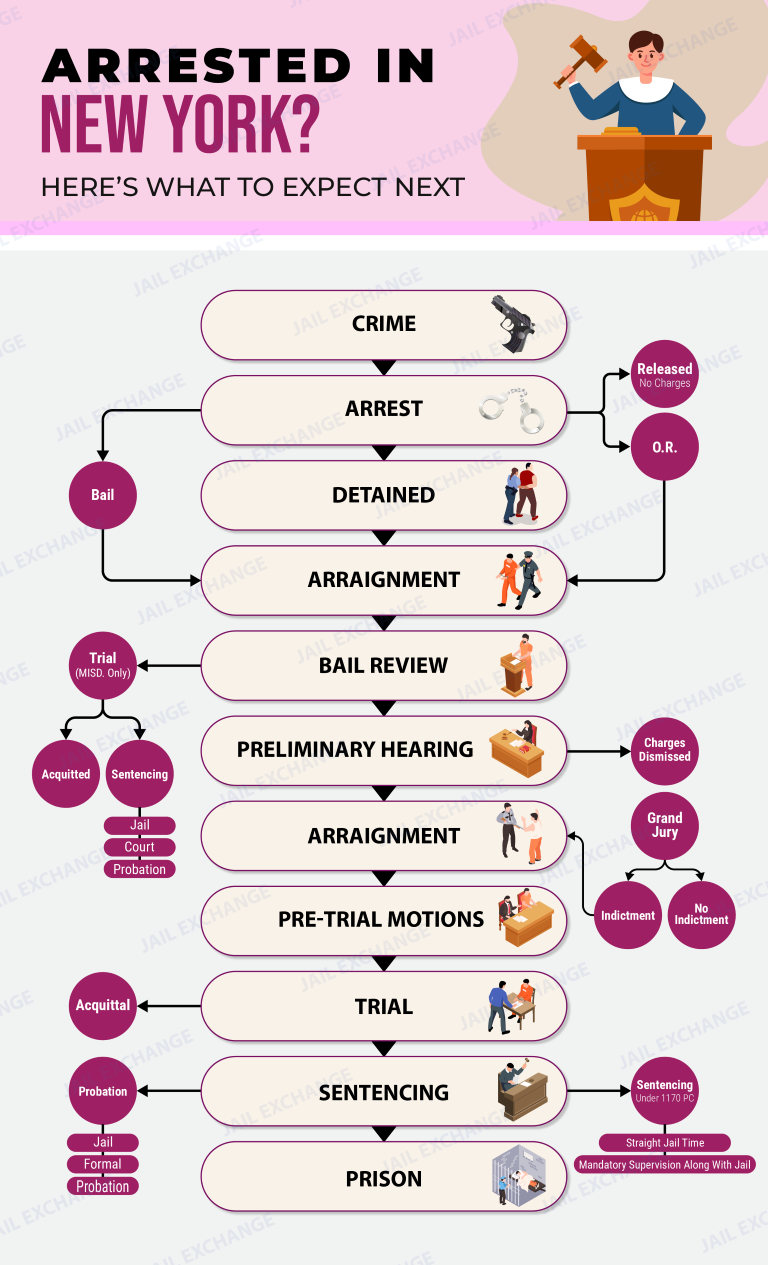
If you scroll down below this content, and the listing of the courts in Jefferson County, you will find a simple flowchart diagram and a video that will help you visualize the stages of the Criminal Court Process.
Arrest is when New York, Jefferson County or local police take a person into custody and start the legal process. The arrested person may or may not be immediately jailed.
In less serious crimes, the person may only be given a citation ordering that they appear in municipal or Jefferson County court on a certain date. In cases involving more serious crimes, the person is usually placed in the county jail until an arraignment, or a judge decides the next step.
Booking is when the Jefferson County sheriff or local police gather information such as the detainee’s name, address and why the person is being arrested. Booking also includes fingerprinting, criminal history, investigation, and verification of identity. Bail for lower-level crimes may be set right after booking so the arrested can “bail or bond out” before being detained.
The prosecution, sometimes called “the government” or “the people” or “the state” is the side that press the charges and seeks punishment for the offense. These are attorneys that work for the municipal (or city) courts, county courts, circuit courts, courts of appeal and supreme court. In New York, the prosecuting attorney for the state or county is called an Assistant District Attorney or ADA or District Attorney or DA and a U.S. Attorney prosecutes for federal cases.
Jurisdiction is an important term in the court system that means whether a court has the obligation or duty or right to handle a case. For example, if you run a red light in your town or city, a municipal court would likely have jurisdiction over your case, but the next town or city over would not have jurisdiction over your case. If you attempted to flee from police when they attempted to stop you after you ran the red light, it becomes a more serious crime, and the municipal court might not have jurisdiction so you might be assigned to a higher-level court that has jurisdiction over the more serious crime. Jurisdiction varies from state to state and sometimes county to county.
District Court can be a New York State District Court (which are only in Nassau and parts of Suffolk County), or it can refer to a United States Federal District Court that hears federal cases and there are four US District Courts in New York. It is important to ask the arresting officer or court the exact address of the courthouse rather than trying to figure it out yourself and miss your court appearance.
Bail is money paid that is kept by the courts to make sure that the arrested does not flee the area before their trial. Bail amounts and conditions are determined at the arraignment. Once the case is over, the bail money is returned. If a person does not pay bail, they remain in jail until their trial. Bail can be denied if the court feels that the arrested would be a danger to others if released.
A bond proceeding is the determination of how much bail is to be paid and usually happens at the same time as an arraignment. During bond proceedings, the defendant can have an attorney present but does not have the right to an attorney. A judge or court officer in the {county extended} or municipal court sets bail.
Judges in New York rely on a statewide bail schedule, which sets out a recommended range of bail amounts for different offenses. Judges can still exercise discretion in setting bail above or below the recommended range.
A judicial public bond or personal recognizance bond is a bond where someone representing the defendant signs paperwork promising to pay the money if the defendant does not show up to court. If the defendant does not show, the full amount will be due and the people who signed the paperwork will be responsible for paying the court. Sometimes the court decides that there is a good chance that the arrested will show up for trial and not flee so they are released on their own promise, or recognizance.
Cash percentage in lieu of bonds. If the bond order permits, the defendant pays a percentage of the amount, (sometimes up to 100%) to the court, which then holds the money until the case is over. The amount is returned if the defendant is acquitted or the case is dismissed, or it can be used toward paying any court fines incurred by the defendant.
Surety Bond is when defendant pays a percentage of the bond amount (usually 10–15%) to a professional bondsman or bail bond company licensed to do business in New York, {county extended}. The bondsman then signs the bond on behalf of the defendant. The defendant does not receive any of the money back. If the bondsman feels the defendant is a flight risk, they can refuse to give a bond or charge a higher fee. For example, a bondsman may determine a defendant is a flight risk if they are from a state other than New York.
A Property Bond is a bond in which the bond is pledged in land or home real estate (mobile homes are not accepted). Usually, the property must be in Jefferson County, and it must be worth at least the amount of the bond.
Transfer bond is transferable across state lines but generally a bond company will only assume the loan to adjoining states.
It is always important to have family involvement after being arrested. Not only can they make calls and communicate on your behalf (not all bond companies will accept collect calls), but family support will show the court that there are people who will make sure that the defendant makes it to court, not only for the defendant’s own good, but because they may have signed bond paperwork and responsible to pay if the defendant does not show in court. Chances of obtaining a bond from a bond company or clerk of court are better if family is involved.
(There have been phone scams where a bond company calls and informs a person that their family member has been arrested and they ask for financial information. A bondsman will not call asking for money without involvement of the arrested.)
A criminal defense attorney (also called lawyer or counsel) is hired or retained to represent the arrested as early as possible after the arrest. If the arrested cannot afford a lawyer, the New York court would assign indigent representation, usually called a public defender or an assigned or contracted attorney to represent the person for free or a small fee or a reduced rate, depending on the county. Indigent representation is only available for juvenile cases, appeals and cases that could result in jail time. It is not available for civil cases or cases that would not result in jail time.
In New York State, criminal attorneys can be asked by the courts to represent people periodically at a much-reduced rate. This is called an 18-B assignment.
A right to an attorney is in the 6th Amendment of the U.S. Constitution; that all people that are going to be heard in trial are entitled to be represented by a lawyer and if they cannot afford one, the court will provide one. This only applies to criminal cases and not to civil cases or criminal cases that would not result in jail time.
In New York State, the Office of Indigent Legal Services is the state agency that oversees indigent defense as a whole, but it is up to each county to fund and run their own indigent services.
For less serious cases or civil cases, there are pro bono volunteers who volunteer legal services for free or for a small fee. They often will hold clinics to teach people how to represent themselves in court. The attached link has a list of pro bono organizations in New York State.
Many courts will provide forms and help for people who want to represent themselves, called pro se. Here is a link for legal self-help in New York, and another website for which court to go to.
Pretrial proceeding is the process where both sides (prosecution and defense) gather information, interview witnesses, request records, videos etc. Pretrial proceedings also include communications with the judge assigned to the case and these appearances are either in person or by on-line conferencing. Some pretrial proceedings may not require a defendant’s appearance, allowing an attorney to appear in their place. The information that is gathered is called discovery and both sides must share the information that they have gathered. This information does not include conversations between the arrested and their attorney.
Most cases do not go to trial because both sides reach a plea deal, where both sides try to reach a reasonable punishment based on what was learned in the pretrial proceedings. A plea deal can only happen if the accused person admits they are guilty in exchange for a lighter punishment. The reason they must admit guilt is because it would not be fair to punish someone who claims they are not guilty. There are times in plea bargaining when the prosecution agrees to give a lighter sentence in exchange for information leading to the arrest of a more serious criminal related to the crime.
Trial is where both sides share their information in front of a judge or a judge and jury. After listening to all the evidence, the judge or jury decides the verdict which is whether if the person is guilty or not guilty. If a court has only a judge hearing both sides, it is called a bench trial. If a jury is selected, it is called a jury trial. If the defendant is found non-guilty, they are released. If they are found to be guilty, the next step is sentencing.
Sentencing is the punishment that the judge decides the person should get. This could be fines, community service, probation, jail time or a combination.
Appeal is asking for a higher court to hear the case again. If the accused person thinks something went wrong at trial or has new information that was not available during the trial or that the sentence is too harsh, the defense attorney can ask for an appeal. It is not unusual for an appeal when there is a long jail sentence, but an appeal can be denied if the appellate court feels that the original trial or sentencing was fair.
A misdemeanor crime in New York State is a crime that has a penalty such as fines, probation, community service or up to one year in a county jail. Common misdemeanor offenses include petty theft, simple assault, trespassing, some drug offenses or harassment.
A felony crime in New York State is a more serious crime than a misdemeanor and can be punished with more significant fines and prison (not jail) time over one year. Examples of felony crimes include murder, rape, theft, aggravated assault, drug trafficking, kidnapping, armed burglary and identity theft.
The Jefferson County Clerk of Court is an elected official whose responsibilities for Criminal Court’s administrative issues include receiving criminal warrants, receiving bail, creating the trial schedule, receiving fees, fines and maintaining court records.
A warrant is used to get someone to appear in court or to law enforcement. There must be good reason to believe that the person is involved in a crime. The warrant gives authority to arrest the person and search for evidence for the investigation of the crime.
A criminal summons is issued to request that a person appear in court at a particular time and date. It does not involve an arrest. A traffic ticket, summary citation or lesser misdemeanor could be considered a summons if you are given a court date.
A summary citation, commonly referred to as a ticket, is a criminal summons by a law enforcement officer either in person or via mail accusing the defendant of a minor offense, stating potential fine, listing the court having jurisdiction and instructions for addressing the issue. Defendants may or may not be required to appear in court or handle the matter by entering a plea via mail.
Fines are usually paid to the District Court or clerk of court and payment methods can be found on the District Court or Jefferson County Clerk of Court website. If you do not pay your fine on time, you can lose your driver’s license, must pay additional fees or even have a warrant for your arrest. It is important to read the instructions on the ticket issued by the police officer or court at the time of your arrest. For a parking ticket or summary citation, the fine amount and how to send payment should be on the ticket.
CRIMINAL COURTS IN NEW YORK STATE
The Criminal Court System in New York City, Nassau County and parts of Suffolk County are different from all of the other counties and cities in the state of New York.
After someone is arrested in New York, which court to go can be complicated. It depends on where the crime occurred and what type of crime it was. To further complicate things, New York City, Nassau County and parts of Suffolk County process the arrested differently than the rest of New York State. The arresting police officers or police department are best suited to advise you of which court the arrested should go to until a lawyer is retained. The NY Unified Court website also provides a guide as to which court to use.
When someone is arrested in New York, they are usually brought to the local city, town or village police department where booking occurs before being seen in a justice court which is the name given to town or village courts.
Most traffic and vehicle offenses are handled in a justice court as well as misdemeanors. If you can say that the crime happened in the “Town of ___” or “Village of____”, and it was not a felony crime, you will most likely appear in a justice court. The judges are called justices of the peace are on call 24 hours/day to be available for arraignments and to issue orders of protection. There are 1,200 justice courts in New York State except for New York City.
If the offense occurred in one of about 60 cities in New York, your case will be heard in a city court which acts the same as a justice court.
District courts are only in Nassau and parts of Suffolk County, and they act like the justice courts, they can handle traffic matters, misdemeanor cases and conduct felony arraignments.
County Courts can handle most criminal cases from beginning to end or they can receive felony cases from justice courts (or district courts in Nassau and Suffolk County) that need to be further prosecuted or go to trial. County courts hear mostly criminal cases and some family court matters but not civil cases. If your case is appealed from the justice or city court, it will likely be heard in a county court.
The term Supreme Court in New York confuses a lot of people because it sounds like a high-level court that hears special cases and has a panel of justices. This is not so in New York. There is a supreme court in each county in New York State. A New York Supreme Court handles civil, divorce, criminal cases and some juvenile cases. Criminal cases are handled in a division of supreme court called the Criminal Term.
A New York Supreme Court is a trial level court for cases that handle more serious or complicated for county courts with the exception of New York City where most criminal felony cases are handled in New York City Supreme Court instead of a county court. A New York Supreme Court has an Appellate Division that hears appeals from the supreme court criminal term, from family court and from county courts.
New York Court of Appeals is the highest court in New York meaning that the decisions are final unless it is a matter for the U.S. Supreme Court. Most appeals are heard in a New York Supreme Court Appeals Division.
Family Court handles cases involving family and domestic issues, such as child custody, child support, and domestic violence. Juvenile crimes are usually heard in Family Court and there is a court in each county. Here is a link for more information on juvenile court.
Specialty Courts or Problem-Solving Courts are being adopted in many states as a way to handle cases that involve non-violent and first-time offender cases in a way to where the offender can retain a job or responsibilities while following specific orders of the court as returned court appearances, periodic evaluations or testing for substances. Problem-solving courts in New York include: Drug treatment courts, family treatment courts, human trafficking courts, mental health courts, opioid courts and veterans treatment courts. Follow this link to find out more about a problem-solving court in New York State.
The New York State Court System is complicated and there are factors that can change the court type and location, so it is important to follow the instructions given by the paperwork given by the police or judge at the time of the arrest or by your attorney.
New York City Criminal Courts
If a crime is committed in New York City the initial process is different than the rest of New York State. If the crime is committed in one of the five boroughs (The Bronx, Kings County (Brooklyn), New York County (Manhattan), Queens County or Richmond County (Staten Island), the arrested is taken to the New York City Criminal Court which handles lower-level cases, arraignments and trials for misdemeanors which are crimes punished by a fine or imprisonment of less than one year. It also conducts arraignments, preliminary hearings and plea bargaining for some felonies.
The more serious felony cases are transferred to the New York County Supreme Court.
The New York County Supreme Court’s Criminal Term handles cases in parts. A part deals with a certain type of proceeding or crime. The parts in NYC Supreme Court Criminal Term include many conference and trial parts, youth part, narcotics part, domestic violence parts, diversion and mental illness parts. Here is more information on New York City’s Criminal Court.
New York Court of Appeals is the highest court in New York meaning that the decisions are final unless it is a matter for the U.S. Supreme Court. Most appeals are heard in a New York Supreme Court Appeals Division.
Family Court handles cases involving family and domestic issues, such as child custody, child support, and domestic violence. Juvenile crimes are usually heard in Family Court and there is a court in each county.
Here is a link for more information on juvenile court.
Specialty Courts or Problem-Solving Courts are being adopted in many states as a way to handle cases that involve non-violent and first-time offender cases in a way to where the offender can retain a job or responsibilities while following specific orders of the court as returned court appearances, periodic evaluations or testing for substances.
Problem-solving courts in New York include: Drug treatment courts, family treatment courts, human trafficking courts, mental health courts, opioid courts and veterans treatment courts. Follow this link to find out more about a problem-solving court in New York State.
The following link gives information regarding New York City’s Drug Treatment Court.
The New York State Court System is complicated and there are factors that can change the court type and location, so it is important to follow the instructions given by the paperwork given by the police or judge at the time of the arrest or by your attorney.
Nassau County Criminal Court System
After someone is arrested in New York, which court to go can be complicated. It depends on where the crime occurred and what type of crime it was. To further complicate things, New York City, Nassau County and parts of Suffolk County process the arrested differently than the rest of New York State. The arresting police officers or police department are best suited to advise you of which court the arrested should go to until a lawyer is retained.
The initial process following an arrest in Nassau County is different than the rest of New York State in that the initial process does not occur in city, town or village court but in Nassau County District Court. The District Court in Nassau County handles traffic and vehicle matters, misdemeanor cases from beginning to end, including trial and preliminary proceedings in felony criminal cases. The felony cases will then be transferred to a county or supreme court for further prosecution and/or trial.
The Nassau County Court can handle most criminal cases from beginning to end or they can receive felony cases from district courts that need to be further prosecuted or go to trial. County courts hear mostly criminal cases and some family court matters but not civil cases. If the case is considered serious enough or is complicated, it will be moved to a New York State Supreme Court. If your case is appealed from the district court, it will likely be heard in the Nassau County Court.
The term Supreme Court in New York confuses a lot of people because it sounds like a high-level court that hears special cases and has a panel of justices. This is not so in New York. There is a supreme court in each county in New York State. A New York Supreme Court handles civil, divorce, criminal cases and some juvenile cases. Criminal cases are handled in a division of supreme court called the Criminal Term.
A New York Supreme Court is a trial level court for cases that handle more serious or complicated for county courts with the exception of New York City where most criminal felony cases are handled in New York City Supreme Court instead of a county court. A New York Supreme Court has an Appellate Division that hears appeals from the supreme court criminal term, from family court and from county courts.
New York Court of Appeals is the highest court in New York meaning that the decisions are final unless it is a matter for the U.S. Supreme Court. Most appeals are heard in a New York Supreme Court Appeals Division.
Family Court handles cases involving family and domestic issues, such as child custody, child support, and domestic violence. Juvenile crimes are usually heard in Family Court and there is a court in each county.
Here is a link for more information on juvenile court.
Specialty Courts or Problem-Solving Courts are being adopted in many states as a way to handle cases that involve non-violent and first-time offender cases in a way to where the offender can retain a job or responsibilities while following specific orders of the court as returned court appearances, periodic evaluations or testing for substances. Problem-solving courts in New York include: Drug treatment courts, family treatment courts, human trafficking courts, mental health courts, opioid courts and veterans treatment courts. Follow this link to find out more about a problem-solving court in New York State.
The New York State Court System is complicated and there are factors that can change the court type and location, so it is important to follow the instructions given by the paperwork given by the police or judge at the time of the arrest or by your attorney.
Suffolk County New York Criminal Court System
After someone is arrested in New York, which court to go can be complicated. It depends on where the crime occurred and what type of crime it was. To further complicate things, New York City, Nassau County and parts of Suffolk County process the arrested differently than the rest of New York State. The arresting police officers or police department are best suited to advise you of which court the arrested should go to until a lawyer is retained.
Parts of Suffolk County (Western Towns of Babylon, Huntington, Smithtown, Islip and Brookhaven) and all of Nassau County differ from the rest of New York State. The remaining towns of Suffolk County are like the rest of New York State where the court process starts in city, town or village court. In the five western towns of Suffolk County, all cases start at the District Court.
The initial process following an arrest in the Western Towns of Suffolk County is different than the rest of New York State in that the initial process does not occur in city, town or village court but in Suffolk County District Court. The District Court in Suffolk County handles traffic and vehicle matters, misdemeanor cases from beginning to end, including trial and preliminary proceedings in felony criminal cases. The felony cases will then be transferred to the Suffolk County Court or supreme court for further prosecution and/or trial.
Suffolk County Court can handle most criminal cases from beginning to end or they can receive felony cases from the district court in Suffolk County that need to be further prosecuted or go to trial. County courts hear mostly criminal cases and some family court matters but not civil cases. If the case is considered serious enough or is complicated, it will be moved to a New York State Supreme Court. If your case is appealed from the district court, it will likely be heard in a county court.
The term Supreme Court in New York confuses a lot of people because it sounds like a high-level court that hears special cases and has a panel of justices. This is not so in New York. There is a supreme court in each county in New York State. A New York Supreme Court handles civil, divorce, criminal cases and some juvenile cases. Criminal cases are handled in a division of supreme court called the Criminal Term.
A New York Supreme Court is a trial level court for cases that handle more serious or complicated for county courts with the exception of New York City where most criminal felony cases are handled in New York City Supreme Court instead of a county court. A New York Supreme Court has an Appellate Division that hears appeals from the supreme court criminal term, from family court and from county courts.
Family Court handles cases involving family and domestic issues, such as child custody, child support, and domestic violence. Juvenile crimes are usually heard in Family Court and there is a court in each county.
Here is a link for more information on juvenile court.
Specialty Courts or Problem-Solving Courts are being adopted in many states as a way to handle cases that involve non-violent and first-time offender cases in a way to where the offender can retain a job or responsibilities while following specific orders of the court as returned court appearances, periodic evaluations or testing for substances.
Problem-solving courts in New York include: Drug treatment courts, family treatment courts, human trafficking courts, mental health courts, opioid courts and veterans treatment courts. Follow this link to find out more about a problem-solving court in New York State.
The New York State Court System is complicated and there are factors that can change the court type and location, so it is important to follow the instructions given by the paperwork given by the police or judge at the time of the arrest or by your attorney.
FEDERAL COURT
Federal Court deals with crimes involving violations of United States laws. Federal crimes include federal drug trafficking, federal tax evasion and fraud that crossed state lines and include crimes that occur on federal property as post offices or federal buildings.
Cases involving crimes that involve the FBI or DEA or Immigration agencies are federal crimes. Terrorism is a federal crime.
There are some differences in the Federal court system as compared to the New York state court system. For example, the attorneys who work for the courts are called United States Attorneys and Federal judges are called District Court Judges (not to be confused by local state district courts).
Federal Magistrate Judges hear the case early on, but they do not decide on the cases at a trial like the Federal District Court Judges. In a federal case, a grand jury is used for indictments.
There are four U.S. Federal Judicial Districts in New York.