
Nassau County Correctional Center Criminal Court Process
Criminal Court Process for Nassau County New York
Nassau County Criminal Court Guide
Nearly all adult arrests on this stretch of Long Island lead first to a single courthouse, the District Court at 99 Main Street, Hempstead, NY 11550. That court arraigns adults, tries misdemeanors and handles the opening steps of felonies. Felonies that reach an indictment move to County Court, 262 Old Country Road, Mineola, NY 11501, where the chief clerk answers at 516-493-3690 during business hours. Glen Cove and Long Beach run their own city courts, and dozens of villages hold small justice courts.
For a quick custody check, use the Correctional Center inmate lookup. Our Recent Arrests and Jail Roster page answers the rest about an arrest and a stay in custody: locating a loved one, who is held today, warrants, the charge list, booking photos, appointed lawyers and how to collect property.
Anyone a judge keeps in custody is taken to the Correctional Center in East Meadow, 100 Carman Avenue, East Meadow, NY 11554, 516-572-4200. After a fresh arrest, the District Court is the place to call: 516-493-4200. Release rules, bail forms and payment windows fill our bail page.
1. Misdemeanor or felony: which Nassau County court has it?
New York sorts crimes by how much punishment they can bring:
- Violations, such as disorderly conduct, aren't legally crimes. At worst they bring 15 days behind bars.
- Misdemeanors are lesser crimes. Class A tops out at 364 days in a local jail, and class B at three months (Penal Law § 70.15).
- Felonies are serious crimes that can mean state prison. They run from class E, the lowest, up to class A, the highest (Penal Law § 70.00).
Here is who hears what. The District Court, or a city court inside Glen Cove or Long Beach, takes violations and misdemeanors. It also handles the first part of every felony, such as the arraignment and a hearing to test the evidence. Once a grand jury indicts, the felony goes to County Court for trial. This county sits in the state's 10th Judicial District, which it shares with Suffolk.
↑ Back to the question list2. Addresses and phones for each criminal courthouse
Clerks work the phones and counters during weekday business hours, so a quick call can save a wasted trip:
- District Court, 99 Main Street, Hempstead, NY 11550. Main information 516-493-4200. Criminal North 516-493-4045, Criminal South 516-493-4201, Treatment Court 516-493-4145, interpreters 516-493-4230.
- County Court, 262 Old Country Road, Mineola, NY 11501, with a West Wing at 252 Old Country Road, Mineola, NY 11501. Main line and cashier 516-493-3710, chief clerk 516-493-3690, indictments 516-493-3717, Felony Treatment Court 516-493-3620, Mental Health 516-493-3520, interpreters 516-493-3780.
- Supreme Court, 100 Supreme Court Drive, Mineola, NY 11501, 516-493-3400. The main courthouse switchboard for the district is 516-493-3000.
- Family Court, 101 County Seat Drive, Mineola, NY 11501, first and second floors, 516-493-4000. This has been its home since June 2, 2025. The old Westbury building is closed.
3. City and village courts across the county
There are no town courts. The two cities each have a court of their own:
- Glen Cove City Court, 13 Glen Street, Glen Cove, NY 11542, 516-403-2441
- Long Beach City Court, 1 West Chester Street, Long Beach, NY 11561, 516-442-8544
The 64 villages are different. Most hold a justice court of their own for village code tickets, traffic and some lesser crimes. Call the village and ask for the court clerk. The ticket itself also names the court and its address.
Villages in the Town of Hempstead. Atlantic Beach 516-371-4552; Bellerose 516-358-2962; Cedarhurst 516-295-5522; East Rockaway 516-887-6312; Floral Park 516-326-6325; Freeport 516-377-2329; Garden City 516-465-4080; Lynbrook 516-599-0416; New Hyde Park 516-354-6330; Rockville Centre 516-678-9233. For Hempstead Village, Hewlett Bay Park, Hewlett Harbor, Hewlett Neck, Island Park, Lawrence, Malverne, Mineola, South Floral Park, Stewart Manor, Valley Stream and Woodsburgh, the Town of Hempstead's main line at 516-489-5000 can give you the village's number.
Villages in the Town of North Hempstead. East Hills 516-621-6117; Great Neck Estates 516-482-6430; Lake Success 516-482-7430; North Hills 516-365-8857; Roslyn Harbor 516-621-7261; Thomaston 516-482-3110. For Baxter Estates, East Williston, Flower Hill, Great Neck, Great Neck Plaza, Kensington, Kings Point, Manorhaven, Munsey Park, Old Westbury, Plandome, Plandome Heights, Plandome Manor, Port Washington North, Roslyn, Roslyn Estates, Russell Gardens, Saddle Rock, Sands Point, Westbury and Williston Park, call the Town of North Hempstead at 516-627-0590.
Villages in the Town of Oyster Bay. Farmingdale 516-293-2292; Muttontown 516-364-2240. For Bayville, Brookville, Centre Island, Cove Neck, Lattingtown, Laurel Hollow, Massapequa Park, Matinecock, Mill Neck, Old Brookville, Oyster Bay Cove, Sea Cliff and Upper Brookville, the Town of Oyster Bay at 516-624-6100 can connect you.
↑ Back to the question list4. The arraignment, step by step
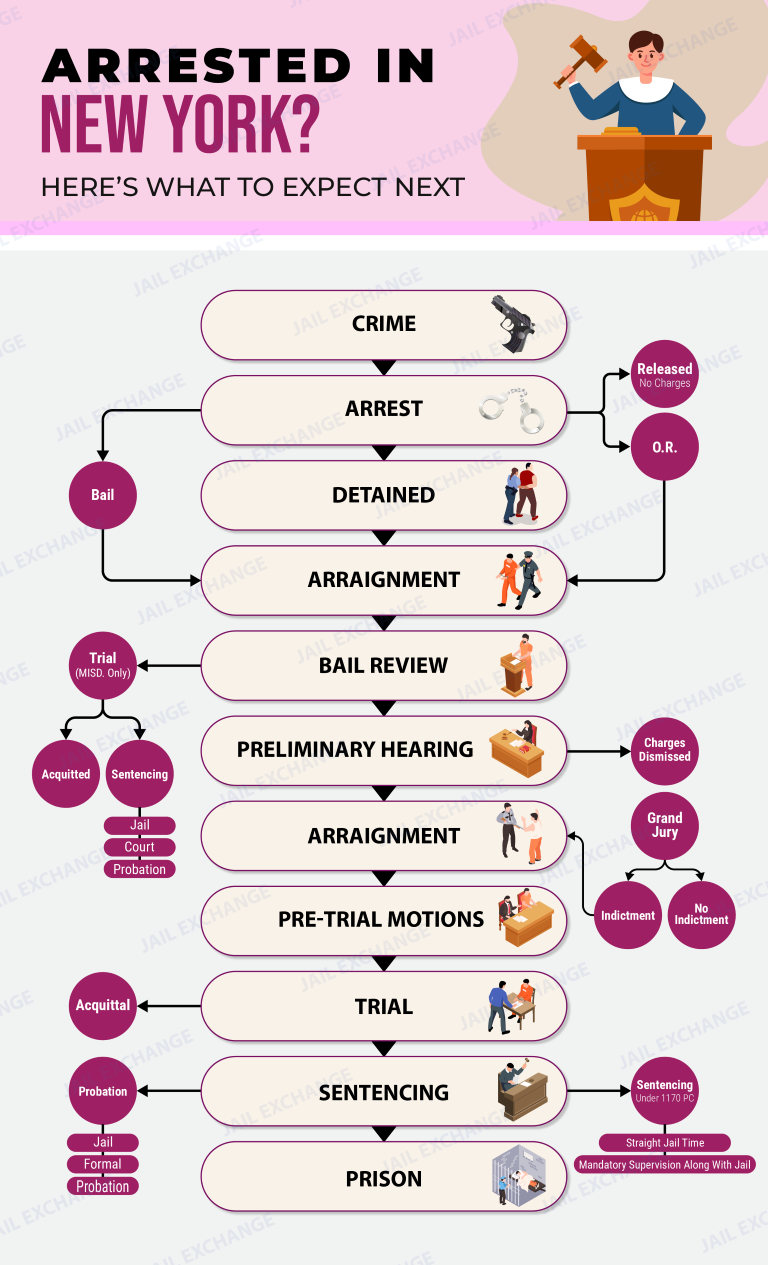
Arraignment is the first time the accused sees a judge. Court system guidance puts it at roughly one day after the handcuffs, as a rule. For people held overnight in this county, it most often takes place at the District Court in Hempstead. Someone given a desk appearance ticket at the precinct goes home and shows up on the date printed on it instead (CPL 150.20).
- A lawyer meets the person. One is assigned for free if they can't pay (CPL 510.10(2)).
- The judge reads or summarizes the charges in the complaint.
- On a misdemeanor, the person enters a plea, and the judge sets the next date if the case goes on.
- The judge decides release: going home on a promise, going home with rules, bail, or for some serious felonies, jail with no bail (CPL 510.10).
- The judge may issue a temporary order of protection in a family case (CPL 530.12).
Someone jailed on a felony complaint starts a clock running: 120 hours, stretched to 144 if a weekend or holiday intervenes. By then a hearing must begin or a grand jury must indict. If not, the jail frees the person on recognizance, barring a few exceptions (CPL 180.80).
↑ Back to the question list5. How do DWI, theft and other misdemeanors move here?
Misdemeanors stay in District Court, or in a city court for arrests inside Glen Cove or Long Beach. The District Attorney's Office prosecutes them. After arraignment, the case comes back for later dates while the two sides trade evidence and talk about a deal.
- Evidence. Prosecutors get 20 calendar days after arraignment to turn over discovery when the defendant sits in jail. Out of custody, the deadline is 35 (CPL 245.10).
- Speedy trial. Readiness deadlines run 90 days on a class A charge and 60 on most class B charges (CPL 30.30).
- Penalties. Petit larceny, a class A misdemeanor, risks a $1,000 fine and close to a year (364 days) locked up. Class B charges risk $500 and three months (Penal Law §§ 70.15, 80.05).
- Other results. Probation on class A runs two or three years. A conditional discharge swaps jail for twelve months of court rules (Penal Law §§ 65.00, 65.05).
The District Court's Treatment Court, 516-493-4145, works with people whose arrests are tied to drugs or alcohol. Ask the defense lawyer if the case fits.
↑ Back to the question list6. Steps in a felony case, from complaint to sentence
A felony moves through these stages:
- Felony complaint and arraignment in District Court, or in a city court for arrests in those cities.
- Grand jury. Prosecutors present the case to a grand jury, which votes whether to indict. Before that vote, the accused may tell prosecutors in writing that they want to speak to the jurors (CPL 190.50(5)).
- Arraignment on the indictment in County Court in Mineola, where a plea is entered.
- Discovery and motions. The defense gets the evidence and asks the court to rule on legal issues.
- Plea or trial. The case ends with a guilty plea, a dismissal, or a jury's verdict.
- Sentencing.
Top prison terms by class are: A, life; B, 25 years; C, 15 years; D, 7 years; E, 4 years (Penal Law § 70.00). Prosecutors get six months to be trial-ready (CPL 30.30). Felony fines can reach $5,000, or double what the person gained (Penal Law § 80.00). People with addiction may qualify for judicial diversion into treatment (CPL Article 216) through Felony Treatment Court, 516-493-3620.
↑ Back to the question list7. What changes when a felony is violent?
The law treats violent felonies more harshly at every stage:
- Bail is possible. Every violent felony sits on the qualifying list, which puts money bail and remand in play (CPL 510.10(4)).
- Set prison terms. Sentences are fixed numbers of years, followed by post-release supervision. A class B violent felony, like first-degree robbery, carries 5 to 25 years. Class D, like second-degree assault, carries 2 to 7 (Penal Law § 70.02).
- Family violence. Strangling a household member or breaking a protection order also opens the door to bail. After a felony sentence, an order of protection can run 8 years or longer (CPL 530.12).
- Youth cases. A teen of 16 or 17 may face a violent felony charge. The Youth Part keeps that case only if prosecutors show someone was badly hurt, a weapon was shown, or the act was sexual (CPL 722.23).
8. Prosecutors and public defenders in Nassau County
The elected District Attorney's Office prosecutes crimes across the county, in District Court, the city courts and County Court. Its main office shares the Old Country Road address in Mineola: 262 Old Country Road, Mineola, NY 11501, switchboard 516-571-3800.
State law makes each county pay for lawyers for people who can't afford one (County Law § 722). Here that job is paid for by the county and handled by the Legal Aid Society of Nassau County. A defense lawyer must be there at arraignment (Executive Law § 832(4)). Being in jail, or earning under 250% of the poverty line, makes a person presumed eligible.
To learn which lawyer was assigned, call the District Court's information line at 516-493-4200. For an indicted case, call the County Court chief clerk at 516-493-3690. People held at the jail who can't make bail can also ask the county's Incarcerated Person Assistance Program for help: 240 Old Country Road, 6th Floor, Suite 606, Mineola, NY 11501, 516-571-5955.
↑ Back to the question list9. Looking up a Nassau County case or court date
The state's free WebCrims search covers the criminal courts of this county. Here is how to use it:
- Open WebCrims and pick the search by defendant name.
- Type at least the first two letters of the first and last name.
- Pick the county to narrow the list.
- Open the case to see the court, the part and the next date.
WebCrims shows only open cases that have a future court date. It leaves out finished cases, sealed cases, youthful offender cases and any case with no date set, including one with a warrant out. For those, call the court. Reach District Court at 516-493-4200 and County Court at 516-493-3710. A village case is answered by that village's court clerk. Keep the defendant's name and birthday at hand.
↑ Back to the question list10. Open warrants: checking and clearing them
Warrants here are served by the Sheriff's Enforcement Division and by police. For warrant questions, call the Sheriff's Department at 516-572-4100 or county police headquarters at 516-573-8800. Statewide fugitives appear on the New York State Police wanted list. A court clerk can also tell you by phone or at the counter whether a warrant is open. Clearing it starts with a defense lawyer, who can walk in with the person to the issuing court and ask the judge to vacate it. For a District Court warrant, the court sits at 99 Main Street, Hempstead, NY 11550, 516-493-4200.
↑ Back to the question list11. When the charge is federal instead
Federal crimes committed wholly or largely in Nassau or Suffolk are Central Islip cases in the U.S. District Court for the Eastern District of New York. The courthouse is at 100 Federal Plaza, Central Islip, NY 11722, 631-712-6000. The clerk is open 9:00 a.m. to 4:00 p.m. on weekdays, with last entry at 3:45 p.m.
- A detention hearing comes at the first federal appearance. There, the magistrate sets the terms for the months before trial, or orders the person held (18 U.S.C. 3142).
- The U.S. Marshals Service, 225 Cadman Plaza East, Room G20S, Brooklyn, NY 11201, 718-473-3000, holds federal defendants. Many stay at MDC Brooklyn, 80 29th Street, Brooklyn, NY 11232, 718-840-4200.
- Federal Defenders of New York represents people who can't pay: 100 Federal Plaza, 7th Floor, Room 770, Central Islip, NY 11722, 631-712-6500.
- U.S. Probation in Central Islip writes reports before sentencing: 202 Federal Plaza, West Wing, 2nd Floor, Central Islip, NY 11722, 631-712-6300.
After a federal sentence, find the person on the Federal Bureau of Prisons inmate locator.
↑ Back to the question list12. Immigration holds and the criminal case
An immigration hold leaves the state charges in place, though it can change the day of release. It plays out like this:
- Immigration agents fill out Form I-247A. That form asks the Sheriff to keep the person up to 48 hours after they would otherwise be released (8 CFR 287.7(d)).
- Agents collect the person at the jail.
- ICE's New York City Field Office covers Long Island: 26 Federal Plaza, 9th Floor, Suite 9-110, New York, NY 10278, 212-436-9315. ICE runs its own center in Batavia, 4250 Federal Drive, Batavia, NY 14020, 585-344-6500.
- Search the ICE Online Detainee Locator to find where they are.
New York law sets limits. A 2018 state appeals case, People ex rel. Wells v DeMarco, held that local officers can't make civil immigration arrests under state law. Executive Law § 170-k, enacted May 27, 2026, ended 287(g) agreements as of August 25, 2026. The county's Sheriff's Office and Police Department were two of the 12 agencies the Attorney General notified on July 24, 2026. Under Civil Rights Law § 28, anyone heading to a courthouse, inside one or on the way home is shielded from civil arrest unless a judge signed the warrant or order.
↑ Back to the question list13. Where a state prison term is served
Terms up to 12 months are done locally, in East Meadow. Longer felony sentences go to the New York State Department of Corrections and Community Supervision (DOCCS).
- Following sentencing, people usually stay put in East Meadow until the state sends a transport. A reception center classifies them, and then they move to a prison that matches.
- Look them up on the DOCCS Incarcerated Lookup. The DIN, their state number, is the fastest way to search.
- Facility-by-facility details live in our New York state prisons guide.
14. Court for teens and children in Nassau County
The Raise the Age law changed youth cases in 2018 and 2019:
- Ages 16 and 17, felony. The case opens in the Youth Part of County Court, 262 Old Country Road, Mineola, NY 11501. For a nonviolent felony, the default is a transfer to Family Court. The DA can block it only by proving "extraordinary circumstances" in a motion filed within 30 days (CPL 722.23).
- Ages 16 and 17, misdemeanor. Those are routed to probation intake, never adult court.
- Ages 12 to 15. Most cases are juvenile delinquency cases in Family Court (Family Court Act § 301.2).
Officers who pick up a child have to notify a parent immediately (Family Court Act § 305.2). Any child kept in detention goes before Family Court on the next court day or inside 72 hours, whichever is sooner (Family Court Act § 307.3). Young people are kept out of the adult jail. The county's 32-bed Juvenile Detention Center is run by the Department of Social Services. Teens facing adult felony charges go to a separate specialized secure center. Family Court is at 101 County Seat Drive, Mineola, NY 11501, 516-493-4000. Probation's Family Division, 516-571-9000, knows which facility has the youth.
↑ Back to the question list15. Help and rights for crime victims
Victims have a voice in New York cases and can get real help:
- Prosecutor's office. Victims in a case can call the District Attorney's switchboard at 516-571-3800, at 262 Old Country Road, Mineola, NY 11501.
- County support center. The Crime Victims Assistance Center is at 231 St. Brigid Lane, Westbury, NY 11590, 516-573-5360 (alternative number 516-573-5361).
- Money for losses. The state Office of Victim Services can pay for medical and counseling bills, funeral costs and other losses. Call 800-247-8035.
- Release alerts. Register with VINE at 888-846-3469 or on VINELink for a call, text or email when someone is released.
- Orders of protection. In a family case, the criminal judge may forbid any contact with the victim. If prosecutors drop or reduce a family case, they must tell the victim about filing in Family Court (CPL 530.12).
- State prison notices. For parole hearings and release dates, sign up with the DOCCS victim notification form.
Nassau County Criminal Court System
After someone is arrested in New York, which court to go can be complicated. It depends on where the crime occurred and what type of crime it was. To further complicate things, New York City, Nassau County and parts of Suffolk County process the arrested differently than the rest of New York State. The arresting police officers or police department are best suited to advise you of which court the arrested should go to until a lawyer is retained.
The initial process following an arrest in Nassau County is different than the rest of New York State in that the initial process does not occur in city, town or village court but in Nassau County District Court. The District Court in Nassau County handles traffic and vehicle matters, misdemeanor cases from beginning to end, including trial and preliminary proceedings in felony criminal cases. The felony cases will then be transferred to a county or supreme court for further prosecution and/or trial.
The Nassau County Court can handle most criminal cases from beginning to end or they can receive felony cases from district courts that need to be further prosecuted or go to trial. County courts hear mostly criminal cases and some family court matters but not civil cases. If the case is considered serious enough or is complicated, it will be moved to a New York State Supreme Court. If your case is appealed from the district court, it will likely be heard in the Nassau County Court.
The term Supreme Court in New York confuses a lot of people because it sounds like a high-level court that hears special cases and has a panel of justices. This is not so in New York. There is a supreme court in each county in New York State. A New York Supreme Court handles civil, divorce, criminal cases and some juvenile cases. Criminal cases are handled in a division of supreme court called the Criminal Term.
A New York Supreme Court is a trial level court for cases that handle more serious or complicated for county courts with the exception of New York City where most criminal felony cases are handled in New York City Supreme Court instead of a county court. A New York Supreme Court has an Appellate Division that hears appeals from the supreme court criminal term, from family court and from county courts.
New York Court of Appeals is the highest court in New York meaning that the decisions are final unless it is a matter for the U.S. Supreme Court. Most appeals are heard in a New York Supreme Court Appeals Division.
Family Court handles cases involving family and domestic issues, such as child custody, child support, and domestic violence. Juvenile crimes are usually heard in Family Court and there is a court in each county.
Here is a link for more information on juvenile court.
Specialty Courts or Problem-Solving Courts are being adopted in many states as a way to handle cases that involve non-violent and first-time offender cases in a way to where the offender can retain a job or responsibilities while following specific orders of the court as returned court appearances, periodic evaluations or testing for substances. Problem-solving courts in New York include: Drug treatment courts, family treatment courts, human trafficking courts, mental health courts, opioid courts and veterans treatment courts. Follow this link to find out more about a problem-solving court in New York State.
The New York State Court System is complicated and there are factors that can change the court type and location, so it is important to follow the instructions given by the paperwork given by the police or judge at the time of the arrest or by your attorney.