Schoharie County Correctional Facility Criminal Court Process
Criminal Court Process for Schoharie County New York
Schoharie County Criminal Court Guide
In this rural county, a criminal charge always starts out before a town justice or at the joint Town and Village of Schoharie bench. Felonies that a grand jury indicts then go to County Court, 290 Main Street, Schoharie, NY 12157. While a case is pending, anyone kept in custody stays at the Sheriff's Schoharie County Correctional Facility, 157 Steadman Way, Howes Cave, NY 12092. Below are all the courts, how a case travels through them and the offices worth calling.
Wondering if your person is still in a cell? Run their name through the Sheriff's inmate lookup first. Our Inmates in Custody page deals with the custody side of an arrest: who is being held, recent bookings, outstanding warrants, the charges, mugshots, public defense and picking up property.
For a felony already in County Court, call the clerk at 518-453-6998 and ask for the next date and which judge has it. For a town or village case, use that court's justice line from the list below. Release and bail payments have their own home on our bail and release page.
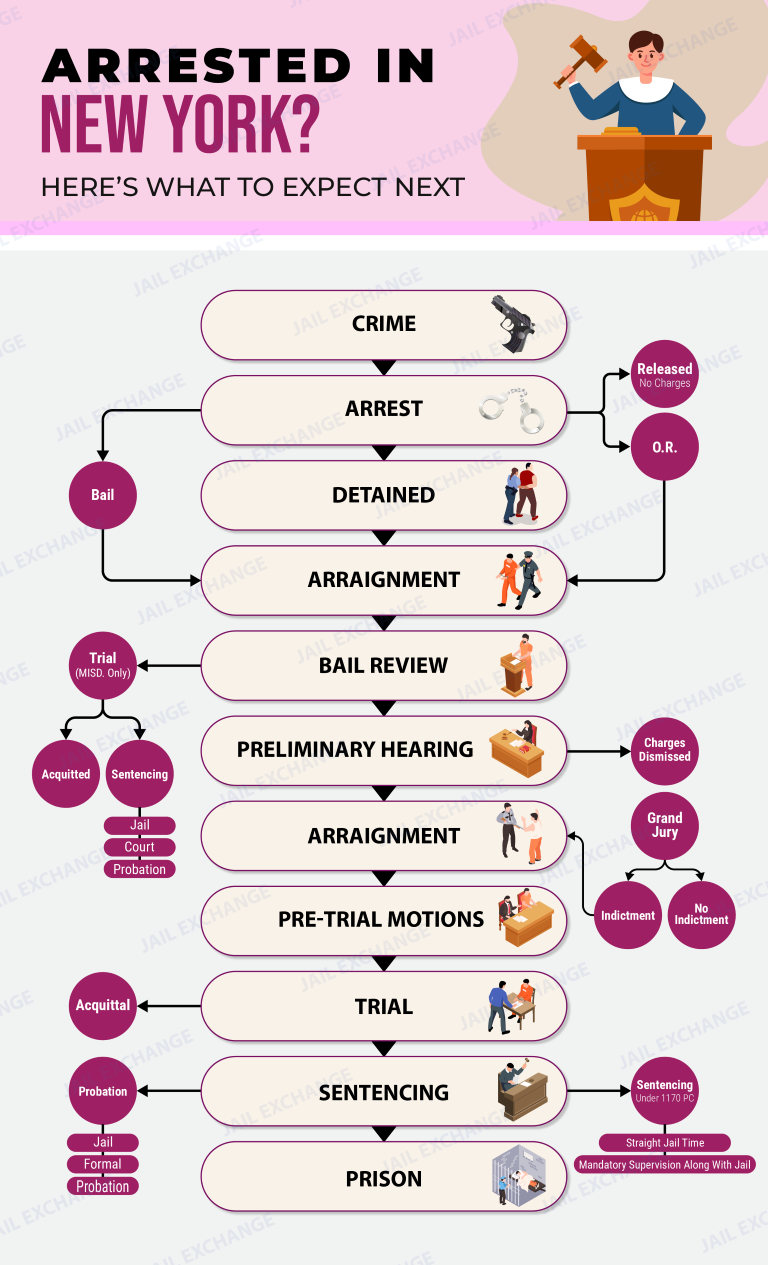
1. Town justice or County Court: who hears which charge?
The charge sets the court. New York sorts offenses into three groups:
- Felonies, graded A through E, with A the most serious. A felony is a serious crime, and it can send someone to state prison.
- Misdemeanors, class A or B. These are lesser crimes. The jail time for one can't go past 364 days, served locally.
- Violations, which are not crimes under the law; jail for one is capped at 15 days.
Town and village courts act as the local criminal courts here. Misdemeanors, violations and traffic tickets are decided there. Every felony also gets its start there, with the arraignment and the preliminary hearing. County Court takes over a felony once it is indicted. Supreme Court, which shares the county courthouse, has power over felonies as well. Cases against minors are routed to the Youth Part or Family Court instead.
This county falls within New York's Third Judicial District. Appeals from here travel to the Appellate Division's Third Department.
↑ Back to the question list2. Where do Schoharie County's higher courts sit?
- County Court and Supreme Court: the county courthouse, 290 Main Street, Schoharie, NY 12157. County Court 518-453-6984. Clerk's office for both courts 518-453-6998; ring it to confirm today's hours.
- Family Court: 300 Main Street, Schoharie, NY 12157, 518-453-6982.
- Regional treatment court: 300 Main Street, Schoharie, NY 12157, 518-453-8685. Treatment courts steer some nonviolent defendants whose addiction played a part in the crime into court-supervised treatment.
Need a ramp, an interpreter or another change to take part? Ask the court system's District Executive at 518-285-8300 before the court date.
Federal charges are heard in Albany, inside the James T. Foley U.S. Courthouse, 445 Broadway, Albany, NY 12207, 518-257-1789.
↑ Back to the question list3. What local justice courts does Schoharie County have?
No city courts exist in the county. All 16 towns run a justice court of their own. Of the six villages, only Schoharie keeps a court, and it shares justices with the town. Confirmed court locations:
- Blenheim Town Court, mailing address PO Box 161, North Blenheim, NY 12131, 518-827-6257
- Broome Town Court, 920 State Route 145, Middleburgh, NY 12122, 518-827-8777
- Carlisle Town Court, 541 Crommie Road, Carlisle, NY 12031, 518-234-7080
- Esperance Town Court, 104 Charleston Street, Esperance, NY 12066. Justice phone 518-868-5165; town hall 518-875-6109
- Fulton Town Court, 1168 Bear Ladder Road, West Fulton, NY 12194, 518-827-6391
- Gilboa Town Court, State Route 990V, PO Box 105, Gilboa, NY 12076, 607-588-7604
- Sharon Town Court, 106 Park Street, Sharon Springs, NY 13459, 518-284-3419
- Town and Village of Schoharie courts, 300 Main Street, Schoharie, NY 12157. Justices' line 518-295-6575; alternative number for the town court 518-295-7879
These justice courts have county phone numbers, and the town offices sit at the addresses shown. Call the court first to learn where and when it meets:
- Cobleskill Town Court: 518-234-7886; town offices, 378 Mineral Springs Road, Cobleskill, NY 12043
- Conesville Town Court: 607-588-7211, extension 5; town hall, 1306 State Route 990V, Gilboa, NY 12076
- Jefferson Town Court: 607-652-2109; town offices, 677 North Harpersfield Road, Jefferson, NY 12093
- Middleburgh Town Court: 518-827-5100, extension 2; town hall, 139 Cotton Hill Road, Middleburgh, NY 12122
- Richmondville Town Court: 518-294-8851; town offices, 104 Municipal Lane, Richmondville, NY 12149
- Seward Town Court: 518-234-2292; town offices, 795 Lowe Road, Cobleskill, NY 12043
- Summit Town Court: 518-287-1194; town hall, 1580 Charlotte Valley Road, Summit, NY 12175
- Wright Town Court: 518-872-1784; town offices, 105A School Street, Schoharie, NY 12157
The court system's town and village court finder lists hours and courtrooms. The County Court clerk at 518-453-6998 can also help you find the right justice.
↑ Back to the question list4. What goes on at arraignment in a town court?
Arraignment is the first hearing. It usually comes within about a day of an arrest, or on the date printed on an appearance ticket. Late-night and weekend arrests may lead to an off-hours session. Call the jail at 518-295-2264 to find out when and where.
At the hearing:
- The justice reads out the charge.
- Defense counsel is present. If the accused can't pay, the Assigned Counsel Program supplies one.
- The justice decides release: home on a promise, home with conditions, bail, or, for some serious felonies, jail without bail.
- In family violence cases, the justice may issue a temporary order of protection (CPL 530.12).
- A next date is set.
Felony cases have a deadline. A jailed person goes free unless, within 120 hours (144 if a Saturday, Sunday or holiday intervenes), a preliminary hearing starts or the grand jury acts (CPL 180.80). The accused may also choose to testify before the grand jury, but must tell the District Attorney in writing first, before an indictment is filed (CPL 190.50(5)).
↑ Back to the question list5. How do lower-level charges, like misdemeanors, get resolved?
Most never leave the justice court that first heard them. The usual path:
- Arraignment. Many people arrive holding an appearance ticket and never spent a night locked up.
- Discovery. The DA hands over its evidence within 20 days when the accused is jailed. The limit is 35 days for someone at home (CPL 245.10).
- Plea talks and motions.
- Trial, unless the case is settled or dismissed. Readiness deadlines: 90 days for the more serious misdemeanors (class A), 60 for class B, 30 when only a violation is charged (CPL 30.30(1)).
- Sentence.
Maximum penalties (Penal Law §§ 70.15, 80.05):
- Class A misdemeanor: 364 days and a $1,000 fine
- Class B misdemeanor: 3 months and a $500 fine
- Violation: 15 days and a $250 fine
Probation is another sentence: a class B misdemeanor brings one year, a class A two or three. Another option is a conditional discharge, meaning release on rules with no supervision. Drivers with an eligible ticket may ask about the District Attorney's Traffic Diversion Program at traffic@schohariecounty-ny.gov. Applying doesn't cancel a court date unless the court says so.
↑ Back to the question list6. How does a Schoharie County felony case unfold step by step?
- Arrest and local arraignment. The first hearing and the release decision happen before a town or village justice.
- Preliminary hearing or grand jury. The time rule in CPL 180.80 pushes prosecutors to move fast while the person is held.
- Indictment. Grand jurors decide whether formal charges are filed. The accused may testify first after sending written notice.
- County Court arraignment. The case moves to 290 Main Street, Schoharie, NY 12157.
- Discovery and motions. Evidence is shared under CPL Article 245.
- Plea or trial. The DA gets six months to reach trial readiness (CPL 30.30(1)).
- Sentencing, then a possible appeal to the Appellate Division, Third Department.
Under Penal Law § 70.00, the longest prison term grows with the class. It can reach 4 years for an E, 7 for a D, 15 for a C and 25 for a B. A class A felony can mean life.
A felony fine can reach $5,000 or double the money gained. Felony probation runs three to five years.
↑ Back to the question list7. Why does a violent felony change the stakes?
Violent felonies, listed in Penal Law § 70.02, carry a fixed prison term, one exact number of years, and then a stretch of post-release supervision. Some examples, from least to most serious:
- Class E violent felonies: one and a half to four years
- Second-degree assault, a class D: two to seven years
- Second-degree robbery or burglary (class C): at least 3.5 years, at most 15
- First-degree robbery or burglary, a class B: five to twenty-five years
Because violent felonies count as qualifying offenses, judges have the power to require bail, or even remand with no bail (CPL 510.10(4)). In family violence cases, a final order of protection can last for years. After a felony conviction, it can run up to 8 years past the sentence or the end of the maximum term, whichever is longer (CPL 530.12(5)).
Clean Slate's automatic sealing passes over sex crimes and most class A felonies (CPL 160.57). Sealing a violent felony by later application is barred too (CPL 160.59).
↑ Back to the question list8. Prosecutor and assigned counsel: how do I reach them?
Prosecution. The District Attorney is elected by county voters, and that office prosecutes every criminal case here. It is in the Harvey E. Stoddard Public Safety Facility, 157 Steadman Way, Howes Cave, NY 12092, 518-295-2272, Monday to Friday from 9:00 a.m. to 5:00 p.m.
Defense. People who can't afford a lawyer are served by the Assigned Counsel Program of the Office of Legal Defense of Indigents. It names private attorneys at county expense. The office is at 284 Main Street, Schoharie, NY 12157, 518-295-8740, weekdays 9:00 a.m. to 5:00 p.m. The application is on the office's web page.
- A lawyer must be there for an eligible person at arraignment (Executive Law § 832(4)).
- Jail time or low income usually makes someone eligible.
- Whether someone qualifies is the judge's decision in the end.
A family may swap in a private attorney whenever they like.
↑ Back to the question list9. How do I track down a case or its next court date?
WebCrims, the state's online search, covers courts in New York City and on Long Island, plus a short list of other County Courts and city courts. Only pending matters with an upcoming date appear there. Cases in this county's courts are tracked by phone instead:
- County Court or Supreme Court felonies: the clerk, 290 Main Street, Schoharie, NY 12157, 518-453-6998
- Town or village cases: the justice court that has it, using the numbers in the court list on this page
- Juvenile matters go through Family Court, 300 Main Street, Schoharie, NY 12157, 518-453-6982
Before you call, write down the person's full name and birth date. The defense lawyer gets every notice and is often the quickest source. For a federal case, search PACER, which charges 10 cents a page.
To see your own full New York record, the Division of Criminal Justice Services runs a record review. It starts with fingerprints and costs $17.50.
↑ Back to the question list10. Is there an active warrant, and what clears it?
Warrants here are served by the Sheriff's deputies. Ask at 518-295-2266 on weekdays, or dispatch at 518-295-8114 at any hour. Official lists: the New York State Police Wanted and Missing page, and the Probation Department's wanted list, which names the court behind each warrant. You can also check by phone or in person with the court that signed the warrant. To clear one, contact a lawyer (Assigned Counsel, 518-295-8740) and walk in together to that court, or call it to get a new date set. County Court's clerk sits at 290 Main Street, Schoharie, NY 12157, 518-453-6998.
↑ Back to the question list11. What if federal prosecutors bring the charge?
A federal case from this area lands in the U.S. District Court for the Northern District of New York, Albany Division; its judges use the James T. Foley U.S. Courthouse, 445 Broadway, Albany, NY 12207, 518-257-1789.
- The first hearing covers the charge, probable cause and whether the person stays locked up. A detention hearing takes place then unless a short delay is granted (18 U.S.C. 3142).
- Anyone denied release stays in U.S. Marshals custody. The Albany office is at 445 Broadway, Albany, NY 12207, 518-472-5401.
- The Federal Public Defender, 54 State Street, Suite 310, Albany, NY 12207, 518-436-1850, represents people who can't pay.
- Most federal cases end in a plea; the figure tops 90 percent. For most felony sentences, the judge first reads a presentence report from probation.
Court papers are on PACER. After sentencing, the Federal Bureau of Prisons inmate locator shows where someone is serving time.
↑ Back to the question list12. How can an ICE detainer touch a Schoharie County case?
A detainer is a separate federal request. It does not end the state case. Step by step:
- The request, on Form I-247A, comes from immigration agents.
- It asks staff to keep the person up to 48 hours after they would otherwise be released (8 CFR 287.7(d)).
- If ICE takes custody, the person may be moved to a federal site, for instance the Buffalo (Batavia) Service Processing Center, 4250 Federal Drive, Batavia, NY 14020, 585-344-6500.
- The ICE Online Detainee Locator can find them.
The state charge keeps going. A person moved by ICE can miss a court date, so the defense lawyer should tell the court right away.
New York sets limits. A state appeals court found in People ex rel. Wells v DeMarco (2018) that state law gives local police and deputies no power over civil immigration arrests. Executive Law § 170-k, in force since May 27, 2026, ends all 287(g) agreements with ICE as of August 25, 2026. Civil Rights Law § 28 shields people traveling to court, waiting there or heading home from civil arrest, except under a warrant or order a judge issued.
↑ Back to the question list13. Which agency holds people sentenced to state prison?
State prison time is handled by the Department of Corrections and Community Supervision (DOCCS). Shorter local sentences stay in the county jail.
When a sentenced person is ready to leave the county jail, the county tells DOCCS. DOCCS must accept the person within ten business days. The first stop is one of its reception centers. Doctors, testers and classification staff size up each newcomer there. Then the person moves to a regular prison.
Search for them in the DOCCS Incarcerated Lookup. The DIN, an ID number given at reception, is the fastest search. A last name with a birth year works too. The lookup goes down for upkeep around 11:45 p.m. each night. Families can also reach DOCCS at 518-457-5000, 1220 Washington Avenue, Albany, NY 12226. Our New York state prisons page profiles all of them.
↑ Back to the question list14. How do courts handle someone under 18?
Age decides the court:
- Under 16: usually handled in Family Court as a delinquency case. A child of 13, 14 or 15 accused of a very serious crime, like murder, kidnapping or robbery, can be charged as a juvenile offender (CPL 1.20(42)).
- 16 or 17: a felony opens in the Youth Part as an adolescent offender case. Nonviolent ones get moved over to Family Court. A DA hoping to hold onto such a case has 30 days to show the judge extraordinary circumstances. Misdemeanors go to probation intake (CPL 722.23).
- 16 to 18: a young person found guilty may receive youthful offender treatment, which takes the place of a conviction (CPL 720.10).
Young people are not held in the adult jail. A parent must be told of the arrest without delay. Detectives can interview a child only in a room picked by the court system, or at the child's home if a parent says yes (Family Court Act § 305.2).
The Probation Department handles juvenile intake and diversion at 157 Steadman Way, Howes Cave, NY 12092, 518-295-2274. Family Court is at 300 Main Street, Schoharie, NY 12157, 518-453-6982.
↑ Back to the question list15. Where can Schoharie County crime victims turn for help?
The District Attorney's office keeps victims up to date on the case. Call 518-295-2272 with questions about court dates or how the case is going.
- Money for losses: the state Office of Victim Services can help pay medical, counseling and funeral costs. Call 800-247-8035.
- Release alerts: register with VINE at vinelink.com or 888-846-3469 for a call or text when someone is released.
- Protection: when a case involves family violence, the judge handling the charge may add stay-away terms, barring the accused from the victim's home, school or job (CPL 530.12). Victims can also file their own petition in Family Court, and prosecutors who drop or reduce such a case must try to say so.
- Local help: the county's Domestic Violence Hotline is 518-234-2231.