
Riverhead Correctional Facility Criminal Court Process
Criminal Court Process for Suffolk County New York
Suffolk County Criminal Court Guide
Felonies are tried at County Court inside the Cromarty Court Complex, Criminal Courts Building, 210 Center Drive, Riverhead, NY 11901. Lower charges from Babylon, Brookhaven, Huntington, Islip and Smithtown go to the First District Court in Central Islip; East End towns and many villages run justice courts. People who are held go to the Sheriff's Riverhead Correctional Facility, 100 Center Drive South, Riverhead, NY 11901, or the Yaphank Correctional Facility, 200 Glover Drive, Yaphank, NY 11980. Each houses men and women from minimum to maximum security.
You can check on someone through the Sheriff's inmate search. Our Inmates in Custody page deals with what happens after an arrest. It shows how to confirm someone is held, read recent arrests, check warrants and charges, see mugshots, find a public defender and claim belongings.
For a felony case, call the Chief Clerk's Office at 631-852-2120 on weekdays from 9 a.m. to 5 p.m. to learn the next court date. When someone is still behind bars, our bail and release page shows the path home before trial.
1. Misdemeanor or felony: which Suffolk County court has the case?
State law ranks offenses into three tiers:
- Felonies are serious crimes that can bring state prison. Class A is the most serious level and class E the least.
- Misdemeanors are lesser crimes. A class A misdemeanor can mean up to 364 days in a local jail, and a class B up to three months.
- Violations, such as disorderly conduct, are not crimes. The most jail they carry is 15 days (Penal Law § 70.15).
In the five western towns, the First District Court hears misdemeanors and violations and holds the first steps of felony cases. On the East End, town and village justices do the same work. Once a grand jury indicts someone for a felony, the case moves up to County Court in Riverhead. The Supreme Court here mostly handles civil and divorce cases. Family Court and the Youth Part deal with young people.
↑ Back to the question list2. Where are the main criminal courthouses?
The county belongs to New York's 10th Judicial District. These buildings handle most criminal work:
- County Court (felonies after indictment), Criminal Courts Building, 210 Center Drive, Riverhead, NY 11901. The criminal office is at 631-852-1462. Weekdays, 9 a.m. to 5 p.m.
- First District Court, Criminal Term, Cohalan Court Complex, 400 Carleton Avenue, Central Islip, NY 11722, 631-208-5775. Windows open weekdays 8:30 a.m. to 4:30 p.m. Courtroom D-11 holds arraignments all 365 days. Clerks work on the 2nd floor, and trial rooms fill floors 3 to 6.
- Supreme Court, with buildings at 1 Court Street, Riverhead, NY 11901, and 400 Carleton Avenue, Central Islip, NY 11722. General questions go to 631-740-3850.
- Family Court, 400 Carleton Avenue, Central Islip, NY 11722, 631-740-3800, and 210 Center Drive, 2nd Floor, Riverhead, NY 11901, 631-852-3905.
- Drug Treatment Court, sitting in both the Criminal Courts Building, 210 Center Drive, Riverhead, NY 11901, and the Cohalan complex, 400 Carleton Avenue, Central Islip, NY 11722, 631-208-5776.
- East End Regional Intervention Court, held in Southampton Town Justice Court, 32 Jackson Avenue, Hampton Bays, NY 11946, 631-702-2963.
The District Court's branch buildings in Lindenhurst, Huntington Station, Hauppauge, Ronkonkoma and Patchogue take civil claims only. Criminal matters stay in Central Islip.
↑ Back to the question list3. Which town and village courts are in Suffolk County?
With no incorporated cities anywhere in the county, city courts don't exist here. Every East End town keeps a justice court:
- East Hampton Town Court: 159 Pantigo Road, East Hampton, NY 11937, 631-324-4134
- Riverhead Town Court: 210 Howell Avenue, Riverhead, NY 11901, 631-727-3200, extension 229
- Shelter Island Town Court: 46 North Ferry Road, Shelter Island, NY 11964, 631-749-8989
- Southampton Town Court: 32 Jackson Avenue, Hampton Bays, NY 11946, 631-702-2990
- Southold Town Court: 53095 Main Road, Southold, NY 11971, 631-765-1852
These villages keep a court of their own, listed A to Z:
- Amityville: 21 Ireland Place, Amityville, NY 11701, 631-691-3303
- Asharoken: 1 Asharoken Avenue, Northport, NY 11768, 631-261-8677
- Babylon: 153 West Main Street, Babylon, NY 11702, 631-669-1771
- Belle Terre: 55 Cliff Road, Belle Terre, NY 11777, 631-473-5105
- Bellport: 4 Bell Street, Bellport, NY 11713, 631-286-0327, extension 122 for the clerk
- Brightwaters: 40 Seneca Drive, Brightwaters, NY 11718, 631-665-1281
- Head of the Harbor: 500 North Country Road, Saint James, NY 11780, 631-584-2034
- Huntington Bay: 244 Vineyard Road, Huntington, NY 11743, 631-427-2843
- Islandia: 1100 Old Nichols Road, Islandia, NY 11749, 631-348-1133
- Lake Grove: 980 Hawkins Avenue, Lake Grove, NY 11755, 631-585-2008
- Lindenhurst: 430 South Wellwood Avenue, Lindenhurst, NY 11757, 631-957-7508
- Lloyd Harbor: 32 Middle Hollow Road, Huntington, NY 11743, 631-549-8896
- Nissequogue: 631 Moriches Road, Saint James, NY 11780, 631-862-8576
- Northport: 224 Main Street, Northport, NY 11768, 631-757-0935
- Ocean Beach: 157-164 Bay Walk, Ocean Beach, NY 11770, 631-583-0104
- Old Field: 207 Old Field Road, East Setauket, NY 11733, 631-941-9416
- Patchogue: 14 Baker Street, Patchogue, NY 11772, 631-475-2753
- Poquott: 45 Birchwood Avenue, East Setauket, NY 11733, 631-476-4043
- Port Jefferson: 121 West Broadway, Port Jefferson, NY 11777, 631-473-8287
- Quogue: 123 Jessup Avenue, Quogue, NY 11959, 631-653-9400
- Sag Harbor: 55 Main Street, Sag Harbor, NY 11963, 631-725-0621
- Saltaire: Village Hall, 103 Broadway, on Fire Island, with mail sent to PO Box 5551, Bay Shore, NY 11706, 631-583-5566
- Shoreham: 80 Woodville Road, Shoreham, NY 11786, 631-849-1444
- Southampton Village: 151 Windmill Lane, Southampton, NY 11968, 631-204-2140
- The Branch: 40 Route 111, Smithtown, NY 11787, 631-265-3315, extension 1
- Westhampton Beach: 165 Mill Road, Westhampton Beach, NY 11978, 631-288-3980, extension 1
- Westhampton Dunes: meets at 165 Mill Road, Westhampton Beach, NY 11978, 631-466-1632
Babylon, Brookhaven, Huntington, Islip and Smithtown have no town justice court. Their criminal cases go to the First District Court in Central Islip.
↑ Back to the question list4. Arraignment day, step by step
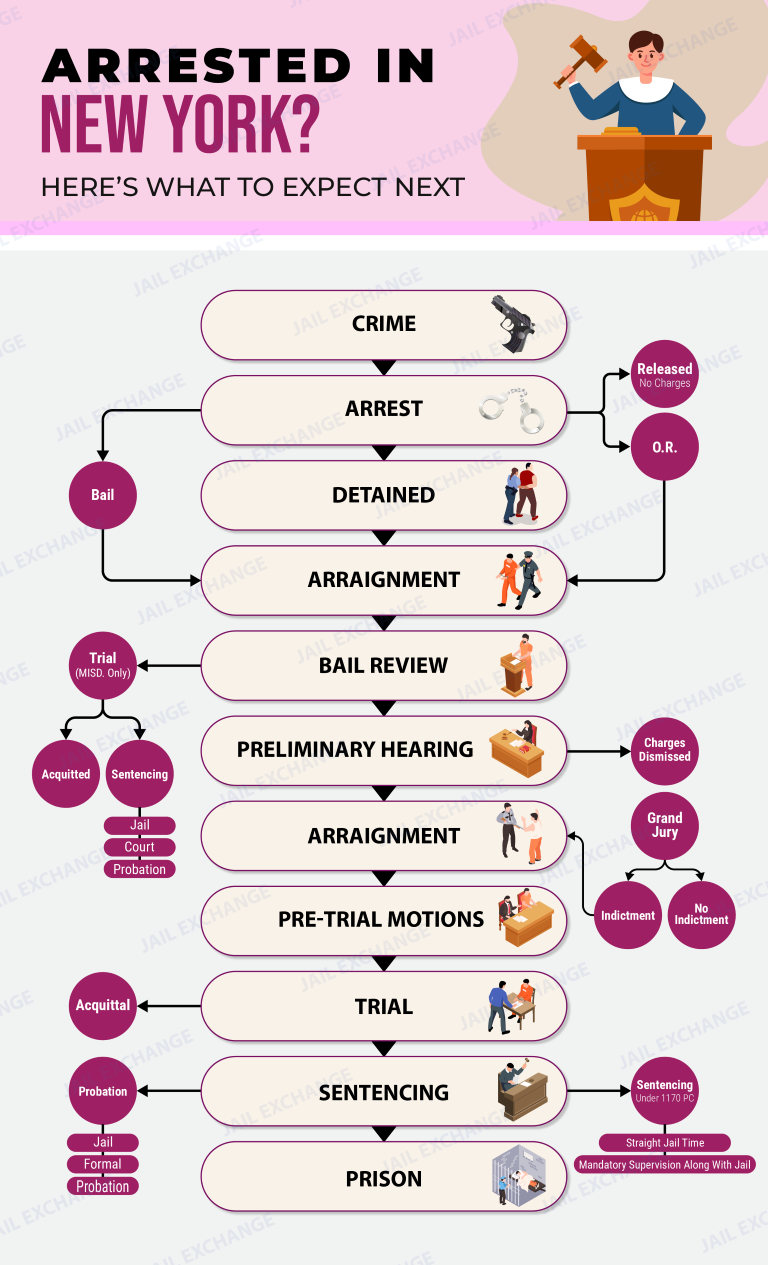
At the arraignment, the accused faces a judge for the first time. In this county it usually comes within a day of the arrest. For the western towns, it happens in Courtroom D-11 at the Cohalan complex in Central Islip, any day of the year. On the East End, it happens in the town or village court where the arrest took place.
- The judge reads out the charge.
- A defense lawyer is there. A free one is assigned if the person can't pay.
- The prosecutor and the defense argue about release, and the judge issues a securing order (CPL 510.10).
- For a misdemeanor, the person usually enters a plea of not guilty.
- Felony charges get no plea at this stage. A grand jury has to weigh them first.
People who got a desk appearance ticket skip the night in a cell. They show up on the date printed on the ticket instead (CPL 150.20).
↑ Back to the question list5. DWI, shoplifting and similar misdemeanors: the usual path
A first DWI, petit larceny or criminal mischief count normally stays in District Court or the local justice court from start to finish.
- Discovery. Prosecutors must share their evidence within 20 days if the person is held, or 35 days if not (CPL 245.10).
- Speedy trial clock. The People must be ready within 90 days for a class A misdemeanor, or 60 days for a class B (CPL 30.30).
- Treatment parts. District Court runs a Drug Court, Mental Health Court, Veterans Treatment Court, domestic violence parts and a Human Trafficking Court. A judge may send a case to one of them.
- Ending the case. A plea deal settles most of these charges, though some head to trial.
Possible penalties:
- Class A misdemeanor: up to 364 days in jail and a fine of up to $1,000, or two to three years of probation.
- Class B misdemeanor: up to three months and a fine of up to $500, or one year of probation.
- Violation: 15 days at most, plus a fine capped at $250.
- Conditional discharge: no jail, but rules to follow for a year (Penal Law § 65.05).
Under the Clean Slate Act, most misdemeanor convictions are sealed on their own three years after release or sentencing (CPL 160.57).
↑ Back to the question list6. From felony complaint to County Court
- Felony complaint. The case opens in District Court or a justice court. If the person is held, a hearing or grand jury vote must come within 120 hours, or 144 hours with a weekend or holiday in between, or the person is released (CPL 180.80).
- Grand jury. A group of residents decides whether to bring an indictment. The accused has the right to testify by giving written notice first (CPL 190.50).
- County Court. After indictment, the case moves to County Court in Riverhead for motions, a plea or a trial.
- Speedy trial. Prosecutors must be ready within six months (CPL 30.30).
Top prison terms by class (Penal Law § 70.00):
- Class A: life
- Class B: up to 25 years
- Class C: up to 15 years
- Class D: up to 7 years
- Class E: up to 4 years
Fines can reach $5,000 or twice what the crime earned. Someone whose drug use led to a felony may qualify for Judicial Diversion (CPL Article 216). Ask the program at 631-852-3545.
↑ Back to the question list7. Why are violent felony charges handled harder?
State law names a group of crimes as violent felony offenses (Penal Law § 70.02). Examples are first-degree robbery or burglary (class B), second-degree robbery or burglary or gun possession (class C), and second-degree assault (class D).
- Fixed sentences. A violent felony brings a set number of years, then post-release supervision. Class B carries 5 to 25 years. Class C carries 3.5 to 15, class D carries 2 to 7, and class E carries 1.5 to 4.
- Bail is possible. Most violent felonies are qualifying offenses, so a judge may set bail or remand (CPL 510.10(4)).
- Orders of protection. In family cases, the court can order the accused to stay away from the alleged victim (CPL 530.12).
- Sealing limits. Sex offenses and most class A felonies are left out of Clean Slate sealing.
The County Court Chief Clerk at 631-852-2120 can tell you which judge has a case.
↑ Back to the question list8. The DA's office and free defense lawyers
Prosecution. Voters choose the District Attorney, whose office handles each criminal charge filed here. Find the main office in Building 77 of the William J. Lindsay County Complex on Veterans Memorial Highway, Hauppauge, NY 11788, 631-852-3185. Its executive offices also use 631-853-4161. Prosecutors also work from the Central Islip and Riverhead court buildings and from East End bureaus.
Defense. The Legal Aid Society of Suffolk County is the public defender. Its offices are at 400 Carleton Avenue, 4th Floor, Central Islip, NY 11722. Call 631-853-5212 for District Court cases or 631-852-1650 for the Riverhead office. When Legal Aid can't take a case, the judge appoints a private lawyer from the Assigned Counsel Defender Plan.
A lawyer must be offered at arraignment, even before money forms are checked (Executive Law § 832(4)). People in jail, and people earning under 250% of the federal poverty line, are presumed to qualify. For a paid lawyer, the bar's referral line is 631-234-5577.
↑ Back to the question list9. Finding a docket or upcoming date online
Use WebCrims, the state court system's search. It covers every criminal court in Nassau and Suffolk counties.
- Open WebCrims and choose the name option.
- Enter two or more letters of both the first name and the surname.
- Narrow the results to Suffolk.
- Write down the docket number, the courtroom and the next date.
WebCrims lists only open cases with a court date coming up. You won't find closed matters there, nor sealed files, youthful offender files or anything stalled by a warrant. For those, call the court:
- District Court, 400 Carleton Avenue, Central Islip, NY 11722, 631-208-5775. Dates can't be moved by phone.
- County Court Criminal Office, 210 Center Drive, Riverhead, NY 11901, 631-852-1462.
- Town or village court: use the numbers in the local court list on this page.
To see your own state record, the state takes fingerprints through IdentoGo at 877-472-6915. The fee is $17.50.
↑ Back to the question list10. Checking for and clearing a Suffolk County warrant
The Sheriff's Warrant Squad tracks down people with criminal warrants. It works out of the Family Court Building at 400 Carleton Avenue, Central Islip, NY 11722. Ask about a warrant through the Sheriff's Office at 631-852-2200, or call the court that may have issued it. Statewide fugitives appear on the New York State Police Wanted and Missing page. WebCrims leaves out cases waiting on a warrant, so phone instead. Clearing it means hiring a lawyer or calling Legal Aid, then walking into the issuing court together. For western-town cases that is District Court, 400 Carleton Avenue, Central Islip, NY 11722, 631-208-5775. For felonies after indictment, it is County Court, 210 Center Drive, Riverhead, NY 11901, 631-852-2120.
↑ Back to the question list11. How does a federal case from Long Island work?
When federal prosecutors bring charges for crimes on Long Island, the case is filed in Central Islip at the U.S. District Court for the Eastern District of New York. It stands at 100 Federal Plaza, Central Islip, NY 11722. The help desk is 631-712-6000, and the clerk's office opens weekdays 9 a.m. to 4 p.m.
- Detention hearing. At the first appearance, a judge rules on whether the accused may leave or must stay in custody before trial. The judge looks at the charge, the proof, the person's ties and record, and any danger (18 U.S.C. 3142).
- Defense. Federal Defenders of New York works at 100 Federal Plaza, 7th Floor, Room 770, Central Islip, NY 11722, 631-712-6500.
- Custody. The U.S. Marshals hold anyone the judge orders detained. Their district office is at 225 Cadman Plaza East, Room G20S, Brooklyn, NY 11201, 718-473-3000.
- Records. Federal filings are on PACER, at 10 cents a page.
After a prison sentence, find the person with the Federal Bureau of Prisons inmate locator.
↑ Back to the question list12. What does an ICE detainer do to a court case?
An immigration hold runs alongside the criminal case. It doesn't replace it.
- ICE may send the jail Form I-247A, a detainer request.
- The form seeks to keep the person up to 48 hours after they would otherwise be released (8 CFR 287.7(d)).
- After a pickup, the file moves to the ICE field office that serves Long Island, found at 26 Federal Plaza, 9th Floor, Suite 9-110, New York, NY 10278, 212-436-9315. Detainees can be moved to places such as the Batavia center upstate or to other states.
- Track the person with the ICE Online Detainee Locator.
State rules matter here. A 2018 appeals ruling in People ex rel. Wells v DeMarco, brought against this county's Sheriff, concluded that officers working for the state, a county or a town cannot lean on state law to detain someone whose only issue is civil immigration status. Since August 25, 2026, Executive Law § 170-k has barred every 287(g) agreement. Civil Rights Law § 28 protects people coming to, attending or leaving court from civil immigration arrest, unless a judge has authorized it in writing. Before any plea, ask the defense lawyer how a conviction could change immigration status.
↑ Back to the question list13. Sentenced to state time: what comes next?
Felony terms over one year are served with the state Department of Corrections and Community Supervision (DOCCS). Shorter terms stay in the county jail.
Once a judge sentences someone to state time, the jail sends the papers, and the state picks the person up within ten business days. A reception center then runs medical checks and tests and gives a security level. After that, the person is placed in a prison that matches.
- Find someone on the DOCCS Incarcerated Lookup. The DIN number works best.
- Call DOCCS during business hours at 518-457-5000.
- See our state prisons in New York page for each facility.
14. Young defendants and Raise the Age
Since Raise the Age, most young people are kept out of adult criminal court.
- Under 16. Most cases go to Family Court as juvenile delinquency cases. Only very serious crimes by 13- to 15-year-olds are charged as juvenile offender cases.
- Ages 16 and 17, misdemeanor. The case goes to probation intake instead of criminal court.
- Ages 16 and 17, felony. These adolescent offender cases begin in the Youth Part. A nonviolent charge gets sent to Family Court unless, within 30 days, prosecutors convince the judge of extraordinary circumstances (CPL 722.23).
- Detention. A young person who is held stays in a youth detention center and is kept apart from adult inmates.
- Ages 16 to 18. A youthful offender finding can replace a conviction for many young people (CPL 720.10).
Family Court sits at 400 Carleton Avenue, Central Islip, NY 11722, 631-740-3800. Legal Aid's Children's Law Bureau answers at 631-439-2450.
↑ Back to the question list15. What help do crime victims get in Suffolk County?
- Victim Services. The District Attorney's Victim Services Unit answers weekdays from 9 a.m. to 5 p.m. at 631-852-3185. Visit the DA's Hauppauge offices at the Lindsay complex, Veterans Memorial Highway, Hauppauge, NY 11788.
- Money for losses. The state Office of Victim Services can help pay medical, counseling and funeral bills. Its help line is 800-247-8035.
- Release alerts. Register with VINE or call 888-846-3469 to hear when someone leaves custody.
- Orders of protection. A criminal court can order the accused to stay away during the case and after sentencing (CPL 530.12).
Suffolk County New York Criminal Court System
After someone is arrested in New York, which court to go can be complicated. It depends on where the crime occurred and what type of crime it was. To further complicate things, New York City, Nassau County and parts of Suffolk County process the arrested differently than the rest of New York State. The arresting police officers or police department are best suited to advise you of which court the arrested should go to until a lawyer is retained.
Parts of Suffolk County (Western Towns of Babylon, Huntington, Smithtown, Islip and Brookhaven) and all of Nassau County differ from the rest of New York State. The remaining towns of Suffolk County are like the rest of New York State where the court process starts in city, town or village court. In the five western towns of Suffolk County, all cases start at the District Court.
The initial process following an arrest in the Western Towns of Suffolk County is different than the rest of New York State in that the initial process does not occur in city, town or village court but in Suffolk County District Court. The District Court in Suffolk County handles traffic and vehicle matters, misdemeanor cases from beginning to end, including trial and preliminary proceedings in felony criminal cases. The felony cases will then be transferred to the Suffolk County Court or supreme court for further prosecution and/or trial.
Suffolk County Court can handle most criminal cases from beginning to end or they can receive felony cases from the district court in Suffolk County that need to be further prosecuted or go to trial. County courts hear mostly criminal cases and some family court matters but not civil cases. If the case is considered serious enough or is complicated, it will be moved to a New York State Supreme Court. If your case is appealed from the district court, it will likely be heard in a county court.
The term Supreme Court in New York confuses a lot of people because it sounds like a high-level court that hears special cases and has a panel of justices. This is not so in New York. There is a supreme court in each county in New York State. A New York Supreme Court handles civil, divorce, criminal cases and some juvenile cases. Criminal cases are handled in a division of supreme court called the Criminal Term.
A New York Supreme Court is a trial level court for cases that handle more serious or complicated for county courts with the exception of New York City where most criminal felony cases are handled in New York City Supreme Court instead of a county court. A New York Supreme Court has an Appellate Division that hears appeals from the supreme court criminal term, from family court and from county courts.
Family Court handles cases involving family and domestic issues, such as child custody, child support, and domestic violence. Juvenile crimes are usually heard in Family Court and there is a court in each county.
Here is a link for more information on juvenile court.
Specialty Courts or Problem-Solving Courts are being adopted in many states as a way to handle cases that involve non-violent and first-time offender cases in a way to where the offender can retain a job or responsibilities while following specific orders of the court as returned court appearances, periodic evaluations or testing for substances.
Problem-solving courts in New York include: Drug treatment courts, family treatment courts, human trafficking courts, mental health courts, opioid courts and veterans treatment courts. Follow this link to find out more about a problem-solving court in New York State.
The New York State Court System is complicated and there are factors that can change the court type and location, so it is important to follow the instructions given by the paperwork given by the police or judge at the time of the arrest or by your attorney.