Westchester County, just north of the Bronx, is New York's most populous county outside New York City and Long Island, and its county seat is White Plains. Lower-level cases and first appearances are handled by six City Courts and more than thirty town and village justice courts, while indicted felonies are tried in Westchester County Court at the Richard J. Daronco Courthouse in White Plains. The Westchester County District Attorney prosecutes everything from traffic misdemeanors to homicides. People held before trial are in the custody of the Westchester County Department of Correction at its jail on the Grasslands campus in Valhalla.
- Westchester County Court and Supreme Court (Ninth Judicial District), Richard J. Daronco Westchester County Courthouse, 111 Dr. Martin Luther King Jr. Boulevard, White Plains, NY 10601; criminal department (914) 824-5400
- White Plains City Court, 77 South Lexington Avenue, White Plains, NY 10601, (914) 824-5675
- Yonkers City Court, Robert W. Cacace Justice Center, 100 South Broadway, Yonkers, NY 10701, (914) 831-6450
- Mount Vernon City Court, 2 Roosevelt Square North, Mount Vernon, NY 10550, (914) 831-6440
- New Rochelle City Court, 475 North Avenue, New Rochelle, NY 10801, (914) 358-8000
- Peekskill City Court, 2 Nelson Avenue, Peekskill, NY 10566, (914) 831-6480
- Rye City Court, 21 McCullough Place, Rye, NY 10580, (914) 831-6400
- Westchester County District Attorney, 111 Dr. Martin Luther King Jr. Boulevard, White Plains, NY 10601, (914) 995-3414
- Legal Aid Society of Westchester County (primary public defender), White Plains, (914) 286-3400
- Westchester County Department of Correction (county jail), 10 Woods Road, Valhalla, NY 10595, (914) 231-1000
Which court hears your case. In Westchester, violations, misdemeanors and DWI charges are decided in the local criminal court where the offense took place. Inside Yonkers, Mount Vernon, New Rochelle, White Plains, Peekskill or Rye, that is the City Court; anywhere else it is a Town Court (for example Greenburgh, Yorktown or Cortlandt) or a Village Court (for example Port Chester, Croton-on-Hudson or Tarrytown). Felonies are arraigned in those same local courts, including at weekend and holiday arraignment sessions, and stay there only until a Westchester grand jury indicts or the defendant waives indictment and agrees to a superior court information. The case then moves to Westchester County Court in White Plains (some indicted cases are heard in Supreme Court in the same building). Felony cases against 16- and 17-year-olds are routed to the White Plains Youth Part of County Court, which the juvenile section explains.
Where pretrial detainees are held. Unlike most New York counties, Westchester's jail is not run by the Sheriff. The Westchester County Department of Correction operates it at 10 Woods Road in Valhalla, with a Jail Division for men awaiting trial or sentencing and for women, and a separate Penitentiary Division for men serving sentences of a year or less. After an arrest by any of the county's dozens of police departments, people are held at the arresting agency for arraignment, then transported to Valhalla if the judge sets bail they cannot pay or remands them. The department's main number is (914) 231-1000.
- Local courts in Westchester County (city, town and village courts)
- The Westchester courthouses and how cases are divided
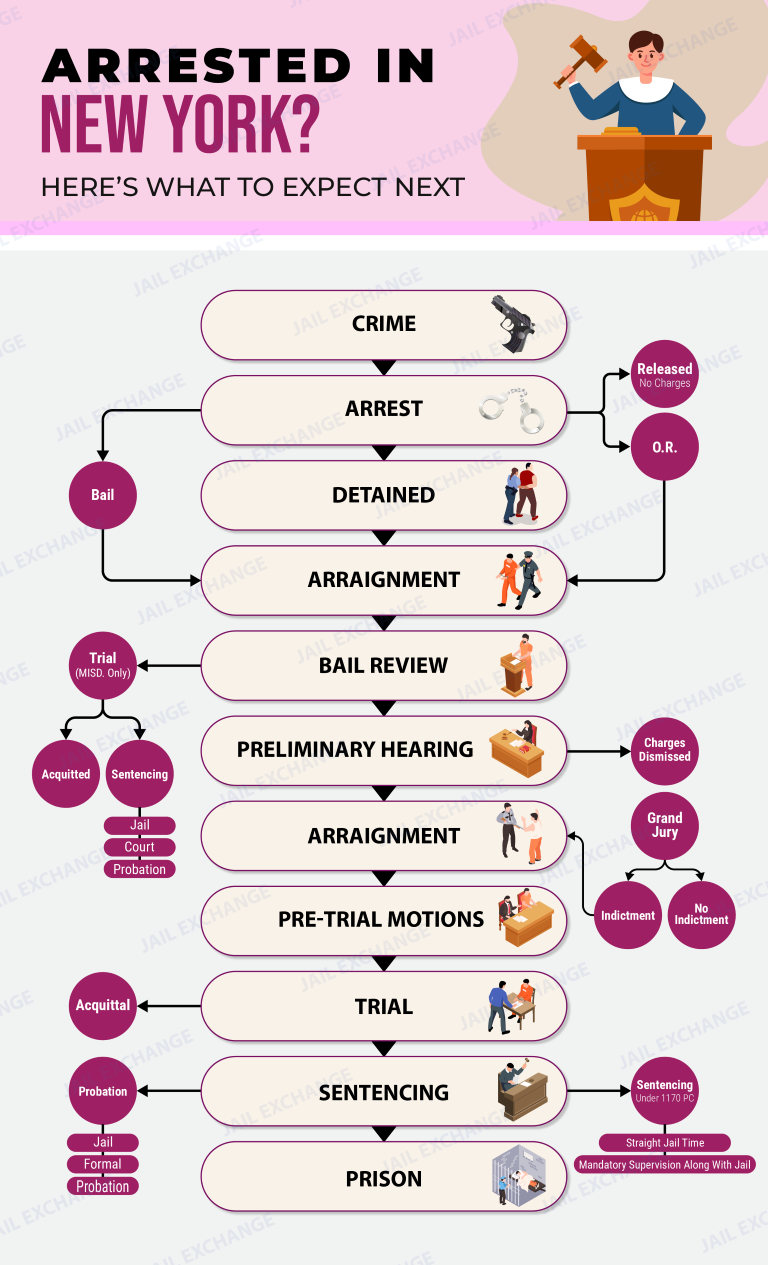
- What happens after an arrest in Westchester
- The Westchester County jail in Valhalla
- Public defenders and assigned counsel
- The District Attorney, branch offices and diversion
- Treatment and specialty courts
- Misdemeanor (for example, petit larceny, a first DWI, third-degree assault, criminal trespass)
- Felony (for example, burglary, grand larceny, drug sale, second-degree assault)
- Violent felony (for example, murder, rape, robbery)
- Juveniles (under 18) arrested in Westchester County
- Federal cases (U.S. District Court) from Westchester County
Local courts in Westchester County (city, town and village courts)
The six City Courts are full-time courts with law-trained judges. The town and village justice courts sit on scheduled days and evenings. Several municipalities share a court or a building, and a few village courts have been merged into town courts; the notes after the lists explain where those cases go.
City Courts
- Mount Vernon City Court — 2 Roosevelt Square North, Mount Vernon, NY 10550, (914) 831-6440
- New Rochelle City Court — 475 North Avenue, New Rochelle, NY 10801, (914) 358-8000
- Peekskill City Court — 2 Nelson Avenue, Peekskill, NY 10566, (914) 831-6480
- Rye City Court — 21 McCullough Place, Rye, NY 10580, (914) 831-6400
- White Plains City Court — 77 South Lexington Avenue, White Plains, NY 10601, (914) 824-5675
- Yonkers City Court — Robert W. Cacace Justice Center, 100 South Broadway, Yonkers, NY 10701, (914) 831-6450
Town Courts
- Town of Bedford Court — 321 Bedford Road, Bedford Hills, NY 10507, (914) 666-6965
- Town of Cortlandt Court — 1 Heady Street, Cortlandt Manor, NY 10566, (914) 734-1090
- Town of Eastchester Court — 40 Mill Road, Eastchester, NY 10709, (914) 771-3353
- Town of Greenburgh Court — 188 Tarrytown Road, White Plains, NY 10607, (914) 989-1850
- Town/Village of Harrison Court — Municipal Building, 1 Heineman Place, Harrison, NY 10528, (914) 670-3010
- Town of Lewisboro Court — Orchard Square, 20 North Salem Road, Lower Level, Cross River, NY 10518, (914) 763-5417
- Town of Mamaroneck Court — Town Center, 740 West Boston Post Road, Mamaroneck, NY 10543, (914) 381-7875
- Town/Village of Mount Kisco Court — 40 Green Street, Mount Kisco, NY 10549, (914) 241-7033
- Town of Mount Pleasant Court — 1 Town Hall Plaza, Valhalla, NY 10595, (914) 742-2324
- Town of New Castle Court — 200 South Greeley Avenue, Chappaqua, NY 10514, (914) 238-4726
- Town of North Castle Court — 15 Bedford Road, Armonk, NY 10504, (914) 273-8627
- Town of North Salem Court — 66 June Road, North Salem, NY 10560, (914) 669-9691
- Town of Ossining Court — 86 Spring Street, Ossining, NY 10562, (914) 762-8562
- Town of Pelham Court — 34 Fifth Avenue, Pelham, NY 10803, (914) 738-7030
- Town of Pound Ridge Court — 179 Westchester Avenue, Pound Ridge, NY 10576, (914) 764-3983
- Town of Rye Court — 350 North Main Street, Port Chester, NY 10573, (914) 939-3305
- Town/Village of Scarsdale Court — 1001 Post Road, Scarsdale, NY 10583, (914) 722-1120
- Town of Somers Court — Town House, 335 Route 202, Somers, NY 10589, (914) 277-8225
- Town of Yorktown Court — 2295 Crompond Road, Yorktown Heights, NY 10598, (914) 962-6216
Village Courts
- Village of Ardsley Court — 507 Ashford Avenue, Ardsley, NY 10502, (914) 693-1703
- Village of Briarcliff Manor Court — 1111 Pleasantville Road, Briarcliff Manor, NY 10510, (914) 944-2788
- Village of Bronxville Court — 200 Pondfield Road, Bronxville, NY 10708, (914) 337-2454, ext. 117
- Village of Buchanan Court — 236 Tate Avenue, Buchanan, NY 10511, (914) 737-1033
- Village of Croton-on-Hudson Court — Municipal Building, 1 Van Wyck Street, Croton-on-Hudson, NY 10520, (914) 271-6266
- Village of Dobbs Ferry Court — 112 Main Street, Dobbs Ferry, NY 10522, (914) 693-6161
- Village of Elmsford Court — 15 South Stone Avenue, Elmsford, NY 10523, (914) 592-8949
- Village of Hastings-on-Hudson Court — Municipal Building, 7 Maple Avenue, Hastings-on-Hudson, NY 10706, (914) 478-3403
- Village of Irvington Court — Village Hall, 85 Main Street, Irvington, NY 10533, (914) 591-7095
- Village of Larchmont Court — Village Hall, 120 Larchmont Avenue, Larchmont, NY 10538, (914) 834-6230, ext. 8
- Village of Mamaroneck Court — Village Hall, 169 Mount Pleasant Avenue, Mamaroneck, NY 10543, (914) 777-7710
- Village of Pleasantville Court — 80 Wheeler Avenue, Pleasantville, NY 10570, (914) 769-2027
- Village of Port Chester Court — 350 North Main Street, Port Chester, NY 10573, (914) 939-8220
- Village of Sleepy Hollow Court — 28 Beekman Avenue, Sleepy Hollow, NY 10591, (914) 631-2783
- Village of Tarrytown Court — 1 Depot Plaza, Tarrytown, NY 10591, (914) 631-5215
- Village of Tuckahoe Court — 65 Main Street, Tuckahoe, NY 10707, (914) 961-4787
Merged and shared courts. The Village of Ossining's justice court was consolidated into the Ossining Town Court in 2017. The Pelham Town Court handles cases from the villages of Pelham and Pelham Manor. The Rye Town Court serves Rye Brook and the Rye Neck section of Mamaroneck, among other areas, and shares a building with the Port Chester Village Court. Harrison, Mount Kisco and Scarsdale are each both a town and a village, with one court.
The Westchester courthouses and how cases are divided
The Richard J. Daronco Westchester County Courthouse at 111 Dr. Martin Luther King Jr. Boulevard in downtown White Plains is the hub of the county's felony system. County Court and Supreme Court judges hear indicted cases there, the grand juries sit there, and the District Attorney's main office is in the same complex. The criminal department on the second floor can be reached at (914) 824-5400. Family Court also has a part in the building, and the administrative offices of the Ninth Judicial District, which covers Westchester, Dutchess, Orange, Putnam and Rockland counties, are located there as well.
The six City Courts carry the heaviest misdemeanor caseloads. Yonkers City Court, in the Cacace Justice Center on South Broadway, serves the county's largest city and has one of the heaviest dockets. City Court judges can also hear felony complaints, hold preliminary hearings and accept pleas to reduced misdemeanor charges.
The justice courts in towns and villages such as Greenburgh, Yorktown, Cortlandt and Port Chester handle the rest of the county, along with a large volume of traffic and parking matters. Because Greenburgh, Mount Pleasant and the other big towns contain several villages, a single stretch of road can fall within two different courts' boundaries; your ticket or appearance notice controls.
What happens after an arrest in Westchester
- Booking. The arresting agency (Yonkers Police, Westchester County Police, a town or village department, or the State Police) photographs and fingerprints the person and checks for warrants.
- Ticket or custody. For many misdemeanors and violations, officers issue a desk appearance ticket and release the person with a court date, usually two to three weeks away. Otherwise the person is held for arraignment.
- Arraignment. Most custodial arrests are arraigned within about 24 hours, in the local court or at an off-hours session. A lawyer, usually from the Legal Aid Society of Westchester County, is available to represent people at arraignment if they have not hired one.
- Release decision. The judge applies New York's bail law. For most misdemeanors and nonviolent felonies, the judge must release the defendant on recognizance or with non-monetary conditions, which in Westchester commonly means supervision by the county Probation Department's pretrial services unit and, in some cases, electronic monitoring. Bail or remand is available only for qualifying offenses, such as most violent felonies, domestic-violence-related charges and new felonies committed while another felony case is pending. When bail is set, the judge must consider the person's ability to pay and offer at least two forms, such as cash and a partially secured or insurance-company bond. Commercial bail bonds are legal in New York.
- Next court date. Misdemeanors stay in the local court. Felonies are adjourned for grand jury action, and if the person is jailed, the 120-hour rule applies: the case must be presented to a grand jury, or a preliminary hearing held, within 120 hours of arrest (144 with a weekend), or the defendant is generally entitled to release.
Discovery under CPL Article 245 begins soon after arraignment, and the speedy-trial clock in CPL 30.30 starts running: 60 days for a Class B misdemeanor, 90 days for a Class A misdemeanor and six months for a felony, not counting excludable delays.
The Westchester County jail in Valhalla
The Westchester County Department of Correction is a county agency, separate from the county's Department of Public Safety, and it runs the only county jail. Its facilities sit on the Grasslands campus off Woods Road in Valhalla, near Westchester Medical Center and the county's other institutional buildings.
- Jail Division: men who are accused of a crime or awaiting sentencing, and women at every stage, including those sentenced to a year or less.
- Penitentiary Division: sentenced men serving terms of one year or less.
People sentenced to more than a year in prison remain in Valhalla only until they are transferred to the state prison system. Families can call the department at (914) 231-1000 to confirm whether someone is in custody and to ask about visiting, mail and money deposits. Defense lawyers schedule legal visits directly with the facility.
Public defenders and assigned counsel
Westchester does not have a county-run Public Defender's office. Instead, the county contracts with the Legal Aid Society of Westchester County, (914) 286-3400, a nonprofit that represents most people who cannot afford a lawyer in the City Courts, the justice courts, County Court and Family Court. Its staff attorneys cover arraignments throughout the county.
When Legal Aid has a conflict, typically because it already represents a co-defendant or a witness, the court appoints a private lawyer under the county's assigned counsel plan, paid at state-set rates. Eligibility is based on whether the person can afford to hire an attorney, taking into account income, expenses and the seriousness of the charge; owning a home or having a job does not automatically disqualify someone. Ask for appointed counsel at the first court date. Statewide standards, overseen by the Office of Indigent Legal Services, call for counsel to be present at arraignment.
The District Attorney, branch offices and diversion
The elected Westchester County District Attorney has its main office at the White Plains courthouse, (914) 995-3414. Because there are so many local courts, assistant district attorneys are assigned from branch offices that handle the City Courts and justice courts in their area:
- Greenburgh branch, 188 Tarrytown Road, White Plains, NY 10607, (914) 995-4075
- Mount Vernon branch, City Court Building, 2 Roosevelt Square North, Mount Vernon, NY 10550, (914) 813-5025
- New Rochelle branch, 475 North Avenue, 2nd Floor, New Rochelle, NY 10801, (914) 813-5800
- Northern Westchester branch, 1940 Commerce Street, Yorktown Heights, NY 10598, (914) 862-5140
- Rye branch, 3010 Westchester Avenue, Suite 205, Purchase, NY 10577, (914) 813-7257
- White Plains branch, City Court Building, 77 South Lexington Avenue, White Plains, NY 10601, (914) 422-6265
- Yonkers branch, 104 South Broadway, Yonkers, NY 10701, (914) 231-2700
Misdemeanor and lower-level felony cases are often resolved through diversion, especially for people with little or no record. Depending on the charge, that can take the form of an adjournment in contemplation of dismissal tied to community service or counseling, a program for young adults, a DWI or shoplifting education class, or a referral to a treatment court. Prosecutors make the initial offer, but defense lawyers regularly negotiate for diversion, and the judge must approve the final disposition. The DA's office also has bureaus that focus on domestic violence, special victims, economic crime and narcotics.
Treatment and specialty courts
Westchester's courts use several problem-solving approaches, though not every court offers every program. Participation is voluntary and normally requires a guilty plea, with a promised outcome, often dismissal or a reduced charge, if the participant completes the program.
- Drug treatment courts operate in County Court and in several City Courts. They combine supervised treatment, frequent drug testing and regular court appearances. Felony drug defendants may also seek judicial diversion under CPL Article 216, which allows a County Court judge to order treatment in place of a conventional sentence.
- Mental health court programs link defendants with serious mental illness to treatment and case management under court monitoring.
- Veterans treatment court programs address charges involving veterans, with mentoring from fellow veterans and coordination with VA services.
- Domestic violence parts, including an Integrated Domestic Violence approach in which one judge handles a family's related criminal, Family Court and matrimonial matters, focus on victim safety and compliance with orders of protection.
- Human trafficking intervention parts handle prostitution-related charges by connecting defendants with services rather than punishment.
Availability depends on the charge, the defendant's history and the court where the case is pending. A defense lawyer can ask the District Attorney and the judge whether a specialty court is an option.
Misdemeanor (for example, petit larceny, a first DWI, third-degree assault, criminal trespass)
Westchester's City Courts and justice courts process tens of thousands of misdemeanor and traffic-crime cases each year. A typical case begins with a desk appearance ticket, a shoplifting arrest at a mall in White Plains or Yonkers, or a DWI stop on the Saw Mill or Hutchinson parkway.
The first court date
At arraignment, the defendant receives a copy of the accusatory instrument, is advised of the right to counsel and, if eligible, is represented by Legal Aid or assigned counsel. Release is mandatory for most misdemeanors, on recognizance or with non-monetary conditions; bail is possible only for qualifying offenses, which at the misdemeanor level mainly means certain domestic-violence charges and violations of orders of protection. Many defendants are also served with a temporary order of protection at arraignment in assault and harassment cases.
Penalties
- Violations such as disorderly conduct or second-degree harassment carry up to 15 days in jail.
- A Class B misdemeanor, third-degree criminal trespass being a common Westchester example, is capped at 3 months and $500.
- A Class A misdemeanor can mean up to 364 days in Valhalla and a $1,000 fine; mall shoplifting of $1,000 or less (petit larceny), third-degree assault and second-degree trespass fall here.
- A first DWI under Vehicle and Traffic Law 1192 is a misdemeanor: up to a year in jail, a $500 to $1,000 fine, revocation of at least six months, the Drinking Driver Program and an ignition interlock for at least 12 months. Aggravated DWI (.18 or more) carries $1,000 to $2,500 and at least a one-year revocation. Driving while ability impaired is an infraction. A child aged 15 or younger in the car makes the DWI a felony under Leandra's Law.
Outcomes and timing
Common resolutions include an adjournment in contemplation of dismissal, a plea to a violation, a conditional discharge, a fine, community service or probation; jail is usually reserved for repeat offenders or aggravated conduct. Prosecutors must provide discovery before they can answer ready, and the speedy-trial deadlines are 90 days for Class A and 60 days for Class B misdemeanors. Most cases in Westchester take two to six months; busy City Court calendars can push that longer.
Felony (for example, burglary, grand larceny, drug sale, second-degree assault)
Westchester felony cases move from a City Court or justice court to the Daronco Courthouse in White Plains. Along the way, many are reduced to misdemeanors or resolved by early pleas.
Local court phase
The defendant is arraigned on a felony complaint. The local judge decides release but cannot take a felony plea. For a nonviolent felony, release on recognizance or conditions is the rule; bail and remand are available for qualifying offenses. If the defendant is held, the 120-hour clock for grand jury action or a preliminary hearing applies. Some cases are reduced to misdemeanors by agreement and resolved in the local court.
Grand jury
Westchester grand juries sit at the courthouse in White Plains and hear the District Attorney's evidence in closed session. Defendants may testify, which requires waiving immunity and should be done only with careful advice. Defendants who reach an early agreement frequently waive indictment and plead to a superior court information.
County Court phase
After indictment, the case is assigned to a County Court or Supreme Court judge in White Plains. The defendant is arraigned, discovery under CPL Article 245 must be turned over, and the defense files omnibus motions that may lead to suppression hearings. The People must be ready for trial within six months, less excludable time. Felony trials are decided by a unanimous jury of 12. Most cases end in a plea.
Sentences
For a first offense, maximum terms are about 4 years for a Class E felony, 7 for Class D, 15 for Class C and 25 for Class B; many nonviolent felonies can be resolved with probation or a split sentence of local jail and probation.
- Grand larceny climbs with the dollar amount: more than $1,000 is a Class E, more than $3,000 a Class D, more than $50,000 a Class C and more than $1 million a Class B felony. Westchester's white-collar cases, including thefts from elderly victims and employers, are common.
- Burglary in the third degree, entering a building such as a store or office to commit a crime, is a Class D nonviolent felony; residential burglary is charged as a violent felony.
- Criminal sale of a controlled substance in the third degree is Class B, but the 2009 drug-law reforms allow shorter terms, probation in some cases and judicial diversion to treatment.
- Assault in the second degree is a Class D violent felony, with a determinate sentence of 2 to 7 years for a first offender.
Defendants with a felony conviction in the prior ten years (excluding time incarcerated) are sentenced as predicate felons with higher minimums. Every determinate prison term imposed in White Plains carries a period of post-release supervision. A Westchester felony typically takes six to eighteen months.
Violent felony (for example, murder, rape, robbery)
Violent felony cases in Westchester, many of them from Yonkers, Mount Vernon and New Rochelle, are investigated by city detectives or the Westchester County Police, often with the District Attorney's investigators. Because the bail statute treats these charges as qualifying offenses, a Westchester judge can hold the defendant on bail or remand him or her to Valhalla. Only a County Court or Supreme Court judge may set bail on a homicide charge.
Penalties
- First-degree murder: life without parole, or life with a minimum the judge sets between 20 and 25 years. Executions are not part of New York law.
- Second-degree murder: a minimum of 15 to 25 years, maximum life; life without parole in limited circumstances.
- First-degree rape: Class B violent felony, 5 to 25 years plus post-release supervision of up to 20 years for sex offenses, along with sex-offender registration.
- Robbery: an armed or injury-causing robbery (first degree, Class B violent) carries 5 to 25 years; a robbery with an accomplice present or while displaying what appears to be a gun (second degree, Class C violent) 3½ to 15; the third degree is a nonviolent Class D.
Violent felony offenders must serve at least six-sevenths of a determinate sentence. Prior violent felonies trigger persistent or second violent felony offender sentencing with much higher minimums.
The process
Serious violent cases in Westchester often include lengthy discovery (surveillance video, cell-phone records, DNA), Huntley, Mapp and Wade hearings on statements, physical evidence and identifications, and trials lasting one to several weeks. A timeline of one to two years or more is common. Victims have rights to notice, to be consulted on certain dispositions, to make a victim impact statement and to seek compensation from the state Office of Victim Services. The Legal Aid Society of Westchester County, (914) 286-3400, or assigned counsel represents defendants who cannot afford counsel.
Juveniles (under 18) arrested in Westchester County
New York's Raise the Age law, which took effect for 16-year-olds in 2018 and 17-year-olds in 2019, means a Westchester teenager is no longer prosecuted as an adult by default.
Family Court
Children aged 12 to 15 accused of criminal acts are juvenile delinquents and are handled by Westchester County Family Court, which sits in three locations:
- White Plains, 111 Dr. Martin Luther King Jr. Boulevard, White Plains, NY 10601, (914) 824-5500
- Yonkers, 53 South Broadway, Yonkers, NY 10701, (914) 995-6555
- New Rochelle, 420 North Avenue, New Rochelle, NY 10801, (914) 831-6590
The Westchester County Department of Probation conducts intake and may adjust the case, meaning resolve it with services and no petition. If the case proceeds, the Westchester County Attorney presents it to a Family Court judge. Sixteen- and seventeen-year-olds charged with misdemeanors are also handled in Family Court, except for most traffic offenses.
Youth Part
Sixteen- and seventeen-year-olds charged with felonies (adolescent offenders) and 13- to 15-year-olds charged with designated serious violent felonies (juvenile offenders) are arraigned in the Youth Part of Westchester County Court, presided over by a judge with Family Court training. For a nonviolent felony, the adolescent offender's case is sent to one of the three Family Court locations unless the DA convinces the Youth Part judge that extraordinary circumstances exist. Violent felony cases may also be removed if the youth did not cause significant physical injury, display a weapon or commit a sex offense. When the Youth Part is closed, an accessible magistrate handles emergency arraignments.
Detention
Youths under 18 are not held in the adult jail. The county's secure juvenile detention center, Woodfield Cottage, is on the Grasslands campus in Valhalla, and adolescent offenders who must be held are placed in specialized secure detention certified by the state Office of Children and Family Services. Non-secure detention, in small group settings, is used for youths who need supervision but not a locked facility. Family Court records are confidential. The Legal Aid Society, (914) 286-3400, provides attorneys for children in many of these cases.
Federal cases (U.S. District Court) from Westchester County
Westchester is in the U.S. District Court for the Southern District of New York, and it is one of the six "Northern Counties" whose criminal cases the court's rules assign to its White Plains courthouse: the Hon. Charles L. Brieant Jr. Federal Building and U.S. Courthouse, 300 Quarropas Street, White Plains, NY 10601. A case can still be heard in Manhattan if the crime was committed mostly elsewhere in the district.
What lands in federal court
Federal prosecutors in White Plains bring cases involving drug trafficking and gang conspiracies (often investigated with Yonkers and Mount Vernon police), firearms offenses, large frauds against companies headquartered in the county, health care and securities fraud, public corruption, child exploitation and crimes committed on federal property. Federal charges can be brought even if state charges are also pending.
The federal players in White Plains
- U.S. Attorney's Office for the Southern District, White Plains Division, 50 Main Street, White Plains, NY 10606, (914) 993-1900
- Federal Defenders of New York, White Plains office, 81 Main Street, Suite 124, White Plains, NY 10601; Criminal Justice Act panel lawyers are also appointed
- U.S. Marshals Service, White Plains, Brieant U.S. Courthouse, 300 Quarropas Street, (914) 682-6175
Inside a federal prosecution
A federal arrest leads to an initial appearance before a magistrate judge in White Plains. If the government moves for detention, a hearing is usually held within three court days. Under the Bail Reform Act, the defendant is released on conditions, which can include a bond co-signed by family members, travel limits and supervision by U.S. Pretrial Services, unless no conditions will reasonably assure appearance and public safety. If charged by complaint, the defendant must be indicted within 30 days; the Speedy Trial Act sets a 70-day trial deadline that is frequently tolled in complex cases. A jury of 12 must be unanimous, but most defendants plead guilty, often after lengthy plea negotiations.
The district judge sentences only after U.S. Probation prepares a presentence report. Judges consider the advisory Sentencing Guidelines but must impose any mandatory minimum, such as five or ten years in many drug cases. There is no federal parole; prisoners serve about 85 percent of their sentence in Bureau of Prisons custody and then begin supervised release. Federal pretrial detainees from the Southern District are commonly held at the Metropolitan Detention Center in Brooklyn, the primary federal pretrial facility serving the New York City area, or in another facility under contract with the Marshals. Appeals from a White Plains conviction are heard by the Second Circuit, which sits at Foley Square in Manhattan. Federal prosecution of juveniles is rare and requires special certification.
This Westchester County court guide is a general overview, not legal advice. Court procedures, the bail and discovery laws, and local court locations change, so confirm details with the court listed on your paperwork or with your lawyer. Anyone who cannot afford an attorney can call the Legal Aid Society of Westchester County at (914) 286-3400.