
Alleghany County Jail
Alleghany County Jail
Jail Phone Number
336-372-4455Alleghany County Inmate Search: Your Sparta Jail Lookup, Step by Step
Anyone arrested by Sparta officers or county deputies goes to the Alleghany County Jail, 40 Alleghany Street, Sparta, NC 28675. Read on for photos, charges, appointed lawyers, seeing your person, letters, deposits and hearings.
Start with the online inmate search, entering the last name. Try odd spellings too. Brand new bookings often take hours to appear, so an empty result alone settles little.
A sure answer comes from the officers at 336-372-4455. Tell them who you are looking for, using the legal name and birthday. Also ask for the charge and the bond total. To see what follows, read our bail page and court page.
Read inmate search answers
 Read inmate search answers
1. How do I search the Alleghany County jail list?
- Open the inmate search in your browser.
- Type the surname. If hundreds of rows appear, add a first name.
- Still blank? Use a pet name, a second name, or the surname from before a wedding.
- Copy down every date or number shown beside the name.
- Still nothing? Dial 336-372-4455 and ask an officer to look it up by hand.
Have the legal name and birthday ready. Officers pair people with records using those two facts.
↑ Back to the question list2. The name is blank. Where did they go?
A name may be missing for these reasons:
- Booking is underway. Prints and forms get done before a record goes up.
- Back home. A magistrate could have allowed an unsecured bond, or a bondsman could have covered a secured one.
- In an adult's care. Some people are let go into the custody of a responsible grown-up.
- Sent elsewhere. Picture a different county's cells, a state prison, or a federal or ICE hold.
- A slip of the keyboard. A single wrong letter hides the row.
The detention desk at 336-372-6233 can say where the person is.
↑ Back to the question list3. Which lockup holds Alleghany County arrests?
One building handles bookings: the jail at 40 Alleghany Street, Sparta, NC 28675, 336-372-4455. The Sheriff's Office runs it around the clock. The county's official pages describe a single adult jail. No annex, district jail or work release unit is named.
- Arrested close to the line? A neighboring county's cells might hold the person first, so ask the Sparta desk to check.
- Already sentenced? Ask if the person was transferred to a state, federal or immigration site.
Call before you drive. A wasted trip over mountain roads costs hours.
↑ Back to the question list4. Are mugshots shown on the Alleghany County search?
Booking photos are the Sheriff's call. State law does not clearly open them to the public, so mugshots appear only if this Sheriff chooses to post them. Names, ages, addresses, charges, and the time and place of arrest are public.
To ask for a photo, call the arresting agency: the Sheriff's Office at 336-372-4455 or Sparta Police at 336-372-4252.
- Photos made by ICE are requested separately, using the records form from ICE.
- Federal booking photos are kept private. The U.S. Marshals Service may release one if, for example, a fugitive is being hunted.
5. Who tells me if they are freed or moved away?
VINE, also called SAVAN, is a free state service. It sends word the moment a person is freed, or moved from a county lockup or a prison.
- Register on VINELink.
- Or phone 877-627-2826, any time, day or night.
Alerts are only a safety net. To be waiting outside when someone is let go, ask the jail at 336-372-4455 for timing.
↑ Back to the question list6. Who sets bond in an Alleghany County arrest, and how?
A magistrate normally decides the terms for release soon after booking, around the clock. Magistrates are reached at the Courthouse, 12 N Main Street, Sparta, NC 28675, 336-372-4911. Four kinds of release exist:
- Unsecured bond: the person owes nothing unless they skip court.
- Custody release: an adult promises to supervise.
- Secured bond: cash, land or a bondsman.
- House arrest with an ankle monitor, which comes only alongside a secured bond.
Only a judge may decide release on the gravest charges, like murder or kidnapping. A domestic violence arrest can bring a hold of up to 48 hours. Someone who stays in custody must see a District Court judge inside 72 hours.
Before paying, ring the jail at 336-372-4455. Bondsmen may take no more than 15 percent, and they keep it. Verify one with the insurance department lookup. Find details on our Alleghany bail page. The state bail law page adds a light overview.
↑ Back to the question list7. What was my relative booked for, and where is it written?
The Clerk of Superior Court holds every criminal file. Visit the Courthouse, 12 N Main Street, Sparta, NC 28675, or phone 336-372-3900 on weekdays between 8:00 a.m. and 5:00 p.m.
- Look up a name in the state eCourts portal for charges, hearing dates and case events.
- Or read the clerk a name along with a birthday.
- The District Attorney's office, 336-372-3910, chooses which charges go forward.
A very fresh arrest may not be filed yet. In that case, ask the jail what the booking sheet says.
↑ Back to the question list8. Money is tight. Will an Alleghany County court pick a lawyer?
Hiring your own is always an option. Without the money, the person requests an appointed attorney at the first hearing and completes an affidavit of indigency (AOC-CR-226). Qualifying is up to the judge. A conviction can bring a bill for repayment.
The state's defender directory names no office here. In that case the judge chooses a private attorney, paid through Indigent Defense Services, 919-354-7200. For process questions, ask the Clerk of Superior Court at 336-372-3900.
↑ Back to the question list9. Can I stop by to see them?
Open days, hours and clothing rules shift over time, so call 336-372-4455 first and ask:
- When are visitors welcome?
- Is an appointment required?
- Which identification will they accept?
- What clothing is fine?
- Do video visits exist?
A visit might be canceled at the last minute. Our visiting guide lists typical rules.
↑ Back to the question list10. Sending money for the commissary
Cash credited to the account pays for chips, toiletries and calls. Reach the jail at 336-372-4455 to hear which ways of adding money work this week, the dollar limits, and what you must have with you. Keep the full legal name ready.
For deposit options, open our money guide. For a list of purchases, see our commissary guide. Never put bills in the mail.
↑ Back to the question list11. Are phone, text and video contact allowed?
Ask the desk at 336-372-4455 how your relative can contact you, what a call costs, and which text or video options exist. Assume every call is taped. Details of the case are for your attorney alone.
Both our jail calls guide and our email and texting guide go further.
↑ Back to the question list12. Addressing a letter to the jail
Call before you send anything. The Sheriff's site shows a mailing address for the office, PO Box 53, Sparta, NC 28675. Ask the jail for the inmate mail format at 336-372-4455 and learn what items are accepted.
Print the inmate's full name on the front, put your own address on the back flap, and keep money and sharp things out. Our mail guide lists common rules.
↑ Back to the question list13. Getting clothes and belongings back
What a person wore or carried in is stored until release. Before bringing or collecting anything, call 336-372-4455 and learn what the jail allows. Take photo ID to 40 Alleghany Street, Sparta, NC 28675, and ask whether a signed slip is needed.
↑ Back to the question list14. My relative needs a doctor in jail
Phone 336-372-4455 and ask who handles health care at the jail. Give every medicine's name, the dosing schedule, and the ordering doctor, plus that doctor's number. Inside, the person can ask for care with a written health request.
Emergencies go to 911 first. Name a mental health emergency plainly on that call.
↑ Back to the question list15. Might the Sparta authorities be looking for my relative?
In rural areas the Sheriff's deputies serve warrants, while Sparta officers handle town addresses. Call the Sheriff's Office, 336-372-4455, or Sparta Police, 336-372-4252, and give the name you are worried about. Court files sit with the Clerk of Superior Court, 336-372-3900, and can also be searched in the state's eCourts system. A lawyer can guide you on a real warrant, so talk to one before showing up anywhere. Finally, call the court that signed the order. You can find the clerk at 12 N Main Street, Sparta, NC 28675.
↑ Back to the question list16. When is their next Alleghany County court date?
Both District and Superior Court meet at the Courthouse, 12 N Main Street, Sparta, NC 28675. The clerk's desk, 336-372-3900, can look up a hearing date when you provide the person's name and birth date.
- Use the state court date lookup with a name.
- Misdemeanors start in District Court. Felonies reach Superior Court after a grand jury indictment.
Judges here also serve other counties, so session days are limited. Our court page walks through each stage.
↑ Back to the question list17. A federal agency took them. What now?
Alleghany's federal cases belong to the Statesville division of the U.S. District Court, 200 West Broad Street, Room 304, Statesville, NC 28677, 704-883-1000.
- On the first federal court date, the judge weighs lockup against freedom during the case (18 U.S.C. 3142).
- The Marshals have custody until the trial starts. To learn the location, contact them at 401 West Trade Street, Charlotte, NC 28202, 704-350-8000.
- Without money for a lawyer, try the Federal Defenders, 129 West Trade Street, Suite 300, Charlotte, NC 28202, 704-374-0720.
- Following sentencing, the Bureau of Prisons runs an inmate locator for finding people.
18. Immigration agents want to take over custody
Steps in an immigration hold:
- ICE begins with Form I-247A, called a detainer (8 CFR 287.7(d)), sent to the jail. It requests that the person stay in custody.
- North Carolina changed its rules on October 1, 2025 (Session Law 2025-85). A judicial official may now order a person held up to 48 hours after they would otherwise be released. This gives ICE time to take custody.
- At release on certain charges, the official tries to confirm citizenship. If that is unknown, a federal check of up to two hours follows.
- Search the ICE Online Detainee Locator using a name and a birth country.
We could not confirm any Sheriff agreement with ICE. The jail can say: 336-372-4455.
↑ Back to the question list19. Finding a person in a North Carolina prison
Prison terms are served under the state Department of Adult Correction, which tracks each person it holds. Look up a name or offender number in its offender search. It reaches back to 1972 and includes probation and parole, but leaves out county jails.
- Main line: 919-733-2126.
- Misdemeanor terms over 90 days, and impaired driving terms, may be served in a county jail.
- Our state prisons guide covers more.
20. A minor was arrested: now what?
A case against a minor is heard in juvenile court, which sits in the Courthouse at 12 N Main Street, Sparta, NC 28675, 336-372-3900. Those files are confidential.
A held youth is entitled to a hearing within 5 calendar days. That hearing cannot be waived. Youths usually go to the state center nearest home. The clerk can tell you which one holds a child from this area.
↑ Back to the question list21. Which departments patrol Alleghany County?
Ask the agency that arrested the person about reports and photos.
- Sheriff's Office, 40 Alleghany Street, Sparta, NC 28675, 336-372-4455. A good first call for places beyond the town limits.
- Sparta Police, PO Box 1018, Sparta, NC 28675, 336-372-4252.
- State Highway Patrol: Troop F serves this county, and its District II office is in Wilkesboro, 336-667-1236. The Sparta substation answers at 336-640-1020. Troop F headquarters: 1033 Smyre Farm Road, Newton, NC 28658, 828-466-5504.
For a campus or small-town department not shown here, the Sheriff's desk can point you in the right direction.
↑ Back to the question listHow bail works in Alleghany County: Sparta and Roaring Gap
People arrested in Alleghany County are taken to the Alleghany County Detention Center, 40 Alleghany Street, Sparta, NC 28675. This page explains how a bond gets set and what the choices are. It also shows how to pay one and what happens if someone misses court.
Start with the Alleghany County Inmate Search to see if your person is inside. Then open Inmates in Custody for recent arrests, charges and warrants. Names can take a few hours to show up.
Right now, call the jail at 336-372-4455. Ask whether a magistrate has set a bond yet and how to pay it. The magistrates' office at 336-372-4911 can help too. Next, read about court dates and charges for what comes after.
1. Where is the Alleghany County jail?
The Alleghany County Detention Center is at 40 Alleghany Street in Sparta. The main number is (336) 372-4455, and the detention desk is (336) 372-6233. Mail goes to PO Box 53, Sparta, NC 28675. The Alleghany lockup is rated for 76 people.
↑ Back to the question list2. Why might someone from Sparta wait a few days for a judge?
District court rides a circuit through four counties in District 34. If the person is held, North Carolina law still requires a first appearance within 72 hours or at the next district court session in Alleghany County, whichever comes first (G.S. 15A-601). If no district judge is in the county, the clerk or a magistrate can hold that first appearance.
↑ Back to the question list3. Judge or magistrate: who sets Alleghany bonds?
Usually the Sparta magistrate sets it in Sparta. The Sparta clerk or a Sparta judge can also act in Alleghany. Sparta officers bring arrestees to the Alleghany magistrate (NC law, G.S. 15A-511; NC law, G.S. 15A-532). By law, Alleghany keeps 3 or more magistrates (NC law, G.S. 7A-133). Your Sparta loved one stays in the Alleghany County Detention Center meanwhile.
↑ Back to the question list4. Which bond types does Alleghany County use?
The Sparta magistrate picks one of four Sparta options (NC law, G.S. 15A-534, part a).
• An Alleghany electronic monitor means house arrest. In Sparta, it comes with a secured bond.
• Post cash, land, or an Alleghany surety for a Sparta secured bond.
• In Alleghany, an unsecured bond costs Alleghany families nothing up front. If Sparta court is skipped, the Alleghany defendant owes it.
• Custody release means an Ennice person supervises. The Piney Creek detainee may pick an Alleghany secured bond instead.
A written promise ended in Alleghany on December 1, 2025.
↑ Back to the question list5. Why did an Alleghany County magistrate set a money bond?
For non-violent Alleghany charges, the Alleghany magistrate starts with no-money options (NC law, G.S. 15A-534, part b).
Alleghany flight risks change that in Sparta. Danger to a Sparta resident counts too. Sparta witness risks count too in Alleghany.
Three Alleghany Class 1 convictions in 10 years? Alleghany then requires a secured bond (NC law, G.S. 15A-534, part b). A new Alleghany felony on probation means a Sparta danger finding (NC law, G.S. 15A-534, part d2).
↑ Back to the question list6. Are bond amounts set by charge in Sparta?
Sparta has no set Alleghany price list. Sparta's magistrate uses Alleghany's suggested amounts. For Alleghany, the senior Sparta superior judge issues the policy (NC law, G.S. 15A-535). The Alleghany chief district judge is consulted too.
The Sparta magistrate weighs the charge and record (NC law, G.S. 15A-534, part c). Ties to Roaring Gap help. Past no-shows hurt an Alleghany defendant.
A first minor Sparta charge often gets an unsecured Alleghany bond. Alleghany felony bonds often reach thousands in Sparta. In Sparta, misdemeanor bonds may reach thousands in Alleghany. Gun charges in Sparta run higher in Alleghany.
↑ Back to the question list7. How can I pay an Alleghany County bond?
An Alleghany County magistrate takes Alleghany bonds. Call (336) 372-4455 first. With no official present, the Alleghany County Detention Center can accept it (NC law, G.S. 15A-537).
Pay a Sparta bond in cash, land, or an Alleghany surety (NC law, G.S. 15A-531). A Roaring Gap relative can sign unpaid with enough Alleghany property. An Alleghany surety may be a Sparta bail agent.
Bondsman fees in Sparta top out at 15% (NC law, G.S. 58-71-95). Alleghany jailers can't be sureties, except for Sparta family (NC law, G.S. 15A-541). Check a Sparta bondsman with the NC Department of Insurance bondsman lookup. Collateral reaches families in Sparta within 15 days.
↑ Back to the question list8. In Alleghany County, which charges skip the magistrate?
In Alleghany, these need an Alleghany County judge (NC law, G.S. 15A-533, part b and c): first-degree arson; kidnapping; capital crimes; first-degree burglary; forcible rape and many sex crimes; sex crimes against a child 15 or younger; murder or attempted murder; assault with a deadly weapon with intent to kill causing serious injury; human trafficking; armed robbery; shooting into an occupied building or car.
For them, Alleghany presumes no Sparta release is safe. A Sparta judge can still allow release in Alleghany. Repeat Sparta gang cases in Alleghany also match (NC law, G.S. 15A-533, part d through g).
↑ Back to the question list9. What does Iryna's Law mean for Alleghany County?
In Sparta, since December 1, 2025, violent Alleghany charges face a presumption against Sparta release (NC law, G.S. 15A-534, part b1). Sparta families may call it Iryna's Law.
Forceful felonies charged in Sparta count in Alleghany (NC law, G.S. 15A-531, part 9). Sex-offender registration felonies count in Sparta. Some Alleghany fentanyl trafficking counts in Sparta.
A first violent Alleghany charge needs a secured bond or Sparta monitor. Alleghany repeat violent charges bring a Sparta monitor if available. The Alleghany judge writes reasons for Alleghany (NC law, G.S. 15A-534, part d).
↑ Back to the question list10. After a Sparta domestic violence arrest, what happens?
At first, only an Alleghany County judge sets domestic terms (NC law, G.S. 15A-534.1, part a). A Sparta 50B order violation counts in Alleghany. Stalking a Laurel Springs partner counts in Alleghany.
The Alleghany County Detention Center may hold your Alleghany family member up to 48 hours (NC law, G.S. 15A-534.1, part b). After that, Sparta's magistrate sets Alleghany terms. Sparta judges often order Alleghany no-contact terms.
↑ Back to the question list11. What special holds can an Alleghany arrest bring?
Several rules matter for Sparta arrests:
• Alleghany rioting: an Alleghany County judge acts within 24 hours (NC law, G.S. 15A-534.8).
• Threatening a Sparta officer: a Sparta judge acts within 48 hours (NC law, G.S. 15A-534.9).
• Sparta meth cases: Alleghany judges may presume release unsafe (NC law, G.S. 15A-534.6).
• Children harmed in Sparta: an Alleghany County magistrate orders no contact (NC law, G.S. 15A-534.4).
• DWI in Alleghany: an impaired Sparta defendant may wait 24 hours (NC law, G.S. 15A-534.2).
• School threats in Alleghany: the Alleghany judge decides within 48 hours (NC law, G.S. 15A-534.7).
↑ Back to the question list12. What happens to an Alleghany County bond after a new arrest?
A new Alleghany charge goes to an Alleghany County judge (NC law, G.S. 15A-533, part h). The Alleghany County Detention Center may hold your Alleghany family member 48 hours. Then the Alleghany magistrate acts for Alleghany. Simple Sparta traffic charges don't count in Alleghany.
In Alleghany, the new bond may double in Sparta (NC law, G.S. 15A-534, part d3). For good cause, Alleghany can revoke Sparta release (NC law, G.S. 15A-534, part f). Alleghany's minimum is $1,000 here in Sparta.
↑ Back to the question list13. After a Piney Creek arrest, when is court?
An Alleghany district judge sees your Sparta loved one within 72 hours (NC law, G.S. 15A-601). Long Sparta closures allow 96 hours in Alleghany. Alleghany may act sooner, at the next Sparta session.
Before that, the Alleghany magistrate can change it in Sparta (NC law, G.S. 15A-534, part e). Later, an Alleghany district judge can in Sparta.
Still denied? Write to an Alleghany superior court judge (NC law, G.S. 15A-538). The Alleghany DA can seek Sparta changes too (NC law, G.S. 15A-539).
↑ Back to the question list14. Can an Alleghany County bond be forfeited?
Skipping Alleghany court on purpose is a Sparta crime (NC law, G.S. 15A-543). On a Sparta misdemeanor, an Alleghany no-show is Class 2. Skip an Alleghany felony date, and the new Sparta charge is a Class I felony.
The Alleghany judge enters a full forfeiture in Alleghany (NC law, G.S. 15A-544.3). Only listed Alleghany reasons work, like Sparta surrender. Alleghany sureties get 150 days to ask the Sparta clerk (NC law, G.S. 15A-544.5). The Sparta clerk mails notice within 30 days (NC law, G.S. 15A-544.4).
After 150 days, the Alleghany clerk dockets a Sparta judgment (NC law, G.S. 15A-544.6). Picked up again, the Roaring Gap detainee faces a doubled Alleghany bond (NC law, G.S. 15A-534, part d1).
↑ Back to the question list15. What is a bond surrender in Alleghany County?
Before a missed Sparta date, an Alleghany surety may surrender the Laurel Springs detainee (NC law, G.S. 15A-540, part a). Then the Sparta clerk releases the Alleghany surety. After a missed Alleghany date, a Sparta surety may bring your Alleghany family member in (NC law, G.S. 15A-540, part b). The Alleghany magistrate then sets new terms (NC law, G.S. 15A-540, part c).
Otherwise, an Alleghany bond lasts until Sparta judgment (NC law, G.S. 15A-534, part h). Alleghany dismissal or probation can end it in Sparta.
↑ Back to the question list16. How do Alleghany district and superior courts differ?
Criminal court for Alleghany County is held in Sparta. The county shares judges with Ashe, Wilkes, and Yadkin, so district court does not sit every day.
Alleghany misdemeanors stay in Sparta district court (NC law, G.S. 7A-133). The District 34 DA prosecutes Alleghany cases in Sparta (NC law, G.S. 7A-60). After indictment, Alleghany felonies go to Sparta Superior Court 34 (NC law, G.S. 7A-41).
↑ Back to the question list17. Can Alleghany County give me a court-appointed lawyer?
There is no Alleghany public defender office in Sparta. An Alleghany County judge appoints a state-paid Alleghany lawyer. Ask at the Sparta first appearance (Indigent Defense Services directory). If convicted, your Sparta loved one may repay Alleghany County's costs to the state.
↑ Back to the question list18. An Alleghany County teen was arrested. What now?
Most Alleghany teens under 18 start in Sparta juvenile court (NC law, G.S. 7B-1501). An Alleghany County judge decides detention within 5 days (NC law, G.S. 7B-1906). Alleghany juveniles face no money bail in Sparta. Serious Alleghany felonies can move to Sparta adult court. Since 2019, that includes Alleghany 16- and 17-year-olds in Sparta.
↑ Back to the question list19. Which federal court covers Alleghany County?
Alleghany is in the U.S. District Court for the Western District of North Carolina (28 U.S.C. 113). Court meets in Asheville, Bryson City, Charlotte, Shelby, and Statesville. The clerk: Charlotte, Charles R. Jonas Federal Building, 401 W. Trade St., 704-350-7400. Alleghany bondsmen don't work there. The Western District court nearest Alleghany County is in Statesville.
↑ Back to the question list20. Who can confirm an Alleghany County bond amount?
Call the Alleghany County Detention Center at (336) 372-4455. On weekdays, the Alleghany clerk in Sparta can help. Give the Alleghany officer your Alleghany family member's birth date.
↑ Back to the question list21. Alleghany County bail contacts
- Jail: Alleghany County Detention Center, 40 Alleghany Street, Sparta, NC 28675; (336) 372-4455
- Courts: Alleghany County Courthouse, Sparta
- Districts: District Court 34; Superior Court 34; Prosecutorial 34
- Inmate search: Alleghany County Inmate Search
Judges and magistrates set release terms case by case. Nothing here is legal advice.
↑ Back to the question listAlleghany County Jail Inmate Visitation
Friends and Family – This facility in Alleghany County, North Carolina does not post a public visiting calendar. Current days and times come from a call to 336-372-4455. Jails commonly keep hours off public pages for privacy, security, and assignment by inmate or unit.
Follow These Steps
- Line up the inmate's full name and date of birth, your own name and ID, and a booking number if you have one.
- Call 336-372-4455 and identify yourself, explain your relationship, and keep the call courteous and specific.
- Many jails assign a visiting time only after booking and often wait from 48 hours up to a week; ask when the person becomes eligible.
- On the call, ask how long you will be able to stay, whether approval is required before you visit and how to get on the list, what ID staff will want to see, whether a child is allowed to visit and what is required, and how far in advance a time must be reserved. Also ask what the visiting days and times are, whether visits take place in person, by video, or both, and what attire is allowed and what you can have with you.
Typical Conditions of a Visit
Here is a short list of rules many jails enforce. Ask whether they apply here.
- Typical conduct rules are strict: cause a disturbance and you can be asked to leave, or even permanently barred from future visits.
- Most jails may have visits cancelled without notice, including during a lockdown or a facility count.
- No food, drinks, or gum are typically allowed in the visiting area.
- Be prepared to submit a visitor application and go through a background check, which some jails require before visits.
- Most jails want you to enter with just a photo ID and a vehicle key, and nothing else in your hands.
- Most jails may ask for a minor's birth certificate or proof of legal guardianship before the child can visit.
- Leave phones, smartwatches, jewelry, purses, and bags in the car or in a locker.
Good to Know
Video or scheduled visits at Alleghany County Jail in Alleghany County are handled through HomeWAV.

HomeWav provides secure, pay-per-minute remote video visitation that allows friends and family members to connect with an incarcerated loved one from home. Using a computer with a webcam or the HomeWav mobile app, visitors can hold live, face-to-face video sessions without traveling to the detention center or sitting in jail waiting areas.
Important: Advance Account Approval and Visiting Hours Differ
Detention centers do not permit instant or unvetted video calls. All prospective visitors must register an account, upload government-issued photo identification, and await facility review before any session can take place, an approval process that can take up to 48 hours depending on the jail. Some facilities allow on-demand video calls when the inmate is logged into the kiosk, while others require scheduling appointments in advance, which you should confirm by calling the facility directly. If you delay setting up your account, you risk missing your loved one's designated visiting window.
Step-by-Step Instructions to Register and Set Up Video Visitation
- Visit www.homewav.com or download the HomeWav mobile app for iOS or Android.
- Click Sign Up and create your user account using your primary email address and phone number.
- Upload a clear photo of your valid government ID (driver's license or passport) and take a live selfie for identity verification.
- Search for the facility and select your incarcerated loved one by legal name or booking ID.
- Wait for email notification confirming that facility administration has approved your visitor profile.
- Add funds to your HomeWav account balance using a major credit or debit card to cover pay-per-minute video call fees.
- Depending on the jail's system, schedule an upcoming visit time or remain logged into the app to receive video calls initiated directly by the inmate.
What the Inmate Needs to Do
The inmate logs onto the HomeWav kiosk or wall terminal in their housing unit using their assigned PIN. If you have an active balance and approved status, your name appears in their directory. The inmate selects your name to initiate the video call or joins the appointment at the pre-scheduled time. Inmates and visitors must strictly observe jail conduct and dress codes, as sessions are monitored by staff and will disconnect immediately upon any infraction.
Official Provider: HomeWav Official Website
Customer Service Telephone: 1-844-394-6639
Support Hours: Monday – Friday, 8:00 AM – 5:00 PM CST
Supported Languages: English and Spanish
Other Services Provided by HomeWav
In addition to Remote Video Visitation, HomeWav offers several other communication services at participating correctional facilities:
- Voice Calling Accounts: Fund calling minutes so your loved one can call your telephone directly from the HomeWav unit.
• Learn more on our website: Voice Calling Accounts Guide | • Visit official vendor page: HomeWav Voice Calls - Inmate Text Messaging: Exchange quick electronic text messages and digital photos through the HomeWav app.
• Learn more on our website: Inmate Text Messaging Guide | • Visit official vendor page: HomeWav Text Messaging
Alleghany County Courts: Where Criminal Cases Are Heard in Sparta
Criminal cases here go to District Court or Superior Court at the courthouse, 12 N Main St, Sparta, NC 28675. People arrested in the county wait at the Alleghany County Detention Center, 40 Alleghany Street, Sparta, NC 28675. Below you will find who hears which cases and what the steps look like.
To check if someone is locked up, use the Jail Roster from the Sheriff. For more, see Recent Arrests, with warrants, charges and where to ask about a court-paid lawyer. Look up the case date as soon as you can.
Your first call can go to the Clerk of Superior Court at 336-372-3900. Ask for the next court date and which room to go to. If your person is still held, the jail at 336-372-4455 can tell you more. To get them out, read about bail and bonds.
1. Where will the criminal case be heard?
Courthouse addresses and telephone numbers
- Alleghany County Courthouse, 12 N. Main St., Sparta, NC 28675, 336-372-3900
The first question after a Alleghany County arrest is often whether the charge is a misdemeanor or felony.
State court: The Alleghany County District Court handles most misdemeanors and the opening felony hearings. The Alleghany County Superior Court handles felony trials and appeals for a new trial from District Court.
District and Superior Court serve different purposes, even when they use rooms in the same courthouse.
↑ Back to the question list2. What happens after an arrest and how does release work?
Families often hear about booking before they hear about court. A magistrate can review conditions for release while the criminal case is pending.
Release can involve a written promise to appear, an unsecured bond, a secured bond, or other conditions. A secured bond does not mean the person is already guilty. A judge may review release terms, and restrictions can include staying away from an alleged victim.
For certain arrests, extra review or holding rules apply. A person held in custody should be told the charges and brought before judicial officials under the applicable rules. Missing a required appearance can result in an order for arrest, so the next date deserves immediate attention.
↑ Back to the question list3. How are misdemeanor cases handled and punished?
Ordinary misdemeanor accusations are decided by a District Court judge first; a convicted defendant can seek a new trial in Superior Court.
Important misdemeanor sentencing figures: North Carolina uses Classes A1, 1, 2, and 3. A1 ranges from 1–60 days at prior-conviction Level I to 1–150 days at Level III; Class 1 reaches 45, 45, or 120 days by level; Class 2 reaches 30, 45, or 60 days; Class 3 reaches 10, 15/20, or 20 days depending on the person’s prior convictions and permitted sentencing disposition.
The word “maximum” does not mean everyone goes to jail. Some combinations of class and prior record require or allow community punishment instead. Ordinary fine ceilings are $200 for Class 3 and $1,000 for Class 2, while Class A1 and Class 1 fines are generally left to the court unless a particular crime has its own rule (G.S. 15A-1340.23).
↑ Back to the question list4. How does a felony case move through the courts?
The state may seek an indictment from a grand jury before a felony proceeds to Superior Court.
After a first appearance, a probable-cause hearing may be scheduled; an indictment can change whether a preliminary hearing is needed. In Superior Court, the parties exchange evidence, argue motions and may negotiate a plea. Someone pleading not guilty to a felony is entitled to a jury trial. The prosecutor must prove the case beyond a reasonable doubt.
Class A through I felonies carry different sentencing possibilities. Prior-record points, offense class, aggravating or mitigating factors and the date of the crime can substantially change the lawful range. The court uses the structured-sentencing grid in G.S. 15A-1340.17, not a single fixed statewide number for all felonies.
↑ Back to the question list5. What happens with serious violent crimes?
Accusations such as murder, serious sexual assault and armed robbery carry far more serious consequences than routine misdemeanors. A Superior Court jury may hear the evidence, with appointed or retained defense counsel. In some cases there are special rules for bonds, mandatory minimums, and life imprisonment.
First-degree murder may be punished by life without parole or death under the statutes governing capital cases; other homicides have different classifications and punishments. Sentences for rape and robbery depend on the precise offense statute and any aggravating factors. A family should never rely on a broad label like “assault” to calculate a sentence.
↑ Back to the question list6. How do juvenile cases work?
A complaint involving a young person can follow juvenile delinquency procedures rather than the ordinary adult criminal docket. Youth hearings are generally in District Court, with different goals and privacy protections. For many delinquent acts the juvenile system has jurisdiction over offenses committed before age 16, while some 16- and 17-year-olds accused of specified lower-level conduct may also be handled there under the applicable statutes.
Intake staff may recommend diversion or formal proceedings. A juvenile can be placed under supervision, ordered into services, or in appropriate cases detained or committed. Serious charges may trigger special transfer rules. Parents or guardians should ask about counsel and the youth’s next hearing.
↑ Back to the question list7. How does North Carolina decide fines and sentences?
Here is the key to reading a North Carolina sentence: the judge first looks at the offense class, then the defendant’s prior convictions or prior-record points. The law limits both the length and the type of sentence. “Community” punishment may mean probation or conditions instead of immediate jail; “intermediate” punishment can be more restrictive; “active” punishment means incarceration.
For misdemeanors, examples of the longest grid terms are Class A1 up to 150 days, Class 1 up to 120, Class 2 up to 60 and Class 3 up to 20, for the applicable highest prior-conviction level. These are not automatic sentences. Fines: ordinarily Class 3 up to $200 and Class 2 up to $1,000; the usual statutory text leaves A1 and Class 1 fine amounts to the judge unless another law controls. For felonies, the North Carolina felony grid in G.S. 15A-1340.17 specifies the allowable minimum and maximum prison term according to class and prior-record level.
Some crimes have their own minimums, enhancements, restitution obligations, court costs, sex-offender requirements, or driving restrictions. The offense date matters because the legislature has updated the sentencing charts, including changes effective for crimes committed on or after December 1, 2025.
↑ Back to the question list8. Are there city courts or other local criminal courts?
North Carolina does not operate a separate municipal criminal-court system like some states. City police departments may arrest a person and city ordinances may lead to enforcement, but ordinary state criminal prosecutions go through District Court and Superior Court. Magistrates handle functions such as issuing warrants and setting release conditions.
This is why someone arrested by a city police officer in Alleghany County generally receives a state-court case, not a separate “city criminal court” proceeding. A local police holding area is not the county courthouse.
↑ Back to the question list9. What if the charge is a federal crime?
Most crimes prosecuted by a county District Attorney remain in state court. A separate federal criminal case can arise from violating a federal statute, such as certain interstate fraud, trafficking offenses, federal firearm offenses, bank robbery involving a federally insured bank, or crimes on federal property. Not every serious state crime is automatically a federal crime.
Usual federal venue for Alleghany County: U.S. District Court for the Western District of North Carolina. Federal contact: Charlotte federal clerk, 866-851-1605. Charles R. Jonas Federal Building, 401 W. Trade Street, Room 1200, Charlotte, NC 28202
Federal magistrate judges handle initial appearances and detention hearings; federal prosecutors work for the U.S. Attorney. Federal felony cases generally involve a grand jury indictment unless properly waived. The U.S. Sentencing Guidelines and federal statutes, not North Carolina’s state sentencing grid, govern federal sentences.
This is general court information, not legal advice. If the accused cannot afford an attorney, ask at the first appearance about appointed counsel.
↑ Back to the question list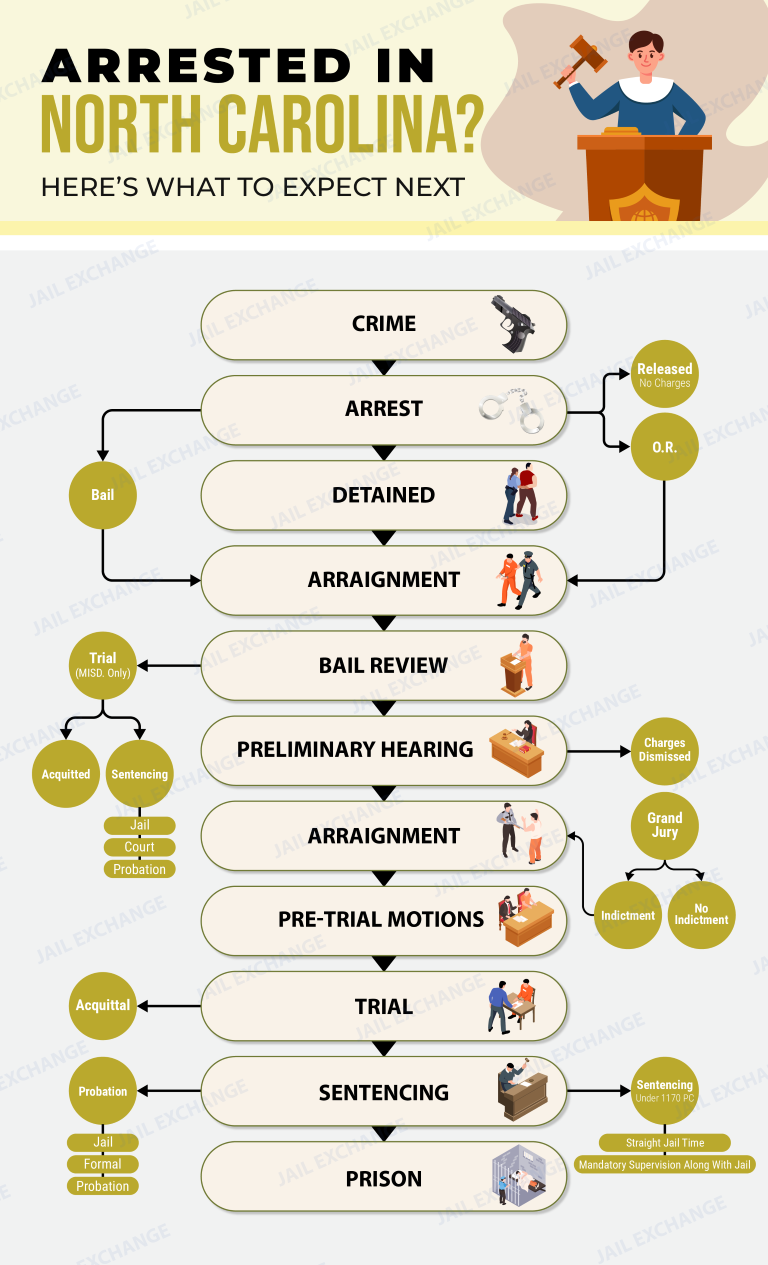
Information for this service is currently unavailable.
Pick up the phone before you try to send a single dollar. Alleghany County keeps its deposit process off the internet: nothing public says whether it takes online payments, a lobby machine or money orders, and nothing names whose name belongs on a money order's payee line. The one route to those answers is a call to 336-372-4455, with the inmate's legal name and birthday close at hand.
While you wait to get through, know that small county jails lean on postal money orders more than anything else. These are usually left at the front desk of the Law Enforcement Center or mailed in. That is only the common pattern, not a published Alleghany rule, so let staff confirm it and name the payee before you buy one.
Ring during weekday business hours if you can. Someone at the Sheriff's Office answers around the clock, yet the office asks the public to save routine, non-emergency matters for normal weekday hours. That office runs the jail from inside the Law Enforcement Center, 40 Alleghany Street, Sparta.
What does the balance buy? Snack food, soap and similar toiletries, and phone time. Don't tuck postage into a letter, either: stamps can't come in by mail, so the person gets them through commissary.
The Alleghany County Sheriff's Office runs the county jail inside the Alleghany Law Enforcement Center in Sparta, which is staffed around the clock. Letters, legal papers and publications all use the center's post office box rather than the Alleghany Street building. Officers pass out the mail on weekdays, with no cap on how many letters one person gets.
One address for letters, legal mail and publications:
Inmate's Full Name & Inmate ID #
Alleghany Law Enforcement Center
PO Box 53
Sparta, NC 28675
- Return address: Sparta staff look for the sender's name and mailing address in the top left corner, and a letter missing them will most likely never be handed over.
- Ink: Only blue or black. The jail turns away felt markers, crayons, colored ink and lipstick.
- Books: Each book has to be new and mailed by its publisher, and the jail throws out any book with extremely violent, pornographic or obscene pages.
- Magazines and newspapers: Like books, they must be sent by the publisher itself, and an issue showing profanity, weapons or adult material is held back from the inmate.
- Greeting cards: Send a plain one, not a musical card.
- Not allowed inside: Glitter, confetti, perfume and drawings, including doodles on the envelope.
- Stamps: They can't be mailed in. Inmates buy them from commissary, and people with no money get a few each week.
- Breaking the rules: Alleghany County allows no slack on mail violations. Mail privileges can be suspended, and contraband sent by mail can lead to criminal charges.
Short video messages through electronic messaging cost $1.00 each, plus a $1.00 fee on every purchase. To see whether someone is still held, use the inmate lookup or call 336-372-4455.

PayTel Communications provides telecommunications services that allow incarcerated individuals to place outbound calls from housing units to family and friends. Because correctional facilities do not accept incoming calls, establishing a PayTel prepaid account links calling funds directly to your 10-digit telephone number so calls connect without carrier restrictions.
Important: Mobile Phones Automatically Block Inmate Calls
Mobile cellular carriers automatically block collect calls originating from jail phone systems. While some residential landlines might allow direct monthly billing, mobile phones and internet-based lines require an active prepaid balance, which you can verify by checking with your provider. If you do not register online and fund your account right away, your loved one will receive an automated operator message stating that your number cannot accept calls.
Step-by-Step Instructions to Register and Fund a Phone Account
- Visit www.paytel.com or call PayTel customer service at 1-800-729-8355.
- Click Open an Account and register using your primary 10-digit telephone number and email address.
- Select the state and facility where the inmate is currently detained.
- Link the inmate to your profile using their full legal name and booking ID number.
- Select your deposit dollar amount and complete payment using a credit or debit card.
- Confirm that your mobile phone allows calls from automated or unknown correctional numbers.
What the Inmate Needs to Do
The inmate dials your 10-digit number from any dayroom phone and enters their assigned PIN. The automated system verifies that your phone number has an active prepaid balance and prompts you to accept the call. All non-privileged conversations are recorded and monitored by facility staff.
Official Provider: PayTel Official Website
Customer Service Telephone: 1-800-729-8355
Support Hours: Monday – Friday, 8:00 AM – 9:00 PM EST; Saturday, 9:00 AM – 6:00 PM EST
Supported Languages: English and Spanish
Other Services Provided by PayTel Communications
In addition to Prepaid Phone Calling Accounts, PayTel provides digital communications at participating facilities:
- Inmate Messaging & Digital Communications: Send electronic messages and photos directly to an inmate's terminal.
• Learn more on our website: Inmate Messaging Guide | • Visit official vendor page: PayTel Messaging
HomeWav Inmate Text Messaging provides a fast, two-way digital communication platform that allows families to exchange text messages and photo attachments with an incarcerated loved one. Messages are delivered directly to the inmate's terminal or tablet screen within hours, bypassing long postal mail processing times.
Important: Digital Mail Screening Rules Vary by Facility
Inmates cannot receive incoming phone calls, and traditional postal mail rules differ across jurisdictions. While some detention centers still allow regular handwritten letters, many facilities now restrict physical paper mail or mandate electronic messaging, which you can verify by checking facility rules. If you do not register online and set up message credits immediately, your loved one may face lengthy periods without direct written contact from family.
Step-by-Step Instructions to Register and Send Text Messages
- Download the HomeWav mobile app on your smartphone or go to www.homewav.com.
- Register your account, complete identity verification, and link your incarcerated contact.
- Navigate to the Text Messaging section of the app.
- Purchase messaging credits using a credit or debit card.
- Type your message and attach approved JPEG photos if permitted by facility guidelines.
- Send your message to the facility's automated and manual screening queue.
What the Inmate Needs to Do
All electronic correspondence is screened by correctional staff before delivery. Once approved, messages appear in the inmate's inbox on their housing unit HomeWav kiosk or tablet. The inmate opens the message, reads your note, and types an electronic reply using available account credits.
Official Provider: HomeWav Official Website
Customer Service Telephone: 1-844-394-6639
Support Hours: Monday – Friday, 8:00 AM – 5:00 PM CST
Supported Languages: English and Spanish
Other Services Provided by HomeWav
In addition to Inmate Text Messaging, HomeWav offers video visitation and voice calling services:
- Remote Video Visitation: Schedule and join live video visits from home using your phone or computer.
• Learn more on our website: Video Visitation Guide | • Visit official vendor page: HomeWav Video Visits - Voice Calling Accounts: Prepay for voice calling minutes so your loved one can call your telephone directly.
• Learn more on our website: Voice Calling Accounts Guide | • Visit official vendor page: HomeWav Voice Calls
HomeWAV provides secure handheld wireless tablets designed specifically for county jails and regional detention facilities. Through HomeWAV's closed facility network, these mobile tablets grant incarcerated individuals direct access to on-demand video calls, voice calling, two-way text messaging, digital educational programs, and institutional grievances directly from their living areas.
Important: Tablet Access Hours and Account Balances Vary
Detention centers do not manage tablet distribution identically. While some agencies issue individual personal tablets to every detainee at booking, others utilize shared pod docking stations or restrict tablet use to specific dayroom hours, which you should confirm with the facility directly. Although core educational and legal resources are generally provided free of charge, sending messages, initiating video calls, or making phone calls from the tablet requires an active prepaid HomeWAV balance funded by outside contacts.
Step-by-Step Instructions to Support HomeWAV Tablet Use
- Visit www.homewav.com or download the HomeWAV mobile app.
- Register your account and complete identity verification by uploading your government-issued ID.
- Search for your facility by state and add your incarcerated loved one by legal name or booking ID.
- Select Add Funds and deposit money into your HomeWAV account balance.
- Review transaction fees, complete payment using a credit or debit card, and record your confirmation receipt.
- Inform your loved one that calling, messaging, and video minutes are funded on their device.
What the Inmate Needs to Do
The inmate unlocks their assigned HomeWAV tablet using their individual PIN. When funds are present in your account, they can select your name from their approved contacts to initiate an on-demand video session, place a voice call, or draft a text message. Devices must be placed on docking charging carts during institutional count times and night lockup.
Official Provider: HomeWAV Official Website
Customer Service Telephone: 1-844-394-6639
Support Hours: Monday – Friday, 8:00 AM – 5:00 PM CST
Supported Languages: English and Spanish
Other Services Provided by HomeWAV
In addition to Tablet Services, HomeWAV provides several direct communication solutions:
- Remote Video Visits: Meet face-to-face over secure live video from home on your schedule.
• Learn more on our website: Video Visitation Guide | • Visit official vendor page: HomeWAV Video Visits - Prepaid Phone Calling: Prepay for voice calling minutes so your loved one can call your telephone directly.
• Learn more on our website: Phone Calling Guide | • Visit official vendor page: HomeWAV Voice Services - Digital Inmate Messaging: Send electronic messages and photos directly to an inmate's device.
• Learn more on our website: Digital Messaging Guide | • Visit official vendor page: HomeWAV Messaging
Nearby counties
- Jail (Main): 336-372-4455
- Sheriff: 336-372-4455
The Alleghany County Jail serves the following cities and towns of Alleghany County: Laurel Springs, Sparta and Whitehead.