
Durham Youth Detention
Durham Youth Detention
Physical Address
2432 Broad StreetDurham, NC 27704
Jail Phone Number
919-560-0840Durham County Inmate Search: Where to Look First After an Arrest
People arrested here are booked at the Durham County Detention Facility, 219 South Mangum Street, Durham, NC 27701. That one building holds intake, release, the magistrates' office, medical care and the housing areas, and it never closes. This page first shows how to find the person. After that it covers photos, bail, the charge, lawyers, visits, money, letters, belongings and court dates.
Open the Sheriff's online jail search first. Type the last name first. If nothing shows, put in a first name, a nickname, or another way the name could be spelled. Someone brought in just hours back might not appear, since the list can lag behind the booking desk. When the name is not there, phone the jail.
The fastest step right now is a call to 919-560-0912. Tell staff who you are looking for, with a birthday if you have it. Ask where the person sits, why, and what court date is next. Our bail page explains release rules, and our court page explains hearings.
Read inmate search answers
 Read inmate search answers
1. Steps for using the Durham County jail roster
Use the Sheriff's list on a phone or a computer. Here are the steps:
- Open the jail search.
- Type the last name. Too many names? Then add the first name.
- Try a second spelling, a nickname or a maiden name if nothing appears.
- Look across each row for whatever it lists, such as the charge, the arrest date or a bond.
- Note any ID or booking number the row gives. With it, staff can pull up the right file sooner.
The list can run behind real life. For the newest facts, call the jail at 919-560-0912 and ask for Records.
↑ Back to the question list2. A name that will not come up: what it means
Several things can cause a blank result:
- Still being booked. Fingerprints, photos and health questions take hours.
- Already home. A magistrate could have allowed release, or a family member could have paid a bond.
- Another spelling. A typo or a nickname can hide a name.
- Held elsewhere. Another county, the state or federal agents could have the person.
- A minor. Juvenile detention, not this jail, takes anyone who is not yet 18.
Call the jail at 919-560-0912. Staff can say if the person is inside, and the criminal magistrates answer at 919-560-6826.
↑ Back to the question list3. Where in Durham County a booked person is kept
The place to start is the detention facility, 219 South Mangum Street, Durham, NC 27701, 919-560-0912. It is the adult jail for people arrested in the city, in Research Triangle Park and in the rest of the county. One building serves every purpose: new arrivals, people waiting for court, medical care and the different housing levels. No second building, work release unit or shared regional jail showed up in our research.
A person picked up near the county's edge could be in a jail next door. Look at the JE pages for Orange, Wake, Granville, Person and Chatham counties. A federal or immigration hold is covered further down.
↑ Back to the question list4. Mugshots after an arrest here: what to expect
Do not count on it. Our research could not confirm that the Sheriff's search shows booking photos, so use the jail search and judge a row with your own eyes. State law leaves booking photos in a gray area. A Sheriff decides whether to put mugshots online.
Anybody may learn a handful of facts about an arrest. The public can get the arrestee's name and age, plus the home address. They can also get the charge that was alleged, with the time and place it happened. Want to know about a photo? Phone whichever agency made the arrest, or the jail at 919-560-0912.
- For a photo held by ICE, go to the ICE records page to ask.
- The federal government does not release mugshots, except that the U.S. Marshals Service may let one out when it hunts a fugitive.
5. A free ping for the day an inmate walks out or moves
Yes. VINE is free and sends calls, texts or emails. You get an alert if a person is released, or transferred from local custody into a state prison. Register through VINELink or phone 877-627-2826, any hour.
Anyone may use VINE, not only victims, and it tracks custody status too. Treat alerts as a backup. For a release time you can trust, call the jail at 919-560-0912.
↑ Back to the question list6. Bond, bail and release rules for a Durham County arrest
A magistrate usually sets the terms soon after booking, at any hour. The criminal magistrates are in the jail building, 919-560-6826. The magistrate may choose among four paths. Release can come with a promise and no payment now. A responsible person or group can take the defendant into their care. A bond can be secured with cash, land or a bondsman's pledge. Or the defendant can be confined at home and tracked by a monitor, which is added on top of such a secured bond. The old promise-to-appear option ended on December 1, 2025. The county also runs a pretrial services program that can supervise people a judge releases.
Some charges, such as murder or kidnapping, go to a judge, not a magistrate. Following a domestic violence arrest, it can be two days before any judge sees the person. If the defendant remains locked up, a District Court judge sees them in no more than three days.
Before you pay a secured bond, phone the jail. Bondsmen set their own price but cannot ask for over 15 percent of the bond. You do not get that money back. Check a bondsman at the NC Department of Insurance lookup. Our bail page has more, and so do the bail laws of the state.
↑ Back to the question list7. Reading the charge: who knows and where it is kept
Ask the jail first. Call 919-560-0912 and say you want the charge and bond. The Sheriff's list may also show it.
Court records come next. The Clerk of Superior Court files every criminal case, at the courthouse, 510 S. Dillard St., Durham, NC 27701, 919-808-3000. The clerk needs the full name along with a date of birth. You can also use the state's eCourts portal, with charges, hearing dates and the history of each case.
Deciding which charges move ahead is the job of the District Attorney. That office is in the same courthouse, 919-808-3010.
↑ Back to the question list8. Free lawyers for Durham defendants who cannot pay
People who cannot pay can ask for a free lawyer. The best time is the first court date. The person signs a money-need form (an affidavit of indigency). A judge then decides who qualifies, and the court can order the cost paid back later.
The Public Defender Office for Defender District 16 is at 510 S. Dillard Street, Suite 4700, Durham, NC 27701, 919-808-3023. Hiring a private attorney is possible whenever you like. Indigent Defense Services answers statewide questions at 919-354-7200.
Do not let the person talk about the case on a jail phone. Calls can be recorded.
↑ Back to the question list9. Seeing a loved one at the jail, in person or on screen
Our visitation page has more. These are the official rules, listed on the Sheriff's visitation page:
- In person: Tuesdays 4:00 to 7:30 p.m. for Pods A and B, and Thursdays 4:00 to 7:30 p.m. for Pods C and D.
- Book 2 to 7 days ahead. Each person may have up to 2 visits a month.
- Visitors 18 and older need a photo ID.
- Video: free on Monday, Wednesday, Friday, Saturday and Sunday, 9 a.m. to noon and 4 to 7 p.m.
Sign up for video visits on the GTL VisitMe site or at the lobby kiosk at 219 South Mangum Street, Durham, NC 27701. Questions? Call 919-560-0912.
↑ Back to the question list10. Adding funds for snacks and calls
See our money page for the full steps. The Sheriff's page lists three ways:
- Online with TouchPay, any hour.
- By phone with TouchPay at 866-232-1899.
- At the lobby kiosk, open 24 hours. It takes cash, Visa, Mastercard and MoneyPak.
Card payments carry fees. Keep your receipt. If money does not appear, call the jail at 919-560-0912 and ask for Records.
↑ Back to the question list11. Talking by phone from inside
People inside usually call out. Families cannot dial in. The jail's calling rules, rates and any tablet service are not in our research, so call 919-560-0912 and ask what it takes to open a calling account. The phone page on this site and the email and text page describe usual setups.
Video visits are one kind of contact the Sheriff does describe. They are free, and you register on GTL VisitMe or at the lobby kiosk. Assume that calls can be recorded.
↑ Back to the question list12. Addressing a letter so it reaches an inmate
Our mail page has tips. The Sheriff's page gives these official rules. A scanning center, and not the jail itself, receives personal letters:
Durham County Detention Center, NC
Inmate Name, ID Number
P.O. Box 247
Phoenix, MD 21131
Staff scan each letter offsite through a vendor named ViaPath and TextBehind. Do not send cash or checks. Legal mail, books and packages use a different address: P.O. Box 771, Durham, NC 27702. If you have doubts, call 919-560-0912.
↑ Back to the question list13. Wallets, clothes and keys held at booking
The jail stores clothing and items taken at booking. The rules for pickup are not in our research, so call 919-560-0912 and ask for Property. Ask what hours to come, what ID to bring, and whether a friend may pick up with written permission.
Money held for the person may be returned on release. Ask Records at the same number. Nothing is mailed unless staff approve it first.
↑ Back to the question list14. Getting health care help for an inmate
Call the jail at 919-560-0912 and ask for the medical unit. They will need the full name, the birth date, the health issue and any medicine the person takes. Staff cannot always share details back, but they can pass your message on.
The person inside should hand in a written medical request too, naming the care needed. For an urgent danger, say that clearly at the start of your call.
↑ Back to the question list15. Might a warrant exist for a person you know?
Deputies serve warrants for the county, while city police handle theirs. Call 919-560-6826 and ask the magistrates about a warrant. Calling is the most certain way to learn whether one exists.
Another route is the Clerk's criminal division in Superior Court, 919-808-3000, or the state's eCourts case search. See a lawyer before taking steps to clear a warrant. Once you have, call the court behind it. You can find the clerk at 510 S. Dillard St., Durham, NC 27701.
↑ Back to the question list16. Hearing dates and rooms for Durham County cases
Our court page explains each stage. Criminal cases sit at the courthouse, 510 S. Dillard St., Durham, NC 27701. District Court takes misdemeanors and the opening phase of felony cases. Only after grand jurors return an indictment does a felony reach trial in Superior Court.
Search dates at the state's court date search. You can also call the clerk at 919-808-3000. Skipping a court date leads to a new bond set at no less than twice the old one.
↑ Back to the question list17. Facing federal charges instead
The Middle District of North Carolina covers this county, and its local courthouse is the John Hervey Wheeler Courthouse, 323 E. Chapel Hill Street, Durham, NC 27701. Clerk calls go to 336-332-6000. Crimes at the federal prison complex in Butner fall in the Eastern District. Its clerk is at 310 New Bern Avenue, Raleigh, NC 27601, 919-645-1700.
The detention hearing falls to a federal magistrate judge, under 18 U.S.C. 3142. The U.S. Marshals Service for the Middle District is at 324 West Market Street, Suite 234, Greensboro, NC 27401, 336-332-8700. The Federal Public Defender is at 301 North Elm Street, Suite 410, Greensboro, NC 27401, 336-333-5455. After sentencing, use the BOP inmate locator.
↑ Back to the question list18. An immigration hold on the person
Sometimes ICE files a detainer (Form I-247A) plus an administrative warrant on a person with a pending charge. When that happens, a judicial official can order the person held for ICE up to 48 hours after they would otherwise be released (8 CFR 287.7(d)). North Carolina law now sets that process, and the jail tells ICE when release nears.
Use the ICE Online Detainee Locator to find someone ICE has taken. We did not confirm a local ICE office, so call the jail at 919-560-0912 to ask whether a hold exists. Talk to a lawyer fast.
↑ Back to the question list19. After a sentence: tracing someone into state prison
After a sentence, the North Carolina Department of Adult Correction takes custody. Staff first classify the person, then pick a fitting prison. Try the Offender Public Information search, and type a surname or the state's offender number. Its records cover people in prison or on probation or parole, and no one held in a county jail. The department is at 214 West Jones St., Raleigh, NC 27603, 919-733-2126.
A short sentence may be served inside a county jail. See JE's state prisons page for more.
↑ Back to the question list20. A Durham teen taken into custody
Adult booking is not used for children. If a youth has to stay in custody, juvenile detention is the place, and the court must hold a hearing in 5 calendar days or less. Juvenile court, which sits inside District Court, hears these cases in private.
The state lists the county Youth Home, 2432 Broad Street, Durham, NC 27704, 919-560-0840. Call Juvenile Justice at 919-560-6824 to learn where a youth is. The courthouse is at 510 S. Dillard St., Durham, NC 27701.
↑ Back to the question list21. Agencies that bring people to this jail
Which agency made the arrest? Ring the jail at 919-560-0912 and ask for Records. City officers, university police and the Sheriff all bring people to the same jail.
- City: the Durham Police Department.
- Campuses: the police at North Carolina Central University and at Duke University.
- Sheriff: deputies cover the rest of the county. Call the jail line, 919-560-0912.
- Highway Patrol: Troop C, District VII, Durham, 919-560-6868. Troop C headquarters is at 1831 Blue Ridge Rd., Raleigh, NC 27607.
We could not confirm non-emergency numbers for city and campus police, so ask the jail or magistrates, 919-560-6826, to point you to the right one.
↑ Back to the question listInformation for this service is currently unavailable.
Durham County District and Superior Court Cases After an Arrest
A criminal case in Durham begins before a District Court judge, and felonies later go to a Superior Court jury. Both courts sit at the Durham County Courthouse, 510 S. Dillard St., Durham, NC 27701. Anyone still in custody is held at the Durham County Detention Facility, 219 South Mangum Street, Durham, NC 27701.
Check whether someone is in jail using the Durham County Inmate Search. Looking for more? The Jail Roster page on our site lists new bookings, the charges, and open warrants.
Need a hearing date or room? Call the Clerk of Superior Court at 919-808-3000 with the full name. If you need someone out, read our bail and bond page first.
1. Where will the criminal case be heard?
In Durham County, the name of the charge is a useful clue to which courtroom handles it.
Courthouse locations and direct telephone numbers
- Durham County Courthouse, 510 S. Dillard St., Durham, NC 27701, 919-808-3000
State court: The Durham County District Court handles most misdemeanors and the opening felony hearings. The Durham County Superior Court handles felony trials and appeals for a new trial from District Court.
Court notices may show a courtroom used for an initial hearing rather than the place of a later felony trial.
↑ Back to the question list2. What happens after an arrest and how does release work?
The first few hours can involve fingerprinting, medical screening, property storage, and a magistrate deciding whether release is allowed.
Release can involve a written promise to appear, an unsecured bond, a secured bond, or other conditions. A secured bond does not mean the person is already guilty. A judge may review release terms, and restrictions can include staying away from an alleged victim.
For certain arrests, extra review or holding rules apply. A person held in custody should be told the charges and brought before judicial officials under the applicable rules. If the accused cannot afford a defense lawyer, asking promptly about eligibility for appointed counsel is important.
↑ Back to the question list3. How are misdemeanor cases handled and punished?
For most misdemeanors, District Court is where the trial occurs. A jury is not used at that stage.
Important misdemeanor sentencing figures: North Carolina uses Classes A1, 1, 2, and 3. A1 ranges from 1–60 days at prior-conviction Level I to 1–150 days at Level III; Class 1 reaches 45, 45, or 120 days by level; Class 2 reaches 30, 45, or 60 days; Class 3 reaches 10, 15/20, or 20 days depending on the person’s prior convictions and permitted sentencing disposition.
The word “maximum” does not mean everyone goes to jail. Some combinations of class and prior record require or allow community punishment instead. Ordinary fine ceilings are $200 for Class 3 and $1,000 for Class 2, while Class A1 and Class 1 fines are generally left to the court unless a particular crime has its own rule (G.S. 15A-1340.23).
↑ Back to the question list4. How does a felony case move through the courts?
A person facing a felony will usually see a District Court judge before any Superior Court trial.
After a first appearance, a probable-cause hearing may be scheduled; an indictment can change whether a preliminary hearing is needed. In Superior Court, the parties exchange evidence, argue motions and may negotiate a plea. Someone pleading not guilty to a felony is entitled to a jury trial. The prosecutor must prove the case beyond a reasonable doubt.
Class A through I felonies carry different sentencing possibilities. Prior-record points, offense class, aggravating or mitigating factors and the date of the crime can substantially change the lawful range. The court uses the structured-sentencing grid in G.S. 15A-1340.17, not a single fixed statewide number for all felonies.
↑ Back to the question list5. What happens with serious violent crimes?
Accusations such as murder, serious sexual assault and armed robbery carry far more serious consequences than routine misdemeanors. A Superior Court jury may hear the evidence, with appointed or retained defense counsel. In some cases there are special rules for bonds, mandatory minimums, and life imprisonment.
First-degree murder may be punished by life without parole or death under the statutes governing capital cases; other homicides have different classifications and punishments. Sentences for rape and robbery depend on the precise offense statute and any aggravating factors. A family should never rely on a broad label like “assault” to calculate a sentence.
↑ Back to the question list6. How do juvenile cases work?
A complaint involving a young person can follow juvenile delinquency procedures rather than the ordinary adult criminal docket. Youth hearings are generally in District Court, with different goals and privacy protections. For many delinquent acts the juvenile system has jurisdiction over offenses committed before age 16, while some 16- and 17-year-olds accused of specified lower-level conduct may also be handled there under the applicable statutes.
Intake staff may recommend diversion or formal proceedings. A juvenile can be placed under supervision, ordered into services, or in appropriate cases detained or committed. Serious charges may trigger special transfer rules. Parents or guardians should ask about counsel and the youth’s next hearing.
↑ Back to the question list7. How does North Carolina decide fines and sentences?
Here is the key to reading a North Carolina sentence: the judge first looks at the offense class, then the defendant’s prior convictions or prior-record points. The law limits both the length and the type of sentence. “Community” punishment may mean probation or conditions instead of immediate jail; “intermediate” punishment can be more restrictive; “active” punishment means incarceration.
For misdemeanors, examples of the longest grid terms are Class A1 up to 150 days, Class 1 up to 120, Class 2 up to 60 and Class 3 up to 20, for the applicable highest prior-conviction level. These are not automatic sentences. Fines: ordinarily Class 3 up to $200 and Class 2 up to $1,000; the usual statutory text leaves A1 and Class 1 fine amounts to the judge unless another law controls. For felonies, the North Carolina felony grid in G.S. 15A-1340.17 specifies the allowable minimum and maximum prison term according to class and prior-record level.
Some crimes have their own minimums, enhancements, restitution obligations, court costs, sex-offender requirements, or driving restrictions. The offense date matters because the legislature has updated the sentencing charts, including changes effective for crimes committed on or after December 1, 2025.
↑ Back to the question list8. Are there city courts or other local criminal courts?
North Carolina does not operate a separate municipal criminal-court system like some states. City police departments may arrest a person and city ordinances may lead to enforcement, but ordinary state criminal prosecutions go through District Court and Superior Court. Magistrates handle functions such as issuing warrants and setting release conditions.
This is why someone arrested by a city police officer in Durham County generally receives a state-court case, not a separate “city criminal court” proceeding. A local police holding area is not the county courthouse.
↑ Back to the question list9. What if the charge is a federal crime?
Most crimes prosecuted by a county District Attorney remain in state court. A separate federal criminal case can arise from violating a federal statute, such as certain interstate fraud, trafficking offenses, federal firearm offenses, bank robbery involving a federally insured bank, or crimes on federal property. Not every serious state crime is automatically a federal crime.
Usual federal venue for Durham County: U.S. District Court for the Middle District of North Carolina. Federal crimes arising at the Federal Correctional Institution in Butner are assigned to the Eastern District; most other Durham locations are in the Middle District. Federal contact: Greensboro federal clerk, 336-332-6000. L. Richardson Preyer Federal Building and Courthouse, 324 W. Market Street, Greensboro, NC 27401
Federal magistrate judges handle initial appearances and detention hearings; federal prosecutors work for the U.S. Attorney. Federal felony cases generally involve a grand jury indictment unless properly waived. The U.S. Sentencing Guidelines and federal statutes, not North Carolina’s state sentencing grid, govern federal sentences.
This is general court information, not legal advice. If the accused cannot afford an attorney, ask at the first appearance about appointed counsel.
↑ Back to the question list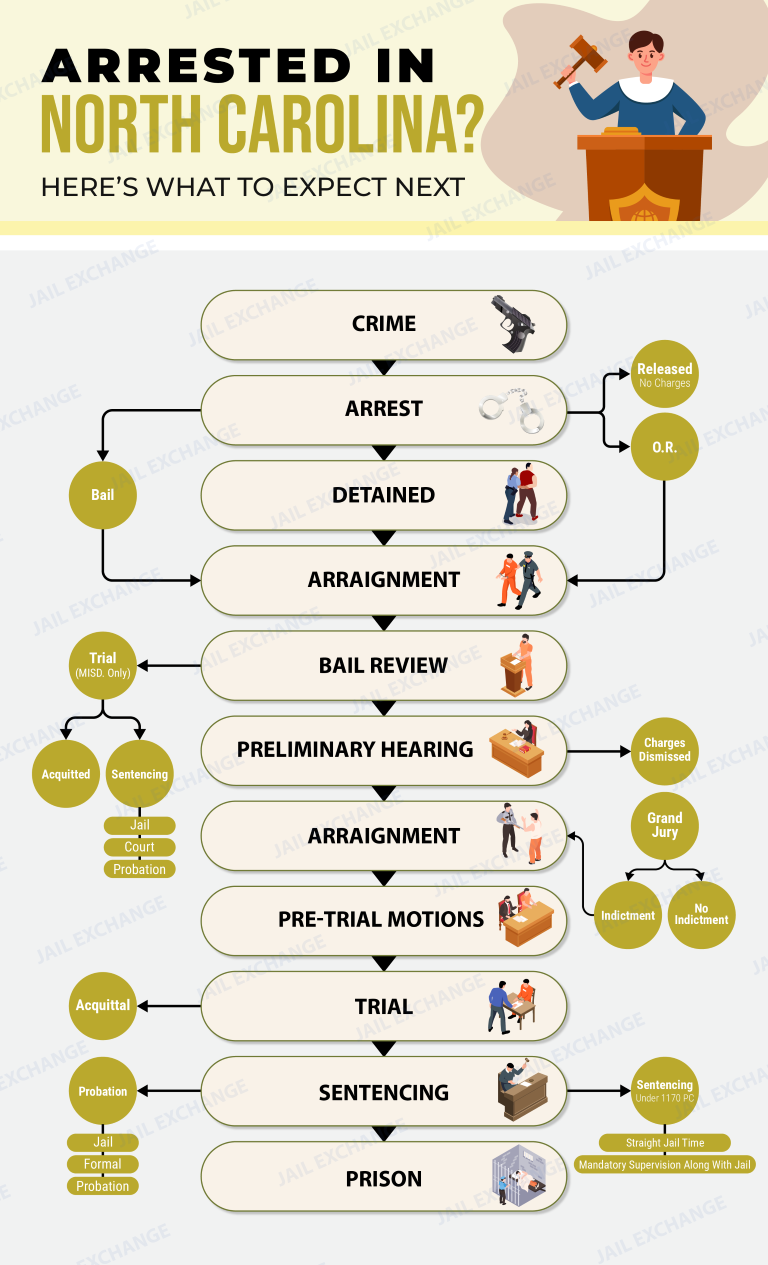
Information for this service is currently unavailable.
Information for this service is currently unavailable.
Information for this service is currently unavailable.
Information for this service is currently unavailable.
Information for this service is currently unavailable.
Information for this service is currently unavailable.
Durham County County Jails
Nearby counties
- Juvenile Home: 919-560-0840
- Administration: 919-560-0840
- Adult Probation: 919-560-6036
- Arrest Warrants: 919-560-8883
- Bail: 919-560-0913
- Court: 919-808-3002
- District Attorney: 919-808-3010
- Inmate Info: 919-560-0772
- Juvenile: 919-560-0840
- Juvenile Court: 919-560-6824
- Juvenile Probation: 919-560-0880
- Police: 919-560-4600
- Police Tips: 919-560-7151
- Public Defender: 919-808-3023
- Records: 919-560-0905
- Sheriff: 919-560-0853
The Durham Youth Detention serves the following cities and towns of Durham County: Durham, Bahama, Bragtown, Butner, Gorman, Morrisville and Research Triangle Park.