Grand Forks Co. Juvenile Detention Criminal Court Process
Criminal Court Process for Grand Forks County North Dakota
Grand Forks County Criminal Court Guide
Grand Forks County criminal court guide. When an arrest interrupts a family, it helps to sort out where the accused is held, who makes release decisions, and where hearings occur.
Below are explanations of jail intake, bond decisions, serious charges, juvenile cases, statutory fines, and U.S. District Court proceedings. The penalty figures are legal limits, not a prediction about any particular defendant.
Cases arising in Grand Forks County ordinarily go through the Northeast Central Judicial District. The District Court hears criminal matters at the county courthouse in Grand Forks. A municipal ordinance accusation, if one applies, may be handled by a separate city court.
1. Where are the criminal courts, and how do I contact them?
Grand Forks County District Court and Clerk: 124 S 4th St, Grand Forks, ND 58201. Telephone: 701-787-2700. The county belongs to the Northeast Central Judicial District. Call the published clerk number about filing questions or a listed hearing; the clerk cannot provide legal advice.
District Courts in North Dakota hear both misdemeanors and felonies. State law does not divide these cases between a county District Court and a separate state Circuit Court. The judge handling a case can be assigned from elsewhere in the judicial district.
Some cities handle ordinance violations in municipal court. The county District Court contact above is for state criminal charges; a municipal ticket identifies the separate city court if one is involved. No unverified municipal street address or phone number has been inserted here.
↑ Back to the question list2. What happens immediately after an arrest?
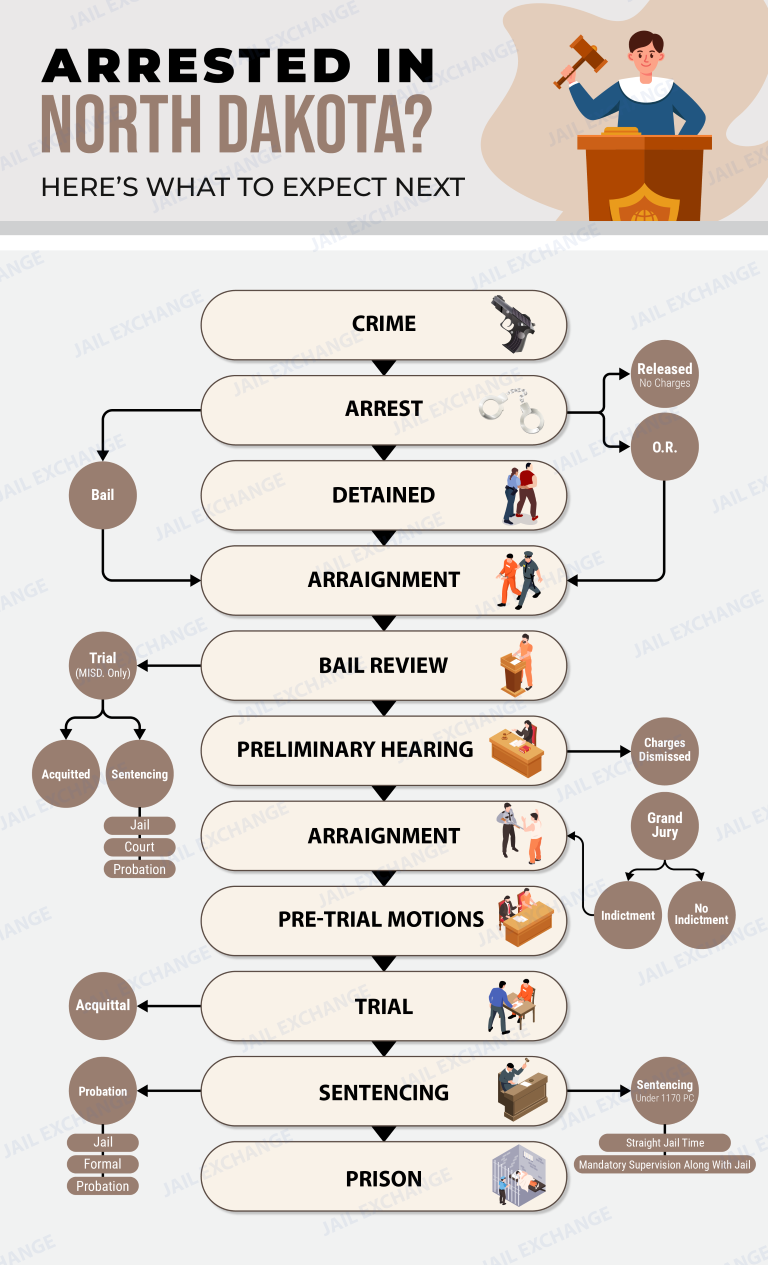
An arrest in Grand Forks County may lead to booking, which means the jail records the charges, photographs and fingerprints the person, lists their belongings, and checks for medical needs. Booking alone does not mean the person has been convicted.
For a Grand Forks County arrest, the charging paperwork and initial judicial order control the next hearing. The courthouse in Grand Forks can explain its public filing and calendar procedures, but it does not operate as a jail. When someone is not released after arrest, they may be held in a jail in the county or a neighboring county’s jail, depending on the local custody arrangements. The courthouse handles the criminal case; it is not the jail.
↑ Back to the question list3. Can someone get out of jail before trial, and how does bond work?
Family members often want a dollar figure immediately. That amount may not exist until a judicial officer reviews the case; North Dakota judges can use promises to appear, money conditions, and restrictions on contact or travel.
Conditions can include returning for every hearing, avoiding contact with a named person, reporting to a supervising agency, or obeying travel limits. If the bond involves money, ask for the actual written order before paying anyone; release and refunds depend on the terms set by the court.
↑ Back to the question list4. How does a misdemeanor case move through court?
The court process for a lower-level offense usually starts with written charges and an appearance in front of a judge. The prosecution must prove guilt if the defendant contests the accusation; the person has the right to legal counsel under applicable rules.
The two ordinary misdemeanor classes have different limits: a Class B misdemeanor permits no more than 30 days and $1,500, while a Class A misdemeanor permits up to 360 days and $3,000. Some crimes carry extra rules, court costs or treatment requirements. A conviction is not automatic simply because police wrote a report.
↑ Back to the question list5. What happens if the charge is a felony?
A felony charge puts a person at risk of a state prison sentence. The court must address counsel and release before the case reaches a possible trial; the state’s attorney must establish guilt beyond a reasonable doubt if the accusation is contested.
Sentencing starts with the statute that defines the convicted offense. North Dakota uses Classes C, B, A, and AA for felonies; prior convictions, mandatory provisions, restitution, and the judge’s orders may affect the result. A case can be resolved by dismissal, plea, or trial, and the sentence cannot be predicted just from the original arrest accusation.
↑ Back to the question list6. What changes when the accusation involves violence?
Serious violent accusations get the same presumption of innocence as other criminal charges. Judges may weigh danger to witnesses or the public in release decisions, and certain offenses carry added sentencing rules.
Under N.D.C.C. § 12.1-32-02.1, certain qualifying felonies involving a firearm or dangerous weapon can require mandatory imprisonment, including four years for specified Class AA, A or B felonies and two years for qualifying Class C felonies. The facts and exact charges must meet the statute; the rule is not automatic for every violent accusation.
↑ Back to the question list7. What happens when someone under 18 is accused?
The juvenile court process emphasizes both accountability and rehabilitation. Youth may be referred for an assessment, placed on conditions at home, or brought before a judge if the matter needs formal action.
A youth’s hearing may be confidential, and information available to the public can be narrower than in an adult case. Parents should ask counsel about detention review, school needs, appropriate services and whether a juvenile petition has actually been filed.
↑ Back to the question list8. What fines and jail or prison sentences are possible?
North Dakota Century Code § 12.1-32-01 sets the standard punishment ceilings below. These are maximum legal limits for the class, not typical sentences handed out in Grand Forks County. The exact offense may require a different minimum or special sentence.
| Offense class | Maximum ordinary penalty |
|---|---|
| Infraction | No ordinary jail term; fine up to $1,000. |
| Class B misdemeanor | Up to 30 days in jail, a fine up to $1,500, or both. |
| Class A misdemeanor | Up to 360 days in jail, a fine up to $3,000, or both. |
| Class C felony | Up to 5 years in prison, a fine up to $10,000, or both. |
| Class B felony | Up to 10 years in prison, a fine up to $20,000, or both. |
| Class A felony | Up to 20 years in prison, a fine up to $20,000, or both. |
| Class AA felony | Life imprisonment, with or without the possibility of parole as provided by law. |
A judge may consider probation, imprisonment, restitution, a fine, treatment, or a lawful combination of penalties. Previous convictions, weapon allegations, and special laws can change the sentencing calculation. An infraction generally means a fine rather than jail, except the statute includes special treatment for certain repeat infractions.
↑ Back to the question list9. What if the charge is a federal crime?
Federal prosecutions from Grand Forks County are handled by the U.S. District Court for the District of North Dakota, not by the county District Court. Federal jurisdiction can arise from federal drug trafficking, crimes involving federal property, qualifying interstate fraud, immigration offenses, and certain firearm laws. A crime is not federal merely because it is serious.
The federal district has staffed offices in Bismarck and Fargo and additional courthouses in Minot and Grand Forks. One useful staffed federal contact is the Quentin N. Burdick U.S. Courthouse, 655 1st Ave N, Suite 130, Fargo, ND 58102, telephone 701-297-7000. The particular case docket or summons—not the county alone—determines where a person must appear.
Federal courthouse directory
- Bismarck — William L. Guy Federal Building and U.S. Courthouse: 220 E Rosser Ave, Suite 476, Bismarck, ND 58501; 701-530-2300
- Fargo — Quentin N. Burdick U.S. Courthouse: 655 1st Ave N, Suite 130, Fargo, ND 58102; 701-297-7000
- Minot — Bruce M. Van Sickle U.S. Courthouse: 100 1st St SW, Minot, ND 58701; 701-530-2300 (telephone reaches staffed Bismarck or Fargo office)
- Grand Forks — Ronald N. Davies U.S. Courthouse: 102 N 4th St, Grand Forks, ND 58203; 701-297-7000 (telephone reaches staffed Bismarck or Fargo office)
A federal defendant may appear before a U.S. magistrate judge, receive a detention hearing, be formally charged by indictment or another permitted procedure, and later enter a plea or go to trial. Federal sentencing uses statutes and federal guidelines; any prison sentence is generally administered by the Federal Bureau of Prisons.
↑ Back to the question listGeneral public information about criminal courts, not individual legal advice. A defense attorney can explain the exact charges, possible punishment, court order, and available defenses.