
Ward County Detention Center
Ward County Detention Center
Jail Phone Number
701-857-6530Ward County Inmate Search and Custody Information
Open the county’s inmate locator and check the posted update time. The county describes the roster as updated daily, so call the center about a recent arrest. This is the starting point for finding a person at Ward County Detention Center.
Ward County Detention Center is listed at 204 Front Street, Minot, ND. Call 701-857-6530 for the current booking status or before visiting.
If the arrest happened recently, ask which agency booked the person and whether intake is complete. Keep the booking details available when you ask about calls, court or release in Ward County.
1. How do I check who is in custody?
Open the county’s inmate locator and check the posted update time. The county describes the roster as updated daily, so call the center about a recent arrest. Official custody resource
↑ Back to the question list2. What can the Ward booking desk tell me?
Call 701-857-6530 with the full name, date of birth and arresting agency. Ask whether the person is physically at this facility, whether a transfer has been recorded and what identifying number to use in a follow-up.
↑ Back to the question list3. What can I do if the booking is missing?
Ask the agency involved in the Ward County arrest whether the person was released, is still awaiting intake or was moved. A dated list can lag a new booking. Use the facility telephone for the current status.
↑ Back to the question list4. Can I view a mugshot or charge?
Check the records made available by the responsible county or facility. A booking photograph may be unavailable. Use the court record and clerk to confirm filed charges, hearing dates and case outcomes.
↑ Back to the question list5. Who can confirm a warrant?
Ask the issuing court or law enforcement agency. For a Ward County arrest, start with the agency that took the person into custody and ask for the proper contact. The jail can tell you what it is able to share about holds attached to a booking.
↑ Back to the question list6. What if another jail has the person?
For a Minot arrest, ask whether police are still processing the person or whether the county center has accepted custody.
↑ Back to the question list7. How do I arrange contact or a visit?
Get the booking details before setting up any calls, visits or mail. Ask detention staff about the current system and visitor rules. Official contact information
↑ Back to the question list8. Can I put money on an account or pay bond?
Confirm the person’s location with 701-857-6530 before paying. A deposit for personal purchases is different from bail. The Ward County bail guide covers release and payment questions.
↑ Back to the question list9. How can I check the next hearing?
Find the case through North Dakota court records. Check the county and case number, then use the court guide to identify the clerk who can confirm the date.
↑ Back to the question list10. Can I receive a custody alert?
Use North Dakota SAVIN / VINELink to look for a matching record and register for available notices. For a time-sensitive custody change in Ward County, confirm directly with staff.
↑ Back to the question list11. Where do I search after a transfer to prison?
Use the North Dakota DOCR resident lookup for eligible state records and the Bureau of Prisons locator for federal prison custody. If a recent federal arrest does not show up there, ask the lawyer which facility is holding the person before trial.
↑ Back to the question listICE Detainees
Minot's jail on Front Street SE also keeps people in immigration custody. ICE lists the Ward County Detention Center as a USMS IGA site, in other words ICE borrows space under Ward County's contract with the U.S. Marshals, while the St. Paul Field Office runs the immigration side. For anyone in that group, the county locator is the wrong search box. ICE runs its own Online Detainee Locator; it wants either the A-Number and birth country, or the person's name spelled precisely, birth country and birthday. Citizens and anyone held on a Ward County or North Dakota charge belong on the county's roster above; ICE's tool skips them and skips minors. ICE points families with questions to 701-857-6530, option 1.
What Minot families ask about immigration custody
How far away is the immigration court?
Far. No EOIR page names this jail, but ICE's St. Paul office, which covers North Dakota, files its cases with the Fort Snelling Immigration Court, 1 Federal Drive, Suite 1850, Fort Snelling, MN 55111, 612-725-3765, some 450 miles east of Minot. In practice detainees here appear by video, and the court on the Notice to Appear is the one that counts. EOIR's case information website and its around-the-clock line, 1-800-898-7180, report the next hearing once you key in the A-Number.
Bond: what's possible from North Dakota
Often nothing. Under ICE's July 2025 position, crossing without inspection means no bond, Fort Snelling's judges apply that, and in 2026 the Eighth Circuit Court of Appeals, which governs North Dakota's federal court, upheld it. That leaves habeas petitions from Minot without a path to a bond hearing for now. Other appeals courts disagree, and the Supreme Court has agreed to break the tie. People who did pass inspection, a lapsed work visa being one example, keep the right to ask ICE and then a judge for a bond of $1,500 or more. The exception is mandatory detention, triggered by listed crimes or by a Laken Riley Act arrest or charge. The bail section explains payment.
The proof needed to deport
The lawful-entry question flips who must convince the judge. Had your relative been admitted, ICE's evidence has to be clear and convincing. Had they not, your relative must prove a right to remain. Every claim for relief, asylum included, is the claimant's to prove. Being civil, removal cases come with no public defender. Look at EOIR's free legal services map; an immigration lawyer or accredited representative can review your relative's situation, and ICE says a list of pro bono groups is posted in every housing unit here. Nothing in this section is legal advice.
What leads to a deportation flight?
The judge rules, the short appeal period passes or the appeal ends, and the order is final. ICE then secures travel papers from the home country and sets the date. Expedited removal and reinstated older orders get there faster, with no hearing. Follow along on the locator (a "not in custody" entry stays 60 days) or through ICE's detention line, 1-888-351-4024, open weekdays from 7 a.m. to 7 p.m. Central.
Could prison time follow?
Not from the ICE hold itself, which is civil. A U.S. Attorney, however, may charge reentry after deportation under 8 U.S.C. 1326; the cap is 2 years, or 10 or 20 years with qualifying earlier crimes. In North Dakota those cases go to the federal district court, one of whose courthouses is in Minot.
Is there a way back later?
Deportation shuts the door for a set time: 10 years after a judge's order, 5 after expedited removal, 20 after a second deportation, indefinitely after an aggravated felony. DHS can lift that early through Form I-212. Anyone with more than a year of unlawful time who later re-enters illegally faces the permanent bar.
Daily conditions in Ward County
Detainees are sorted by security level and sex, not by country, so housing units mix nationalities. Health care is provided free, interpreters are free for medical, legal and ICE matters, and consulate calls are always free; for countries on the mandatory-notification list, the consulate is contacted regardless.
Expected length of stay
Ward County and ICE publish no local average. The nationwide figure in ICE's FY2024 annual report is 46.9 days, and bond rules, court backlog and travel documents decide where any one case lands.
Visits, calls, money and mail
Immigration detainees use the jail's regular services. Visits are arranged through Inmate Canteen, one 20-minute visit every 72 hours, and minors need a parent or guardian with proof of the relationship. Detainees make outgoing calls with Reliance phone time. See the messages and tablets sections. Put money on the account for commissary. Send mail to the jail's P.O. box with the full name and A-Number.
Ward County bail and bond: from the Minot detention center to the clerk
Adults arrested in Ward County are held at the Ward County Detention Center, 204 Front Street, Minot.
To see whether a person is inside and whether bail has been set, use Ward County Inmate Search. For questions the search cannot answer, call the detention center at 701-857-6530.
Posting bail pays the court that set it, so confirm the exact spot for the payment by phone first.
1. How do I find out if someone is inside the Ward County Detention Center?
Run the name through Ward County Inmate Search. It shows custody and the bail amount once a judge or the jail has set one. Fresh arrests can take a short while to post. For anything the search cannot show, the detention center answers at 701-857-6530.
2. What is the address of the jail in Minot?
The Ward County Detention Center is at 204 Front Street, Minot, ND 58702. Mail goes to P.O. Box 907, Minot, ND 58702. The Sheriff's Office uses the same post office box and answers at 701-857-6500.
3. Where do I hand over bail money in Ward County?
Call the detention center at 701-857-6530 before you leave home and ask where the money should go for that person's case. Bail is paid to the court that set it, and the jail desk can tell you whether the payment is taken at the jail or through the clerk of district court at 701-857-6600. Take the booking name, a photo ID, and the case number if you have one.
4. Can I pay the bond online or by card?
Ask the detention center at 701-857-6530 which card or online options are open for the person you are helping. Do not use a website that promises release for a fee. Money added to an inmate account for phone calls or store items is not bail and does not free anyone.
5. What amount will the judge set?
North Dakota has no statewide dollar bail chart. Supreme Court Administrative Rule 63 is a framework for release decisions before the first court appearance, and it holds no dollar figures. Rule of Criminal Procedure 46 tells the judge to choose a promise to appear or an unsecured bond unless that will not reasonably assure a return to court. The number you see on the record comes from the judge's own order.
6. Can the jail keep my relative even after I offer money?
Yes, in some cases. Rule 63 allows the jail to hold a person until a judge sees them if the arrest is for a Class AA, A, B, or C felony, for a warrant that already carries bond conditions, for missing court, or for certain misdemeanors such as domestic violence. Staff at 701-857-6530 can say which category applies.
7. How fast does a judge see someone arrested in Minot?
The arresting officer must bring the person before a magistrate without unnecessary delay under Rule 5. Rule 63 asks for every effort to hold that first appearance within 48 hours of arrest, and a hearing can be run by video. Late-week arrests may wait for the next court session.
8. Which courthouse hears the case?
The Ward County Courthouse is at 315 3rd Street SE, Minot, ND 58701, and the clerk of district court answers at 701-857-6600. Ask for the case number, the judge, and the date of the next hearing. Write the number on every receipt.
9. What if Minot police made the arrest?
The Minot Police Department has a holding area that the state inspects. A person arrested in town may sit there before being taken to the detention center. Ask the arresting officer for the report number, then check the search link above to see when the booking reaches the jail.
10. Can a prisoner from Ward County be housed somewhere else?
Yes. The McLean County Detention Center, 709 6th Avenue, Washburn, ND 58577, holds prisoners from Ward County as well as its own. When the search shows nothing but you know of an arrest, ask the detention center whether the person was moved.
11. Do bail agents work in Ward County?
Licensed bail agents write bonds across North Dakota under chapter 26.1-26.6 of the Century Code. The Insurance Department, 701-328-2440, licenses them. Get the fee and all collateral terms in writing, and check with the detention center that the court accepts that agent's bond.
12. Can property count as bail?
A court must approve a surety bond. Under Rule 46, a surety describes the property it offers and files a declaration of adequate assets, and it names the clerk of court as the person to receive legal papers. Ask the clerk at 701-857-6600 what the judge in the case requires.
13. How does a Minot family get a public defender?
The state's indigent defense commission has an office at 18 Second Street NE, Suite 1, in Minot, 701-857-7750; its main office is 701-845-8632. Tell the judge at the first appearance that you need appointed counsel, and have a lawyer raise a request to lower bail.
14. What if the person is under 18?
The county runs the Ward County Juvenile Detention Center in Minot, 701-857-6518. Adult searches do not show youth. Call that number for where the young person is, and the clerk at 701-857-6600 for the hearing time.
15. What if the arrest happened on the Fort Berthold Reservation?
Ask the arresting officer which agency made the arrest, which court takes the case, and for the report number. Tribal detention for Fort Berthold is the Gerald Tex Fox Justice Center in New Town, 701-627-5300, open Monday to Friday, 8 a.m. to 4:30 p.m.
16. What if someone in Ward County misses a hearing?
Missing a hearing breaks a bond condition, and the court then declares the money forfeited. Notice goes to the surety through the clerk, and the surety has 90 days to pay or ask the judge to undo the order. Move fast: a lawyer can ask for a new date.
17. Who receives the refund?
Bail posted in Ward County is treated as the defendant's money, even if a relative paid it. A judge can apply it to fines, costs, or restitution when the case ends. Any balance goes to the defendant. A fee paid to a bail agent stays with the agent.
18. How can I tell a real bail call from a scam?
The jail and the court do not ask for gift cards, crypto, or payment to a private phone app. Hang up and dial 701-857-6530 or the clerk at 701-857-6600 yourself.
Ward County bail contacts
- Jail
- Ward County Detention Center, 204 Front Street, Minot, ND 58702; 701-857-6530
- Bond help
- Jail bail and bond instructions
- Custody lookup
- Ward County Inmate Search
- Sheriff's Office
- P.O. Box 907, Minot, ND 58702; 701-857-6500
- District court
- Ward County Courthouse, 315 3rd Street SE, Minot, ND 58701; clerk 701-857-6600
- Public defender
- 18 Second Street NE, Suite 1, Minot; 701-857-7750; Commission main office 701-845-8632
- Juvenile
- Ward County Juvenile Detention Center, Minot; 701-857-6518
- Tribal detention
- Gerald Tex Fox Justice Center, 603 1st Street South, New Town; 701-627-5300
- Bail agent complaints
- North Dakota Insurance Department, 701-328-2440
Payment spots, hours, and phone numbers in Ward County can change, and a judge may order a different amount. Phone the detention center before you hand over money. This page gives general information, not legal advice.
ICE Detainees
Does Ward County bail free someone with an ICE hold?
Usually not by itself. Bail posted in Ward County settles the North Dakota charge. An ICE detainer changes things: the Front Street jail may keep your relative until immigration officers arrive, and from then on only ICE or an immigration judge can release them. Phone 701-857-6530 and ask whether there's an immigration detainer before spending money on a bondsman.
The immigration bond itself
ICE sets it, refuses it, or releases without one. The floor is $1,500. If ICE's answer is no or the figure is out of reach, the detainee may request a free redetermination hearing, where the judge asks whether they're dangerous or likely to run.
Why most detainees in Minot can't get one now
Since July 2025 ICE has treated people who came in without inspection as having no right to bond, and the immigration appeals board signed on. North Dakota's federal appeals court, the Eighth Circuit, did the same in 2026, so a habeas case filed from here won't currently produce a bond hearing. The Supreme Court has taken the question. Lawfully admitted people can still request bond unless certain convictions or a Laken Riley Act charge put them in mandatory detention.
Posting a bond ICE has set
- Who pays: a relative or friend inside the U.S. who is a citizen or green-card holder (ID required), or a nonprofit or law firm with a signed authorization; their SSN, ITIN or EIN goes on Form I-352.
- Payment: full amount, online in ICE's CeBONDS, by Fedwire or ACH only. Read ICE's bond page first.
- Timing: 9 a.m. to 3 p.m. Central, weekdays, no federal holidays; release generally follows the same day once the bond form is approved.
- Information to have: detainee's full name and A-Number.
When is it refunded?
The money stays with ICE until the case is over. Then ICE issues a cancellation and mails the payer the deposit with interest. Skip an appearance ICE demands, though, and the deposit is gone. For a bond hearing, a volunteer from EOIR's pro bono legal providers list may be able to help. This page explains the process in general and isn't legal advice.
Depositing Money in an Inmate's Account so that they can Self Bail

Inmate Canteen (TurnKey Corrections) allows families and approved guarantors to pay court appearance bonds, cash bail, and booking discharge fees online using a credit or debit card. By processing payments remotely, you eliminate the need to obtain cashier's checks or deliver physical cash directly to the detention facility booking window.
Important: Verify Bond Status Before Processing Bail Payments
Bail posting procedures are not uniform across all municipal courts and county detention facilities. While many jails accept card payments around the clock, some require magistrate confirmation or impose physical intake processing periods. Always call the booking desk to verify that booking is complete, an exact cash bond amount has been set, and no additional holds or warrants exist from other jurisdictions, as credit card transaction fees cannot be refunded once authorized.
Step-by-Step Instructions to Pay Cash Bail Online
- Call the jail booking window to confirm the exact dollar amount of the bond and verify that online bail payments are accepted for the defendant.
- Navigate to www.inmatecanteen.com on your computer or mobile device.
- Select Pay Bond / Bail from the main service directory.
- Select the state and facility where the individual is currently detained.
- Search for the defendant using their legal first and last name or assigned booking number.
- Review the active bond requirements, enter your card billing details, and review the non-refundable processing charge.
- Authorize payment, save your confirmation number, and immediately call the booking desk to notify deputies so release paperwork can begin.
What the Inmate Needs to Do
The booking officer verifies payment confirmation in the facility's TurnKey Corrections management terminal. Staff print the official appearance bond and conditions of release. The inmate signs the release paperwork, after which staff complete property return and physical discharge according to facility staffing.
Official Provider: Inmate Canteen Official Website
Customer Service Telephone: 1-715-690-2965
Support Hours: Monday – Friday, 8:00 AM – 5:00 PM CST
Supported Languages: English and Spanish
Other Services Provided by Inmate Canteen (TurnKey Corrections)
In addition to Cash Bail & Bond Payments, Inmate Canteen provides several other communication, financial, and commissary services:
- Trust & Phone Deposits: Deposit money directly into an inmate's jail trust account or phone calling balance.
• Learn more on our website: Trust & Phone Deposits Guide | • Visit official vendor page: Inmate Canteen Deposits - Commissary & Care Packages: Order pre-approved snack boxes, food packages, and clothing directly to the jail.
• Learn more on our website: Commissary Orders Guide | • Visit official vendor page: Inmate Canteen Commissary - Remote Video Visitation: Schedule and join live face-to-face video visits from your computer or smartphone.
• Learn more on our website: Video Visitation Guide | • Visit official vendor page: Inmate Canteen Video Visits - Inmate Tablets & Chirp Units: Learn how handheld devices provide access to messaging, phone calls, and media.
• Learn more on our website: Tablet Programs Guide | • Visit official vendor page: Inmate Canteen Devices
Lobby and home video visits at Ward County Detention Center
Open Inmate Canteen (TurnKey) or register at the jail lobby kiosk. Allow up to 48 hours for approval. The county says a person in custody can receive one free lobby kiosk visit every 72 hours.
Adult video visiting hours
- Lobby: Daily, 1–6 p.m. and 7:30–10 p.m. Central.
- From home: Daily, 1–6 p.m. and 7:30–10 p.m. Central. Check any charge in Inmate Canteen before paying.
The adult detention center’s visitor address is 204 Front Street SE, Minot, ND 58701. Call 701-857-6530 if you need help with a reservation. These are the adult center’s rules. Ward County adult video visiting instructions
Inmate Canteen Video Visitation allows family members and approved contacts to hold scheduled, face-to-face video visits with incarcerated loved ones from home. Using a computer with a webcam or a mobile device, visitors can connect directly through housing-unit video kiosks without traveling to the correctional facility.
Important: Advance Visitor Clearance Required
Detention centers do not permit unscheduled or unverified video sessions. Correctional facilities require prospective visitors to submit government-issued photo identification and receive administrative clearance before booking an appointment, an approval process that can take up to 48 hours depending on facility staffing. You should verify your visitor approval status with the facility prior to scheduling. If you do not register well in advance, you will miss your loved one's scheduled visiting window for the week.
Step-by-Step Instructions to Register and Schedule a Video Visit
- Visit www.inmatecanteen.com and sign into your account.
- Register your visitor profile and upload a clear photograph of your government-issued ID (driver's license or passport) for facility background review.
- Wait for email notification confirming facility visitor approval.
- Select Video Visitation, choose the detention facility, and select the inmate.
- Browse the available schedule calendar, select an open time slot, and pay the visitation fee using a credit or debit card.
- Log into the website or app 10 minutes prior to the start time on a device with a functioning camera, microphone, and reliable high-speed internet connection.
What the Inmate Needs to Do
The inmate receives a visitation notification on their housing unit video kiosk. At the appointed time, they log in with their PIN and sit before the terminal. Inmates and visitors must strictly observe jail dress and conduct rules; sessions are monitored by staff and will terminate immediately upon any violation.
Official Provider: Inmate Canteen Official Website
Customer Service Telephone: 1-715-690-2965
Support Hours: Monday – Friday, 8:00 AM – 5:00 PM CST
Supported Languages: English and Spanish
Other Services Provided by Inmate Canteen (TurnKey Corrections)
In addition to Remote Video Visitation, Inmate Canteen provides several other communication, financial, and commissary services at participating correctional facilities:
- Commissary & Snack Packs: Order pre-approved snack boxes, food packages, and clothing directly to the jail.
• Learn more on our website: Commissary Orders Guide | • Visit official vendor page: Inmate Canteen Commissary - Digital Messaging & Chirp Texts: Send electronic messages and photos directly to housing pod kiosks and handheld devices.
• Learn more on our website: Digital Messaging Guide | • Visit official vendor page: Inmate Canteen Messaging - Trust & Phone Deposits: Deposit money directly into an inmate's jail trust account or phone calling balance.
• Learn more on our website: Trust & Phone Deposits Guide | • Visit official vendor page: Inmate Canteen Deposits
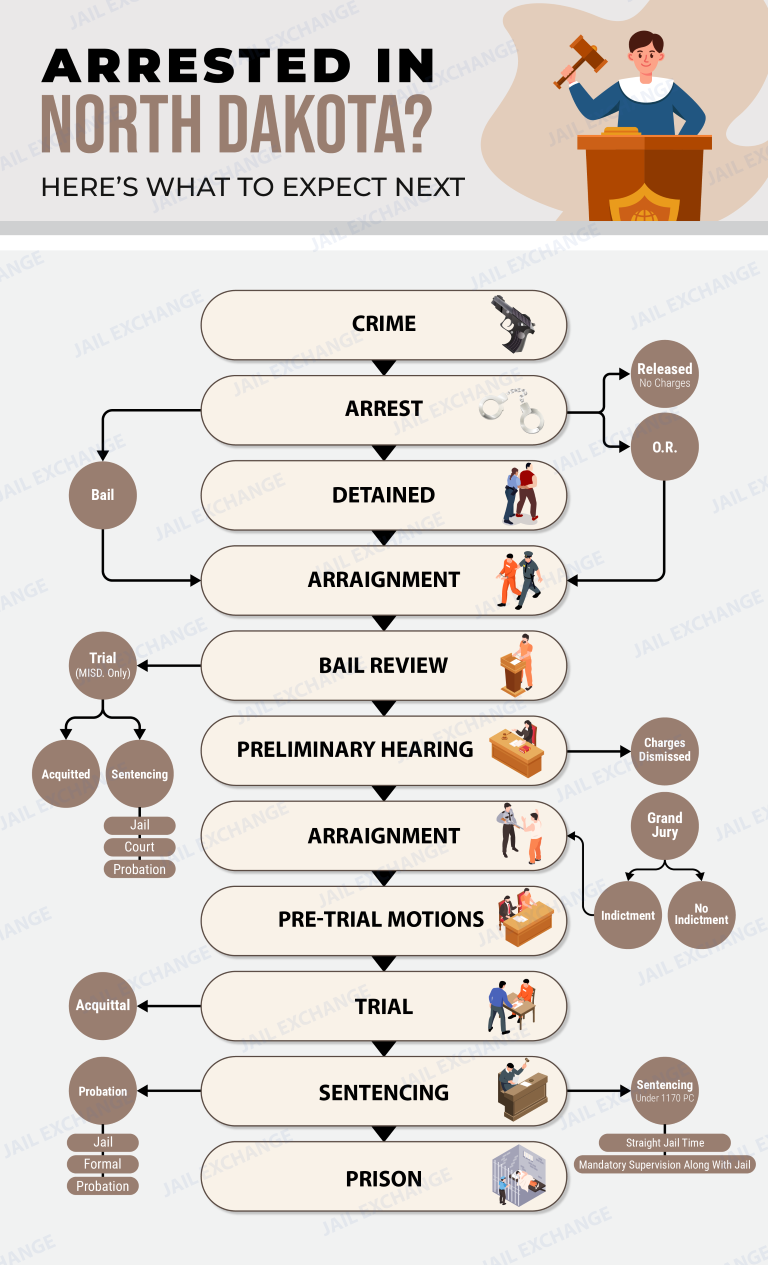
Ward County Criminal Court Guide
Ward County criminal court guide. Relatives may hear terms such as initial appearance, bond, arraignment, or probation without anyone explaining them.
This guide gives the courthouse address and clerk telephone number, explains booking and release, and shows how misdemeanor and felony cases develop. Statewide law sets many of the limits, but your actual court date, charges, and conditions come from the individual case.
Cases arising in Ward County ordinarily go through the North Central Judicial District. The District Court hears criminal matters at the county courthouse in Minot. A municipal ordinance accusation, if one applies, may be handled by a separate city court.
1. Where are the criminal courts, and how do I contact them?
Ward County District Court and Clerk: 315 3rd St SE, Minot, ND 58701. Telephone: 701-857-6600. The county belongs to the North Central Judicial District. Call the published clerk number about filing questions or a listed hearing; the clerk cannot provide legal advice.
District Courts in North Dakota hear both misdemeanors and felonies. State law does not divide these cases between a county District Court and a separate state Circuit Court. The judge handling a case can be assigned from elsewhere in the judicial district.
Some cities handle ordinance violations in municipal court. The county District Court contact above is for state criminal charges; a municipal ticket identifies the separate city court if one is involved. No unverified municipal street address or phone number has been inserted here.
↑ Back to the question list2. What happens immediately after an arrest?
For a custodial arrest connected to Ward County, the first hours usually involve identifying the accused, logging possessions, checking for other warrants, and arranging an appearance before a judicial officer. A family may not immediately receive a court date.
For a Ward County arrest, the charging paperwork and initial judicial order control the next hearing. The courthouse in Minot can explain its public filing and calendar procedures, but it does not operate as a jail. When someone is not released after arrest, they may be held in a jail in the county or a neighboring county’s jail, depending on the local custody arrangements. The courthouse handles the criminal case; it is not the jail.
↑ Back to the question list3. Can someone get out of jail before trial, and how does bond work?
Being arrested does not automatically mean a person must pay money to get out. Courts can use nonfinancial release conditions, but a judicial officer can also order bond or detention based on the charge and circumstances.
Conditions can include returning for every hearing, avoiding contact with a named person, reporting to a supervising agency, or obeying travel limits. If the bond involves money, ask for the actual written order before paying anyone; release and refunds depend on the terms set by the court.
↑ Back to the question list4. How does a misdemeanor case move through court?
Someone charged with a misdemeanor in Ward County may have multiple dates: an initial appearance, a hearing to settle outstanding issues, and possibly a trial. A guilty plea ends the trial stage and moves the case to sentencing.
The two ordinary misdemeanor classes have different limits: a Class B misdemeanor permits no more than 30 days and $1,500, while a Class A misdemeanor permits up to 360 days and $3,000. Some crimes carry extra rules, court costs or treatment requirements. A conviction is not automatic simply because police wrote a report.
↑ Back to the question list5. What happens if the charge is a felony?
In a Ward County felony matter, an early judicial proceeding determines the next steps and release conditions. More hearings may follow as both sides review reports, witness statements, and legal challenges.
Sentencing starts with the statute that defines the convicted offense. North Dakota uses Classes C, B, A, and AA for felonies; prior convictions, mandatory provisions, restitution, and the judge’s orders may affect the result. A case can be resolved by dismissal, plea, or trial, and the sentence cannot be predicted just from the original arrest accusation.
↑ Back to the question list6. What changes when the accusation involves violence?
When the accusation involves violence, evidence such as medical findings, recordings, and eyewitness accounts may become important. A defense lawyer can challenge the evidence and seek appropriate release terms.
Under N.D.C.C. § 12.1-32-02.1, certain qualifying felonies involving a firearm or dangerous weapon can require mandatory imprisonment, including four years for specified Class AA, A or B felonies and two years for qualifying Class C felonies. The facts and exact charges must meet the statute; the rule is not automatic for every violent accusation.
↑ Back to the question list7. What happens when someone under 18 is accused?
For children accused of wrongdoing in Ward County, the juvenile court may involve parents or guardians and consider services, treatment, and supervision. Certain serious cases can raise questions about adult-court jurisdiction under state law.
A youth’s hearing may be confidential, and information available to the public can be narrower than in an adult case. Parents should ask counsel about detention review, school needs, appropriate services and whether a juvenile petition has actually been filed.
↑ Back to the question list8. What fines and jail or prison sentences are possible?
North Dakota Century Code § 12.1-32-01 sets the standard punishment ceilings below. These are maximum legal limits for the class, not typical sentences handed out in Ward County. The exact offense may require a different minimum or special sentence.
| Offense class | Maximum ordinary penalty |
|---|---|
| Infraction | No ordinary jail term; fine up to $1,000. |
| Class B misdemeanor | Up to 30 days in jail, a fine up to $1,500, or both. |
| Class A misdemeanor | Up to 360 days in jail, a fine up to $3,000, or both. |
| Class C felony | Up to 5 years in prison, a fine up to $10,000, or both. |
| Class B felony | Up to 10 years in prison, a fine up to $20,000, or both. |
| Class A felony | Up to 20 years in prison, a fine up to $20,000, or both. |
| Class AA felony | Life imprisonment, with or without the possibility of parole as provided by law. |
A judge may consider probation, imprisonment, restitution, a fine, treatment, or a lawful combination of penalties. Previous convictions, weapon allegations, and special laws can change the sentencing calculation. An infraction generally means a fine rather than jail, except the statute includes special treatment for certain repeat infractions.
↑ Back to the question list9. What if the charge is a federal crime?
Federal prosecutions from Ward County are handled by the U.S. District Court for the District of North Dakota, not by the county District Court. Federal jurisdiction can arise from federal drug trafficking, crimes involving federal property, qualifying interstate fraud, immigration offenses, and certain firearm laws. A crime is not federal merely because it is serious.
The federal district has staffed offices in Bismarck and Fargo and additional courthouses in Minot and Grand Forks. One useful staffed federal contact is the William L. Guy Federal Building and U.S. Courthouse, 220 E Rosser Ave, Suite 476, Bismarck, ND 58501, telephone 701-530-2300. The particular case docket or summons—not the county alone—determines where a person must appear.
Federal courthouse directory
- Bismarck — William L. Guy Federal Building and U.S. Courthouse: 220 E Rosser Ave, Suite 476, Bismarck, ND 58501; 701-530-2300
- Fargo — Quentin N. Burdick U.S. Courthouse: 655 1st Ave N, Suite 130, Fargo, ND 58102; 701-297-7000
- Minot — Bruce M. Van Sickle U.S. Courthouse: 100 1st St SW, Minot, ND 58701; 701-530-2300 (telephone reaches staffed Bismarck or Fargo office)
- Grand Forks — Ronald N. Davies U.S. Courthouse: 102 N 4th St, Grand Forks, ND 58203; 701-297-7000 (telephone reaches staffed Bismarck or Fargo office)
A federal defendant may appear before a U.S. magistrate judge, receive a detention hearing, be formally charged by indictment or another permitted procedure, and later enter a plea or go to trial. Federal sentencing uses statutes and federal guidelines; any prison sentence is generally administered by the Federal Bureau of Prisons.
↑ Back to the question listGeneral public information about criminal courts, not individual legal advice. A defense attorney can explain the exact charges, possible punishment, court order, and available defenses.
ICE Detainees
Will the immigration case be heard in Minot?
Not in the Ward County courthouse, which deals only with state charges. Deportation cases are heard by immigration judges employed by the Justice Department's EOIR. For people ICE's St. Paul office holds in North Dakota, that is normally the Fort Snelling Immigration Court outside Minneapolis, at 1 Federal Drive, Suite 1850, Fort Snelling, MN 55111 (612-725-3765, public counter weekdays 8 to 4). EOIR's published list doesn't mention the Ward County jail, so let the Notice to Appear confirm the court. With Fort Snelling a day's drive away, detainees in Minot almost always join by video link. Hearing dates are on EOIR's ACIS lookup or at 1-800-898-7180; you'll need the A-Number.
Inside the courtroom
Round one is a quick status session where the judge reads the charges, takes admissions or denials, and asks what the person is applying for. Round two, the individual hearing, is the trial: testimony, exhibits, ruling. A court interpreter is provided free. Who must prove what depends on entry: ICE must clearly and convincingly prove deportability for anyone it once admitted, while someone who entered without admission has to establish their own right to stay. Asylum and other relief are proven by the person applying.
Help from a lawyer
Immigration court appoints nobody. Families can search EOIR's pro bono directory for nonprofits. ICE's page for the jail says legal representatives may visit clients from 8 a.m. to 4:30 p.m., and a list of free legal organizations is posted in the housing units.
Losing the case
Get an appeal to the Board of Immigration Appeals filed immediately; the window is only days long and the Board must receive it in time. If the order stands, ICE obtains the paperwork from the home country and carries out the deportation. Officers can skip the courtroom altogether in expedited removal and reinstatement cases.
A federal criminal case
North Dakota has one federal district, and its U.S. District Court sits in Minot, Bismarck, Fargo and Grand Forks. That is where an illegal reentry prosecution under 8 U.S.C. 1326 would be tried, carrying up to 2, 10 or 20 years based on prior record.
Coming back
Deportation generally means a 10-year wait before returning legally; other cases bring 5 years, 20 years or a lifetime bar. DHS can approve an earlier return on Form I-212, but an unlawful return after more than a year of unlawful presence risks a permanent bar. This overview is not legal advice.
Inmate Canteen (operated by TurnKey Corrections) allows friends and family members to purchase pre-approved commissary packages, including brand-name snacks, confectionery goods, personal hygiene products, stationery, and apparel kits sent directly to an incarcerated loved one. Every package is packed to adhere strictly to facility security regulations, ensuring items pass institutional intake without being rejected at the loading dock.
Important: Package Deadlines and Delivery Windows Vary
Detention centers do not manage care package deliveries under identical schedules. While some facilities allow weekly orders, others restrict deliveries to bi-weekly or monthly distribution windows, and spending limits vary from jail to jail. You should verify the facility's active cutoff schedule and order allowances by calling them directly. If an order is submitted after the weekly processing deadline, delivery will be held until the following cycle, leaving your loved one waiting an extra cycle for fresh snacks, thermal wear, or personal care supplies.
Step-by-Step Instructions to Place a Commissary Package Order
- Confirm the inmate's legal first and last name, date of birth, and assigned booking or inmate ID number.
- Navigate to www.inmatecanteen.com and sign in or create a user profile.
- Select Commissary / Store and choose your state and detention center.
- Search for the inmate to unlock the facility's approved product catalog.
- Select allowable snack foods, candies, personal care goods, and clothing items up to the facility's allowed spending limit.
- Proceed to checkout, enter your debit or credit card billing details, and submit payment.
- Save your digital receipt and confirmation tracking number for your records.
What the Inmate Needs to Do
The inmate does not need an internet account to receive care packages. TurnKey Corrections prepares the order in secure, tamper-evident packaging and delivers it directly to the jail commissary department. Facility staff inspect the shipment and deliver the items during regular housing unit commissary rounds, where the inmate signs for receipt.
Official Provider: Inmate Canteen Official Website
Customer Service Telephone: 1-715-690-2965
Support Hours: Monday – Friday, 8:00 AM – 5:00 PM CST
Supported Languages: English and Spanish
Other Services Provided by Inmate Canteen (TurnKey Corrections)
In addition to Commissary Care Packages, Inmate Canteen provides several other communication, financial, and visitation services:
- Tablets & Chirp Units: Learn how secure handheld devices allow inmates to communicate, read, and message.
• Learn more on our website: Tablet Programs Guide | • Visit official vendor page: Inmate Canteen Devices - Remote Video Visitation: Schedule and join live face-to-face video visits from your computer or smartphone.
• Learn more on our website: Video Visitation Guide | • Visit official vendor page: Inmate Canteen Video Visits - Digital Messaging: Send electronic messages and photos directly to housing pod kiosks and handheld devices.
• Learn more on our website: Digital Messaging Guide | • Visit official vendor page: Inmate Canteen Messaging - Trust & Phone Deposits: Deposit money directly into an inmate's jail trust account or phone calling balance.
• Learn more on our website: Trust & Phone Deposits Guide | • Visit official vendor page: Inmate Canteen Deposits
Buy Commissary for an Inmate in the Ward County Detention Center
Ward County Detention Center Inmate Commissary - Sending Money or Purchasing Commissary for an Inmate
Ward County Detention Center allows inmates to purchase commissary. This can be snacks, hygiene products, stamps, stationary, clothing and even electronics.
You can buy commissary for an inmate using an online service called Inmate Canteen.
Inmate Canteen Customer Service can be reached at 715-690-2965, or by email at support@inmatecanteen.com.

There is a monthly limit of $200-300 on how much inmates can spend on commissary items.
This amount is subject to change so call the facility at 701-857-6530 in order to confirm the amount that cannot be exceeded.
Inmates have access to both an in-house commissary store, and commissary packages that can be purchased and shipped to the inmate by friends and family.
Scroll down for information on the Ward County Detention Center's service they use for you being able to purchase commissary items online and have them shipped directly to the inmate.
You can also go to our Inmate Money page for information on how to send money to an inmate.
Inmate Canteen Trust & Phone Deposits allow friends and family members to transfer money directly into an incarcerated person's jail trust account or telephone calling balance using a credit or debit card. Deposited funds give your loved one the financial balance needed to buy personal care goods, over-the-counter medication, snacks, and phone talk time from the facility canteen.
Important: Facility Banking Policies Vary Across Jails
Once a person is booked and moved to a cell, facilities do not always allow cash drop-offs or phone payments directly to the jail window. Some might and you should confirm this by calling the facility and asking. But if you do not register online and fund your loved one's trust account immediately, they may be forced to wait days or weeks for standard paper processing, leaving them without essential soap, clean undergarments, basic medical sundries or snacks.
Step-by-Step Instructions to Register and Deposit Funds
- Confirm the inmate's legal first and last name, date of birth, and assigned booking or inmate ID number.
- Navigate to www.inmatecanteen.com on your computer or mobile device.
- Click on Deposit Funds and select whether to fund the Trust Account (for commissary) or Phone Account (for talk time).
- Select the state and facility where the inmate is currently housed.
- Search for the inmate to confirm their active housing record matches the facility roster.
- Enter your deposit dollar amount, review convenience fees, and enter your debit or credit card billing details.
- Submit payment and save the digital confirmation receipt for your financial records.
What the Inmate Needs to Do
The inmate does not need an internet connection to receive trust funds. Once payment clears, the balance posts directly to their accounting profile in the jail's internal system. The inmate can review their updated balance at the pod kiosk terminal and place their regular weekly commissary order or make outbound phone calls.
Official Provider: Inmate Canteen Official Website
Customer Service Telephone: 1-715-690-2965
Support Hours: Monday – Friday, 8:00 AM – 5:00 PM CST
Supported Languages: English and Spanish
Other Services Provided by Inmate Canteen (TurnKey Corrections)
In addition to Trust & Phone Deposits, Inmate Canteen provides several other communication, financial, and commissary services at participating correctional facilities:
- Commissary & Snack Packs: Order pre-approved snack boxes, food packages, and clothing directly to the jail.
• Learn more on our website: Commissary Orders Guide | • Visit official vendor page: Inmate Canteen Commissary - Remote Video Visitation: Schedule and join live face-to-face video visits from your computer or smartphone.
• Learn more on our website: Video Visitation Guide | • Visit official vendor page: Inmate Canteen Video Visits - Digital Messaging & Chirp Texts: Send electronic messages and photos directly to housing pod kiosks and handheld devices.
• Learn more on our website: Digital Messaging Guide | • Visit official vendor page: Inmate Canteen Messaging
Deposit Money for an Inmate in the Ward County Detention Center
One trust account holds the money a person at Minot's Ward County Detention Center spends on commissary and phone time.
In the lobby or visitation area at 204 Front Street, a kiosk accepts cash, debit and credit. Reception will also take cash, money orders and cashier's checks, though the jail keeps its drop-off times unpublished; 701-857-6530 has the hours. From home, deposit through Inmate Canteen. Paying by phone isn't an option.
Mailing it takes four steps:
- Pick up a money order or cashier's check.
- Pay to: the person, or the Ward County Sheriff's Office.
- Memo: their name and ID number.
- Envelope, with nothing else in it: Ward County Detention Center, P.O. Box 907, Minot, ND 58702.
Deposits here are not bail, and paying into the account won't get anyone released.
The Ward County Detention Center on Front Street in Minot is one of North Dakota's largest county jails, with room for 286 adults. Along with Ward County's own arrests, it holds people for Renville, McHenry and Burke counties, several nearby cities, the Minot Air Force Base and the U.S. Marshals. Mail arrives through the jail's post office box and is delivered on paper on weekdays once officers have searched it.
Personal mail, legal mail, books and magazines:
Inmate's Full Name & Inmate ID#
Ward County Detention Center
P.O. Box 907
Minot, ND 58702
- Addressing it: Under the person's full booked name, add their inmate ID number. The inmate locator shows who is in custody.
- From line: Print your full name and mailing address top left on the envelope. Without it, expect the letter to go undelivered.
- Writing: Blue or black pen. Felt markers, crayons, colored ink and lipstick prints are not allowed, and neither are drawings on the envelope or postcard.
- Inside the envelope: No glitter, confetti or other loose extras.
- Photos: Regular prints may be sent. Polaroids may not.
- Newspapers and magazines: Local or national papers and magazines have to be shipped by the publisher. Issues with weapons, profanity, nudity or adult content are taken away.
- Books: Ward County takes new books mailed by their publisher, never hardcovers or books with wire spirals.
- Greeting cards: Plain, with no music.
- Stamps: Not accepted by mail. Send money to the inmate's account instead and they can buy stamps from commissary.
- Contraband: Drugs, weapons or other illegal items may be turned over to the Ward County Sheriff or prosecutors, and repeat problems can cost the inmate visits and phone calls.
The jail's number is 701-857-6530.
Information for this service is currently unavailable.
Information for this service is currently unavailable.
Inmate Canteen (TurnKey Corrections) provides specialized handheld tablets and Chirp communication units to incarcerated individuals in county detention centers. Running over a secure internal wireless network, these devices allow inmates to send and receive text messages, submit facility requests, review commissary balance accounts, and read digital materials directly from their living areas.
Important: Tablet Hardware Deployment and Rental Rules Vary
Detention centers do not manage tablet distribution identically. While some agencies issue individual personal tablets to every detainee at booking, others utilize shared pod docking stations or restrict tablet use to specific dayroom hours, which you should confirm with the facility directly. Although core educational and legal resources are generally provided free of charge, sending messages, initiating video calls, or making phone calls from the tablet requires an active balance funded by outside contacts.
Step-by-Step Instructions to Support and Fund Tablet Use
- Confirm that TurnKey Corrections / Inmate Canteen tablets or Chirp devices are active at the facility.
- Navigate to www.inmatecanteen.com and sign into your user profile.
- Link the inmate to your account by state, detention facility, and their legal name or booking ID.
- Select Messaging / Chirp Funds or Trust Deposits to add funds to their available balance.
- Specify your deposit amount, review convenience fees, and enter your credit or debit card billing details.
- Submit payment, save your confirmation receipt, and notify your loved one that their device balance is available.
What the Inmate Needs to Do
The inmate logs into their assigned tablet or Chirp device using their personal PIN. They can review their available messaging balance, read incoming family correspondence, and type replies directly on the device. Tablets are returned to docking stations during facility count times and for overnight charging.
Official Provider: Inmate Canteen Official Website
Customer Service Telephone: 1-715-690-2965
Support Hours: Monday – Friday, 8:00 AM – 5:00 PM CST
Supported Languages: English and Spanish
Other Services Provided by Inmate Canteen (TurnKey Corrections)
In addition to Tablet Services, Inmate Canteen provides several other communication, financial, and commissary services:
- Commissary & Care Packages: Order pre-approved snack boxes, food packages, and clothing directly to the jail.
• Learn more on our website: Commissary Orders Guide | • Visit official vendor page: Inmate Canteen Commissary - Remote Video Visitation: Schedule and join live face-to-face video visits from your computer or smartphone.
• Learn more on our website: Video Visitation Guide | • Visit official vendor page: Inmate Canteen Video Visits - Digital Messaging: Send electronic text messages and digital photos directly to housing pod kiosks and handheld devices.
• Learn more on our website: Digital Messaging Guide | • Visit official vendor page: Inmate Canteen Messaging - Trust & Phone Deposits: Deposit money directly into an inmate's jail trust account or phone calling balance.
• Learn more on our website: Trust & Phone Deposits Guide | • Visit official vendor page: Inmate Canteen Deposits
Ward County Juvenile Facilities
Nearby counties
- Jail (Main): 701-857-6530
The Ward County Detention Center serves the following cities and towns of Ward County: Burlington, Des Lacs, Donnybrook, Douglas, Kenmare, Makoti, Minot, Minot AFB, Sawyer, Surrey, Velva, Voltaire and Westhope. At times this facility may also house inmates arrested in the following counties: Pembina County and Renville County.