Hamilton County Jail - Talbert House Criminal Court Process
Criminal Court Process for Hamilton County Ohio
Hamilton County Municipal Court and Common Pleas Court in Cincinnati
The Municipal Court handles misdemeanors, traffic tickets and a felony's first hearing, for every part of Hamilton County. Felony trials are held by the Common Pleas judges at the courthouse, 1000 Main Street, Cincinnati, OH 45202. Deputies hold arrested adults at the Hamilton County Justice Center, 1000 Sycamore Street, Cincinnati, OH 45202.
Type a last name into the Sheriff's roster search to find out whether the family member is in the jail. Our Jail Roster pages cover charges, warrants and mugshots.
Call the Municipal Court criminal and traffic clerk at 513-946-6010. Ask when the first hearing is and which courtroom to go to. To pay a bond, use our bail page.
1. Local courts in Hamilton County (municipal, county and mayor's courts)
Cincinnati is the county seat of Hamilton County, Ohio's third-most-populous county, and almost all of its criminal courts sit within a few blocks of each other downtown. The Hamilton County Municipal Court, which covers the entire county, handles misdemeanors, OVI and traffic cases and the opening stage of every felony, while about thirty suburban cities and villages also run mayor's courts for ordinance and traffic tickets. Felonies are tried in the General Division of the Hamilton County Court of Common Pleas at the courthouse on Main Street and prosecuted by the elected Hamilton County Prosecuting Attorney; city prosecutors, including Cincinnati's, handle many municipal-court misdemeanors. Arrested adults are held by the Hamilton County Sheriff at the Justice Center on Sycamore Street.
- Hamilton County Court of Common Pleas, General Division, Hamilton County Courthouse, 1000 Main Street, Cincinnati, OH 45202, (513) 946-5656
- Hamilton County Municipal Court, Criminal and Traffic, Hamilton County Justice Center, 1000 Sycamore Street, Cincinnati, OH 45202, (513) 946-6010
- Hamilton County Municipal Court, Civil, Hamilton County Courthouse, 1000 Main Street, Cincinnati, OH 45202, (513) 946-5700
- Hamilton County Juvenile Court, 800 Broadway, Cincinnati, OH 45202, (513) 946-9200
- Hamilton County Prosecuting Attorney, William Howard Taft Law Center, 230 E. Ninth Street, Suite 4000, Cincinnati, OH 45202, (513) 946-3000
- Hamilton County Public Defender, William Howard Taft Law Center, 230 E. Ninth Street, Cincinnati, OH 45202, (513) 946-3700
- Hamilton County Justice Center (jail, Hamilton County Sheriff's Office), 1000 Sycamore Street, Cincinnati, OH 45202, (513) 946-6400
Which court hears your case. Every misdemeanor, OVI and traffic charge in Hamilton County, whether from Over-the-Rhine, Colerain Township, Harrison or Anderson Township, can be filed in the Hamilton County Municipal Court, because its territory is countywide; there is no county court. Many suburbs, among them Norwood, Blue Ash, Sharonville, Reading, Springdale and Forest Park, also run mayor's courts that hear their own ordinance and traffic cases. A mayor's court has no jury and limited authority, so OVI charges and contested matters are commonly sent to the Municipal Court, and any defendant can ask to transfer a case there. Felonies begin in the Municipal Court with the initial appearance, bond and preliminary hearing; once a Hamilton County grand jury returns an indictment, or the defendant waives it and proceeds by bill of information, the case moves to the Common Pleas General Division at 1000 Main Street. Appeals go to Ohio's First District Court of Appeals in Cincinnati.
Where pretrial detainees are held. The Hamilton County Sheriff's Office books adults arrested by the Cincinnati Police, suburban departments, township and university police, the Sheriff's patrol and the State Highway Patrol into the Hamilton County Justice Center at 1000 Sycamore Street, the county's main jail and one of the largest in Ohio. Pretrial detainees stay there until they post bond or the case ends. For custody, bond or visiting information, call the Sheriff's Office at (513) 946-6400.
Hamilton County's local courts are a single countywide municipal court and a long list of suburban mayor's courts. Mayor's courts usually meet only on set evenings or mornings each month, so call ahead for the session schedule.
Municipal court
- Hamilton County Municipal Court — criminal and traffic, Hamilton County Justice Center, 1000 Sycamore Street, Cincinnati, OH 45202, (513) 946-6010; civil, Hamilton County Courthouse, 1000 Main Street, (513) 946-5700. Territory: all of Hamilton County, including Cincinnati, every suburban city and village, and all twelve townships. Hears misdemeanors, OVI, traffic, felony initial appearances and preliminary hearings, small claims and civil cases.
County court
None. The countywide Municipal Court leaves no area for a county court.
Mayor's courts
- Addyston Mayor's Court — 235 Main Street, Addyston, OH 45001, (513) 941-1313, ext. 10
- Amberley Village Mayor's Court — 7149 Ridge Road, Cincinnati, OH 45237, (513) 531-2040
- Arlington Heights Mayor's Court — 601 Elliott Avenue, Arlington Heights, OH 45215, (513) 821-2076
- Blue Ash Mayor's Court — 4343 Cooper Road, Blue Ash, OH 45242, (513) 745-8554
- Cheviot Mayor's Court — Cheviot City Hall, 3814 Harrison Avenue, Cheviot, OH 45211, (513) 946-6040
- Cleves Mayor's Court — 101 N. Miami Avenue, Cleves, OH 45002, (513) 941-1212
- Deer Park Mayor's Court — 777 Blue Ash Road, Deer Park, OH 45236, (513) 791-8056
- Elmwood Place Mayor's Court — 6118 Vine Street, Elmwood Place, OH 45216, (513) 242-2578
- Evendale Mayor's Court — 10500 Reading Road, Evendale, OH 45241, (513) 956-2692
- Fairfax Mayor's Court — 5903 Hawthorne Avenue, Fairfax, OH 45227, (513) 272-9941
- Forest Park Mayor's Court — 1203 W. Kemper Road, Forest Park, OH 45240, (513) 595-5224
- Glendale Mayor's Court (sessions conducted by a magistrate) — 301 E. Sharon Road, Glendale, OH 45246, (513) 771-7645
- Golf Manor Mayor's Court — 6450 Wiehe Road, Golf Manor, OH 45237, (513) 531-3108
- Greenhills Mayor's Court — 11000 Winton Road, Greenhills, OH 45218, (513) 825-2101
- Harrison Mayor's Court — 300 George Street, Harrison, OH 45030, (513) 202-8456
- Indian Hill Mayor's Court — 6525 Drake Road, Indian Hill, OH 45243, (513) 561-6500
- Lincoln Heights Mayor's Court — 1201 Steffen Avenue, Lincoln Heights, OH 45215, (513) 733-5900, ext. 9
- Lockland Mayor's Court — 101 N. Cooper Avenue, Lockland, OH 45215, (513) 761-1124, ext. 105
- Madeira Mayor's Court — 7141 Miami Avenue, Madeira, OH 45243, (513) 272-4214
- Mariemont Mayor's Court — 6907 Wooster Pike, Mariemont, OH 45227, (513) 271-4089
- Montgomery Mayor's Court — Montgomery Safety Center, 10150 Montgomery Road, Montgomery, OH 45242, (513) 985-1606
- Mount Healthy Mayor's Court — 7700 Perry Street, Mount Healthy, OH 45231, (513) 931-8840
- Newtown Mayor's Court — Municipal Center, 3537 Church Street, Newtown, OH 45244, (513) 561-7697, ext. 16
- North College Hill Mayor's Court — 1646 W. Galbraith Road, North College Hill, OH 45239, (513) 521-1594
- Norwood Mayor's Court — 4701 Montgomery Road, Norwood, OH 45212, (513) 458-4535
- Reading Mayor's Court — 1000 Market Street, Reading, OH 45215, (513) 733-5768
- St. Bernard Mayor's Court — 4200 Vine Street, St. Bernard, OH 45217, (513) 242-2727
- Sharonville Mayor's Court — 10900 Reading Road, Sharonville, OH 45241, (513) 563-1146
- Silverton Mayor's Court — 6860 Plainfield Road, Silverton, OH 45236, (513) 792-6561
- Springdale Mayor's Court — 12105 Lawnview Avenue, Springdale, OH 45246, (513) 346-5778
- Terrace Park Mayor's Court — 428 Elm Avenue, Terrace Park, OH 45174, (513) 831-2137
- Woodlawn Mayor's Court — 10143 Woodlawn Boulevard, Woodlawn, OH 45215, (513) 772-1273
- Wyoming Mayor's Court — Safety Services Building, 600 Grove Avenue, Wyoming, OH 45215, (513) 821-0141; sessions are held at the Municipal Building, 800 Oak Avenue
Cincinnati itself has no mayor's court; its cases go to the Municipal Court. Communities missing from the list above, including North Bend and all twelve townships, also send tickets directly to the Municipal Court.
↑ Back to the question list2. Downtown courthouses and offices
Downtown Cincinnati's justice district is compact. The Hamilton County Courthouse at 1000 Main Street holds the Common Pleas General Division courtrooms, the Clerk of Courts' felony and civil offices, and Municipal Court civil and some criminal courtrooms. Across Central Parkway and up Sycamore Street, the Hamilton County Justice Center at 1000 Sycamore is both the jail and the place where in-custody defendants are arraigned in the Municipal Court and where criminal and traffic payments and records are handled.
The William Howard Taft Law Center at 230 E. Ninth Street houses the Prosecuting Attorney, the Public Defender and the Probate Court. The Juvenile Court occupies the 800 Broadway building, which it shares with the Domestic Relations Division. Mayor's courts meet in their own city or village buildings, listed in the local courts section.
Bring a photo ID and expect airport-style screening at each building. Parking is limited, and Cincinnati Metro buses and the downtown streetcar stop within a short walk of the courthouses. Defendants who are out on bond should check the case number and courtroom on their paperwork, because Municipal Court judges sit in several rooms across both buildings.
↑ Back to the question list3. What happens after an arrest in Hamilton County
Booking at the Justice Center
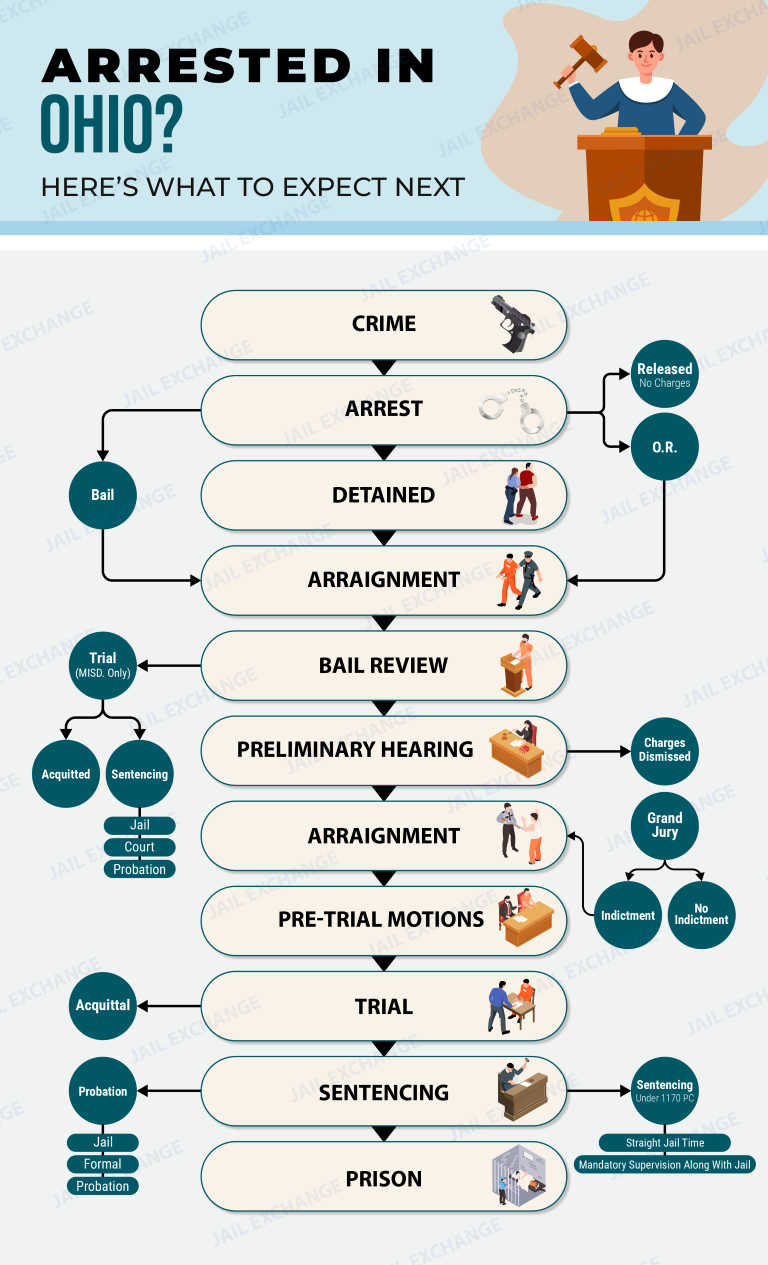
After an arrest, police transport the person to the Justice Center intake area on Sycamore Street. Deputies take fingerprints and photographs, inventory property, run warrant checks and complete medical screening. During busy periods, intake can take many hours.
Pretrial screening and bond
Before the first hearing, Hamilton County's pretrial services staff typically interview the defendant and prepare a risk assessment for the judge. Bond for some minor offenses can be posted from a schedule. For everything else, a Municipal Court judge sets bond at arraignment; under the 2022 amendment to Ohio's Constitution, the judge must weigh public safety, the defendant's record, the seriousness of the charge and the likelihood of appearance. Possible outcomes include release on recognizance, release with supervision or electronic monitoring, a 10 percent deposit bond, a cash bond or a surety bond posted through a licensed bail bond company. Protection orders often accompany release in domestic violence cases.
Arraignment
In-custody arraignments are held daily at the Justice Center, usually the next court day after arrest. A public defender is typically present to represent people who need one at this first hearing. Misdemeanor defendants enter pleas; felony defendants receive a preliminary hearing date and a bond decision.
The road to Common Pleas
A jailed felony defendant is entitled to a preliminary hearing within 10 days of the first appearance, or within 15 days if released, though the Hamilton County grand jury often indicts before then, ending the Municipal Court's role. After indictment, the case is arraigned in the Common Pleas courthouse, assigned to a judge and set for pretrial conferences. The 270-day speedy-trial limit applies, with each day held in jail solely on the charge counting three times.
↑ Back to the question list4. The Hamilton County Justice Center
The Justice Center at 1000 Sycamore Street is the Sheriff's main detention facility. It holds people awaiting trial on municipal and felony charges, people serving local misdemeanor sentences, and people held on warrants, probation violations or for other jurisdictions. Its population is large and changes quickly, so the Sheriff's online and phone inmate lookups are the fastest way to confirm whether someone is there.
Money for commissary and phone accounts can be deposited through the jail's approved vendors, and visits are generally by video under a schedule the Sheriff sets. Bonds can be posted at the Justice Center. A person whose case is resolved with a prison sentence is transferred to the Ohio Department of Rehabilitation and Correction, usually through its reception center. Call (513) 946-6400 with questions about a specific inmate.
↑ Back to the question list5. Public defense in Hamilton County
The Hamilton County Public Defender, (513) 946-3700, is one of Ohio's largest public defense offices. Its attorneys represent eligible adults in the Municipal Court and the Common Pleas Court and represent children in the Juvenile Court, and the county also appoints qualified private attorneys from an assigned-counsel list when the office has a conflict or a case requires it. Eligibility is based on a financial affidavit; an application fee of up to $25 may be assessed, and the court can waive it.
People in custody can ask for a public defender at arraignment at the Justice Center. Those released on a summons or bond should contact the office before their first court date. Mayor's courts generally cannot impose lengthy jail terms, and a defendant who wants appointed counsel in a jailable mayor's court case can ask to have the case moved to the Municipal Court.
↑ Back to the question list6. The Prosecuting Attorney, diversion and victims
The elected Hamilton County Prosecuting Attorney, (513) 946-3000, prosecutes all felonies in the county, files juvenile delinquency cases and handles criminal appeals. Misdemeanors in the Municipal Court are prosecuted by several offices: the City of Cincinnati's prosecutors for offenses inside the city, suburban law directors and prosecutors for their own communities, and the county prosecutor's staff for many township and state-law cases. Mayor's court cases are prosecuted by the village or city's own prosecutor.
Diversion
Diversion programs in Hamilton County let eligible first-time or low-level defendants avoid a conviction by completing conditions such as treatment, community service, restitution or classes, after which the charge is dismissed and can be sealed. The county prosecutor runs a diversion option for certain nonviolent felony offenders, and the city and municipal courts offer misdemeanor diversion, including programs aimed at theft, drug possession and young adults. Ohio's intervention in lieu of conviction statute provides another path for people whose offense was tied to substance use or mental illness. Eligibility is decided case by case, and violent offenses generally do not qualify.
Victims
The prosecutor's victim-witness division helps victims receive notice of hearings and bond decisions, prepare impact statements and request restitution. Marsy's Law, part of Ohio's Constitution since 2017, guarantees victims the right to be present and heard at major stages of the case.
↑ Back to the question list7. Specialty dockets in Hamilton County
Hamilton County was an early adopter of treatment-based courts, and both the Common Pleas and Municipal courts now run a range of them. Participants are supervised closely, with frequent court appearances, drug and alcohol testing and required treatment, in exchange for reduced charges, dismissals or alternatives to jail when they finish.
- Drug court: one of Ohio's longest-running felony drug court programs, operated through the Common Pleas Court for defendants whose crimes are driven by addiction.
- Mental health court: dockets for defendants with serious mental illness, connecting them with treatment and case management.
- Veterans treatment court: a docket that pairs veterans with mentors and VA services.
- OVI and other treatment dockets: Municipal Court programs for repeat impaired drivers and people with addiction-related misdemeanors.
- Human trafficking court: a Municipal Court docket for people, mostly women, charged with prostitution-related offenses who are trafficking survivors or at risk, focused on services and exit from exploitation.
Programs and eligibility criteria change, and admission usually requires agreement from the prosecutor and the judge. A defense attorney can tell a client which docket fits and how to apply.
↑ Back to the question list8. Misdemeanor (for example, petty theft, a first OVI, assault, criminal trespass)
Hamilton County's Municipal Court handles a very large volume of misdemeanors: shoplifting at Kenwood or Tri-County retailers, fights in Over-the-Rhine or near the University of Cincinnati, OVI arrests on I-71, I-74 and I-75, and trespass at closed businesses. Suburban tickets for minor offenses may first appear in that community's mayor's court.
Penalties
- First-degree misdemeanor: no more than 180 days in jail and a $1,000 fine; petty theft (property under $1,000), assault and aggravated trespass are typical.
- Second degree: a jail cap of 90 days and fines to $750.
- Third degree: up to 60 days and $500.
- Fourth degree: up to 30 days and $250; basic criminal trespass is in this group.
- Minor misdemeanor: a citation punishable by a fine of $150 or less, with no possibility of jail.
First OVI in Hamilton County
Ohio grades a first-offense OVI as an M1. Ohio law requires at least three consecutive days in jail, or completion of a 72-hour driver intervention program instead, and six days where the test showed .17 or more or there was a qualifying refusal. The fine is $375 to $1,075. The license is suspended on the spot under the administrative license suspension, and a conviction adds a court suspension of one to three years; judges can grant limited privileges for work, school and treatment, and some drivers qualify for unlimited privileges with an ignition interlock. OVI charges written in a suburb are frequently filed in, or transferred to, the Municipal Court.
Trial rights and outcomes
A Municipal Court defendant who wants a jury must file a written jury demand, and the eight-member jury must agree unanimously. Ohio's speedy-trial statute requires trial within 90 days for M1 and M2 charges and 45 days for M3 and M4 charges. Common results include dismissal, diversion, a plea to a lesser charge, fines and court costs, community control with conditions such as treatment or a theft class, and jail time that is partly or fully suspended. A typical case takes one to four months, and many records can be sealed after a waiting period.
↑ Back to the question list9. Felony (for example, burglary, felony theft, drug trafficking, felonious assault)
Felony charges in Hamilton County range from car break-ins and retail theft rings to fentanyl trafficking and shootings with injuries. They begin with a Municipal Court arraignment at the Justice Center and continue in the Common Pleas General Division after indictment.
How a felony moves
- Arraignment and bond in the Municipal Court, generally the next court day.
- Preliminary hearing or direct indictment. The grand jury, which sits regularly in Hamilton County, often indicts within days or weeks, and the preliminary hearing is then cancelled.
- Common Pleas arraignment at 1000 Main Street, where the case is assigned to one of the General Division judges.
- Discovery and pretrial conferences, during which the defense reviews police reports, video and lab results and negotiates with the assistant prosecutor.
- Motions, such as requests to suppress evidence from a search.
- Resolution: most cases end in a plea; the rest go to a 12-person jury that must be unanimous.
- Sentencing, often after a presentence investigation by county probation.
Ranges by degree
- F5: 6 to 12 months; a theft valued from $1,000 up to $7,500 lands here. Community control is presumed for many first-time offenders.
- F4: 6 to 18 months; thefts from $7,500 to $150,000 are graded at this level.
- F3: 9 to 36 months, though the range runs 12 to 60 months for designated serious F3s; burglary of an occupied structure where no one is likely present is usually here.
- F2: 2 to 8 years; felonious assault and burglary where someone is likely present.
- F1: 3 to 11 years; aggravated burglary and high-level trafficking.
For F1 and F2 crimes on or after March 22, 2019, the Reagan Tokes Law produces indefinite sentences: a stated minimum, and a maximum of up to half again as long. Drug trafficking charges are graded by drug type and weight and can fall at any felony level, with major drug offender specifications at the top. Gun specifications add mandatory prison terms that must be served before the base sentence. Intervention in lieu of conviction remains available for some drug-related offenses. A Hamilton County felony usually takes four months to a year.
↑ Back to the question list10. Violent felony (for example, murder, rape, aggravated robbery)
Cincinnati Police homicide investigators, suburban detectives and the Sheriff's Office investigate the county's most serious violent crimes, and specialized units in the Prosecuting Attorney's office handle homicide, sexual assault and gun-violence cases. Bonds are usually set very high, and the prosecutor may seek to deny bail entirely for qualifying offenses after a hearing.
What the charges carry
- Aggravated murder: life imprisonment without parole, life with a parole board hearing after 20, 25 or 30 years, or death if capital specifications are charged and proven. Executions are on hold in Ohio, which has not executed anyone since 2018.
- Murder: 15 years to life in prison.
- Rape: a first-degree felony with an indefinite term under Reagan Tokes; life sentences are possible when the victim is a child under 13 and force or other aggravating facts are proven.
- Aggravated robbery: a first-degree felony, regularly combined with firearm specifications that add years of mandatory prison.
Victims and surviving family members are entitled under Marsy's Law to notice, presence and a voice at bond, plea and sentencing hearings. Violent felony cases in Hamilton County commonly take one to two years or longer, particularly when there are multiple defendants, scientific evidence or a capital specification. Defendants who stay in custody remain at the Justice Center during that time.
↑ Back to the question list11. Juveniles (under 18) arrested in Hamilton County
The Hamilton County Juvenile Court, a division of the Court of Common Pleas at 800 Broadway in downtown Cincinnati, (513) 946-9200, hears delinquency cases against youths under 18. Complaints are filed by the juvenile division of the Prosecuting Attorney's office, and children are usually represented by the Public Defender's juvenile unit or appointed counsel.
Intake and diversion
Juvenile Court intake screens new referrals. Lower-level and first-time cases are often diverted or handled unofficially, through community programs, restorative justice, mediation, counseling or restitution, and closed when the youth succeeds. Other cases are handled officially before a magistrate or judge.
Hamilton County Youth Center
Youths who cannot safely go home are held at the Hamilton County Youth Center, the juvenile detention center at 2020 Auburn Avenue in Cincinnati's Mount Auburn neighborhood. A detention hearing must take place promptly, within 72 hours of admission or on the next court day, and the magistrate decides whether to continue detention, release the youth to a parent or order alternatives such as electronic monitoring. Juveniles are not held in the Justice Center with adults.
Adjudication, DYS and adult court
Dispositions include probation, treatment and community programs, out-of-home placement and, for felony adjudications, commitment to the Ohio Department of Youth Services. Ohio requires mandatory bindover to adult court for some 16- and 17-year-olds, and some 14- and 15-year-olds, charged with the most serious offenses, and allows discretionary bindover for youths 14 and older after an amenability hearing. The prosecutor may instead seek a Serious Youthful Offender designation, which combines a juvenile disposition with an adult sentence that is suspended unless the youth fails. Juvenile files are largely closed to the public, and a large share can later be sealed or expunged.
↑ Back to the question list12. Federal cases (U.S. District Court) from Hamilton County
Hamilton County is home base for the Western Division of Ohio's southern federal judicial district, the Southern District of Ohio. Federal crimes committed in the county are generally prosecuted at the Potter Stewart U.S. Courthouse, 100 East Fifth Street, Cincinnati, OH 45202, a short walk from the county courthouse.
Who's who
- Prosecution: U.S. Attorney's Office, Cincinnati branch, 221 E. Fourth Street, Suite 400, Cincinnati, OH 45202, (513) 684-3711
- Defense: Federal Public Defender, Southern District of Ohio, Cincinnati office, 250 E. Fifth Street, Suite 350, Cincinnati, OH 45202, (513) 929-4834
- Custody and transport: U.S. Marshals Service, Potter Stewart U.S. Courthouse, 100 E. Fifth Street, Room 130, Cincinnati, OH 45202, (513) 684-3594
What turns a case federal
In Hamilton County, federal cases commonly arise from FBI, DEA, ATF, Homeland Security Investigations, IRS and Postal Inspection Service investigations into drug trafficking organizations, felons with firearms and gun trafficking, violent crime and robbery affecting interstate commerce, child exploitation, public corruption and large fraud schemes. Joint task forces with Cincinnati Police and the Sheriff mean some arrests begin locally and are later adopted for federal prosecution.
The federal timeline
Someone taken into federal custody in Hamilton County is brought before a U.S. magistrate judge at the Potter Stewart courthouse, hears the charges and receives appointed counsel from the Federal Public Defender or the Criminal Justice Act panel if needed. When the government moves for detention, the hearing is generally held within three court days. The magistrate then applies the Bail Reform Act, either releasing the defendant on conditions supervised by U.S. Pretrial Services, sometimes with home detention or monitoring, or ordering detention; money bail from commercial bondsmen plays no part. A case begun by complaint must be indicted within 30 days, and the Speedy Trial Act sets 70 days from indictment to trial, a period that excludable delays frequently lengthen. Roughly nine in ten federal defendants plead guilty; those who go to trial face a 12-person jury that must be unanimous.
Sentences and appeals
U.S. Probation prepares a presentence report, and the district judge calculates the advisory Sentencing Guidelines while honoring any statutory mandatory minimum. Federal law abolished parole, so prisoners serve about 85 percent of their terms in the Bureau of Prisons when good-conduct credit is earned, then complete supervised release. The Sixth Circuit Court of Appeals, headquartered in Cincinnati, decides appeals. Federal pretrial detainees are in Marshals custody and are housed in jails and detention facilities that contract with the Marshals; the Federal Bureau of Prisons inmate locator gives families from Hamilton County a way to find a Cincinnati-area defendant using a name or register number. A detainee from Cincinnati held pretrial at a Marshals-contract jail could be listed in that jail's listing. Only rarely are juveniles prosecuted in federal court.
Treat this Hamilton County guide as general background on how criminal cases proceed in Cincinnati's courts, not as legal advice, since court rules, programs and mayor's court schedules change. If you face a charge, contact a defense lawyer or the Hamilton County Public Defender at (513) 946-3700, and verify any hearing date with the court or mayor's court handling the case.
↑ Back to the question list