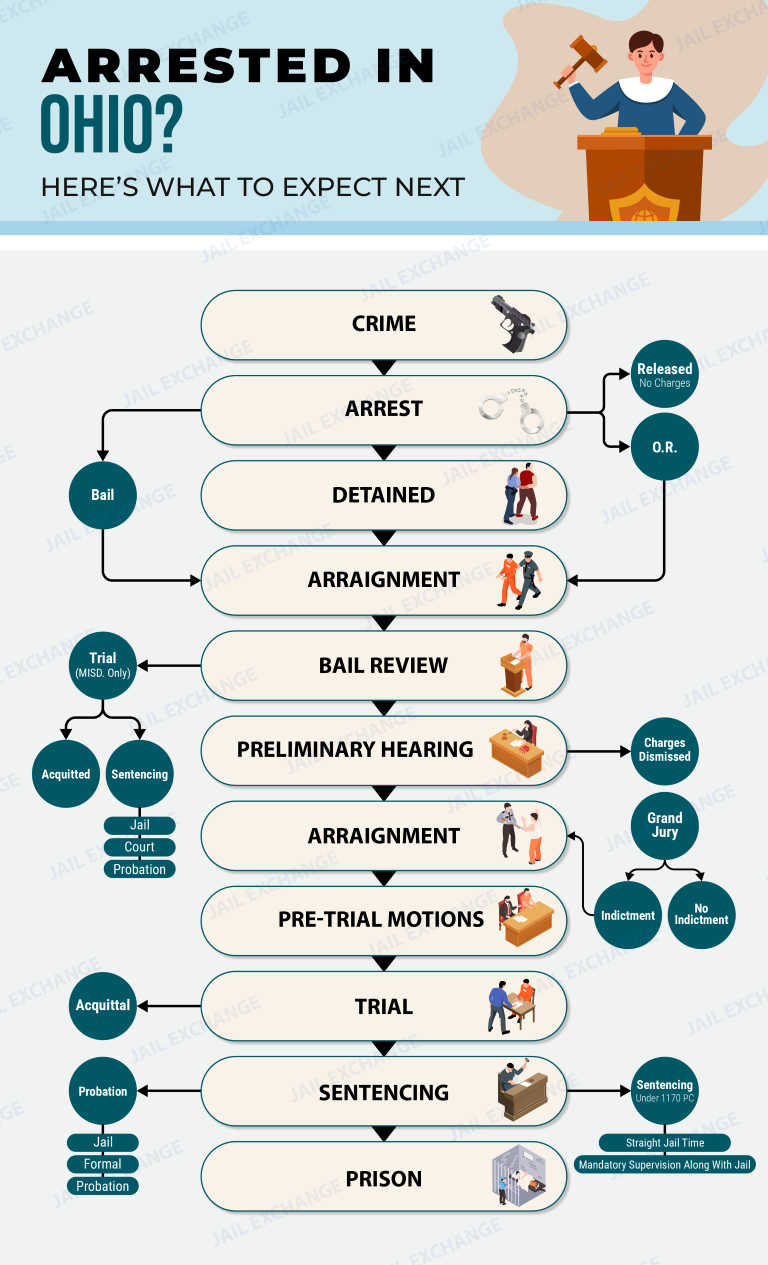
Putnam County Adult Detention Facility Criminal Court Process
Criminal Court Process for Putnam County Ohio
Putnam County is a farming county in northwest Ohio with its county seat in Ottawa. The Putnam County Municipal Court, in the Ottawa courthouse, has jurisdiction across the whole county for misdemeanors, OVI and traffic charges and for the early stage of felony cases, and Columbus Grove holds a mayor's court for its own tickets. Felonies are tried in the Putnam County Court of Common Pleas. The elected Putnam County Prosecuting Attorney handles felony and juvenile prosecutions, and adults held after arrest are kept in the Sheriff's Putnam County Jail on Heritage Trail.
- Putnam County Court of Common Pleas, Putnam County Courthouse, 245 E. Main Street, Suite 301, Ottawa, OH 45875, (419) 523-3110
- Putnam County Municipal Court, Putnam County Courthouse, 245 E. Main Street, Ottawa, OH 45875, (419) 523-3110
- Putnam County Probate and Juvenile Court, Putnam County Courthouse, 245 E. Main Street, Ottawa, OH 45875, (419) 523-3012
- Putnam County Prosecuting Attorney, 336 E. Main Street, Suite B, Ottawa, OH 45875, (419) 523-3600
- Putnam County Jail (Putnam County Sheriff's Office), 1035 Heritage Trail, Ottawa, OH 45875, (419) 523-3208
- Public defense: Ohio Public Defender, Northwest Regional Hub trial office (serving Putnam, Allen and Hardin counties), (567) 242-2788
Which court hears your case. In Putnam County, every misdemeanor, OVI and traffic case, whether from Ottawa, Leipsic, Kalida, Ottoville, Pandora or a county road, is filed in the Putnam County Municipal Court, which state law gives jurisdiction over the entire county; there is no separate county court. The one exception is Columbus Grove, whose police can send village ordinance and traffic tickets to the Columbus Grove Mayor's Court, a court with no jury that must transfer the case to the municipal court if the defendant asks. Felony charges also start in the municipal court, which conducts the initial appearance, sets bond and holds any preliminary hearing. After the grand jury indicts, or the defendant waives indictment and proceeds on a bill of information, the case moves to the Court of Common Pleas, General Division. Appeals from Putnam County go to the Third District Court of Appeals.
Where pretrial detainees are held. The Putnam County Sheriff runs the county jail at 1035 Heritage Trail on the edge of Ottawa. Arrests by the Sheriff, the Highway Patrol and the village police departments are booked there, and pretrial detainees stay until they post bond or the court releases them. For custody or bond information, call (419) 523-3208.
- Local courts in Putnam County (municipal, county and mayor's courts)
- Misdemeanor (for example, petty theft, a first OVI, assault, criminal trespass)
- Felony (for example, burglary, felony theft, drug trafficking, felonious assault)
- Violent felony (for example, murder, rape, aggravated robbery)
- Juveniles (under 18) arrested in Putnam County
- Federal cases (U.S. District Court) from Putnam County
1. Local courts in Putnam County (municipal, county and mayor's courts)
Putnam County's former county court has been replaced by a countywide municipal court, so local criminal cases now go to just two places.
Municipal court
- Putnam County Municipal Court — Putnam County Courthouse, 245 E. Main Street, Ottawa, OH 45875, (419) 523-3110. Jurisdiction: all of Putnam County, including Ottawa, Columbus Grove, Leipsic, Kalida, Ottoville, Pandora, Fort Jennings, Continental, Glandorf, Miller City, Cloverdale, Dupont, Belmore, Gilboa and every township.
County courts
None. The municipal court's countywide territory replaced the former county court.
Mayor's courts
- Columbus Grove Mayor's Court — 113 E. Sycamore Street, Columbus Grove, OH 45830, (419) 659-2365
The Columbus Grove court handles a relatively small number of village ordinance and traffic cases each year. A defendant there can enter a plea or have a bench trial before the mayor or magistrate; a jury request, or a charge outside the mayor's court's authority, sends the case to the municipal court in Ottawa.
2. Misdemeanor (for example, petty theft, a first OVI, assault, criminal trespass)
Most misdemeanor defendants in Putnam County receive a citation and a court date rather than a jail stay. OVI drivers, people arrested after a domestic dispute and anyone with a warrant are more likely to be booked on Heritage Trail. Where the court's bond schedule applies, they can post bond at the jail; otherwise they stay in custody until the municipal judge sets conditions, usually the next court day.
Municipal court steps
The process opens with an arraignment, at which the judge reads the charge, explains rights and possible penalties, and asks for a plea. A defendant who could go to jail and cannot pay a lawyer may ask for appointed counsel; the Ohio Public Defender's Northwest Regional Hub provides trial representation in Putnam County, and eligibility is based on a financial affidavit, with a possible small application fee. If the plea is not guilty, the case is set for a pretrial conference with the prosecutor. A jury of eight, which must be unanimous, is available only if the defense demands it in writing; otherwise the judge decides. The state must try an M1 or M2 within 90 days and an M3 or M4 within 45 days, and days in jail on the charge are counted triple.
Penalties
- M1: up to 180 days, up to $1,000 (assault; theft below $1,000).
- M2: up to 90 days, up to $750.
- M3: up to 60 days, up to $500.
- M4: up to 30 days, up to $250 (the usual level for criminal trespass; aggravated trespass is an M1).
- Minor misdemeanor: no jail, fine of $150 or less.
A first OVI
First-offense OVI is an M1. Putnam County judges must order at least three consecutive days in jail or in a 72-hour driver intervention program, or at least six days with a test of .17 or higher or certain refusal histories. Fines for a first OVI here run $375 to $1,075. An administrative suspension can begin at the time of arrest, and conviction carries a court suspension of one to three years. Limited driving privileges are often granted, and unlimited privileges with an ignition interlock are allowed in some cases. Treatment, if an assessment recommends it, is commonly required.
Putnam misdemeanors may be dismissed, diverted, resolved through intervention in lieu of conviction or sentenced with fines, community control or jail. One to four months is typical, and records can frequently be sealed later.
3. Felony (for example, burglary, felony theft, drug trafficking, felonious assault)
Because the municipal court and the Common Pleas Court share the Putnam County Courthouse, a felony case usually changes courtrooms rather than buildings when it is indicted.
In the municipal court
After a felony arrest, the municipal judge sets bond at the initial appearance, usually held the next court day. Ohio's constitution requires the judge to consider public safety, the defendant's record, the seriousness of the offense and the likelihood of appearance. Options include recognizance, a 10 percent deposit, and cash or surety bonds, which bail bond companies may post. The preliminary hearing must be held within 10 days for a jailed defendant or 15 days for one who is free, unless the grand jury indicts first.
In the Common Pleas Court
The Prosecuting Attorney presents the case to a Putnam County grand jury, or the defendant waives indictment and proceeds on a bill of information. Arraignment in Common Pleas follows, then discovery, pretrial conferences and motions. Ohio's speedy-trial law requires trial within 270 days of arrest, counting each day in jail on the charge as three. Most cases are resolved by plea; if the case is tried, a 12-member jury must agree unanimously. The court generally orders a presentence investigation before sentencing.
Degrees and penalties
- F5: 6 to 12 months. Example: theft of $1,000–$7,500. First-time nonviolent offenders at this level and F4 are often presumed eligible for community control.
- F4: 6 to 18 months. Example: theft of $7,500–$150,000.
- F3: 9 to 36 months, or 12 to 60 months for certain offenses. Example: burglary when nobody is likely to be present.
- F2: 2 to 8 years. Examples: felonious assault; burglary of an occupied home when a person is likely present.
- F1: 3 to 11 years. Example: aggravated burglary.
For F1 and F2 offenses committed on or after March 22, 2019, the Reagan Tokes Law imposes an indefinite sentence, with a maximum up to half again as long as the minimum. Drug trafficking charges range from F5 to F1 depending on the drug and amount, and firearm specifications add mandatory prison time. Intervention in lieu of conviction is an option for some substance-related offenses. Felony cases in Putnam County usually run four months to a year.
4. Violent felony (for example, murder, rape, aggravated robbery)
Violent felonies are uncommon in Putnam County. When they occur, the Prosecuting Attorney's office takes them to the grand jury quickly, and the court generally sets a high bond or holds the defendant without bail at the state's request.
Aggravated murder is punishable by life with parole eligibility after 20, 25 or 30 years, life without parole, or death; Ohio retains the death penalty, but no executions have been carried out since 2018. Murder brings 15 years to life. Rape is an F1 with an indefinite Reagan Tokes sentence, and life terms are possible in some cases with victims under 13. Aggravated robbery is also an F1, typically with additional mandatory time if a firearm specification is attached.
Victims are entitled under Marsy's Law to receive notice, attend court and be heard, and the Prosecuting Attorney's victim services staff can help. Forensic work and expert testimony mean these cases often take one to two years.
5. Juveniles (under 18) arrested in Putnam County
Juvenile delinquency cases are heard by the Putnam County Probate and Juvenile Court in the courthouse at 245 E. Main Street, Ottawa, (419) 523-3012. Complaints are filed by the Prosecuting Attorney, and the court's intake process decides whether a case can be handled unofficially, for example through diversion with community service, restitution or counseling, or must be filed as an official case.
Detention. Most youths are released to a parent. Putnam County does not operate its own juvenile detention facility; a youth who must be held is typically transported to a juvenile detention center elsewhere in northwest Ohio that accepts Putnam County youths, and the juvenile court can tell parents which one. A detention hearing is held promptly, generally within 72 hours or by the next court day.
Outcomes. A youth found delinquent may receive probation, community service, counseling, monitoring or, for felony-level offenses, commitment to the Ohio Department of Youth Services (DYS). Ohio requires mandatory bindover to adult court for some 16- and 17-year-olds, and in narrower cases 14- and 15-year-olds, charged with the most serious crimes; a judge may also order a discretionary bindover for a youth 14 or older after an amenability hearing. For certain serious offenses the court can impose a Serious Youthful Offender sentence, which pairs a juvenile disposition with an adult sentence that is stayed.
The youth has a right to an attorney, appointed if necessary. Records of Putnam County juvenile cases are generally confidential, and sealing is often available.
6. Federal cases (U.S. District Court) from Putnam County
District and courthouse
Putnam County is part of the Northern District of Ohio, Western Division. Although federal law lists both Lima and Toledo as places of holding court for that division, the district's local rule assigns Putnam County to Toledo, so its federal cases are generally heard at the James M. Ashley and Thomas W.L. Ashley U.S. Courthouse, 1716 Spielbusch Avenue, Toledo, OH 43604; Clerk's Office (419) 213-5500.
Federal offices
- U.S. Attorney's Office, Northern District of Ohio: branch office in Toledo; main office 801 W. Superior Avenue, Suite 400, Cleveland, OH 44113, (216) 622-3600
- Federal Public Defender, Northern District of Ohio: branch office in Toledo; CJA panel attorneys are also appointed
- U.S. Marshals Service, Ashley U.S. Courthouse, 1716 Spielbusch Avenue, Suite 313A, Toledo, OH 43604, (419) 376-3094
What makes a case federal
A federal case begins when an agency such as the FBI, DEA, ATF or HSI investigates a violation of federal law and the U.S. Attorney files charges. In a county like Putnam, that might be methamphetamine or fentanyl distribution, a firearm possessed by a person with a felony record, child exploitation online, or fraud involving federal farm, benefit or loan programs.
How federal cases proceed
A magistrate judge in Toledo holds the initial appearance and appoints counsel for eligible defendants. When the government seeks detention, the hearing is usually held within three court days, and the Bail Reform Act requires the judge to choose release on conditions monitored by U.S. Pretrial Services or detention before trial. An indictment must be returned within 30 days of arrest on a complaint, and the Speedy Trial Act sets a 70-day deadline for trial that is commonly extended. Plea agreements resolve most cases; a federal jury has 12 members and must be unanimous. U.S. Probation prepares a presentence report, the judge considers the advisory Sentencing Guidelines, and mandatory minimums apply where the statute requires. There is no federal parole, so defendants serve about 85 percent of their sentences in the Bureau of Prisons and then supervised release. Appeals are heard by the Sixth Circuit.
Detention
A Putnam County resident held on a federal charge is a U.S. Marshals prisoner, placed in jails and detention facilities under contract; family members near Ottawa can search the Federal Bureau of Prisons inmate locator for someone from Putnam County using a name or register number. Putnam County prisoners awaiting trial in a county contract jail can be listed on its posted roster. Federal charges against juveniles are rare.
This page offers general information about criminal cases in Putnam County and is not legal advice; court practices in Ottawa can change. Anyone charged with a crime should speak with a defense lawyer or contact the Ohio Public Defender's Northwest Regional Hub at (567) 242-2788; the courts in Ottawa can be reached at (419) 523-3110.