Chillicothe, Ohio's first capital, is the county seat of Ross County and the place where all of its criminal courts sit. The Chillicothe Municipal Court has jurisdiction throughout Ross County for misdemeanors, OVI and traffic cases and for the first stage of felonies, and the county has no mayor's courts. Felonies are tried in the Ross County Court of Common Pleas on North Paint Street. The Ross County Prosecuting Attorney handles felony and juvenile prosecutions, Chillicothe's law director prosecutes most municipal-court misdemeanors, and adults held after an arrest are in the custody of the Ross County Sheriff.
- Ross County Court of Common Pleas, Ross County Courthouse, 2 N. Paint Street, Suite B, Chillicothe, OH 45601, (740) 702-3010
- Chillicothe Municipal Court, 95 E. Main Street, Chillicothe, OH 45601, (740) 773-3515
- Ross County Probate and Juvenile Court, Ross County Courthouse, 2 N. Paint Street, Suite A, Chillicothe, OH 45601, (740) 774-1177
- Ross County Prosecuting Attorney, 33 W. Main Street, Suite 200, Chillicothe, OH 45601, (740) 702-3115
- Ross County Sheriff's Office and Jail, 28 N. Paint Street, Chillicothe, OH 45601, (740) 773-1186
- Ross County Public Defender (Ohio Public Defender, Ross County trial office), 14 S. Paint Street, Suite 54, Chillicothe, OH 45601, (740) 772-4772; toll-free (800) 618-6548
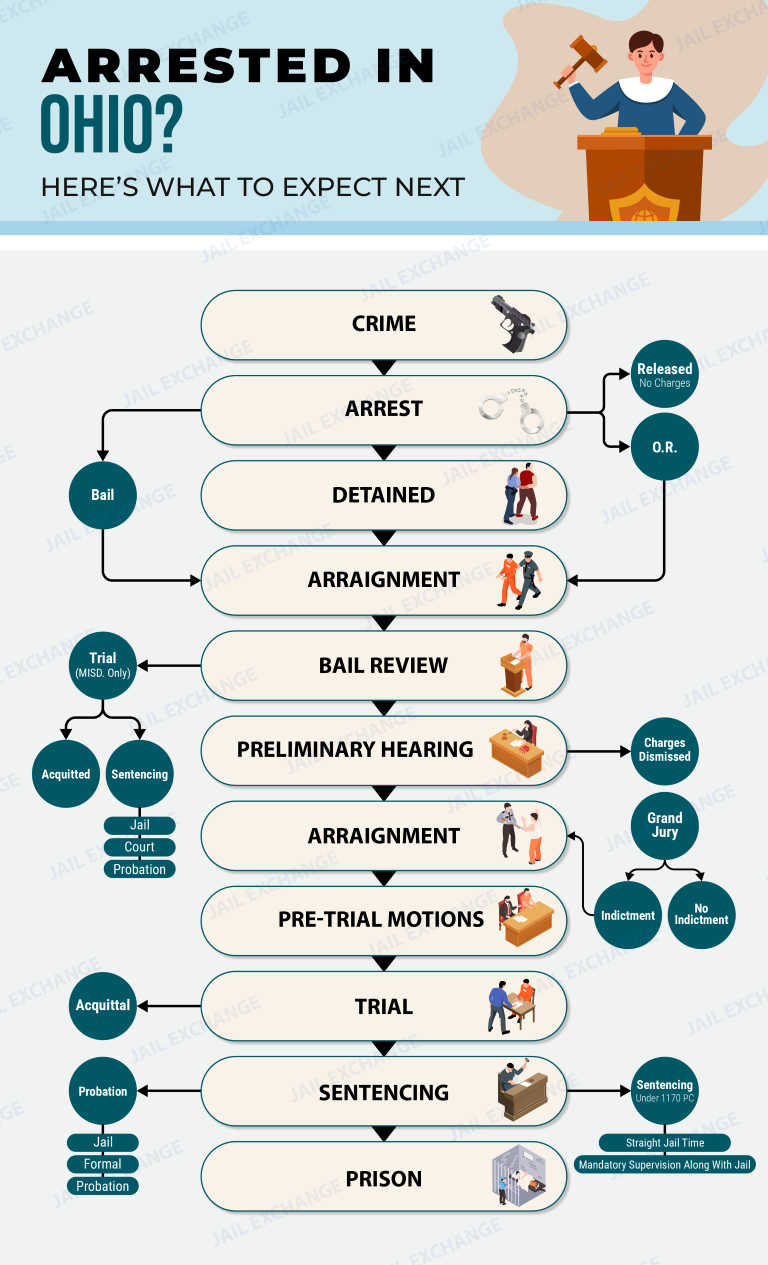
Which court hears your case. Ross County's misdemeanor, OVI and traffic cases go to the Chillicothe Municipal Court on East Main Street, whose territory is the entire county, from Frankfort and Kingston to Bainbridge, Adelphi and South Salem. No county court operates here, and the Supreme Court of Ohio's latest list shows no mayor's courts in Ross County, so every local ticket is filed in that one court. A felony also starts in the municipal court with the initial appearance, bond and preliminary hearing; after a grand jury indictment or a waiver and bill of information, the case moves to the General Division of the Ross County Court of Common Pleas. Appeals are decided by the Fourth District Court of Appeals.
Where pretrial detainees are held. Chillicothe police, Sheriff's deputies, village officers and the Highway Patrol bring adults they arrest to the jail run by the Ross County Sheriff in downtown Chillicothe, near the courthouse. People who cannot post bond remain there while their case is pending. The two state prisons on the north side of Chillicothe hold only people serving state sentences and are separate from the county jail. To check on someone, call the Sheriff's Office at (740) 773-1186.
- Local courts in Ross County (municipal, county and mayor's courts)
- Misdemeanor (for example, petty theft, a first OVI, assault, criminal trespass)
- Felony (for example, burglary, felony theft, drug trafficking, felonious assault)
- Violent felony (for example, murder, rape, aggravated robbery)
- Juveniles (under 18) arrested in Ross County
- Federal cases (U.S. District Court) from Ross County
Local courts in Ross County (municipal, county and mayor's courts)
Ross County has the simplest possible local court arrangement: one municipal court, and nothing else below the Common Pleas level.
Municipal court
- Chillicothe Municipal Court — 95 E. Main Street, Chillicothe, OH 45601, (740) 773-3515. Territory: all of Ross County, including Chillicothe, Frankfort, Kingston, Adelphi, Bainbridge, Clarksburg, South Salem, Londonderry, Richmond Dale, Hallsville and all 16 townships.
County courts
None; the municipal court's countywide reach leaves no territory for a county court.
Mayor's courts
Ross County has no mayor's courts on the Supreme Court of Ohio's most recent registry. Village police in places like Frankfort or Kingston file their ordinance and traffic citations directly in the Chillicothe Municipal Court.
Besides criminal and traffic cases, the municipal court hears small claims, evictions and civil lawsuits up to its monetary limit. The criminal clerk can give court dates, fine amounts and payment options.
Misdemeanor (for example, petty theft, a first OVI, assault, criminal trespass)
A shoplifting charge at a Bridge Street store or a trespass complaint in a township is often handled with a summons or citation, so the person goes home and comes to court later. Police are more likely to book someone at the jail for OVI, domestic violence or an open warrant; that person can post any bond set by the court's schedule, or waits to appear before the municipal judge, normally the next court day and often by video.
Inside Chillicothe Municipal Court
The first hearing is the arraignment: the judge reads the charge and possible penalties, explains rights and takes a plea. Ross County is one of the few counties with a public defender office run by the Ohio Public Defender, and eligible defendants facing possible jail are referred to the Ross County Public Defender after filling out a financial affidavit; a small application fee may apply. After a not-guilty plea, the case is set for a pretrial with the city prosecutor, where many cases are resolved. A Ross County misdemeanor is tried to the judge unless a jury is demanded in writing, in which case eight jurors must unanimously agree. The trial deadline is 90 days for M1 and M2 charges and 45 days for M3 and M4 charges, counting jailed days three for one.
How misdemeanors are graded
- First degree: 180 days and $1,000 at most. Assault and theft under $1,000 belong here.
- Second degree: 90 days, $750.
- Third degree: 60 days, $500.
- Fourth degree: 30 days, $250, which is where criminal trespass usually falls; aggravated trespass jumps to first degree.
- Minor misdemeanor: no jail and no more than a $150 fine.
First-offense OVI
OVI is an M1 even on a first offense. The law requires at least three days, served either in jail or in a 72-hour driver intervention program, and six days when the test result is .17 or above or certain refusal circumstances apply. The fine is $375 to $1,075. An administrative license suspension can begin at arrest; after conviction, the court orders a suspension of one to three years. Limited driving privileges are commonly available, and unlimited privileges with an ignition interlock are allowed in some cases. An assessment and any recommended treatment are typically ordered.
Cases can end with dismissal, diversion, intervention in lieu of conviction, fines, community control or jail. In Chillicothe, a misdemeanor usually takes one to four months to resolve, and sealing may be available later.
Felony (for example, burglary, felony theft, drug trafficking, felonious assault)
In Ross County a felony case passes through two courthouses a few blocks apart: the municipal court on East Main Street, then the Common Pleas Court on North Paint Street.
First appearance
The municipal judge sets bond after considering, as the Ohio Constitution now requires, the risk to public safety, the defendant's criminal history, the seriousness of the offense and whether the defendant is likely to appear. Ohio allows recognizance bonds, 10 percent deposit bonds and full cash or surety bonds; licensed bail bond agents commonly write the surety bonds. The Ross County Public Defender is usually appointed at this stage for those who qualify.
Preliminary hearing and indictment
The preliminary hearing, a probable cause hearing before the municipal judge, must take place within 10 days for a jailed defendant or 15 days for one who is released. Often the Prosecuting Attorney goes directly to the Ross County grand jury, and an indictment makes the hearing unnecessary. Defendants may also waive indictment and proceed on a bill of information.
Common Pleas
After arraignment in the Common Pleas Court, the case moves through discovery, pretrial conferences and motions such as requests to suppress evidence. Ohio's 270-day speedy-trial rule applies, with each jailed day counting as three. Most defendants accept a plea agreement; a trial requires a unanimous verdict from 12 jurors. A presentence investigation generally precedes sentencing.
Sentencing ranges
At the low end, an F5 (for instance, theft of $1,000 to $7,500) carries 6 to 12 months and an F4 (theft of $7,500 to $150,000) carries 6 to 18 months, and community control is presumed for many first-time nonviolent offenders at those levels. An F3 carries 9 to 36 months, or 12 to 60 months for certain offenses, and covers burglary when no one is likely present. An F2 carries 2 to 8 years and includes felonious assault and burglary of an occupied home when a person is likely there. An F1 carries 3 to 11 years, as with aggravated burglary. If the F1 or F2 offense was committed on or after March 22, 2019, the Reagan Tokes Law makes the sentence indefinite, with a possible additional period of up to half the minimum. Trafficking runs from F5 to F1 depending on the drug and quantity, and firearm specifications add mandatory prison time. People whose offense stemmed from addiction can seek intervention in lieu of conviction. Ross County felony cases usually take four months to a year.
Violent felony (for example, murder, rape, aggravated robbery)
Prosecutors in Ross County treat homicide, rape and armed robbery cases as top priorities, presenting them to the grand jury quickly and often asking the court to hold the defendant without bail or on a very large bond.
- Aggravated murder: possible sentences are death, life without parole, or life with parole eligibility after 20, 25 or 30 years. Ohio's death penalty remains law, but no execution has been carried out since 2018.
- Murder: 15 years to life.
- Rape: charged as an F1 and punished with an indefinite Reagan Tokes term; life terms are possible in certain cases with child victims under 13.
- Aggravated robbery: a first-degree felony, often with a firearm specification.
Marsy's Law guarantees victims notice of hearings and the right to be present and heard, including at plea and sentencing. These cases frequently last one to two years, and longer when there is extensive forensic evidence.
Juveniles (under 18) arrested in Ross County
Youth cases are heard by the Ross County Probate and Juvenile Court, 2 N. Paint Street, Suite A, Chillicothe, (740) 774-1177. The Prosecuting Attorney files delinquency complaints, and intake officers decide whether a case can be handled unofficially or through diversion, for example with counseling, community service or restitution, or must proceed formally.
Detention. Ross County youths who cannot go home are held at the South Central Ohio Regional Juvenile Detention Center, 184 Cattail Road, Chillicothe, OH 45601, (740) 773-4169, a regional center whose member counties are Ross, Fayette, Highland, Jackson, Pike and Vinton. A detained youth must have a detention hearing promptly, generally within 72 hours or by the next court day.
Outcomes. A juvenile judge may order probation, treatment, community service, restitution or monitoring, and for felony-level offenses can commit the youth to the Ohio Department of Youth Services (DYS). Some 16- and 17-year-olds charged with the most serious offenses, and in narrower circumstances 14- and 15-year-olds, must be bound over to adult court; for other felonies, a youth 14 or older may be transferred at the judge's discretion after an amenability hearing. A Serious Youthful Offender disposition, combining a juvenile sentence with a suspended adult one, is possible in certain serious cases.
Youths have the right to counsel, and the Ross County Public Defender represents those who qualify. Ross County juvenile files stay largely out of public view, and many can later be sealed.
Federal cases (U.S. District Court) from Ross County
Federal cases from Chillicothe and the rest of Ross County belong to the Southern District of Ohio, Eastern Division, and they are generally heard about 45 miles north in Columbus at the Joseph P. Kinneary U.S. Courthouse, 85 Marconi Boulevard, Columbus, OH 43215.
When Ross County cases go federal
Charges are federal when the conduct violates federal law and an agency such as the FBI, DEA, ATF, HSI or the VA Office of Inspector General investigates. Drug trafficking along U.S. 23 and U.S. 35, gun possession by people with felony records, child exploitation, and crimes on federal property such as the Chillicothe VA Medical Center campus are examples.
Federal contacts in Columbus
- U.S. Attorney, Southern District of Ohio: 303 Marconi Boulevard, Suite 200, Columbus, OH 43215, (614) 469-5715
- Federal Public Defender: 10 W. Broad Street, Suite 1020, Columbus, OH 43215, (614) 469-2999
- U.S. Marshals Service: 85 Marconi Boulevard, Room 460, Columbus, OH 43215, (614) 469-5540
Process
A federal defendant's first stop is an initial appearance before a magistrate judge, who appoints the Federal Public Defender or a CJA panel lawyer if the defendant cannot afford counsel. A detention hearing, when the government requests one, is generally held within three court days. The Bail Reform Act lets the judge release the defendant with conditions supervised by U.S. Pretrial Services or order detention. Charges brought by complaint must be presented to a grand jury, with an indictment returned within 30 days. Trial must begin within 70 days under the Speedy Trial Act, though extensions are common. Most federal cases end with guilty pleas, and a trial jury of 12 must be unanimous. After conviction, U.S. Probation prepares a presentence report; the Sentencing Guidelines are advisory, while mandatory minimum terms bind the judge. Federal prisoners cannot be paroled and serve about 85 percent of their sentences in the Bureau of Prisons, followed by supervised release. A Ross County defendant who appeals goes to the Sixth Circuit, which sits in Cincinnati.
Where federal detainees are held
Detained federal defendants are in U.S. Marshals custody and are housed at jails or detention centers that contract with the Marshals Service; Ross County families can search the Federal Bureau of Prisons inmate locator for a Chillicothe-area defendant by name or register number. Someone from Chillicothe kept before trial in a contracting jail may show up on the facility's roster. Federal prosecution of people under 18 is unusual.
The Ross County information here is general and should not be relied on as legal advice; procedures in Chillicothe's courts can change. Anyone charged with an offense should talk with a defense lawyer or contact the Ross County Public Defender at (740) 772-4772; for court dates, call the Chillicothe Municipal Court at (740) 773-3515.