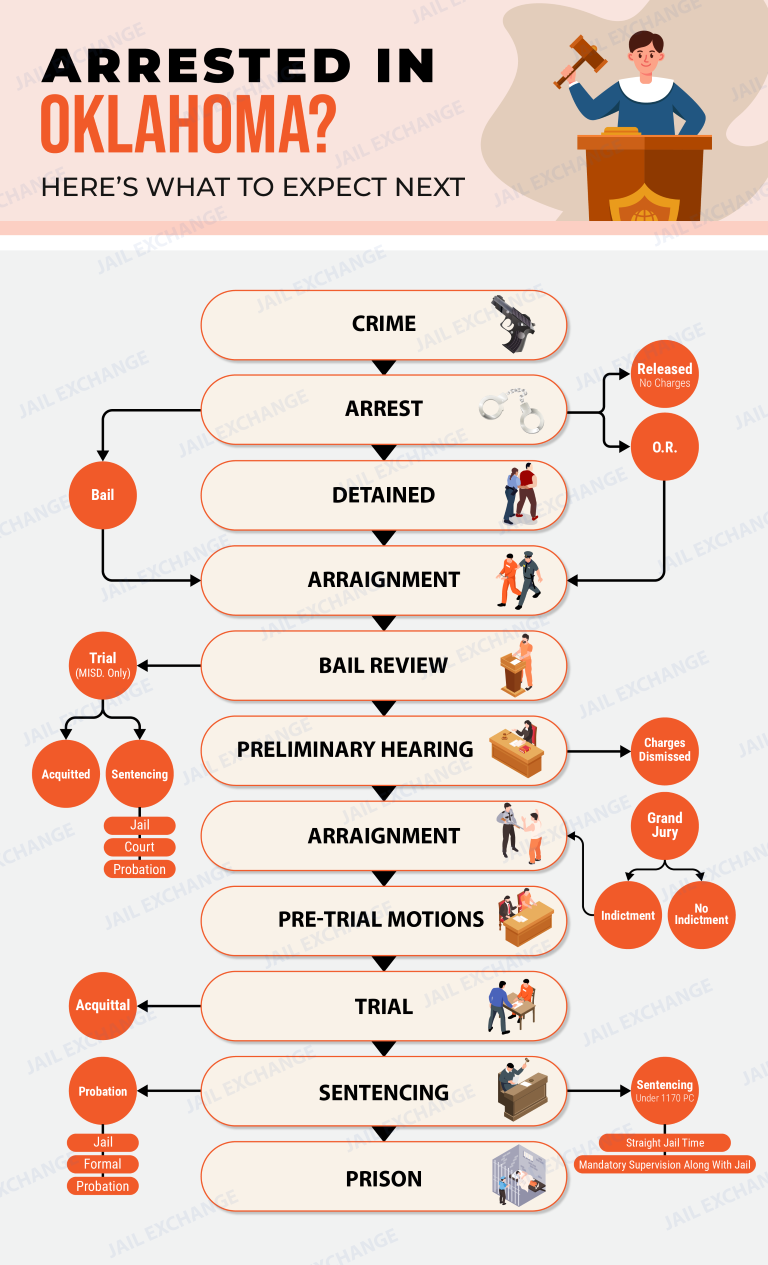
Cleveland County Detention Center Criminal Court Process
Criminal Court Process for Cleveland County Oklahoma
Cleveland County Criminal Court Guide
Norman holds the District Court, where every state criminal charge from this county is filed, while city tickets go to municipal courts in Norman, Moore, Noble and Oklahoma City. Adults who are locked up wait at the Cleveland County Detention Center, 2550 W. Franklin Road, Norman, OK 73069. Below are the courts, the path a case takes, and how to look up dates and warrants.
Is the person still behind bars? Run their name through the official Sheriff lookup. The rest of the arrest is on our Inmates in Custody page. That page lists who is booked now and covers new arrests, open warrants, mugshots, appointed lawyers, property pickup and the charges themselves.
Today, call the Court Clerk at 405-321-6402. Ask for the case number, the next hearing date and the courtroom. Want them home while the case plays out? Go to our bail and bond page.
1. Which court takes a misdemeanor here, and which takes a felony?
The District Court hears both. Every felony, misdemeanor and state traffic case in the county is filed with its Court Clerk, including tickets written by troopers, deputies and park rangers. The difference is the possible punishment:
- Misdemeanor: a lesser crime. Any sentence behind bars is spent in the county lockup.
- Felony: a crime serious enough for state prison. Felonies committed from January 1, 2026 on are grouped into lettered classes, and the most violent ones sit in classes Y, A and B (HB 1792, later adjusted by HB 2104 and HB 2105).
- City ordinance cases: heard by the municipal court of the town where the ticket was written.
State Question 780, in effect since July 1, 2017, turned simple drug possession into a misdemeanor. Property crimes now need a value over $1,000 to count as a felony. If the person is a tribal citizen and the alleged crime happened in Indian country, a tribal or federal court may take the case instead (McGirt v. Oklahoma), so ask the lawyer.
↑ Back to the question list2. Where do Cleveland County criminal cases get heard?
State cases use two buildings in Norman, a few blocks apart:
- Courthouse and Court Clerk, 200 S. Peters Ave., Norman, OK 73069, 405-321-6402. Six judges have offices here. Filings, case files, protective orders and court-appointed lawyer forms are handled at the clerk's counter during business hours.
- County Office Building, 201 S. Jones Ave., Norman, OK 73069. Four more judges work from this building, and the District Attorney's office is in Suite 300. Call the clerk to learn which judge and courtroom have the case.
- Federal court for federal crimes, 200 NW 4th Street, Oklahoma City, OK 73102, 405-609-5000.
The county also offers text message reminders for court dates. Signing up is a simple way to avoid a missed hearing and a new warrant.
↑ Back to the question list3. Do Norman, Moore and the smaller towns run city courts?
Yes. These municipal courts hear city ordinance cases, such as traffic and minor offenses inside town limits:
- Norman Municipal Court, 321 N. Webster Avenue, Norman, OK 73069, 405-366-5325. Open weekdays 8 a.m. to 5 p.m. Fines can be paid on the city court payment page.
- Moore Municipal Court, inside the Public Safety Center at Main Street and Broadway, 101 E. Main Street, Moore, OK 73160, 405-793-5040. Open weekdays 8 a.m. to 5 p.m. The top penalty it can give is $800.
- Noble Municipal Court, Noble City Hall, 304 S. Main St., Noble, OK 73068, 405-872-9251. The clerk is in weekdays 8:30 a.m. to 4:30 p.m., and court is held the first Tuesday of each month.
- Oklahoma City Municipal Court, for the part of that city inside this county, 701 Couch Drive, Oklahoma City, OK 73102, 405-297-2781.
For a ticket from Lexington, Slaughterville or Etowah, call Lexington City Hall, 111 E. Broadway St., Lexington, OK 73051, 405-527-6123, or the Court Clerk. Since a 2026 change, a city fine above what state law allows is void, and the court lowers it to the allowed amount (SB 1775).
↑ Back to the question list4. First hearing in front of a judge: what happens?
This early hearing gets the case started. In plain terms, the person can expect to:
- hear what crime they are accused of
- find out how to request a free lawyer when money is short
- have bail set, kept or changed
- get the date of the next hearing
Under the state Constitution, the accused gets a quick and open trial, a jury drawn from the county where the crime took place, and a chance to be heard through counsel (Okla. Const. art. II § 20). That right reaches any misdemeanor that could mean jail, as the state's top criminal court held in 2025 (Spybuck v. State, 2025 OK CR 7).
Inside the jail, staff hand out the lawyer application on request. The jail at 405-701-7700 can say when the first court date is.
↑ Back to the question list5. How do drug possession and DUI misdemeanors move through court?
The District Attorney files misdemeanor charges with the Court Clerk, and a District Court judge handles the case. Typical steps:
- The person appears, hears the charge and enters a plea.
- Bail is set, or the person is released on conditions.
- The lawyer and prosecutor trade evidence and may talk about a plea deal.
- The charge is dropped, settled by plea, or tried.
- Jail time on a misdemeanor is spent in the county lockup, not prison.
Two common charges carry special rules. Since State Question 780, a simple drug possession charge is a misdemeanor rather than a felony (63 O.S. § 2-402). A first DUI can be a misdemeanor, but a repeat DUI arrest means the person waits for a judge to fix bail and give reasons on paper (HB 1222). Ask the lawyer for the exact penalty range on the charge filed.
↑ Back to the question list6. What steps does a Cleveland County felony go through?
Most felonies follow roughly this order:
- Arrest and booking at the Detention Center on Franklin Road.
- Bail or a no-bail hearing before a District Court judge.
- Charges filed by the District Attorney with the Court Clerk.
- A lawyer hired or appointed through OIDS.
- Hearings where the evidence is tested and plea talks happen.
- Trial before a jury from this county, unless the case ends sooner.
- Sentencing once guilt is admitted or proven.
When the crime took place in 2026 or later, the written judgment has to state which class applies and how long the person must serve at minimum. If a judgment leaves out the class, the Department of Corrections uses the lowest one (HB 2105). The class system does not reach back to older crimes.
↑ Back to the question list7. Do violent felonies bring tougher rules?
They do. The rules get stricter at almost every step:
- No-bail holds. A judge can refuse release on a violent charge if the evidence is strong and no conditions would keep people safe (Okla. Const. art. II § 8).
- Top classes. The worst violent crimes now carry the top letters: Y, A or B.
- Abuse in front of a child. A 2026 law makes domestic abuse committed while a child is present a Class B5 felony (SB 1238).
- No bail on appeal. Since November 1, 2025, anyone found guilty of abusing a partner or a child stays locked up while appealing (HB 1066).
- Protective orders. When the person named in an order is sitting in the county jail, deputies must try to serve it within one day of issue (SB 623).
8. Who prosecutes in Cleveland County, and who defends people without money?
State charges filed here are handled by the District 21 District Attorney. The district also covers Garvin and McClain counties. The local office is at 201 S. Jones, Suite 300, Norman, OK 73069, 405-321-8268.
When the accused is broke, the judge may appoint counsel through the Oklahoma Indigent Defense System, or OIDS. Its Norman Non-Capital Trial office is at 111 N. Peters Ave, Suite 500, Norman, OK 73069, 405-801-2655.
- A judge, not OIDS, decides who qualifies. The form goes to the Court Clerk at 405-321-6402.
- There is a $40 fee for the form. The money is paid into the Court Fund, and the applicant may ask to put it off to the case's end.
- The county's step-by-step sheet for a court lawyer walks through the form.
9. How can I find a case or a hearing date online?
For case records, the Court Clerk sends people to the Oklahoma State Courts Network (OSCN). The Sheriff's Office also links Oklahoma District Court Records (ODCR). On either site, choose this county and look up the person or the case number.
- A case record lists what has been filed and the dates coming up.
- For help, phone the Court Clerk at 405-321-6402 with the full name and birth date.
- Get dates by text through the county's court date reminder service.
For a city ticket, call that town's court instead, such as Moore at 405-793-5040.
↑ Back to the question list10. Is there a Cleveland County warrant, and how is it lifted?
County warrants are served by Sheriff's deputies, 405-701-8888. Search its Warrant Check, or check OSCN case records. State and federal lists: the Oklahoma Attorney General's most wanted, the DOC escape alerts and the Marshals' top fugitives. To clear it, call a lawyer first and plan a turn-in to the issuing court. Deputies take surrender calls at 405-701-8916. Or phone the Court Clerk to ask about posting a bond or getting a fresh court date: 200 S. Peters Ave., Norman, OK 73069, 405-321-6402.
↑ Back to the question list11. Federal charges: how are they handled?
A federal arrest here puts the case in the Western District of Oklahoma. Court is held at 200 NW 4th Street, Oklahoma City, OK 73102, 405-609-5000, and the clerk works weekdays 8:30 a.m. to 4:30 p.m.
- Prosecutor: U.S. Attorney's Office, 210 Park Avenue, Suite 400, Oklahoma City, OK 73102, 405-553-8700.
- Release: the judge weighs release or detention at a hearing set under 18 U.S.C. 3142. U.S. Probation and Pretrial Services, 215 Dean A. McGee Avenue, Room 201, Oklahoma City, OK 73102, 405-609-5800, prepares reports for the court.
- Custody: the U.S. Marshals, 200 Northwest 4th Street, Room 2022, Oklahoma City, OK 73102, 405-231-4206, keep federal prisoners before trial. Some stay at the Federal Transfer Center, 7410 S. MacArthur Boulevard, Oklahoma City, OK 73169.
- After sentencing: the BOP inmate locator names the prison they were sent to.
12. Will an ICE hold alter the state charge?
The District Court case goes on as before. The detainer only bites on the day the person is due to leave jail.
- Form I-247A arrives from ICE, asking the Detention Center to keep the person.
- Staff may then hold your loved one past release. A federal rule caps that hold (8 CFR 287.7(d)): up to 48 hours after they would otherwise be released.
- During that window, ICE comes for the person.
- Oklahoma is covered by ICE's Dallas Field Office, 8101 N. Stemmons Frwy, Dallas, TX 75247, 972-367-2200. The Oklahoma City ICE office is at 1220 Sovereign Row, Oklahoma City, OK 73108, 405-219-3199, open Tuesday to Thursday, 8 a.m. to 3 p.m.
- ICE detainees from this area are often placed at the Cimarron Correctional Facility, 3200 S. Kings Hwy., Cushing, OK 74023, 918-225-3336.
- Check the ICE detainee search for the person's location.
A state law (22 O.S. § 171.2) also covers how jails verify whether an inmate is a citizen. The state's HB 4156 crime of unlawful presence (21 O.S. § 1795) has been frozen by a federal judge since May 2025. Defense lawyers should weigh immigration effects before any plea.
↑ Back to the question list13. Where does a Cleveland County prison sentence get served?
A state prison sentence goes to the Oklahoma Department of Corrections (DOC). Expect a long stay in the county jail first, normally 6 to 9 months past sentencing. Then DOC moves them to an assessment and reception center, which scores the person's custody level and assigns a prison.
- For men, intake is at the Lexington Assessment and Reception Center, 15151 State Highway 39, Lexington, OK 73051, 405-527-5676, right here in the county.
- The Joseph Harp Correctional Center, a medium-security prison, is also in Lexington, at 16161 Moffat Rd., Lexington, OK 73051, 405-527-5593.
- The DOC Offender Lookup finds a prisoner by name. Each prison is covered in our Oklahoma state prisons guide.
- Once the person is in DOC custody, their case manager answers questions about them.
14. Youths under 18: what rules apply?
Youths are held apart from adults, and their cases follow juvenile rules. Four Oklahoma counties run their own juvenile bureaus. This county is one of the other 73, which rely on the Office of Juvenile Affairs (OJA).
- Local OJA office: 1650 W. Tecumseh Rd., Suite 300, Norman, OK 73069, 405-360-4310, weekdays 8 a.m. to 5 p.m.
- Detention: the Alan J. Couch Juvenile Detention Center serves the county. Ask OJA how to reach it.
- Youthful offenders: the Youthful Offender Act lets prosecutors treat a teen aged 15 to 17 who is accused of a serious crime as a youthful offender. For acts after November 1, 2018, the court keeps its hold on the case until age 19.
- Adult court: certification moves a youth case to adult court, and reverse certification sends one back.
15. Which protections do Cleveland County crime victims get?
Marsy's Law, the Victims Bill of Rights in the state Constitution, protects victims here (Okla. Const. art. II § 34). Among other things, victims have a right to:
- treatment that is fair and respects their safety, dignity and privacy
- speak at hearings on release, a plea, the sentence or parole
- restitution paid in full and on time
- a case that wraps up without needless delay
Notices about the case come only after the victim writes to the District Attorney's office and asks. List the accused person's name, the county and case number, plus a phone number and mailing address for you. The Victim Witness and Restitution Center shares the DA's line, 405-321-8268. Money for medical care, counseling, lost wages or a funeral may come from the state Crime Victims Compensation Program, 405-264-5006. Custody alerts come from VINELink.
↑ Back to the question list