Garfield County Detention Center Criminal Court Process
Criminal Court Process for Garfield County Oklahoma
Garfield County Criminal Court Guide
Felony and misdemeanor charges brought in Garfield County are heard under one roof, the county courthouse at 114 W. Broadway Ave., Enid, OK 73701. People held while a case moves along stay at the county Detention Facility, 1020 South 10th Street, Enid, OK 73701. Below you'll find each local court, the stages a case passes through, who prosecutes and who defends, record searches and warrants.
Before any court date matters, find out where the person is. The jail's Active Inmates list shows who is booked and the day it happened. Our Inmates in Custody page covers what comes after that: locating someone, recent bookings, open warrants, criminal charges, booking photos, public defenders and claiming belongings at release.
Any weekday between 8:00 a.m. and 4:30 p.m., dial the Court Clerk at 580-237-0232. Get the case number, the next hearing on the calendar and the judge's name. If the person hasn't been released, read our bail page for each bond step.
1. Which court hears misdemeanors and felonies here?
Every state charge here, small or serious, lands in the District Court. The state Constitution creates a District Court for each judicial district, with authority over every kind of case (Okla. Const. art. VII § 7(a)). So the same court takes a first shoplifting count and a murder charge.
- Its judges. The judges come in three ranks: district, associate district and special (Okla. Const. art. VII § 8(a)). Each of the 77 counties has at least one associate district judge, by constitutional rule.
- Juries. Felony trials use twelve jurors. Misdemeanor trials use six.
- The district. This county shares Judicial District 4 with Alfalfa, Blaine, Dewey, Grant, Kingfisher, Major, Woods and Woodward. District 4 is part of the Northwest-Panhandle administrative district (20 O.S. § 22).
- City cases. Ordinance tickets belong in municipal court. Its reach stops at criminal and traffic matters (Okla. Const. art. VII § 1).
A felony can lead to state prison. Penalties for a misdemeanor can mean a fine, a county jail term or the two together.
↑ Back to the question list2. What is the Garfield County Courthouse address and clerk schedule?
The courthouse stands at 114 W. Broadway Ave., Enid, OK 73701. The Court Clerk's office is on the second floor and handles every criminal file.
- Court Clerk: 580-237-0232. Open Monday through Friday, 8:00 a.m. to 4:30 p.m., including the noon hour. Closed on holidays.
- Jury information line: 580-548-2488, for anyone called to serve.
- Judges' offices in the building: two district judges at 580-237-5031 and 580-548-2424, the associate district judge at 580-237-0236 and the special judge at 580-237-0245.
- Another District 4 judge works out of the Woodward County Courthouse, 1600 Main Street, Woodward, OK 73801, 580-256-6716.
Clerk staff can pull up a case and make copies. The charge is $1.00 for the first page, 50 cents per page after that, and 50 cents to certify. They can't give legal advice. Records requests may also be emailed to garfieldrequests@oscn.net.
↑ Back to the question list3. Are there city and town courts in the county?
Yes. The largest is Enid Municipal Court, at the Dr. Martin Luther King Jr. Municipal Complex, 401 West Owen K. Garriott Road, Enid, OK 73701, 580-234-0400. It is open weekdays from 8:00 a.m. to 5:00 p.m.
- Traffic and adult misdemeanor dockets: Monday, Wednesday and Thursday at 2:00 p.m., plus Friday at 9:00 a.m.
- Juvenile cases that aren't traffic: Thursday afternoons.
- Bond amounts come from the city's own code. Case details are on the city's municipal case search.
Two towns post court pages on their town websites. In Drummond, ask at Town Hall, 424 Main Street, Drummond, OK 73735, 580-493-2900. In Covington, ask at Town Hall, 224 W Main St, Covington, OK 73730, 580-864-7428.
Got a ticket from Breckenridge, Carrier, Douglas, Fairmont, Garber, Hillsdale, Hunter, Kremlin, Lahoma, North Enid or Waukomis? The town hall there can say where it goes. So can the District Court Clerk at 580-237-0232. Since SB 1775 (2026), when a city fines someone more than state law permits, the extra is void and the fine shrinks to the legal top amount.
↑ Back to the question list4. What goes on at arraignment, the first court date?
This first trip to court opens the case. Nobody decides guilt yet. At the District Court arraignment on a felony, the person hears the charge read, but no plea is entered yet. The right to counsel is written into the state Constitution (Okla. Const. art. II § 20), so the subject of a lawyer comes up early.
- Video court. Someone held in a different county's jail can be arraigned by video (SB 1711, 2024).
- Bond. Release is often raised at this stage. Bring proof of a job and a home if a family member speaks.
- Speedy trial. State law sets review points counted from this first appearance. They fall at 9 months when the charge is the only thing holding someone in jail, and at 18 months for a defendant living at home on bond (SB 325, 2024).
The day of the first hearing depends on the calendar. Jail staff at 580-548-2429 or the Court Clerk can say when the person is scheduled.
↑ Back to the question list5. Misdemeanor DUI, theft or drug charges: what comes next?
A misdemeanor is the less serious type of crime. Jail time for one means the county jail, never a state prison. These cases go through the District Court here unless a city charged them.
- Drug possession. Since July 1, 2017, State Question 780 has treated simple possession as a misdemeanor.
- Theft and other property crimes. The same measure raised the felony line to $1,000, so smaller thefts are usually misdemeanors.
- DUI. A second or later DUI arrest can't be bonded out at the jail. A judge must set bail in writing first (HB 1222).
The case usually moves from the charge to a first appearance, then to plea talks with the prosecutor. If there is no deal, a six-person jury can hear it. Ask the Court Clerk at 580-237-0232 what is set next in your case.
↑ Back to the question list6. How does a Garfield County felony case unfold?
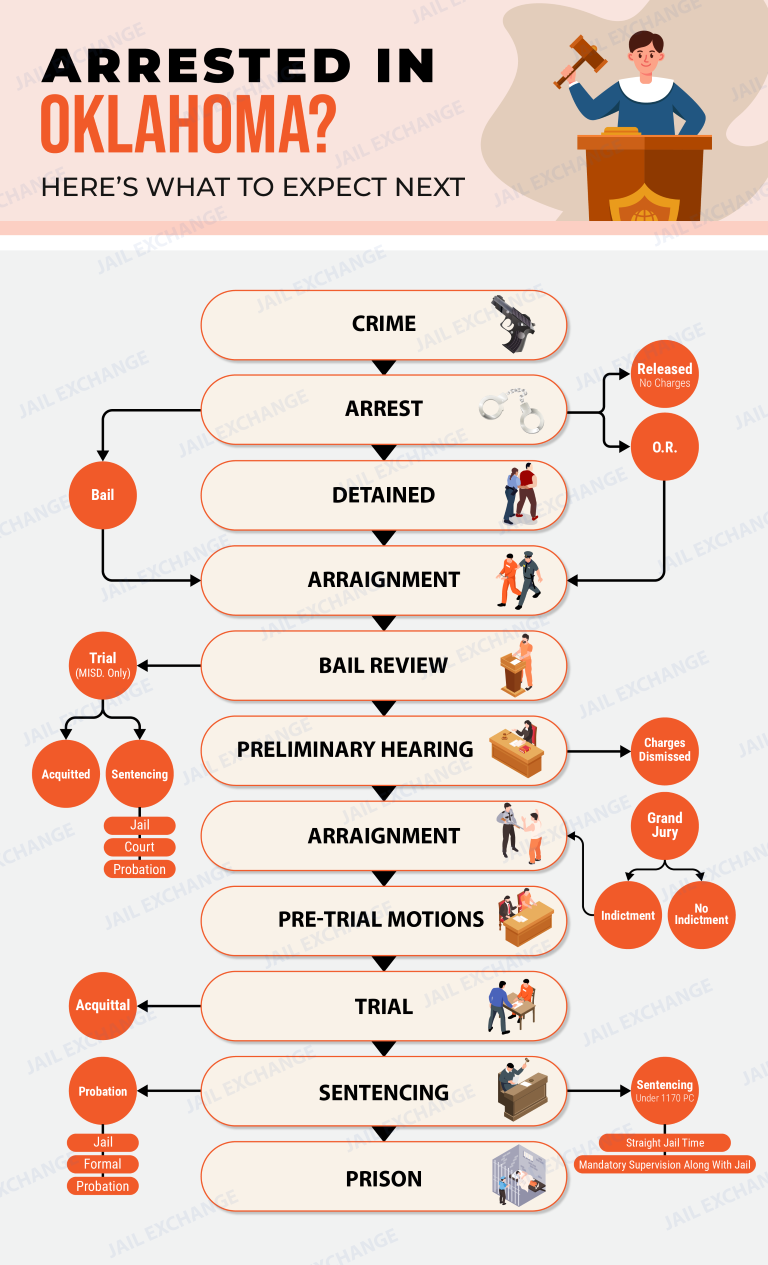
With prison possible, a felony moves more slowly and has more steps. Here is the usual path:
- Charge. The District Attorney's office files the felony.
- Arraignment. The person hears the charge read. Pleas wait until later.
- Preliminary hearing. A judge alone listens, and nobody is found guilty here. The state must prove three points: a crime took place, it happened in this county, and there is probable cause, meaning solid grounds to believe the accused committed it.
- Plea or trial. Plenty of cases end in a negotiated plea. Those that don't are tried before twelve jurors.
- Sentencing. The judge or jury sets the sentence.
A letter grade now goes with every felony committed from January 1, 2026 on. Class Y and Class A1 sit at the top, while D2 and D3 are the lightest (HB 1792, later amended by HB 2104 and HB 2105). New ranges were written for the C and D classes, and the others keep their old ranges. Judgments now state both the class and the shortest stay the person must complete. DOC notes that credit for jail time before sentencing is ordered in almost every case.
↑ Back to the question list7. Do violent felonies carry extra rules?
Yes, at nearly every stage. A judge may deny bail on a violent charge after finding the proof strong and no safe release plan (Okla. Const. art. II § 8). Picking up a violent charge during release on a violent-crime bond flips the starting point, because the law then presumes jail (HB 3782, 2024).
Sentences are tougher too. Under Oklahoma's 85% rule, anyone found guilty of a listed crime stays for 85% of the prison term before the parole board will look at the case (21 O.S. § 13.1). Armed robbery, both degrees of murder, the top grade of manslaughter, first degree burglary and rape, child abuse and human trafficking are among the crimes listed. Credits can be earned along the way, yet they don't count until the 85% mark. Per the jury instructions, a life sentence for one of these crimes makes parole possible only after roughly 38 years and 3 months.
Violent felonies committed since January 1, 2026, belong to the top classes: Y, A and B. SB 1238, passed in 2026, moved domestic abuse done in front of a child into Class B5.
↑ Back to the question list8. Who prosecutes and defends Garfield County cases?
The two sides each have a home office in town.
- Prosecution. The elected District Attorney for District 4 covers five counties: Garfield, Blaine, Canadian, Grant and Kingfisher. The local office is at 108 S. Independence St., Enid, OK 73701, 580-233-1311.
- Defense for people who can't pay. The Oklahoma Indigent Defense System (OIDS) trial office is at 205 W Maple Ave, Suite 410, Enid, OK 73701, 580-977-2040.
Phoning OIDS can't get someone appointed. That power belongs to the judge, who decides who qualifies and then names OIDS. The application is picked up and filed at the Court Clerk's office, and a jailed person can request it from staff. It costs $40, paid to the court fund, and paying it later, at the end, is allowed on request.
↑ Back to the question list9. Which websites show case files and hearing dates?
The Court Clerk links two free record sites for this county. Search either one by the person's name:
- Oklahoma State Courts Network (OSCN), for dockets, filings and hearing dates
- Oklahoma District Court Records (ODCR), another way into the same county records
- The city's municipal case search, for Enid traffic and city criminal cases
Help is also there in person. Clerk staff will look up a case, print copies and take records requests by email at garfieldrequests@oscn.net. Questions about bond amounts, fines and court costs are steered to the two record sites, or call 580-237-0232. Write the case number down. It speeds up every later call.
↑ Back to the question list10. How do you check on, and clear, a Garfield County warrant?
The Sheriff's Office, 216 W. Oxford Ave., Enid, OK 73701, sends deputies to serve warrants across the county. Phone 580-237-0244 and ask Records/warrants if anything is active under the person's name. Statewide, look at the DOC Orange Alert escape page, the Attorney General's 10 Most Wanted roster and, on the national side, the U.S. Marshals 15 Most Wanted. Each pending case, with its docket, can be found on OSCN and ODCR. Getting a warrant cleared starts with a lawyer's advice. Next comes a surrender to the issuing court, or a phone call to that court to set a bond or a fresh court date. For District Court warrants, the clerk is at 114 W. Broadway Ave., Enid, OK 73701, 580-237-0232.
↑ Back to the question list11. How do federal charges from Garfield County work?
Federal crimes, such as many gun, drug and fraud cases, are charged by the U.S. Attorney and heard in the U.S. District Court for the Western District of Oklahoma. Enid is named in federal law as a place this court may sit, but the main clerk's office is in Oklahoma City.
- Court clerk: 200 NW 4th Street, Oklahoma City, OK 73102, 405-609-5000.
- Prosecutor: U.S. Attorney's Office, 210 Park Avenue, Suite 400, Oklahoma City, OK 73102, 405-553-8700.
- Release: a federal judge holds a detention hearing (18 U.S.C. 3142). Pretrial officers write a report for the judge first. Their office is at 215 Dean A. McGee Avenue, Room 201, Oklahoma City, OK 73102, 405-609-5800.
- Custody: pretrial prisoners stay with the U.S. Marshals, many at the Federal Transfer Center, 7410 S. MacArthur Blvd, Oklahoma City, OK 73169, 405-682-4075.
- Defense: the Federal Public Defender, 215 Dean A. McGee Avenue, Oklahoma City, OK 73102, 405-609-5930.
After a federal sentence, the Federal Bureau of Prisons inmate locator shows where the person is serving it.
↑ Back to the question list12. Can an immigration hold change the criminal case?
A detainer doesn't stop the state charge. It adds a federal step that kicks in at the moment of release:
- First the paperwork: Form I-247A, ICE's detainer, reaches the jail.
- Officers at the jail may then keep the person up to 48 hours after they would otherwise be released (8 CFR 287.7(d)), giving ICE time to arrive.
- ICE officers take custody. ICE's Dallas Field Office, which handles Oklahoma, is at 8101 N. Stemmons Frwy, Dallas, TX 75247, 972-367-2200. A state office sits at 1220 Sovereign Row, Oklahoma City, OK 73108, 405-219-3199.
- ICE may send detainees on to the Cimarron Correctional Facility, 3200 S. Kings Hwy., Cushing, OK 74023, or route them through the Federal Transfer Center in Oklahoma City.
- Check the ICE Online Detainee Locator to learn where they went.
Pleading guilty may carry immigration fallout, so noncitizens should raise it with their lawyer right away. A federal judge's order keeps Oklahoma from enforcing its own immigration crime, 21 O.S. § 1795 (HB 4156), and the state's appeal is still open.
↑ Back to the question list13. Where does someone serve an Oklahoma prison term?
A state prison sentence is carried out by the Oklahoma Department of Corrections (DOC), 4345 N. Lincoln Blvd., Oklahoma City, OK 73105, 405-425-2500. The trip to prison is not quick. DOC says the usual stay at the county jail before a transfer runs 6 to 9 months, with very short sentences often moving first.
The person first goes to an assessment and reception center. Staff there score things like the crime and the sentence length to set a custody level, which decides the prison. Once there, the person's case manager is the best contact for questions.
- Our Oklahoma prisons directory profiles each facility.
- Run a name search on the DOC Offender Lookup.
- After release, supervision may run through the state's Enid Probation and Parole office, 1016 West Broadway, Enid, OK 73707, 580-977-3400.
14. How are charges against a teen handled?
Most youth cases stay out of adult court. This county works with the state Office of Juvenile Affairs (OJA), 2501 N. Lincoln Blvd., Suite 500, Oklahoma City, OK 73105, 405-530-2800. OJA lists a local center, the Garfield County Juvenile Detention Center. Call OJA to confirm where a youth is placed.
- Police or the Sheriff may hold a youth for processing, but only up to 6 hours.
- Once detained, a youth is entitled to a detention hearing. It must come on the next judicial day, or two judicial days later when there is good cause, like trouble with transport.
- Prosecutors have up to five court days to file a petition while the youth is held. After that, a judge reviews detention every 10 days.
- A teen aged 15, 16 or 17 accused of a grave crime, such as second degree murder, kidnapping or first degree rape, may face a youthful offender case. So can a first degree murder charge against a 13 or 14 year old.
- A judge can also certify a youth for adult court. Reverse certification works the other way, moving a case from adult court to juvenile court.
City offenses by youth in Enid go to the municipal court's juvenile docket on Thursday afternoons.
↑ Back to the question list15. How does Marsy's Law protect Garfield County victims?
Section 34 of the Oklahoma Constitution's Bill of Rights belongs to victims. Since 2018, people call it Marsy's Law (Okla. Const. art. II § 34). Among its promises:
- full and timely restitution
- the right to address the court before decisions on release, pleas, sentences or parole
- fair treatment, with care for their dignity, privacy and safety
- a case that moves without unreasonable delay
Victims can sign up for case updates through a letter. Address it to the prosecutors at 108 S. Independence St., Enid, OK 73701, 580-233-1311. Name the defendant and give the case number and county, plus the street or P.O. box and the number that should get the updates.
Custody alerts are free through VINELink. Money for counseling, medical care, wages lost to the crime, crime scene cleanup or a funeral may be available from the Crime Victims Compensation Program. Call 405-264-5006. SB 623 (2025) puts protective orders aimed at a jailed person at the front of the line. The first service attempt has a 24-hour deadline.
↑ Back to the question list