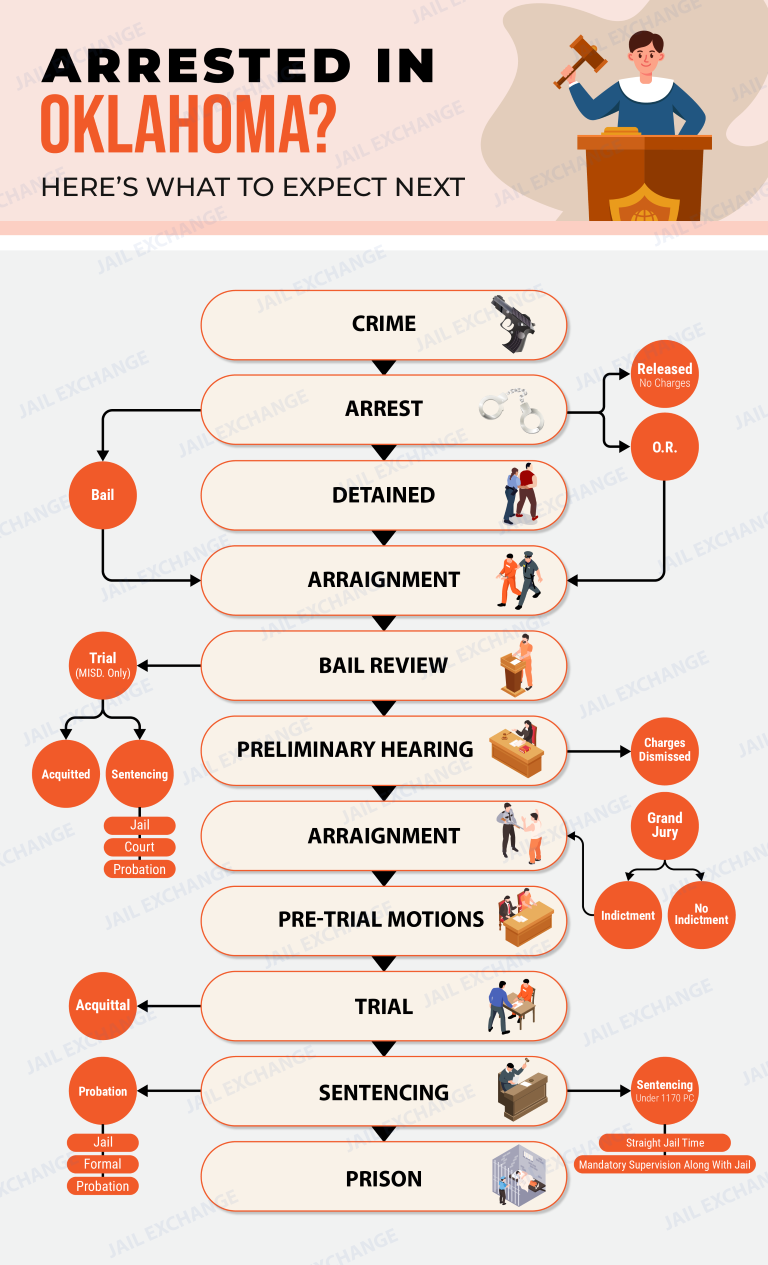
Grady County Jail Criminal Court Process
Criminal Court Process for Grady County Oklahoma
Grady County Criminal Court Guide
State charges brought here are tried in Chickasha, and adults who can't make bond wait at the Grady County Detention Center, 215 North 3rd Street, Chickasha, OK 73018. The District Court takes those state charges, while a handful of towns keep city courts for local tickets. Below you'll find each step of a case, the prosecutor, the defense and ways to track hearing dates.
To confirm your person is still in a cell, search the jail authority's hourly roster. Our Jail Roster page covers the custody questions: brand new bookings, the counts filed, warrants, mugshots, appointed counsel and property pickup.
Ring the Detention Center at 405-222-1000. Ask for two things, the coming hearing date and the case number, and write both down, because clerks and lawyers will ask for them. If getting the person home comes first, start with our bail and bond guide.
1. Felony or misdemeanor: where does each case go?
Both land in the District Court when the state files the charge. The state Constitution gives each district court power to hear every type of case (Okla. Const. art. VII § 7). District judges sit there, joined by associate district and special judges, as art. VII § 8 sets out.
- Felony: the serious tier, where a guilty verdict can bring state prison. Twelve jurors hear a felony trial.
- Misdemeanor: the lower tier. Jail time for one is served locally, in the county jail, and a District Court jury for it has six members.
- City ordinance case: a municipal court hears it. Municipal courts can only take criminal and traffic matters (art. VII § 1).
Each felony from January 1, 2026 forward is given a class letter by law. Class Y is the most serious, while D3 is the least serious class of all (HB 1792; HB 2104; HB 2105). Older crimes stay under the rules in place when they happened.
↑ Back to the question list2. Which courthouse handles a Grady County charge?
Every state charge here, felony or misdemeanor, goes to the District Court in Chickasha. It belongs to Judicial District 6, shared with Caddo County. The Detention Center at 405-222-1000 or the Sheriff's Office at 405-222-5085 can give you the Court Clerk's phone and office hours. The clerk then tells you which courtroom to use.
Other courts that may touch a case from here:
- Chickasha Municipal Court, 2001 W. Iowa Avenue, Chickasha, OK 73018, 405-222-6022. Open Monday to Thursday 7:30 a.m. to 5:30 p.m. and Friday 7:30 to 11:30 a.m.
- Blanchard Municipal Court, 300 North Main Street, Blanchard, OK 73010, 405-485-9322. Open weekdays 8 a.m. to 5 p.m.
- U.S. District Court for the Western District of Oklahoma, 200 NW 4th Street, Oklahoma City, OK 73102, 405-609-5000, for federal crimes.
- Chickasaw Nation District Court, 821 N. Mississippi, Ada, OK 74820, 580-235-0281, for some cases against tribal citizens.
3. Which towns in Grady County run their own city court?
A town court deals with tickets and ordinance charges written inside its limits. What each one offers:
- Chickasha: the clerk works at the police station, 2001 W. Iowa Avenue, Chickasha, OK 73018, 405-222-6022. The first court date and time are printed on the ticket. Fines go in at the window by Visa or MasterCard ($20 minimum), through the mail by check or money order, or on the city's online ticket payment page.
- Blanchard: 300 North Main Street, Blanchard, OK 73010, 405-485-9322. Sign in for traffic court by 2:30 p.m., and for juvenile or compliance court by 3:30 p.m.
- Tuttle: call City Hall, 221 W Main Street, Tuttle, OK 73089, 405-381-2335, or pay a ticket on the Tuttle court payment page.
- Ninnekah: court sits once a month, with sessions set for November 30 and December 28, 2026. Ask the Ninnekah Police Department, 301 Old US Highway 81, Ninnekah, OK 73067, 405-222-0882.
For Rush Springs, Verden, Amber, Minco, Alex, Bridge Creek, Bradley, Norge and Pocasset, call that town's office, or ask the Sheriff's Office at 405-222-5085 where its tickets are heard. Verden Town Hall is at 101 S. Main St., Verden, OK 73092, 405-933-7972.
↑ Back to the question list4. What happens when the person first goes before a judge?
The opening hearing in District Court is an arraignment. The judge reads the charges, rules on bond and checks that the person understands the right to a lawyer. Anyone who can't pay for one gets the court-appointed counsel form, often near this hearing.
- At a felony arraignment, no guilty or not guilty plea is usually taken yet.
- At a misdemeanor arraignment, the person enters a plea and gets a next date.
- A person jailed outside the county can appear by video (SB 1711).
Timing follows the court's calendar. Staff at 405-222-1000 will know the date after the court sets it. Separately, a 2024 law adds speedy-trial checkpoints counted from that first appearance: a review at 9 months when that charge alone keeps the person locked up, or at 18 months when they're free on bond (SB 325).
↑ Back to the question list5. What usually happens on a DUI, drug or theft misdemeanor?
Typical misdemeanors in Chickasha's courts: theft under $1,000, simple drug possession, a first DUI. Voters passed State Question 780 in 2017. Since then, simple possession is a misdemeanor, and stealing goods worth $1,000 or less stays a misdemeanor too (63 O.S. § 2-402).
- Arrest, booking at the Detention Center, then a bond decision.
- Arraignment, when the plea goes on the record.
- Talks between the defense and the District Attorney, which can end in a plea deal.
- Without a deal, six jurors hear the trial.
- Sentencing, where the judge can order a fine, probation, county jail time or a mix.
Repeat DUIs get tougher treatment. Release on a second one waits until a judge signs off on bail and gives reasons in writing (HB 1222), and some later DUIs are charged as felonies.
↑ Back to the question list6. What steps does a Grady County felony case go through?
- First arraignment. Charges and bond are reviewed, and a plea normally waits.
- Preliminary hearing. No jury sits here. The prosecutor must prove two things to the judge: a crime occurred inside the county, and probable cause links it to the accused.
- District Court arraignment. Once a judge sends the case on, the plea is entered here.
- Pretrial motions and plea talks. A plea deal can wrap things up at this point.
- Jury trial. Twelve jurors decide guilt.
- Sentencing. For crimes from 2026 on, the judge's order lists the felony letter. It also says the least time the person must serve (HB 2105).
- Appeal. The Court of Criminal Appeals reviews convictions sent up from here.
The new class law spelled out sentence ranges just for C and D felonies. Everything else keeps its old range, and the judgment will name the class.
↑ Back to the question list7. Do violent charges like murder or robbery follow tougher rules?
Yes, in several ways that families feel right away:
- Bail. On a violent charge, bail can be refused, but only after the judge finds the proof strong and decides release terms can't protect others (Okla. Const. art. II § 8). A violent arrest during a bond for an earlier violent case pushes the court toward detention (HB 3782).
- The 85% rule. A set list of crimes delays parole (21 O.S. § 13.1). No parole review happens before 85% of that sentence has passed. Crimes on that list include armed robbery, first degree murder, child abuse, first degree burglary and first degree rape.
- Life terms. Jurors are told that for an 85% crime, life counts as 45 years. Parole can't be considered until 38 years and 3 months in.
- New classes. The violent offenses land in the Y, A and B groups. Domestic abuse with a child present is Class B5 under a 2026 law (SB 1238).
After conviction, bail on appeal is barred for intimate partner abuse and child abuse (HB 1066).
↑ Back to the question list8. Which offices prosecute and defend Grady County cases?
State charges are filed by the elected District Attorney. This county's DA district, number 6, stretches over Caddo, Jefferson and Stephens counties as well. The Chickasha office is at 201 N 4th St, Chickasha, OK 73018, 405-224-4770.
On the defense side, a 2025 Court of Criminal Appeals ruling says any charge carrying possible jail time, misdemeanors included, comes with a guaranteed lawyer (2025 OK CR 7). People who can't pay are served by the Oklahoma Indigent Defense System through its contract office for Caddo and Grady counties:
- Contract office: 803 Robert S Kerr Ave, Oklahoma City, OK 73106, 405-521-1155
- Main office: 111 N. Peters Ave, Suite 500, Norman, OK 73069, 405-801-2601
The judge decides who qualifies, based on what the person earns, owes and owns (22 O.S. § 1355A). A $40 Court Fund fee comes with the form. The judge can let that payment wait for the final ruling if asked. People in custody get the form from jail staff.
↑ Back to the question list9. Where can a case or hearing date be looked up?
Two statewide sites carry Oklahoma court records. Try both, because counties use different ones:
Select the county and type a last name or case number. The bond receipt or jail paperwork may show that number. Still stuck? The Detention Center at 405-222-1000 can share the case number and how to reach the clerk.
For a city ticket in Chickasha, the Municipal Court at 405-222-6022 can give the date over the phone.
↑ Back to the question list10. Warrant worries: how do you check and clear one?
Deputies working out of the Sheriff's Office, 302 N 3rd Street, Chickasha, OK 73018, carry out county warrants. Phone 405-222-5085 and ask whether one is on file. Online lists: the Sheriff's Most Wanted page, escape notices from DOC Orange Alert, the Marshals Service's 15 Most Wanted and the AG's Oklahoma 10 Most Wanted. OSCN and ODCR show case filings too. Clearing a warrant starts with hiring a lawyer, who can help arrange a surrender at the Detention Center, 215 North 3rd Street, Chickasha, OK 73018. A city warrant goes back to the Municipal Court, 2001 W. Iowa Avenue, Chickasha, OK 73018, 405-222-6022.
↑ Back to the question list11. What does a federal case from Grady County look like?
Federal crimes here are charged in the Western District of Oklahoma. Chickasha is named in federal law as one spot the court can meet, yet the clerk works from 200 NW 4th Street, Oklahoma City, OK 73102, 405-609-5000.
- Prosecutor: U.S. Attorney's Office, 210 Park Avenue, Suite 400, Oklahoma City, OK 73102, 405-553-8700.
- Defense: Federal Public Defender, 215 Dean A. McGee Avenue, Oklahoma City, OK 73102, 405-609-5930.
- Detention hearing: under 18 U.S.C. 3142, a judge rules on pretrial release.
- Custody: anyone held goes to the U.S. Marshals. Their Oklahoma City office, 200 Northwest 4th Street, Room 2022, Oklahoma City, OK 73102, 405-231-4206, can say where. Some are housed at the Federal Transfer Center, 7410 S. MacArthur Blvd, Oklahoma City, OK 73169.
- After sentencing: use the Federal Bureau of Prisons inmate locator.
12. When might a tribal or federal court take a case instead?
McGirt v. Oklahoma (July 9, 2020) took most crimes by tribal citizens in Indian country out of state court. The Court of Criminal Appeals later reached the same result for the Chickasaw reservation. Major crimes by Native Americans there are federal cases, and smaller ones may be tribal.
Castro-Huerta (June 29, 2022) went the other way for non-Indians. If one is accused of harming an Indian there, both the state and the federal government may prosecute. The case law is still moving, so ask a lawyer which court a particular arrest belongs in.
Tribal court for the Chickasaw Nation: 821 N. Mississippi, Ada, OK 74820, 580-235-0281. The Nation's Lighthorse Police patrol this county from the Newcastle precinct, 400 N.W. 32nd St., Newcastle, OK 73089, 580-436-1166.
↑ Back to the question list13. How might an ICE hold affect the state case?
It can change when, or whether, the person walks out. The state case keeps going, but release may lead straight to federal custody:
- The Detention Center receives an I-247A, the detainer ICE uses.
- Once the state's own reason to hold them ends, the jail may keep them up to 48 hours after they would otherwise be released (8 CFR 287.7(d)).
- ICE agents pick up the person. ICE runs Oklahoma from its Dallas Field Office, 8101 N. Stemmons Frwy, Dallas, TX 75247, 972-367-2200, and its Oklahoma City office, 1220 Sovereign Row, Oklahoma City, OK 73108, 405-219-3199.
- Detainees often go to the Cimarron Correctional Facility, 3200 S. Kings Hwy., Cushing, OK 74023, 918-225-3336.
- Look them up on the ICE Online Detainee Locator with their name and birth country.
Oklahoma made "impermissible occupation" a state crime (21 O.S. § 1795). A federal judge has paused it, and the appeal is still open. Raise any immigration worry with the defense lawyer early.
↑ Back to the question list14. When does a sentenced person move to a DOC prison?
Expect a stretch at the Detention Center first. DOC's usual timeline for transfer is 6 to 9 months past sentencing, and the shortest sentences tend to go first. Intake staff at a DOC reception site then score how much security the person needs. The prison is chosen from that score.
- The DOC Offender Lookup lists the person by name after the move.
- Our Oklahoma prisons list gives every DOC site a page of its own.
- Mail needs the person's name plus the ODOC number. DOC's site covers money deposits and visiting rules.
- DOC's main office: 4345 N. Lincoln Blvd, Oklahoma City, OK 73105, 405-425-2500.
15. Teen charged with a crime: how does court work?
For anyone under 18 charged here, the case is handled with the Office of Juvenile Affairs (OJA), 2501 N. Lincoln Blvd, Suite 500, Oklahoma City, OK 73105, 405-530-2800. Any teen kept in custody stays at a licensed juvenile detention center, never with adult inmates.
- Staff screen each youth inside 48 hours of arrival, before the first detention hearing.
- Until the case is decided, staff must recommend every 10 days whether detention should continue.
- A delinquency finding can mean probation, or custody with OJA.
Some cases cross over. Certification moves a youth case into adult court. Reverse certification moves an adult filing over to the youth side. Older teens, 15 through 17, who are accused of crimes such as second degree murder, kidnapping or armed robbery fall under the Youthful Offender Act. Children aged 13 and 14 charged with first degree murder are covered as well. For crimes after November 1, 2018, the status can last until age 19.
↑ Back to the question list16. What protections does Marsy's Law give Grady County victims?
Marsy's Law is in the Oklahoma Constitution (Okla. Const. art. II § 34). It promises victims fair and respectful treatment. When release, a plea or the sentence comes up in court, a victim may be heard. Restitution in full is promised, along with a prompt end to the case.
- Case updates: ask the DA's office in writing. Name the defendant, the case number and county, plus your phone number and mailing address. The local office is at 201 N 4th St, Chickasha, OK 73018, 405-224-4770.
- Custody alerts: register through VINELink, or by phone with OK VINE at 877-654-8463.
- Help with costs: the state's compensation program for crime victims may cover medical bills, counseling, lost pay and funerals. Call 405-264-5006.
- Protective orders: serving one on someone in jail gets top priority. Under SB 623, an officer tries to hand it over inside 24 hours.