Seminole County Jail Criminal Court Process
Criminal Court Process for Seminole County Oklahoma
Seminole County Criminal Court Guide
The District Court in Wewoka decides state criminal charges, and adults who stay in custody are kept at the Seminole County Jail, 211 E 2nd Street, Wewoka, OK 74884. Three cities keep municipal courts, and the Seminole Nation has a tribal court of its own. Below are addresses for each one, the road a case travels and ways to find court dates.
Wondering whether they are still inside? Type their name into the official county inmate search. Then our Jail Roster page fills in custody details, such as who is held tonight, the latest bookings, warrants still open, what each charge is, appointed defense lawyers and how belongings get picked up.
Ring the Court Clerk first, 405-257-6236. Ask for three things: the case number, each charge filed and when the next hearing is. To work on getting your person out, open our bail and bond page.
1. Where do Seminole County misdemeanors and felonies get decided?
Both land in District Court. The state constitution sets up one District Court in each judicial district, and it can take every kind of case (Okla. Const. art. VII § 7). Hughes, Pontotoc and this county make up District 22. Every county must have one associate district judge or more, plus special judges named to help (Okla. Const. art. VII § 8).
- Felony: a grave crime with possible time in state prison.
- Misdemeanor: a less serious crime, mostly punished by county jail or a fine.
- Ordinance violation: a broken city rule. A municipal court hears it. The constitution keeps them to criminal and traffic cases (Okla. Const. art. VII § 1).
For felonies dated January 1, 2026 or later, the law groups each crime into a letter class. Y and A1 are the worst. D2 and D3 are the mildest. Three laws set this up: HB 1792, HB 2104 and HB 2105. Thanks to State Question 780 (July 1, 2017), possessing drugs only for yourself is a misdemeanor, and so is a property crime below $1,000.
↑ Back to the question list2. Which buildings hold court for people charged here?
- District Court, Court Clerk: 120 S. Wewoka Ave., Wewoka, OK 74884, 405-257-6236. Hours are 8:00 a.m. to 4:00 p.m. Postal mail goes to P.O. Box 130, Wewoka, OK 74884.
- Seminole Municipal Court: 401 N Main, Seminole, OK 74868, 405-382-4330.
- Wewoka Municipal Court: 123 S. Mekusukey Ave, Wewoka, OK 74884, 405-257-2413.
- Maud Municipal Court: City of Maud, 208 W Main, Maud, OK 74854, 405-374-2717.
- Seminole Nation Tribal Court: 206 E. 2nd St., Wewoka, OK 74884, 405-562-7072. Weekday hours run 8:00 a.m. to 5:00 p.m.
- Federal court: U.S. District Court for the Eastern District of Oklahoma, 101 North 5th Street, Room 208, Muskogee, OK 74401, 918-684-7920.
Write the case number on a slip of paper before you go. Clerks find files quicker with it.
↑ Back to the question list3. Do Seminole, Wewoka and Maud run their own courts?
They do. Tickets and ordinance charges written by each city's officers stay in that city's court.
- Seminole Municipal Court, 401 N Main, Seminole, OK 74868, 405-382-4330. A "pay my ticket" button sits on the city's court page.
- Wewoka Municipal Court, at City Hall, 123 S. Mekusukey Ave, Wewoka, OK 74884, 405-257-2413 (request the court clerk). Sessions start at 1:30 p.m. on the month's fourth Monday, holidays aside. Pay a fine around the clock through the city's bill payment page using an account number. In-person payments go to the Water Department inside City Hall, 7:30 a.m. to 4:30 p.m. Monday through Thursday, and 8:00 a.m. to noon on Friday.
- Maud Municipal Court, 208 W Main, Maud, OK 74854. Sessions start at 4:00 p.m. on the month's second Monday. Its clerk sits at City Hall, 405-374-2717, and fines may be paid on the Maud court payment page. Maud reaches over the line into Pottawatomie County.
Konawa, Bowlegs, Cromwell, Lima and Sasakwa round out the county's towns. Tickets from those places can be traced by the District Court Clerk at 405-257-6236, who can name the court that has them.
↑ Back to the question list4. Could a Seminole County arrest end up in tribal court?
Yes. This county is inside the Seminole Nation Reservation. Oklahoma's Court of Criminal Appeals ruled that Congress never did away with this reservation. That brings in the U.S. Supreme Court's McGirt v. Oklahoma decision of July 9, 2020.
- Picture a tribal citizen accused of breaking the law on reservation land. That case normally goes to tribal court or federal court, and state court steps aside.
- Murder and other major crimes by Native American suspects there go federal.
- Oklahoma v. Castro-Huerta (June 29, 2022) opened state court to one more group: non-Indians charged with crimes against Indians.
- Courts are still settling how this works when the accused belongs to a different tribe.
Find the Seminole Nation Tribal Court at 206 E. 2nd St., Wewoka, OK 74884 (letters to P.O. Box 1220, Wewoka, OK 74884), 405-562-7072. Lighthorse Police, the Nation's officers, take calls at 405-652-7358. Only a lawyer who knows the facts can say which court is right.
↑ Back to the question list5. First hearing jitters: what does an arraignment involve?
Usually it is the person's first time before a judge. The charges are read out, and bond comes up. For a District Court felony, no plea is entered yet. A person jailed in some other county may appear on video instead (SB 1711).
A lawyer has to be offered whenever jail is possible. The 2025 case Spybuck v. State settled that point. Someone who can't pay asks for the court-appointed counsel form. From inside the jail, ask the staff.
The state also sets review points so a case doesn't drag. Measured from the first appearance, the review comes at 9 months if the person sits in jail only for that case, or 18 months if they are out on release (SB 325). The Court Clerk, 405-257-6236, keeps the hearing calendar.
↑ Back to the question list6. What path do DUI, drug and theft misdemeanors take?
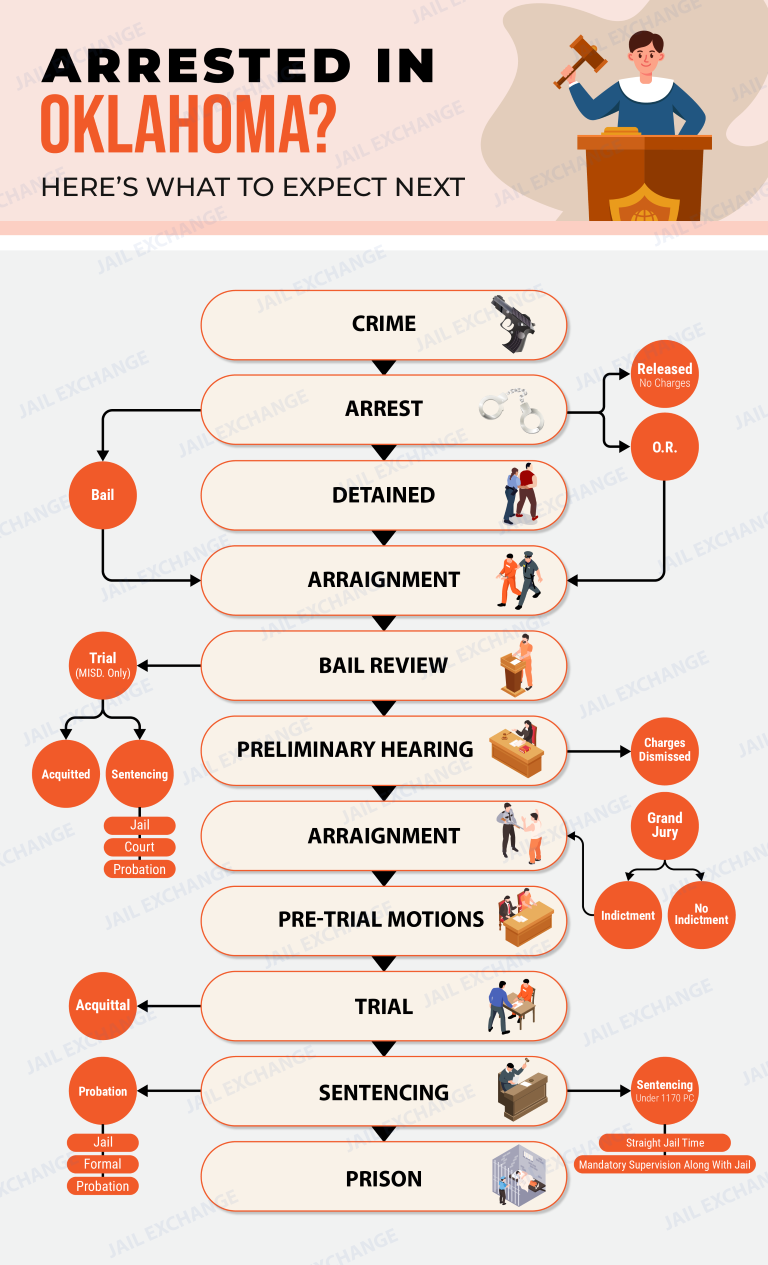
A typical misdemeanor goes through these stages:
- An officer writes a ticket, or makes an arrest and the jail books the person.
- The District Attorney files charges. For a city case, the city files.
- At arraignment, the person pleads and the judge reviews bond.
- Some cases settle with a plea deal, while others are tried. Six jurors decide a District Court misdemeanor.
- On a conviction, the judge sentences within the limits the law sets for that crime.
Examples worth knowing: under State Question 780, simple possession of drugs, and theft below $1,000, stay misdemeanors. On a DUI that is a second or later offense, release on bail needs a judge's order (HB 1222). A city fine set higher than the law permits is void and gets cut to the legal top (SB 1775). Ask the lawyer what range applies to the exact charge.
↑ Back to the question list7. How does a felony move through Seminole County District Court?
- Arraignment. The charges get read, and the judge sets bond.
- Preliminary hearing. There is no jury. The judge listens for proof of three points. A crime happened. Probable cause ties the accused to it. And the offense occurred inside county lines.
- Plea or trial. When the judge finds the proof is enough, the person answers the charge. Twelve jurors hear a felony trial.
- Sentencing. For felonies dated in 2026 or later, the judge's final order must state the class, along with the minimum stretch to serve (HB 2105).
Fixed ranges and time-served rules now cover Class C and D felonies, while the other classes keep their earlier ranges. Days spent locked up before sentencing are nearly always credited by the judge. Hearing dates and courtroom questions go to the Court Clerk at 405-257-6236.
↑ Back to the question list8. Do violent charges bring tougher rules?
- No-bail holds. For a violent charge, the judge may deny bail outright, but only if guilt looks clear and the public needs protecting (Okla. Const. art. II § 8).
- Second violent arrest while out on bond. The law tilts toward detention (HB 3782).
- Highest classes. Violent felonies sit in classes Y, A and B. Hurting a partner or family member while a child watches is Class B5 (SB 1238, 2026).
- The 85% rule. Its list includes child abuse and murder in the first degree (21 O.S. § 13.1). A parole review only opens once 85% of the term is behind them.
- Appeals. Starting November 1, 2025, appeal bonds are off the table after a conviction for child abuse or intimate partner abuse (HB 1066).
- Protective orders. If the person named sits in the county jail, a first try at serving the order comes within 24 hours (SB 623).
9. Which office prosecutes, and who defends a broke defendant?
District 22's elected District Attorney brings state charges in Hughes, Pontotoc and Seminole counties. This county's branch takes mail at P.O. Box 1300, Wewoka, OK 74884 and phone calls at 405-257-3368.
Defense for people without money is paid for by the Oklahoma Indigent Defense System (OIDS). Its contract law office for Hughes and Seminole counties works from P.O. Box 1663, Seminole, OK 74818, 405-382-3750.
- A judge reviews the money form and, if the person qualifies, assigns OIDS (22 O.S. § 1355A). OIDS itself can't pick a lawyer for someone who calls.
- The Court Clerk takes the finished application at 120 S. Wewoka Ave., Wewoka, OK 74884, 405-257-6236.
- A $40 fee is owed to the Court Fund. Asking to delay it until the case closes is allowed.
- OIDS headquarters: 111 N. Peters Ave, Suite 500, Norman, OK 73069, 405-801-2601.
10. Is there a website showing their case and hearings?
Two free statewide websites hold Oklahoma district court records. Search the person's name on both:
Choose this county when the site asks. No luck? Phone the Court Clerk at 405-257-6236 and give the full name plus date of birth. A city ticket lives with the city court that issued it. Tribal matters go through the Seminole Nation Tribal Court, 405-562-7072.
↑ Back to the question list11. Is a Seminole County warrant out, and how does it get cleared?
Sheriff's deputies arrest people named in this court's warrants. Phone 405-257-5445 and ask if one is out, or look up the name on OSCN or ODCR. The Attorney General keeps an official Oklahoma 10 Most Wanted list. Also check the U.S. Marshals Service's 15 Most Wanted fugitives and DOC Orange Alert escape notices. Before clearing a warrant, speak with a lawyer. Then report to whichever court issued the warrant, or ring it to set up a bond or a new date. Find the District Court Clerk at 120 S. Wewoka Ave., Wewoka, OK 74884, 405-257-6236.
↑ Back to the question list12. Federal charge instead of a state one: now what?
Federal prosecutors file this county's cases in the U.S. District Court for the Eastern District of Oklahoma, 101 North 5th Street, Room 208, Muskogee, OK 74401, 918-684-7920. The clerk's window is open weekdays 8:30 a.m. to 4:30 p.m.
- Prosecution: U.S. Attorney's Office, 520 Denison Ave, Muskogee, OK 74401, 918-684-5100.
- Free defense: Federal Public Defender, 112 North 7th Street, Muskogee, OK 74401, 918-687-2430.
- Jail or home? That gets settled by a federal judge in a detention hearing (18 U.S.C. 3142).
- Who holds them: the U.S. Marshals Service, 101 North 5th Street, Suite 136, Muskogee, OK 74401, 539-239-5500. Some prisoners pass through the Federal Transfer Center, 7410 S. MacArthur Blvd, Oklahoma City, OK 73169.
- Post-sentence: search the Federal Bureau of Prisons inmate locator.
13. Can an ICE detainer change things in court?
Hearings and trial carry on in the normal way. The detainer shows its effect on what would have been release day.
- The jail gets Form I-247A from immigration officers, a written request to keep the person.
- Under it, staff may keep them up to 48 hours after they would otherwise be released, giving ICE time to arrive (8 CFR 287.7(d)).
- Oklahoma cases fall under the ICE Dallas Field Office, 8101 N. Stemmons Frwy, Dallas, TX 75247, 972-367-2200. ICE also keeps an Oklahoma City office, 1220 Sovereign Row, Oklahoma City, OK 73108, 405-219-3199.
- A detention center ICE uses for this state is the Cimarron Correctional Facility, 3200 S. Kings Hwy., Cushing, OK 74023, 918-225-3336.
- Track them down with the ICE Online Detainee Locator.
A guilty plea can hurt an immigration case. Noncitizens should bring this up with their defense lawyer before signing any deal. Oklahoma's HB 4156 (21 O.S. § 1795) created a state immigration crime, but a federal judge put that law on pause, and Oklahoma's appeal is still going.
↑ Back to the question list14. Which agency runs state prison sentences?
The Oklahoma Department of Corrections (DOC) carries out state prison terms. It is based at 4345 N. Lincoln Blvd, Oklahoma City, OK 73105, 405-425-2500. Sentenced prisoners normally remain at the county jail until DOC sends for them. By DOC's count that takes 6 to 9 months. Shorter terms may get moved up the list.
- A custody score is worked out first, and a prison is chosen from it.
- Check status anytime on the DOC Offender Lookup.
- Send questions to the person's case manager. If that name is unknown, phone the prison's records officer.
- Our Oklahoma state prisons section describes each prison.
15. How are cases against minors handled?
District Court hears juvenile matters on a docket separate from adults. Youth services for this county come from the Office of Juvenile Affairs (OJA), 2501 N. Lincoln Blvd, Suite 500, Oklahoma City, OK 73105, 405-530-2800.
- Once a youth is placed in detention, a hearing before a judge is due the next judicial day. With good cause, such as no ride to court, it may slip to two judicial days.
- Waiting for a petition to be filed can take up to five judicial days. From then on, continued detention gets a fresh recommendation every 10 days.
- Prosecutors may file youthful offender charges in serious cases against teens aged 15 through 17. A first degree murder charge opens that door at 13 or 14 too.
- Moving a youth to adult court is certification. Going the other way, back to juvenile court, is reverse certification.
For the next hearing, parents may call OJA, or the Court Clerk at 405-257-6236.
↑ Back to the question list16. How does Seminole County protect crime victims?
Marsy's Law sits in the state constitution (Okla. Const. art. II § 34). Among its promises: victims are treated fairly and with dignity, get a say when judges weigh bail, plea bargains and punishment, can seek full repayment for losses, and are owed a timely finish to the case.
- Victims who want updates must ask in writing. Address it to the District Attorney's office, P.O. Box 1300, Wewoka, OK 74884, 405-257-3368. In it, write your phone, your mailing address, the county, the case number and who is charged.
- Free custody alerts come from VINELink or OK VINE, 877-654-8463. OK VINE follows protective orders as well.
- The Crime Victims Compensation Program may pay costs the crime caused, such as doctor visits, counseling, lost paychecks and burial. Its lines are 405-264-5006 or 800-745-6098.