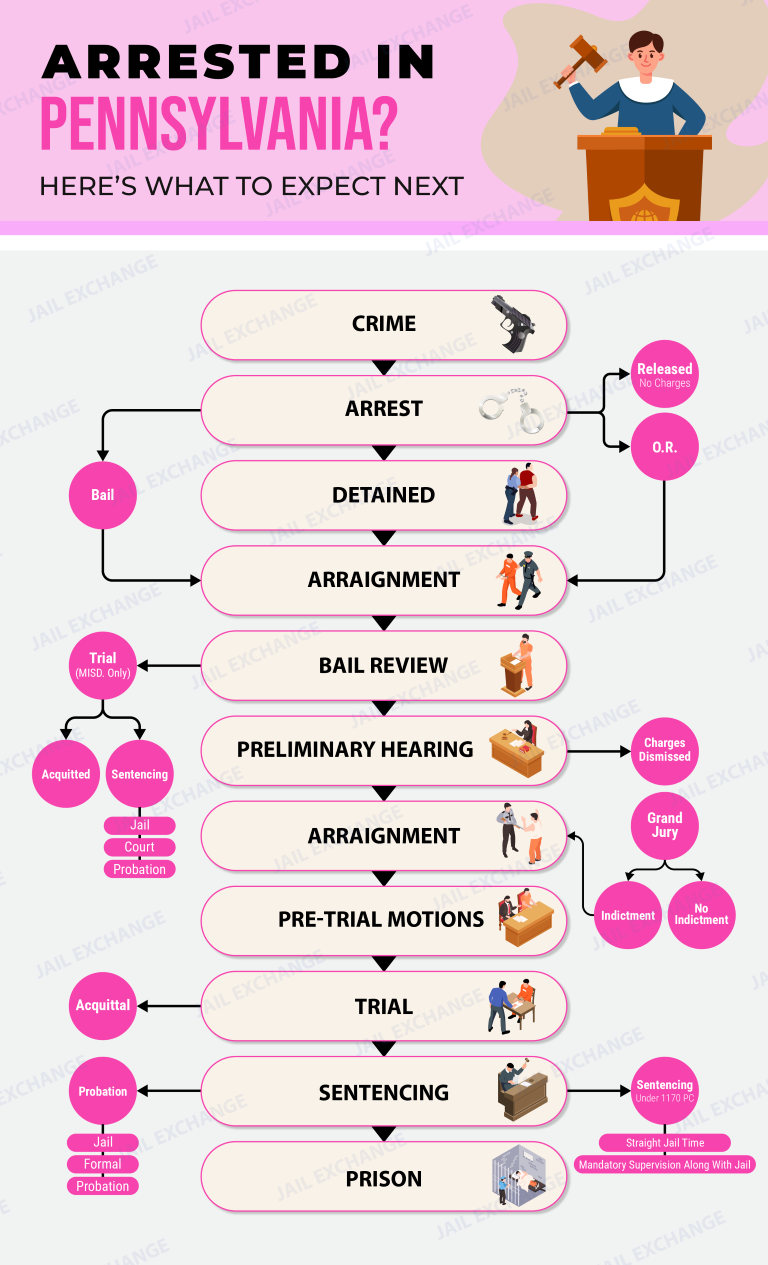
Fulton County Sheriff's Office Criminal Court Process
Criminal Court Process for Fulton County Pennsylvania
Fulton County Criminal Court Guide
Criminal cases from Fulton County are heard in McConnellsburg or at one of three small district courts, but the county holds no prisoners itself. Adults waiting for court stay at the Bedford County Correctional Facility, 425 Imlertown Road, Bedford, PA 15522, a one-building jail that classifies people from intake, or the Franklin County Jail, 1804 Opportunity Avenue, Chambersburg, PA 17201, which holds adult men and women and has its own booking area. This guide walks a case from arrest to sentence.
Start by putting the person's name into the official inmate lookup. A second stop, our Jail Roster page, walks through who is locked up, new bookings, charges and open warrants. It also covers mugshot requests, defense lawyers and getting back property.
Phone the Clerk of Courts at 717-485-4212 and ask for three facts: which district office holds the file, the case's docket number and when the next hearing falls. If you still need to know which jail took the person, the Sheriff's Office answers at 717-485-4221. For release before trial, see our bail guide.
1. Where do misdemeanors and felonies get decided?
Criminal cases here move through two levels of state court:
- Magisterial district courts rule on summary cases. Those are the smallest offenses, like most traffic tickets. These courts also run the early hearings in bigger cases and set bail.
- The Court of Common Pleas handles misdemeanors and felonies once a district judge passes them up. Its judges serve the 39th Judicial District, which joins Franklin and Fulton. It also retries summary cases on appeal.
Put simply, a misdemeanor or felony opens in a district office and closes at the courthouse with a plea or a trial. Anyone who wants to appeal a summary ruling has 30 days to file.
↑ Back to the question list2. Where are the Fulton County courthouses?
The main building for criminal cases sits in the county seat:
- County courthouse (Court of Common Pleas), 201 N. Second Street, McConnellsburg, PA 17233, 717-485-4212. Hours run 8:30 a.m. to 4:30 p.m., Monday through Friday. A newer hearing room is on the first floor. The court's page has the language access plan, interpreter help and a disability request form.
- Clerk of Courts, in the same building and the same phone. The clerk keeps criminal files and shares an office with the Prothonotary and Register of Wills. Email prothonotary@co.fulton.pa.us.
- District Court Administrator for Franklin and Fulton, Franklin County Courthouse, 157 Lincoln Way East, Chambersburg, PA 17201, 717-261-3848. This office runs court schedules for the whole district.
- Magisterial District Court 39-4-01, 27952 Great Cove Road, Suite 1, Hustontown, PA 17229, 717-987-3221
- Magisterial District Court 39-4-02, 208 North Second Street, McConnellsburg, PA 17233, 717-485-4842
- Magisterial District Court 39-4-03, 8328 Great Cove Road, Suite 100, Needmore, PA 17238, 717-573-2225
3. Does the county have town or borough courts?
No town or borough runs a court of its own. In Pennsylvania, magisterial district courts do that local job. The county has 13 towns: the boroughs of McConnellsburg and Valley-Hi, plus Ayr, Belfast, Bethel, Brush Creek, Dublin, Licking Creek, Taylor, Thompson, Todd, Union and Wells townships. All of them are covered by these three offices:
- 39-4-01, 27952 Great Cove Road, Suite 1, Hustontown, PA 17229 (mail to PO Box 369), 717-987-3221
- 39-4-02, 208 North Second Street, McConnellsburg, PA 17233, 717-485-4842
- 39-4-03, 8328 Great Cove Road, Suite 100, Needmore, PA 17238 (mail to PO Box 171), 717-573-2225
Most often a case is filed with the district office covering the spot where police say the offense took place. Unsure which office serves a township? The District Court Administrator can say, at 717-261-3848. Tickets and fines from these courts can be paid on the UJS payment page.
↑ Back to the question list4. What happens at the very first court appearance?
The opening hearing is the preliminary arraignment. Pennsylvania's own guide for crime victims puts this hearing, in most cases, about six hours after an arrest. Video links are common. At it, a district judge (Pa.R.Crim.P. 540):
- reads each charge aloud and gives the person the written complaint
- tells the defendant about counsel and other rights
- settles bail or another kind of release
- schedules the preliminary hearing
For someone held in jail, the rules allow at most 14 days before the preliminary hearing. Someone on release can wait as long as 21. At it, a prima facie case is all the prosecutor must show. That is a modest showing that a crime likely took place and that this person likely did it. Fail that, and the charges are thrown out. Pass it, and the case is "held for court" in Common Pleas. The defense may also skip the hearing on purpose, which moves the case up right away.
↑ Back to the question list5. How do DUI, theft and other misdemeanor cases move?
Once a misdemeanor reaches Common Pleas, the District Attorney writes up the final charge paper, known as an information. Formal arraignment usually follows within one to two months. The person receives the information there and pleads. Next is a pretrial conference, where a lot of cases settle with a plea bargain. Whatever is left goes to trial, either before a judge or before 12 jurors whose verdict has to be unanimous.
Misdemeanor grades and their ceilings (18 Pa.C.S. §§ 1101, 1104):
- M1: 5 years and $10,000
- M2: 2 years and $5,000
- M3: 1 year and $2,500
DUI law is complex. Still, at the lowest (general) blood alcohol tier, a first or second DUI is normally a misdemeanor; the most jail it brings is six months (75 Pa.C.S. § 3803). People with a clean past, above all in a first DUI, may be offered Accelerated Rehabilitative Disposition, or ARD. That choice belongs to the District Attorney, with a judge's sign-off. Finish the program's classes, fees and supervision, and the judge dismisses the charge, and the record can later be expunged (wiped clean).
County costs from the Clerk of Courts include $165 for a guilty plea, no contest plea or ARD, and $200 for a trial.
↑ Back to the question list6. What path does a felony case follow?
A felony goes through the same early steps as a misdemeanor, but the stakes climb. Here is the usual order:
- Preliminary arraignment at a district court, with bail decided there.
- Preliminary hearing at that same office, unless the defense waives it.
- Information, the formal charging paper the District Attorney files.
- Formal arraignment, when the defendant gives a plea.
- Pretrial conference, where most plea offers are made.
- Trial with or without a jury. Jurors or the judge must be sure of guilt beyond a reasonable doubt.
- Sentencing, after probation staff write a pre-sentence report for the judge.
Felony limits (18 Pa.C.S. §§ 1101, 1103): F1 up to 20 years and $25,000; F2 up to 10 years and $25,000; F3 up to 7 years and $15,000. Appeals climb to the Superior Court first and can reach the Pennsylvania Supreme Court.
↑ Back to the question list7. Are violent or serious felonies treated differently?
Yes, at several points:
- Bail. Where the top sentence is life or death, a judge may deny bail entirely. The prosecutor must still prove at a hearing that this is justified (Pa. Const. art. I, § 14).
- Murder penalties. First-degree murder carries a death sentence or life. For second degree the law sets life. The third degree has a 40-year top (18 Pa.C.S. § 1102).
- Teens in adult court. A charge of murder, or of certain violent crimes with a weapon, begins in adult court even for a 15, 16 or 17 year old.
- Victim voice. If the crime injured someone, or was a burglary, the victim gets a chance to speak before any plea bargain, dismissal or sentence.
- Prison. With a maximum of 5 years or longer, the time is spent in a state prison (42 Pa.C.S. § 9762).
8. Who prosecutes and defends Fulton County cases?
Every criminal case here is prosecuted by the District Attorney's Office, 116 West Market Street, McConnellsburg, PA 17233, 717-485-5419, email districtattorney@co.fulton.pa.us. It is open weekdays 8:30 a.m. to 4:30 p.m. Call this office to ask about ARD.
The Public Defender's Office takes clients who lack money for a lawyer, from the preliminary hearing through trial, probation hearings and juvenile cases. It is at 201 N. 2nd Street, McConnellsburg, PA 17233, 717-485-3447, email publicdefender@co.fulton.pa.us. Applicants sign a sworn form about their money, as the Public Defender Act requires (16 P.S. § 9960.1 and following). A phone call to the office explains the steps to apply.
Since Act 34 of 2023, state grants help counties pay for this defense work.
↑ Back to the question list9. Which tools show a docket or hearing date?
Docket sheets are free to read on the state court website, and no sign-up is needed:
- Open the UJS case search.
- Pick the participant name search, set the county to Fulton and enter the first and last name. If you have the docket number, search by that instead.
- Read the docket sheet for the charges, bail, money owed, each scheduled hearing and the courtroom.
New filings can lag a bit. Sealed, expunged and juvenile files stay hidden there. The portal also leaves out which jail a person sits in. Staff at the Clerk of Courts can help: 717-485-4212, or the district court that has an early-stage case. A full name and date of birth speed things up.
↑ Back to the question list10. Could a Fulton County warrant be pending, and how is it resolved?
The Sheriff's Office, 207 North 2nd Street, McConnellsburg, PA 17233, 717-485-4221, serves Common Pleas bench warrants and takes calls weekdays from 8:00 a.m. to 4:00 p.m. Troopers from 500 Fulton Drive, McConnellsburg, PA 17233, 717-485-3131, and constables also serve warrants. Three agencies post fugitive lists: the State Police (its top ten), the Department of Corrections (people who fled parole) and the U.S. Marshals (its top fifteen). Open cases show on the UJS case search, or the Sheriff can check by phone. Clearing one begins with a defense lawyer, hired or public. With that help, a person can turn themselves in where the warrant came from, or ring that office and request a later hearing. Reach the Clerk of Courts office in person at 201 N. Second Street, McConnellsburg, PA 17233, 717-485-4212.
↑ Back to the question list11. What sets a federal prosecution apart?
Federal court for this county means the U.S. District Court for the Middle District of Pennsylvania, Harrisburg division. Hearings take place in the Sylvia H. Rambo federal courthouse in Harrisburg, 1501 North 6th Street, Suite 101, Harrisburg, PA 17102, 717-221-3920.
- The U.S. Attorney's Office files and tries federal charges, 1501 North 6th Street, Harrisburg, PA 17102 (Box 202), 717-221-4482.
- A detention hearing comes at the federal defendant's first court date. That hearing settles whether pretrial jail or release follows (18 U.S.C. 3142).
- While a federal case is open, a jailed defendant is a Marshals prisoner, moved to each hearing by deputy marshals. The Marshals keep a district office at 235 North Washington Avenue, Unit 215, Scranton, PA 18503, 570-346-7277.
- If the defendant can't pay for counsel, the federal defender may be appointed: 100 Chestnut Street, Harrisburg, PA 17101 (third floor), 717-782-2237.
- After sentencing, follow the person on the Federal Bureau of Prisons inmate locator, which covers people held since 1982.
12. Where does an immigration detainer fit in?
The state case keeps moving. The detainer only affects the date the person walks out.
- ICE (Immigration and Customs Enforcement) sends the host jail a written detainer, Form I-247A.
- ICE asks the jail, in writing, to hold someone up to 48 hours after they would otherwise be released (8 CFR 287.7(d)).
- The Third Circuit appeals court, which hears Pennsylvania's federal appeals, decided Galarza v. Szalczyk (3d Cir. 2014). Its view: a detainer counts only as a request. A jail holding a person on that basis alone may answer for the decision. Each host jail therefore sets its own policy. Ask Bedford at 814-623-2955 or Franklin at 717-264-9513.
- ICE's Philadelphia Field Office covers Pennsylvania: 114 N. 8th Street, Philadelphia, PA 19107, 215-656-7164.
- Use the ICE Online Detainee Locator to see if ICE is holding someone.
13. Which sentences mean state prison?
Judges here hand down a two-number sentence, a floor and a ceiling. The ceiling fixes where time is served (42 Pa.C.S. § 9762). With a top number under 2 years, the sentence is served in county jail, so a Fulton case would mean a host jail. Five years or more as the top number sends the person to a state prison. When the maximum is at least 2 years but under 5, state prison is the rule. Keeping the person local takes a yes from the judge who imposed it, from the District Attorney and from the jail itself.
Men are processed at a state diagnostic and classification center, and women at a separate one. Classification takes weeks to months and sets the person's security level. After that, the state prison system chooses where the person goes.
- To find someone already moved, use the state prison locator.
- Pennsylvania Department of Corrections, 1920 Technology Parkway, Mechanicsburg, PA 17050, 717-728-2573.
- Each prison's visit and mail rules sit on our Pennsylvania state prisons overview.
14. How does juvenile court work for Fulton County teens?
Under the Juvenile Act, a "child" is anyone under 18, and most of these cases stay out of adult court (42 Pa.C.S. § 6301 and following). Public searches never show those files.
- Juvenile cases run through Adult and Juvenile Probation, 318 North 1st Street, McConnellsburg, PA 17233, 717-485-3192. Parents can phone this office about where a youth is detained and the hearing date.
- Youths who are held go to a juvenile detention center. The adult jails in Bedford and Franklin do not take them.
- The public defender handles juvenile cases as well, at 717-485-3447.
- Murder, and some armed violent crimes, put a teen 15 or older in adult court at the start. Defense lawyers can still request a move back to the juvenile system.
15. What protections does the law give crime victims?
Pennsylvania's Crime Victims Act lets victims take part (18 P.S. § 11.101 and following). They can:
- learn what help exists and hear about major court events
- attend the court case, with a support person
- comment on bail and, for crimes that hurt someone or burglary, on plea deals and the sentence
- seek restitution for losses
- receive notice once the accused leaves a county jail
Victims can sign up for release notices through PA SAVIN on VINELink or at 866-972-7284 (TTY 866-847-1298). For help with costs such as counseling or medical bills, call the state compensation program at 800-233-2339. Questions about the case go to the District Attorney's Office, 116 West Market Street, McConnellsburg, PA 17233, 717-485-5419.
Nobody on the defendant's side should reach the victim, even by passing on a note. Reaching out can violate the release terms.
↑ Back to the question list