Huntingdon County Prison Criminal Court Process
Criminal Court Process for Huntingdon County Pennsylvania
Huntingdon County Criminal Court Guide
Criminal charges here begin before one of three magisterial district judges, then serious ones climb to the Court of Common Pleas in the county courthouse, 223 Penn Street, Huntingdon, PA 16652. Defendants who can't make bail wait at the Huntingdon County Prison, 300 Church Street, Huntingdon, PA 16652, in the Main Cell Block or, for work release inmates, the Work Release block. Lewistown's Mifflin County jail may house some of them too, mainly women. Below: each court and case stage.
Not sure the person is still in a cell? The official inmate lookup checks custody by name. Afterward, our Inmates in Custody page walks through what else follows an arrest, such as recent bookings, outstanding warrants, criminal charges, mugshots, public defenders and property pickup.
Today, phone the Clerk of Courts at 814-643-1610. Write down the docket number, the next hearing date and the office that holds the file. If release still comes first, our bail page lays out each step.
1. Summary, misdemeanor, felony: who hears what here?
Two levels of trial court share the work in Pennsylvania:
- Magisterial district courts decide summary offenses, the lowest grade of crime. A speeding ticket is one example, and so is a citation for disorderly conduct. These courts also run the opening stages of every bigger case, from the preliminary arraignment and bail to the preliminary hearing. The state has over 550 of them.
- The Court of Common Pleas sits as the 20th Judicial District, a one-county district. Misdemeanors and felonies land there once a preliminary hearing holds them for court. A summary verdict can be appealed there within 30 days, and that appeal is tried over from scratch.
- Juvenile court, a branch of Common Pleas, takes most cases against anyone under 18.
2. Huntingdon County courthouse and court office addresses
- County courthouse (Court of Common Pleas), 223 Penn Street, Huntingdon, PA 16652, 814-643-4510. Open weekdays 8:30 a.m. to 4:30 p.m. Courtroom No. 1 doubles as Central Court.
- Clerk of Courts, keeper of criminal files, in the same building at 223 Penn Street, Huntingdon, PA 16652, 814-643-1610. Alternative number: 814-643-5511.
- Court Administration, which sets the court calendar, 223 Penn Street, Floor 2, Huntingdon, PA 16652, 814-643-5078.
- Magisterial District Court 20-3-01, Porter Township Building, 7561 Bridge Street, Suite 1, Alexandria, PA 16611, 814-669-4550
- Magisterial District Court 20-3-02, Bailey Building, 233 Penn Street, Huntingdon, PA 16652, 814-643-2270
- Magisterial District Court 20-3-04, 1 West Shirley Street, Suite B, Mount Union, PA 17066, 814-212-9123
- Federal court for this region: Sylvia H. Rambo United States Courthouse, 1501 North 6th Street, Suite 101, Harrisburg, PA 17102, 717-221-3920
3. Do boroughs like Mount Union run a local court?
No. Pennsylvania boroughs and townships share district courts instead. Here, three magisterial district courts divide the map:
- Magisterial District Court 20-3-01, Porter Township Building, 7561 Bridge Street, Suite 1, Alexandria, PA 16611, 814-669-4550
- Magisterial District Court 20-3-02, Bailey Building, 233 Penn Street, Huntingdon, PA 16652, 814-643-2270
- Magisterial District Court 20-3-04, 1 West Shirley Street, Suite B, Mount Union, PA 17066, 814-212-9123
Local ordinance tickets and summary citations go to the district that covers that town. Court Administration at 814-643-5078 can tell you which district a township falls in.
A fourth setting, Central Court (Magisterial District 20-0-00), meets at the courthouse. Under a 2015 court order, almost every criminal hearing after the arraignment is heard there, no matter which district the arrest happened in.
↑ Back to the question list4. From arraignment to preliminary hearing: the opening steps
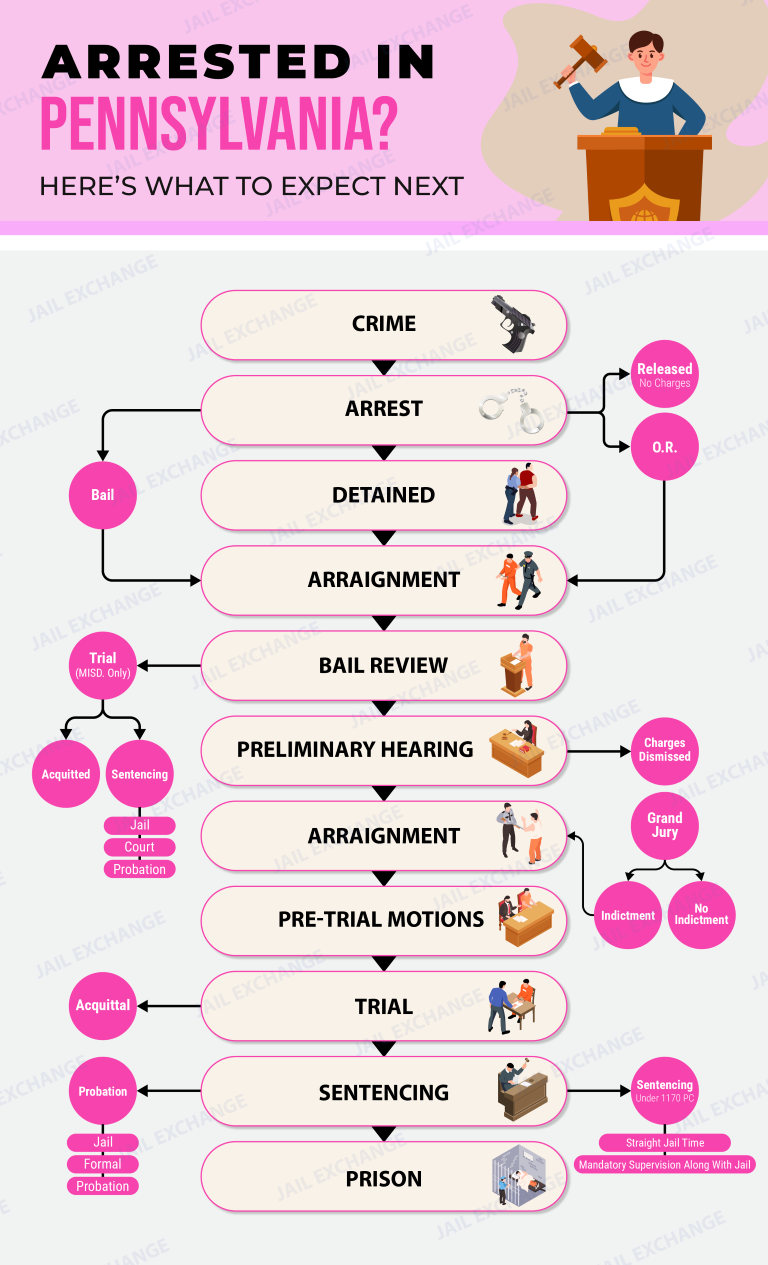
Preliminary arraignment. It generally comes within hours, often over video. An MDJ hands the person the complaint, explains each charge, covers the right to counsel and announces bail. Before it ends, the MDJ sets the preliminary hearing (Pa.R.Crim.P. 540).
Preliminary hearing. It has to be held inside 14 days if the defendant is locked up, or 21 days if not. A 2015 order moved these hearings to Central Court, Courtroom No. 1, on Wednesdays at 8:45 a.m. Here the DA needs a prima facie case, meaning there must be enough evidence of a crime and of the defendant's likely part in it. Weak proof means dismissal. A defendant may also give up, or waive, this hearing.
Those same rules put a public defender at every Central Court session. To confirm today's schedule, call Court Administration at 814-643-5078.
↑ Back to the question list5. DUI and other misdemeanor charges, start to finish
Pennsylvania grades misdemeanors by their maximum penalty (18 Pa.C.S. §§ 1101, 1104):
- M1: up to 5 years and $10,000
- M2: up to 2 years and $5,000
- M3: up to 1 year and $2,500
- Summary offense, one step lower: up to 90 days and $300
Most first DUI charges are misdemeanors. Prior offenses and higher test levels push the grade up (75 Pa.C.S. § 3803). Once the preliminary hearing is over, the file goes up to Common Pleas. Formal arraignment comes next, then a pretrial conference, then either a plea or a trial, and finally sentencing.
A first offender may get a chance at ARD, Accelerated Rehabilitative Disposition (Pa.R.Crim.P. 310). Expect supervision, classes, fees and community service. Completing it gets the charge dismissed, and it can then be expunged. Only the District Attorney can make the offer, and the court must accept the person. Local ARD rules are available from the DA's office at 814-643-5371.
↑ Back to the question list6. Huntingdon County felony cases, step by step
- Arrest and preliminary arraignment in front of an MDJ, who sets bail.
- Preliminary hearing, normally in Central Court, within 14 days if the person is held.
- The information. The DA files this formal charging document, and charges may be added or dropped in it.
- Formal arraignment, held in Common Pleas roughly 30 to 60 days afterward. The defendant enters a plea at that time.
- Pretrial conference, a meeting where many cases settle with a plea deal.
- Trial, either by a judge or by a jury of 12. All twelve must agree. Doubt that is reasonable means a not-guilty verdict.
- Sentencing. Probation prepares a pre-sentence report, and the judge weighs it along with the state sentencing guidelines.
Each felony grade has a cap: F1 at 20 years and $25,000, F2 at 10 years and $25,000, F3 at 7 years and $15,000 (18 Pa.C.S. § 1103). A conviction can be appealed to the Superior Court.
↑ Back to the question list7. Murder and violent felonies: what changes?
- Sentences. Murder in the first degree carries death or life imprisonment (18 Pa.C.S. § 1102). Second-degree murder brings a life term, and third degree allows up to 40 years.
- No-bail holds. A judge can refuse bail on a charge that carries life, or when no conditions short of jail would protect anyone (Pa. Const. art. I, § 14). The DA must prove that need with evidence presented at a hearing.
- Youth charged as adults. Any murder charge against a teen aged 15 to 17 is filed in adult court. So are certain violent crimes on a state list if a deadly weapon was involved.
- Victim input. When a crime causes injury, the victim may speak before a plea bargain and at sentencing.
8. The DA and the public defender: who is who
Prosecution: the District Attorney's Office, 207 Washington Street, Huntingdon, PA 16652, 814-643-5371, handles every state criminal case here.
Defense: the county Public Defender's Office represents people with too little money to hire counsel (16 P.S. § 9960.1 and following). Applicants sign a sworn statement about their finances, and the county uses its own limit to decide. Under Central Court rules adopted in 2015, the form travels with the preliminary hearing notice. For the office's location and hours, call the county's main office, 233 Penn Street, Huntingdon, PA 16652, 814-643-3091.
Act 34 of 2023 made Pennsylvania help fund county public defense for the first time.
↑ Back to the question list9. Finding a docket or hearing date online
- Pull up the state judiciary's UJS Web Portal case search, a free tool with no login.
- Choose to search by participant name. Type the first and last name and set the county, or use the docket number instead.
- The docket sheet that opens lists charges, bail, coming dates, the courtroom and any payments.
Fresh filings can lag behind. Juvenile, sealed and expunged matters never appear. Because the portal tracks court records rather than custody, use the inmate lookup or the prison to see who is held. The Clerk of Courts can also answer by phone at 814-643-1610.
↑ Back to the question list10. Warrant checks and clearing one up
Sheriff's deputies, 814-643-0880, track down anyone a Common Pleas judge orders arrested, while police and constables handle other warrants. Two official wanted lists reach this area: the State Police Ten Most Wanted sheet and the 15 Most Wanted page kept by U.S. Marshals. To check on one person, phone the Sheriff or look for an open case on the UJS portal. Clearing one means working with a lawyer to surrender at the issuing court. A call to that court asking for a fresh date can also work. The Clerk of Courts, 223 Penn Street, Huntingdon, PA 16652, 814-643-1610, knows which court issued it.
↑ Back to the question list11. Federal charges filed against Huntingdon County residents
Federal crimes go to the U.S. District Court for the Middle District of Pennsylvania. This county is assigned to its Harrisburg division: Sylvia H. Rambo United States Courthouse, 1501 North 6th Street, Suite 101, Harrisburg, PA 17102, 717-221-3920.
- A detention hearing (18 U.S.C. 3142) decides whether the person may go home before trial.
- Federal pretrial detainees are in U.S. Marshals custody. Middle District office: 235 North Washington Avenue, Unit 215, Scranton, PA 18503, 570-346-7277.
- Court-appointed defense comes from the Federal Public Defender, 100 Chestnut Street, Floor 3, Harrisburg, PA 17101, 717-782-2237.
- After a prison term begins, search the Federal Bureau of Prisons inmate locator.
12. An ICE detainer in the middle of a state case
The state charges keep going, yet a detainer can shape bail and plea decisions. In order:
- Immigration officers deliver a detainer to the prison on Form I-247A.
- That paper requests custody up to 48 hours after they would otherwise be released (8 CFR 287.7(d)).
- A detainer is a favor ICE asks, not a command, and the Church Street staff may refuse it, per Galarza v. Szalczyk (3d Cir. 2014). Keeping a person locked up on nothing but a detainer can expose the county to a lawsuit. Each jail sets its own approach, so ask the prison at 814-643-2490.
- Pennsylvania cases belong to ICE's Philadelphia Field Office, 114 N. 8th Street, Philadelphia, PA 19107, 215-656-7164.
- Search the ICE Online Detainee Locator to find someone ICE has taken.
Before any plea, a defendant who lacks U.S. citizenship should raise immigration effects with the defense lawyer.
↑ Back to the question list13. County prison or state prison after a sentence?
The maximum term sets the place (42 Pa.C.S. § 9762). With a cap below 2 years, the time is served in the county prison. With a cap of 5 years or longer, the person goes to a state facility. Sentences in the 2-to-5 range go to the state unless the prison, the District Attorney and the court agree to keep the person close to home.
State inmates start at a diagnostic and classification center. Testing and review there can take weeks to months, and then each person is transferred to a regular prison. Ways to follow them:
- The Pennsylvania DOC inmate locator
- The Pennsylvania Department of Corrections, 1920 Technology Parkway, Mechanicsburg, PA 17050, 717-728-2573
- Our guide to Pennsylvania state prisons
14. Charges against a teenager under 18
Juvenile court, not adult court, hears most cases involving young people (42 Pa.C.S. § 6301 and following). Those records stay off the public UJS portal.
- Juvenile Probation investigates youth arrests and makes recommendations to the judge: 430 Penn Street, Huntingdon, PA 16652, 814-643-1177.
- Secure detention means the Central Counties Youth Center, 148 Paradise Rd., Bellefonte, PA 16823, 814-355-0650. Youth are not held in the adult prison.
- Exceptions. Adult court is where a murder case opens if the youth is age 15, 16 or 17 (42 Pa.C.S. § 6302). So can some violent felonies named in the statute when a deadly weapon is involved. A defense motion can send the case down to juvenile court.
15. Huntingdon County crime victims and their rights
The Crime Victims Act (18 P.S. § 11.101 and following) lets victims:
- get information on services and notice of major court events
- speak about bail, and in injury cases, about plea bargains and the sentence
- receive word, in injury cases, when the defendant leaves the county prison
- ask for restitution to cover losses
Free alerts on release or transfer come from PA SAVIN through VINELink or 866-972-7284. The state Victims Compensation Assistance Program, 800-233-2339, can help pay for things like counseling or medical bills. Locally, the District Attorney's Office at 814-643-5371 assists victims.
Relatives of the defendant should keep clear of the victim, including through friends or notes. That contact can violate bail conditions and bring added charges.
↑ Back to the question list