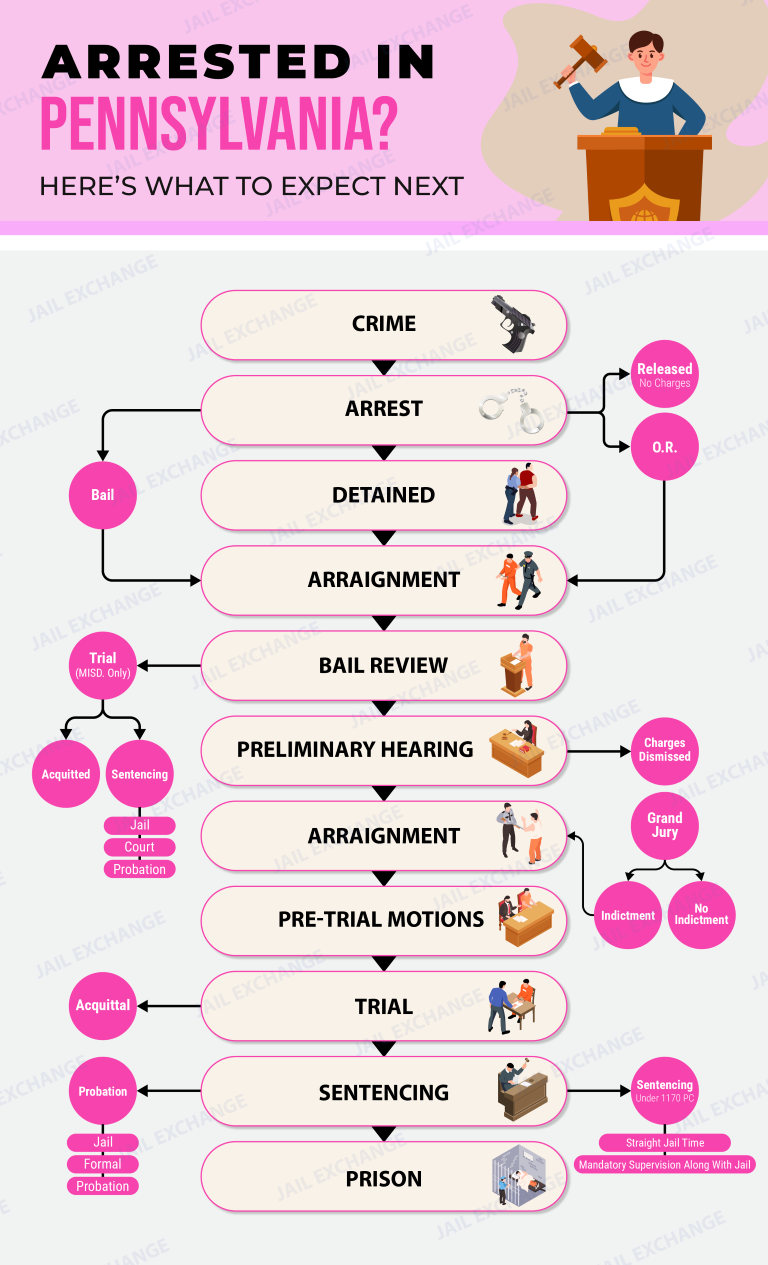
Lebanon County Correctional Facility Criminal Court Process
Criminal Court Process for Lebanon County Pennsylvania
Lebanon County Criminal Court Guide
Criminal cases here climb two steps: six neighborhood district courts first, then the Court of Common Pleas inside the Municipal Building. If held during the case, a defendant stays at the Lebanon County Correctional Facility, 730 East Walnut Street, Lebanon, PA 17042, one building for men and women with a work release section. Below are court addresses, the order of hearings, penalties and ways to find a date.
To confirm where someone is, try the official inmate lookup. After that, our Jail Roster covers the custody picture: who was booked, warrants still active, the exact charges, mugshots, free lawyers and personal property pickup.
On a weekday, phone the Clerk of Courts at 717-228-4419. Request the docket number, plus the coming hearing's date and courtroom. When release still comes first, our bail page spells out every route home.
1. Summary, misdemeanor or felony: whose courtroom hears it?
Pennsylvania splits the work between a local judge and a county judge.
- Magisterial district courts settle the smallest cases on their own. Those are summary offenses, like traffic tickets, disorderly conduct and many shoplifting tickets. With bigger charges, these courts do the first two jobs. They hold the arraignment, where bail is set. Then they hold the preliminary hearing.
- The Court of Common Pleas, 52nd Judicial District, receives each misdemeanor and felony a district judge passes along. Its territory is this one county. A summary case lost before a district judge can come here too, for an entirely new trial, as long as the appeal arrives no later than 30 days after the ruling.
Misdemeanors are the lighter crimes, graded M1, M2 and M3. Felonies, graded F1, F2 and F3, are the serious tier, with murder above them.
↑ Back to the question list2. Where is the Lebanon County courthouse, and which offices sit there?
Common Pleas holds court at 400 S. 8th Street, Lebanon, PA 17042, 717-274-2801, Monday through Friday, 8:30 a.m. to 4:30 p.m. County offices call it the Municipal Building. Court offices inside:
- Clerk of Courts, keeper of criminal and juvenile files: Room 102, 717-228-4419, weekdays 8:30 a.m. to 4:30 p.m.
- District Court Administration, which runs the court calendar and the 10% Bail Program: Room 311, 717-228-4440, same hours.
On the county's Court System page you'll find a criminal jury trial list and the year's court calendar. Three special courts run under Probation's watch: Drug Court, DUI Court for a second or third DUI, and Veterans Court, which pairs each veteran with a mentor. Entry starts with a written application to the District Attorney's Office.
↑ Back to the question list3. Which district court covers each Lebanon County town?
No borough or city here keeps a court of its own. Local ordinance cases, tickets and first hearings go to one of six magisterial district courts, chosen by where the event happened. Each goes by a number:
- 52-1-01, 502 State Drive, Lebanon, PA 17042, 717-279-0300: city Wards 1, 2 and 3.
- 52-2-01, 502 State Drive, Lebanon, PA 17042, 717-279-0400: city Wards 5, 8 and 9.
- 52-3-01, 728 East Walnut Street, Lebanon, PA 17042, 717-272-3084: Bethel, Heidelberg, Jackson and Millcreek townships, plus Cornwall, Mount Gretna and Myerstown boroughs.
- 52-3-03, 1720 State Route 72 North, Lebanon, PA 17046, 717-273-0024: Jonestown, North Lebanon Township, Swatara Township and West Lebanon Township.
- 52-3-04, 138 West Walnut Street, Cleona, PA 17042, 717-273-0885: Cleona, plus Annville, North Annville, South Annville, North Cornwall and Union townships.
- 52-3-05, 325 South Railroad Street, Palmyra, PA 17078, 717-838-8151: Palmyra, plus Cold Spring, East Hanover, North Londonderry and South Londonderry townships.
Live in city Ward 4, 6 or 7, or a town left off this list? District Court Administration at 717-228-4440 can match your address to a court. The county's district map draws the lines too.
↑ Back to the question list4. Arraignment, then the preliminary hearing: what goes on?
Soon after booking, a district judge holds the preliminary arraignment. A guide from the state's victim services office says that usually comes within six hours. At this short session the defendant gets the complaint on paper, hears each charge, learns about the right to counsel and receives a bail decision. A preliminary hearing date gets set as well (Pa.R.Crim.P. 540).
Someone kept in jail gets that hearing inside 14 days. Someone released gets it inside 21. There, the Commonwealth needs a prima facie case. That legal phrase means proof strong enough to show a crime happened and to point at this defendant as the one who probably did it. Defendants rarely take the stand at this point. Weak evidence ends the charges. When the proof holds up, the judge sends the file to Common Pleas, a ruling called "held for court." Some defendants waive this hearing on purpose to speed things up.
Clients of the Public Defender receive a "Three Date Letter" after the preliminary hearing. It lists the upcoming court dates.
↑ Back to the question list5. First DUI, retail theft and lesser charges: penalties and ARD
A misdemeanor walks the same early road as a felony: arraignment, preliminary hearing, then Common Pleas. The most a judge may impose (18 Pa.C.S. §§ 1101 and 1104):
- M1: 5 years and a $10,000 fine
- M2: 2 years and $5,000
- M3: 1 year and $2,500
- Summary offense: 90 days and $300, unless another law sets a bigger fine
Most first and second DUIs at the basic alcohol level are misdemeanors, and jail time tops out at six months. A refused test, a high alcohol reading or past DUIs push the grade up, and lawmakers have reworked these rules several times lately.
Plenty of first-timers are offered Accelerated Rehabilitative Disposition, known as ARD. The District Attorney picks who may join, and a judge signs off. Forms in English and Spanish sit on the ARD application page. Mail yours to the DA's ARD coordinator, or fax it to 717-272-0839. A DUI applicant must also book a CRIN evaluation. Completing the program gets the charge dismissed.
↑ Back to the question list6. Felony charges: the road through Common Pleas
A felony held for court moves along like this:
- The information. Prosecutors file a formal charging paper, sometimes adding counts and sometimes removing them.
- Formal arraignment. Typically four to eight weeks later. The defendant receives that paper and pleads.
- Pretrial conference and call of the list. Deals are often struck here, and trial dates get fixed.
- Trial. Twelve jurors must vote together that guilt is proven beyond a reasonable doubt. A defendant can pick a bench trial, decided by the judge alone, instead.
- Sentencing. Probation prepares a pre-sentence report. Outcomes range from fines and probation up to jail or prison, often with restitution to victims.
Maximums under 18 Pa.C.S. § 1103 and § 1101: F1, 20 years and $25,000; F2, 10 years and $25,000; F3, 7 years and $15,000. Appeals from a guilty verdict head to the Superior Court first and the Supreme Court last.
↑ Back to the question list7. Homicide and violent felony cases: what changes?
The gravest charges reshape both bail and punishment.
- Under 18 Pa.C.S. § 1102, first-degree murder brings either death or life imprisonment. A second-degree murder conviction brings life. Third-degree murder allows as long as 40 years.
- Bail may be refused when the charge carries death or life, or when no condition short of jail protects people. A hearing with real evidence is required first (Pa. Const. art. I, § 14).
- Teens aged 15 through 17 accused of murder, or of certain listed violent crimes with a deadly weapon, are charged as adults from day one.
- A victim in such a case may be heard on any plea offer, and later on the sentence.
For some family violence charges, the District Attorney offers a Domestic Violence ARD track. The defense lawyer can ask whether it fits.
↑ Back to the question list8. Who prosecutes in Lebanon County, and who defends people without money?
Prosecution: the District Attorney's Office, Room 11, 400 S 8th Street, Lebanon, PA 17042, 717-228-4403, weekdays 8:30 a.m. to 4:30 p.m. County detectives are part of this office and back up local police around the clock.
Defense: the Public Defender's Office, Room 122, Municipal Building, 400 South 8th Street, Lebanon, PA 17042, 717-228-4421, weekdays 8:30 a.m. to 4:30 p.m. There is no fee. Fill out its application and attach household income proof, for example the last four pay stubs and any benefit letter dated within 30 days. Email it, fax it or hand it in.
State law asks every applicant to swear to their finances in writing (16 P.S. § 9960.1 and following). Its caseload includes adults and juveniles, probation violations and summary charges where jail is possible.
↑ Back to the question list9. Finding a docket number or the next court date online
Head to the free UJS Web Portal case search. Nobody has to sign up.
- Choose "participant name," or choose docket number when you have one.
- Enter the last name, then the first, and set the county.
- Click into the docket sheet. Charges, bail, filings and scheduled dates appear there for both district court and Common Pleas matters.
Entries made today might not appear until later. Juvenile, sealed and expunged matters never appear. Nor will a docket reveal which jail holds a person.
Stuck? The Clerk of Courts at 717-228-4419 can walk you through it. That office treats its records as open to the public unless a law blocks access.
↑ Back to the question list10. Warrant worries: checking lists and turning yourself in
Bench and criminal warrants go out through the Sheriff's Office: Room 3, Municipal Building, 400 South 8th Street, Lebanon, PA 17042, 717-228-4410, weekdays 8:00 a.m. to 4:30 p.m. Local police and constables serve warrants too. Official lists to check: county warrants and most wanted; city police warrants and most wanted; the statewide PSP fugitive sheet; and the U.S. Marshals top 15. To clear a bench warrant, bring a lawyer and surrender at the Sheriff's Office. Arriving before 11 a.m. often means seeing a judge at 1 p.m. The Clerk of Courts in Room 102 of the same building, 717-228-4419, can also check by phone.
↑ Back to the question list11. A federal charge from this county: court, lawyers and custody
Local federal cases belong to the U.S. District Court for the Middle District of Pennsylvania, Harrisburg Division. Hearings take place at 1501 North 6th Street, Suite 101, Harrisburg, PA 17102, 717-221-3920, the Sylvia H. Rambo courthouse.
- A detention hearing (18 U.S.C. 3142) settles whether a federal defendant waits for trial at home.
- The federal side of the courtroom is the U.S. Attorney's Office, 1501 North 6th Street, Harrisburg, PA 17102 (mail to Box 202), 717-221-4482.
- Anyone released gets supervised by U.S. Probation and Pretrial Services, 1501 N. 6th St., Suite 100, Harrisburg, PA 17102, 717-901-2860.
- Housing before trial is the Marshals' call. For the U.S. Marshals Service, phone or write its Scranton district office, 235 North Washington Avenue, Unit 215, Scranton, PA 18503, 570-346-7277.
- Following a sentence, use the Federal Bureau of Prisons inmate locator.
12. ICE detainers and a pending Lebanon County case
The state charges keep going even after ICE files paperwork. Where the detainer bites is release day.
- LCCF gets a Form I-247A from ICE, a request to hold the person for federal pickup.
- The hold can last up to 48 hours after they would otherwise be released (8 CFR 287.7(d)).
- The Third Circuit, the federal appeals court for Pennsylvania, held in Galarza v. Szalczyk (2014) that this form is a request and carries no force of an order. A county jailing someone on that form alone is responsible for its choice. So county jails write their own detainer rules. Call LCCF at 717-274-5451 for this one's practice.
- ICE's Philadelphia Field Office covers the state: 114 N. 8th Street, Philadelphia, PA 19107, 215-656-7164.
- Search for a detained person on the ICE Online Detainee Locator.
Pleading guilty may bring immigration trouble, so a non-citizen should share their status with the defense lawyer right away.
↑ Back to the question list13. After a guilty verdict here: Walnut Street or a state prison?
The sentence's maximum controls the answer (42 Pa.C.S. § 9762). A maximum below two years is served on East Walnut Street. From two up to five years, the judge may keep the person local or send them to the state. A five-year maximum or higher sends the person to the state.
State prisons are run by the Pennsylvania Department of Corrections, 1920 Technology Parkway, Mechanicsburg, PA 17050, 717-728-2573. Classification comes first and can stretch from weeks into months. Only after that does a prisoner move to a home institution.
- Look for state prisoners with the DOC inmate locator.
- Read up on every institution at our Pennsylvania state prisons page.
Probation after release runs through Probation Services, which is apart from the jail: 508 Oak Street, Lebanon, PA 17042, 717-273-1557.
↑ Back to the question list14. Charges against someone younger than 18
Under the Juvenile Act (42 Pa.C.S. § 6301 and following), a minor's case usually belongs to juvenile court. These are not adult criminal cases, and the UJS docket site never shows them.
Juvenile probation officers share the Probation Services office at 508 Oak Street, Lebanon, PA 17042. Phone 717-273-1557 and request juvenile probation. Staff can name the detention center holding a youth and the date of the first hearing. Youths who are detained go to a juvenile center, never the adult jail.
The Public Defender represents juveniles at no cost as well. A small group of older teens, accused of murder or of listed violent crimes with a deadly weapon, start out in adult court instead. Their lawyer may petition to send the case back to juvenile court.
↑ Back to the question list15. Lebanon County crime victims: notice, a voice and money help
Pennsylvania's Crime Victims Act (18 P.S. § 11.101 and following) gives victims notice of major court events and a voice on bail. Often they may also weigh in on a proposed plea, and they can address the judge before a sentence. Where someone was hurt, the victim can ask to hear when the defendant gets out of LCCF.
- Court support comes from the DA's Victim Witness Unit, Room 11, 400 S 8th Street, Lebanon, PA 17042, 717-228-4412.
- No-cost custody alerts come through PA SAVIN at VINELink Pennsylvania or 866-972-7284.
- Bills tied to the crime, such as counseling or lost pay, can sometimes be repaid through VCAP, the state's victim compensation fund: 800-233-2339.
A word to families of the accused: no calls, texts or notes to the victim, even through friends. Any such contact can count as a bail violation, and it may even bring a new case.
↑ Back to the question list