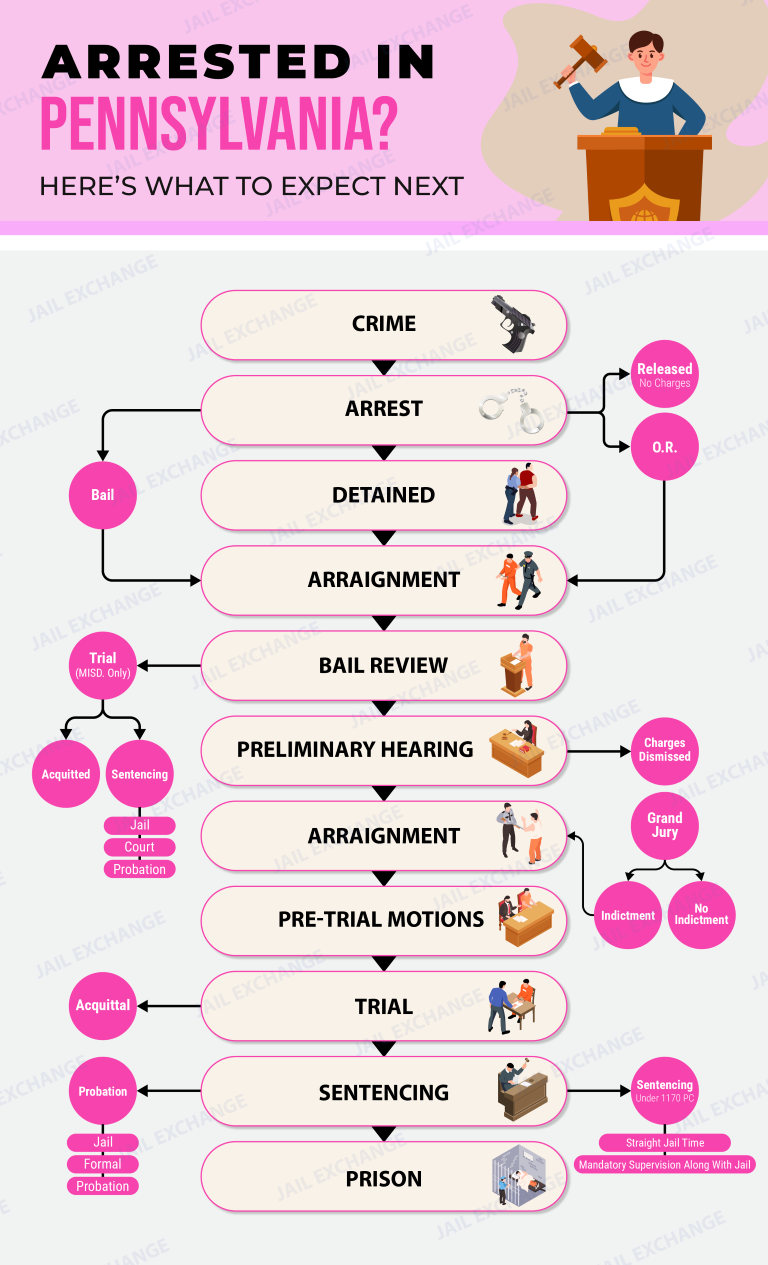
Philadelphia Detention Center Criminal Court Process
Criminal Court Process for Philadelphia County Pennsylvania
Philadelphia County Criminal Court Guide
Both criminal courts sit in the Criminal Justice Center named for Juanita Kidd Stout, 1301 Filbert Street, Philadelphia, PA 19107. Defendants held before trial go to a city jail, the biggest being Curran-Fromhold Correctional Facility, 7901 State Road, Philadelphia, PA 19136. Philadelphia Industrial Correctional Center, 8301 State Road, Philadelphia, PA 19136, is for men and women, the Detention Center, 8201 State Road, Philadelphia, PA 19136, provides inpatient health care, and Riverside Correctional Facility, 8151 State Road, Philadelphia, PA 19136, serves youthful offenders and offers treatment areas. This guide traces a case from video arraignment to sentence.
Check custody with the Department of Prisons locator. Search by full name and birth date, or by police ID number. Our Recent Arrests page focuses on arrests and what custody involves. That means new bookings, who is held now, charges, mugshots, open warrants, public defenders and picking up belongings.
On a weekday, call the Common Pleas criminal information counter at 215-683-7004. Ask three things: the docket number, which court has it and the next listing date. Still waiting for a release? Our bail and release page comes first.
1. Municipal Court or Common Pleas: who hears what?
Philadelphia's First Judicial District has two trial courts for crimes. Which one gets a case depends mostly on how much prison time the charge can bring.
- Philadelphia Municipal Court hears adult misdemeanors and other charges that carry up to 5 years. It also hears summary cases that are not traffic tickets, for adults and juveniles. Misdemeanor trials there have a judge and no jury.
- Felony cases start in Municipal Court too. That court holds the preliminary hearing, where a judge checks whether the evidence is strong enough to continue.
- The Court of Common Pleas, Trial Division, hears every felony once it is held for court. It also hears appeals from Municipal Court, which become a new trial where the person may ask for a jury.
- Juvenile Court, part of the Common Pleas Family Division, takes most cases about people under 18.
For help telling which court has a case, call Municipal Court's criminal Court Administration at 215-683-7290.
↑ Back to the question list2. Where are Philadelphia's criminal courtrooms?
Nearly everything happens at the Stout Center for Criminal Justice, known as the CJC, 1301 Filbert Street, Philadelphia, PA 19107. General court information: 215-686-7000. Offices to know inside:
- Municipal Court, Criminal Division: Room 208, weekdays 9 a.m. to 5 p.m. Court Administration answers at 215-683-7290.
- Common Pleas, Trial Division, Criminal: Room 203, weekdays 9 a.m. to 5 p.m. Information counter: 215-683-7004.
- Criminal Listings: Room 206, weekdays 8 a.m. to 5 p.m. Trial Commissioner Unit: 215-683-7010.
- Office of Judicial Records, Criminal (the clerk of courts): Room 310, weekdays 8 a.m. to 5 p.m. Phone: 215-683-7700.
- Common Pleas arraignments: Room 505, weekdays 11 a.m. to 1 p.m.
Other offices:
- Court Administrator, 236 City Hall, Philadelphia, PA 19107, 215-686-2547.
- Court Reporter and Interpreter Services, 100 South Broad Street, 2nd Floor, Land Title Building, Philadelphia, PA 19110, 215-683-8000. Ask here about an interpreter.
- Juvenile Court, 1501 Arch Street, Philadelphia, PA 19102, 215-686-4000, weekdays 9 a.m. to 5 p.m.
3. Why are there no district judges in Philadelphia?
Across Pennsylvania, more than 550 magisterial district judges handle the first steps of a criminal case. Philadelphia has none. The city of Pittsburgh is the only other place without them. In both cities a municipal court does that work instead.
So in Philadelphia, Municipal Court:
- holds the round-the-clock video arraignments where bail is set
- hears felony preliminary hearings
- tries misdemeanors and summary offenses that are not traffic cases
- runs diversion and treatment courts
Some Municipal Court courtrooms are in police district buildings, so a hearing notice may list a police district address instead of Filbert Street. The Criminal Division office is in Room 208 of the Criminal Justice Center, 1301 Filbert Street, Philadelphia, PA 19107. For the right room, call 215-686-7000.
A person who wants to file charges against someone, called a private criminal complaint, goes to the District Attorney's unit at 1425 Arch Street, 4th Floor, Philadelphia, PA 19102, 215-686-9864.
↑ Back to the question list4. What happens at the video arraignment?
The first court step is the preliminary arraignment. In Philadelphia, a Municipal Court magistrate holds it by video at any hour. The magistrate sits in a basement courtroom at the Criminal Justice Center, 1301 Filbert Street, Philadelphia, PA 19107. The person stays at the police booking center and appears on a screen. Court guides say it usually happens within 24 hours of the arrest.
Before it starts, the District Attorney's Charging Unit, which works every hour of the year, decides which charges to file. Then the magistrate (Pa.R.Crim.P. 540):
- reads the charges aloud and hands over the complaint
- explains the right to a lawyer and assigns one
- sets bail and any release rules
- sets the date for the next hearing
Relatives with questions about the hearing can call the Pretrial Services Bail Interviewing Unit at 215-683-3707, which is staffed day and night.
Anyone the magistrate holds is moved from the booking center to a jail run by the Department of Prisons. All four sit in Northeast Philadelphia:
- Curran-Fromhold Correctional Facility, 7901 State Road, Philadelphia, PA 19136, 215-685-7843, the largest of them
- Philadelphia Industrial Correctional Center, 8301 State Road, Philadelphia, PA 19136, 215-685-7100, where adult men are housed
- the Detention Center, 8201 State Road, Philadelphia, PA 19136, 215-685-8436, for people who need inpatient medical or behavioral treatment
- Riverside Correctional Facility, 8151 State Road, Philadelphia, PA 19136, 215-685-6911, which has treatment areas and holds youthful offenders; its ASD MOD III unit stands at 8101 State Road, Philadelphia, PA 19136
To find out which building has women, or who a unit holds, phone the round-the-clock locating line at 215-685-8394.
↑ Back to the question list5. What path do DUI, theft and other misdemeanor cases take?
Most misdemeanors stay in Philadelphia Municipal Court from start to finish. The trial is in front of a judge, with no jury. A person found guilty there can appeal to the Court of Common Pleas, where the case is tried again from the beginning and a jury can be asked for.
Top penalties set by state law (18 Pa.C.S. §§ 1101, 1104-1105):
- M1, a first-degree misdemeanor: as much as 5 years and a $10,000 fine
- M2: as much as 2 years and a $5,000 fine
- M3: as much as 1 year and a $2,500 fine
- Summary offense, the bottom grade: as much as 90 days and a $300 fine
At the general alcohol level, a first or second DUI counts as a misdemeanor punishable by no more than six months behind bars (75 Pa.C.S. § 3803). Higher test levels, a refusal or several prior DUIs raise the grade, and the law changed in 2025 and 2026, so a lawyer should check the exact charge.
Many first offenders can leave the regular track through a diversion program, so ask the defense lawyer about it. For a misdemeanor date or courtroom, call the Common Pleas information counter at 215-683-7004.
↑ Back to the question list6. How does a Philadelphia felony case unfold?
A felony moves from Municipal Court up to the Court of Common Pleas:
- Video arraignment. Charges are read and bail is set.
- Preliminary hearing in Municipal Court. It must be set within 14 days of the arraignment for someone held in jail, or within 21 days for someone free on bail (Pa.R.Crim.P. 540). The DA has to present a prima facie case, meaning evidence that points to a crime and makes it likely this person committed it. Without that, the judge throws the charge out.
- Held for court. The DA files the formal charges, called the information.
- Common Pleas arraignment in Room 505 of the Criminal Justice Center, 1301 Filbert Street, Philadelphia, PA 19107, about 21 days after the case is held for court.
- Pretrial conference, often two to three weeks later. Plea deals are common here.
- Trial by a jury of 12, which must agree unanimously, or by a judge alone.
- Sentencing, after the court's probation staff prepare a pre-sentence report.
Top penalties (18 Pa.C.S. §§ 1101, 1103): first-degree felony, 20 years and $25,000; second-degree, 10 years and $25,000; third-degree, 7 years and $15,000. The Criminal Listings Unit, 215-683-7010, schedules Common Pleas dates.
↑ Back to the question list7. How are murder and violent charges treated?
The most serious cases follow tighter rules all the way through:
- Murder penalties. First-degree murder carries either the death penalty or life in prison. A second-degree conviction brings a life term. Third-degree can bring up to 40 years (18 Pa.C.S. § 1102).
- Bail can be refused. For a charge that can carry life, or when no rules short of jail will keep people safe, a judge may deny bail. The DA must prove this with evidence at a hearing (Pa. Const. art. I, § 14; Commonwealth v. Talley).
- Teens in adult court. Murder charges, and certain violent charges where a weapon was used by someone 15 or older, begin in adult court (42 Pa.C.S. § 6302).
- Victims speak up. In injury cases, victims may comment before a plea deal or sentence.
- Emergency protection orders. After 5 p.m. or on holidays, emergency Protection from Abuse requests go to Room B-03 of the Criminal Justice Center, 1301 Filbert Street, Philadelphia, PA 19107.
The DA's main office is at 215-686-8000.
↑ Back to the question list8. What diversion programs does the DA offer?
The District Attorney's Charging Unit looks at most new cases to see if they fit a program that can end without a conviction. The DA decides who is offered a spot, and a judge must approve (Pa.R.Crim.P. 310 and following).
- ARD (Accelerated Rehabilitative Disposition): for people with little or no record and minor charges. It means court costs, any restitution, and probation of 6 months to 2 years. Finishing it gets the charge dismissed, and the record can be expunged.
- DUI-ARD: for a first misdemeanor DUI. It adds safe driving school and assessments, with 6 months to 1 year of probation.
- Accelerated Misdemeanor Program (AMP): two tiers for lower-level cases.
- Summary Diversion: a $200 class held on a Saturday at the Criminal Justice Center. Call 215-686-7000.
Municipal Court also runs treatment courts, including Philadelphia Treatment Court, DUI Treatment Court and The Choice is Yours (coordinator 215-683-3788), plus Veterans Court, Domestic Violence Diversion and Project Dawn Court (coordinator 215-683-1584) and Mental Health Court. Only the DA, the court or a lawyer can refer someone. Read the DA's adult diversion page and ask the defense lawyer early.
↑ Back to the question list9. Who prosecutes, and who defends people in Philadelphia?
Prosecutor. Every criminal case in the city is prosecuted by the District Attorney's Office, at 3 South Penn Square, Philadelphia, PA 19107-3499, 215-686-8000.
Free defense. State law gives every other county a public defender's office but leaves Philadelphia out (16 P.S. § 9960.1 and following). Philadelphia's free defense comes from the Defender Association of Philadelphia instead, at 1441 Sansom Street, Philadelphia, PA 19102, 215-568-3190, weekdays 9 a.m. to 5 p.m.
- A lawyer is assigned at the video arraignment.
- Pretrial Services does appointment-of-counsel interviews on weekdays, 8 a.m. to 4 p.m. Its Notification Unit, 215-683-3710, can say where.
- When the Defender Association has a conflict, the Court Appointment Unit at 215-683-7007 handles appointing outside counsel.
A Defender Association lawyer also sits in the courtroom on weekday mornings when people turn themselves in on bench warrants.
↑ Back to the question list10. Finding a docket sheet or court date
Start with these free tools:
- UJS case search: look up a name together with the county, or a docket number. No account is needed. Docket sheets for Municipal Court and Common Pleas show charges, bail, court dates and courtrooms. Brand-new entries can lag a little.
- Upcoming criminal court dates from the First Judicial District.
- New Municipal Court criminal filings, by defendant name or court date.
The public portal leaves out juvenile, sealed and expunged cases. The portal also cannot tell you which jail holds someone.
For paper records, the Office of Judicial Records keeps criminal files at the Criminal Justice Center, 1301 Filbert Street, Philadelphia, PA 19107. Its administrative office answers weekdays from 8 a.m. to 5 p.m. at 215-683-7700. Court guides list a copy of a case file at $12.50 and a docket or court summary at $5.00 each.
↑ Back to the question list11. Checking and clearing a Philadelphia warrant
The Sheriff's Office Fugitive Warrant Unit, 714 Market Street, Philadelphia, PA 19106, serves bench warrants around the clock at 215-683-3726; police and constables serve others. Official wanted pages: Philly's Fugitives, police wanted posts, the State Police Ten Most Wanted, the FBI wanted list and the Marshals' list of 15 most wanted fugitives. To check a name, call the court's Data Verification Unit at 215-683-3723. To clear one, bring a lawyer to Courtroom 403 of the Criminal Justice Center, 1301 Filbert Street, Philadelphia, PA 19107, on a weekday at 7:30 a.m. Court records: 215-683-7700.
↑ Back to the question list12. How does a federal case from Philadelphia work?
Federal crimes are charged in the U.S. District Court for the Eastern District of Pennsylvania. Philadelphia cases go to the federal courthouse named for James A. Byrne, 601 Market Street, Philadelphia, PA 19106. The clerk's office is at 215-597-7221.
- The U.S. Attorney's Office handles federal prosecutions from 615 Chestnut Street, Suite 1250, Philadelphia, PA 19106, 215-861-8200.
- A detention hearing settles where the person stays until trial (18 U.S.C. 3142).
- Until trial, federal marshals keep detained defendants in custody. Their Eastern District office is at 601 Market Street, Room 2110, Philadelphia, PA 19106, 215-597-7272. Many wait at the Federal Detention Center, 700 Arch Street, Philadelphia, PA 19106, 215-521-4000.
- Those who cannot afford private counsel are represented by the Federal Community Defender (Suite 540 West), 601 Walnut Street, Philadelphia, PA 19106, 215-928-1100.
Once a federal sentence begins, find the person through the Federal Bureau of Prisons inmate locator.
↑ Back to the question list13. Does an ICE hold change a Philadelphia case?
The charges move forward in the city's courts as usual. The detainer only comes into play once the person is due for release.
- ICE files Form I-247A, a written detainer, with the jail.
- It can hold the person up to 48 hours after they would otherwise be released (8 CFR 287.7(d)).
- Detainers are requests only. Galarza v. Szalczyk (3d Cir. 2014) is the Third Circuit case that settled this. That federal appeals court hears Pennsylvania cases, and it added that a county can be liable for holding someone on a detainer alone. Policies vary, so call the Department of Prisons, 7901 State Road, Philadelphia, PA 19136, 215-685-7711.
- ICE's Philadelphia Field Office, 114 N. 8th Street, Philadelphia, PA 19107, 215-656-7164, covers Pennsylvania.
- To find someone ICE has taken, use the ICE Online Detainee Locator.
14. Where do people from Philadelphia serve prison time?
The maximum term decides the place (42 Pa.C.S. § 9762). Any sentence whose top end reaches 5 years goes to state prison. A maximum between 2 and 5 years also points to state prison, except when the jail, the DA and the court all agree the person can stay in the city. Anything under 2 years is served in a city jail.
State prisoners start with weeks or months of testing and sorting at a reception and classification center. Then the Pennsylvania Department of Corrections chooses a prison that suits the person's custody level and program needs.
- Search the state inmate locator by name or inmate number.
- Read our Pennsylvania state prisons guide for each facility.
- The DOC's central office is at 1920 Technology Parkway, Mechanicsburg, PA 17050, 717-728-2573.
City probation after jail is run by the courts' Adult Probation and Parole Department, 714 Market Street, 1st Floor, Philadelphia, PA 19106, 215-683-1000.
↑ Back to the question list15. How does Juvenile Court handle a teenager?
Under the Juvenile Act, a person under 18 is a child, and most charges go to Juvenile Court instead of adult court (42 Pa.C.S. § 6302). The court is at 1501 Arch Street, Philadelphia, PA 19102, 215-686-4000, open weekdays 9 a.m. to 5 p.m.
- Detained youth stay at the Philadelphia Juvenile Justice Services Center, 91 North 48th Street, Philadelphia, PA 19139, 215-686-4845 (24 hours). It is the city's only secure juvenile detention center.
- The Delinquent Intake Unit there decides on detention at any hour: 215-686-4999.
- Juvenile probation district lines: North 215-686-4141, West 215-686-7483, South 215-686-7962.
- For murder, or a listed violent offense where a deadly weapon was used by a teen of 15 or more, the case begins as an adult case. A defense lawyer may file to have it moved down to the juvenile side.
Juvenile files are kept off the public UJS portal.
↑ Back to the question list16. How are crime victims supported in Philadelphia?
Victims get help at every court step from a DA team called Victim and Witness Services. Call 215-686-8027. The DA's office is at 3 South Penn Square, Philadelphia, PA 19107-3499.
- Under the Crime Victims Act, victims may be told of major court steps, may comment on bail, and in injury cases may speak before a plea or sentence (18 P.S. § 11.101 and following).
- Free release and transfer alerts come from PA SAVIN, run by the state, at 866-972-7284 (TTY 866-847-1298).
- The state Victims Compensation Assistance Program can help pay for medical bills, counseling, funerals and lost pay. Call 800-233-2339.
Family members of a defendant may not contact the victim, not even by passing messages through friends. Any such contact may violate release conditions and bring fresh charges.
↑ Back to the question list