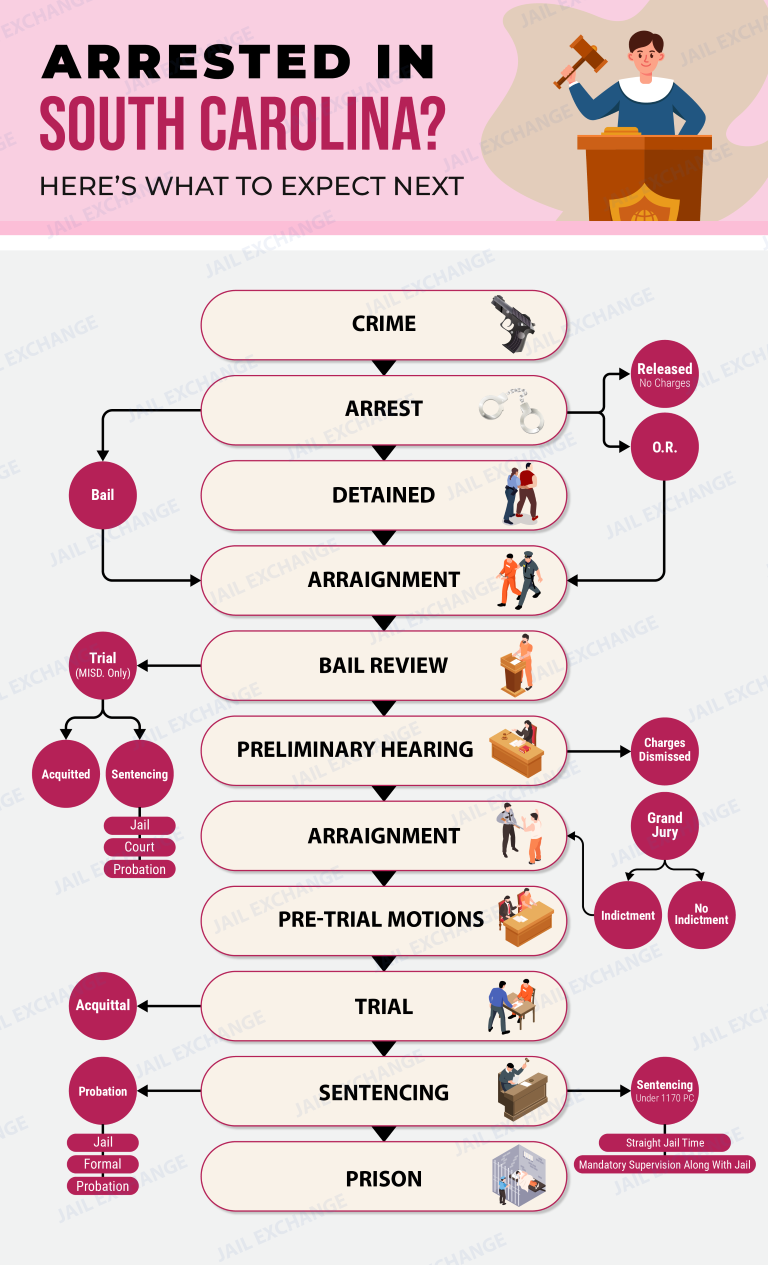
Cherokee County Detention Center Criminal Court Process
Criminal Court Process for Cherokee County South Carolina
Criminal Court in Cherokee County: A Family Guide
Criminal cases from this corner of the Upstate are heard in Gaffney and Blacksburg, with felonies tried at the courthouse, 125 E. Floyd Baker Blvd., Gaffney, SC 29340. Anyone arrested in the county waits at the Cherokee County Detention Center, 315 E. Dr. LM Rosemond Lane, Gaffney, SC 29340. Below: each local court, the path a case follows, the prosecutor and defender offices, and ways to find a hearing date.
First, see if the person is in custody. Use the jail's official inmate lookup. For the arrest itself, turn to our Jail Roster page, which explains who is in jail now, the latest bookings, warrants, charges, mugshots, public defenders and getting someone's property back.
Next, phone the Clerk of Court at 864-487-2571, weekdays 8:30 a.m. to 5:00 p.m. Ask whether a case is open, which court owns it and the next date on the calendar. Still waiting on a release? Our bond and release guide covers that.
1. Summary court, General Sessions or Family Court?
South Carolina sorts criminal cases by weight.
- Summary courts, meaning magistrate courts and city (municipal) courts, try charges that carry up to $500, up to 30 days, or both (S.C. Code 22-3-550; S.C. Code 14-25-65). Shoplifting of $2,000 or less also stays there, with fines up to $1,000 (S.C. Code 16-13-110). These judges run bond hearings and preliminary hearings as well.
- The Court of General Sessions is the criminal branch of the circuit court. Felonies and heavier misdemeanors are tried here. Venue is the county of the alleged crime.
- Family Court takes most charges against anyone under 18.
- Federal court handles federal crimes through its Spartanburg Division.
For circuit court, this county pairs with Spartanburg County to form the 7th Judicial Circuit (S.C. Code 14-5-610).
↑ Back to the question list2. The Cherokee County courthouse on Floyd Baker Blvd.
General Sessions and Family Court share the courthouse at 125 E. Floyd Baker Blvd., Gaffney, SC 29340. Letters go to P.O. Box 2289, Gaffney, SC 29342.
- Clerk of Court, General Sessions: 864-487-2571, Monday through Friday, 8:30 a.m. to 5:00 p.m. Felony files, ten percent bond deposits and court papers run through this office.
- Family Court desk: 864-487-2570.
- Jury line: 864-487-2585.
Circuit judges hold General Sessions in set terms. The clerk knows when the next term opens and which cases are on it.
↑ Back to the question list3. Magistrate offices and city courts
- Magistrate Court, main office, 312 E. Frederick St., Gaffney, SC 29340, 864-487-2533. Criminal clerk and jury trials: 864-902-2385. Preliminary hearings and domestic violence court: 864-902-2384. Traffic: 864-902-2386. A magistrate covers weekends too.
- Magistrate Court, Blacksburg office, 301 West Cherokee Street, Suite A, Blacksburg, SC 29702, 864-839-2492.
- City of Gaffney Municipal Court, inside City Hall, 201 North Limestone Street, Gaffney, SC 29340, 864-487-8524. Hours: 8:15 a.m. to 5:15 p.m. Monday to Thursday, 8:15 a.m. to 12:30 p.m. Friday. City officers' traffic, misdemeanor and ordinance cases from inside city limits come here. A ticket from a deputy or trooper goes to the magistrate instead.
- Blacksburg Municipal Court, P.O. Box 487, Blacksburg, SC 29702, 864-839-2332. That line also rings Town Hall.
Magistrate juries seat six people (S.C. Code 22-3-545). For a jury, the court needs written notice five or more days ahead of trial.
↑ Back to the question list4. Day one in court: the bond hearing
The first stop is a bond hearing, due within 24 hours of the arrest (S.C. Code 22-5-510). A magistrate or city judge goes over the charges, settles bond and sets any conditions.
- When city police made the arrest, hearings run daily at 8:30 a.m. and 4:30 p.m. in the Municipal Courtroom at City Hall, 201 N. Limestone Street, Gaffney, SC 29340.
- For any other arrest, the jail at 315 E. Dr. LM Rosemond Lane, Gaffney, SC 29340, 864-487-2529, can give the hearing time and place.
Police must hand the judge the person's record, pending charges and other bonds before or at the hearing (S.C. Code 22-5-510(E)). The victim gets notice and a chance to talk. Felony defendants can ask a magistrate to test the evidence at a preliminary hearing. The deadline to ask is 10 days counted from bond (Rule 2(a), SCRCrimP).
↑ Back to the question list5. Shoplifting, simple assault and other small cases
Low-level charges like third-degree assault and battery, or taking $2,000 or less from a store, usually stay in a magistrate or city courtroom.
- The court gives or mails a trial date.
- The person then pleads guilty, asks the judge to rule, or chooses a jury of six.
- A guilty finding leads to a sentence inside the legal limits.
Some ceilings to know:
- Third-degree assault and battery: $500 plus 30 days (S.C. Code 16-3-600(E)(2))
- Shoplifting at $2,000 or under: $1,000 plus 30 days (S.C. Code 16-13-110(B))
- In General Sessions, a Class A misdemeanor can carry three years; each step down the alphabet trims a year (S.C. Code 16-1-20)
A missed trial date can bring a bench warrant. Questions about a magistrate case go to the criminal clerk at 864-902-2385.
↑ Back to the question list6. Steps in a Cherokee County felony case
- Bond. A magistrate sets it within 24 hours, unless only a circuit judge may.
- Preliminary hearing. A written demand is due 10 days after bond is set (Rule 2(a), SCRCrimP). At this hearing, a magistrate decides if the proof is strong enough to send the case on to circuit court. Scheduling: 864-902-2384.
- General Sessions. The file moves to circuit court at the courthouse, and the Solicitor's office takes over.
- The end. The case finishes with a plea, a trial, a dismissal or a program such as PTI.
Felony class sets the longest possible prison stay (S.C. Code 16-1-20). The top letter, Class A, allows 30 years. Every letter after it shaves off five, ending at 5 years for Class F. Store theft between $2,000 and $10,000 is a five-year felony. Past $10,000, the limit doubles to ten.
↑ Back to the question list7. Violent and life-sentence charges
- Murder brings death or 30 years to life (S.C. Code 16-3-20(A)). A circuit judge, never a magistrate, sets bond on murder and on any charge that can mean death or life.
- For other crimes on the violent list in S.C. Code 16-1-60, a magistrate keeps the power to grant or deny bond.
- A fresh violent or gun felony arrest during an existing bond for one voids the earlier release by law. Within 30 days, circuit court reviews it (S.C. Code 17-15-55(C)). Committing a violent crime while on that kind of bond is itself a felony, punishable by up to five years (S.C. Code 17-15-270).
- Violent charges can't use the ten percent deposit or Pretrial Intervention (S.C. Code 17-22-50).
- Victims of these crimes have strong rights to be told about hearings and to speak.
8. Solicitor and public defender in Cherokee County
Both sides of a General Sessions case work from offices in town.
- 7th Circuit Solicitor, county office (the prosecutor): 202 N. Petty St., Gaffney, SC 29340, 864-487-2576. The office prosecutes for Spartanburg and this county. A victim advocate is on staff.
- Seventh Circuit Public Defender, county office: 229 E. Floyd Baker Blvd., Gaffney, SC 29340, 864-514-3123, weekdays 8:30 a.m. to 5:00 p.m. A staff member comes to the jail to sign people up. The $40 application fee can be cut or waived (S.C. Code 17-3-30).
For statewide help with appointed counsel, contact the SC Commission on Indigent Defense, 1330 Lady Street, Suite 401, Columbia, SC 29201, 803-734-1343.
↑ Back to the question list9. Second chances: PTI and other programs
The Solicitor decides who gets into these programs. Finish one, and the charge is dismissed.
- Pretrial Intervention (PTI) is meant for first-time, nonviolent charges. DUI and violent crimes are excluded (S.C. Code 17-22-50). Fees are a $100 application plus $250 to take part, $350 tops, and may be waived for anyone unable to afford them (S.C. Code 17-22-110). After success, the person may ask for an expungement (S.C. Code 17-22-150).
- Alcohol Education Program serves people 17 to 20 at the time of arrest, for a $250 fee (S.C. Code 17-22-520 and 17-22-550).
- Traffic Education Program covers some minor traffic tickets, one time only.
- Drug court runs here too; the public defender handles drug court cases.
Diversion staff see people at 312 East Frederick Street, Gaffney, SC 29340, on Thursdays from 8:30 a.m. to 4:30 p.m. The diversion office answers at 864-596-2630.
↑ Back to the question list10. Public Index, rosters and phone lookups
- Search the county Public Index on the SC Judicial Branch site by name or case number.
- Scan the court rosters that the Clerk of Court links for upcoming hearings.
- Call the right office: General Sessions at 125 E. Floyd Baker Blvd., Gaffney, SC 29340, 864-487-2571; the main magistrate office at 312 E. Frederick St., Gaffney, SC 29340, 864-487-2533; or city court at 201 North Limestone Street, Gaffney, SC 29340, 864-487-8524.
Keep the person's legal name, date of birth and any case or warrant number close by. To learn where someone is being held, use the jail lookup.
↑ Back to the question list11. Warrants in Cherokee County: check, then clear
Deputies handle warrants outside the towns; police in Gaffney and Blacksburg handle them inside town limits. Phone the Sheriff's Office, 312 E. Frederick St., Gaffney, SC 29340, 864-489-4722, for the warrants desk, or ring the magistrate office, 312 E. Frederick St., Gaffney, SC 29340, at 864-487-2533 about a bench warrant. Two statewide lists are worth a glance: the state probation agency's most wanted page and the federal Marshals' top fugitives. Getting one cleared means a defense lawyer's help, then either turning yourself in to the issuing judge or asking that court to set another date. Felony warrant questions belong with the Clerk of Court, 125 E. Floyd Baker Blvd., Gaffney, SC 29340, 864-487-2571.
↑ Back to the question list12. A federal arrest: Spartanburg Division steps
Federal crimes from here go to the Spartanburg Division of the U.S. District Court for the District of South Carolina. Court may sit at the Donald S. Russell Federal Building, 201 Magnolia Street, Spartanburg, SC 29306. That building has no clerk. Questions go to the Greenville clerk's office at 250 East North Street, Greenville, SC 29601, 864-241-2700.
- A federal magistrate judge sees the person first and holds the detention hearing then. Short delays are allowed (18 U.S.C. 3142).
- The U.S. Marshals hold defendants who are not released. Call the Greenville office, 300 East Washington Street, Room 232, Greenville, SC 29601, 864-232-1566, to ask where.
- After a prison sentence, track the person in the Federal Bureau of Prisons inmate locator.
13. How an ICE detainer changes a state case
An immigration hold runs beside the state case. It does not replace it.
- ICE delivers a detainer to the Detention Center using Form I-247A.
- With this form, ICE wants the person held as long as 48 extra hours beyond the usual release time (8 CFR 287.7(d)).
- ICE then picks the person up. The agency's South Carolina office belongs to its Atlanta Field Office: 3950 Faber Place Drive, North Charleston, SC 29405, 843-746-9800.
- Families can search the ICE Online Detainee Locator.
State law gives each jail 72 hours to verify the immigration status of anyone booked for a crime. A finding of unlawful presence goes on to Homeland Security (S.C. Code 23-3-1100). Bond judges also weigh unlawful presence (S.C. Code 22-5-510(D)(4)).
↑ Back to the question list14. Where a sentence ends up being served
Ninety days or less is typically served locally (S.C. Code 24-3-30). The Detention Center holds people sentenced to 90 days or less. Longer terms go to the South Carolina Department of Corrections (SCDC), which chooses the prison (S.C. Code 24-3-20).
- SCDC's intake step is called reception and evaluation. Families wait to visit in person until it ends, unless it runs over 30 days.
- Once they're in the system, the SCDC inmate search lists them.
- SCDC: 4444 Broad River Road, Columbia, SC 29210, 803-896-8500.
- Our South Carolina state prisons pages describe visits and mail at each prison.
15. Cherokee County youth in Family Court
Charges against children under 18 go to Family Court, in the same courthouse. Seventeen-year-olds facing a Class A through D felony, or one carrying at least 15 years, are tried as adults instead (S.C. Code 63-19-20(1)).
- Any youth kept in detention is entitled to a judge's review within 48 hours (weekends and holidays excluded) (S.C. Code 63-19-830).
- Teens aged 14 to 16 face adult court for some grave felonies. That move needs an investigation and a Family Court hearing first (S.C. Code 63-19-1210).
- Most counties' detained youth stay at the DJJ Juvenile Detention Complex, 1725 Shivers Road, Columbia, SC 29210, 803-896-9440.
- Local DJJ office: 113 W. Buford St., Suite A, Gaffney, SC 29340, 864-487-2564.
The public defender takes Family Court cases too. Parents sign the money form for a child and owe the fee (S.C. Code 17-3-45).
↑ Back to the question list16. Rights of crime victims in these courts
Victims hold rights under the state constitution (S.C. Const. art. I, § 24). They may learn of and speak at bond hearings. They hear about an arrest or release. They can get paid back for losses. Police must give them fair warning of a bond hearing. If word came too late, the judge waits (S.C. Code 16-3-1525).
- The Solicitor's victim advocate works at 202 N. Petty St., Gaffney, SC 29340, 864-487-2576.
- Sign up for no-cost custody alerts through VINELink South Carolina, or call 866-727-2846 (English or Spanish).
- Statewide, victims may lean on the Attorney General's advocates, based in the Rembert Dennis Building, 1000 Assembly Street, Room 519, Columbia, SC 29201, 803-737-3739.
Families of the person charged: keep clear of the victim. Don't phone, message or send word through a third person. Contact of that sort may break a bond condition and lead to another charge.
↑ Back to the question list