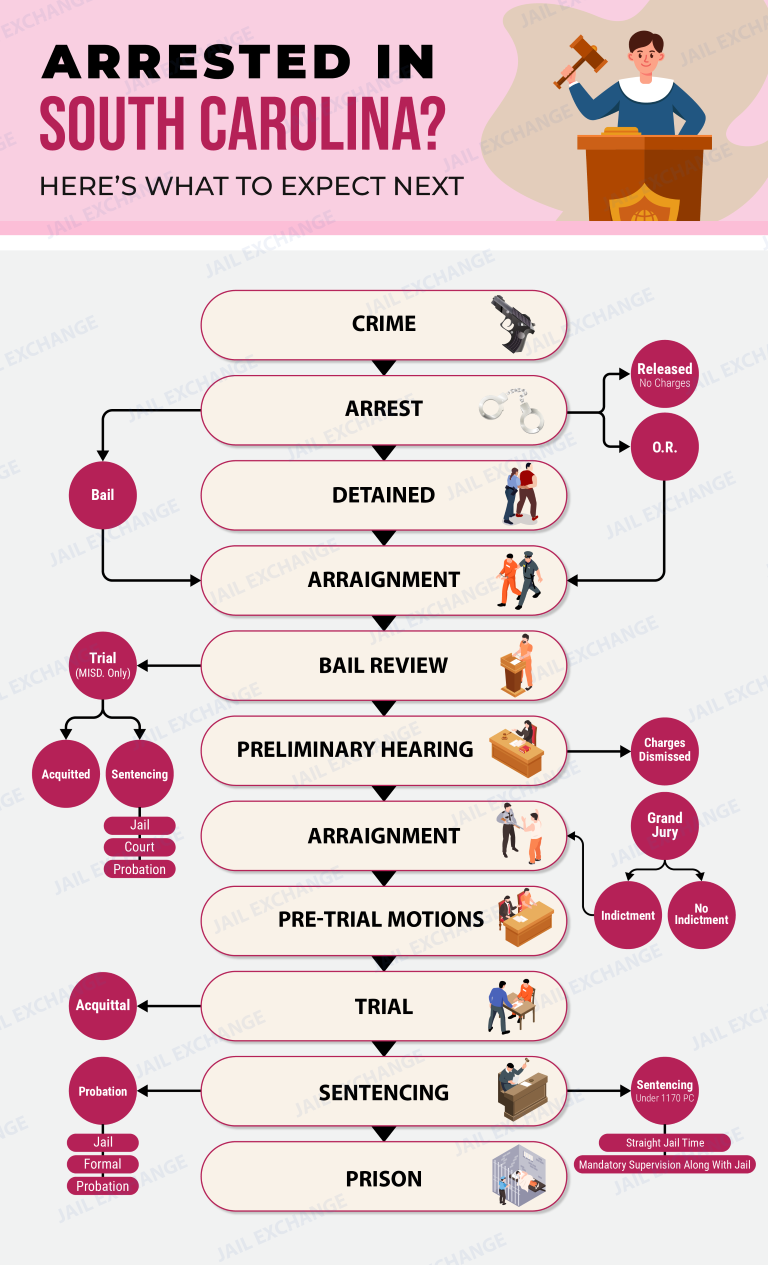
The city of Chester is the county seat of Chester County, which lies along the Catawba and Broad rivers between Rock Hill and Columbia. Summary cases and the first bond decision after an arrest are handled by the county magistrates and by municipal courts in Chester, Fort Lawn and Great Falls, while felonies are tried in the Court of General Sessions at the Main Street courthouse. Chester is one of three counties, with Fairfield and Lancaster, in the Sixth Judicial Circuit, and the Sixth Circuit Solicitor prosecutes its General Sessions docket. People arrested in the county are booked at the Chester County Detention Center on Dawson Drive.
- Chester County Clerk of Court (General Sessions and Family Court), Chester County Courthouse, 140 Main Street, Chester, SC 29706, (803) 385-2605
- Chester County Magistrate Court, Law Enforcement Center, 2740 Dawson Drive, Chester, SC 29706, (803) 581-5136
- Sixth Circuit Solicitor's Office, which prosecutes Chester County General Sessions and juvenile cases
- Sixth Circuit Public Defender, Chester County office, Chester County Courthouse, 140 Main Street, Chester, SC 29706, (803) 385-3232
- Chester County Detention Center (Chester County Sheriff's Office), 2740 Dawson Drive, Chester, SC 29706, (803) 581-2602
Which court hears your case. The Magistrate Court is Chester County's summary court. Its judges try offenses with a ceiling of 30 days in jail or a $500 fine, and the handful of offenses that statutes send there with fines as high as $1,000, among them shoplifting of goods worth $2,000 or less; they also hear first-offense DUI, issue warrants, set bond and hold preliminary hearings. The Municipal Courts of Chester, Fort Lawn and Great Falls handle ordinance violations and the same summary-level state charges when they occur inside town limits. Felonies and higher misdemeanors must be indicted by the Chester County grand jury and are then tried in the Court of General Sessions, the criminal side of the Circuit Court.
Where pretrial inmates are held. Chester's Law Enforcement Center on Dawson Drive puts the Sheriff's Office, the detention center, the magistrate court and the city's municipal court in one complex. Deputies, city and town officers and troopers bring arrestees there, and the bond hearing usually happens in the same building. A person who cannot make bond remains in custody there. Call the detention center at (803) 581-2602 or the Sheriff's Office at (803) 581-5131 with custody questions.
- Local courts in Chester County (magistrate and municipal courts)
- Misdemeanor (for example, shoplifting, a first DUI, third-degree assault and battery, trespassing)
- Felony (for example, burglary, grand larceny, drug distribution, first-degree assault and battery)
- Violent felony (for example, murder, criminal sexual conduct, armed robbery)
- Juveniles (under 18) arrested in Chester County
- Federal cases (U.S. District Court) from Chester County
Local courts in Chester County (magistrate and municipal courts)
Chester County keeps its magistrates in one place: the Law Enforcement Center, next to the Chester County Detention Center, where bond hearings, preliminary hearings and summary trials are all held. Two phone lines serve the office. The three municipal courts meet on their own calendars, so confirm the date with the town before going.
Magistrate court (county)
- Chester County Magistrate Court — 2740 Dawson Drive, Chester, SC 29706, (803) 581-5136 or (803) 581-6506. Covers every part of the county outside the three towns' limits.
Municipal courts
- Chester Municipal Court — Chester Law Enforcement Center, 2740 Dawson Drive, Chester, SC 29706, (803) 581-2133, ext. 249
- Fort Lawn Municipal Court — P.O. Box 37, Fort Lawn, SC 29714, (803) 872-4724
- Great Falls Municipal Court — P.O. Box 177, Great Falls, SC 29055, (803) 482-2145
A defendant in any of these courts may request a jury of six instead of a bench trial. Appeals from a magistrate or municipal conviction are heard by the Circuit Court at the Chester County Courthouse, and the notice generally must be filed within 10 days of sentencing.
Misdemeanor (for example, shoplifting, a first DUI, third-degree assault and battery, trespassing)
Officers in Chester County settle a large share of minor offenses with a ticket or summons instead of an arrest. Someone stopped for DUI on Highway 9 or I-77, accused in a domestic incident, or wanted on a warrant is more likely to be taken to Dawson Drive for fingerprints and a photograph.
Release
State law calls for a bond hearing within 24 hours, and Chester's magistrates hold it at the Law Enforcement Center. Release can be on a personal recognizance bond, a cash or surety bond (licensed bondsmen operate in the county), or a property bond, with conditions such as no contact with the complaining witness. Victims receive notice and may address the magistrate.
Court and counsel
In summary court, the officer who made the arrest often prosecutes the case, while the Sixth Circuit Solicitor's Office may handle DUI or criminal domestic violence. If jail is possible and the defendant cannot afford a lawyer, the Sixth Circuit Public Defender, (803) 385-3232, takes applications; a $40 fee may be charged and can be waived. The defendant chooses between pleading guilty, a bench trial or a six-person jury.
What the charges carry
- Shoplifting worth up to $2,000: up to 30 days in jail or as much as a $1,000 fine.
- Assault and battery in the third degree: no more than 30 days, with a fine capped at $500.
- Trespassing: a maximum of 30 days and $200.
- First-offense DUI under .10: 48 hours to 30 days in jail, or 48 hours of public service in its place; a $400 fine plus assessments; a six-month license suspension that an ignition interlock device can cut short; and the ADSAP alcohol and drug program. Higher readings (.10 to .16, and .16 and up) bring tougher minimums, and refusing the breath test triggers a separate suspension.
Chester misdemeanors can end with dismissal, a conditional discharge, PTI or the alcohol education program, a fine, probation or jail time. Some outcomes qualify for expungement. These cases typically finish in one to three months.
Felony (for example, burglary, grand larceny, drug distribution, first-degree assault and battery)
Chester County felonies open with a magistrate's warrant and end, if not dismissed, in General Sessions at the Main Street courthouse. The Sixth Circuit's judges and prosecutors rotate among Chester, Fairfield and Lancaster counties, so General Sessions meets in Chester for scheduled terms rather than every week.
How the case moves
- Booking and release decision. At the Chester County Detention Center the person is processed, and a magistrate sets bond within 24 hours, sometimes with GPS monitoring or a no-contact order.
- Preliminary hearing. A request must be made within 10 days of the bond hearing. The magistrate then decides whether there is probable cause to continue.
- Grand jury. The Sixth Circuit Solicitor presents the case to the Chester County grand jury, which deliberates privately and decides whether to issue a true bill of indictment.
- Docketing. Indicted cases are placed on the General Sessions roster. Discovery, plea negotiations and pretrial motions follow.
- Plea or trial. Plea agreements resolve most felonies, and if the case is tried, the 12 jurors have to reach a unanimous verdict.
Punishment for common felonies
- Burglary, second degree: up to 10 years, or up to 15 for the violent version, which includes entering a dwelling at night.
- Grand larceny: more than $2,000 up to $10,000, up to 5 years; above $10,000, up to 10.
- Drug distribution: the drug, the amount and the person's record set the range, and trafficking quantities trigger mandatory minimum terms.
- First-degree assault and battery: a 10-year maximum. ABHAN, assault and battery of a high and aggravated nature, can bring up to 20.
South Carolina's felony classes, A through F, carry maximums of 30, 25, 20, 15, 10 and 5 years. A "no parole offense" requires 85 percent of the sentence to be served before release eligibility. Longer sentences are carried out in the South Carolina Department of Corrections. Pretrial intervention can lead to dismissal for many first offenders. A Chester County felony often takes one to two years from arrest to resolution.
Violent felony (for example, murder, criminal sexual conduct, armed robbery)
A Chester County magistrate has no authority to set bond on a charge of murder or any other offense punishable by life imprisonment or death. A circuit judge decides, and the accused waits at the Chester County Detention Center until that hearing. Changes to state law in 2023 and 2024 also added hearings and conditions for defendants charged with violent offenses while out on bond. The Sheriff's Office often works these investigations with the State Law Enforcement Division (SLED).
- Murder: 30 years to life without parole; death is possible when the Solicitor seeks it and an aggravating factor is found. The state ended a long pause in executions in 2024; the methods are lethal injection, the electric chair and the firing squad.
- First-degree criminal sexual conduct: a sentence of up to 30 years, along with placement on the sex-offender registry.
- Armed robbery: at least 10 and as many as 30 years, without parole.
Most violent felonies are "most serious" offenses under the repeat-offender statute, so a second such conviction can mean life without parole. Victims are protected by the state constitution's Victims' Bill of Rights, which guarantees notice of proceedings and a chance to be heard. Chester's violent felony cases usually take one to three years or more.
Juveniles (under 18) arrested in Chester County
When a Chester County youth under 18 is charged, the case goes to Family Court at the county courthouse. The 2019 raise-the-age law put 17-year-olds in Family Court too, with exceptions for certain serious crimes.
Intake
The Department of Juvenile Justice (DJJ) office for Chester County screens the referral, talks with the family and makes a recommendation to the Sixth Circuit Solicitor, who decides whether to dismiss, offer diversion such as arbitration, or file a Family Court petition.
Detention
There is no juvenile detention center in Chester County. A Chester youth who has to be held is typically sent to the Juvenile Detention Center that DJJ runs in Columbia. A Family Court judge must hold a detention hearing, generally within 48 hours excluding weekends and holidays, to decide whether the child is released or stays detained.
Outcomes
- Probation and community programs, often with counseling, school requirements and restitution.
- Commitment to DJJ for a fixed or indeterminate time, at most until the 22nd birthday.
- Waiver to adult court: for certain serious offenses by older juveniles, usually 14 or older, the Solicitor may seek transfer to General Sessions, and the Family Court decides after a hearing.
Juvenile files are confidential, and many can later be expunged. A child has a right to a lawyer, and the Sixth Circuit Public Defender at (803) 385-3232 represents those who qualify.
Federal cases (U.S. District Court) from Chester County
Chester County is assigned by statute to the Rock Hill Division of the U.S. District Court for the District of South Carolina. No federal court currently sits in Rock Hill, and the court routes that division's cases to Columbia, roughly an hour south of Chester on I-77.
Federal offices for Chester County cases
- Matthew J. Perry Jr. U.S. Courthouse, 901 Richland Street, Columbia, SC 29201; Clerk's Office (803) 765-5816
- U.S. Attorney's Office, 1441 Main Street, Suite 500, Columbia, SC 29201, (803) 929-3000
- Federal Public Defender, 1901 Assembly Street, Suite 200, Columbia, SC 29201, (803) 765-5070
Arrest and charging
Cases become federal when an agency like the FBI, DEA, ATF or Homeland Security Investigations takes conduct that violates federal law to the U.S. Attorney. In Chester County that most often means drug trafficking, illegal gun possession by people with felony convictions, fraud, or child exploitation. Some cases could be charged by either system, and prosecutors decide where they go.
Release or detention
The first appearance is before a U.S. magistrate judge, who appoints the Federal Public Defender or a panel lawyer for those who qualify. Federal bail follows the Bail Reform Act. When prosecutors ask to hold the defendant, a detention hearing is generally held within three court days; the judge then sets conditions supervised by U.S. Pretrial Services or orders detention. There are no bondsmen in federal court.
Indictment and trial
A complaint must be followed by a grand jury indictment within 30 days. Under the Speedy Trial Act, trial should begin within 70 days of indictment, although continuances are routine. The large majority of defendants plead guilty, and a federal trial verdict requires every one of the 12 jurors.
Sentencing and appeal
A presentence report from U.S. Probation precedes sentencing. The judge weighs the advisory Sentencing Guidelines and any mandatory minimum. Because federal parole no longer exists, a prisoner serves about 85 percent of the term in the Bureau of Prisons with good-conduct credit, and supervised release follows. The U.S. Court of Appeals for the Fourth Circuit hears appeals.
Locating a federal defendant
Search the Federal Bureau of Prisons inmate locator by name or register number. If the person is awaiting trial in a county jail that houses federal detainees for the Marshals, the jail's own roster may list the person too. Federal prosecutions of juveniles are rare.
This Chester County guide summarizes the usual course of a criminal case and is not legal advice; local court schedules and procedures can change. Anyone charged in Chester County should consult a defense attorney or contact the Sixth Circuit Public Defender's Chester office at (803) 385-3232, and should verify court dates with the Clerk of Court at (803) 385-2605.