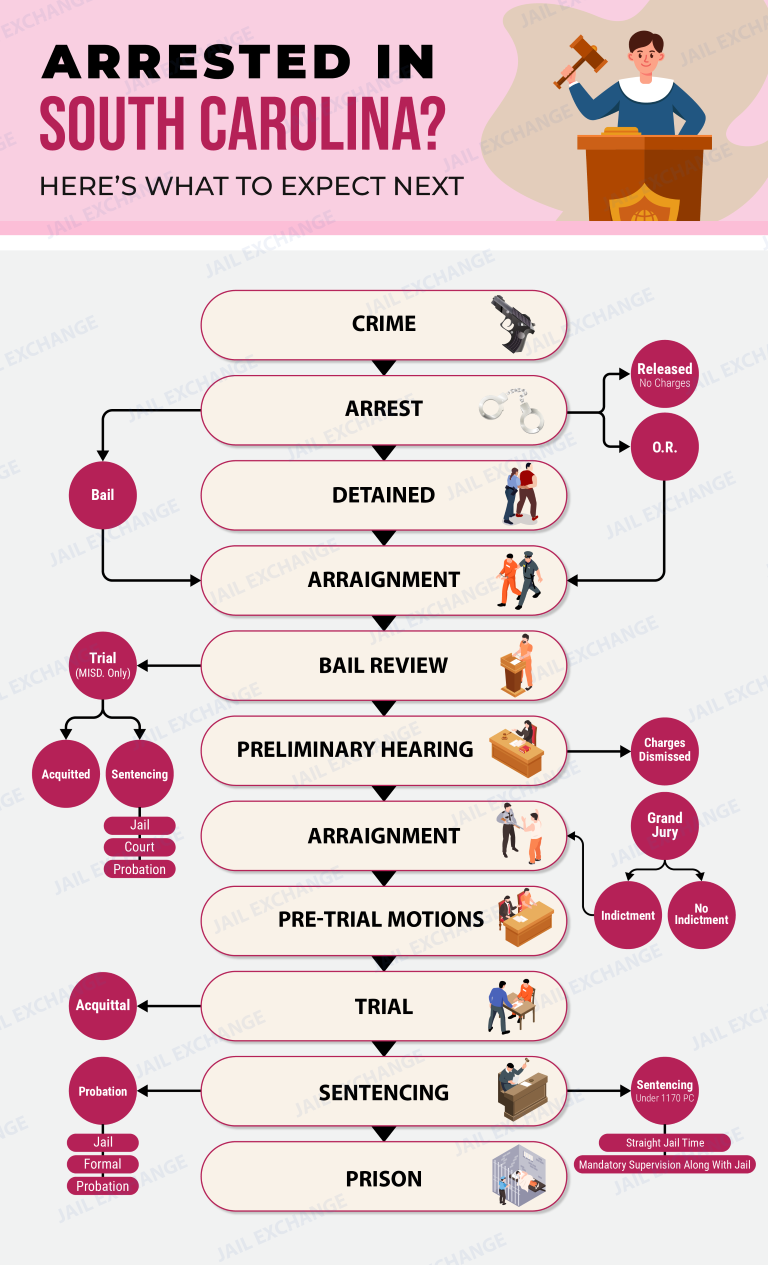
Chesterfield County Detention Center Criminal Court Process
Criminal Court Process for Chesterfield County South Carolina
Chesterfield County Criminal Court Guide
Local criminal cases pass through three spots: Bond Court inside the Chesterfield County Detention Center, 319 Goodale Road, Chesterfield, SC 29709, the courthouse at 200 West Main Street, Chesterfield, SC 29709, and five town courts. Adults awaiting trial stay at the Goodale Road jail. Below: which court gets which charge, each step of a case, and who prosecutes and who defends.
Not sure whether your person is still in custody? Check the Detention Center's confinement lookup. Then try our Inmate Lists page for everything tied to custody: new bookings, active warrants, filed charges, mugshots, appointed counsel and property pickup.
Phone the Clerk of Court, 843-623-2574, on a weekday between 8:30 a.m. and 5:00 p.m. Ask which court owns the case and its next date. To work on getting them home first, head to our bail and release page.
1. Small charge or felony: which bench hears it?
South Carolina routes a charge by the heaviest punishment it can bring:
- Magistrate court tries offenses capped at a $500 fine, 30 days in jail, or both (S.C. Code 22-3-550). Shoplifting of $2,000 or less lands here too, with fines up to $1,000 (S.C. Code 16-13-110). A jury in this court has six members (S.C. Code 22-3-545).
- Town (municipal) courts have the same limits for arrests inside their town lines (S.C. Code 14-25-65).
- The Court of General Sessions sits as the criminal arm of circuit court. Felonies go there, along with misdemeanors too big for summary court, with trial held in whichever county the crime occurred in. Locally that means the Fourth Judicial Circuit, a group that also takes in Darlington, Dillon and Marlboro (S.C. Code 14-5-610).
- Family Court hears charges against children under 18.
Even a felony starts small. Its bond hearing, and any probable cause review, happen in summary court before the file moves up to General Sessions.
↑ Back to the question list2. Where are the Chesterfield County courthouses?
Two buildings matter most. Note the hours before you set out:
- Clerk of Court for General Sessions and Family Court, 200 West Main Street, Chesterfield, SC 29709, 843-623-2574. Open Monday through Friday, 8:30 a.m. to 5:00 p.m. The Family Court desk has its own line, 843-623-6301.
- Central Magistrate Court, 200 West Main Street, Chesterfield, SC 29709, 843-623-9009. The public window runs 9:00 a.m. to 4:30 p.m. on weekdays.
- Bond Court, held at the Detention Center, 319 Goodale Road, Chesterfield, SC 29709, 843-623-2261. Sessions run at 8:30 a.m. and 3:00 p.m. on weekdays, and on weekends from 8:00 to 10:00 a.m. and again at 5:00 p.m. Holiday times change.
Upcoming hearing lists are on the county's court rosters page.
↑ Back to the question list3. Do Cheraw, Pageland and other towns have courts?
Five towns run a municipal court for tickets, town ordinances and minor crimes their own officers charge:
- Cheraw Municipal Court, P.O. Box 219, Cheraw, SC 29520, 843-537-8411
- Town of Chesterfield court, which sits at Town Hall, 112 Main Street, Chesterfield, SC 29709, on the third Tuesday of each month, with no session in December. Court clerk: 843-623-2419.
- Jefferson Municipal Court, P.O. Box 306, Jefferson, SC 29718, 843-658-7600
- McBee Municipal Court, P.O. Box 177, McBee, SC 29101, 843-335-6613
- Pageland Municipal Court, 310 West McGregor Street, Pageland, SC 29728, 843-672-6437
Charges from Mount Croghan, Patrick, Ruby and the open countryside normally go to the Central Magistrate Court instead. Call 843-623-9009 to confirm where a ticket is set.
↑ Back to the question list4. Inside the first hearing at Goodale Road
State law sets a 24-hour clock for the bond hearing, held by a magistrate or town judge (S.C. Code 22-5-510). Locally it happens in a courtroom at the jail. Police must give the judge a packet first: criminal history, open charges, the incident write-up and notice of other bonds (S.C. Code 22-5-510(E)).
- The judge reads the charges and decides between a personal recognizance bond, a money bond or extra conditions.
- The alleged victim may attend and give an opinion on bond.
- Can't pay a lawyer? Say so, and the court can assign a public defender.
- On felony-level charges, a defendant gets 10 days from this hearing to demand a preliminary hearing (Rule 2(a), SCRCrimP).
Family members may watch. Ask Bond Court at 843-623-2261 which session your person is on.
↑ Back to the question list5. Shoplifting and simple assault: how do they play out?
Lighter charges usually begin and end in one summary courtroom. The person may plead guilty, or plead not guilty and choose a bench trial or a six-person jury. Typical charges:
- Third-degree assault and battery: up to $500, 30 days, or both (S.C. Code 16-3-600(E)(2))
- Shoplifting of $2,000 or less: up to $1,000, 30 days, or both (S.C. Code 16-13-110(B))
- Classed misdemeanors (A, B and C) reach three, two and one year, and they belong in General Sessions (S.C. Code 16-1-20)
Diversion is up to the Solicitor. One option, the Alcohol Education Program, serves those from 17 up to their 21st birthday charged with things like underage possession, for a $250 fee (S.C. Code 17-22-520 and 17-22-550). A Traffic Education Program covers some minor traffic charges.
Ticket fines can be paid on the magistrate court's payment page, and any South Carolina ticket can be found with the statewide ticket search.
↑ Back to the question list6. Steps in a felony case, from jail to General Sessions
A felony case usually moves in this order:
- Bond hearing at Goodale Road, or in circuit court for charges punishable by death or life.
- Preliminary hearing. It has to be requested within 10 days after bond is set (Rule 2(a), SCRCrimP). A magistrate tests the State's evidence to see if the case can proceed.
- Solicitor review. The Fourth Circuit Solicitor's office settles the final charges and screens for programs like Pretrial Intervention.
- General Sessions. The case ends with a plea, a trial or a dismissal. Dates for each county are on the Solicitor's court dates page.
A felony's class caps the sentence. Class A allows as much as 30 years, and each step down trims five, so Class F tops out at 5 (S.C. Code 16-1-20). Shoplifting above $2,000 but below $10,000 is a felony with a five-year cap, and $10,000 or more can bring ten.
↑ Back to the question list7. How do violent charges change things?
The legislature's violent-crime list includes murder, carjacking, kidnapping, armed robbery and both top grades of burglary (S.C. Code 16-1-60). That label matters at every stage:
- Bond. A magistrate may grant or refuse it. Murder-type charges, where death or life is on the table, go to a circuit judge.
- Murder penalty. Death, or 30 years to life (S.C. Code 16-3-20(A)).
- No 10 percent deposit is allowed (S.C. Code 17-15-15).
- No Pretrial Intervention (S.C. Code 17-22-50).
- On bond already? Getting charged with a fresh violent or firearm felony cancels the existing bond automatically, and circuit court must take it up inside 30 days (S.C. Code 17-15-55(C)). A violent offense by someone already on bond for one is a separate felony, punishable by five years at most (S.C. Code 17-15-270).
- Quick review. When the State asks to revoke or change a bond, a circuit judge can hold an emergency hearing within 48 hours (S.C. Code 17-15-55(B)).
8. Who prosecutes Chesterfield County cases, and who defends?
The Fourth Circuit Solicitor prosecutes General Sessions cases in four counties: this one, Darlington, Dillon and Marlboro, and keeps a local office at 207 West Main Street, Chesterfield, SC 29709, 843-479-6516.
- Pretrial Intervention (PTI) is for first-time defendants with nonviolent charges, and DUI is excluded. Once PTI is finished, the charge is dropped and an expungement request may follow (S.C. Code 17-22-150). Fees are $100 to apply and $250 to take part (S.C. Code 17-22-110). Details are on the Solicitor's PTI page.
- Other Solicitor options, such as drug court and juvenile arbitration, are listed on the programs page.
On the defense side, the county's public defenders work from 101 West Main Street, Suite B, Chesterfield, SC 29709, 843-623-2286. Applying takes an income affidavit and a $40 fee, which the clerk may shrink or drop (S.C. Code 17-3-30). The state agency over public defense is the South Carolina Commission on Indigent Defense, 1330 Lady Street, Suite 401, Columbia, SC 29201, 803-734-1343.
↑ Back to the question list9. Finding a case file or court date online
The South Carolina Judicial Branch runs a Public Index for this county. It covers local tickets, warrants and most civil cases, showing parties, hearing dates and times, bonds and motions. Search by last and first name. Bond hearings show up under the "Bond Court" agency.
- Upcoming dockets: the court rosters
- General Sessions terms: the Solicitor's calendar
- Tickets anywhere in the state: the ticket search
The Clerk of Court can print a statement of everything filed in a General Sessions case for $10. Bring photo ID, a Social Security number and a date of birth. Magistrate files are kept by that court instead, so call it at 843-623-9009. The Public Index won't tell you where someone is jailed.
↑ Back to the question list10. Checking for and clearing a Chesterfield County warrant
Countywide, the Sheriff's deputies handle warrant service. Inside Cheraw, Pageland, McBee and other towns, local officers do too. For a check, contact the Sheriff's Office, 203 Watson Street, Chesterfield, SC 29709, 843-623-2101, weekdays 8:30 a.m. to 5:00 p.m., or write to its warrants and civil process division. Magistrate warrants appear on the county's Public Index. Statewide, see the probation agency's Most Wanted Offenders (tips 888-761-6175) and the federal 15 Most Wanted list. Resolving one starts with hiring counsel. Next, the two of you go back to the issuing judge, or phone that court's staff for a new date. For General Sessions bench warrants, reach the Clerk of Court, 200 West Main Street, Chesterfield, SC 29709, 843-623-2574.
↑ Back to the question list11. What does a federal prosecution look like from here?
Federal charges filed here go to the Florence Division of the U.S. District Court for the District of South Carolina. The clerk's office is in the McMillan Federal Building, 401 West Evans Street, Florence, SC 29501, 843-676-3820.
- Whether they stay locked up before trial is the question a detention hearing answers when they first see the magistrate judge (18 U.S.C. 3142). Either side can ask to delay it a little: the defense by five days at most, the government by three.
- Federal defendants waiting for trial are in the Marshals' hands. The Marshals' Florence branch sits at 401 West Evans Street, Suite 341, Florence, SC 29501, 843-662-0750. Staff there can say which jail has your person.
- After a prison sentence, the Federal Bureau of Prisons inmate locator shows where they are.
12. Immigration holds and the state prosecution
The local case keeps moving with or without a detainer. Release day is where it bites. Agents lodge Form I-247A, which asks for a hold of up to 48 hours after they would otherwise be released, leaving time for ICE pickup (8 CFR 287.7(d)).
- State law gives jailers 72 hours to verify the legal status of anyone booked for a crime. Those found to be here unlawfully get reported to Homeland Security (S.C. Code 23-3-1100).
- A bond judge must weigh unlawful presence together with flight risk (S.C. Code 22-5-510(D)(4)).
- The ICE office for South Carolina: 3950 Faber Place Drive, North Charleston, SC 29405, 843-746-9800.
- Look up someone in ICE custody with the ICE Online Detainee Locator.
A conviction may change someone's immigration standing, so mention the detainer to defense counsel at once.
↑ Back to the question list13. Prison time after a General Sessions sentence
A judge's sentence decides the place. A sentence of ninety days or less is generally served locally, at the county jail (S.C. Code 24-3-30). Longer terms go to the South Carolina Department of Corrections, which picks the prison and sometimes leaves people in a county jail by agreement (S.C. Code 24-3-20).
- Intake for state prisoners begins with reception and evaluation, and only after that is a prison assigned.
- Track them on the state's incarcerated inmate search, which shows people in state prisons as of the previous midnight.
- The department's headquarters: 4444 Broad River Road, Columbia, SC 29210, 803-896-8500.
- Our South Carolina state prisons guide explains visits and mail.
14. How does a Chesterfield County juvenile case proceed?
Children under 18 go to Family Court at 200 West Main Street, Chesterfield, SC 29709, reached through the Clerk's Family Court desk, 843-623-6301. There's one carve-out: at 17, a teen goes to adult court if the felony charged sits in Classes A to D or could bring 15-plus years (S.C. Code 63-19-20(1)).
- Six hours is the most a teen may spend in an adult jail. Kids 10 and younger can't be locked in any jail or detention center (S.C. Code 63-19-820).
- A detention hearing must take place within 48 hours, weekends and holidays excluded (S.C. Code 63-19-830).
- Youths kept in custody are sent to Columbia, to the state's Juvenile Detention Complex, 1725 Shivers Road, Columbia, SC 29210, 803-896-9440.
- For teens of 14, 15 or 16 accused of grave felonies, a hearing can move the case up to General Sessions (S.C. Code 63-19-1210).
Juvenile Justice staff for this county work from 200 West Main Street, Chesterfield, SC 29709, 843-623-2378.
↑ Back to the question list15. Protections for people harmed by a crime
The state Constitution lists rights for crime victims. They get told when bail will be set and may address the judge. They hear when the accused is caught, freed or escapes, and they can talk with the prosecutor (S.C. Const. art. I, § 24). Police must make a real effort to alert them before bail is set. Without that effort, the judge has to postpone (S.C. Code 16-3-1525).
- Victim Advocacy Division, Attorney General's office: 1000 Assembly Street, Room 519, Columbia, SC 29201, 803-737-3739.
- To get custody updates at no charge, use VINELink South Carolina or call 866-727-2846. Both work in English and Spanish.
Families supporting the accused should keep clear of the alleged victim entirely and pass along no notes or messages. Contact like that can violate bond terms and bring fresh charges.
↑ Back to the question list