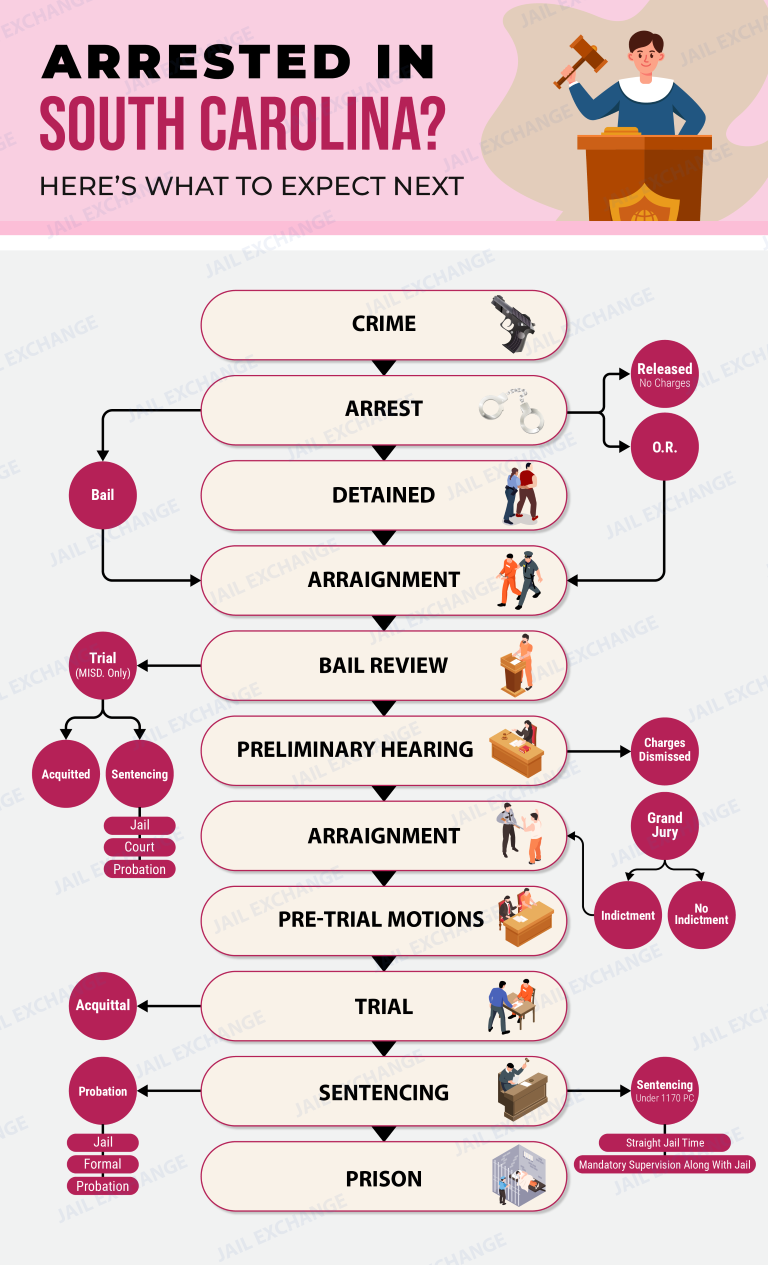
Jasper County Detention Center Criminal Court Process
Criminal Court Process for Jasper County South Carolina
Jasper County Criminal Court Guide
Cases here open with a hearing at the central Bond Court, tucked inside the county Detention Center, 12008 North Jacob Smart Blvd, Ridgeland, SC 29936, the jail for adults arrested in this county. From there, small charges go before a magistrate or a town judge, while felonies head up to the Court of General Sessions. Keep reading for every courthouse, each step of a case, and the lawyers on both sides.
Still held, or already out? The official inmate lookup will tell you by name. Our Inmates in Custody page goes deeper on arrest and jail matters: today's jail population, recent bookings, booking photos, public defenders, active warrants, charges and how property gets returned.
Today, phone the Clerk of Court at 843-726-7710 (weekdays) and jot down two facts: the case number, then the date of the next hearing. If release hasn't happened yet, our bond and release page shows each way to post it.
1. Who hears the case: magistrate, town judge or circuit court?
Criminal cases in this county are split between two tiers of state court.
- Summary courts. That means the county's magistrate offices and the town courts in Hardeeville and Ridgeland. Their limit is a $500 fine, 30 days behind bars, or both (S.C. Code 22-3-550; 14-25-65). They also take shoplifting of $2,000 or under, where the fine may climb to $1,000 (S.C. Code 16-13-110). Summary judges also handle bond and preliminary hearings.
- Court of General Sessions. It is the circuit court wearing its criminal hat. Felonies land here, along with any misdemeanor whose penalty exceeds what summary judges may impose, tried in the county where it happened.
The 14th Judicial Circuit links this county with Allendale, Beaufort, Colleton and Hampton (S.C. Code 14-5-610). All five share a single Solicitor's Office and a single public defender office. Felony case records sit with the Clerk of Court at 265 Russell Street, Ridgeland, SC 29936, 843-726-7710.
Federal crimes are a separate track, handled by the U.S. District Court for the District of South Carolina.
↑ Back to the question list2. Jasper County courthouses: addresses and hours
The county had 38,533 residents as of July 1, 2025, per the Census estimate. Its criminal courts work out of these buildings:
- Clerk of Court, 265 Russell Street, Ridgeland, SC 29936, 843-726-7710. Hours run 9:00 a.m. to 5:00 p.m., Monday to Friday, except legal holidays. General Sessions, Common Pleas and Family Court records are kept here. Spaces near the building fill fast, so come early.
- Bond Court, in the jail building at 12008 North Jacob Smart Blvd, Ridgeland, SC 29936, 843-726-7737. Some judge is on call at every hour. Besides bond, it signs warrants asked for by citizens, deputies and state troopers.
- Magistrate Court, 967 West Adams Street, Ridgeland, SC 29936, 843-726-7933. A branch sits at 21 Martin Street, Hardeeville, SC 29927, 843-784-2628. Each is open from 8:00 a.m. to 4:00 p.m. on weekdays.
- Central Traffic Court, in the same West Adams Street building, 843-726-7717. Sessions are Tuesday and Thursday at 10:00 a.m. and 2:00 p.m. Trooper and deputy tickets come here, and a criminal docket is called once each month.
Coming by I-95 to West Adams Street? Exit at 21 and head west on Main Street (Highway 336). Turn left on Jacob Smart Boulevard (U.S. 17), then right at the first street.
↑ Back to the question list3. Do Hardeeville and Ridgeland have their own judges?
They do. Both towns run a municipal court for tickets and arrests by their own officers and for breaking local ordinances.
- Hardeeville Municipal Court, 26 Martin Street, Hardeeville, SC 29927, 843-784-3366. Its mailing address is P.O. Box 582, Hardeeville, SC 29927. A judge can be reached seven days a week to set bond or issue warrants. On each month's fourth Thursday, the Spanish Language Court sits, and bond hearings happen there too. Fines can be paid with Visa, MasterCard, Discover, a certified check or a money order, but not a personal check.
- Ridgeland Municipal Court sits in Town Hall, 1 Town Square, Ridgeland, SC 29936, starting at 9:00 a.m. on its set dates. Its judge also covers bond and warrants every day of the week. For questions, begin with the town police office at 843-726-7530.
A town judge's power stops where a magistrate's does: $500, 30 days or both (S.C. Code 14-25-65). Larger charges from either town move to General Sessions.
↑ Back to the question list4. Bond hearing day: what should we expect?
S.C. Code 22-5-510 requires the bond hearing within 24 hours after the arrest. Deputy and trooper arrests are heard by Bond Court in the jail building. Town officers' arrests go before the Hardeeville or Ridgeland town judge. For a hearing time, call Bond Court at 843-726-7737. Weekday sessions often begin near 10:00 a.m., and Saturdays and Sundays have sessions of their own.
It is a short hearing. In it, the judge:
- names each charge and tells the person what rights they have
- decides on bond, or hands that choice to a circuit judge for the gravest charges
- starts the request for a court-appointed lawyer
Because victims have a right to advance notice and a voice, staff may pause the hearing while they reach out. Guilt is not decided here, and no plea is taken. The only question is release.
↑ Back to the question list5. Simple assault or shoplifting: how does it play out?
Minor cases (third-degree assault and battery, say, or a shoplifting charge under $2,000) stay in summary court. Arrests by deputies land in Magistrate Court, and town officers send theirs to the Hardeeville or Ridgeland court. Tickets from troopers and deputies go to Central Traffic Court, 967 West Adams Street, Ridgeland, SC 29936, 843-726-7717.
Most of these cases follow a simple path. First the bond hearing, then a court date, then a plea or a trial. Magistrate juries seat six people (S.C. Code 22-3-545). Typical penalties:
- Third-degree assault and battery: $500 fine and 30 days are the most (S.C. Code 16-3-600(E)(2)).
- Shoplifting $2,000 or under: the most is a $1,000 fine and 30 days (S.C. Code 16-13-110(B)).
- Classed misdemeanors are heavier and go to General Sessions. Under S.C. Code 16-1-20, the longest possible jail term is 3 years at Class A, falling a year per step down to Class C.
Fines in traffic court can be paid online by card, but only in full. Mailed payments: a cashier's check or money order only, with no personal or business checks. A payment plan needs a judge's approval in court.
Some first offenses can be diverted by the 14th Circuit Solicitor. Young adults 17 through 20 may qualify for the Alcohol Education Program ($250 fee, S.C. Code 17-22-520 and 17-22-550), and there is a Traffic Education Program as well. Read the Solicitor's court alternatives page or call the main office, 108 Traders Cross, Okatie, SC 29909, 843-779-8477.
↑ Back to the question list6. Jasper County felony: what are the steps?
Felony cases and the more serious misdemeanors are heard by the Court of General Sessions. Here is the usual order of events:
- The arrest, followed by booking at the Detention Center.
- Bond hearing inside 24 hours. If the charge could mean life or a death sentence, a circuit judge rules on bond instead.
- A preliminary hearing, on request. Defense lawyers have a 10-day request window, counted from the bond hearing (Rule 2(a), SCRCrimP). At this hearing a magistrate checks the proof.
- The case moves up to General Sessions, where the 14th Circuit Solicitor prosecutes.
- It ends with a dismissal, a diversion program, a plea or a trial.
The class of a felony sets the longest possible term (S.C. Code 16-1-20). Class F felonies top out at five years; Class A felonies reach 30. Shoplifting between $2,000 and $10,000 is a felony capped at five years, and $10,000 or more can bring ten (S.C. Code 16-13-110(B)).
Facing a first charge that is not violent? Ask the Solicitor about Pretrial Intervention (PTI). Completing PTI ends with a dismissal; an expungement request can follow (S.C. Code 17-22-150). DUI and violent charges are left out. The cost is a $100 application plus a $250 participation fee, and both may be waived for someone with no money (S.C. Code 17-22-110). The Solicitor's main office is at 108 Traders Cross, Okatie, SC 29909, 843-779-8477.
↑ Back to the question list7. Murder, robbery and other violent charges: what's different?
Which crimes count as violent? S.C. Code 16-1-60 holds the full list. It starts with murder and attempted murder. It also takes in armed robbery, carjacking, kidnapping and voluntary manslaughter, plus first or second degree burglary and the two most serious degrees of criminal sexual conduct. A 2026 law added firing a gun at or into a house or other building.
When a charge is on that list:
- Bond may be denied by a magistrate. If life or death is possible, a circuit judge alone decides (S.C. Code 22-5-510(A)). In this county, Bond Court magistrates leave murder and first-degree burglary bonds to others.
- Ten percent deposits are off the table (S.C. Code 17-15-15).
- PTI is closed to the person (S.C. Code 17-22-50).
- Another arrest for a violent or gun felony during a bond on one cancels that bond by law, and new release terms get decided at a General Sessions hearing set no later than day 30 (S.C. Code 17-15-55(C)). The second offense counts as a separate felony with as much as five added years (S.C. Code 17-15-270).
Murder carries a mandatory minimum of 30 years, with life or death as the top (S.C. Code 16-3-20(A)).
↑ Back to the question list8. Solicitor and public defender: where are they?
Prosecution. The 14th Circuit Solicitor's Office brings General Sessions cases for the state. Its office for this county is at 265 Russell St., Ridgeland, SC 29936, 843-779-8729. Hours vary, so call first. The circuit's headquarters is at 108 Traders Cross, Okatie, SC 29909, 843-779-8477.
Defense. If the accused has no money for counsel, a lawyer comes from the 14th Circuit public defender's local office, Court House Square, Annex Building, 262 3rd Avenue, Ridgeland, SC 29936, 843-717-3683. The right to appointed counsel is in S.C. Code 17-3-10. The person signs an affidavit about their money, and a $40 application fee applies unless the clerk lowers it or lets it go (S.C. Code 17-3-30, 17-3-45).
The state body over public defenders is the South Carolina Commission on Indigent Defense, 1330 Lady Street, Suite 401, Columbia, SC 29201, 803-734-1343.
↑ Back to the question list9. Public Index search: finding the case online
The Public Index for this county, run by the South Carolina Judicial Branch and linked by the Sheriff's Office, lets you search by name. Pull up the record to see the case.
That index covers court files only, not who is behind bars. For custody, the official inmate lookup is the right tool.
If you'd rather talk to someone, call the court that has the case:
- General Sessions: Clerk of Court, 265 Russell Street, Ridgeland, SC 29936, 843-726-7710.
- Magistrate matters: 967 West Adams Street, Ridgeland, SC 29936, 843-726-7933.
- Traffic tickets: Central Traffic Court, at the same West Adams Street address, 843-726-7717.
- Hardeeville town cases: 26 Martin Street, Hardeeville, SC 29927, 843-784-3366.
10. Checking for, and clearing, a warrant here
Here, deputies and town officers serve warrants. The Sheriff's Warrants Clerk answers 843-726-7777 weekdays, 9:00 a.m. to 5:00 p.m., and may ask you to visit 12008 North Jacob Smart Blvd, Ridgeland, SC 29936 with photo ID. Ridgeland police keep an outstanding warrants list. Statewide pages: PPP Most Wanted Offenders; the U.S. Marshals keep a national 15 Most Wanted page. Look for court cases on the Public Index. Clearing it takes a trip, lawyer in tow, to the issuing court. Some people start by phoning that court about a new date instead. Clerk of Court: 265 Russell Street, Ridgeland, SC 29936, 843-726-7710.
↑ Back to the question list11. Federal charges from Jasper County: what happens?
The Beaufort Division of the U.S. District Court for the District of South Carolina is where this county's federal cases are filed. That division holds court in Charleston, in the J. Waties Waring Judicial Center at 83 Meeting Street, Charleston, SC 29401. Call the clerk at 843-579-1401.
The steps:
- Detention hearing. At the person's opening appearance, under 18 U.S.C. 3142. Outcomes are release on recognizance, release with conditions, or being held until trial.
- Postponement. The defense can seek as many as five days, the prosecution as many as three. The person waits in custody.
- Pretrial jailer. Federal defendants answer to the Marshals Service until trial. The U.S. Marshals office in Charleston: 85 Broad Street, Room 260, Charleston, SC 29401, 843-727-4255.
- Once sentenced. The Federal Bureau of Prisons takes charge, and its BOP inmate locator finds people by register number or by name.
12. Immigration detainer: does the case go on?
The state charge stays alive and must still be settled in court. What the hold changes is the release day itself. ICE's tool is Form I-247A, sent to the jail. Under 8 CFR 287.7(d) it asks that the person be held up to 48 hours after they would otherwise be released, so agents can pick the person up.
South Carolina law plays a part too. Each criminal booking starts a 72-hour window. Inside it, the jail runs an immigration check. A finding of unlawful presence goes to Homeland Security (S.C. Code 23-3-1100). Bond judges, for their part, factor in unlawful presence and any danger of flight (S.C. Code 22-5-510(D)(4)).
After a pickup by ICE, use the ICE Online Detainee Locator. ICE's office for South Carolina is at 3950 Faber Place Drive, North Charleston, SC 29405, 843-746-9800. Make sure the defense lawyer knows about immigration status before any plea deal, because a conviction can affect it.
↑ Back to the question list13. Jail or prison: where is time served?
Up to three months, the time is normally served in the county jail (S.C. Code 24-3-30). Sentenced people at the Detention Center must take a work assignment.
More than three months, and the person belongs to the South Carolina Department of Corrections, which chooses the prison (S.C. Code 24-3-20). SCDC sends every newcomer through reception and evaluation first. Plan on no in-person visits during that phase, unless it goes past 30 days.
Look up state prisoners in the SCDC inmate search, refreshed daily. SCDC's main office is at 4444 Broad River Road, Columbia, SC 29210, 803-896-8500. For a list of prisons, see our South Carolina state prisons page.
↑ Back to the question list14. Charged before turning 18: which court?
Most cases against people under 18 belong to Family Court (S.C. Code 63-19-20(1)). Adult court takes over for a 17-year-old when the felony ranks Class D or above, or carries 15 or more years. The Clerk of Court keeps Family Court records at 265 Russell Street, Ridgeland, SC 29936, 843-726-7710.
Once a child is taken into custody, a Family Court judge reviews the hold within 48 hours, with weekends and holidays skipped (S.C. Code 63-19-830). Youth kept before trial stay at the Juvenile Detention Complex, 1725 Shivers Road, Columbia, SC 29210 (visitation line 803-896-9440), part of the South Carolina Department of Juvenile Justice. Six hours is the cap for a child in an adult jail. Kids aged 10 or less never go to jail or detention (S.C. Code 63-19-820).
For ages 14 to 16, a judge can, after a hearing, send a serious felony up to General Sessions (S.C. Code 63-19-1210). The local DJJ office is at 1504 Grays Hwy., Ridgeland, SC 29936, 843-726-5666. The 14th Circuit Solicitor also offers juvenile court alternatives.
↑ Back to the question list15. Jasper County crime victims: what rights apply?
Victims' rights are written into the state constitution (S.C. Const. art. I, § 24). Officers owe the victim a real try at notice about the arrest and about bond court, and victims may come and be heard. A judge has to push the hearing back when that notice arrived too late (S.C. Code 16-3-1525). Restitution is another right.
Places that help:
- The 14th Circuit Solicitor's victim services, local office at 265 Russell St., Ridgeland, SC 29936, 843-779-8729.
- The Attorney General's Victim Advocacy Division, 1000 Assembly Street, Room 519, Columbia, SC 29201, 803-737-3739.
- Free custody alerts from SC VINE, in English or Spanish, through VINELink South Carolina or 866-727-2846.
If you are on the side of the accused, stay away from the victim. Do not call, text or send word through friends, since contact can violate the bond.
↑ Back to the question list