Lexington County Detention Center Criminal Court Process
Criminal Court Process for Lexington County South Carolina
Lexington County Criminal Court Guide
After an arrest anywhere from Chapin to Pelion, adults usually land in the Lexington County Detention Center, 521 Gibson Road, Lexington, SC 29072. Three buildings share that site: the 1975 old jail joined to Sheriff headquarters, a 1991 annex holding lower-risk inmates on lesser charges, and a pod-style unit from 1998. Below are the courts, how a case travels from Bond Court to General Sessions, and where to check dates.
The Sheriff's inmate lookup confirms whether your person is still on the Gibson Road roster. Our Jail Roster page is the hub for custody after an arrest. It covers mugshots, fresh bookings, the charges filed, open warrants, court-appointed lawyers, getting belongings back and simply locating a prisoner.
Your first call should be the Clerk of Court at 803-785-8212. Ask which court holds the charges. Copy down the case number and the next hearing's date and hour. Still trying to get someone released? Our bail page explains Bond Court and how to pay.
1. Where do small charges go, and where do felonies go?
South Carolina splits criminal cases between two levels of court.
- Summary courts are the magistrate and municipal (city) courts. They try charges worth a fine of $500 or less, 30 days in jail or less, or both (S.C. Code 22-3-550; S.C. Code 14-25-65). Some laws let them go higher. Shoplifting of $2,000 or less, for example, can carry a $1,000 fine there (S.C. Code 16-13-110). These courts also set bonds and run preliminary hearings.
- The Court of General Sessions is where the circuit court tries crimes. It takes felonies and the larger misdemeanors from the county where the crime happened. This county belongs to the Eleventh Judicial Circuit, together with Saluda, Edgefield and McCormick counties (S.C. Code 14-5-610).
Federal charges are filed in Columbia's federal court instead. Charges against most children go to Family Court.
↑ Back to the question list2. Where are the Lexington County courthouses?
County court offices keep weekday hours of 8 a.m. to 5 p.m. Most sit near East Main Street in the town of Lexington.
- Marc H. Westbrook Judicial Center (General Sessions, Family Court and the Clerk of Court): 205 East Main Street, Lexington, SC 29072, 803-785-8212. Everyone goes through a security screen at the door, and there is nowhere to leave banned items.
- Summary Court Center: 139 East Main Street, Lexington, SC 29072, administration 803-785-2140. Suite A holds Central Traffic and DUI Court, 803-785-2142. Suite B is the town's magistrate, 803-785-2383. Suite C holds Domestic Violence Court, 803-785-2886, which also hears bad check cases.
- Preliminary Hearing Court: also at 139 East Main Street, Lexington, SC 29072, 803-785-2520.
- Bond Court: Law Enforcement Complex, 521 Gibson Road, Lexington, SC 29072, 803-785-2845. Sessions run at 10 a.m. and 3 p.m. on weekdays and from 10 a.m. on weekends and holidays.
- Chief Magistrate's office: 428 Oak Drive, Lexington, SC 29073, 803-785-2568.
Magistrate offices outside the county seat:
- Irmo: 111 Lincreek Drive, Columbia, SC 29212, 803-785-2384
- Batesburg-Leesville: 5585 Augusta Highway, Leesville, SC 29070, 803-785-5013
- Swansea: 500 Charlie Rast Road, Swansea, SC 29160, 803-785-6250
- Oak Grove: 428 Oak Drive, Lexington, SC 29073, 803-785-6251
- Cayce-West Columbia: 650 Knox Abbott Drive, Cayce, SC 29033, 803-785-6267
3. Which towns run their own municipal courts?
A ticket or arrest by town police usually goes to that town's municipal court. These are the ones with confirmed details:
- Cayce Municipal Court: 1800 12th Street, Cayce, SC 29033. The clerk answers at 803-550-9550, weekdays 8:30 a.m. to 4:30 p.m. Court meets Tuesdays at 8 a.m. and Thursdays at 2:30 p.m.
- Irmo Municipal Court: inside Irmo Town Hall, 7300 Woodrow Street, Irmo, SC 29063. The Town Hall number is 803-781-7050. Irmo spreads into Richland County too.
- Columbia Municipal Court: part of the city of Columbia lies in this county. Arrests by city officers on that side go to the city's bond court, held daily at 8 a.m. and 1:30 p.m. Its general line is 803-545-3150.
For a town court that isn't listed, such as West Columbia, Batesburg-Leesville or Springdale, ask the chief magistrate's office at 803-785-2568 where the case sits. The court's name also appears on the ticket or the bond papers.
↑ Back to the question list4. What goes on at Bond Court the first time?
The first stop is the bond hearing, usually at Bond Court inside the Law Enforcement Complex, 521 Gibson Road, Lexington, SC 29072, 803-785-2845. State law sets it within 24 hours of arrest (S.C. Code 22-5-510).
- A magistrate explains each charge, then sets release terms.
- No plea is taken. The case isn't decided here.
- The victim may come and speak about bond.
- The person can say they want a lawyer and request one from the public defender's office.
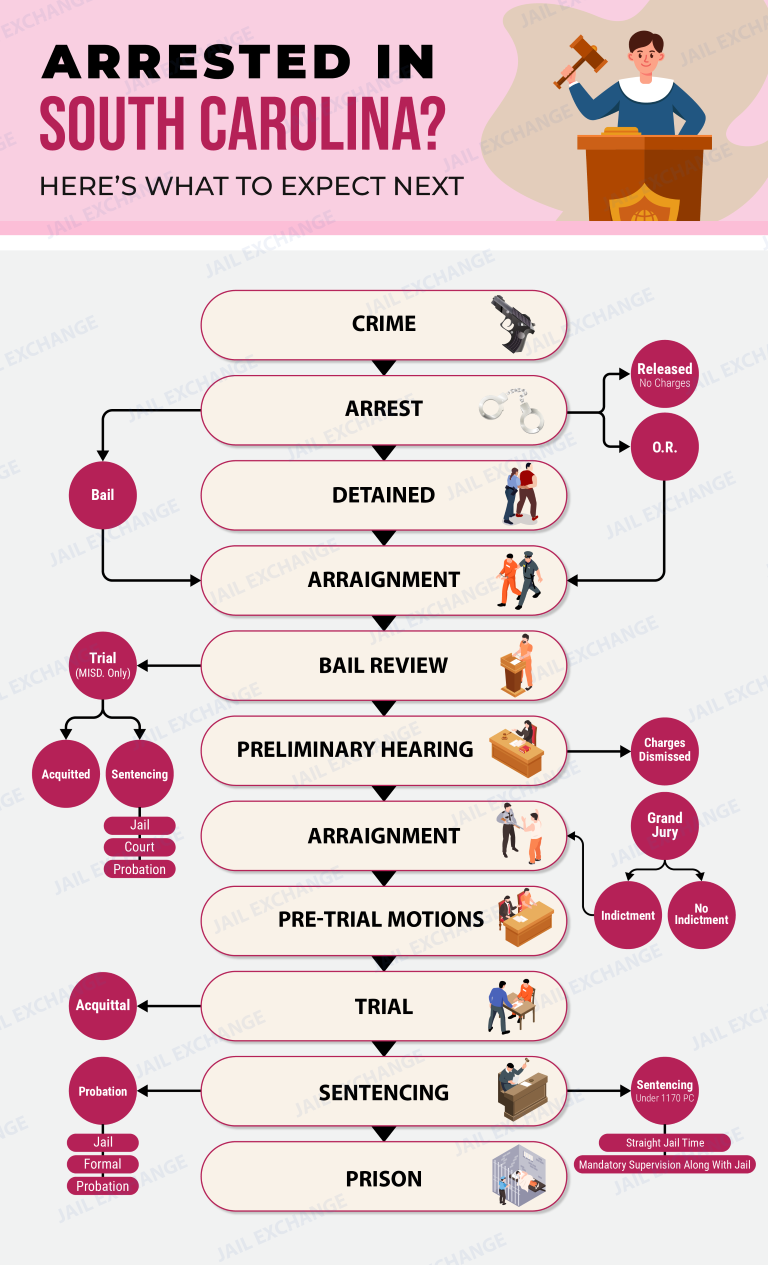
For a charge a magistrate can't try, such as a felony, the person may demand a preliminary hearing. That demand has a deadline: 10 days from the bond hearing (Rule 2(a), SCRCrimP). It tests whether there is enough proof to keep the case going. For Sheriff's or state warrants, it is held at Preliminary Hearing Court, 139 East Main Street, Lexington, SC 29072, 803-785-2520. Town police warrants are heard in that town's court. If neither the person nor a lawyer shows up, the hearing is waived. The accused can't testify or call witnesses there.
↑ Back to the question list5. How do assault, shoplifting and DUI cases move?
Small cases stay in the summary courts. The ticket or bond papers name the court and the date. Typical charges here:
- Third-degree assault and battery: up to $500, up to 30 days, or both (S.C. Code 16-3-600(E)(2)). Cases between family or partners go to Domestic Violence Court, 139 East Main Street, Lexington, SC 29072, 803-785-2886.
- Shoplifting of $2,000 or less: up to $1,000 and 30 days (S.C. Code 16-13-110).
- DUI and traffic crimes: handled by Central Traffic and DUI Court, 803-785-2142. Ask that court about the penalty for the exact charge.
On the court date, the person may plead guilty or not guilty. Pleading not guilty opens the door to a trial, and magistrate juries seat six people (S.C. Code 22-3-545). Some first-time cases can be sent to a Solicitor's program instead:
- The Alcohol Education Program, for ages 17 to 20 with no earlier alcohol charge. Its fee is $250, which can be cut or waived (S.C. Code 17-22-520 and 17-22-550).
- The Traffic Education Program, for minor traffic charges.
- The Worthless Check Unit, 803-785-8142, for bad check charges.
6. How does a Lexington County felony case move?
Felony cases go through these stages:
- Bond hearing within 24 hours at Bond Court.
- Preliminary hearing, when the defense files a timely request.
- Solicitor review. The prosecutor's office studies the file, chooses the final charges and may offer a plea deal or a diversion program.
- General Sessions term. The case is placed on a court roster at the Judicial Center. The person must come to each date on it.
- Plea or trial. A circuit judge hands down any sentence.
Each class has a ceiling on prison time (S.C. Code 16-1-20):
- Top terms run 30 years for Class A, then 25, 20, 15, 10 and 5 for B through F.
- Class A, B and C misdemeanors max out at 3, 2 and 1 year.
For roster dates, call the General Sessions office at 803-785-8223.
↑ Back to the question list7. How do violent-crime cases differ?
State law names certain crimes as violent (S.C. Code 16-1-60). Examples include murder and attempted murder; armed robbery and carjacking; kidnapping; and first- or second-degree burglary or criminal sexual conduct. That label matters at several stages:
- Bond. A magistrate may deny bond. Bond in murder cases, and in cases that could bring a life sentence or execution, is set only by a circuit judge.
- New charge while out. When a person is charged with another violent or gun-related felony while bonded out on one, state law cancels the original bond automatically, and a circuit judge has 30 days to hold a hearing on it (S.C. Code 17-15-55(C)).
- Added charge. A violent crime done during bond for an earlier violent crime brings an extra felony count worth as much as five years (S.C. Code 17-15-270).
- No PTI. Pretrial Intervention is closed to violent charges (S.C. Code 17-22-50).
A murder conviction means at least 30 years and up to life, or death (S.C. Code 16-3-20(A)).
↑ Back to the question list8. Which offices prosecute and defend Lexington County cases?
The Eleventh Circuit Solicitor's Office prosecutes General Sessions cases. Its main office is at 205 East Main Street, Suite 309, Lexington, SC 29072, 803-785-8352. The Clerk of Court uses that same number for questions about which prosecutor has a case.
The Eleventh Circuit Public Defender's Office takes the cases of defendants who lack money for private counsel. Its office is at 202 East Main Street, Lexington, SC 29072, 803-785-8873. Apply through the Clerk's public defender line, 803-785-8549. Expect a sworn money form and a $40 fee that the clerk can lower or waive (S.C. Code 17-3-30).
The Solicitor's Diversion Programs office runs Pretrial Intervention (PTI). It is at 205 East Main Street, Suite 105, Lexington, SC 29072, 803-785-8197.
- PTI is for first-time, nonviolent charges and can be used once.
- Fees are a $100 application fee and a $250 participation fee, plus any provider costs and restitution. State law lets them be waived for people who can't pay (S.C. Code 17-22-110).
- The office takes fees by U.S. Postal money order and sees people only by appointment.
- When the program is finished, the Solicitor drops the charge. After that, the record can be cleared through expungement (S.C. Code 17-22-150). The expungement line is 803-785-8037.
9. How do I track the case online or by phone?
Three free Judicial Branch tools cover this county:
- Public Index for case records, searched by name or case number.
- Circuit court rosters for General Sessions dates.
- Summary court dockets for magistrate court dates.
The Public Index tracks court cases. To learn where a person is held, use the Sheriff's inmate lookup.
By phone, the Docket Clerk is at 803-785-8583 and the Clerk's criminal desk at 803-785-8553. Give staff the person's full name and birthday. Traffic tickets and fines can be paid on the county's online payments page.
↑ Back to the question list10. Warrants: how do you check for one and clear it?
Deputies from the Sheriff's Department serve most warrants, while town officers handle their own. Call the Warrant Division at 803-785-2499 on business days, or the county's non-emergency line, 803-785-2521, at night. In Cayce, bench warrant questions go to Public Safety at 803-794-0456. Two statewide lists help: the U.S. Marshals 15 Most Wanted roster, and Probation, Parole and Pardon Services' Most Wanted Offenders page. A clerk can confirm a court warrant by phone or at the counter. To settle one, the person should line up a lawyer first. Next comes a voluntary surrender to the issuing court, or a call to that clerk's office for a new date. Felony warrant help: Clerk of Court, 205 East Main Street, Lexington, SC 29072, 803-785-8212.
↑ Back to the question list11. How are Lexington County federal charges handled?
Any federal case that starts here belongs to the Columbia Division of the U.S. District Court for the District of South Carolina. Hearings happen in a downtown federal building known as Matthew J. Perry, Jr. U.S. Courthouse, 901 Richland Street, Columbia, SC 29201, 803-765-5816. Business hours are 8:30 a.m. to 4:30 p.m. on weekdays.
- At a defendant's first federal court appearance, the judge decides on detention or release (18 U.S.C. 3142). The defense may get that hearing moved up to five days out; the government, three.
- Deputy U.S. marshals guard federal defendants until trial and move them between jail and court. The Columbia office is at 901 Richland Street, Suite 1300, Columbia, SC 29201, 803-765-5821.
- After a prison sentence, the person moves to a federal prison. Find them with the Federal Bureau of Prisons inmate locator.
12. Will an immigration detainer affect the state charges?
A detainer doesn't pause the state charges. Its bite comes at release time. Through Form I-247A, federal agents ask the Gibson Road jail to keep the person up to 48 hours after they would otherwise be released, which gives ICE time for a pickup (8 CFR 287.7(d)).
- Jails here get 72 hours to run a status check on people held on criminal charges (S.C. Code 23-3-1100). A finding of unlawful presence gets reported to Homeland Security.
- Bond judges must weigh unlawful presence along with flight risk (S.C. Code 22-5-510(D)(4)).
- Any noncitizen should get the defense lawyer's advice on immigration risks before taking a plea.
- Once ICE has the person, search the ICE Online Detainee Locator.
- ICE's South Carolina office is at 3950 Faber Place Drive, North Charleston, SC 29405, 843-746-9800.
13. What happens after a prison sentence here?
Sentences of three months or shorter are normally served at the Gibson Road jail (S.C. Code 24-3-30). Longer terms go to the South Carolina Department of Corrections, which assigns the prison (S.C. Code 24-3-20).
- New SCDC arrivals first go through a classification stage. Families usually wait to visit in person until that period is over; a stay longer than 30 days is the exception.
- Once a prison is assigned, the SCDC inmate search shows it along with the living unit.
- SCDC is based at 4444 Broad River Road, Columbia, SC 29210, 803-896-8500.
- Our South Carolina state prisons section has pages for each prison.
After release, probation and parole run through the state's county office at 605 West Main Street, Suite 104, Lexington, SC 29072, 803-359-2551.
↑ Back to the question list14. What happens to a Lexington County teen who is charged?
Family Court takes charges against people younger than 18. It meets at the Judicial Center, 205 East Main Street, Lexington, SC 29072, and you reach it through the Clerk of Court at 803-785-8212. The exception covers 17-year-olds. If the felony is Class A to D, or its top penalty reaches 15 years, the teen faces adult court instead (S.C. Code 63-19-20(1)).
- When a teen stays locked up, a detention hearing follows within 48 hours. That clock skips Saturdays, Sundays and holidays (S.C. Code 63-19-830).
- Teens aged 14 to 16 can face a waiver hearing, after which a judge may move a serious felony to General Sessions (S.C. Code 63-19-1210).
- Many first offenses go to the Solicitor's Juvenile Arbitration program. Ask the Diversion office at 803-785-8197.
- Youth held before court usually go to the Juvenile Detention Complex, 1725 Shivers Road, Columbia, SC 29210, 803-896-9440.
The Department of Juvenile Justice's county office is at 605 West Main Street, Lexington, SC 29072, 803-359-5526.
↑ Back to the question list15. How does the law protect victims in this county?
South Carolina's constitution gives victims a voice in the case (S.C. Const. art. I, § 24). Police have to make a fair effort to notify a victim of the arrest and of the bond hearing date. The victim may attend Bond Court and share their view with the judge. A hearing set without enough warning to the victim has to be pushed back (S.C. Code 16-3-1525).
- Free alerts on custody changes come from VINELink South Carolina or the phone line at 866-727-2846, which works in Spanish as well as English.
- Advocates in the state Attorney General's Victim Advocacy Division can help at 803-737-3739.
- For case updates, call the Solicitor's Office at 803-785-8352.
Anyone close to the accused should stay well clear of the victim. That means no calls, no texts and no messages sent through friends. Any of those may break the bond's conditions and lead to new charges.
↑ Back to the question list