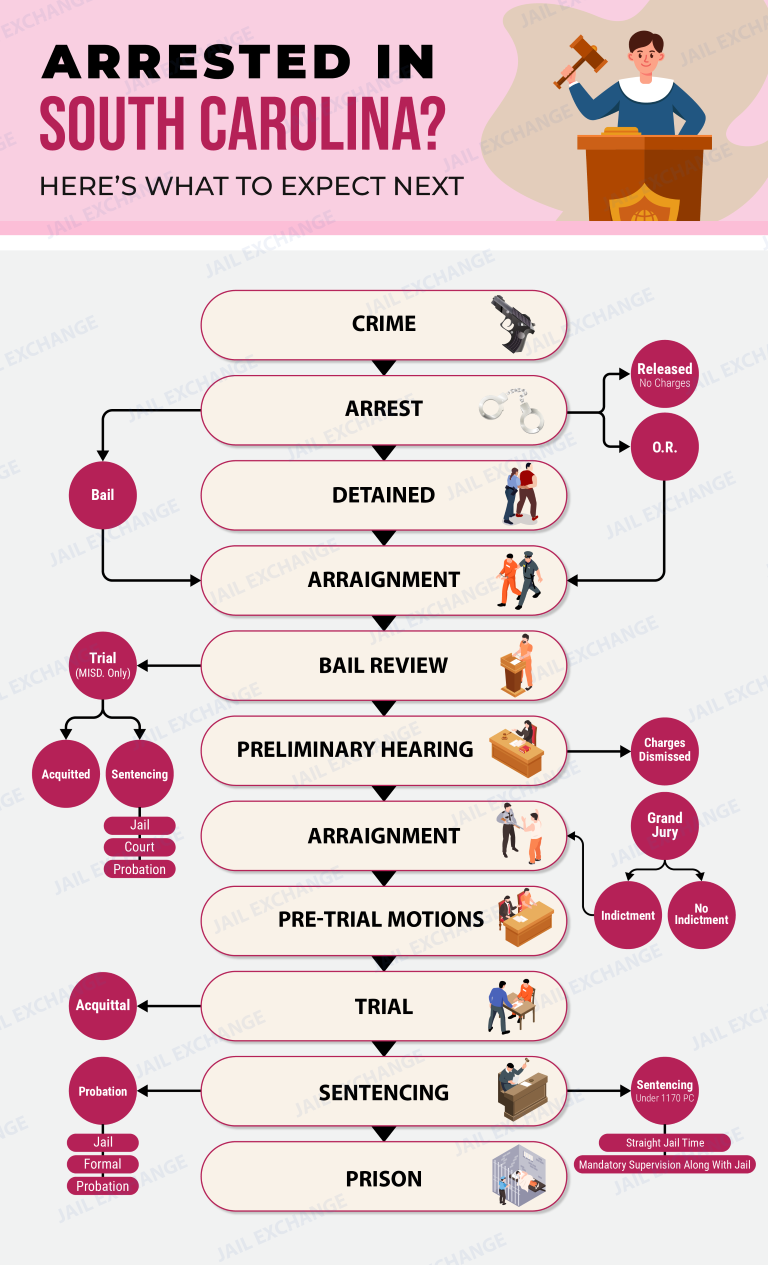
Marion County Detention Center Criminal Court Process
Criminal Court Process for Marion County South Carolina
Marion County Criminal Court Guide
Two court levels handle crimes from this county. Summary court, meaning the Magistrate's Office or one of four town courts, hears the start of every case, and serious ones move up to the Court of General Sessions. While a case is open, adults who cannot make bond stay at the Marion County Detention Center, 2715 E. Highway 76, Suite D, Mullins, SC 29574. Below are the court offices, the path a case takes, and ways to track dates and warrants.
Is your person still in jail? The jail's current inmate list will tell you. Our Jail Roster page answers custody questions, such as recent bookings, warrants on file and charge details. It also covers booking photos, finding a person who is held, applying for a public defender and collecting property.
For the court and the date, ring the Clerk of Court at 843-423-8240. If bond has not been posted yet, our bail page walks through bond court and paying.
1. Which Marion County court takes my person's charge?
Two layers of state court handle crimes in this county:
- Summary courts. This means the Magistrate's Office plus the four town courts. They try lesser charges, usually capped at a $500 fine, 30 days in jail, or both (S.C. Code 22-3-550, 14-25-65). Some laws raise that cap. Shoplifting of $2,000 or less, for one, can bring a $1,000 fine (S.C. Code 16-13-110). Bond court and preliminary hearings are summary court jobs as well.
- The Court of General Sessions. As the criminal arm of the circuit court, it takes every felony and the heavier misdemeanors for crimes committed in the county. The 12th Judicial Circuit covers just two counties, this one and Florence (S.C. Code 14-5-610).
Most charges against people under 18 go to Family Court, which works through the Clerk of Court, 1305 N Main St, Marion, SC 29571, 843-423-8240. Federal crimes are tried in Florence, at 401 West Evans Street, Florence, SC 29501, 843-676-3820.
↑ Back to the question list2. Where are Marion County's criminal court offices?
- Magistrate's Office, 2715 East Highway 76, Suite B, Mullins, SC 29574, 843-292-5238. A single countywide office runs bond court, minor criminal and traffic cases and preliminary hearings. Bonds and fines are taken weekdays from 8:30 a.m. to 4:00 p.m., holidays excepted. Its email is Magistratecourt@marionsc.org.
- Clerk of Court for General Sessions and Family Court, 1305 N Main St, Marion, SC 29571, 843-423-8240. Hours run Monday to Friday, 8:30 a.m. to 5:00 p.m. Letters go to P.O. Box 295, Marion, SC 29571.
The Magistrate's Office stands on Highway 76 in the same complex as the Detention Center, roughly halfway between Mullins and the city of Marion. For the courtroom where a General Sessions hearing will be held, ask the Clerk's staff.
↑ Back to the question list3. Which towns hold their own court?
Marion, Mullins, Nichols and Sellers each keep a municipal court. A town court hears ordinance violations, traffic tickets and small crimes from inside town limits, and its judge can set bond (S.C. Code 14-25-115).
- Marion Municipal Court, 1024 S. Main St., Marion, SC 29571, 843-423-8616
- Mullins Municipal Court, 151 E. Front St., Mullins, SC 29574, 843-464-0707
- Nichols Municipal Court, 514 West Mullins Street, Nichols, SC 29581, 843-526-2193
- Sellers Municipal Court, 2552 Hwy 301, Sellers, SC 29592, 843-752-5009
Pay a town ticket through that town's own court. The county's online ticket link serves Magistrate tickets. Charges from outside town limits go to the Magistrate's Office at 843-292-5238.
↑ Back to the question list4. How does the bond hearing go?
This is the first step in every case. Bond court meets on weekdays at 9:00 a.m. and 3:00 p.m., and at 9:00 a.m. on weekends and holidays. The hearing has to be held inside the first 24 hours after arrest (S.C. Code 22-5-510). At that session:
- The magistrate goes over each charge and picks the type and amount of bond.
- Police supply the judge with the criminal history, other open charges and any bonds the person already has (S.C. Code 22-5-510(E)).
- A victim may be told of the hearing and may speak. The session can be held back so the victim can come.
- Weekday sessions also take guilty pleas on minor charges.
Charges beyond a magistrate's trial power allow a preliminary hearing, but only if your person asks. The request must come within 10 days after bond court (Rule 2(a), SCRCrimP). The hearing, held by a magistrate, checks whether there is enough proof for the case to go on.
↑ Back to the question list5. How are small charges like shoplifting or simple assault handled?
Small cases never leave summary court:
- The court date appears on the ticket, the summons or the bond paperwork.
- Anyone wanting a jury in magistrate court must ask in writing before that date. Six people sit on that jury (S.C. Code 22-3-545).
- Fines on many minor cases can be paid at the Magistrate's Office.
- Skipping the date brings a bench warrant, and a driver's license can be suspended until it is cleared.
Maximum sentences for some common charges:
- Third-degree assault and battery: $500 and 30 days (S.C. Code 16-3-600(E)(2)).
- Shoplifting goods worth $2,000 or less: $1,000 and 30 days.
- Class A, B and C misdemeanors, tried in General Sessions: three years, two years and one year (S.C. Code 16-1-20).
6. Which dates follow a felony arrest?
The 12th Circuit Solicitor prosecutes felonies in the Court of General Sessions. That office publishes a calendar giving each arrest two early court dates, based on the months when the arrest took place:
- Arrested July through September 2026: initial appearance October 8, 2026; docket appearance November 5, 2026.
- Arrested October through December 2026: initial appearance January 14, 2027; docket appearance March 18, 2027.
- Arrested January through March 2027: initial appearance April 22, 2027; docket appearance June 8, 2027.
The class of a felony limits how long a sentence can run (S.C. Code 16-1-20). Class A carries up to 30 years. Classes B, C and D cap at 25, 20 and 15 years. Classes E and F cap at 10 and 5. Murder carries the harshest range of all, starting at 30 years and reaching life or death (S.C. Code 16-3-20(A)). Stealing more than $2,000 worth of goods from a store is a felony as well.
Dates can move, so confirm yours with the Clerk of Court at 843-423-8240.
↑ Back to the question list7. What changes for a violent or very serious felony?
A charge on the state's violent offense list shifts the case in several ways (S.C. Code 16-1-60):
- Bond. The magistrate can decline to set bond. For murder or a crime punishable by death or life, bond is out of the magistrate's hands entirely, and a circuit judge sets it (S.C. Code 22-5-510(A)).
- Arrest while on bond. If a new violent or gun felony arrest comes while an earlier bond is in force, that earlier bond is voided, and the circuit court reviews it within 30 days (S.C. Code 17-15-55(C)). Such a crime is also chargeable on its own as a felony, worth up to five years (S.C. Code 17-15-270).
- Deposits. The 10 percent cash bond option is closed (S.C. Code 17-15-15).
- Diversion. Pretrial Intervention will not accept violent charges (S.C. Code 17-22-50).
- Young defendants. Grave felony charges against children 14 to 16 may move to General Sessions once a transfer hearing is held (S.C. Code 63-19-1210).
8. Which office prosecutes, and where is the public defender?
Felony prosecution belongs to the 12th Circuit Solicitor's Office, which covers Florence County as well. You will find its local branch at 101 Court St., Marion, SC 29571, 843-431-5040. The main office is at 180 N. Irby St., Florence, SC 29501, 843-665-3091. Forms and program details are on the Solicitor's website.
No money for a lawyer? Your person can apply for a public defender. Applying means signing a sworn statement about money and paying a $40 fee, which the clerk can shrink or waive (S.C. Code 17-3-30, 17-3-45). The public defender's county office is at 221 North Main Street, Marion, SC 29571, 843-423-3303. Statewide questions go to the South Carolina Commission on Indigent Defense, 1330 Lady Street, Suite 401, Columbia, SC 29201, 803-734-1343.
↑ Back to the question list9. Which programs can lead to a dismissal?
Entry into a diversion program is the Solicitor's call. The 12th Circuit runs these:
- Pretrial Intervention (PTI) for first-time, nonviolent charges. Completing PTI gets the charge dismissed. After that, an expungement request is possible (S.C. Code 17-22-150). It costs a $100 application fee and a $250 participation fee, $350 in all, and people who cannot pay can have the fees waived (S.C. Code 17-22-110). DUI and violent charges are excluded.
- Alcohol Education Program for people aged 17 to under 21, with a $250 fee (S.C. Code 17-22-550).
- Traffic Education Program for small traffic tickets.
- Treatment courts: veterans treatment court, adult DUI court, a program for first DUI offenses, plus drug courts for adults and for juveniles.
- Youth programs: juvenile arbitration and juvenile PTI.
To apply, contact the Solicitor's local office, 101 Court St., Marion, SC 29571, 843-431-5040.
↑ Back to the question list10. Where can I track a Marion County case online?
- Open the South Carolina Judicial Branch case records search and pick this county from the list.
- See the county's court rosters for upcoming General Sessions terms.
- Phone the Clerk of Court, 1305 N Main St, Marion, SC 29571, 843-423-8240, about General Sessions and Family Court dates.
- Phone the Magistrate's Office, 2715 East Highway 76, Suite B, Mullins, SC 29574, 843-292-5238, about bond court, preliminary hearings and minor cases.
Searches work best when you know the legal name and birth date. Court records show the case, not the jail. To see whether your person is still held, use the jail's inmate list.
↑ Back to the question list11. How do we check and clear a warrant here?
Deputies with the Sheriff's Office handle warrant service outside town limits, while police in Marion, Mullins, Nichols and Sellers handle it in town. Ask the Sheriff's Office whether a warrant exists by calling 843-423-8216, or the Magistrate's Office, 2715 East Highway 76, Suite B, Mullins, SC 29574, 843-292-5238, since its records cover bench warrants for missed court. For wanted fugitives, check the state probation agency's Most Wanted Offenders. Federal fugitives show up on the U.S. Marshals' 15 Most Wanted. Talk to a lawyer before trying to clear a warrant. Your person can then report to the court that signed the warrant, while the lawyer asks for a new date if needed. For a General Sessions warrant, call or visit the Clerk of Court: 1305 N Main St, Marion, SC 29571, 843-423-8240.
↑ Back to the question list12. What if the case lands in federal court?
Federal charges against people from this county go to the U.S. District Court for the District of South Carolina, Florence Division, at the McMillan Federal Building, 401 West Evans Street, Florence, SC 29501, 843-676-3820.
- A detention hearing comes right at the first appearance. The federal judge decides there whether your person goes home or stays held, though a short postponement is possible if either side requests it (18 U.S.C. 3142).
- Ask the U.S. Marshals' Florence office, 401 West Evans Street, Suite 341, Florence, SC 29501, 843-662-0750, where a federal defendant is being held before trial.
- After a sentence, the Federal Bureau of Prisons inmate locator accepts a name or a BOP register number.
13. Will an ICE detainer affect the local charge?
A detainer can affect custody, but the local charge still proceeds. The steps:
- ICE's request to hold someone comes on Form I-247A, called a detainer.
- Under 8 CFR 287.7(d), the jail can hold the person for up to 48 hours after they would otherwise be released, so that ICE can take custody.
- Jails in this state check within 72 hours whether people booked on criminal charges are lawfully present. If someone lacks lawful status, the Department of Homeland Security is notified (S.C. Code 23-3-1100).
- Unlawful presence, together with flight risk, is on the list of things a bond judge has to consider (S.C. Code 22-5-510(D)(4)).
Search for someone in ICE custody on the ICE Online Detainee Locator, or call ICE at 3950 Faber Place Drive, North Charleston, SC 29405, 843-746-9800.
↑ Back to the question list14. Where does someone serve a prison term from these courts?
Short terms usually stay local. The Detention Center, 2715 E. Highway 76, Suite D, Mullins, SC 29574, 843-423-0121, keeps people sentenced to 90 days or less (S.C. Code 24-3-30). If the term runs past three months, custody shifts to the South Carolina Department of Corrections, which assigns the prison (S.C. Code 24-3-20).
- State prisoners begin with reception and evaluation before they are placed.
- Find them on the SCDC incarcerated inmate search, which is refreshed each night.
- SCDC headquarters: 4444 Broad River Road, Columbia, SC 29210, 803-896-8500.
- Our guide to South Carolina state prisons lists each prison's rules.
15. How are cases against teens handled in Marion County?
Family Court hears nearly every charge against a child under 18. At 17, though, a serious charge changes things. Charges in felony Classes A through D, or felonies that can bring 15 years, send a 17-year-old to adult court (S.C. Code 63-19-20(1)).
- Officers call the Department of Juvenile Justice, which must answer within an hour and advise whether the child needs to be held (S.C. Code 63-19-810(B)).
- No child stays in an adult jail past six hours. Nobody ten or younger may be jailed (S.C. Code 63-19-820).
- Detained youths are taken to the Juvenile Detention Complex, 1725 Shivers Road, Columbia, SC 29210, 803-896-9440.
- Family Court then holds a detention hearing, at most 48 hours later, skipping weekends and holidays (S.C. Code 63-19-830).
- When a child aged 14, 15 or 16 is accused of a serious felony, a transfer hearing can shift the case to General Sessions (S.C. Code 63-19-1210).
The juvenile justice office serving this county is at 1305 North Main St., Marion, SC 29571, 843-431-1110. Filings in Family Court go through the Clerk of Court at 843-423-8240.
↑ Back to the question list16. Which rights protect crime victims in Marion County?
The state constitution (S.C. Const. art. I, § 24) and state law (S.C. Code 16-3-1525) give victims these rights:
- Notice of the arrest and the bond hearing, and a chance to speak there. A judge must postpone a bond hearing if the victim was told too late.
- Word when the accused is released or escapes, and time to confer with the prosecutor.
- Prompt restitution.
The Sheriff's Office has a Victim Services division, and the Detention Center tells victims when someone is let out. Reach the Sheriff's Office at 1811 North Hwy 501 Bypass, Marion, SC 29571, 843-423-8216. For free custody alerts, use VINELink South Carolina or call 866-727-2846. Another resource is the Attorney General's Victim Advocacy Division, 1000 Assembly Street, Room 519, Columbia, SC 29201, 803-737-3739.
Steer clear of the victim if you are close to the accused. Even a message sent through a friend can break bond conditions.
↑ Back to the question list