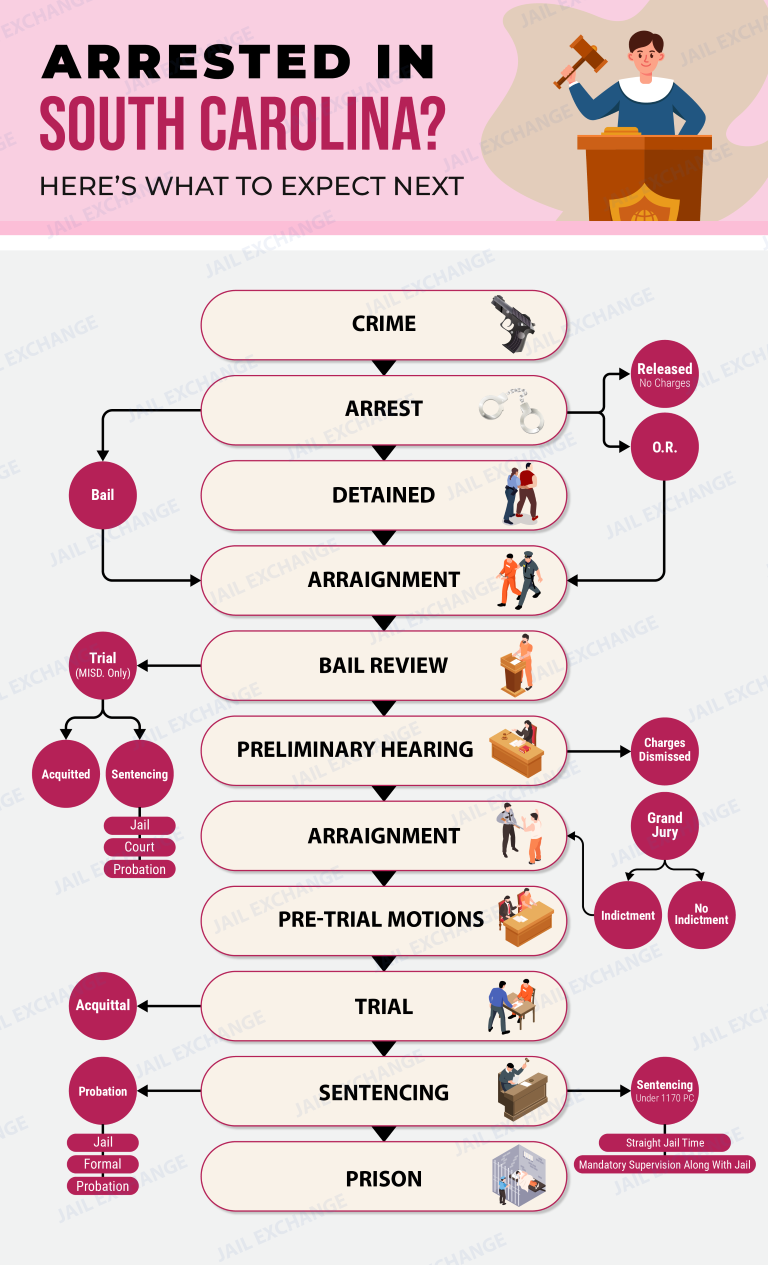
Sumter County Sheriff's Office Detention Center Criminal Court Process
Criminal Court Process for Sumter County South Carolina
Sumter County Criminal Court Guide
Two downtown buildings handle almost every criminal case here: Summary Court on East Canal Street for lesser charges, and the Judicial Center on North Harvin Street for felonies. Adults who are arrested wait at the Sumter County Sheriff's Office Detention Center, 1250 Winkles Road, Sumter, SC 29153. This guide covers each court, how charges move forward, the prosecutor and public defender offices, and tracking a court date.
To confirm someone is locked up, check the official inmate lookup, which names current inmates and their bail. For the arrest and custody side, see our Inmates in Custody page. It helps with locating a person, warrants still active, the charges filed, mugshots, public defenders and property release.
Phone the Clerk of Court at 803-436-2227, weekdays 8:30 a.m. to 5 p.m. Ask staff which court is handling the case and the next date on its calendar. Still waiting on release? Our bail page covers bond step by step.
1. Which court takes minor charges, and which takes felonies?
The work splits between two levels of court. Minor charges stay in summary court, which means the county magistrates and the city court. Those judges can hand down a fine as high as $500, a jail term as long as 30 days, or both (S.C. Code 22-3-550; S.C. Code 14-25-65). A few laws give them more room. Shoplifting of $2,000 or less, for example, can bring a $1,000 fine there (S.C. Code 16-13-110).
Felonies and the heavier misdemeanors go to the Court of General Sessions. That court is the circuit court's criminal branch, and it hears each case in the county where the offense happened. Along with Clarendon, Lee and Williamsburg, this county makes up the Third Judicial Circuit (S.C. Code 14-5-610).
Magistrates also set most bonds and hold preliminary hearings, even on felony charges. A magistrate trial with a jury uses six jurors (S.C. Code 22-3-545).
↑ Back to the question list2. Where do Sumter County criminal courts sit?
Every office below keeps weekday hours of 8:30 a.m. to 5 p.m.
- Judicial Center (Court of General Sessions and Family Court): Clerk of Court, third floor, 215 N. Harvin St., Sumter, SC 29150, 803-436-2227. The General Sessions desk in Room 311 answers at 803-436-2264.
- Summary Court (county magistrates): 190 E. Canal St., Sumter, SC 29150, 803-436-2280. Its mail goes to P.O. Box 1428, Sumter, SC 29151.
- Municipal Court (city cases): 190 E. Canal Street, Sumter, SC 29150, 803-436-2290.
- Bond hearings: inside the Detention Center, 1250 Winkles Road, Sumter, SC 29153, 803-436-2340.
- U.S. District Court (federal cases): 901 Richland Street, Columbia, SC 29201, 803-765-5816.
3. Is there a city court in town?
Yes. The City of Sumter runs a Municipal Court at 190 E. Canal Street, Sumter, SC 29150, 803-436-2290. It is open Monday through Friday, 8:30 a.m. to 5 p.m. Charges written by city police inside city limits usually land there.
A city judge works under the same limits as a magistrate: up to $500, up to 30 days, or both (S.C. Code 14-25-65). City judges can also set and accept bonds (S.C. Code 14-25-115). The city's court page links the state's online ticket payment site for tickets and fines.
For a ticket from Mayesville, Pinewood or another small town, call the county Summary Court, 190 E. Canal St., Sumter, SC 29150, at 803-436-2280. Staff can tell you which court has it.
↑ Back to the question list4. What should families expect at bond court?
The first hearing is the bond hearing. State law sets a 24-hour deadline for it (S.C. Code 22-5-510). Here, it takes place inside the Detention Center, 1250 Winkles Road, Sumter, SC 29153, with a magistrate presiding. The jail lists sessions on weekdays at 8 a.m. and 2 p.m. Weekend and holiday sessions take place in the morning when needed.
- The magistrate reads the charges and sets bond and release conditions.
- The judge gets the person's record and a list of other open cases from the arresting agency.
- A victim has the right to be there and speak.
- For murder and other charges that can mean life in prison, the magistrate cannot set bond. A circuit judge does that later.
For a charge too serious for magistrate court, the defense has 10 days after the bond hearing to request a preliminary hearing (Rule 2(a), SCRCrimP). There, a magistrate checks for probable cause to send the case on. To confirm the session time, call 803-436-2340.
↑ Back to the question list5. What happens in a Summary Court assault or shoplifting case?
Lesser charges start and end in Summary Court, 190 E. Canal St., Sumter, SC 29150, 803-436-2280, or in city court. A typical path looks like this:
- An officer writes a ticket or gets a warrant, and the person is booked or told when to show up.
- The person goes to court on that date and pleads guilty or not guilty.
- After a not guilty plea, the case is tried before a judge, or before a jury of six.
- If found guilty, the judge sets the fine, jail time or both.
Two charges come up often here. Third-degree assault and battery carries up to $500 and 30 days (S.C. Code 16-3-600(E)(2)). Shoplifting of $2,000 or less carries up to $1,000 and 30 days (S.C. Code 16-13-110(B)).
Some young people can ask for the Alcohol Education Program. It is open to people 17 to under 21 with no past alcohol charge, and its fee is $250 (S.C. Code 17-22-520 and 17-22-550). A first minor traffic charge may fit the Traffic Education Program (S.C. Code 17-22-310).
↑ Back to the question list6. What are the steps in a General Sessions felony case?
A felony moves from the magistrate's bond hearing up to the Court of General Sessions at the Judicial Center, 215 N. Harvin St., Sumter, SC 29150. The Clerk's criminal line is 803-436-2232. The Solicitor's Office in that building, 803-436-2185, sets the General Sessions calendar, not the Clerk.
- Bond hearing at the jail, usually within a day.
- A preliminary hearing before a magistrate, when the defense requests one by the deadline.
- The case is filed in General Sessions and assigned to a prosecutor.
- Plea talks between the prosecutor and the defense.
- A trial, if there is no deal, and then sentencing.
The class of the felony sets the top sentence. The worst class, A, allows up to 30 years. Each class below drops five years, down to Class F at five years (S.C. Code 16-1-20). Shoplifting over $2,000 but under $10,000 counts as a felony carrying as much as five years. At $10,000 or more, it can mean up to ten years (S.C. Code 16-13-110(B)).
First-time, nonviolent defendants may qualify for Pretrial Intervention. The Third Circuit asks people to apply within 75 days of arrest or before indictment. Fees are a $100 application fee and a $250 participation fee. Both may be waived for people without the means to pay (S.C. Code 17-22-110). Completing the program gets the charge dismissed, after which the person may apply to have the record expunged (S.C. Code 17-22-150). Call the PTI office at 803-436-2197.
↑ Back to the question list7. How are violent or serious felonies handled differently?
State law lists which crimes count as violent (S.C. Code 16-1-60). Examples include murder, kidnapping, armed robbery, carjacking, certain drug trafficking and burglary in the first or second degree. In 2026, firing a gun into a home or other building was added (2026 Act No. 138). Only crimes named on the list count.
- Bond. A magistrate may refuse bond on a listed violent crime. For murder and other charges that carry a possible death sentence or life term, only a circuit judge sets bond.
- Repeat cases. Picking up another violent or gun felony charge while out on bond for one ends that earlier bond on its own. A circuit court must hear the matter within 30 days (S.C. Code 17-15-55(C)).
- Fast review. The state can ask a circuit judge for an emergency hearing on bond within 48 hours (S.C. Code 17-15-55(B)).
- No PTI. People charged with a violent crime or DUI can't use Pretrial Intervention (S.C. Code 17-22-50).
- Murder. A conviction brings death or a minimum of 30 years, up to life (S.C. Code 16-3-20(A)).
8. Which offices bring charges and defend the accused?
The Third Circuit Solicitor's Office prosecutes General Sessions cases and juvenile cases in Family Court. Its local office is in the Judicial Center, 215 N. Harvin St., Sumter, SC 29150, 803-436-2185, open weekdays 8:30 a.m. to 5 p.m. That office also runs Pretrial Intervention, Juvenile Arbitration and help for victims.
The Third Circuit Public Defender works in Room 151 of that building, 215 North Harvin Street, Room 151, Sumter, SC 29150, 803-436-2424. Its alternative number is 803-774-6137. To ask for a lawyer, fill out the county's Application for Counsel. A sworn money statement is required, along with a $40 fee that the clerk can reduce or waive (S.C. Code 17-3-30).
The South Carolina Commission on Indigent Defense oversees public defenders statewide from 1330 Lady Street, Suite 401, Columbia, SC 29201, 803-734-1343.
↑ Back to the question list9. Where can I look up a Sumter County case?
The state court system runs a free Public Index for this county. Follow these steps:
- Open the Public Index and pick a search by name or case number.
- Enter the last name, then the first. If many names come up, add a birth date to narrow them.
- Open the case to see charges, its status and coming dates.
- Check the court rosters for the cases set on a given day.
The Public Index shows court cases. It does not show where a person is jailed. For General Sessions dates, call the Clerk at the Judicial Center, 215 N. Harvin St., Sumter, SC 29150, 803-436-2227. A certified copy of a sentence sheet costs $10. For magistrate dates, call Summary Court, 190 E. Canal St., Sumter, SC 29150, at 803-436-2280.
↑ Back to the question list10. Is there a warrant out in Sumter County?
Deputies in the Sheriff's Civil Process (Warrants) Division serve warrants for the city and county from 1281 North Main Street, Sumter, SC 29153, 803-436-2020. City police serve them as well. To check, call that line or search the Public Index. Lists of wanted people: the Marshals' top 15 fugitives, the state's Probation, Parole and Pardon Services Most Wanted and the Sheriff's Most Wanted. A lawyer can help clear it, either by planning a turn-in or by asking the judge who signed the warrant to reset the date. Magistrate warrants run through Summary Court, 190 E. Canal St., Sumter, SC 29150, 803-436-2280.
↑ Back to the question list11. How does a federal case from here work?
Federal crimes are charged in the U.S. District Court for the District of South Carolina. This county belongs to the Columbia Division. Its courthouse, named for Matthew J. Perry, Jr., is at 901 Richland Street, Columbia, SC 29201, 803-765-5816. The clerk is open weekdays from 8:30 a.m. to 4:30 p.m.
- The judge rules on detention at the defendant's first appearance (18 U.S.C. 3142).
- A delay is possible: as much as five days when the defense requests it, or three when the government does.
- Deputy U.S. Marshals take charge of anyone held for trial. Reach the Columbia office at 901 Richland Street, Suite 1300, Columbia, SC 29201, 803-765-5821.
- For someone already sentenced, use the Federal Bureau of Prisons inmate locator.
12. How do ICE holds and state charges interact?
The state charges go on as usual. What a detainer changes is release: it can keep the person locked up after the state case would free them. Here is the order of things:
- U.S. Immigration and Customs Enforcement (ICE) lodges a hold, called Form I-247A, at the jail.
- When the person is due for release, the jail can keep them up to 48 hours after they would otherwise be released (8 CFR 287.7(d)).
- Within that window, ICE can take the person into its own custody.
- Search the ICE Online Detainee Locator. It needs the person's country of birth plus either their name or their A-number.
- ICE's South Carolina office is at 3950 Faber Place Drive, North Charleston, SC 29405, 843-746-9800.
South Carolina adds two rules. Within 72 hours, a jail must check the immigration status of anyone it holds on a criminal charge, and it must alert the Department of Homeland Security about anyone unlawfully present (S.C. Code 23-3-1100). A judge setting bond must think about unlawful presence and flight risk (S.C. Code 22-5-510(D)(4)). Before any plea, tell the defense lawyer the person's immigration status.
↑ Back to the question list13. Which prison system takes people sentenced here?
A sentence of 90 days or less stays under county control, usually in the local jail (S.C. Code 24-3-30). Anything longer goes to the South Carolina Department of Corrections, which picks the place (S.C. Code 24-3-20). The state can even place someone in a county jail by agreement.
- Step one for a new state inmate is a stay in reception and evaluation. If that stay lasts 30 days or less, family cannot visit in person during it.
- Next, staff pick a prison that matches the person's needs and security level.
- Use the Department of Corrections inmate search to find them. It reflects custody as of the prior midnight and leaves out county inmates.
- Department headquarters: 4444 Broad River Road, Columbia, SC 29210, 803-896-8500.
- Each state prison is described on our South Carolina state prison listings.
14. How are cases against children handled?
Family Court hears most cases against people under 18 (S.C. Code 63-19-20(1)). Its clerk is at the Judicial Center, 215 N. Harvin St., Sumter, SC 29150, 803-436-2366. Prosecutors from the Solicitor's Office at that address, 803-436-2185, handle these cases and offer Juvenile Arbitration to some first-time youth.
- When a child is held, the law gives 48 hours to hold a detention hearing, and that clock pauses over weekends and holidays (S.C. Code 63-19-830).
- A teen aged 14 to 16 with a serious felony charge can be sent to adult court. A judge must first look into the case and hold a hearing (S.C. Code 63-19-1210).
- Most detained youth end up at the state's Juvenile Detention Complex, 1725 Shivers Road, Columbia, SC 29210, 803-896-9440. Its JDC Annex was formerly the Midlands Evaluation Center.
- The local juvenile justice office is at 20 Magnolia St., Sumter, SC 29150, 803-778-2368.
15. How are victims in Sumter County cases protected?
Victims hold rights under South Carolina's Constitution: notice of bond hearings and a voice at them, word of an arrest, release or escape, and full restitution (S.C. Const. art. I, § 24). Officers have to make a reasonable try to give victims notice of a bond hearing early enough to attend (S.C. Code 16-3-1525).
- The Sheriff's victim advocate works from 1281 North Main Street, Sumter, SC 29153, 803-436-2044.
- The Solicitor's Office has victim services for General Sessions and Family Court cases at 215 N. Harvin St., Sumter, SC 29150, 803-436-2185.
- VINELink South Carolina sends free custody updates. Its phone line, 866-727-2846, works in English and Spanish.
- The state Attorney General runs a Victim Advocacy Division at 1000 Assembly Street, Room 519, Columbia, SC 29201, 803-737-3739.
A word for the defendant's family: keep clear of the victim, and refuse to relay notes or messages. That contact can violate the bond and land the person back in jail.
↑ Back to the question list