Bennett County Sheriff's Office Criminal Court Process
Criminal Court Process for Bennett County South Dakota
Bennett County Criminal Court Guide
Criminal cases filed in Bennett County are heard in Martin, where one Clerk of Courts office at 202 Main, Martin, SD 57551 serves both the magistrate and circuit courts. Adults waiting on those cases sit in the Winner City Jail, 217 E 3rd St., Winner, SD 57580, because the county has a jail contract with that city. This guide maps the route from arrest to sentence.
First, make sure no release has happened yet, using the official inmate lookup. Then come back to our Inmates in Custody page, which takes on the arrest end of things. It covers who's locked up today, the latest bookings, pending charges, a live warrant and mugshots. It also covers appointed lawyers and claiming property.
Next, phone the Martin clerk at 605-685-6969. Get three facts: the case number, the coming hearing and whether the file is in magistrate or circuit court. Getting someone home before trial is the job of our bail page.
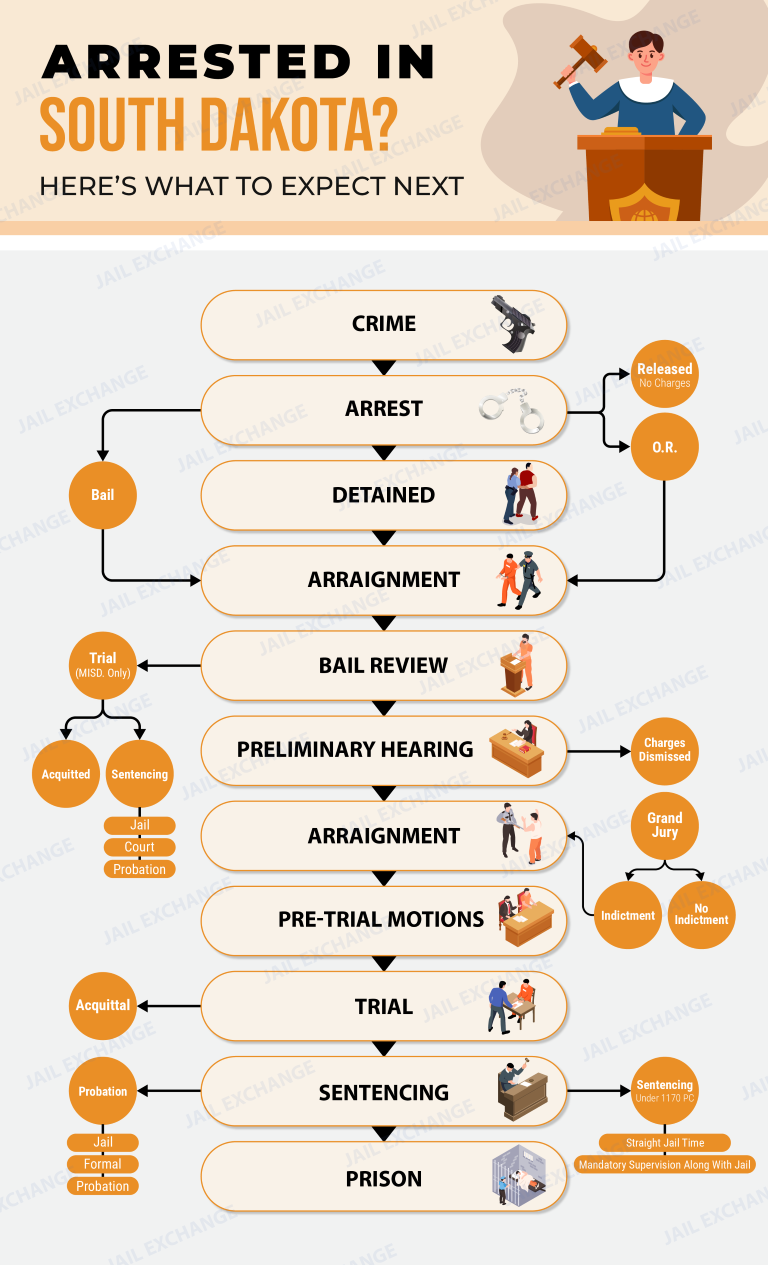
1. Misdemeanor or felony: which Martin court decides it?
Every courtroom in the state belongs to the Unified Judicial System, which has seven circuits. Bennett falls in the Sixth. Its two trial courts share the Martin clerk's office:
- Magistrate court (SDCL 16-12B-11) rules on misdemeanors plus city ordinance tickets. It also issues warrants (SDCL 16-12B-5), fixes bond (SDCL 16-12B-7) and runs first appearances (SDCL 16-12B-10). Pleas are allowed there on any charge topping out at $2,000 or a year behind bars (SDCL 16-12B-8).
- Circuit court owns felonies and juvenile cases.
Felonies start small. Bond and the first appearance happen in magistrate court, and then the file moves up for a plea or trial in circuit court.
↑ Back to the question list2. Where is the courthouse for Bennett County cases?
Court business runs through the Clerk of Courts at 202 Main, Martin, SD 57551, 605-685-6969, fax 605-685-1075. Window hours are 8:00 a.m. to noon and 12:30 to 4:30 p.m., Monday through Friday, on Mountain time. The Sheriff's Office is attached to the courthouse, at 201 State Street, Martin, SD 57551, 605-685-6515.
- Court Services, which supervises Bennett probationers, has its office at 200 E 3rd St, Winner, SD 57580, 605-842-3551.
- Sixth Circuit Drug & DUI Court meets at 8 E. Second Ave., Fort Pierre, SD 57532, 605-220-3850. People get in by referral. Whether a Bennett file fits is a question for defense counsel. The statewide Division of Treatment Courts answers at 605-773-4161.
Before a hearing, call the clerk to confirm the courtroom and time.
↑ Back to the question list3. Where do Martin city ordinance cases go?
To the same magistrate court that hears county misdemeanors. Ordinance violations belong to magistrate court by statute (SDCL 16-12B-11), so a ticket written under a Martin ordinance lands on the county docket.
Paperwork for those cases runs through the Clerk of Courts, 202 Main, Martin, SD 57551, 605-685-6969. Owed fines may be settled with a card through the state's ePayments site, or by signing a payment plan at the clerk's window. Tribal ordinance cases on Pine Ridge Reservation land go to Oglala Sioux Tribe court instead.
↑ Back to the question list4. What does the first hearing in Martin look like?
SDCL 23A-4-1 tells officers to bring an arrested person to the nearest open magistrate, and its phrase is "without unnecessary delay." The hearing can run in person or over a video screen. Pleading waits for a later day.
Under SDCL 23A-4-3, the magistrate walks through these points:
- what the complaint accuses the person of
- the choice of paying for a lawyer or requesting an assigned one
- pretrial release and any bond
- that no statement is required
- for felony complaints only, a chance at a preliminary hearing
Sixth Circuit judges also fill in a bond findings form explaining why a simple promise to return is or isn't enough.
↑ Back to the question list5. How is a Martin DUI or other misdemeanor handled?
The State's Attorney starts a misdemeanor with a complaint in magistrate court. The person then enters a plea. Saying not guilty sets up a trial.
- Class 1: the cap is one year in county jail (SDCL 22-6-2), plus or instead of a $2,000 fine. First and second DUIs sit here.
- Class 2: a 30-day jail cap, with a fine of up to $500 on top or instead.
- Where the top penalty is $500 or 30 days, a clerk magistrate (SDCL 16-12C-11) can accept the plea and pass sentence.
The speedy trial rule (SDCL 23A-44-5.1) gives the state 180 days, starting at the first appearance in Martin. Postponements the defense requests are excluded from that clock. For DUI sentences and probation, a judge may require the 24/7 Sobriety Program (SDCL 1-11-21).
↑ Back to the question list6. What are the stages of a Bennett County felony case?
- Bond and first appearance, both in magistrate court.
- Preliminary hearing (SDCL 23A-4-3). Here a judge asks if there is enough evidence to go on. Bennett defendants held in Winner get one within 15 days; those out on bond, within 45. Waiving it is allowed, and an indictment wipes it out.
- Formal charge. The State's Attorney typically charges by information, a written accusation. Bennett grand juries, six to ten people each (SDCL 23A-5-1), gather only if a circuit judge calls them in.
- Circuit court, for the plea, motions and any trial, still under the 180-day rule.
- Sentence, once guilt is admitted or proven.
Maximum terms rise with the class. Class 6, the lowest, allows two years at most (SDCL 22-6-1), with a fine capped at $4,000. After that come five years for Class 5, ten for Class 4, fifteen for Class 3, 25 for Class 2 and 50 for Class 1. Probation is presumed for Class 5 and Class 6 (SDCL 22-6-11).
↑ Back to the question list7. Do violent charges face stricter rules here?
Yes, at several stages:
- Bond. The clerk's schedule skips murder, kidnapping and first-degree manslaughter, so a judge sets those bonds. Holding someone with no bail at all takes a capital charge and strong proof (S.D. Const. art. VI, § 8).
- Heavier classes. Class C and Class B felonies carry life. A Class A felony carries death or life. Fines for Class 2 felonies and above can reach $50,000.
- Domestic abuse. A judge sets bond (SDCL 25-10-40), and the person must leave the alleged victim's home and family alone until that first hearing.
- Jury strikes. The top four felony classes (SDCL 23A-20-20) let each side drop 20 would-be jurors for any reason.
- Federal reach. The Major Crimes Act (18 U.S.C. 1153) sends crimes like murder or robbery by an Indian person in Indian country to federal court.
8. Which offices prosecute and defend in Bennett?
Adult and juvenile crimes here are charged by the State's Attorney, 501 2nd Avenue, Martin, SD 57551, 605-685-6986, open weekdays 8:00 a.m. to 4:30 p.m. Mountain time. Staff there can't advise private people or act as anyone's lawyer.
On defense, the county funds an appointed lawyer whenever someone can't pay for one (SDCL 23A-40-7, 23A-40-8). Ask for one at the first appearance, or turn in form UJS-224R to the Clerk of Courts, 202 Main, Martin, SD 57551, 605-685-6969. Repayment can be ordered later (SDCL 23A-40-10), and a county lien may follow, though it can never take the homestead (SDCL 23A-40-15).
Appeals work differently. The state Office of Indigent Legal Services, set up in 2024, takes direct criminal appeals.
↑ Back to the question list9. Where can I see Bennett County court dates online?
- The state runs Find a Court Date at no charge. Look up coming hearings with a name or case number. A county calendar for the next ten court days, today included, is there too.
- UJS eCourts shows docket entries in public files, and searches are free.
- PARS returns case summaries back to 1989 for $20 a search, charged even on a blank result.
- Courthouse access terminals let you look at what a PARS summary lists.
For anything older than 1989, or a fast answer, ring the clerk at 605-685-6969 with the defendant's full legal name and birthday ready.
↑ Back to the question list10. How do you learn about a warrant and clear it?
Bennett deputies serve arrest and bench warrants. Ask about one at the Sheriff's Office, 201 State Street, Martin, SD 57551, 605-685-6515, or after hours through Dispatch, 605-842-1014. On tribal land, Oglala Sioux Tribe Public Safety handles tribal warrants from 977 Horse Thief Road, Pine Ridge, SD 57770, 605-867-8101. Online, see the DOC Most Wanted list naming escapees and walkaways, the state Sex Offender Registry, and the case search on UJS ePayments, which marks active warrants. Clearing one starts with a lawyer's call. After that, the person turns in at the courthouse whose judge signed it, or the clerk can talk about a fresh court date: 202 Main, Martin, SD 57551, 605-685-6969.
↑ Back to the question list11. When does Oglala Sioux Tribe court take the case?
Some Bennett land lies inside the Pine Ridge Reservation, where Oglala Sioux Tribe police patrol. A tribal member arrested by tribal officers on a tribal charge usually ends up in tribal court. Custody then passes to the tribe's jail in Pine Ridge, SD 57770, run by the tribe's Department of Corrections, 605-867-8187. See its JE facility page.
These tribal offices are all in Pine Ridge, SD 57770:
- Tribal Court Administration: 605-867-5151
- Tribal prosecutor (Attorney General): 605-867-2095
- Tribe headquarters: 107 West Main Street, Pine Ridge, SD 57770, 605-867-5821
Serious crimes on the reservation can go to federal court instead. Arrests by county deputies go to state court in Martin and the Winner jail.
↑ Back to the question list12. What happens if Bennett County charges turn federal?
The Western Division of the U.S. District Court for the District of South Dakota handles any federal case out of Bennett, from the federal building at 515 Ninth Street, Rapid City, SD 57701.
- The federal judge settles detention at the opening hearing (18 U.S.C. 3142). Only short delays are allowed: three days if the government asks, five if the defense does.
- The U.S. Attorney's Office, which prosecutes federal cases, sits at 201 Federal Building, 515 Ninth Street, Rapid City, SD 57701, 605-342-7822.
- U.S. Probation and Pretrial Services, in Room 257 of that building, prepares reports for the judge, 605-399-5920.
- Pretrial, the defendant is in the hands of deputy U.S. marshals, whose office is at 515 9th Street, Suite 323, Rapid City, SD 57701, 605-342-6331.
- After a sentence, check the Federal Bureau of Prisons inmate locator.
13. Could immigration officers step in when the Martin case ends?
Yes, on release day. The charge in Martin keeps going as usual, but here is what a detainer adds:
- ICE lodges a Form I-247A at the defendant's jail.
- The form seeks a hold up to 48 hours after they would otherwise be released (8 CFR 287.7(d)), so agents have time to arrive.
- For this state, the responsible office is ICE's St. Paul Field Office, 1 Federal Drive, Suite 1601, Fort Snelling, MN 55111, 612-843-8600.
- After ICE takes over, use the ICE Online Detainee Locator.
- Last, state law. SB 7 (2025) bars county or city rules that block staff from reporting someone's immigration status to federal officers.
14. After a felony sentence, where does prison time happen?
Time for a misdemeanor is jail time, served at the county level. Prison terms for felonies are carried out by the South Dakota Department of Corrections (SDCL 22-6-1). For Class 5 and Class 6 felonies, county jail of a year or less is an option (SDCL 22-6-1.1).
- Locate people serving state time with the DOC offender locator.
- Probation is a Court Services job. Parole decisions sit with the state Board of Pardons and Paroles, 605-367-5040.
- Read up on every facility through our South Dakota state prisons page.
15. How are charges against a child under 18 handled?
Children 10 and over fall under juvenile court (SDCL 26-8C-2), which is part of circuit court. The State's Attorney prosecutes those cases as well. Most kids picked up by officers go home with a parent. Keeping a child locked up takes one of the reasons listed in SDCL 26-8C-3, in the least strict setting that works.
A move to adult court is allowed only after a transfer hearing (SDCL 26-11-4). Juvenile probation runs through Court Services, 200 E 3rd St, Winner, SD 57580, 605-842-3551. Families can ask the Sheriff's Office at 605-685-6515 where the youth is being held.
↑ Back to the question list16. What rights do victims have in Bennett County?
Marsy's Law sits in South Dakota's Constitution (S.D. Const. art. VI, § 29). Victims who ask get timely notice of court dates. They may speak up at release, plea and sentencing hearings. The law also promises full restitution and a quick alert when the accused leaves custody by release or escape.
- Free custody alerts come through SAVIN, online or at 844-299-4608. Juvenile cases are not in SAVIN; for those, the State's Attorney keeps victims informed.
- That office sits at 501 2nd Avenue, Martin, SD 57551, 605-685-6986.
- Tribal case victims can reach Oglala Sioux Tribe Victim Services, Pine Ridge, SD 57770, at 605-867-1508.