
Campbell County Sheriff's Office
Campbell County Sheriff's Office
Campbell County Sheriff
605-955-3355Inmate Search for Campbell County: Locating Someone Held Out of County
Campbell County runs no jail at all. People arrested by its deputies are processed through the Sheriff's Office, 111 2nd Street NE, Mound City, SD 57646, and then lodged at the jail that serves Campbell County, which lies in a different county. This page shows how to pin down where the person is and what to do next.
Look first in the official inmate lookup. Enter a surname, choose the record that fits, and read the custody status and holding facility. A very recent booking may take a while to show up.
Phoning the Sheriff at 605-955-3355 is often faster, and the line is answered every hour of the day. Tell staff the person's name and birthday, then ask which jail has them and what bond is set. Posting bond gets its own walkthrough on our bail page. Each hearing, start to finish, gets its turn on our court page.
Read inmate search answers
 Read inmate search answers
1. How do I begin searching for a Campbell County arrestee?
The official lookup is powered by SAVIN, a statewide system run through the Attorney General that tracks custody and sends notices, at savin.sd.gov. Step by step:
- Open the official inmate lookup page.
- Enter only the last name to start. Adding a given name can come later if too many results show.
- Choose the entry whose age fits the person you're seeking.
- Check the custody status line and the facility name. Together they reveal which jail is holding them.
- Jot down any offender or booking number listed. Staff at the jail work faster with it.
Still stuck? The Sheriff's Office at 605-955-3355 can search its own arrest log.
↑ Back to the question list2. Nothing showed up in the lookup. What next?
An empty search rarely means something is wrong. Common reasons:
- In transit. Campbell County prisoners ride to a jail in another county, and that trip plus booking can eat up hours.
- Already home. Bond may have come straight off the schedule, or a judge may have granted PR release.
- Name trouble. Records follow the legal name, so check a maiden name, middle name or the long form of a nickname.
- Held by another system. Federal, tribal and state prison systems run separate searches.
- A minor. Juveniles stay out of adult listings.
Every arrest by the county's deputies passes through the Sheriff's Office. Call 605-955-3355 day or night, or come in between 8:00 a.m. and 4:00 p.m. Central on a weekday.
↑ Back to the question list3. Which jail could hold someone from Campbell County?
The county pays another county to hold its prisoners, an arrangement state law permits (SDCL 24-11-3). The Sheriff can say exactly which one. Small counties in this part of the state often use regional jails such as these, so the person could be in one of them:
- Edmunds County Detention Center, 221 2nd Street, Ipswich, SD 57451, 605-426-6002. A 40-bed jail, staffed around the clock.
- Brown County Jail, 22 Court Street, Suite 1, Aberdeen, SD 57401, 605-626-7101.
- Hughes County Jail, 3100 East Highway 34, Pierre, SD 57501, 605-773-7475.
Before you drive anywhere, confirm the jail with the Sheriff's Office at 605-955-3355.
↑ Back to the question list4. Where do mugshots come from?
Photos are taken at booking by whichever jail processes the person, and that jail holds them. You won't see mugshots on the online state lookup. Ask that jail, or the Sheriff's Office at 605-955-3355, whether a copy can be released to you.
- For a picture taken by ICE, file through the agency's records request form.
- Federal agencies seldom release booking photos. Fugitive photos from the U.S. Marshals Service are a rare exception.
Criminal history for the whole state sits with the Division of Criminal Investigation. Its fingerprint check runs $30, and a kit comes from the Identification Section at 605-773-3331.
↑ Back to the question list5. Can I get notified free when they're released or moved?
Yes. SAVIN will alert you, free, when a registered person's custody changes, for example on release or transfer to a new facility. The service runs 24 hours a day through the Attorney General's office.
- Find the person in SAVIN, then register for notices.
- A help line, 844-299-4608, is staffed weekdays from 8:00 a.m. to 5:00 p.m. Central.
- Juvenile cases are outside SAVIN. Anyone harmed by a youth offender should contact the State's Attorney.
Families may register too; it isn't only for victims. A release can also be confirmed by phoning the Sheriff's Office at 605-955-3355.
↑ Back to the question list6. How does someone arrested in Campbell County get released?
At the first appearance, a judge or clerk magistrate sets the terms. The law's default is release on a signed promise, and money or extra rules come in only when that falls short (SDCL 23A-43-2, 23A-43-3).
- The statewide FY27 schedule gives ranges for many charges. For instance, DUI number one or two carries a $225 to $1,000 bond.
- Judges alone set bond on domestic abuse, murder and kidnapping.
- Court-held bond money sits with the Clerk of Courts, 111 2nd Street NE, Mound City, SD 57646, 605-955-3536, open Tuesday and Thursday mornings.
- In this circuit, cash bail can be tapped for fines, costs and restitution, and only the rest is refunded.
Our bail page has the amounts, where to pay and how bondspersons work.
↑ Back to the question list7. Who can tell me the specific charges?
The booking charge is available from the Sheriff's Office, 605-955-3355. Expect it to shift once the prosecutor reads the reports.
The final call on charges belongs to the Campbell County State's Attorney, 204 Main Street, Herreid, SD 57632, 605-437-2426.
When the case is on file, UJS eCourts lists docket entries, and PARS sells a case summary at $20 per search. The clerk, 605-955-3536, can help too. For scale: a Class 1 misdemeanor tops out at one year in jail, and felonies climb from Class 6, two years at most, all the way to Class A (SDCL 22-6-1, 22-6-2).
↑ Back to the question list8. Can someone held in jail have a lawyer appointed?
Yes, when money is short. Ask for an appointed lawyer at the first court appearance, right after the judge describes that option (SDCL 23A-4-3). The judge names one at county expense, following the Fifth Circuit's court-appointed attorney guidelines (SDCL 23A-40-6, 23A-40-7).
- Later, the court may order the fee paid back (SDCL 23A-40-10).
- Family can still hire private counsel if they prefer.
- Paperwork questions go to the clerk at 605-955-3536, Tuesday or Thursday mornings.
9. What should I ask before planning a visit?
The host jail writes the visiting rules, not Campbell County. Get the jail's name from the Sheriff at 605-955-3355, then phone that jail with this checklist:
- open days and hours for visits
- in-person, video from your own device, or a mix
- how much notice to give and which ID they want
- whether kids may come along, and any dress code
Some South Dakota jails offer video visiting, often booked on a vendor's website. Our visiting guide helps with a first trip.
↑ Back to the question list10. How can family fund a jail account?
Commissary snacks, soap, stamps and phone time all come out of the account. Deposit options and limits differ by jail. Ask the Sheriff's Office (605-955-3355) which jail it is, then check with that jail about a lobby kiosk, online transfers or money orders.
Our money guide covers usual ways to deposit, and the commissary guide lists what can be bought. Never mail cash.
↑ Back to the question list11. Who runs phone calls, tablets and messaging?
The holding jail does, usually through a contracted phone company. Families often need a prepaid account before calls can connect. Ask the jail for the vendor's name, the rates and whether tablets or electronic messages are allowed. Calls are likely recorded, except those with an attorney.
Discuss the charges with the lawyer and nobody else. For setup help, see the jail phone guide and the inmate email guide. The Sheriff at 605-955-3355 can name the jail to call.
↑ Back to the question list12. What address do letters go to?
Get the exact address from the holding jail before writing. Several South Dakota jails now send personal mail to a scanning company out of state and take only legal mail at the jail. Ask about booking numbers on the envelope and whether photos or cards are allowed in.
Write the full legal name, include a return address and keep to plain paper and envelopes. Our mail guide lists typical rules. To learn which jail to ask, call the Sheriff at 605-955-3355.
↑ Back to the question list13. Can I pass messages after a domestic abuse arrest?
No. Until the first court appearance, a person held on a domestic abuse charge has to keep clear of the alleged victim, plus that person's family or household. This covers calls, texts, letters and messages sent through someone else. A violation is charged as a Class 1 misdemeanor (SDCL 25-10-43).
After that hearing, the judge's no-contact order controls (SDCL 25-10-41). Ask the lawyer what it allows before relaying anything.
↑ Back to the question list14. Who keeps their wallet, keys and phone?
The booking jail bags those items and stores them until the person walks out. A relative collecting things for them should phone the Sheriff's Office first, 605-955-3355, to find out which jail is storing what. Check whether the jail wants the person's signature before handing things over, and carry a photo ID.
Any balance left on the account is normally handed back at release. Be aware, though, that a county is allowed to bill a prisoner for jail costs (SDCL 24-11-45).
↑ Back to the question list15. Who looks after medical needs in custody?
Each county sheriff has charge of the jail and the people in it (SDCL 24-11-13), and state law covers medical treatment for prisoners (SDCL 24-11-21). If your relative needs a prescription or has a health concern, call the holding jail without delay. The Sheriff's Office at 605-955-3355 can put you in touch. Have the drug name, dosage and doctor's phone number ready.
For any emergency, call 911. Mention any risk of suicide or a psychiatric crisis right away.
↑ Back to the question list16. How do I learn if Campbell County has a warrant out?
The Sheriff's deputies handle both arrest warrants and bench warrants in this county. Call 605-955-3355 to ask whether one is pending. UJS ePayments also marks court cases that carry an active warrant. Two statewide lists can help: the Department of Corrections' Most Wanted page for people who fled custody, and the state's Sex Offender Registry. Before acting on a warrant, get legal advice. The lawyer can arrange a surrender through the Sheriff's Office or request a new date from the court that issued it. The clerk's office is at 111 2nd Street NE, Mound City, SD 57646, 605-955-3536.
↑ Back to the question list17. Where can I see the next hearing date in Campbell County?
State hearings all happen at the courthouse, 111 2nd Street NE, Mound City, SD 57646, even for someone housed in a distant jail.
- Find a Court Date lets anyone look up a party name or case number free of charge.
- The clerk answers 605-955-3536 on Tuesday and Thursday, 8:30 a.m. to noon.
- Defense counsel will have the schedule too.
Our court guide explains each stage.
↑ Back to the question list18. Who holds someone after a federal arrest?
The Northern Division hears federal cases from this region, at the federal courthouse, 102 Fourth Avenue SE, Aberdeen, SD 57401. Pretrial Services, in the same building, takes calls at 605-377-2625.
- A judge decides on detention at the first federal court date (18 U.S.C. 3142).
- Until the case ends, the person is a Marshals Service prisoner, housed in a local jail under contract. The U.S. Marshals office in Aberdeen, 102 Southeast 4th Avenue, Suite 409, Aberdeen, SD 57401, 605-226-1794, can say where the person sits.
- After sentencing, use the Federal Bureau of Prisons inmate locator with a name or register number.
19. How does an ICE hold work?
- ICE (Immigration and Customs Enforcement) serves the jail with a hold request, Form I-247A.
- That request allows the jail to keep the person up to 48 hours after they would otherwise be released, leaving time for a pickup (8 CFR 287.7(d)).
- Next the ICE St. Paul Field Office takes charge, at 1 Federal Drive, Suite 1601, Fort Snelling, MN 55111, 612-843-8600. For South Dakota, ICE's detention sites include the Pennington County Jail, 307 Saint Joseph Street, Rapid City, SD 57701, 605-394-6116.
- Search the ICE Online Detainee Locator. Try the A-number first, or else a name plus birth country.
South Dakota's SB 7 (SL 2025, ch 100) blocks any county or city policy that would restrict passing immigration status details to federal agencies.
↑ Back to the question list20. Where do I look once they're sentenced to prison?
With a felony prison sentence, the South Dakota Department of Corrections takes over custody. DOC staff decide which facility.
- Search the DOC offender locator with a full name or a DOC number.
- Each facility's visiting and mail rules appear in our South Dakota state prisons overview.
- Department of Corrections office: 3200 East Highway 34, Pierre, SD 57501, 605-773-3478.
21. Is a teenager handled differently?
Yes. Minors are kept apart from adults. South Dakota juvenile law reaches children 10 and older, and most are released to a parent (SDCL 26-8C-2, 26-8C-3). Whether a youth stays locked up is an intake officer's call, and the case stays in circuit court unless a judge orders a transfer (SDCL 26-11-4).
For a youth's whereabouts and hearing date, call the Sheriff at 605-955-3355 or Court Services, 4304 4th Avenue, Selby, SD 57472, 605-649-7323.
↑ Back to the question list22. Which agencies make arrests in Campbell County?
The county's population was 1,377 as of July 1, 2025, per U.S. Census estimates. Two agencies make arrests here:
- Campbell County Sheriff's Office, 111 2nd Street NE, Mound City, SD 57646, 605-955-3355. This is the county's own law enforcement, covering rural areas and the towns of Mound City, Herreid and Pollock. Calls are answered 24 hours a day.
- South Dakota Highway Patrol, District One, PO Box 1797, Aberdeen, SD 57402-1797, 605-626-2286. Its troopers cover the highways of the state's north-central region.
Whatever town the arrest happened in, the Sheriff's Office is the first call.
↑ Back to the question listBail and Release in Campbell County
Campbell County runs without a jail. Deputies based at the Sheriff's Office, 111 2nd Street NE, Mound City, SD 57646, handle the arrest, then drive adults to the jail that serves Campbell County, which sits in another county. Read on for the people who fix bond, dollar ranges by charge, the offices that hold the money and the hitches that can slow a homecoming.
Start with the official inmate lookup. Type a last name, then pick the matching record. Our Jail Roster then takes up the custody side. It shows the current jail population and the newest bookings. Warrants, charge lists, mugshots, free lawyers and getting a wallet back are there too.
Pick up the phone and dial the Sheriff at 605-955-3355, a line that rings through at any hour. Learn where your loved one landed, the bond figure and the hearing time. The courtroom side lives on our court page.
1. Who decides bond once Campbell County makes an arrest?
A judge, or for routine charges a clerk magistrate. Police are expected to bring the person before a magistrate fast. The statute's own words are "without unnecessary delay" (SDCL 23A-4-1). Some of these hearings run on a TV link, with the defendant still at the jail. No exact hour count is written into that law, so ask the Sheriff at 605-955-3355 when it is set.
Local cases belong to the Fifth Judicial Circuit, whose main office is in Aberdeen. Circuit and magistrate court both sit at 111 2nd Street NE, Mound City, SD 57646. The Clerk of Courts window there opens only Tuesday and Thursday, 8:30 a.m. to noon, 605-955-3536.
A clerk magistrate may fix many bonds straight off the statewide schedule. Charges of murder, kidnapping or domestic abuse need a judge to set the bond.
↑ Back to the question list2. Which release options does state law allow?
Think of it as a ladder. A judge climbs to a harder rung only when the softer one below won't get the defendant back to court (SDCL 23A-43-2, 23A-43-3). From the bottom rung up:
- Own promise. Lawyers call it personal recognizance, or PR. It costs nothing up front.
- Unsecured bond. The person signs for an amount they'd owe only by skipping court.
- Third-party custody. A responsible relative, friend or agency takes charge of the person.
- Daily-life limits. Travel bans, people to avoid, a required address or mental health treatment.
- Ten percent down. A cash deposit no bigger than a tenth of the bond. The money returns when every term is honored.
- Bondsperson or all cash. A licensed agent backs the full figure, or somebody pays the full figure in cash.
What tips the scale? The offense and the evidence come first. A mental health evaluation counts if there is one. So does any sign the person would run off or put others in danger (SDCL 23A-43-4).
↑ Back to the question list3. What are typical bond amounts on local charges?
One statewide guide governs here, the FY27 Fine and Bond Schedule. It kicked in July 1, 2026. Some of its ranges:
- DUI, first or second: $225 to $1,000
- DUI, third or more (a felony): $1,000 to $5,000
- Grand theft: $1,000 to $10,000
- Robbery: $1,000 to $25,000
- Up to two ounces of marijuana, as a misdemeanor: released on PR
- Kidnapping, murder or first-degree manslaughter: judge-only, with no schedule amount
- Domestic abuse: bond comes from a judge, never the clerk
Past record and the details of the arrest can push the number up or down. Phone the Sheriff at 605-955-3355 to hear the actual bond and the charge it's tied to. Schedules are not the same in every county, so compare how bond amounts get set across South Dakota before a Mound City hearing.
↑ Back to the question list4. What steps post bond when the jail is outside Campbell County?
Since the person waits in a jail beyond the county line, plan on two or three phone calls. Go in this order:
- Ring the Sheriff's Office at 605-955-3355. Learn which jail took the person and the bond figure.
- Ask where the money is paid: at that jail's front desk, or to the Clerk of Courts in Mound City.
- Phone the holding jail itself. Ask what forms of payment it takes, its hours for bonds and how it wants money orders addressed.
- Confirm a judge has set bond already. On domestic abuse charges, a judge always goes first.
- Bring ID with your photo and exact change, then hold on to the receipt showing the case number.
Walk-in hours at the Sheriff's Office, 111 2nd Street NE, Mound City, SD 57646, run 8:00 a.m. to 4:00 p.m. Central, Monday to Friday. Someone picks up the phone all night too.
↑ Back to the question list5. What does the Clerk of Courts in Mound City do with bail?
Bond money paid to the court ends up with the clerk. Fifth Circuit policy keeps every bond with the clerk until one of three releases it: a judge, Court Services or the State's Attorney.
- Location: 111 2nd Street NE, Mound City, SD 57646
- Mailing: PO Box 146, Mound City, SD 57646-0146
- Phone: 605-955-3536
- Open: Tuesday and Thursday mornings, 8:30 a.m. to noon
With so few open hours, phone before you drive over. Find out if the office will accept your payment, in what form, and whether the jail frees the person as soon as it clears.
↑ Back to the question list6. Which kinds of payment can I use for bond?
Ask the bond office whether it takes cash or a money order. Check first before you count on a personal check or a debit card, since every office decides that for itself.
A state court site, UJS ePayments, takes card payments online. Its job is fines, court costs and restitution, so it can't be used to bond someone out. One handy extra: it flags a case that carries an active warrant.
The Sheriff at 605-955-3355 knows what the holding jail takes. When the bond goes through the courthouse, the clerk answers at 605-955-3536. Cash should never travel by mail.
↑ Back to the question list7. What rules bind a bondsperson in South Dakota?
Agents need a state license. The licensing office is the state Division of Insurance, 124 South Euclid Avenue, 2nd Floor, Pierre, SD 57501, 605-773-3563, which also checks licenses and takes complaints.
- Posting bonds for pay without that license counts as a Class 6 felony (SDCL 58-22-4).
- No deputy, jailer, police officer or sheriff may profit in any way from a bail bond (SDCL 58-22-3).
- Agents can't solicit clients where prisoners are held (SDCL 58-22-32).
- Prices differ between agents. Insist on a written fee and a written receipt for any collateral.
- A relative who backs the bond as surety owes the court a list of their property, given under oath (SDCL 23A-43-20).
The state courts publish their own bail bond agent list.
↑ Back to the question list8. What else could block release once bond is paid?
A bond settles a single case and nothing more. Watch for these:
- Outside warrants. Paper from some other county or state is a separate matter.
- Supervision holds. A probation officer or parole agent can request that the person stay put.
- Extra case numbers. Two cases mean two bonds.
- Sobriety slips. On the 24/7 program, one blown or skipped test can mean a cell with no bond until the judge weighs in.
- A federal hold or an ICE detainer. Neither one is touched by a state bond.
Before any money changes hands, ask the Sheriff's Office at 605-955-3355 to list each hold on file.
↑ Back to the question list9. Can a judge refuse release altogether?
Yes, but only in one narrow situation. South Dakota's Constitution protects bail for nearly every defendant. The single carve-out covers capital crimes, meaning death-penalty charges, where guilt looks strongly proven (S.D. Const. art. VI, § 8).
Short of that, a judge can still choose tight conditions or a large bond. The offense, the evidence, flight risk and community safety all count (SDCL 23A-43-4). Under Marsy's Law, victims may also speak up when release is decided (S.D. Const. art. VI, § 29).
Prosecution is handled by the Campbell County State's Attorney, 204 Main Street, Herreid, SD 57632, 605-437-2426. Its staff work 8:30 a.m. to 5:00 p.m. Central, Monday through Friday.
↑ Back to the question list10. Can the bond be cut or its terms loosened?
Yes. State law gives two paths:
- The 24-hour review. If the terms are out of reach and a full 24 hours pass after the release hearing with the person still inside, a review can be requested (SDCL 23A-43-8).
- Circuit court. Terms set by a magistrate may be revised by a circuit judge (SDCL 23A-43-14), and any judge may adjust them later (SDCL 23A-43-7).
Families can help the lawyer build the request. Bring paycheck stubs, rental papers, notes from family members and a monthly budget. Volunteering for 24/7 testing, or naming an adult to supervise, may calm a judge's concerns.
The lawyer can reach the clerk at 605-955-3536 on a Tuesday or Thursday morning to set a hearing.
↑ Back to the question list11. How do domestic abuse arrests change bail?
Domestic cases skip the usual shortcuts. Before release, an officer has to alert a judge, and the judge settles bond and any conditions (SDCL 25-10-40).
Typical orders: stay away from the accuser, leave the shared house, stay off alcohol and drugs, attend counseling (SDCL 25-10-41).
Before the first appearance, there can be zero contact with the alleged victim, their relatives or their household, whether direct or through a go-between. Doing so anyway is a Class 1 misdemeanor (SDCL 25-10-43). So relatives should refuse to pass along notes, calls, texts or messages of any kind.
↑ Back to the question list12. How can the 24/7 Sobriety Program become a bail rule?
For DUI, alcohol or drug charges, the court may order the state's 24/7 Sobriety Program as a bond term (SDCL 1-11-20). The Attorney General's office runs it. Options and the most each one may cost:
- Morning and evening breath tests: $3 per test
- Alcohol-monitoring bracelet: $10 per day, with $50 each to install and remove
- Urine testing: $10 per test
- Drug patch: $70 per patch
Fail or skip a test and a new arrest may follow, with the person held, no bond allowed, until a judge reviews it. For the local test site and hours, call the Sheriff at 605-955-3355.
↑ Back to the question list13. Can someone get a lawyer paid for by Campbell County?
Yes, when they can't afford one. The first hearing is the moment to raise it: the person simply asks the judge for counsel (SDCL 23A-40-6). The court then names a lawyer, and the county covers the cost (SDCL 23A-40-7, 23A-40-8). The Fifth Circuit's court-appointed attorney guidelines explain how it works.
- Later on, the court can order repayment of that cost, even when the charge is dismissed (SDCL 23A-40-10).
- The county can file a lien, though a homestead is safe from foreclosure (SDCL 23A-40-11, 23A-40-15).
- One gap: a petty offense or Class 2 misdemeanor gets no appointed lawyer when the person is free and jail is off the table (SDCL 23A-40-6.1).
The clerk at 605-955-3536 can explain the application papers.
↑ Back to the question list14. Which courthouses hear cases from Campbell County?
Local charges are heard in Mound City, no matter which jail holds the defendant.
- Courthouse and Clerk of Courts (circuit and magistrate court), 111 2nd Street NE, Mound City, SD 57646, 605-955-3536. Tuesday and Thursday, 8:30 a.m. to noon.
- Fifth Judicial Circuit office, PO Box 1087, Aberdeen, SD 57402-1087, 605-626-2450.
- Federal court, Northern Division, 102 Fourth Avenue SE, Aberdeen, SD 57401. Federal Probation and Pretrial Services shares that building, 605-377-2625.
Ordinance tickets from Herreid, Pollock and the county seat are also heard by the magistrate.
↑ Back to the question list15. How are cash bonds refunded or forfeited here?
Bail is released by the court once its conditions are fully met, usually after the case ends and the defendant made every court date (SDCL 23A-43-26). A 10 percent deposit comes back on the same terms (SDCL 23A-43-3).
Here the Fifth Circuit adds a twist. Its written policy says bond cash is the defendant's money, no matter who walked it in, a parent and a pal included. Before any refund, the court may take out liquidated costs, restitution, fees for the appointed lawyer and fines. Only the remainder is paid back. Think hard about that before you post cash for anyone.
- Not showing up gives the court grounds to keep the bail. Worse, missing court is a crime of its own. Its grade follows the case the person was out on: a felony or DUI turns a no-show into a Class 6 felony, while one on a misdemeanor case is graded a Class 1 misdemeanor (SDCL 23A-43-31).
- Good cause can rescue the money. A judge may cancel the forfeiture when the person returns and explains (SDCL 23A-43-22).
Once a bond has done its job, the circuit uses a Release of Bond form. Refund questions go to the clerk at 605-955-3536.
↑ Back to the question list16. How does the person get their wallet and account balance back?
Wallets, phones and account balances stay at whichever jail did the booking. On the way out, the person should collect them before leaving.
Gathering things for someone else? Phone the Sheriff's Office at 605-955-3355 before the trip. Learn which jail has the items and whether the person has to sign them over to you, and bring ID. Under state law, a prisoner may be charged for the cost of the jail stay, which could eat into leftover funds (SDCL 24-11-45).
Deposits, balances and refunds are covered in our inmate money guide.
↑ Back to the question list17. What if the charge from Campbell County is federal?
Then a U.S. magistrate or district judge controls release. This area falls in the Northern Division of the U.S. District Court for the District of South Dakota, and that division sits at 102 Fourth Avenue SE, Aberdeen, SD 57401.
- Federal law puts the detention hearing at the very first appearance. A postponement is possible: up to 5 days when the defendant asks, up to 3 when the government does (18 U.S.C. 3142).
- Before trial, the Marshals Service keeps federal defendants in beds it rents at local jails. Aberdeen office: 102 Southeast 4th Avenue, Suite 409, Aberdeen, SD 57401, 605-226-1794.
- Pierre's federal clerk is at 225 South Pierre Street, Pierre, SD 57501, 605-945-4600.
- After a federal sentence, check the Federal Bureau of Prisons inmate locator.
18. Can state bond money beat an ICE detainer?
No. A paid bond leaves an immigration detainer standing. Here is the usual sequence:
- ICE stands for Immigration and Customs Enforcement. Its hold request, Form I-247A, goes to the jail.
- With it, ICE asks the jail for a hold of up to 48 hours after they would otherwise be released (8 CFR 287.7(d)).
- Agents then collect the person. South Dakota cases run through the St. Paul Field Office, 1 Federal Drive, Suite 1601, Fort Snelling, MN 55111, 612-843-8600.
- Look the person up on the ICE Online Detainee Locator using their name and birth country.
A 2025 law, SB 7 (SL 2025, ch 100), bars local governments here from limiting what immigration status facts they share with federal officers.
↑ Back to the question list19. Where do felony prisoners from this county end up?
County jails take misdemeanor sentences. Felony prison terms belong to the South Dakota Department of Corrections. For Class 5 and 6 felonies, the bottom tier, probation is the default outcome. A judge may also pick as much as a year in a county jail over prison (SDCL 22-6-11, 22-6-1.1).
- Look up anyone in state custody with the DOC offender locator; a name or DOC ID works.
- Read up on every state facility at our South Dakota prisons page.
- DOC headquarters: 3200 East Highway 34, Pierre, SD 57501, 605-773-3478.
20. What happens when a youth is picked up in Campbell County?
Kids 10 and up who break a law face juvenile court, a branch of circuit court (SDCL 26-8C-2). Most of the time the child goes home with a parent. Detention needs one of the statute's listed grounds, and the setting must be the least confining one that works (SDCL 26-8C-3).
A move to adult court requires a special transfer hearing and a judge's written order (SDCL 26-11-4).
Parents can call the Sheriff at 605-955-3355 to ask where their son or daughter went and when the judge will see them. Court Services, which runs local probation, sits at 4304 4th Avenue, Selby, SD 57472, 605-649-7323.
↑ Back to the question listCriminal Court Guide for Campbell County
Every state charge from this county lands in one building: the courthouse at 111 2nd Street NE, Mound City, SD 57646, home to both circuit and magistrate court and their shared Clerk of Courts. With no jail in the county, anyone not released is held at the jail that serves Campbell County, outside the county. Follow the case here from arrest to sentence.
Confirm custody with the official inmate lookup. For everything about the stay itself, from current holds and recent bookings to mugshots, warrants, charges, property return and appointed counsel, see Inmates in Custody.
The Sheriff's Office picks up at 605-955-3355 around the clock. Ask three things: the jail's name, the charge, and when the next hearing falls. To push for release ahead of trial, our bail page explains the options.
1. Magistrate versus circuit: who takes which charges?
Both levels belong to South Dakota's Unified Judicial System, and here both meet in Mound City. The split goes by how serious the charge is:
- Magistrate court owns misdemeanors and town ordinance tickets (SDCL 16-12B-11). They sign warrants, set bail amounts and conduct the opening hearing in felonies as well (SDCL 16-12B-5, 16-12B-7, 16-12B-10). They can take a guilty plea on any offense capped at $2,000 or one year (SDCL 16-12B-8).
- Clerk magistrates take pleas in the smallest cases, those topping out at $500 or 30 days (SDCL 16-12C-11).
- Circuit court handles felony trials and youth cases. This county is in the Fifth Judicial Circuit, run from Aberdeen.
So a felony starts small. The early steps happen before a magistrate, and the case then climbs to the circuit bench for plea or trial.
↑ Back to the question list2. Where do Campbell County hearings take place?
All state hearings are held in Mound City. These are the offices to know:
- Clerk of Courts, serving both court levels, 111 2nd Street NE, Mound City, SD 57646, 605-955-3536. Letters go to PO Box 146, Mound City, SD 57646-0146. Counter hours are short, just 8:30 a.m. to noon on Tuesday and Thursday, so ring ahead.
- Fifth Judicial Circuit administration, PO Box 1087, Aberdeen, SD 57402-1087, 605-626-2450.
- Court Services, the probation office this county shares with Walworth County, 4304 4th Avenue, Selby, SD 57472, 605-649-7323.
The free Find a Court Date calendar lists what is scheduled.
↑ Back to the question list3. What court hears a Herreid or Pollock ordinance ticket?
The magistrate at the county courthouse, 111 2nd Street NE, Mound City, SD 57646. South Dakota hands city ordinance violations to magistrate judges, right alongside misdemeanors (SDCL 16-12B-11). The same goes for tickets written inside the county seat.
Once such a case is entered, the fine is payable by card on UJS ePayments, though a new case might not show there for up to 14 days. Questions about a date or a payment plan go to the clerk at 605-955-3536, open Tuesday and Thursday mornings.
↑ Back to the question list4. Where does a defendant stay between hearings?
Not in this county. Campbell County has no jail building, and state law lets a county without one rent space in another agency's jail under a signed agreement, with the sending county paying (SDCL 24-11-3). A defendant may therefore be housed miles away yet still appear in Mound City, in person or by video.
Which jail is it right now? The Sheriff's Office knows: 605-955-3355, at 111 2nd Street NE, Mound City, SD 57646. Walk-in hours are 8:00 a.m. to 4:00 p.m. Central, Monday to Friday.
Keep in mind the person could later get a bill for the cost of that jail time (SDCL 24-11-45).
↑ Back to the question list5. First trip to court: what does the judge explain?
After an arrest, officers have to get the person before the closest magistrate who is free, promptly and with no needless wait, in a courtroom or on video (SDCL 23A-4-1). No plea is taken yet. The judge lays out (SDCL 23A-4-3):
- the charge written in the complaint
- that they may retain a lawyer or ask for one at public cost
- the conditions set for release before trial
- that silence is their right
- in felony cases, a preliminary hearing if they want one
Release terms are usually decided right there. State law names no deadline in hours, so ask the Sheriff's Office at 605-955-3355 when the hearing is on the calendar.
↑ Back to the question list6. DUI, disorderly conduct and other misdemeanors: what's the path?
The State's Attorney files a complaint in magistrate court. If the person pleads not guilty, a trial gets scheduled.
Maximum penalties under SDCL 22-6-2:
- Class 1 misdemeanor, which includes a first or second DUI: as long as one year in a county jail and as much as $2,000.
- Class 2 misdemeanor: a 30-day cap on jail and a $500 fine.
- Petty offense: a flat $25 judgment, court costs left off.
On a disorderly conduct ticket, the statewide schedule lists a total of $132.50. In DUI cases, judges often order the 24/7 Sobriety Program as part of bond or probation (SDCL 1-11-20, 1-11-21). A third DUI is a felony.
The speedy trial clock gives the state 180 days from the first appearance, minus any delay the defense asked for or caused (SDCL 23A-44-5.1).
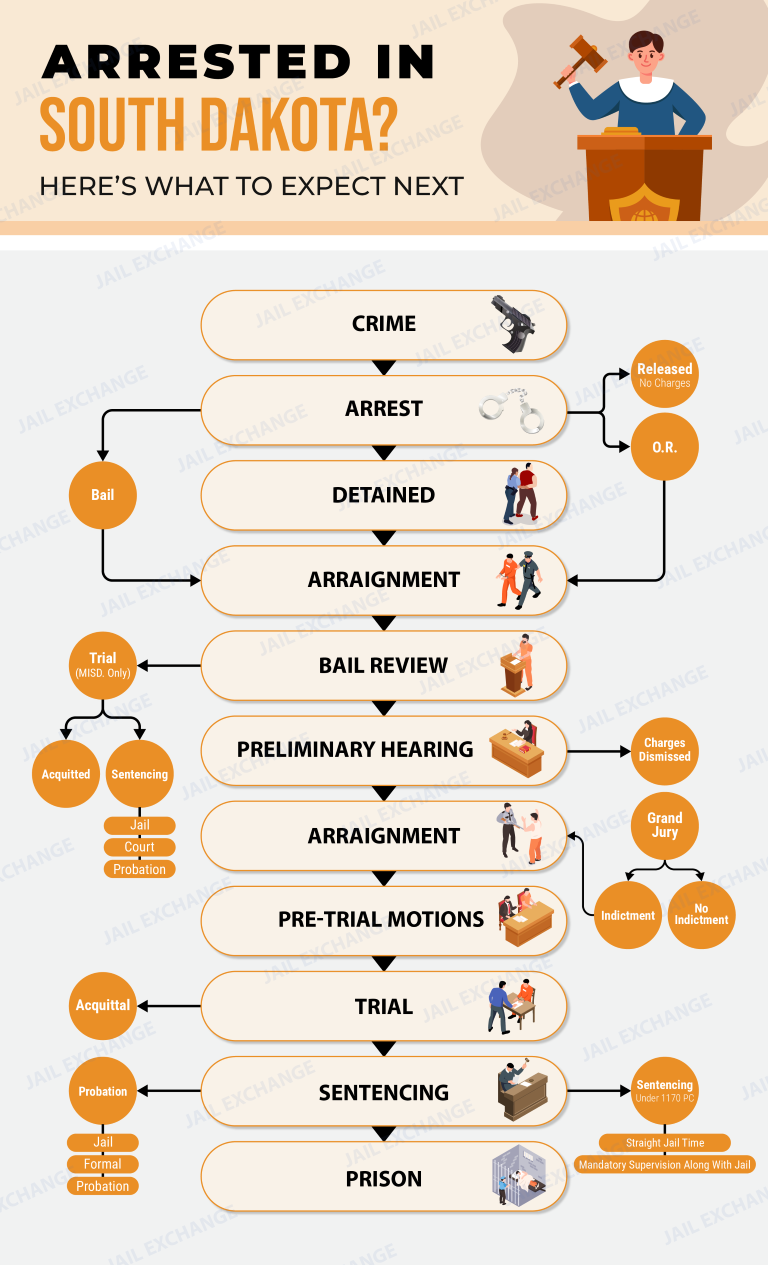
↑ Back to the question list7. Which steps does a felony case go through here?
- First appearance in magistrate court, where bail is fixed.
- Preliminary hearing, where a judge weighs whether the state has enough proof. Someone in custody gets it within 15 days of that first hearing, and someone out gets 45 days. The defense can waive it (SDCL 23A-4-3).
- Charging paper. In most cases the prosecutor files what's called an information. A circuit judge can instead convene a grand jury (6 to 10 people, SDCL 23A-5-1), and its indictment replaces the preliminary hearing.
- Arraignment before the circuit judge, where the plea is entered.
- Jury trial, or a negotiated plea.
- Sentencing.
Prison caps depend on the class (SDCL 22-6-1). Class 6 carries up to 2 years and a $4,000 fine. The ceiling rises to 5 years for Class 5, doubles to 10 for Class 4, and reaches 15, 25 and 50 years for Classes 3, 2 and 1. For Class 5 and 6, probation is the starting assumption, which a judge can set aside only for aggravating facts showing a significant risk to the public (SDCL 22-6-11).
↑ Back to the question list8. Do crimes of violence bring stricter handling?
Yes, in six ways:
- Sentences. Class B and C felonies reach life in prison. Class A can mean life or death (SDCL 22-6-1).
- Bond. On charges of first-degree manslaughter, kidnapping or murder, a clerk can't set it. That call waits until a judge has seen the defendant.
- Holding without bail. The Constitution allows this only for capital offenses backed by clear proof (S.D. Const. art. VI, § 8).
- Domestic abuse. Release waits for a judge. Until the opening hearing, the person charged has to stay away from the complaining witness or anyone in that person's household (SDCL 25-10-40, 25-10-43).
- Jury strikes. In the gravest felony trials (Class 1 and Classes A through C), each side may strike 20 jurors. Lesser felonies allow 10, and misdemeanors 3 (SDCL 23A-20-20).
- Victims. Their voice is heard on release, plea bargains and sentencing (S.D. Const. art. VI, § 29).
9. Which offices prosecute and defend Campbell County cases?
Charges are brought by the Campbell County State's Attorney, 204 Main Street, Herreid, SD 57632, 605-437-2426. The office keeps hours from 8:30 a.m. to 5:00 p.m. Central, Monday to Friday, and takes mail at PO Box 38, Herreid, SD 57632.
On the defense side, someone short of money raises it with the judge at the opening hearing (SDCL 23A-40-6). The court picks a lawyer and the county pays, under the Fifth Circuit's court-appointed attorney guidelines (SDCL 23A-40-7, 23A-40-8).
- Even after an acquittal, the judge may require the person to reimburse the county (SDCL 23A-40-10).
- The county may record a lien, yet it can't force the sale of a homestead (SDCL 23A-40-15).
- Appeals for people who can't pay go to the state Office of Indigent Legal Services, set up in 2024.
10. Can a case go to a treatment court?
Yes, in some cases. The Fifth Circuit runs one treatment court, in Aberdeen: the Brown County Drug & DUI Court. It sits at 101 1st Avenue SE, Aberdeen, SD 57401. A judge, counselors, probation officers and lawyers work together with people whose offenses are driven by addiction. A referral is required, and the defense lawyer should ask whether a case from this county can be accepted.
General questions go to the state Division of Treatment Courts, 605-773-4161.
↑ Back to the question list11. How do I check a court date or look up a file?
- Find a Court Date is free. Search a party name or case number for upcoming dates, or view the county's calendar, which runs ten business days counting today.
- UJS eCourts lists the docket on open cases. Courthouse terminals display records found through PARS.
- PARS sells summaries of public criminal records reaching back to 1989, at $20 per search, charged whether a record turns up or not.
Or call the clerk at 605-955-3536 on Tuesday or Thursday morning, with the defendant's name and birth date ready. Records older than 1989 are kept by the clerk alone.
↑ Back to the question list12. How do I find and clear a warrant in Campbell County?
The Sheriff's deputies serve warrants here. Phone 605-955-3355 to ask whether one exists. A court case with a live warrant also shows a flag on UJS ePayments. Statewide, two more pages are worth a look: the Most Wanted page run by the Department of Corrections, which covers escapes, and the Sex Offender Registry. Clearing one starts with a talk with defense counsel. Next comes a planned surrender through the Sheriff's Office, or a call to the issuing court about a fresh date. The Clerk of Courts is in that building too, 111 2nd Street NE, Mound City, SD 57646, 605-955-3536.
↑ Back to the question list13. Federal case: where is it heard, and who holds the defendant?
Federal prosecutions from here land in the Northern Division of the U.S. District Court for the District of South Dakota, which sits at 102 Fourth Avenue SE, Aberdeen, SD 57401. Federal Probation and Pretrial Services has an office in the same building, 605-377-2625.
- Whether the defendant waits in jail or goes home is decided at the first federal hearing. A short continuance asked for by either side keeps the person locked up until then (18 U.S.C. 3142).
- Federal prisoners travel to court with the U.S. Marshals Service, which also keeps them in custody. Its Aberdeen office: 102 Southeast 4th Avenue, Suite 409, Aberdeen, SD 57401, 605-226-1794.
- The district's clerk keeps an office in Pierre, 225 South Pierre Street, Pierre, SD 57501, 605-945-4600.
- After a prison sentence, search the Federal Bureau of Prisons inmate locator.
14. Will an immigration detainer halt prosecution here?
No. Prosecution in state court continues. A detainer matters only when release comes.
- A detainer (Form I-247A) comes in from ICE, the federal immigration agency.
- It asks for a hold of up to 48 hours after they would otherwise be released, so agents can arrive (8 CFR 287.7(d)).
- The St. Paul Field Office handles this state for ICE, at 1 Federal Drive, Suite 1601, Fort Snelling, MN 55111, 612-843-8600. ICE lists the Pennington County Jail, 307 Saint Joseph Street, Rapid City, SD 57701, 605-394-6116, among its detention sites.
- To locate someone ICE holds, use the ICE Online Detainee Locator.
State law adds one point. Since 2025, SB 7 (SL 2025, ch 100) makes local rules that hold back immigration status information from federal agencies off limits.
↑ Back to the question list15. Where would a prison sentence from this court be served?
Jail time for a misdemeanor is spent locally. Felony prison sentences go to the South Dakota Department of Corrections (SDCL 22-6-1). For Class 5 and 6 felonies, a judge may instead send the person to a county jail, for no longer than twelve months (SDCL 22-6-1.1).
- For anyone in state custody, try the DOC offender locator; it accepts a name or a DOC ID. County jail sentences don't show up there.
- Each prison has a profile at our South Dakota state prisons listing.
- Corrections headquarters: 3200 East Highway 34, Pierre, SD 57501, 605-773-3478.
16. How are teenagers from Campbell County handled in juvenile court?
The circuit court hears juvenile cases, starting at age 10 (SDCL 26-8C-2). After police contact, most kids are released to a parent. Keeping a youth locked up is allowed only for a reason the statute gives, in the gentlest place that works (SDCL 26-8C-3).
Adult court is possible only after a transfer hearing. There the judge looks at how bad the act was, the youth's record, and whether the youth can turn things around (SDCL 26-11-4).
Court Services officers supervise youth on probation, from the office at 4304 4th Avenue, Selby, SD 57472, 605-649-7323. For a youth's current location, ask the Sheriff at 605-955-3355.
↑ Back to the question list17. What protections do victims get in Campbell County cases?
Marsy's Law put victims' rights in the South Dakota Constitution. On request, victims get notice of hearings, a seat in the courtroom and a turn to speak on release, plea and sentence. They are also owed full restitution and quick news of a release or escape (S.D. Const. art. VI, § 29).
- Register with SAVIN for free custody alerts, or call 844-299-4608 on a weekday for help signing up.
- To give a statement or ask about the case, reach the State's Attorney at 605-437-2426, 204 Main Street, Herreid, SD 57632.
- When the offender is a juvenile, SAVIN won't send alerts, so contact the State's Attorney directly.
Information for this service is currently unavailable.
Walworth County Jail is where the account lives. Campbell County has no jail, so after the Sheriff's Office in Mound City books someone, it sends them to Walworth under a contract for jail space. Money goes to the Walworth account, not to Campbell County.
How to deposit there is something the Campbell County Sheriff's Office prefers not to publish, and the same goes for the money order payee and the address to use. The office will sort out all three at 605-955-3355 once you give the inmate's full name and date of birth.
Odds are the answer will be a postal money order. That is the most common way to load an account at a smaller jail, and it can typically be dropped at the front desk or sent by mail. Have the deputy spell out the payee and the mailing address before you buy one.
Cash in the mail is a no.
Campbell County, South Dakota, has no jail in Mound City. Its old arrangement with the Walworth County jail in Selby ended when that jail closed, and the state's 2023 sheriff study lists the Brown, Hughes, Beadle and Faulk county jails as places Campbell County's prisoners are kept. The address printed here belongs to the Brown County Jail on Court Street in Aberdeen, Brown County.
For someone held in Aberdeen (letters, legal mail, books and money orders):
Inmate's Full Name & Inmate ID #
Brown County Jail
22 Court Street, Suite 1
Aberdeen, SD 57401
- Find the right jail: Call the Campbell County Sheriff's Office at 605-955-3355 to learn where the person is being held. If it is the Hughes County Jail in Pierre, the Beadle County Correction Center in Huron or the Faulk County Jail in Faulkton, write to that jail under its own rules.
- Who it's for: In Aberdeen, put the person's full legal name and Brown County inmate ID number above the address.
- Posted only: Brown County takes mail that arrives through the post office. Letters handed in at the counter are refused.
- Your details: A complete return address in the corner is required.
- Money orders in Aberdeen: Payable to the inmate or the Brown County Sheriff's Office, with the inmate's name and ID number in the memo line, sent in a separate envelope.
- What gets a letter rejected: Anything other than blue or black ink, marker, crayon, glitter, perfume or a musical card.
- Reading: New books and newspapers must be shipped straight from the publisher.
Information for this service is currently unavailable.
Information for this service is currently unavailable.
Information for this service is currently unavailable.
Campbell County County Jails
- Campbell County Sheriff: 605-955-3355
The Campbell County Sheriff's Office serves the following cities and towns of Campbell County: Herreid and Pollock.