Campbell County Sheriff's Office Criminal Court Process
Criminal Court Process for Campbell County South Dakota
Criminal Court Guide for Campbell County
Every state charge from this county lands in one building: the courthouse at 111 2nd Street NE, Mound City, SD 57646, home to both circuit and magistrate court and their shared Clerk of Courts. With no jail in the county, anyone not released is held at the jail that serves Campbell County, outside the county. Follow the case here from arrest to sentence.
Confirm custody with the official inmate lookup. For everything about the stay itself, from current holds and recent bookings to mugshots, warrants, charges, property return and appointed counsel, see Inmates in Custody.
The Sheriff's Office picks up at 605-955-3355 around the clock. Ask three things: the jail's name, the charge, and when the next hearing falls. To push for release ahead of trial, our bail page explains the options.
1. Magistrate versus circuit: who takes which charges?
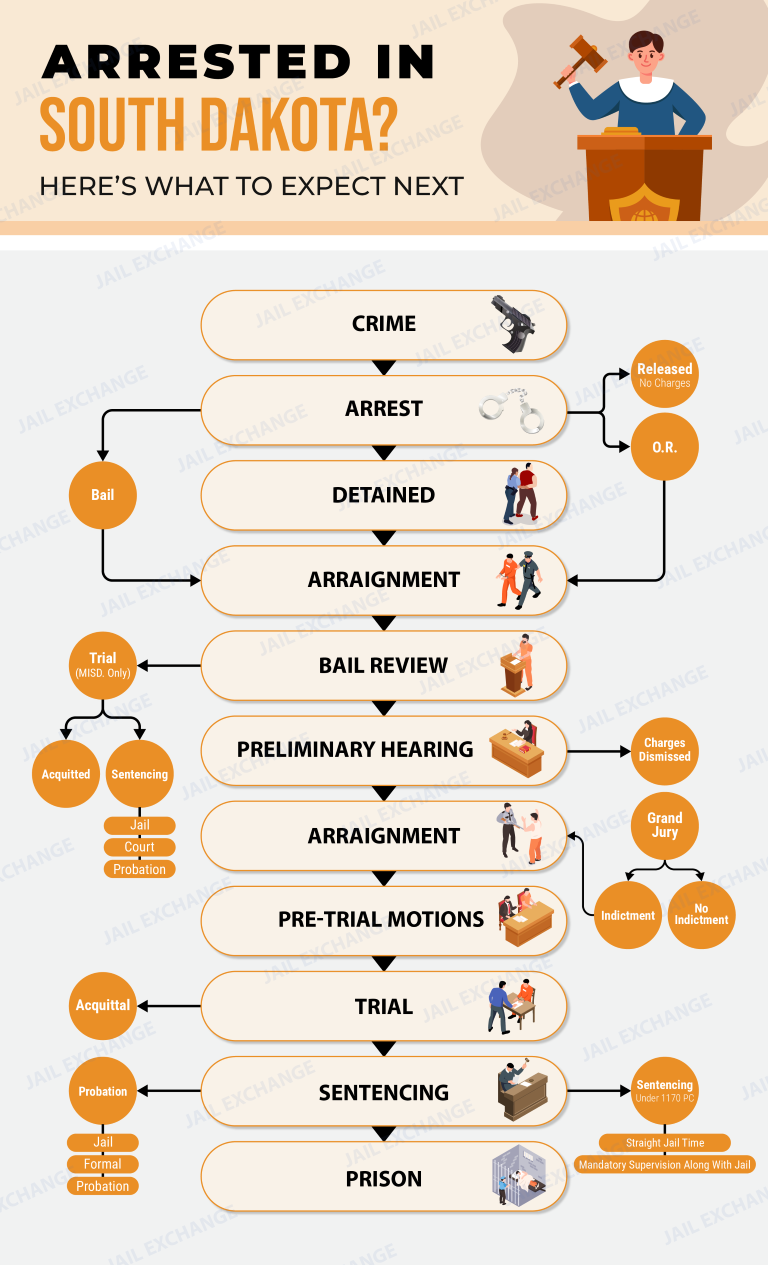
Both levels belong to South Dakota's Unified Judicial System, and here both meet in Mound City. The split goes by how serious the charge is:
- Magistrate court owns misdemeanors and town ordinance tickets (SDCL 16-12B-11). They sign warrants, set bail amounts and conduct the opening hearing in felonies as well (SDCL 16-12B-5, 16-12B-7, 16-12B-10). They can take a guilty plea on any offense capped at $2,000 or one year (SDCL 16-12B-8).
- Clerk magistrates take pleas in the smallest cases, those topping out at $500 or 30 days (SDCL 16-12C-11).
- Circuit court handles felony trials and youth cases. This county is in the Fifth Judicial Circuit, run from Aberdeen.
So a felony starts small. The early steps happen before a magistrate, and the case then climbs to the circuit bench for plea or trial.
↑ Back to the question list2. Where do Campbell County hearings take place?
All state hearings are held in Mound City. These are the offices to know:
- Clerk of Courts, serving both court levels, 111 2nd Street NE, Mound City, SD 57646, 605-955-3536. Letters go to PO Box 146, Mound City, SD 57646-0146. Counter hours are short, just 8:30 a.m. to noon on Tuesday and Thursday, so ring ahead.
- Fifth Judicial Circuit administration, PO Box 1087, Aberdeen, SD 57402-1087, 605-626-2450.
- Court Services, the probation office this county shares with Walworth County, 4304 4th Avenue, Selby, SD 57472, 605-649-7323.
The free Find a Court Date calendar lists what is scheduled.
↑ Back to the question list3. What court hears a Herreid or Pollock ordinance ticket?
The magistrate at the county courthouse, 111 2nd Street NE, Mound City, SD 57646. South Dakota hands city ordinance violations to magistrate judges, right alongside misdemeanors (SDCL 16-12B-11). The same goes for tickets written inside the county seat.
Once such a case is entered, the fine is payable by card on UJS ePayments, though a new case might not show there for up to 14 days. Questions about a date or a payment plan go to the clerk at 605-955-3536, open Tuesday and Thursday mornings.
↑ Back to the question list4. Where does a defendant stay between hearings?
Not in this county. Campbell County has no jail building, and state law lets a county without one rent space in another agency's jail under a signed agreement, with the sending county paying (SDCL 24-11-3). A defendant may therefore be housed miles away yet still appear in Mound City, in person or by video.
Which jail is it right now? The Sheriff's Office knows: 605-955-3355, at 111 2nd Street NE, Mound City, SD 57646. Walk-in hours are 8:00 a.m. to 4:00 p.m. Central, Monday to Friday.
Keep in mind the person could later get a bill for the cost of that jail time (SDCL 24-11-45).
↑ Back to the question list5. First trip to court: what does the judge explain?
After an arrest, officers have to get the person before the closest magistrate who is free, promptly and with no needless wait, in a courtroom or on video (SDCL 23A-4-1). No plea is taken yet. The judge lays out (SDCL 23A-4-3):
- the charge written in the complaint
- that they may retain a lawyer or ask for one at public cost
- the conditions set for release before trial
- that silence is their right
- in felony cases, a preliminary hearing if they want one
Release terms are usually decided right there. State law names no deadline in hours, so ask the Sheriff's Office at 605-955-3355 when the hearing is on the calendar.
↑ Back to the question list6. DUI, disorderly conduct and other misdemeanors: what's the path?
The State's Attorney files a complaint in magistrate court. If the person pleads not guilty, a trial gets scheduled.
Maximum penalties under SDCL 22-6-2:
- Class 1 misdemeanor, which includes a first or second DUI: as long as one year in a county jail and as much as $2,000.
- Class 2 misdemeanor: a 30-day cap on jail and a $500 fine.
- Petty offense: a flat $25 judgment, court costs left off.
On a disorderly conduct ticket, the statewide schedule lists a total of $132.50. In DUI cases, judges often order the 24/7 Sobriety Program as part of bond or probation (SDCL 1-11-20, 1-11-21). A third DUI is a felony.
The speedy trial clock gives the state 180 days from the first appearance, minus any delay the defense asked for or caused (SDCL 23A-44-5.1).
↑ Back to the question list7. Which steps does a felony case go through here?
- First appearance in magistrate court, where bail is fixed.
- Preliminary hearing, where a judge weighs whether the state has enough proof. Someone in custody gets it within 15 days of that first hearing, and someone out gets 45 days. The defense can waive it (SDCL 23A-4-3).
- Charging paper. In most cases the prosecutor files what's called an information. A circuit judge can instead convene a grand jury (6 to 10 people, SDCL 23A-5-1), and its indictment replaces the preliminary hearing.
- Arraignment before the circuit judge, where the plea is entered.
- Jury trial, or a negotiated plea.
- Sentencing.
Prison caps depend on the class (SDCL 22-6-1). Class 6 carries up to 2 years and a $4,000 fine. The ceiling rises to 5 years for Class 5, doubles to 10 for Class 4, and reaches 15, 25 and 50 years for Classes 3, 2 and 1. For Class 5 and 6, probation is the starting assumption, which a judge can set aside only for aggravating facts showing a significant risk to the public (SDCL 22-6-11).
↑ Back to the question list8. Do crimes of violence bring stricter handling?
Yes, in six ways:
- Sentences. Class B and C felonies reach life in prison. Class A can mean life or death (SDCL 22-6-1).
- Bond. On charges of first-degree manslaughter, kidnapping or murder, a clerk can't set it. That call waits until a judge has seen the defendant.
- Holding without bail. The Constitution allows this only for capital offenses backed by clear proof (S.D. Const. art. VI, § 8).
- Domestic abuse. Release waits for a judge. Until the opening hearing, the person charged has to stay away from the complaining witness or anyone in that person's household (SDCL 25-10-40, 25-10-43).
- Jury strikes. In the gravest felony trials (Class 1 and Classes A through C), each side may strike 20 jurors. Lesser felonies allow 10, and misdemeanors 3 (SDCL 23A-20-20).
- Victims. Their voice is heard on release, plea bargains and sentencing (S.D. Const. art. VI, § 29).
9. Which offices prosecute and defend Campbell County cases?
Charges are brought by the Campbell County State's Attorney, 204 Main Street, Herreid, SD 57632, 605-437-2426. The office keeps hours from 8:30 a.m. to 5:00 p.m. Central, Monday to Friday, and takes mail at PO Box 38, Herreid, SD 57632.
On the defense side, someone short of money raises it with the judge at the opening hearing (SDCL 23A-40-6). The court picks a lawyer and the county pays, under the Fifth Circuit's court-appointed attorney guidelines (SDCL 23A-40-7, 23A-40-8).
- Even after an acquittal, the judge may require the person to reimburse the county (SDCL 23A-40-10).
- The county may record a lien, yet it can't force the sale of a homestead (SDCL 23A-40-15).
- Appeals for people who can't pay go to the state Office of Indigent Legal Services, set up in 2024.
10. Can a case go to a treatment court?
Yes, in some cases. The Fifth Circuit runs one treatment court, in Aberdeen: the Brown County Drug & DUI Court. It sits at 101 1st Avenue SE, Aberdeen, SD 57401. A judge, counselors, probation officers and lawyers work together with people whose offenses are driven by addiction. A referral is required, and the defense lawyer should ask whether a case from this county can be accepted.
General questions go to the state Division of Treatment Courts, 605-773-4161.
↑ Back to the question list11. How do I check a court date or look up a file?
- Find a Court Date is free. Search a party name or case number for upcoming dates, or view the county's calendar, which runs ten business days counting today.
- UJS eCourts lists the docket on open cases. Courthouse terminals display records found through PARS.
- PARS sells summaries of public criminal records reaching back to 1989, at $20 per search, charged whether a record turns up or not.
Or call the clerk at 605-955-3536 on Tuesday or Thursday morning, with the defendant's name and birth date ready. Records older than 1989 are kept by the clerk alone.
↑ Back to the question list12. How do I find and clear a warrant in Campbell County?
The Sheriff's deputies serve warrants here. Phone 605-955-3355 to ask whether one exists. A court case with a live warrant also shows a flag on UJS ePayments. Statewide, two more pages are worth a look: the Most Wanted page run by the Department of Corrections, which covers escapes, and the Sex Offender Registry. Clearing one starts with a talk with defense counsel. Next comes a planned surrender through the Sheriff's Office, or a call to the issuing court about a fresh date. The Clerk of Courts is in that building too, 111 2nd Street NE, Mound City, SD 57646, 605-955-3536.
↑ Back to the question list13. Federal case: where is it heard, and who holds the defendant?
Federal prosecutions from here land in the Northern Division of the U.S. District Court for the District of South Dakota, which sits at 102 Fourth Avenue SE, Aberdeen, SD 57401. Federal Probation and Pretrial Services has an office in the same building, 605-377-2625.
- Whether the defendant waits in jail or goes home is decided at the first federal hearing. A short continuance asked for by either side keeps the person locked up until then (18 U.S.C. 3142).
- Federal prisoners travel to court with the U.S. Marshals Service, which also keeps them in custody. Its Aberdeen office: 102 Southeast 4th Avenue, Suite 409, Aberdeen, SD 57401, 605-226-1794.
- The district's clerk keeps an office in Pierre, 225 South Pierre Street, Pierre, SD 57501, 605-945-4600.
- After a prison sentence, search the Federal Bureau of Prisons inmate locator.
14. Will an immigration detainer halt prosecution here?
No. Prosecution in state court continues. A detainer matters only when release comes.
- A detainer (Form I-247A) comes in from ICE, the federal immigration agency.
- It asks for a hold of up to 48 hours after they would otherwise be released, so agents can arrive (8 CFR 287.7(d)).
- The St. Paul Field Office handles this state for ICE, at 1 Federal Drive, Suite 1601, Fort Snelling, MN 55111, 612-843-8600. ICE lists the Pennington County Jail, 307 Saint Joseph Street, Rapid City, SD 57701, 605-394-6116, among its detention sites.
- To locate someone ICE holds, use the ICE Online Detainee Locator.
State law adds one point. Since 2025, SB 7 (SL 2025, ch 100) makes local rules that hold back immigration status information from federal agencies off limits.
↑ Back to the question list15. Where would a prison sentence from this court be served?
Jail time for a misdemeanor is spent locally. Felony prison sentences go to the South Dakota Department of Corrections (SDCL 22-6-1). For Class 5 and 6 felonies, a judge may instead send the person to a county jail, for no longer than twelve months (SDCL 22-6-1.1).
- For anyone in state custody, try the DOC offender locator; it accepts a name or a DOC ID. County jail sentences don't show up there.
- Each prison has a profile at our South Dakota state prisons listing.
- Corrections headquarters: 3200 East Highway 34, Pierre, SD 57501, 605-773-3478.
16. How are teenagers from Campbell County handled in juvenile court?
The circuit court hears juvenile cases, starting at age 10 (SDCL 26-8C-2). After police contact, most kids are released to a parent. Keeping a youth locked up is allowed only for a reason the statute gives, in the gentlest place that works (SDCL 26-8C-3).
Adult court is possible only after a transfer hearing. There the judge looks at how bad the act was, the youth's record, and whether the youth can turn things around (SDCL 26-11-4).
Court Services officers supervise youth on probation, from the office at 4304 4th Avenue, Selby, SD 57472, 605-649-7323. For a youth's current location, ask the Sheriff at 605-955-3355.
↑ Back to the question list17. What protections do victims get in Campbell County cases?
Marsy's Law put victims' rights in the South Dakota Constitution. On request, victims get notice of hearings, a seat in the courtroom and a turn to speak on release, plea and sentence. They are also owed full restitution and quick news of a release or escape (S.D. Const. art. VI, § 29).
- Register with SAVIN for free custody alerts, or call 844-299-4608 on a weekday for help signing up.
- To give a statement or ask about the case, reach the State's Attorney at 605-437-2426, 204 Main Street, Herreid, SD 57632.
- When the offender is a juvenile, SAVIN won't send alerts, so contact the State's Attorney directly.