Miner County Sheriff's Office Criminal Court Process
Criminal Court Process for Miner County South Dakota
Miner County Criminal Court Guide
State criminal cases out of Miner County land at a single courthouse, 401 N. Main St., Howard, SD 57349, where circuit court and magistrate court both sit. Adults waiting on a case are held outside the county, mainly at the Davison County Jail, 1015 S. Miller Avenue, Mitchell, SD 57301, with some at the Edmunds County Jail, 221 2nd Street, Ipswich, SD 57451.
Start with the official inmate lookup to confirm custody. Next, the arrest side is covered on our Inmates in Custody page, which takes in recent bookings, charges on file, unserved warrants, mugshots, court-appointed defense and property pickup.
Right now, ring the Clerk of Courts at 605-772-4612 on a Monday, Wednesday or Friday, between 9 and 4. Give the name and birth date, and request the file number plus the coming hearing. Questions about money for release are covered on our bail page.
1. Which Howard judge takes a misdemeanor case, and which a felony?
Both courts work under one roof, and many cases touch both of them.
- Magistrate court takes misdemeanors and ordinance cases (SDCL 16-12B-11). A magistrate judge also issues warrants (SDCL 16-12B-5), sets bond (SDCL 16-12B-7) and acts as committing magistrate at first appearances (SDCL 16-12B-10). Guilty pleas on offenses capped at $2,000 or one year can be taken and sentenced there (SDCL 16-12B-8).
- Clerk magistrates may accept pleas and sentence when the ceiling is a $500 fine or 30 days (SDCL 16-12C-11).
- Circuit court takes every felony once it moves past the early hearings, along with juvenile cases.
Under SDCL 22-6-2, Class 1 misdemeanors reach as high as a year in county jail plus $2,000. Class 2 misdemeanors stop at 30 days and $500.
↑ Back to the question list2. Where is the Miner County courthouse, and what are its hours?
The courthouse stands at Park Avenue and Main Street: 401 N. Main St., Howard, SD 57349.
- Clerk of Courts: 605-772-4612. Open Monday, Wednesday and Friday only, 9:00 a.m. to 4:00 p.m. Letters go to PO Box 265, Howard, SD 57349-0265.
- Sheriff's Office: first floor of the same building, 605-772-4501. Dispatch is staffed every hour of every day.
- Doors: locked weekdays between 4:00 p.m. and 7:30 a.m., plus Saturdays, Sundays and holidays.
Probation for the county is supervised from Madison. That Court Services office is at 200 East Center Street, Madison, SD 57042, 605-256-5645. Public computers at the courthouse let visitors view court records.
↑ Back to the question list3. Is there a town court in Howard, Carthage or Canova?
No town in the county has a court of its own. A ticket for breaking a city ordinance goes to the magistrate court inside the county courthouse, 401 N. Main St., Howard, SD 57349. The Clerk of Courts there answers at 605-772-4612.
Treatment courts for drug or DUI cases take a referral, so raise the idea with the defense lawyer. The state's treatment court office takes calls at 605-773-4161.
↑ Back to the question list4. What does the judge say at that first hearing?
The first hearing is short. Often it happens over video from the jail in Mitchell or wherever the person is housed. State law calls for it "without unnecessary delay" (SDCL 23A-4-1). At that hearing (SDCL 23A-4-3):
- Pleas come later, not at this hearing.
- The judge explains the charge.
- The judge points out the right to a paid lawyer, or to one assigned by the court.
- The judge says they need not make any statement.
- Release terms are set.
- If the charge is a felony, the person learns of the preliminary hearing right.
Third Circuit rules add a clock. Someone held with no bond needs a judge to find probable cause by the 48-hour mark, or the jail must open the door. Bond calls to judges happen from 8 a.m. to 9 p.m., so a late arrest may sit until morning.
↑ Back to the question list5. How do DUI and simple assault misdemeanors move along?
These cases usually begin and end in magistrate court. First and second DUIs count as Class 1 misdemeanors, as does simple assault. The usual path:
- First appearance, with bond and a lawyer if needed.
- Plea talks. Lots of these cases close with an agreement between the State's Attorney and the defense.
- Plead not guilty, and the court sets a trial. Each side may strike three jurors without giving a reason (SDCL 23A-20-20).
- Sentencing, which can mean jail, a fine, probation, or a mix.
A judge can make the 24/7 Sobriety Program part of probation in a DUI case (SDCL 1-11-21). Under the 180-day rule, the count begins at the first appearance, and defense delays are left off the clock (SDCL 23A-44-5.1). UJS ePayments takes card payments on fines. Someone short on money can ask the clerk about a payment plan.
↑ Back to the question list6. What are the stages of a Miner County felony case?
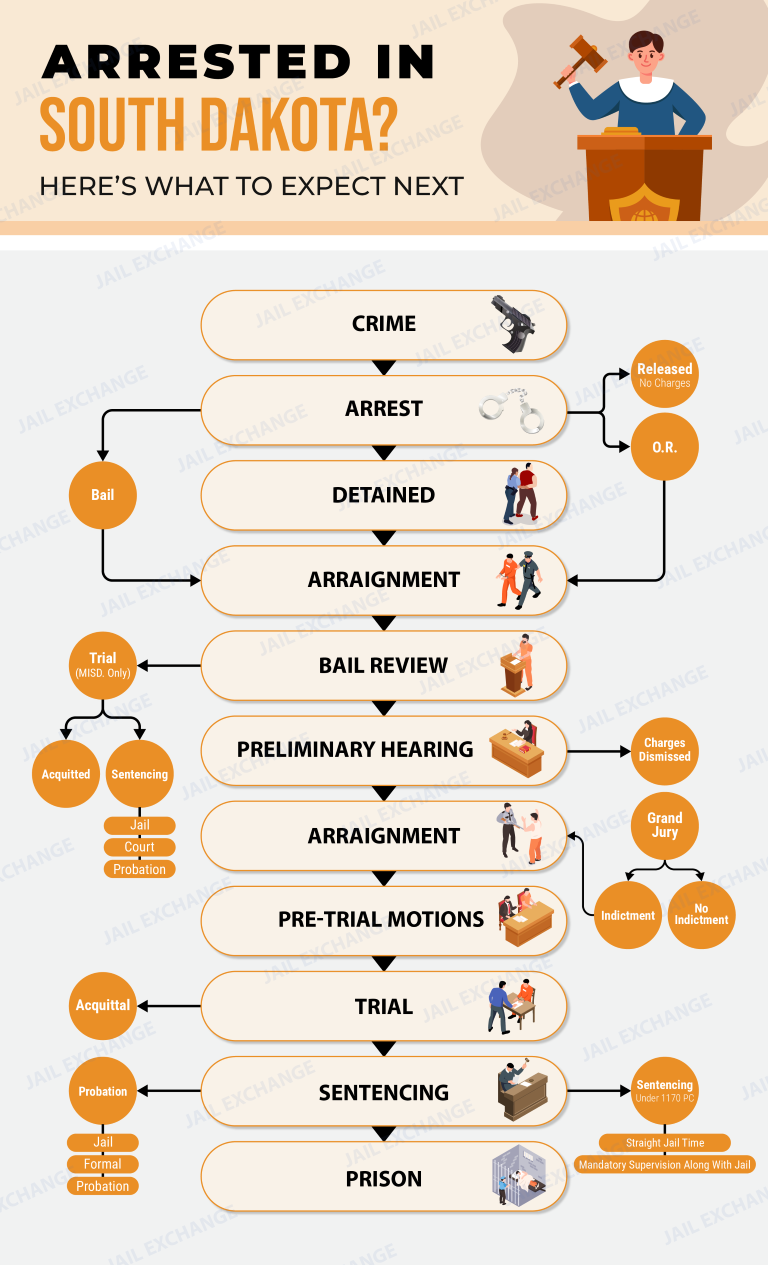
A felony file opens before a magistrate, then moves up to a circuit judge. In order:
- First appearance. Charge read, bond set, lawyer named if requested.
- Preliminary hearing. The judge weighs whether enough proof exists to hold the case for trial. SDCL 23A-4-3 sets the deadline. Count from the first appearance: 15 days for a defendant in jail; one who is out, within 45. A waiver, or an earlier grand jury indictment, cancels it.
- Formal charge. Most often the State's Attorney charges a felony with an information, a written accusation. A grand jury (six to ten people) is summoned only by a circuit judge (SDCL 23A-5-1).
- Trial or plea in circuit court, within the 180-day rule (SDCL 23A-44-5.1).
- Sentencing.
Under SDCL 22-6-1, a Class 6 felony means as long as two years and $4,000, and a Class 5 as long as five years and $10,000. For both, the starting point is probation (SDCL 22-6-11), and up to twelve months in a county jail is the other choice (SDCL 22-6-1.1).
↑ Back to the question list7. How do the gravest charges differ?
Higher felony classes bring much longer terms (SDCL 22-6-1). Class A carries death or life, and Classes B and C carry life. Below those, maximum terms are 50 years (Class 1), 25 (Class 2), 15 (Class 3) and 10 (Class 4).
Bond works differently too. On a first-degree manslaughter, murder or kidnapping charge, no bond comes from the clerk, and a judge handles the first appearance. Under S.D. Const. art. VI, § 8, bail may be refused outright just for capital cases with evident proof. At trial on the four highest classes, each side gets 20 strikes of jurors, twice the number for lesser felonies (SDCL 23A-20-20).
A domestic assault arrest also changes things. A judge, not the jail, sets bond and safety rules (SDCL 25-10-40). Until the first hearing, the accused must stay away from the victim's household (SDCL 25-10-43).
↑ Back to the question list8. Who prosecutes these cases, and who defends them?
Prosecution. The county State's Attorney files and tries criminal cases. Mail goes to PO Box 189, Howard, SD 57349-0189. The office phone is 605-772-4488.
Defense. The county has no public defender's office. A judge appoints a private lawyer for a person who can't pay, and the county covers the bill (SDCL 23A-40-6, 23A-40-7, 23A-40-8). Ask for one at the first appearance. Some points to know:
- Paying the county back for the lawyer can be ordered later, whatever the outcome (SDCL 23A-40-10).
- A lien can attach to property, but a home can't be lost to foreclosure over it (SDCL 23A-40-11, 23A-40-15).
- The state Office of Indigent Legal Services covers appeals, not trials.
Before sentencing, a court services officer may write a report for the judge. The local Court Services office is at 200 East Center Street, Madison, SD 57042, 605-256-5645.
↑ Back to the question list9. Which websites show the case and hearing dates?
Several state tools cover this county's cases:
- Find a Court Date is free. It lists upcoming hearings when you enter someone's name or the case number, and a date search pulls up every Miner hearing set that day.
- UJS eCourts lists docket events on cases open to the public, at no charge to search.
- PARS gives a summary of criminal cases back to 1989. It costs $20 per search, even if nothing turns up.
- Public terminals at the courthouse, 401 N. Main St., Howard, SD 57349, show open records for free.
Older files, from before 1989, must be asked for through the Clerk of Courts at 605-772-4612. Keep the case number handy for every call.
↑ Back to the question list10. Is someone wanted on a Miner County warrant?
Sheriff's deputies carry out both arrest and bench warrants here. For a check, phone the Sheriff at 605-772-4501 or the Clerk of Courts at 605-772-4612. Both work inside the courthouse at 401 N. Main St., Howard, SD 57349. On the state's ePayments site, a case shows whether a warrant is active. Two state lists help too: the DOC Most Wanted page, showing people who escaped or walked away, and the Sex Offender Registry. Clearing it begins with hiring or asking for a lawyer. Then you and the lawyer appear before the judge who issued it. Or the lawyer can ask the clerk for a new date.
↑ Back to the question list11. When does a case go to federal court in Sioux Falls?
Federal charges come from federal agents or the U.S. Attorney, not the county. For this county, they are heard in the Southern Division, United States Courthouse, 400 S. Phillips Ave., Sioux Falls, SD 57104, 605-330-6600.
- Prosecutor: the U.S. Attorney's Office, mail to PO Box 2638, Sioux Falls, SD 57101-2638, 605-330-4400.
- Detention hearing: 18 U.S.C. 3142 puts it at the very first appearance. Any short delay, three days for prosecutors or five for the defense, is spent in custody.
- Custody: the U.S. Marshals, 400 South Phillips Avenue, Room 216, Sioux Falls, SD 57104, 605-330-4351.
- Pretrial and probation officers: 314 S. Main Ave., Suite 100, Sioux Falls, SD 57104, 605-977-8900.
After a federal sentence, search the Federal Bureau of Prisons inmate locator.
↑ Back to the question list12. Will an ICE hold derail the state charge?
No. The charge stays open in the county court, though release may play out differently:
- ICE asks for a hold by sending the jail Form I-247A.
- Under 8 CFR 287.7(d), the jail may keep them up to 48 hours after they would otherwise be released.
- Officers from the St. Paul Field Office, 1 Federal Drive, Suite 1601, Fort Snelling, MN 55111, 612-843-8600, may then take custody.
- Use the ICE Online Detainee Locator to learn where they went.
Make sure the defense lawyer hears about the detainer right away. A 2025 law, SB 7 (SL 2025, ch 100), says no county or city may adopt a rule that limits what local staff tell federal officials about immigration status.
↑ Back to the question list13. Where does a person serve a felony sentence?
A misdemeanor sentence is county jail time. A felony prison term belongs to the South Dakota Department of Corrections, central office at 3200 East Highway 34, Pierre, SD 57501, 605-773-3478. Its prisons include:
- South Dakota State Penitentiary, 1600 North Drive, Sioux Falls, SD 57117, 605-367-5051
- Mike Durfee State Prison, 1412 Wood Street, Springfield, SD 57062, 605-369-2201
- South Dakota Women's Prison, 3200 East Highway 34, Pierre, SD 57501, 605-773-6636
Find a person with the DOC offender locator. Our South Dakota prisons page has visiting and mail details. Parole is run by the state, while probation stays with the court.
↑ Back to the question list14. How does juvenile court treat a Miner County teenager?
Juvenile cases are heard in circuit court for children 10 and older (SDCL 26-8C-2). In the Third Circuit, a youth is either sent home to a parent or held, based on a risk screening. An intake officer may approve detention only for reasons the law lists (SDCL 26-8C-3).
Held youths are driven to Sioux Falls and the Minnehaha County Regional Juvenile Detention Center, 4200 S. West Ave., Sioux Falls, SD 57105, 605-367-4313. Adult court happens only by a judge's order after a transfer hearing (SDCL 26-11-4). SAVIN skips juvenile cases, so victims there should ask the State's Attorney, 605-772-4488.
↑ Back to the question list15. What rights does Marsy's Law give victims?
The state constitution gives victims real rights (S.D. Const. art. VI, § 29). On request, a victim can:
- Get timely notice of hearings and be there.
- Address the court when it rules on release, a plea bargain or the sentence.
- Receive full restitution.
- Be told quickly about a release or escape.
Law officers give each victim a Marsy's Card spelling out these protections. SAVIN sends free notices of a release; enroll at savin.sd.gov or phone 844-299-4608 on weekdays. For anything about the case itself, the State's Attorney is at 605-772-4488.
↑ Back to the question list