Winner City Jail Criminal Court Process
Criminal Court Process for Tripp County South Dakota
Tripp County Criminal Court Guide
One building in the county seat handles state criminal cases here: the county courthouse, 200 E. 3rd St., Winner, SD 57580, where circuit court and magistrate court share space. The county has no jail, so adults held on these charges wait in the city-run Winner City Jail, 217 E 3rd St., Winner, SD 57580, which also boards prisoners for other counties. Below, follow a case from arrest to sentence.
A quick custody check comes first. The official inmate lookup searches by name. The Recent Arrests page on our site covers custody in full: warrants, new bookings, mugshots, charges, property release and court-appointed defenders.
Then phone the Clerk of Courts at 605-842-2266, weekdays from 7:30 a.m. to 4:00 p.m. Three questions help most. What is the case number? When is the next hearing? Is it a felony or a misdemeanor? If getting the person home comes first, open our bail and release page.
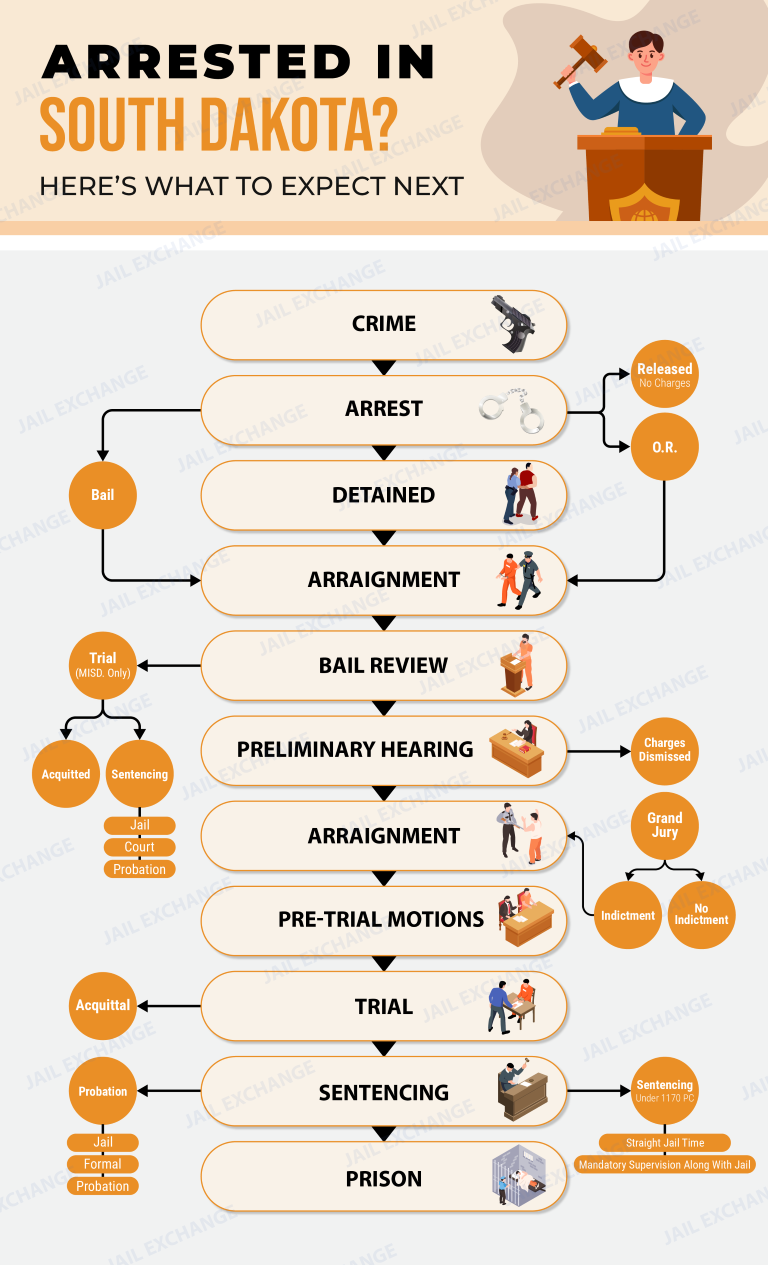
1. Misdemeanor or felony: which Tripp County court takes it?
Both levels start in the same building. Seriousness decides where they end.
- Magistrate court holds misdemeanor trials, plus city ordinance cases (SDCL 16-12B-11). Warrants, bond and first appearances are also theirs to handle (SDCL 16-12B-5, 16-12B-7, 16-12B-10). They can accept a guilty plea and pass sentence on any charge capped at $2,000 or one year (SDCL 16-12B-8).
- Clerk magistrates take pleas on the smallest charges, those carrying no more than $500 or 30 days (SDCL 16-12C-11).
- Circuit court decides felonies once they move past the early hearings. Juvenile cases are heard there too.
This county belongs to the Sixth Judicial Circuit. Federal crimes go to Pierre, and tribal cases go to the Rosebud Sioux Tribe's own court.
↑ Back to the question list2. Which building hears the cases, and what are clerk hours?
Here is every court that could handle a case tied to this county:
- County courthouse (circuit and magistrate court), 200 E. 3rd St., Winner, SD 57580. The Clerk of Courts answers at 605-842-2266, Monday to Friday, 7:30 a.m. to 4:00 p.m. Mail goes to PO Box 311, Winner, SD 57580-0311. This office keeps Todd County's files as well.
- Sixth Circuit Drug & DUI Court, 8 E. Second Ave., Fort Pierre, SD 57532, 605-220-3850.
- Federal court, Central Division, 225 South Pierre Street, Pierre, SD 57501, 605-945-4600.
- Rosebud Sioux Tribe Courthouse, 118 Marshall St., Rosebud, SD 57570, 605-747-2278.
Public computer terminals in South Dakota courthouses let visitors read and print open case records.
↑ Back to the question list3. Do Winner, Colome or Witten run town courts?
No. Towns in this county don't hold court of their own. When a city officer writes up an ordinance violation, a magistrate judge hears it at the county courthouse, 200 E. 3rd St., Winner, SD 57580, alongside the misdemeanors (SDCL 16-12B-11).
So a ticket from any town street ends up on the same docket as a county charge. The Clerk of Courts, 605-842-2266, answers questions about these cases too.
↑ Back to the question list4. What happens when a magistrate first sees the defendant?
SDCL 23A-4-1 requires that an arrested person be taken before a committing magistrate "without unnecessary delay." Video links from the lockup are allowed. The defendant enters no plea that day. The magistrate covers these points (SDCL 23A-4-3):
- the charge, read in plain terms
- the right to hire a lawyer, and to request one if money is short
- release terms or bond
- the right to stay silent
- in felony cases, a preliminary hearing on the evidence, unless waived
Sixth Circuit judges fill out a bond findings form. It asks if a personal promise will do and if the person is dangerous (SDCL 23A-43-4). Release after a domestic abuse arrest waits on a judge's sign-off (SDCL 25-10-40).
↑ Back to the question list5. Misdemeanors like a first DUI: what's the process and penalty?
Most misdemeanors never leave magistrate court. The State's Attorney files the charge, the person pleads, and a not-guilty plea gets a trial date. In a misdemeanor jury trial, the defense and prosecution each get three peremptory strikes, meaning jurors removed without a stated reason (SDCL 23A-20-20).
- Class 1 misdemeanor (a first or second DUI counts): as long as a year in jail and as much as $2,000 in fines (SDCL 22-6-2).
- Class 2 misdemeanor: as long as 30 days, and as much as $500.
- Petty offenses on the bond schedule: a $25 judgment, no added costs.
The 180-day rule sets the trial deadline, counted from the first appearance, with defense delays left out (SDCL 23A-44-5.1). Pay fines and costs online with a card at UJS ePayments. A payment plan can be signed at the clerk's window when the full amount is out of reach.
↑ Back to the question list6. What path does a Tripp County felony follow?
Magistrates handle the start of a felony; circuit judges handle the rest. The usual stops:
- First appearance, where bond is set and the charge is read.
- Preliminary hearing. A judge decides whether there's enough proof to go on. In custody, that's due within 15 days; out of custody, 45 (SDCL 23A-4-3). It's skipped when the defense gives it up, or when a grand jury has already returned an indictment.
- Formal charge. Usually this is an information, a document the State's Attorney prepares. A grand jury (six to ten people) sits only when a circuit judge calls one (SDCL 23A-5-1).
- Circuit court plea, motions and trial, within the 180-day clock (SDCL 23A-44-5.1).
- Sentencing after a plea or verdict.
Lower felonies carry these top penalties: Class 6, two years and $4,000; Class 5, five years and $10,000; Class 4, ten years and $20,000 (SDCL 22-6-1). Unless the judge finds aggravating facts, Class 5 and 6 felonies call for probation (SDCL 22-6-11). A judge may also give up to a year in a local jail (SDCL 22-6-1.1).
↑ Back to the question list7. How are the gravest felonies treated differently?
The stakes and the rules both rise for the worst charges.
- Penalties. The top tier, Class A, means death or life; life is also the sentence for Classes B and C. Class 1 can mean 50 years, Class 2 means 25 and Class 3 means 15. The biggest groups also carry fines as high as $50,000 (SDCL 22-6-1).
- Jury picks. Peremptory strikes rise to 20 per side when the top charge is Class 1 or higher (Class A, B or C), against 10 in other felony trials (SDCL 23A-20-20).
- Bond. The bond schedule doesn't cover murder, kidnapping or first-degree manslaughter, so a judge must set those. Denying bail altogether is reserved for capital charges where proof is strong (S.D. Const. art. VI, § 8).
- Tribal land. Murder, robbery, felony assault and other major crimes by a tribal member there go to federal court (18 U.S.C. 1153).
- Victims. A victim's voice counts at every stage, including release (S.D. Const. art. VI, § 29).
8. Who prosecutes Tripp County cases, and who defends?
Every state charge in the county is filed by the State's Attorney's office, 200 E. 3rd St., Suite 206, Winner, SD 57580, 605-842-2551, which sees people by appointment. Reports of broken 24/7 sobriety rules go to this office too.
Defendants without money for a lawyer ask the judge, and the judge must appoint one (SDCL 23A-40-6). The county covers the cost through some mix of public defenders, court appointments and contracts with lawyers (SDCL 23A-40-7, 23A-40-8). The Clerk of Courts at 605-842-2266 can explain how that works here.
- Repaying the county can be ordered by the court (SDCL 23A-40-10).
- Property liens are allowed, but the county may not foreclose on a homestead (SDCL 23A-40-11, 23A-40-15).
- The state's Office of Indigent Legal Services, begun in 2024, takes appeals, not trials.
Probation is supervised by Court Services, also at 200 E. 3rd St., Winner, SD 57580, 605-842-3551.
↑ Back to the question list9. Is a drug and DUI court part of this circuit?
Yes. The circuit runs the Sixth Circuit Drug & DUI Court, 8 E. Second Ave., Fort Pierre, SD 57532, 605-220-3850. Treatment courts pair close supervision with addiction care. Each participant works with the judge, treatment providers, attorneys and probation officers as one team.
Joining takes a referral, so start with the defense lawyer. Call the court to ask if it takes cases from this county. For questions about the program statewide, the court system's Division of Treatment Courts is at 306 E Capitol Avenue, Suite 310, Pierre, SD 57501, 605-773-4161.
↑ Back to the question list10. Is there a free way to see the next court date?
Yes. Several court system tools cover this, and one phone number backs them all up:
- Scheduled hearings show on Find a Court Date at no charge, by a person's name or the case number. There's also a daily calendar for the county, reaching nine business days out.
- PARS record search shows public criminal case summaries from 1989 on. Each search costs $20, even when nothing turns up.
- UJS eCourts lists docket entries for public records.
- Courthouse terminals let you view and print case records.
For cases older than 1989, or for help reading a record, call the Clerk of Courts at 605-842-2266.
↑ Back to the question list11. Tripp County warrants: who can confirm one, and how is it cleared?
Deputies with the Tripp County Sheriff's Office, 200 E. 3rd St., Suite 106, Winner, SD 57580, 605-842-3600, serve warrants, and so do Winner police at 217 E. 3rd Street, Winner, SD 57580, 605-842-3324. After hours, the Sheriff's line rolls to dispatch. Check UJS ePayments too: it marks cases that carry an active warrant. DOC's Most Wanted page names escapees, and the state Sex Offender Registry is searchable as well. To clear a warrant, surrender at the issuing court, preferably with a lawyer beside you, or call the Clerk of Courts, 200 E. 3rd St., Winner, SD 57580, 605-842-2266.
↑ Back to the question list12. Federal charge instead of state: what happens?
Pierre is home to this region's federal trial court, the U.S. District Court's Central Division, 225 South Pierre Street, Pierre, SD 57501, 605-945-4600. Prosecutors work from the U.S. Attorney's Pierre branch, P.O. Box 7240, Pierre, SD 57501, 605-224-5402.
- Release versus detention gets argued the first time the defendant stands before a federal judge (18 U.S.C. 3142). A delay can be granted, though never longer than five days when asked by the defense or three when asked by the government. The defendant stays held in the meantime.
- Serious crimes in Indian country, such as murder or robbery, fall under federal law (18 U.S.C. 1153).
- The Marshals have custody of federal prisoners until trial. Reach the Pierre office at 225 South Pierre Street, Suite 425, Pierre, SD 57501, 605-224-8396.
- Pretrial supervision: U.S. Probation and Pretrial Services, 225 South Pierre Street, Pierre, SD 57501, 605-945-4640.
- Federal prison sentences show in the Federal Bureau of Prisons inmate locator.
13. Can ICE hold someone after the state case is done?
Yes. ICE can ask the jail to keep a person who would otherwise go free. The steps:
- ICE sends its request to the jail on federal Form I-247A, a document called a detainer.
- The detainer lets jail staff hold the person up to 48 hours after they would otherwise be released (8 CFR 287.7(d)).
- Officers from ICE's St. Paul Field Office collect the person. The office, which handles South Dakota, sits at 1 Federal Drive, Suite 1601, Fort Snelling, MN 55111, 612-843-8600.
- Detainees may be kept at the Pennington County Jail, 307 Saint Joseph St, Rapid City, SD 57701, 605-394-6116, which appears on ICE's facility list.
- The ICE Online Detainee Locator finds people by name and birth country.
Finally, the state's 2025 SB 7 (SL 2025, ch 100) forbids local rules that keep staff from sharing immigration status with federal agents.
↑ Back to the question list14. Where does a felony prison term get served?
The South Dakota Department of Corrections takes custody of anyone sentenced to state prison. Misdemeanor time, and some Class 5 or 6 felony time, is served in a local jail (SDCL 22-6-1, 22-6-1.1, 22-6-2).
- Search the DOC Offender Locator by last name or DOC number to find a state prisoner. Only people in the state prison system show up there, not county jail inmates.
- JailExchange keeps a page on each South Dakota state prison.
- DOC's main office: 3200 East Highway 34, Pierre, SD 57501, 605-773-3478.
Probation belongs to the court system's Court Services, while parole belongs to DOC.
↑ Back to the question list15. How are cases against Tripp County minors handled?
Children age 10 and older who break the law go to circuit court as juvenile cases (SDCL 26-8C-2). Police usually hand a picked-up child back to a parent. Detention is an intake officer's decision, allowed only for reasons the law lists and only in the least restrictive place that works (SDCL 26-8C-3).
- Hughes County's Juvenile Service Center in Pierre takes detained youth from here under a contract. Call 605-773-2290 for its address and rules.
- The Rosebud Sioux Tribe Juvenile Detention Center, 26628 US Highway 18, Mission, SD 57555, 605-856-8701, holds youth in tribal cases.
- Adult court is an option only once a judge holds a transfer hearing (SDCL 26-11-4).
16. Crime victims: what does Marsy's Law promise them?
South Dakota's Marsy's Law gives victims real power in a criminal case (S.D. Const. art. VI, § 29). On request, a victim has the right to:
- hear in good time when hearings are set, and sit in on them
- address the court about release, a plea or the sentence
- full repayment of losses (restitution)
- protection from the accused
- quick word of a release or escape
- a case free of needless delay
Police hand out a Marsy's Card explaining these rights. SAVIN sends free release alerts. Its help line, 844-299-4608, runs 8:00 a.m. to 5:00 p.m. Central on weekdays. Juvenile matters are outside SAVIN's reach. In those, victims contact the State's Attorney at 605-842-2551.
↑ Back to the question list