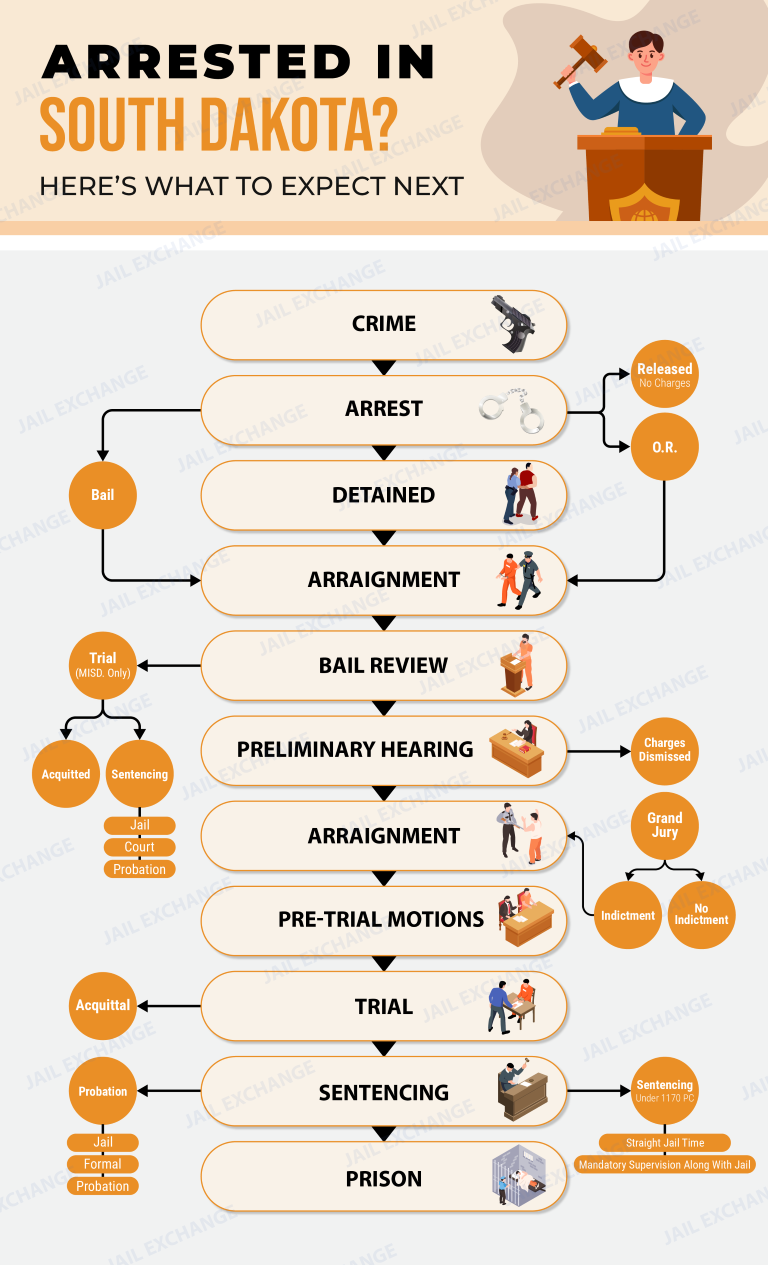
Turner County Sheriff's Office Criminal Court Process
Criminal Court Process for Turner County South Dakota
Turner County Criminal Court Guide
Felony and misdemeanor cases from Turner County are heard in one building, the courthouse at 400 S. Main Avenue, Parker, SD 57053, shared by the circuit court and the magistrate court. Since the county has no jail, people awaiting a hearing stay in a jail elsewhere under contract. The Minnehaha County Jail, 305 W. 4th Street, Sioux Falls, SD 57104, is one the Sheriff may use.
The official inmate lookup may confirm whether the person remains in custody. Our Inmates in Custody page gathers the arrest side in one spot: who was booked, active warrants, the counts filed, booking pictures, public defenders and property release.
Reach the Clerk of Courts at 605-297-3115 from 8 a.m. to 4:30 p.m. on a weekday. Have the spelling of the person's legal name and their birthday handy. Get the case number first, then the date of the coming hearing. For bond, payment and refunds, open our bail page.
1. Is a misdemeanor heard by a different judge than a felony?
Yes, though both courts share the Parker building. South Dakota runs a single statewide system with two trial levels:
- Magistrate court tries misdemeanors along with town ordinance cases (SDCL 16-12B-11). Its judges also sign warrants, decide bond and hold first appearances (SDCL 16-12B-5, 16-12B-7, 16-12B-10). They may take a plea and impose sentence when the most a crime carries is a year or $2,000 (SDCL 16-12B-8).
- Clerk magistrates can take pleas on the smallest offenses, up to a $500 fine or 30 days (SDCL 16-12C-11).
- Circuit court decides felonies and youth cases. Every felony opens with hearings before a magistrate, and a circuit judge takes it from there.
Crimes under federal law go to a separate federal court in Sioux Falls.
↑ Back to the question list2. Which building handles Turner County cases, and when is it open?
Plan on one trip to Parker for nearly any state case:
- Turner County Courthouse, 400 S. Main Avenue, Parker, SD 57053. The building opens 8:30 a.m. to 5:00 p.m., Monday through Friday.
- Clerk of Courts, upstairs at 400 S. Main Avenue, Suite 203, Parker, SD 57053, 605-297-3115, fax 605-297-2115. Its counter is staffed 8:00 a.m. to 4:30 p.m. on weekdays. Mail goes to PO Box 446, Parker, SD 57053-0446.
- First Circuit Court Administrator, 410 Walnut St., Suite 201, Yankton, SD 57078, 605-668-3095, which oversees the circuit's 14 counties.
- James Valley Drug and DUI Court, 200 E. 4th Ave, Mitchell, SD 57301, 605-668-5459. This First Circuit treatment court takes referrals. A defense lawyer can ask whether a local case qualifies.
Leave weapons in the car or at home. Carrying a gun into a courthouse is a Class 1 misdemeanor (SDCL 22-14-23).
↑ Back to the question list3. Where are people held while a Turner County case is open?
In a jail in another county. A county with no jail may contract in writing to house its prisoners in another jail, and it pays that jail's costs (SDCL 24-11-3). The Sheriff's Office makes the arrest, and the case still runs through the courthouse in Parker.
The Sheriff's Office decides where each person is housed. The Minnehaha County Jail, 305 W. 4th Street, Sioux Falls, SD 57104, 605-367-4321, is one that may hold people from here. To learn where your person sits today, ask the Sheriff's Office at 400 S. Main Avenue, Parker, SD 57053, 605-297-3225.
When the jail is far away, first appearances are often done by video (SDCL 23A-4-1).
↑ Back to the question list4. Do Parker, Centerville or Viborg have city courts?
No. None of the towns in the county runs a court of its own. When a town such as Centerville, Viborg, Marion, Hurley or Chancellor writes an ordinance ticket, the magistrate court hears it (SDCL 16-12B-11).
Those tickets are handled on the second floor of the county building, at 400 S. Main Avenue, Suite 203, Parker, SD 57053, 605-297-3115. Many ticket totals come from the statewide fine list. Disorderly conduct, for example, totals $132.50 with costs.
↑ Back to the question list5. What will the judge explain at the opening hearing?
South Dakota's rule is that arrests reach the nearest available judge "without unnecessary delay" (SDCL 23A-4-1). The First Circuit has no set hour count for this. Some appearances are live in the courtroom, while others run on video from the jail.
Pleas come later. For now, the judge explains (SDCL 23A-4-3):
- the accusation
- the right to a lawyer, including a court-appointed one
- bond and release terms
- the choice to stay silent
- in a felony, a hearing on the evidence that can be requested
Families may sit in the gallery. Where the arrest involved domestic abuse, the accused can't reach out to the alleged victim's home in any form until this hearing ends (SDCL 25-10-43).
↑ Back to the question list6. How do DUI and simple assault charges play out in magistrate court?
The State's Attorney files most misdemeanors in magistrate court. Simple assault and first or second DUI offenses are both Class 1 misdemeanors. Here is what each misdemeanor class can bring (SDCL 22-6-2):
- Class 1: one year max behind bars, $2,000 max in fines, or both
- Class 2: 30 days max behind bars, $500 max in fines, or both
After the first appearance comes the plea. Admitting guilt often leads to a sentence the same day. Pleading not guilty gets a trial date set. Lawyers in a misdemeanor trial get three juror strikes each, with no reason needed (SDCL 23A-20-20).
The 180-day rule counts from the first appearance. Time lost to defense requests is excluded (SDCL 23A-44-5.1). In DUI cases a judge may add the 24/7 Sobriety Program to probation or a suspended sentence (SDCL 1-11-21).
↑ Back to the question list7. What stages does a felony go through here?
Felonies travel a longer road:
- Magistrate court. The first appearance and bond.
- Preliminary hearing. A judge looks at the evidence and decides whether the case moves ahead. It must come within 15 days for someone held in jail, or 45 days for someone on bond. The defense can give it up, and an indictment makes it unnecessary (SDCL 23A-4-3).
- Charging paper. Most felonies proceed on an "information" that the State's Attorney writes. Grand juries, with six to ten members, are rare. One meets only if a circuit judge orders it (SDCL 23A-5-1).
- Circuit court. Pleas, motions and any jury trial happen at this level.
- Sentence. A prison term means custody of the state corrections department.
Top penalties by class (SDCL 22-6-1): Class 6, two years and $4,000; Class 5, five years and $10,000; Class 4, ten years and $20,000; Class 3, fifteen years and $30,000; Class 2, twenty-five years; Class 1, fifty years. The law presumes probation at the Class 5 and 6 levels (SDCL 22-6-11). A judge can pick county jail of up to one year in place of prison (SDCL 22-6-1.1).
↑ Back to the question list8. Which rules get stricter for violent or top-class felonies?
The top classes bring tougher rules all the way through:
- Penalties. Class A allows the death penalty or life in prison, while B and C top out at life.
- Bond. On a charge of murder, first-degree manslaughter or kidnapping, the clerk can't set bond, so a judge has to see the defendant (FY27 bond schedule). Bail may be refused outright only on a capital charge backed by overwhelming proof (S.D. Const. art. VI, § 8).
- Family violence. Release waits for a judge, who can order the person out of the home and away from the alleged victim (SDCL 25-10-40, 25-10-41).
- Juror strikes. Twenty peremptory strikes per side if the felony is Class 1 or higher (A, B, C), and ten per side otherwise (SDCL 23A-20-20).
- Probation. A Class 5 or 6 felony can still mean prison when the judge finds the person poses a significant risk to the public (SDCL 22-6-11).
9. Which office prosecutes, and how do low-income defendants get a lawyer?
The State's Attorney prosecutes adult and juvenile crimes for the county. The office is in the courthouse at 400 S. Main Avenue, Parker, SD 57053, 605-297-3975, fax 605-297-2146. It works weekdays 8 a.m. to 5 p.m., by phone or by appointment.
Defendants who can't pay ask for appointed counsel at the first hearing (SDCL 23A-40-6). Each county must provide these lawyers. It may run a defender office, appoint private lawyers, sign contracts, or mix these (SDCL 23A-40-7). The Clerk of Courts at 605-297-3115 can explain how the court here assigns them.
- The court may order repayment to the county, even when the charges end in a dismissal (SDCL 23A-40-10).
- A lien for that debt may be filed, but a homestead can't be foreclosed (SDCL 23A-40-11, 23A-40-15).
- The state's Office of Indigent Legal Services, started in 2024, works on appeals.
10. Where can I find a Turner County court date or case file?
The court system offers these tools:
- Find a Court Date: a free search by party name or case number for coming hearings. The site also builds a county calendar covering today and the next nine court days.
- UJS eCourts: free docket search for open cases.
- Public Access Record Search (PARS) gives a case summary for $20 a search, and the charge applies even if no record comes back. It reaches back to 1989.
The courthouse has public terminals where case records can be viewed. Full files and cases filed before 1989 must be requested from the clerk's office, 605-297-3115.
↑ Back to the question list11. What should I do about a Turner County warrant?
Countywide warrant service, for both arrest and bench warrants, belongs to the Sheriff's Office, 605-297-3225 on weekdays. Centerville police can be reached at 605-563-3911. Online, a case number typed into UJS ePayments reveals an active warrant. The state also runs a DOC Most Wanted list, which tracks escapees, plus a statewide Sex Offender Registry. To deal with a bench warrant, line up a lawyer, and the two of you report to the court that signed it. Another option is phoning the clerk about a fresh court date: Clerk of Courts, 400 S. Main Avenue, Suite 203, Parker, SD 57053, 605-297-3115.
↑ Back to the question list12. Where are federal crimes from this area prosecuted?
Federal charges from the county belong to the Southern Division of the U.S. District Court for the District of South Dakota. Court sits at the U.S. Courthouse, 400 S. Phillips Ave., Sioux Falls, SD 57104. The clerk's office is in Room 128, 605-330-6600.
- The U.S. Attorney's Office prosecutes. Its main office takes mail at P.O. Box 2638, Sioux Falls, SD 57101-2638, 605-330-4400.
- Release or detention is argued the moment the defendant first comes before the federal judge (18 U.S.C. 3142).
- Before trial, federal defendants are held by deputy marshals. The U.S. Marshals office in Sioux Falls: 400 S. Phillips Avenue, Room 216, Sioux Falls, SD 57104, 605-330-4351.
- A sentenced person serves the time with the Federal Bureau of Prisons. Search its inmate finder.
13. How do immigration holds interact with a state case?
Nothing about the charge itself changes, but an extra federal request rides along. In order:
- To start, ICE lodges a detainer with whatever jail is housing the person. The detainer form is Form I-247A.
- When the state case ends its hold, the jail may keep the person up to 48 hours after they would otherwise be released. That gives ICE time to come (8 CFR 287.7(d)).
- The ICE office for this region is the St. Paul Field Office, 1 Federal Drive, Suite 1601, Fort Snelling, MN 55111, 612-843-8600.
- ICE lists the Pennington County Jail, 307 Saint Joseph St, Rapid City, SD 57701, 605-394-6116, among the places it detains people in this state.
- Track a detained person on the ICE Online Detainee Locator.
For a noncitizen, pleading guilty can trigger immigration trouble. Raise it with the defense lawyer early. SB 7 (SL 2025, ch 100), passed in 2025, says local governments here may not limit what officers share with federal officials about immigration status.
↑ Back to the question list14. Where is time served after a felony or misdemeanor sentence?
Jail terms for misdemeanors are served in a county jail. For this county, that is whichever jail the Sheriff contracts with. Felony prison time is served under the South Dakota Department of Corrections, which chooses the facility after sentencing.
- Anyone doing state felony time shows up on the DOC Offender Locator.
- Our guide to state prisons in South Dakota lists each prison.
- Probation is supervised by Court Services. The state lists the Parker office at 210 N. Main, Suite 102, Parker, SD 57053, 605-297-4097. Call before visiting, since another listing places it in the courthouse.
- Parole is handled by the state. For parole questions, call 605-367-5040, the line for the Board of Pardons and Paroles.
15. What if the person charged is still a teenager?
Circuit judges hear youth cases, and the law reaches children from age 10 (SDCL 26-8C-2). The State's Attorney handles juvenile prosecutions too.
- Police contact usually ends with the child going home with a parent or guardian. An intake officer can order detention only for reasons spelled out in law, choosing the least restrictive setting (SDCL 26-8C-3).
- Detained teens are booked into Minnehaha County Regional Juvenile Detention Center, 4200 S. West Avenue, Sioux Falls, SD 57105, 605-367-4313. It serves this county and 15 others.
- Adult charges against a youth need a separate transfer hearing, and a judge decides (SDCL 26-11-4).
16. Which rights does Marsy's Law give Turner County crime victims?
South Dakota's constitution spells out victims' rights in every case (S.D. Const. art. VI, § 29). On request, they include:
- advance notice of every court date, and a seat in the courtroom
- a voice at hearings about bail, a plea bargain or punishment
- safety from the accused, and prompt notice if that person is freed or escapes
- full restitution
Law enforcement is supposed to hand out a Marsy's Card naming these rights. For updates on a case, call the State's Attorney at 605-297-3975. Release alerts are free through SAVIN, online or at 844-299-4608 on weekdays. SAVIN does not track juvenile cases. Victims of a youth offender should call the State's Attorney.
↑ Back to the question list