Dallas is both the county seat and the largest of the roughly two dozen cities inside Dallas County, and almost every felony and misdemeanor filed here is heard in one place: the Frank Crowley Courts Building on North Riverfront Boulevard. Fine-only Class C offenses go to ten justice of the peace courts and to the municipal courts run by Dallas and its suburbs; Class A and B misdemeanors are tried in County Criminal Courts No. 1 through 11; and felonies are assigned to seven Criminal District Courts and ten numbered district courts that hear only criminal cases. The Dallas County Criminal District Attorney prosecutes both felonies and misdemeanors, and the county runs one of the oldest public defender offices in Texas. Adults arrested anywhere in the county are booked into the Dallas County Jail at Lew Sterrett Justice Center, operated by the Sheriff's Department next door to the courthouse.
- Frank Crowley Courts Building (felony and misdemeanor courts), 133 N. Riverfront Blvd., Dallas, TX 75207
- Dallas County District Clerk, criminal division (felony case files), Frank Crowley Courts Building, 2nd floor; felony information line (214) 653-5369
- Dallas County Clerk, Criminal Courts Division (misdemeanor case files), Frank Crowley Courts Building, 2nd floor, Room A-1, Dallas, TX 75207, (214) 653-7099; misdemeanor records (214) 653-5767
- Dallas County Criminal District Attorney, Frank Crowley Courts Building, 133 N. Riverfront Blvd., LB 19, Dallas, TX 75207, (214) 653-3600
- Dallas County Public Defender's Office (criminal, mental health, appellate and capital divisions), 133 N. Riverfront Blvd., Suite C-1, LB 2, Dallas, TX 75207, (214) 653-3550
- Dallas County Pretrial Services, (214) 875-2302
- Lew Sterrett Justice Center (Dallas County Sheriff's Department), 111 W. Commerce St., Dallas, TX 75207, jail information (214) 761-9025
- Henry Wade Juvenile Justice Center (juvenile courts, Juvenile Department and detention), 2600 Lone Star Dr., Dallas, TX 75212, (214) 698-2200
Which court hears your case. Class C misdemeanors are offenses that can only be punished by a fine, such as most traffic tickets, public intoxication, theft of property worth less than $100, or an assault involving offensive contact but no injury. Those go to the Justice of the Peace court for the precinct where the offense happened or, when a city officer wrote the citation inside city limits, to that city's municipal court. Class A and B misdemeanors, a first DWI among them, are filed in one of the eleven County Criminal Courts (County Criminal Court No. 1 through No. 11), all statutory county courts sitting at Frank Crowley; the County Judge's constitutional court handles county business rather than criminal trials. County Criminal Courts of Appeals No. 1 and No. 2 take appeals from the municipal and justice courts. A felony starts with magistrate warnings at the jail and, once a grand jury returns an indictment, is assigned to one of seventeen felony courts: Criminal District Courts No. 1 through No. 7 and the 194th, 195th, 203rd, 204th, 265th, 282nd, 283rd, 291st, 292nd and 363rd Judicial District Courts. Each of those district courts serves Dallas County alone and hears only criminal matters.
Where pretrial inmates are held. The Sheriff's jail complex at Lew Sterrett is the central booking point for every police agency in the county, from the Dallas Police Department and DART Police to suburban departments and state troopers. Some suburban police hold a person briefly in a city holding facility and then transport anyone not released to the county jail. Magistrates at the jail review each arrest, set bail conditions and record requests for appointed counsel. A person who is not released stays in the Sheriff's custody, usually in one of the towers of the downtown complex, until the case ends or release is arranged. For custody questions, inmate property or visitation, call the jail information line at (214) 761-9025.
- Local courts in Dallas County (justice of the peace, municipal and county courts)
- The Frank Crowley Courts Building and other courthouses
- What happens after an arrest: booking, magistration and release
- The Dallas County Jail at Lew Sterrett
- The Dallas County Public Defender's Office and appointed lawyers
- District Attorney diversion programs
- Specialty and treatment courts
- Misdemeanor (for example, theft, a first DWI, assault causing bodily injury, criminal trespass)
- Felony (for example, burglary, felony theft, drug possession or delivery, aggravated assault)
- Violent felony (for example, murder, sexual assault, aggravated robbery)
- Juveniles (under 17) arrested in Dallas County
- Federal cases (U.S. District Court) from Dallas County
Local courts in Dallas County (justice of the peace, municipal and county courts)
Dallas County is divided into five justice of the peace precincts, and each precinct has two places, so ten elected justices share the county's Class C caseload outside city courts along with evictions, small claims and truancy-related matters. The justices also issue arrest and search warrants and can serve as magistrates. Most low-level offenses in Dallas County, however, are written by city police officers and land in a municipal court. The City of Dallas runs by far the busiest one, and nearly every suburb operates its own. Several cities straddle the county line, so a ticket written in one part of a city can belong to a court headquartered in a neighboring county.
Justice of the Peace courts
- Justice of the Peace, Precinct 1, Place 1, 8301 S. Polk St., Suite 2100, Dallas, TX 75232, (972) 228-0280
- Justice of the Peace, Precinct 1, Place 2, 8301 S. Polk St., Suite 2200, Dallas, TX 75232, (972) 228-2272
- Justice of the Peace, Precinct 2, Place 1, 140 N. Garland Ave., Garland, TX 75040, (214) 643-4773
- Justice of the Peace, Precinct 2, Place 2, 500 S. Galloway Ave., Suite P200, Mesquite, TX 75149, (972) 285-5429
- Justice of the Peace, Precinct 3, Place 1, 6820 LBJ Freeway, Suite 3100, Dallas, TX 75240, (214) 321-4106
- Justice of the Peace, Precinct 3, Place 2, 6820 LBJ Freeway, Suite 2100, Dallas, TX 75240, (214) 904-3042
- Justice of the Peace, Precinct 4, Place 1, 106 W. Church St., Suite 205, Grand Prairie, TX 75050, (214) 751-4040
- Justice of the Peace, Precinct 4, Place 2, 106 W. Church St., Suite 210, Grand Prairie, TX 75050, (214) 589-7000
- Justice of the Peace, Precinct 5, Place 1, 3443 St. Francis Ave., Dallas, TX 75228, (214) 943-6980
- Justice of the Peace, Precinct 5, Place 2, 702 E. Jefferson Blvd., Suite 2100, Dallas, TX 75203, (214) 943-5981
The county also lists a general line for questions about justice court citations at (214) 943-5981.
Municipal courts in Dallas County
- Addison Municipal Court, 4799 Airport Pkwy., Addison, TX 75001 (mail: P.O. Box 9010), (972) 450-7111
- Balch Springs Municipal Court, 3117 Hickory Tree Rd., Balch Springs, TX 75180, (972) 557-6057
- Carrollton Municipal Court, 2001 E. Jackson Rd., Carrollton, TX 75006, (972) 466-4750
- Cedar Hill Municipal Court, 285 Uptown Blvd., Building 100, Cedar Hill, TX 75104, (972) 291-5100
- Cockrell Hill Municipal Court, 4125 W. Clarendon Dr., Cockrell Hill, TX 75211, (214) 339-1976
- Coppell Municipal Court, 230 Veterans Way, Coppell, TX 75019, (972) 304-3650
- Dallas Municipal Court, 2014 Main St., Room 331, Dallas, TX 75201, (214) 671-9901
- DeSoto Municipal Court, 211 E. Pleasant Run Rd., DeSoto, TX 75115, (972) 230-9674
- Duncanville Municipal Court, mailing address P.O. Box 380280, Duncanville, TX 75138, (972) 780-5055
- Farmers Branch Municipal Court, 3723 Valley View Ln., Farmers Branch, TX 75244, (972) 484-4112
- Garland Municipal Court, 1791 W. Avenue B, Garland, TX 75042, (972) 205-2330
- Glenn Heights Municipal Court, 1938 S. Hampton Rd., Glenn Heights, TX 75154, (972) 223-1690
- Grand Prairie Municipal Court, 200 W. Main St., Grand Prairie, TX 75050, (972) 237-8663
- Highland Park Municipal Court, Highland Park Town Hall, 4700 Drexel Dr., Highland Park, TX 75205, (214) 559-9303
- Hutchins Municipal Court, 400 N. JJ Lemmon Rd., Hutchins, TX 75141, (972) 225-6121, ext. 502
- Irving Municipal Court, Irving Criminal Justice Center, 305 N. O'Connor Rd., Irving, TX 75061, (972) 721-2451
- Lancaster Municipal Court, 220 W. Main St., Lancaster, TX 75146, (972) 218-1334
- Mesquite Municipal Court, 211 Municipal Way, Mesquite, TX 75149, (972) 216-6206
- Richardson Municipal Court, 2100 E. Campbell Rd., Richardson, TX 75081, (972) 744-4500
- Rowlett Municipal Court, 4401 Rowlett Rd., Rowlett, TX 75088 (in the same building as the Rowlett Police Department)
- Sachse Municipal Court, 3815 Sachse Rd., Building B, Sachse, TX 75048, (469) 429-4766
- Seagoville Municipal Court, 702 N. Highway 175, Seagoville, TX 75159, (972) 287-2192
- Sunnyvale Municipal Court, through Sunnyvale Town Hall, 127 N. Collins Rd., Sunnyvale, TX 75182, (972) 226-7177
- University Park Municipal Court, University Park City Hall, 3800 University Blvd., University Park, TX 75205, (214) 987-5331
- Wilmer Municipal Court, 219 E. Belt Line Rd., Wilmer, TX 75172, (972) 441-6372
Small parts of Dallas County also lie within cities whose courts sit across the county line, including Combine Municipal Court, 100 Davis Rd., Combine, TX 75159, (972) 476-1532, and Ferris Municipal Court, 100 Town Plaza, Ferris, TX 75125, (972) 544-2110. Edges of Ovilla, Wylie, Grapevine and Lewisville also cross into the county, and citations written there go to those cities' own courts. Your ticket or bond paperwork always names the court that has the case.
County criminal courts (Class A and B misdemeanors)
- County Criminal Courts No. 1, 2, 3, 4, 5 and 6, Frank Crowley Courts Building, 3rd floor, 133 N. Riverfront Blvd., Dallas, TX 75207; County Clerk Criminal Courts Division (214) 653-7099
- County Criminal Courts No. 7, 8, 9, 10 and 11, Frank Crowley Courts Building, 4th floor; same clerk's line
- County Criminal Courts of Appeals No. 1 and No. 2, Frank Crowley Courts Building, 3rd floor; County Criminal Court of Appeals No. 2 coordinator (214) 653-5715
Felony courts
- Criminal District Courts No. 1, 3, 4 and 6 and the 265th, 283rd and 292nd District Courts, Frank Crowley Courts Building, 6th floor
- Criminal District Courts No. 2 and 7 and the 194th, 195th, 203rd, 204th and 291st District Courts, Frank Crowley Courts Building, 7th floor
- Criminal District Court No. 5 and the 282nd and 363rd District Courts, also in the Frank Crowley Courts Building; District Clerk felony line (214) 653-5369
A Class C case can be closed by paying the fine, by asking for deferred disposition or a driving safety course, or by pleading not guilty and requesting a trial before the judge or a six-person jury. The Dallas Municipal Court and several suburban courts are courts of record, which means an appeal from them is decided on the written record by a County Criminal Court of Appeals. An appeal from a justice court or from a municipal court that is not a court of record gets a brand-new trial instead. A Class C ticket cannot lead to a jail sentence, but ignoring it can produce a warrant, a hold on license renewal and added fees, so call the court before the date on the citation passes.
The Frank Crowley Courts Building and other courthouses
Dallas County's criminal justice center sits on the west edge of downtown, where the Frank Crowley Courts Building, the Sheriff's jail towers and related county offices form one complex along North Riverfront Boulevard, the street that was called Industrial Boulevard until it was renamed. Courthouse visitors pass through security screening at the entrance, and lines can be long on weekday mornings when dockets start, so plan to arrive well before the time on your notice.
Who is on which floor
- 2nd floor: District Clerk criminal intake and the County Clerk's criminal cashier and records counters, where people pay fines and court costs, pick up copies and check case status.
- 3rd floor: County Criminal Courts No. 1 through 6 and both County Criminal Courts of Appeals, with their clerks.
- 4th floor: County Criminal Courts No. 7 through 11 and the protective order court.
- 5th floor: Several auxiliary courtrooms plus the DIVERT and STAC drug courts.
- 6th and 7th floors: The Criminal District Courts and numbered felony district courts, along with the mental health diversion court.
- 8th floor: A waiting area for specialty court participants.
- 9th floor: The Public Defender's criminal, appellate and investigative divisions.
- 11th floor: The Criminal District Attorney's office, including its misdemeanor, check, organized crime and specialized crime divisions.
Other court buildings
Juvenile delinquency cases are heard at the Henry Wade Juvenile Justice Center on Lone Star Drive, west of the Trinity River, which also houses the Juvenile Department and its detention center. Civil and family district courts sit in the George L. Allen, Sr. Courts Building at 600 Commerce Street, which matters in criminal cases mainly for protective orders tied to divorce or custody disputes. Federal criminal cases go to the Earle Cabell Federal Building at 1100 Commerce Street. Justice of the peace courts and city courts are spread across the county at the addresses in the local courts list.
Felony and misdemeanor dockets typically begin in the morning, and a single courtroom may call dozens of cases. If you are free on bond, check in with the court coordinator or bailiff when you arrive, and do not leave until your case is called or reset. Missing a setting can mean a bond forfeiture and a new warrant.
What happens after an arrest: booking, magistration and release
Booking
After an arrest in Dallas County, officers bring the person to the intake area at Lew Sterrett Justice Center, either directly or after a short stop at a suburban police holding facility. Booking includes a records check, fingerprints, a photograph, a medical and mental health screening and an inventory of property. The arresting agency files its report, and prosecutors in the District Attorney's intake division review whether the charge will be accepted. A new booking can take several hours to appear in the county's online jail lookup, so families calling the jail right after an arrest may be told to try again later.
Magistration
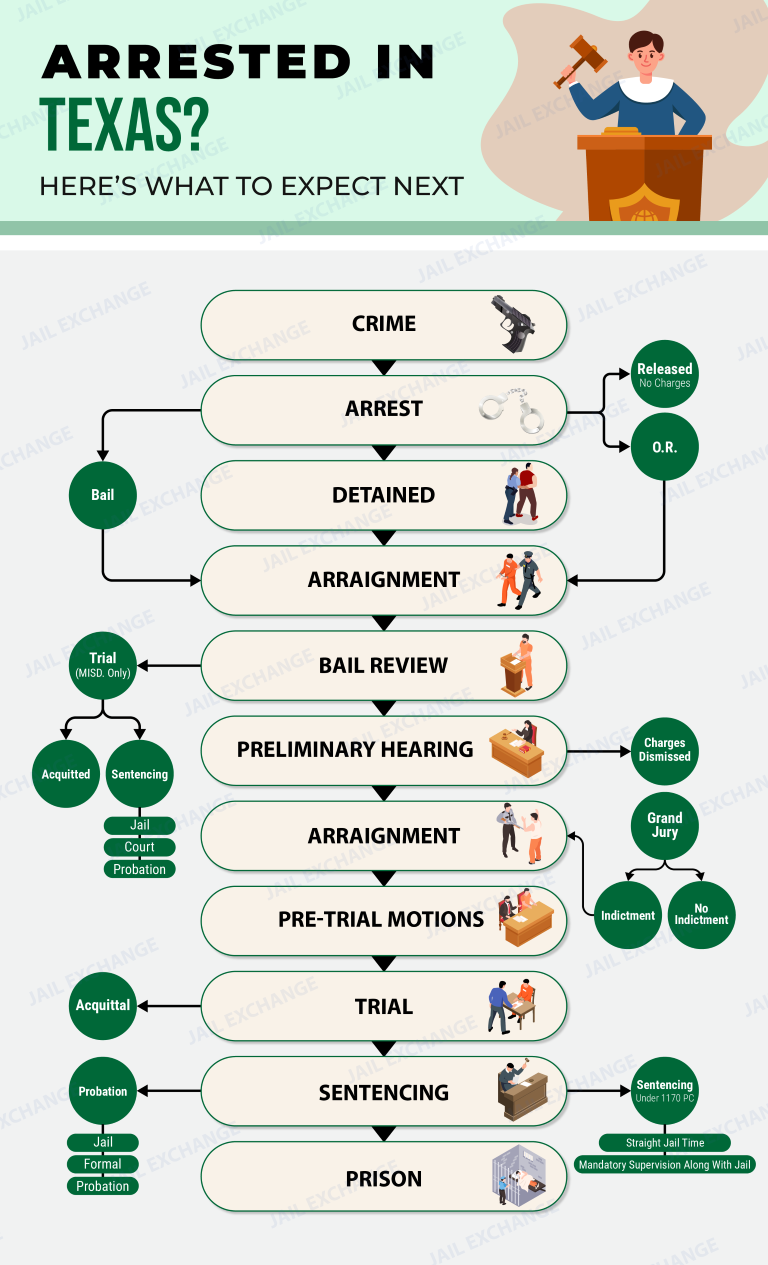
Article 15.17 of the Texas Code of Criminal Procedure requires that an arrested person be taken before a magistrate within 48 hours. In Dallas County, magistrates work around the clock at the jail, and hearings are often done by video from the intake area. The magistrate reads the charges, explains the right to remain silent and the right to a lawyer, asks whether the person wants appointed counsel, determines whether there is probable cause for an arrest made without a warrant, and sets the conditions of release. A person who asks for a lawyer fills out a financial questionnaire at this stage, and the request is forwarded so an attorney can be appointed within the deadlines set by state law.
Setting release conditions
Since the 2021 Damon Allen Act, every magistrate in Texas reviews a public safety report showing a defendant's criminal history and any pending cases before deciding on bail. Release can come through a cash bond posted in full at the jail, a surety bond written by a licensed bail bondsman for a nonrefundable fee, or a personal bond, which is a signed promise to return to court with no money paid up front. Dallas County Pretrial Services, (214) 875-2302, interviews many newly booked defendants and supervises those released on personal bond. Common conditions include reporting to pretrial officers, drug testing, an ignition interlock device after an intoxication arrest, GPS monitoring, and no-contact or stay-away orders in family violence cases. State law bars personal bonds for people charged with violent offenses, and Under a constitutional amendment Texas voters approved in 2025, judges in Dallas County can deny bail in some violent-crime cases.
Holds and delays
Release may be delayed if the person has a warrant from another county or city, a probation or parole hold, or an immigration detainer. Family violence arrests often carry an emergency protective order. A person arrested on a warrant that already lists an amount can sometimes be released as soon as the paperwork is processed. Anyone still in custody can ask the court, through a lawyer, for a lower amount or different conditions at a bond reduction hearing.
Requesting a lawyer
The fastest way to get appointed counsel is to ask the magistrate at the jail. A defendant who was released without asking can contact the Public Defender's Office at (214) 653-3550 or the court handling the case, and the judge will rule on eligibility.
The Dallas County Jail at Lew Sterrett
The Dallas County Jail is one of the largest county jails in Texas. It is run by the Dallas County Sheriff's Department, and its main buildings at Lew Sterrett Justice Center, 111 W. Commerce St., are linked to the Frank Crowley Courts Building so that detained defendants can be brought to court without leaving the complex. The jail houses men and women held before trial, people serving county jail sentences, people awaiting transfer to state prison after a felony conviction, and people held for other agencies.
Finding someone and keeping in touch
- The jail information line, (214) 761-9025, answers questions about whether a person is in custody, charges, release status and property.
- The county's online jail lookup shows a booking number, charges and bond amounts once a booking has been processed.
- Visits, phone accounts, commissary deposits and mail follow Sheriff's Department rules, which change from time to time; confirm the current schedule and the correct mailing format before sending anything.
- Legal visits by attorneys are handled separately from family visitation.
Posting release money
Cash amounts can be paid at the jail, and the bonding window at the jail is open around the clock. A licensed bondsman can post a surety amount for a fee, usually a percentage of the total. Once the paperwork is accepted, release processing can still take several hours, particularly on busy weekend nights.
Health and mental health
Medical and psychiatric care in the jail is provided through Parkland Health, the county hospital district. People who screen positive for serious mental illness at booking may be referred to the Public Defender's mental health division and to diversion options, discussed below. Families with information about a detainee's medications or diagnoses can pass it along through the defense attorney.
The Dallas County Public Defender's Office and appointed lawyers
Dallas County uses a mixed system for indigent defense. The county's Public Defender's Office, a government agency staffed by assistant public defenders, investigators and caseworkers, takes a large share of the cases in which a defendant cannot afford a lawyer. The remaining cases are assigned to private attorneys who meet qualification standards and are paid by the county under the local indigent defense plan adopted by the felony and misdemeanor judges. The Texas Indigent Defense Commission sets statewide standards, helps fund the program and monitors whether appointments happen on time.
Divisions and contacts
- Criminal, mental health, appellate, DNA and capital divisions: Suite C-1 of the Frank Crowley Courts Building (mail to LB 2), (214) 653-3550
- Juvenile and CPS divisions: Henry Wade Juvenile Justice Center, 2600 Lone Star Dr., Suite A-132, LB 2, Dallas, TX 75212, (214) 698-4400
How eligibility works
The judge decides whether a defendant is indigent based on income, household size, assets and expenses, using the sworn information gathered at magistration or later. A person who is released on bail is not automatically disqualified, though the court may consider how the release money was raised. Someone who was found eligible and later becomes able to pay can be ordered to repay part of the cost. When the Public Defender's Office has a conflict, such as representing a co-defendant, a private lawyer is appointed instead.
What a defender does
An appointed lawyer, whether from the public defender's staff or the private list, reviews the evidence, investigates, negotiates with prosecutors, files motions and tries the case if it goes to a jury. The office's mental health attorneys focus on clients with serious psychiatric conditions and work with the specialty courts. Its appellate section handles appeals to the Fifth District Court of Appeals in Dallas and to the Texas Court of Criminal Appeals.
District Attorney diversion programs
The Dallas County Criminal District Attorney's office decides who may enter a pretrial diversion program, and these agreements are offered at the prosecutor's discretion rather than as a right. In a typical diversion agreement, the defendant follows a set of conditions for a fixed period; if every condition is met, the State dismisses the case, and the person may then be able to seek expunction of the arrest record. Breaking the agreement sends the case back to the regular docket.
Programs the office runs
- Misdemeanor Pretrial Diversion (PDI): an agreement for eligible people charged with lower-level misdemeanors, commonly first-time defendants. Conditions can include classes, community service, restitution and staying arrest-free.
- Homeless Diversion Court (HDC): a court-based program that connects people experiencing homelessness with housing and services in place of conventional prosecution for minor offenses.
- STOP: an educational class for people charged with soliciting prostitution.
- HOPE: a program for women charged with prostitution offenses that focuses on services and exit from commercial sexual exploitation.
The office also maintains a restorative justice section and has adopted written charging policies for some low-level offenses, which can affect whether a case is filed at all.
Intoxication cases
A first DWI is generally not eligible for ordinary pretrial diversion in Texas. Instead, defendants charged with DWI in Dallas County may be steered toward a misdemeanor DWI court, deferred adjudication where the law allows it, or a plea to probation with treatment and an ignition interlock. Ask your lawyer which options the prosecutor is offering in your particular court.
Getting considered
A defense lawyer usually requests diversion on the client's behalf, and the decision often turns on criminal history, the facts, the victim's views and whether restitution can be paid. Program questions can be directed to the District Attorney's office at (214) 653-3600. Diversion may carry program fees; a defendant who cannot afford them should raise that through counsel. Defendants without a lawyer can request one through the Public Defender's Office at (214) 653-3550.
Entering a diversion program does not depend on posting bail, but a defendant who is still in jail may have to wait for a lawyer's request to be approved before release conditions are adjusted to fit the program.
Specialty and treatment courts
Dallas County operates one of the widest arrays of specialty courts in Texas. In these programs a judge, prosecutor, defense lawyer, probation officer and treatment providers meet regularly to track each participant's progress. Participants appear in court often, sometimes weekly at first, and face drug testing, counseling and other requirements. Success can mean a dismissal, a reduced charge or an early end to probation; failure can mean sanctions or a return to the regular docket. Eligibility is set program by program, and the Community Supervision and Corrections Department screens many referrals.
Programs listed by the county
- Dallas County Veterans Court: for veterans and service members whose charges are connected to service-related trauma, brain injury or substance use.
- Felony Mental Health ATLAS Court (Achieving True Liberty and Success): for felony defendants with serious mental illness.
- Misdemeanor Mental Health Diversion Court: the misdemeanor counterpart, aimed at stabilizing participants and dismissing cases.
- Felony DWI Court and Misdemeanor DWI Court: intensive supervision and treatment for repeat and first-time intoxicated drivers.
- STAC (Successful Treatment of Addiction through Collaboration) and the Drug DIVERT Court: drug treatment programs for people charged with felony drug offenses, both meeting on the fifth floor at Frank Crowley.
- Dual Diagnosis Court: for people with both substance use disorders and mental illness.
- PRIDE Court (misdemeanor prostitution) and STAR Court (felony prostitution): programs addressing commercial sexual exploitation and trafficking histories.
- Outpatient Competency Restoration (OCR) Court: for felony and misdemeanor defendants found incompetent to stand trial who can be treated safely in the community instead of waiting in jail for a state hospital bed.
- 4C Court: a reentry court for people returning from a state Substance Abuse Felony Punishment Facility (SAFPF).
- Felony Batterers Intervention Court and an Intensive Intervention Court, plus separate family and juvenile specialty programs at the Henry Wade center.
Assistant public defenders staff most of these dockets, though a few, including the misdemeanor DWI court and the batterers intervention program, rely on private counsel. A defendant who is in custody at Lew Sterrett can still be referred; the court may order release on a personal bond once a treatment placement is ready. Ask your lawyer to request screening, or call the Public Defender's Office at (214) 653-3550.
Misdemeanor (for example, theft, a first DWI, assault causing bodily injury, criminal trespass)
Arrest and the first appearance
Many Class B arrests in Dallas County, especially for shoplifting, trespass or driving with an invalid license, start in the intake area at Lew Sterrett. Within 48 hours the person sees a jail magistrate, who sets bail or orders release on personal recognizance, takes any request for appointed counsel and issues protective orders in family violence cases. Many misdemeanor defendants are released within a day. People who cannot post the amount set should know that Texas law requires release on personal bond or a reduced amount if the State is not ready for trial within 30 days of detention on a Class A charge, 15 days on a Class B, subject to exceptions.
Filing and court assignment
Prosecutors in the District Attorney's misdemeanor division file the formal charging document, called an information, and the case is assigned to one of County Criminal Courts No. 1 through 11. The first setting is usually an arraignment or announcement docket where the defendant confirms representation, receives the evidence the State intends to use and hears any plea offer. Several more settings often follow before the case is resolved. The County Clerk's criminal division, (214) 653-7099, can confirm the court and next date.
A lawyer for a misdemeanor
Anyone facing possible jail time on a Class A or B misdemeanor has the right to appointed counsel if they cannot afford one. In Dallas County that lawyer may be an assistant public defender assigned to the County Criminal Courts or a private attorney from the misdemeanor appointment list. Make the request at magistration, at the first court date, or by calling the Public Defender's Office at (214) 653-3550.
How cases end
Outcomes include dismissal, completion of misdemeanor pretrial diversion, deferred adjudication probation (which ends without a conviction if completed), a conviction with probation supervised by the county's misdemeanor probation office at (214) 653-5370, a fine, or time in county jail, sometimes with credit for days already served. A defendant who wants a trial has a jury of six, and the verdict must be unanimous. After some deferred adjudications, a person can petition for an order of nondisclosure that hides the record from most private background checks.
Penalty ranges
- Class B misdemeanor (up to 180 days in county jail and a fine of up to $2,000): theft of $100 to $750, most criminal trespass, possession of up to two ounces of marijuana, and a first DWI.
- First DWI: a minimum of 72 hours in jail, raised to six days if an open container was in the vehicle, with probation often substituted for most of the term; a fine up to $3,000; a license suspension; a DWI education program; possible ignition interlock; and a state traffic fine after conviction. A test result of 0.15 or higher makes the charge a Class A. The administrative license suspension that follows a test refusal or failure is a separate civil proceeding with a short deadline to request a hearing.
- Class A misdemeanor (up to one year in jail and a $4,000 fine): bodily-injury assault, theft valued from $750 up to $2,500, and criminal trespass into a home or while armed with a deadly weapon. A finding of family violence on an assault can bar firearm possession and can turn a later assault charge into a felony.
A typical Dallas County misdemeanor takes two to six months to resolve, and a contested DWI can take longer while lab results and video are reviewed.
Felony (for example, burglary, felony theft, drug possession or delivery, aggravated assault)
From the jail to the grand jury
A felony arrest leads to booking at the Dallas County Jail and a magistrate hearing at Lew Sterrett within 48 hours. The magistrate sets bail after reviewing the public safety report, and the defendant can ask for an appointed lawyer. The case is then routed to one of the seventeen felony courts in the Frank Crowley Courts Building, where the judge handles release conditions and appointments while prosecutors prepare the case for a Dallas County grand jury. Texas requires an indictment for a felony unless the defendant, with a lawyer, waives it and agrees to be charged by information, which sometimes happens when a plea agreement is reached early.
Time limits while the case is pending
If the State is not ready for trial within 90 days after a felony defendant is jailed, article 17.151 generally requires release on personal bond or a reduced amount the defendant can afford, although judges may deny that relief for certain violent and sexual offenses. A grand jury may indict, "no-bill" the case (declining to indict), or take the matter under further review. A no-bill ends the case for now, though prosecutors can present it again if new evidence appears.
After indictment
The indictment is filed with the District Clerk, (214) 653-5369, and the case proceeds through arraignment and a series of settings in the assigned court. The defense receives the State's evidence under the Michael Morton Act, files motions such as requests to suppress evidence, and negotiates with the assigned assistant district attorney. Most felonies end with a plea agreement. A defendant who goes to trial faces a jury of twelve who must agree unanimously, and the defendant can elect to have that jury, rather than the judge, decide the punishment.
Penalty levels
- State jail felony: 180 days to two years in a state jail facility and up to a $10,000 fine. Examples include theft of $2,500 to $30,000, possession of less than one gram of a Penalty Group 1 drug such as methamphetamine or cocaine, and burglary of a building.
- Third-degree felony: two to ten years in prison and up to a $10,000 fine, such as felony DWI with two prior convictions or possession of one to four grams of a Penalty Group 1 substance.
- Second-degree felony: two to twenty years, including burglary of a habitation, most aggravated assaults and manufacture or delivery of one to four grams of a Penalty Group 1 drug.
- First-degree felony: five to ninety-nine years or life, such as delivery of larger drug quantities or aggravated assault on a public servant.
Prior felony convictions can raise the range, and a person with two prior sequential prison convictions can face 25 years to life as a habitual offender.
Probation, prison and parole
First-time defendants are often offered deferred adjudication or regular probation, supervised by the Dallas County Community Supervision and Corrections Department, sometimes through one of the specialty courts. Prison sentences are served in the Texas Department of Criminal Justice. Parole eligibility for most offenses comes after roughly one-quarter of the sentence, counting good-conduct time, while "3g" aggravated offenses, such as those involving a deadly weapon finding, require serving half the sentence (at least two years) before eligibility. Expect a Dallas County felony case to take six to eighteen months, longer if it goes to trial or depends on lab testing.
Felony defendants without money for a lawyer should ask the magistrate for one or call the Public Defender's Office at (214) 653-3550.
Violent felony (for example, murder, sexual assault, aggravated robbery)
Arrest and detention
Serious violent cases in Dallas County are usually investigated by the Dallas Police Department's homicide, robbery or sex crimes units, by suburban police or by the Sheriff's Department, and they often begin with a warrant signed by a judge. After booking at Lew Sterrett, the magistrate hearing still takes place within 48 hours, but release is much harder to obtain. A personal bond is not allowed for violent offenses under the Damon Allen Act, a high bail amount is common, and under the 2025 constitutional amendment judges can deny bail outright in some violent-crime cases after a hearing. Release, when granted, usually comes with GPS monitoring, curfews and no-contact orders.
Prosecution and defense
Violent felonies are handled by experienced trial prosecutors in the Criminal District Attorney's office, and certain cases go to specialized units such as those for family violence, crimes against children and organized crime. Defendants who cannot afford counsel are represented by senior assistant public defenders or by private lawyers certified for the most serious cases. In a capital murder case where the State seeks death, Texas requires two lawyers qualified for capital work, and the Public Defender's capital division or appointed counsel takes on that role. Families can reach the Public Defender's Office at (214) 653-3550.
Grand jury, trial and punishment
After a grand jury indictment, the case is set in one of the Criminal District Courts or felony district courts at Frank Crowley. These cases involve forensic evidence, expert witnesses and extensive motion practice, and they often take one to three years to reach a verdict or plea. Trial is before twelve jurors, and the defendant may ask the jury to decide the sentence.
- Capital murder: life without parole or the death penalty. Texas carries out more executions than any other state, and Dallas County juries have returned death sentences, though such cases are now relatively rare.
- Murder: a first-degree felony, five to ninety-nine years or life; the range may drop to the second-degree level if the jury finds the defendant acted in sudden passion arising from adequate cause.
- Aggravated robbery: first degree; a deadly weapon finding makes it a 3g offense with half-time parole eligibility.
- Sexual assault: second degree, two to twenty years; aggravated sexual assault is first degree, with a 25-year minimum when the victim is a young child. Convictions require sex offender registration.
Victims
Article I, section 30 of the Texas Constitution gives crime victims the right to be informed, to be present at public court proceedings and to be heard at sentencing. The District Attorney's victim services staff can explain notices and protective orders, and victims can register to be notified when a defendant is released from jail or prison.
Juveniles (under 17) arrested in Dallas County
In Texas the juvenile system covers children who were 10 through 16 years old when the alleged offense took place. A 17-year-old is prosecuted as an adult and booked at the adult jail. For younger children, Dallas County has two dedicated juvenile courts, the 304th and 305th Judicial District Courts, both at the Henry Wade Juvenile Justice Center, 2600 Lone Star Dr., Dallas, TX 75212.
Intake and detention
Police take an arrested child to a juvenile processing office or directly to the Henry Wade center, where the Dallas County Juvenile Department handles intake, (214) 698-2200. Intake officers decide whether the child goes home with a parent, receives a referral to services, or is held in the Dr. Jerome McNeil Jr. Detention Center at the same complex. A child who is detained must have a detention hearing before a juvenile judge or referee within two working days, and at that hearing the court decides whether the child stays in detention or goes home under conditions. The child has a right to a lawyer at that hearing. The Juvenile Department also operates post-adjudication programs and the Marzelle C. Hill Transition Center at Henry Wade. Juvenile cases do not use a bail system; the judge alone decides whether a child is released.
Who prosecutes and who defends
The Criminal District Attorney's juvenile division reviews referrals and files a petition when formal proceedings are warranted. Children are often represented by the Public Defender's juvenile division, at Henry Wade, Suite A-132, (214) 698-4400, or by appointed private lawyers; family income does not prevent a child from having counsel appointed when the parents do not hire one.
Possible outcomes
- Supervisory caution or deferred prosecution: a period of supervision, typically up to six months, after which the case is closed if the child complies.
- Adjudication and probation: the court finds the child engaged in delinquent conduct and orders probation, which may include counseling, school requirements, electronic monitoring or placement in a county program.
- State commitment to TJJD, the Texas Juvenile Justice Department: for felony-level conduct, the judge may send the child to a state secure facility.
- Determinate sentencing: for certain serious offenses, a grand jury can approve a petition that allows a sentence of up to 40 years, starting in TJJD with possible transfer to adult prison.
Certification as an adult
The juvenile court may waive its jurisdiction and transfer a child to adult criminal court after a hearing that weighs the seriousness of the offense, the child's background and the protection of the public. Generally, a child 14 or older can be certified for a capital felony, a first-degree felony or an aggravated controlled substance felony, and a child 15 or older for other felonies. A certified youth is tried in the Criminal District Courts at Frank Crowley like an adult.
Records
Juvenile records in Texas are generally confidential and are not open to the public like adult records. Many can be sealed, and some are sealed automatically when the person turns 19 if the case met the legal criteria; an attorney can explain eligibility.
Federal cases (U.S. District Court) from Dallas County
Dallas County is the home of the Dallas Division of the U.S. District Court for the Northern District of Texas, and the Northern District's headquarters for both the court and the U.S. Attorney's Office are downtown, a short walk from the county courthouse complex. Federal prosecutors in Dallas handle cases from Dallas County and six neighboring counties assigned to the Dallas Division.
- U.S. District Clerk, Dallas Division, 1100 Commerce St., Room 1452, Dallas, TX 75242, (214) 753-2200
- U.S. Attorney's Office, Northern District of Texas, Earle Cabell Federal Building, 1100 Commerce St., Suite 300, Dallas, TX 75242, (214) 659-8600
- Federal Public Defender for the Northern District of Texas, which has its main office in Dallas; private lawyers on the Criminal Justice Act (CJA) panel take cases the defender cannot
Which cases end up in federal court
A case is federal when it charges a crime under a U.S. statute and federal prosecutors decide to bring it, often after an investigation by the FBI, DEA, ATF, Homeland Security Investigations, the Secret Service or the U.S. Postal Inspection Service. In Dallas County that commonly means drug trafficking along the Interstate 35, 20, 30 and 45 corridors, illegal possession of firearms by people with felony records, armed robbery of businesses engaged in interstate commerce, bank robbery, health care and investment fraud, public corruption, child exploitation and human trafficking. Cases involving people found in the country after deportation are also filed here. Some arrests made by Dallas police on firearm or drug charges are later adopted by federal prosecutors, and the state case may then be dismissed.
The first days in federal custody
An arrested defendant appears before a U.S. magistrate judge in the Earle Cabell Federal Building, usually the same or next business day, and is told the charges and the right to counsel. If prosecutors oppose release on bail, a detention hearing is generally held within three court days. Under the Bail Reform Act, the magistrate judge either releases the defendant on conditions monitored by U.S. Pretrial Services, such as travel limits, drug testing or home detention, or orders detention because no condition will reasonably assure appearance and public safety. Federal release conditions rarely involve paying money up front, and commercial bondsmen play no role in federal court.
Indictment, plea and trial
When a case starts with a criminal complaint, a federal grand jury must return an indictment within 30 days of the arrest. The Speedy Trial Act sets a 70-day target for trial after indictment or first appearance, but complex cases routinely receive extensions. The great majority of federal defendants plead guilty, often under a written plea agreement. Those who go to trial face a twelve-member jury that must reach a unanimous verdict.
Sentencing and prison
After a conviction, a U.S. probation officer prepares a presentence report, and the district judge calculates the advisory federal Sentencing Guidelines range while applying any mandatory minimum required by statute, such as those common in drug and firearm cases. There is no parole in the federal system; with good-conduct credit, prisoners serve at least about 85 percent of the sentence in a Bureau of Prisons facility, then a term of supervised release. A defendant who appeals takes the case to the New Orleans-based U.S. Court of Appeals for the Fifth Circuit.
Locating a federal defendant
Families looking for a sentenced federal prisoner can enter a name or register number in the Federal Bureau of Prisons inmate locator. A person waiting for trial may instead be housed in a county jail that holds federal detainees under a contract with the U.S. Marshals Service, and that jail's inmate roster may list the person. People under 18 are seldom prosecuted federally; offenses by Dallas County youths are almost always handled in the 304th and 305th juvenile courts.
This guide describes how criminal cases usually proceed in Dallas County and is not legal advice. Court locations, dockets and programs change, so confirm every date and room number with the clerk or on your paperwork, and talk with a defense attorney about your own situation. Anyone who cannot afford a lawyer should ask for one at magistration or call the Dallas County Public Defender's Office at (214) 653-3550; for case information, call the District Clerk at (214) 653-5369 for felonies or the County Clerk at (214) 653-7099 for misdemeanors.