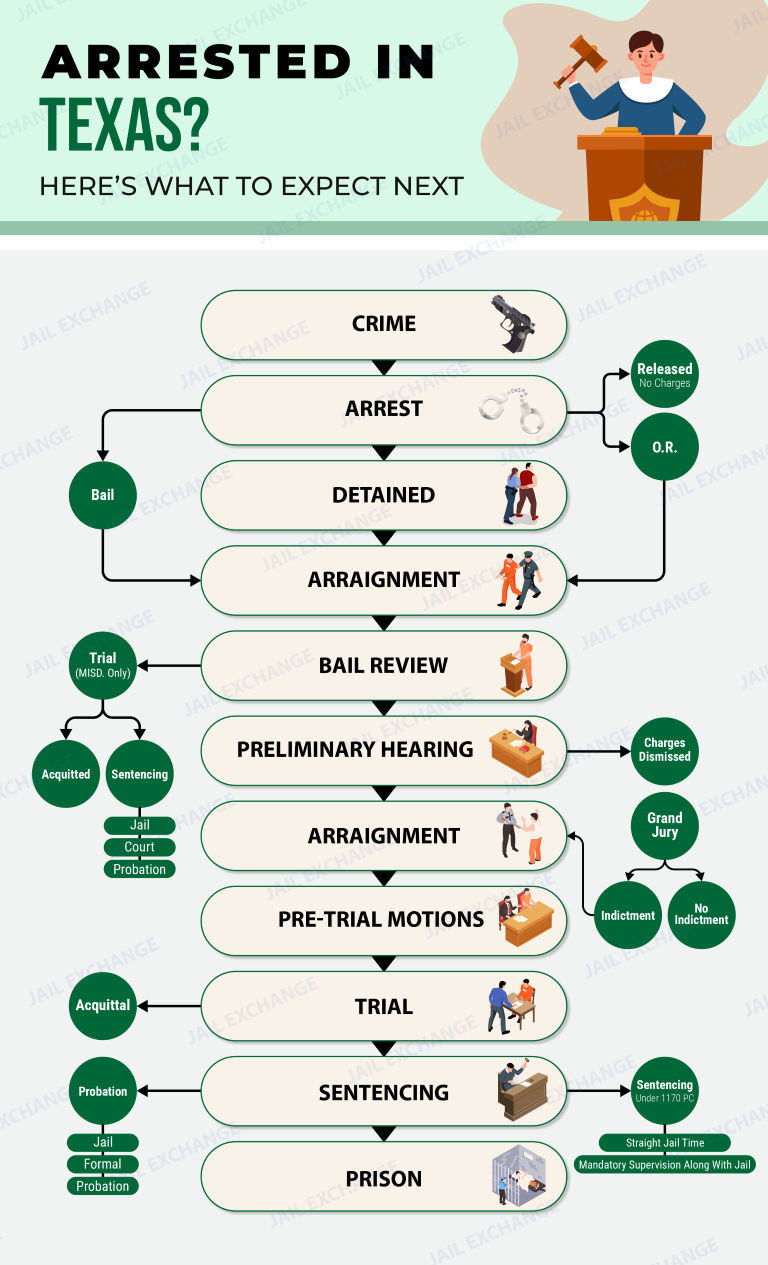
Information on the criminal court process for offenders arrested in Denton County Texas and booked into the Denton County Jail. From the arrest to the sentencing and everything in between.
It might be helpful to define some words that will be used on this site, when explaining the Texas Court System and how it works. The definitions on this site are for general information and not legal advice. It is always preferred to follow information given by your attorney or local authorities.
If you scroll down below this content, and the listing of the courts in Denton County, you will find a simple flowchart diagram and a video that will help you visualize the stages of the Criminal Court Process.
Arrest is when Texas, Denton County or local police take a person into custody and start the legal process. The arrested person may or may not be immediately jailed.
In less serious crimes, the person may only be given a citation ordering that they appear in municipal or Denton County court on a certain date. In cases involving more serious crimes, the person is usually placed in the county jail until an arraignment, or a judge decides the next step.
Booking is when the Denton County sheriff or local police gather information such as the detainee’s name, address and why the person is being arrested. Booking also includes fingerprinting, criminal history, investigation and verification of identity. Bail for lower-level crimes may be set right after booking so the arrested has the opportunity to “bail or bond out” before being detained.
The prosecution, sometimes called “the government” or “the people” or “the state” is the side that press the charges and seeks punishment for the offense. These are attorneys that work for the state of Texas, Denton County or a city or town. The prosecuting attorney for Denton County or the district is called the District Attorney or Assistant District Attorney. A U.S. Attorney prosecutes federal cases.
Jurisdiction is an important term in the court system that means whether a court has the obligation or duty or right to handle a case. For example, if you run a red light in your town or city, a municipal court would likely have jurisdiction over your case, but the next town or city over would not have jurisdiction over your case. If you attempted to flee from police when they attempted to stop you after you ran the red light, it becomes a more serious crime, and the municipal court might not have jurisdiction so you might be assigned to a higher-level court that has jurisdiction over the more serious crime. Jurisdiction varies from state to state and sometimes county to county.
Arraignment in Texas comes after charges are formally filed, usually by indictment for a felony. The trial court reads the charge and the defendant enters a plea of guilty, not guilty or no contest. It is a separate step from the first appearance before a magistrate, where rights are explained, bail is set and a request for an appointed lawyer can be made.
An arraignment is not a trial, and the defendant is entitled to a trial within a reasonable amount of time after the arraignment.
Bail is money paid that is held by the Denton County or municipal court to make sure that the arrested does not flee the area before their trial. In Texas, bail and its conditions are set by a magistrate soon after arrest, at the hearing often called magistration. When the case is over, cash posted as bail is refunded on the court’s order to the person named on the receipt, less any fee the law allows.
If a person does not pay bail, they remain in the Denton County Jail until their trial. Bail can be denied if the court feels that the arrested would be a danger to others if released. Sometimes the court decides that there is a good chance that the arrested will show up for trial and not flee so they are released on their own promise, or recognizance without having to pay bail.
A bond proceeding is the determination of how much bail is to be paid. In Texas it usually happens at the first appearance before a magistrate, soon after arrest, well before any arraignment. A defendant may have a lawyer at a bond proceeding, and a defendant facing a request to deny bail under Proposition 3 has the right to one at that hearing. Jailers, police and prosecutors can’t set bail. In Texas a magistrate does, usually within 48 hours of arrest, and that magistrate may be a justice of the peace, a municipal judge, an appointed magistrate or a county or district judge. Texas doesn’t use one bail schedule for the whole state; each county’s judges adopt their own. Before setting bail, the magistrate reviews a Public Safety Report on the person’s criminal history (the Damon Allen Act, Senate Bill 6, 2021). Since September 2025, Senate Bill 9 sends some felony bail decisions to a judge rather than an appointed magistrate, and since November 2025 Proposition 3 lets a judge deny bail outright for certain violent and sexual felonies after a hearing.
It is always important to have family involvement after being arrested. Not only can they make calls and communicate on your behalf (not all bond companies will accept collect calls), but family support will show the court that there are people who will make sure that the defendant makes it to court, not only for the defendant’s own good, but because they may have signed bond paperwork and responsible to pay if the defendant does not show in court. Chances of obtaining a bond from a bond company or clerk of court are better if family is involved.
(There have been phone scams to where a bond company calls and informs a person that their family member has been arrested and they ask for financial information. A bondsman will not call asking for money without involvement of the arrested.)
A judicial public bond or personal recognizance bond is a bond where someone representing the defendant signs paperwork promising to pay the money if the defendant does not show up to court. If the defendant does not show, the full amount will be due and the people who signed the paperwork will be responsible to pay the court. Sometimes the court decides that there is a good chance that the arrested will show up for trial and not flee so they are released on their own promise, or recognizance.
Cash bonds in Texas. Instead of using a bondsman, the defendant or someone on their behalf deposits the full bail amount with the court or the sheriff. The money is held until the case ends, then refunded on the court’s order to the person named on the receipt, less the administrative fee the law allows (Art. 17.02).
Surety Bond is when defendant pays a percentage of the bond amount (usually 10–15%) to a professional bondsman or bail bond company licensed under Texas law, or by the county’s bail bond board in counties that have one. The bondsman then signs the bond on behalf of the defendant. The defendant does not receive any of the money back. If the bondsman feels the defendant is a flight risk, they can refuse to give a bond or charge a higher fee. For example, a bondsman may determine a defendant is a flight risk if they are from a state other than Texas.
A Property Bond is a bond in which the bond is pledged in land or home real estate (mobile homes are not accepted). Usually, the property must be in Denton County, and it must be worth at least the amount of the bond.
An Unsecured Bond is when the defendant is released without paying bail upfront, but they must pay the full amount if they do not appear in court.
A Secured Bond is when the defendant pays a portion of the bail up front. If they show to court, they would get the money back and if they don’t show up to court, would have to pay the entire bail amount.
A criminal defense attorney (also called lawyer or counsel) is hired or retained to represent the arrested as early as possible after the arrest.
If there is a chance that the case might go to trial and the defendant cannot afford an attorney, the 6th Amendment of the U.S. Constitution requires that the court provide an attorney. This is called indigent representation and a public defender or assigned attorney would represent the defendant in all proceedings. Indigent representation is only available misdemeanor and felony cases that could result in jail time, juvenile cases and certain appeal cases. Class C misdemeanors do not qualify for indigent representation.
Texas requires that the county pays for appointed counsel and expenses and each county may address indigent defense differently but must comply with the state commission’s guidelines. If an accused is not able to afford an attorney, and a public defender is hired, the accused will only pay what they can afford.
For less serious cases or civil cases, pro bono volunteers give legal help free or at low cost. Many hold clinics on representing yourself or clearing (expunging) a record. Pro Bono Texas is a good place to start looking for one.
Many courts will provide forms and help for people who want to represent themselves, called pro se.
In Texas, a district court is the main state trial court for felonies. The name can also mean a U.S. federal district court, which hears federal cases; Texas has four federal judicial districts with offices around the state. It is important that you check the address of the court you are to appear in rather than to ask someone because that person might give you directions to the wrong “district” court. Being late to court can land you in custody as well.
Pretrial proceeding is the process where both sides (prosecution and defense) gather information, interview witnesses, request records, videos etc. Pretrial proceedings also include communications with the judge assigned to the case and these appearances are either in person or by on-line conferencing. Some pretrial proceedings may not require a defendant’s appearance, allowing an attorney to appear in their place. The information that is gathered is called discovery and both sides must share the information that they have gathered. This information does not include conversations between the arrested and their attorney.
Most cases do not go to trial because both sides reach a plea deal, where both sides try to reach a reasonable punishment based on what was learned in the pretrial proceedings. A plea deal can only happen if the accused person admits they are guilty in exchange for a lighter punishment. The reason they must admit guilt is because it would not be fair to punish someone who claims they are not guilty. There are times in plea bargaining when the prosecution agrees to give a lighter sentence in exchange for information leading to the arrest of more serious criminal related to the crime.
Trial is where both sides share their information in front of a judge or a judge and jury. After listening to all the evidence, the judge or jury decides the verdict which is whether if the person is guilty or not guilty. If a court has only a judge hearing both sides, it is called a bench trial. If a jury is selected, it is called a jury trial. If the defendant is found non-guilty, they are released. If they are found to be guilty, the next step is sentencing.
Sentencing is the punishment that the judge decides the person should get. This could be jail or prison time, fines, community service, probation, or a combination.
Appeal is asking for a higher court to hear the case again at an appellate court. If the accused person thinks something went wrong at trial or has new information that was not available during the trial or that the sentence is too harsh, the defense attorney can ask for an appeal. It is not unusual for an appeal when there is a long jail sentence, but an appeal can be denied if the appellate court feels that the original trial or sentencing was fair.
In Texas, a misdemeanor is divided into Class A, Class B and Class C.
A felony crime in Texas is a more serious crime than a misdemeanor and can be punished with more significant fines and jail time of more than one year. Examples of felony crimes are murder, rape, theft, aggravated assault, drug trafficking, kidnapping and identity theft.
In Texas, the elected District Clerk keeps the records for felony cases and the elected County Clerk (or County Court at Law clerk) keeps misdemeanor records; both accept filings, bonds, fees and fines and keep the court’s files.
A warrant is used to get someone to appear in court or to law enforcement. There must be good reason to believe that the person is involved in a crime. The warrant gives authority to arrest the person and search for evidence for the investigation of the crime.
A criminal summons is issued to request that a person appear in court at a particular time and date. It does not involve an arrest. A traffic ticket, summary citation or lesser misdemeanor could be considered a summons if you are given a court date.
A summary citation, commonly referred to as a ticket, is a criminal summons by a law enforcement officer either in person or via mail accusing the defendant of a minor offense, stating potential fine, listing the court having jurisdiction and instructions for addressing the issue. Defendants may or may not be required to appear in court or handle the matter by entering a plea via mail.
Fines are usually paid to the District Clerk or County Clerk, and payment methods can be found on the Denton County District Clerk or County Clerk website. If you do not pay your fine on time, you can lose your driver’s license, have to pay additional fees or even have a warrant for your arrest. It is important to read the instructions on the ticket issued by the police officer or court at the time of your arrest. For a parking ticket or summary citation, the fine amount and how to send payment should be on the ticket.
Justice courts are located within precincts are the lower-level criminal courts that handle Class C misdemeanors such as disorderly conduct, public intoxication and minor possession of alcohol and traffic violations. The judges are magistrates.
Municipal courts handle violations of municipal ordinances (city laws), traffic violations, parking violations and criminal misdemeanor offenses that occur within the city or towns police jurisdiction. They overlap with justice courts in handling Class C misdemeanors. These courts are for criminal misdemeanors and are only punishable by fine and there is no confinement.
When there is an appeal request from a judgement made in justice or municipal court, the case is heard in a county or district court as if the original trial in the lower court had not occurred. This is called trial de novo.
Texas County Courts are the original and trial courts for the more serious Class A and B misdemeanor cases. Each Texas county has one constitutional county court, and many counties have added statutory County Courts at Law to share its caseload; in larger counties those courts hear most Class A and B misdemeanors. County courts are not courts for felony cases.
District courts in Texas are trial courts that handle criminal felony cases from beginning to end.
Every Texas county designates at least one court to sit as its juvenile court (Family Code 51.04). A child in juvenile court is someone who was 10 through 16 at the time of the alleged conduct; at 17, Texas treats a person as an adult in criminal cases. The juvenile cases are handled by judges assigned to only serve “juvenile court”.
Courts of Appeal handle appeals from the district and county courts.
Specialty courts or problem-solving courts are being adopted in many states as a way to handle cases that involve non-violent and first-time offender cases in a way to where the offender can retain a job or responsibilities while following specific orders of the court as returned court appearances, periodic evaluations or testing for substances. Texas offers a variety of specialty courts throughout the state including drug, veteran’s, re-entry and DWI courts.
Texas has two high courts. The Texas Supreme Court is the final word on civil and juvenile cases. The Texas Court of Criminal Appeals in Austin is the highest court for criminal cases and automatically reviews every death sentence. Most criminal appeals reach it after one of the state’s intermediate courts of appeals has ruled.
Federal Court deals with crimes involving violations of United States laws. Federal crimes include federal drug trafficking, federal tax evasion and fraud that crossed state lines and include crimes that occur on federal property as post offices or federal buildings.
Cases involving crimes that involve the FBI or DEA or Immigration agencies are federal crimes. Terrorism is a federal crime.
There are some differences in the Federal court system as compared to the Texas state court system. For example, the attorneys who work for the courts are called United States Attorneys and Federal judges are called District Court Judges (not to be confused by local state district courts).
Federal Magistrate Judges hear the case early on, but they do not decide on the cases at a trial like the Federal District Court Judges. In a federal case, a grand jury is used for indictments.
There are four U.S. Federal Judicial Districts in Texas.