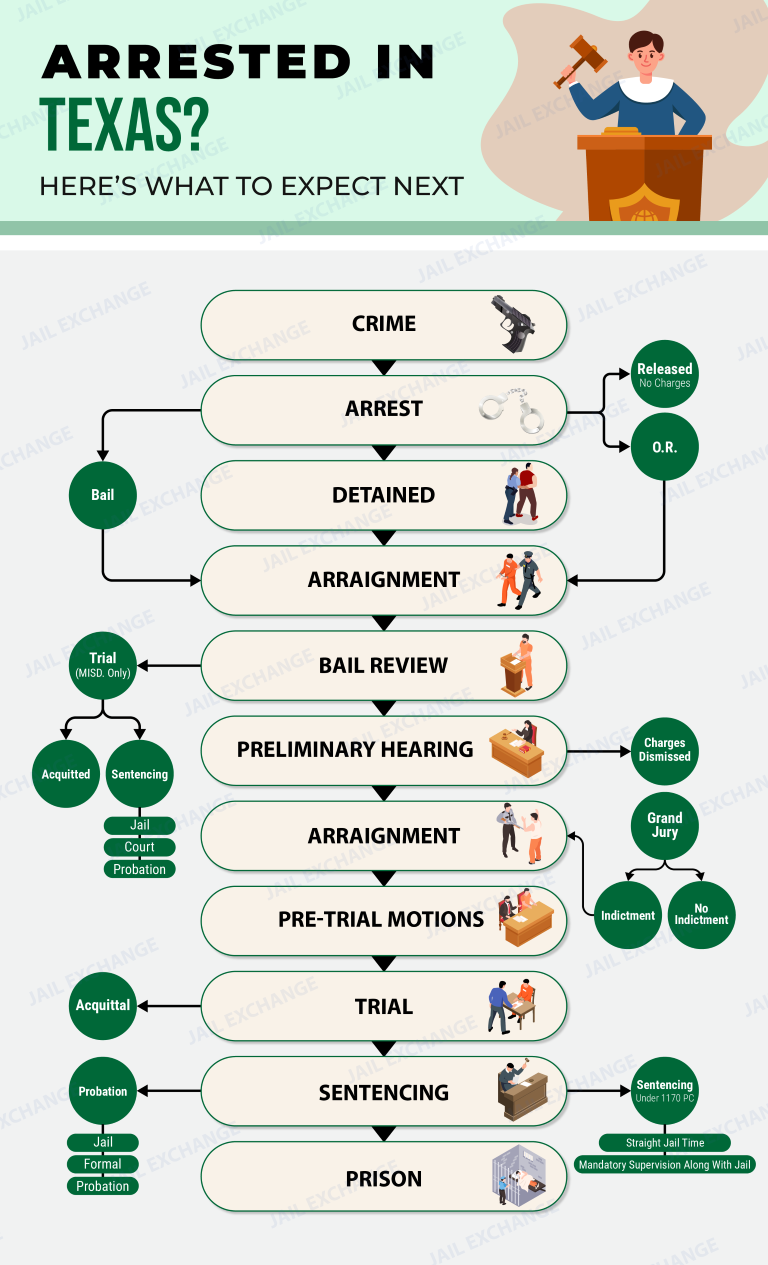
The town of Goliad is the county seat of Goliad County, and court is held at the historic courthouse on North Courthouse Square. Class C cases are handled by two justice of the peace courts and the Goliad Municipal Court, and Class A and B misdemeanors are heard in the constitutional county court with the Goliad County Attorney prosecuting. Felonies go to the district courts of the Victoria-area judicial region, the 24th, 135th and 267th District Courts, which serve Goliad along with Calhoun, DeWitt, Jackson, Refugio and Victoria counties. The 24th Judicial District Attorney, whose office is in Cuero, prosecutes Goliad County felonies, and people arrested in the county are held in the county's own jail, which the Sheriff runs.
- Goliad County Courthouse (county court, district court, District and County Clerk), 127 N. Courthouse Square, Goliad, TX 77963; District and County Clerk (361) 645-3294
- Goliad County Attorney (misdemeanors and juvenile cases), Goliad, TX; reach through the courthouse at (361) 645-3294
- 24th Judicial District Attorney (felonies), Cuero, TX, (361) 275-2612
- Goliad County Sheriff's Office, 700 E. End St., Goliad, TX 77963, (361) 645-1262
- Goliad County Jail, Sheriff's Office, 700 E. End St., Goliad, TX 77963, (361) 645-1262
Which court hears your case. Fine-only Class C misdemeanors (traffic tickets, public intoxication, petty theft under $100, a minor assault without injury, disorderly conduct) are filed in the Justice of the Peace court for Precinct 1 or Precinct 2, depending on where the offense took place, or in the Goliad Municipal Court when the city's officers write the ticket inside Goliad. Class A and B misdemeanors, a first DWI or an assault causing bodily injury, for instance, are heard by the County Judge in the Goliad County Court. Felony defendants receive magistrate warnings first; after a grand jury indicts, the case is assigned to one of the district courts sitting for Goliad County, the 24th, 135th or 267th District Court.
Where pretrial inmates are held. Goliad County operates its own jail at the Sheriff's Office on East End Street. The jail holds a current certificate of compliance from the Texas Commission on Jail Standards. After an arrest by a deputy, a Goliad police officer or a state trooper, adults are booked there, see a magistrate and, if they cannot post bail, remain in custody in Goliad while the case is pending. The Sheriff's Office at (361) 645-1262 answers questions about who is in custody.
- Local courts in Goliad County (justice of the peace, municipal and county courts)
- Misdemeanor (for example, theft, a first DWI, assault causing bodily injury, criminal trespass)
- Felony (for example, burglary, felony theft, drug possession or delivery, aggravated assault)
- Violent felony (for example, murder, sexual assault, aggravated robbery)
- Juveniles (under 17) arrested in Goliad County
- Federal cases (U.S. District Court) from Goliad County
Local courts in Goliad County (justice of the peace, municipal and county courts)
Goliad County's local courts are all in or near the town of Goliad. The Precinct 1 justice court is in the Franklin Street Annex, a few blocks from the courthouse square.
Justice of the Peace courts
- Justice of the Peace, Precinct 1, Franklin Street Annex, 329 W. Franklin St., P.O. Box 678, Goliad, TX 77963, (361) 645-3663
- Justice of the Peace, Precinct 2, Goliad County; the courthouse at (361) 645-3294 can give the current office location and hours
Municipal court
- Goliad Municipal Court, City of Goliad, P.O. Drawer 939, Goliad, TX 77963, (361) 645-3454
County and district courts
- Goliad County Court (constitutional county court: Class A and B misdemeanors, appeals from the justice and municipal courts), 127 N. Courthouse Square, Goliad, TX 77963; clerk (361) 645-3294
- 24th District Court (felonies; part of the six-county Victoria-area district court group), which hears Goliad County cases at the courthouse; court office in Victoria, (361) 575-3172
- 135th District Court and 267th District Court, which share the same six counties and also take Goliad County felony and civil dockets; District Clerk (361) 645-3294
The justices of the peace serve as magistrates as well as trial judges for Class C cases, so one of them usually conducts the hearing at which an arrested person is warned of the charges and bond is set. A conviction in a justice or municipal court can be appealed to the county court for a new trial.
Misdemeanor (for example, theft, a first DWI, assault causing bodily injury, criminal trespass)
U.S. Highways 59, 77A and 183 cross Goliad County, and many misdemeanor arrests start as stops on those roads; others involve visitors to the state historic sites and family disputes. Class C matters are handled with a citation and a court date. Class A and B arrests usually lead to booking at the Goliad County Jail.
Getting out of jail
The person must be taken before a magistrate within 48 hours. The magistrate gives the article 15.17 warnings, explains the right to a lawyer, accepts a request for appointed counsel and sets bail. Release options are a cash bond, a surety bond from a licensed bail bondsman, or a personal bond. In family violence cases the magistrate frequently issues an emergency protective order that limits contact with the alleged victim.
In the Goliad County Court
The Goliad County Attorney files an information if the evidence supports a charge. There is no public defender office; a defendant who cannot afford a lawyer and could be jailed receives a court-appointed private attorney under the county's indigent defense plan, paid in part with Texas Indigent Defense Commission funds. The clerk at (361) 645-3294 can confirm whether an attorney has been assigned. Plea bargains settle most misdemeanor cases. A defendant who goes to trial gets a jury of six, and the verdict must be unanimous.
Penalty ranges for the listed offenses
- Theft: fine-only Class C below $100. At $100 to $749 it is Class B, punishable in Goliad County Court by up to 180 days and a $2,000 fine; at $750 to $2,499 it is Class A, with up to one year and $4,000.
- First DWI: Class B, with a minimum of 72 hours and a maximum of 180 days in jail and a fine of no more than $3,000. A test of 0.15 or more raises it to Class A, an open container sets a six-day minimum, and the driver also faces an administrative license suspension, a DWI education class and possibly an ignition interlock.
- Assault causing bodily injury: Class A; a family violence finding makes any later family violence assault a felony.
- Criminal trespass: Class B, or Class A when the property is a habitation or the person carried a deadly weapon.
Results range from dismissal or pretrial diversion through deferred adjudication, probation, fines and county jail time. Deferred adjudication completed without problems may allow a petition for nondisclosure. A Class C case typically closes within weeks; Class A and B cases generally take two to six months.
Felony (for example, burglary, felony theft, drug possession or delivery, aggravated assault)
Felonies from Goliad County are prosecuted by the 24th Judicial District Attorney's office in Cuero, which also serves neighboring counties. Common felony cases include drug possession and transport on U.S. 59, burglary of homes and ranch buildings, felony theft and aggravated assault.
The path of a felony case
- Magistration. After booking at the Goliad County Jail, the defendant sees a magistrate within 48 hours. The magistrate considers a public safety report under the Damon Allen Act before setting bail, and a person charged with a violent offense cannot get a personal bond.
- Lawyer appointment. The district courts appoint private attorneys for qualifying felony defendants. Ask at magistration, and call the District Clerk at (361) 645-3294 to check on an appointment.
- Grand jury. The District Attorney presents the case to a Goliad County grand jury. If the State is not ready for trial within 90 days of a felony detention, article 17.151 generally requires release on personal bond or reduced bail, except for violent charges.
- Arraignment and plea bargaining. The indicted case is set in the 24th, 135th or 267th District Court. Deferred adjudication, probation or a negotiated prison term resolves most cases.
- Trial. Twelve jurors must agree unanimously; the defendant can elect jury sentencing.
Punishment levels
- State jail felony: confinement in a state jail for six months to two years, plus a fine as large as $10,000; examples are theft of $2,500 to $30,000 and possession of less than a gram of most hard drugs.
- Third degree: 2 to 10 years. Second degree, covering burglary of a habitation and most aggravated assaults: 2 to 20 years. First degree: five years at minimum and up to 99 years or life. Fines up to $10,000 can be added.
- Drug charges are graded by penalty group and quantity, and larger amounts reach the first-degree level.
Prior felony convictions can enhance punishment, up to 25 years to life for habitual offenders. "3g" offenses require half the sentence (minimum two years) before parole eligibility, while most other prisoners are eligible after about a quarter of their time. Goliad County felonies usually resolve in six to eighteen months.
Violent felony (for example, murder, sexual assault, aggravated robbery)
Violent felonies in Goliad County are investigated by the Sheriff's Office, often alongside the Texas Rangers, and prosecuted by the 24th Judicial District Attorney. Personal bonds are prohibited for these charges. Texas voters approved a 2025 constitutional amendment that lets judges deny bail in some violent-crime cases, which means a defendant may remain in the Goliad County Jail until the case is over.
- Capital murder: a conviction results in the death penalty or in life imprisonment with no chance of parole; Texas leads the nation in executions by a wide margin.
- Murder: a first-degree felony with a range of five years up to 99 years or life; a sudden-passion finding lowers the range to second degree.
- Sexual assault is a second-degree felony, while aggravated sexual assault is first degree and carries a 25-year minimum in certain cases with child victims. Sex-offender registration follows a conviction.
- Aggravated robbery: a first-degree "3g" offense, so half of the sentence must be served before parole eligibility.
Victims are protected by article I, section 30 of the Texas Constitution, which gives them notice of court proceedings, the right to be present and an opportunity to be heard. In Goliad County cases, the Cuero prosecutor's victim assistance staff sends those notices. Violent felonies generally take one to three years to resolve.
Juveniles (under 17) arrested in Goliad County
Texas prosecutes 17-year-olds as adults. Children who were 10 to 16 at the time of the offense are handled in juvenile court, which in Goliad County is the court designated by the juvenile board, typically one of the district courts or the County Court. The District and County Clerk at (361) 645-3294 can tell families where a case is pending.
Juvenile probation and the petition
Goliad County's juvenile probation department handles intake for children referred by law enforcement. The intake officer decides whether to release the youth, supervise the case informally, or refer it to the prosecutor (generally the Goliad County Attorney), who decides whether to file a petition. Deferred prosecution, which ends in dismissal when completed, is common for first offenses.
Detention
Goliad County does not have its own juvenile detention center, so a child who must be held is typically placed in a certified regional juvenile facility, such as one in the Victoria area. A judge must hold a detention hearing within two working days, and the court appoints a lawyer for the child if the family has not hired one.
Outcomes
- Dismissal, deferred prosecution, or probation with conditions such as school attendance, curfew, counseling and restitution.
- For felony conduct, a judge's order sending the youth to the Texas Juvenile Justice Department (TJJD).
- Determinate sentencing for the most serious offenses, which can lead to transfer to adult prison after age 19.
- Certification to adult court after a hearing, generally possible at 14 for capital and first-degree felonies and certain aggravated drug felonies, and at 15 for other felonies.
By law, a Goliad County juvenile file is kept confidential, and sealing is possible for most of them later on.
Federal cases (U.S. District Court) from Goliad County
Goliad County belongs to the Southern District of Texas, Victoria Division. The division's courthouse is the Martin Luther King, Jr. Federal Building in downtown Victoria, about 30 miles northeast of Goliad.
- Federal court clerk for the Victoria Division (Martin Luther King, Jr. Federal Building), 312 S. Main, Room 406, Victoria, TX 77901, (361) 788-5000
- U.S. Attorney's Office, Southern District of Texas; the nearest listed branch is in Corpus Christi, 800 North Shoreline Boulevard, Suite 500, Corpus Christi, TX 78401, (361) 888-3111
- Federal Public Defender for the Southern District of Texas, along with private Criminal Justice Act panel attorneys appointed by the court
When a Goliad County case is federal
U.S. 59 is a major route from the Rio Grande Valley toward Houston, so federal cases from Goliad County often involve drug trafficking and human smuggling discovered during highway stops. Other federal charges include firearms possession by felons, fraud and child exploitation. Agencies such as the DEA, Border Patrol, Homeland Security Investigations and the FBI may bring these cases to the U.S. Attorney.
Early proceedings
The defendant is brought before a federal magistrate judge for an initial appearance, where counsel is appointed if needed. A detention hearing, when prosecutors request one, is usually held within three court days. Commercial bail bonds play no part in the Victoria federal courthouse; instead the Bail Reform Act lets the judge release a defendant on conditions supervised by Pretrial Services or order detention.
Indictment, plea or trial, and sentence
If the case began with a complaint, an indictment must be returned within 30 days, and the Speedy Trial Act sets a 70-day deadline for trial that is frequently extended. Most federal defendants plead guilty; a trial jury of twelve must be unanimous. The judge sentences after a presentence report, using the advisory Sentencing Guidelines and any mandatory minimum. Federal inmates are not paroled and serve about 85 percent of their terms in the Bureau of Prisons before beginning supervised release. Appeals from the Victoria Division go to the Fifth Circuit.
Finding a federal inmate
To locate someone in federal custody, use the Federal Bureau of Prisons inmate locator and search by name or register number. A pretrial federal detainee housed in a county jail under a U.S. Marshals contract can show up on that county jail's roster too. Juveniles are rarely charged federally, and Goliad County youth cases almost always stay in state juvenile court.
This guide explains Goliad County criminal court procedure in general terms and is not legal advice; jail and court practices can change. Anyone facing a criminal charge should speak with a defense lawyer. To request a court-appointed attorney, ask at magistration or call the District and County Clerk at (361) 645-3294; for custody information call the Goliad County Sheriff's Office at (361) 645-1262.