
Grimes County Jail
Grimes County Jail
Jail Phone Number
936-873-6439Grimes County Inmate Search: Locating Someone Booked in Anderson
Deputy, constable, trooper or Navasota cop: whoever made the arrest, the ride usually ends at one building, the Grimes County Jail, 382 FM 149 West, Anderson, TX 77830, 936-873-6439. The Sheriff's Office runs it as a single 111-bed lockup for both men and women, from fresh bookings to people waiting on a prison bus.
Start with the official jail inmate search, typing a last name and first name. Pick the match whose age fits, then call the jail for bond and charge details. Results shift as people come and go, so recheck later if a brand-new arrest hasn't appeared. Texas IVSS-Counties works as a free second search: punch in part of a name to see custody status, or sign up for a call at release.
Still stuck? Ring the jail with a short checklist: booked or not, which offenses, and whether bond has been set by a magistrate. For paying to get them out, our bail page helps. For hearings and case numbers, try our criminal court page.
Read inmate search answers
 Read inmate search answers
1. Grimes County jail search, one step at a time
- Open the official jail inmate search.
- Enter just the surname. Pile on a first name only when dozens of rows appear.
- Pick the right person by age or booking date, since common surnames repeat.
- Copy any booking number onto paper. Bondsmen, jailers and attorneys will want it.
- No hit? Try spelling variants, a maiden name, or just the first three letters.
IVSS-Counties accepts partial names too. It spans many Texas counties. That helps when you can't tell which county made the arrest.
↑ Back to the question list2. Booked hours ago, yet nowhere on the list?
Fresh arrests take a while to show. Booking involves fingerprints, a photo, a records check and a property count, and someone may wait hours on a bench before the computer lists them. Give it until the next morning before assuming anything.
- Phone the jail at 936-873-6439. Ask whether the person was booked and when.
- After hours, the Sheriff's dispatch desk answers around the clock at 936-873-2151.
- Arrested in Navasota? Ask the Navasota Police Department, 936-825-6475, if the arrest paperwork is finished and the ride to Anderson has happened.
- Records questions go to the Sheriff's records unit, 936-873-6442, open weekdays 8 a.m. to 4 p.m.
One catch: the jail won't share where someone went after a transfer. If a person vanishes from the list without coming home, the TDCJ, federal and ICE sections of this page cover where people get moved, or a lawyer can track them down.
↑ Back to the question list3. One Grimes County lockup, plus neighbors next door
Only one adult lockup exists countywide, the Sheriff's jail at 382 FM 149 West in Anderson, phone 936-873-6439. It opened in December 1998 and holds up to 111 people. Men and women, misdemeanor and felony, people awaiting trial and people sentenced to TDCJ who are waiting for transport all sleep under that roof. A nurse works on staff, and the jail has passed 29 state inspections in a row as of October 2024. Ask the Navasota Police Department whether a short stay at its station happens before transport.
Arrests made outside Grimes go to that other county's sheriff. Bordering jails, by distance-ish order:
- Brazos County Detention Center, 1835 Sandy Point Road, Bryan, TX 77807, 979-361-4800
- Walker County Jail, 717 FM 2821 Rd W, Huntsville, TX 77320, 936-435-2412
- Montgomery County Jail, 1 Criminal Justice Dr., Conroe, TX 77301, 936-760-5800
- Madison County Jail, 2005 E. Main Street, Madisonville, TX 77864, 936-348-2755
- Washington County Jail, 1206 Old Independence Rd., Brenham, TX 77833, Sheriff's Office 979-277-6251
- Waller County Jail, 100 Sheriff R. Glenn Smith Drive, Hempstead, TX 77445, Sheriff's Office 979-826-8282
4. Grimes County mugshots and booking photo requests
People hunting for mugshots should know the jail search is meant for custody details, so don't count on finding a picture there. Wanting the actual booking photo? Mail or hand the Sheriff's Office, 382 FM 149 West, Anderson, TX 77830, a letter asking for it as public information. Basic arrest information is public in Texas. The agency has to respond quickly or seek an Attorney General ruling (Government Code 552.108). News outlets follow that path too.
- Commercial mugshot sites can't bill you to correct a wrong or partial entry. They also can't run expunged or sealed ones. That's Texas business law, chapter 109.
- For a photo snapped in immigration custody, the route is an ICE records request form.
- Federal arrest pictures generally remain sealed, except when the Marshals share a face of someone on the run.
5. Phone alerts for a release or transfer
Sure. In 2025, Texas swapped its older alert service for IVSS-Counties. Look up your person at ivss-counties.tdcj.texas.gov and choose notifications; an account is optional. Prefer talking? Operators at 866-268-8959 work 24/7, Spanish included.
Once someone is sentenced to state prison, TDCJ handles notices instead. Call TDCJ Victim Services at 800-848-4284.
↑ Back to the question list6. Posting bond at the Anderson jail, briefly
A magistrate meets every arrested person inside 48 hours, reads the rights, asks whether a free lawyer is wanted and sets bond. Then a family has three usual choices:
- Cash bond: pay the full sum at the jail. Payee line: "Grimes County Sheriff's Office," on a money order or cashier's check. Bring photo ID. Personal checks won't work.
- Surety bond: written by a bonding company that the county's bail bond board has approved.
- Personal bond: a signed promise, allowed by the judge on some charges.
Even with bond paid, the door opens only after a statewide and national warrant check comes back clear. Our bail and release page digs deeper into amounts, holds and refunds.
↑ Back to the question list7. What exactly is the charge? Files and lists
The jail search lists them, and booking staff at 936-873-6439 can read them out. Basic facts about an arrest, the offense included, count as public information in Texas. Once a case is filed, go to the court records:
- Felonies sit with the District Clerk, 270 FM 149 W., Anderson, TX 77830, 936-873-4433, plus an online records search.
- Jailable misdemeanor files belong to the County Clerk, 936-873-4410.
- Statewide, re:SearchTX shows many filings after a free sign-up.
8. Grimes County court-appointed lawyers: who qualifies
At the magistrate hearing, the person says yes to wanting appointed counsel and fills out a Financial Assessment Form. Jailers help with the paperwork. The county pays private lawyers to take these cases under one plan for its felony and misdemeanor courts, last changed October 30, 2025.
- Who qualifies: low-income households, roughly 150% of poverty level or less, plus people drawing public aid.
- Timing: once the request arrives, an appointment follows within three business days.
- A jailed client must get a lawyer visit inside five days of appointment.
- Capital murder defendants facing death get a regional capital defender office.
Out of jail and still waiting? Ask the District Clerk at 936-873-4433 where the request stands.
↑ Back to the question list9. Booking a visiting slot on FM 149
Every visit needs an appointment, booked through 936-873-6437. The Sheriff picks the visiting days and hours. Each inmate gets two 20-minute visits, and at one time a single adult plus one child may come in. Inmates name up to five people on a visitor list.
- Bring a valid state ID to check in.
- Leave phones, purses and cameras locked in your car.
- Nothing gets handed over: no items, no money.
- Dress plainly. Men wear a shirt and long pants. Shorts, tank tops, sheer fabric and bare midriffs are refused, and shoes are a must.
Ask about video options when you call. More tips sit on our visitation page.
↑ Back to the question list10. Funding a Grimes County inmate trust account
Deposits travel by post. Buy a money order or cashier's check, write "Inmate Trust Fund" as payee instead of your person's name, and address the envelope to the jail, 382 FM 149 West, Anderson, TX 77830. Put the inmate's name elsewhere on the check, and fill in your own name, street address and phone in the sender section. Don't tuck a letter inside that envelope.
For kiosk or app deposits, ask the jail at 936-873-6439 what's available. Deposit basics fill our inmate money page, while our commissary page explains buying snacks and soap inside.
↑ Back to the question list11. Staying in touch: calls, tablets, messages
Inmates place outgoing calls; families can't ring a cell. Jail staff won't relay messages either, except in an emergency they can verify. To learn which phone, tablet or messaging company serves the Anderson jail, call 936-873-6439, then set up an account with that vendor.
General how-tos for those accounts sit on our inmate calls page and our inmate messaging page.
↑ Back to the question list12. Letters, paperbacks and magazines: mail rules
Letters arrive by post only, addressed to Grimes County Jail, 382 FM 149 West, Anderson, TX 77830. Walk-in drop-offs aren't taken. Personal items beyond letters are refused. Reading material, whether paperbacks, newspapers or magazines, has to come directly from a publisher or online store, and hardcovers bounce. State standards set no ceiling on letters received, and envelopes from lawyers wait to be unsealed with the inmate looking on.
Our inmate mail page shows how to address envelopes.
↑ Back to the question list13. Wallets, keys and clothes taken at booking
Jailers inventory pocket contents and clothing when someone is booked, then keep it all for release day. Need the car keys now? Ask the jail at 936-873-6439 if your person may authorize a pickup by signing for it, and which ID you'll need. Anything police seized as evidence is a separate matter, best handled through a lawyer.
Releases can run late. Each one waits on a statewide and national warrant check, and after a case ends the jail must hold the signed court papers before anyone walks out.
↑ Back to the question list14. Sick, injured or needing pills behind bars
A nurse works at the jail. Prescription medicine comes in only when that nurse approves it, so contact the nurse first through the jail line, 936-873-6439, before bringing any. Mention allergies, recent surgery or mental health needs.
If care seems poor, the state agency over county jails, TCJS, accepts complaints and inquiries and answers at 512-463-5505.
↑ Back to the question list15. Grimes County warrant checks, face to face
Sheriff's deputies (936-873-2151), the constables and Navasota police (936-825-6475) all serve warrants. Records sit with the Communications Division, and a check works only face to face: go yourself, about your own name, carrying a state ID or driver's license, to 382 FM 149 West, Anderson, TX 77830. Phone checks aren't done. DPS keeps a statewide fugitive list, Texas 10 Most Wanted.
A lawyer can also confirm one by checking with the court. Clearing it means walking in, lawyer alongside, to the judge who issued it. Calling the issuing court may also win a new date. For a felony, reach the District Clerk, 270 FM 149 W., Anderson, TX 77830, 936-873-4433.
↑ Back to the question list16. Hearing calendars for felonies and misdemeanors
Each court's coordinator sets the calendar. Felony settings are scheduled by staff for the 12th and 506th District Courts, whom the District Clerk can connect you with at 936-873-4433. Lesser cases and youth cases get scheduled by the County Court at Law's own coordinator, 936-873-4472. IVSS-Counties sends court-event notices as well.
Our court guide explains each step, from magistrate to sentence.
↑ Back to the question list17. Federal prisoners from here: Houston, then BOP
Houston handles federal arrests from here. The Southern District of Texas sits at the Bob Casey United States Courthouse, 515 Rusk Avenue, Houston, TX 77002, clerk 713-250-5500.
- Within days, the government and defense argue over pretrial release at a detention hearing (18 U.S.C. 3142).
- Anyone kept is in U.S. Marshals custody, 515 Rusk Avenue, Room 10002, Houston, TX 77002, 713-718-4800. Ask the Marshals which jail is holding them.
- Following sentencing, the BOP inmate locator lists the prison by name or register number.
18. ICE detainers lodged at the Anderson jail
- Paperwork lands in Anderson first: a detainer on Form I-247A.
- Anderson jailers may then hold your loved one up to 48 hours after they would otherwise be released (8 CFR 287.7(d)), giving ICE time to pick them up.
- State law since 2017 tells Texas jails to comply with those detainers (art. 2A.060; Government Code 752.053). Another statute, passed in 2025, makes every jail-running sheriff pursue a 287(g) pact with ICE, deadline December 1, 2026. Local status? Ask the Sheriff's Office.
- The closest ICE detention site is the Montgomery Processing Center, 806 Hilbig Road, Conroe, TX 77301, 936-521-4900.
- Search the ICE Online Detainee Locator. The Houston Field Office, 126 Northpoint Drive, Houston, TX 77060, answers at 281-774-4816.
19. Tracing a transfer onward to a TDCJ unit
Sentenced to state time? Your loved one sits in Anderson until a TDCJ bus comes. Intake and classification happen first, and only then does the state choose a permanent unit.
- Try the TDCJ inmate search using a surname with a first initial, a SID, or the TDCJ number. Newcomers can take a day or longer to show.
- Our Texas state prisons page lists every unit with contact details.
20. Teens picked up here: juvenile detention steps
Seventeen counts as adult in Texas courtrooms, so a 17-year-old gets booked like anyone else. Younger kids, from 10 through 16, get held in juvenile detention, apart from grown-ups. No youth detention building operates inside this county, so a detained child is driven to one somewhere else.
Juvenile Probation, 936-873-3921, can say which facility took the child and the hearing date. The County Court at Law serves as the juvenile court.
↑ Back to the question list21. Every Grimes County police agency and phone line
The arresting agency's name usually appears with the charge. Local agencies and phones:
- Sheriff's Office: 24-hour line 936-873-2151. Deputies cover rural roads plus towns lacking a police department.
- Navasota Police Department: 936-825-6475.
- Anderson, Bedias, Iola and Todd Mission: call the Sheriff's line above to find out which agency covers each town.
- Constable, Precinct 1 (Iola): mail goes to P.O. Box 450, Iola, TX 77861, 936-394-6100.
- Constable, Precinct 2: P.O. Box 677, Anderson, TX 77830, 936-873-6409.
- Constables, Precincts 3 and 4: 205 Veterans Memorial Drive, Navasota, TX 77868, 936-873-3914.
- Texas DPS Highway Patrol: the local office handles crash reports at 979-836-1975.
Grimes County Bail and Release
Arrests here lead to the Grimes County Jail, 382 FM 149 West, Anderson, TX 77830. It is the single lockup run by the Sheriff's Office, with room for men and women alike. Read on for the magistrate visit, bond choices, paying at the FM 149 lobby, and the snags that sometimes keep a cell door shut after money changes hands. Want the wider Texas picture? Visit our statewide bail rules too.
Check the official jail inmate search first. Texas IVSS-Counties is a free backup: enter part of a name to check custody, and sign up for a phone call when someone walks out. Jump to our Jail Roster page when the arrest itself is the worry: who sits in a cell tonight, who got booked lately, warrants on file, charge details, mugshots, lawyers the court pays for and claiming property.
Dial the jail at 936-873-6439. Find out if the magistrate has already spoken, what each charge's bond totals, and whether any outside hold sits on file. Once your person is home, hop to our court walkthrough for the hearings ahead.
1. Bail after a Grimes County arrest: who decides?
A magistrate makes that call. Under Texas law, the arresting officer or the jail has 48 hours, at most, to put each person in front of one (arts. 14.06(a), 15.17(a)). Grimes's local lawyer plan runs on the same 48-hour clock. Plenty of officials can act as a magistrate, anyone from a district judge to a justice of the peace, with the County Court at Law judge in between (art. 2A.151).
Expect this quick meeting to go like so:
- the magistrate reads off every charge;
- they hear their rights, like staying silent, paying for their own attorney, keeping counsel nearby during questions and ending an interview;
- they are asked if they'd like an attorney at county expense, and jail staff walk them through a Financial Assessment Form;
- bail gets set, and Texas wants the mildest terms that still protect the community and get them back for every hearing (art. 17.028).
Facing Class B or worse? Then, before any dollar figure, the magistrate reviews a so-called public safety report, which pulls together the person's record. No risk rating appears on it, and it proposes no dollar amount. The 2021 Damon Allen Act created it (arts. 17.021, 17.022). Ring 936-873-6439 to learn when the hearing is planned.
↑ Back to the question list2. Which bonds can get someone out?
Under articles 17.01 to 17.03, Texas has bail bonds, which need cash or a surety behind them, and personal bonds, which need neither. Here is how each plays out in Anderson:
- Cash bond. A friend or relative puts down every dollar of the bail. At the Anderson jail that means a cashier's check or money order.
- Bondsman. A board-approved bonding company backs the full amount in court. You pay it a fee for that promise.
- Personal bond. Your loved one signs their own pledge to appear. Nobody hands over bail money first.
- Ticket-level release. With only a Class C offense, a magistrate can let someone leave holding a paper showing the court date and zero bond. Prior felonies or jailable convictions spoil that option (art. 15.17(b)).
Several charge types rule out a personal bond. Picture violent crimes the statute names, or Class A-or-higher terroristic threats. Some protective order violations count, as does a felon caught armed. So does a new charge while already supervised over violence. For burglary, organized criminal activity or a few drug felonies, only the trial judge can okay one (art. 17.03).
Strings may come attached. Drunk-driving charges often bring a car-mounted breath tester (an ignition interlock) for the person's vehicle. The law requires one after a second DWI, a DWI with a youngster riding along, or charges of intoxication assault or manslaughter (art. 17.441(a)).
↑ Back to the question list3. What do bonds cost on typical local charges?
Texas uses no single price list, so the magistrate tailors every amount to one person and one case. The state's checklist (art. 17.15(a)):
- a dollar stake big enough to make skipping court painful;
- it must never turn into a way to punish someone;
- the offense itself, along with how it played out;
- how much cash the family can truly gather;
- how safe any victim, deputy or neighbor will be;
- old arrests, that safety report and citizenship status.
One firm ceiling applies. Picture a warrantless arrest where nobody settles probable cause quickly. Release then becomes required, on bail no larger than $5,000 by hour 24 for a misdemeanor, or $10,000 for a felony by hour 48. Can't raise even that? Then the law swaps in a personal bond (art. 17.033).
How serious the charge is shapes things as well. Class C carries only a fine of up to $500. Class B can mean six months behind bars, Class A a full year, and felonies mean state jail or prison (Penal Code 12.21 to 12.35). For the actual dollars, phone the jail at 936-873-6439.
↑ Back to the question list4. Where on FM 149 do I pay a cash bond?
Cash bonds and cash fines on local charges are paid face to face at 382 FM 149 West, Anderson, TX 77830. Work through it in this order:
- Phone 936-873-6439. Have their full name and birthday ready.
- Jot down each charge's bond. Partial payments get turned away.
- Pick up a cashier's check (or a money order) naming the payee as "Grimes County Sheriff's Office."
- Carry a photo ID into the lobby. Personal checks get refused.
- On a charge from some other county, ask jail staff for the right payee before buying anything.
- Hang on to the receipt. The refund later follows whatever name appears there.
Expect some waiting. Staff run every release through a state and national warrant search, and an outage in that system stalls it. If a judge has just ruled, the jail needs the signed court papers before opening the door.
↑ Back to the question list5. Do the clerks or JP offices handle bonds at all?
Sheriff's Office guidance points cash bonds to the jail window. The clerks deal with the case files: the District Clerk for felonies and the County Clerk for misdemeanors.
Fine-only Class C cases land before a justice of the peace, and those courts normally release people on their own signature (art. 45A.107). Every precinct gets mail at a post office box:
- Precinct 1, P.O. Box 450, Iola, TX 77861, 936-394-2060
- Precinct 2, P.O. Box 266, Anderson, TX 77830, 936-873-6452
- Precinct 3, P.O. Box 828, Navasota, TX 77868, 936-873-3900
Citations written by Navasota officers inside the city limits go to Navasota's municipal court. The police department at 936-825-6475 can point you to it.
Can't cover a fine? Tell the Class C judge. Monthly payments, community service and even a waiver are all on the table, and a judge may order jail time over fine money only if a hearing first shows no honest effort to pay (arts. 45A.252 to 45A.261).
↑ Back to the question list6. Which payment types does the lobby accept?
A cashier's check or money order covering the full bond is the safe choice at the jail.
- Refused: personal checks, and anything short of the total.
- Call about: paper money in exact change. Check on that by phone before the drive.
- Required: photo ID from whoever pays.
Copy the payee name exactly as staff spell it. Going through a bondsman instead? Then you pay that company, and it files the paperwork at the jail. Payment questions go to 936-873-6439.
↑ Back to the question list7. How do licensed bondsmen work under the county board?
The Sheriff's Office calls this a bail bond board county. So only companies the board approves may post bonds. Texas boards license these sureties. They must keep a fresh approved list hanging in criminal courtrooms and wherever people get booked (Occupations Code 1704.105 and 1704.107), so ask at the booking window to see it.
Rules the companies follow:
- State law sets no top limit on what a bondsman charges. Insist on the price and terms in black and white.
- Whatever cash or property you give them, they owe you a receipt for it (Occupations Code 1704.305).
- Companies can't recruit customers inside the jail, and county workers can't recommend one (Occupations Code 1704.304).
- Put a request for your collateral, maybe a pickup truck title, in writing once every linked case wraps up. From that letter, the company gets 30 days (Occupations Code 1704.301).
- The defendant's own hired attorney may personally sign the bond (Occupations Code 1704.163).
A bonding company can back out. When it does, the defense lawyer is told first, and on felonies so is the prosecutor. The company also files a sworn reason with the court (art. 17.19).
↑ Back to the question list8. Can a Grimes County inmate stay locked up after bond?
Yes. Each bond covers just its own charge, so other papers may hold the person:
- Warrant from elsewhere. Say Brazos or Walker County wants them too. A local magistrate may take bail for that county and mail the bond over (Code of Criminal Procedure art. 15.18).
- Parole blue warrant. Someone on state parole can be kept until the parole violation gets its hearing (Government Code 508.254(c)).
- ICE hold. The jail has to honor ICE's request unless proof of legal status is shown (art. 2A.060).
- Domestic violence charge. When a magistrate expects more abuse, the jail keeps the person four extra hours past posting. A signed order may push that to 48 (art. 17.291(b)).
- Separate cases. A JP citation, a misdemeanor and a felony are three bonds, not one.
Release also waits on the warrant check. Before paying, ask the jail at 936-873-6439 to list every hold.
↑ Back to the question list9. Denying bail outright: which cases qualify
The state constitution guarantees bail in nearly every case (Article I, Sections 11 to 11c). For years, refusals were rare. They covered capital cases with evident proof, repeat felons, a felony while out on bond, broken release terms, and some cases of breaking a protective order.
Proposition 3 widened the list after voters approved it on November 4, 2025. It targets the gravest charges, among them murder and capital murder, trafficking, indecency with a child, plus aggravated kidnapping, robbery and sexual assault and certain aggravated assaults involving a weapon or serious harm. For these, bail "shall be denied" after a hearing if the state shows flight is the likelier outcome. Danger to others counts too, but needs clear and convincing proof. Only the state can start this, and any judge granting bail anyway owes the court a written reason (Texas Constitution, Article I, Section 11d).
Also in 2025, Senate Bill 9 handed prosecutors two more options. One lets them ask a district judge to recheck bail on a felony. The other lets them challenge a low amount on appeal in listed violent cases, and release waits until that appeal ends (arts. 17.029, 44.01).
Locally, those motions come from the District Attorney's Office, 270 FM 149 W, Anderson, TX 77830, 936-873-2137, weekdays 8 a.m. to noon and 1 to 5 p.m.
↑ Back to the question list10. Bond too steep? Can you ask the judge for less?
Yes, through the defense attorney, who asks the trial judge in writing for a smaller number or gentler rules. Families can help by pulling together:
- pay stubs, bills or bank statements showing what you can really afford;
- a lease, a work schedule and names of relatives nearby;
- a plan for safety, like a curfew, sobriety checks or no contact at all with the person who reported the crime.
State law supports the request. Bail is never supposed to crush someone, and their finances count (Code of Criminal Procedure art. 17.15(a)). From Class B upward, a defendant may swear to being unable to pay and get a prompt review (art. 17.028).
Slow cases help too. If prosecutors still can't go to trial, the judge has to offer a personal bond or reduce bail. The clock runs 90 days for felonies, 30 for misdemeanors punishable by over 180 days, 15 for lighter jailable misdemeanors, and 5 for fine-only ones, with some carve-outs (art. 17.151).
For felonies, reach the District Clerk at 936-873-4433. Misdemeanor motions run through the County Court at Law, 936-873-4472.
↑ Back to the question list11. Free defense lawyers: who qualifies in Grimes County
A single local plan governs appointments for felony and misdemeanor courts alike. Your loved one may ask for counsel the moment the magistrate brings it up. Blank forms are also available from the Texas Indigent Defense Commission or the District Clerk, and completed ones go to the District Court Coordinator.
- Income test: households earning 150% of the federal poverty line or less pass, after a net income check. People getting public benefits pass too.
- Deadline: counting from when the request arrives, the court gets three working days to name counsel (art. 1.051(c)).
- First visit: appointed lawyers must see a jailed client within five days.
- Death-penalty charges: a separate regional office takes over the defense.
Questions go to the District Clerk, 270 FM 149 W., Anderson, TX 77830, 936-873-4433. The commission sits at 209 West 14th Street, Room 202, Austin, TX 78701, 512-936-6994.
↑ Back to the question list12. Which courthouses take Grimes County cases?
- 12th and 506th District Courts try felonies. Their clerk is at 270 FM 149 W., Anderson, TX 77830, 936-873-4433, open weekdays from 8 a.m. to 4 p.m. Criminal filings have their own line, 936-873-4432.
- County Court at Law hears youth cases along with Class A and B misdemeanors, 936-873-4472. Misdemeanor files stay with the County Clerk, 936-873-4410. Either office can give you the courtroom's street address.
- Justice courts handle Class C matters for Precinct 1 in Iola (936-394-2060), Precinct 2 in Anderson (936-873-6452) and Precinct 3 in Navasota (936-873-3900).
- Federal charges go to the Bob Casey United States Courthouse, 515 Rusk Avenue, Houston, TX 77002, 713-250-5500.
13. Cash bail refunds, fees and forfeiture
A refund order comes from the judge after the final ruling, provided no hearing was missed. The County Clerk returns misdemeanor cash (936-873-4410), and the District Clerk returns felony cash (936-873-4433). The check is cut to the person whose name sits on that bond receipt (Code of Criminal Procedure art. 17.02).
- Under Local Government Code 117.055, clerks may keep 5%, never more than $50, if the result was deferred adjudication or a conviction.
- The court can also apply leftover deposit money to that person's own fines and fees (art. 17.53).
A missed court date puts the deposit at risk. A judgment nisi comes first: a ruling against the bond that becomes final unless the absence is explained (arts. 22.01, 22.02). The bonding company escapes that debt if the person turns up in custody again, with 180 days as the misdemeanor window and 270 days as the felony window (art. 22.13). Worse, skipping is a crime by itself. Penal Code 38.10 treats this bail jumping as a Class C offense when the original case was a fine-only ticket. Tied to any other misdemeanor, it is Class A, and tied to a felony, it rises to third degree.
↑ Back to the question list14. How are personal items and trust money returned at release?
Ask about belongings before release day, since people often leave at odd hours. When you call 936-873-6439, find out:
- how the Inmate Trust Fund pays out whatever money remains;
- when relatives can collect clothes, keys or a cell phone;
- whether pickup by someone else needs a signed release from the inmate.
Bring photo ID. Our inmate money page explains trust accounts.
↑ Back to the question list15. Federal arrests and the detention hearing
Federal prosecutors bring local cases in Houston, before the Southern District's Houston Division. That court meets in the Bob Casey United States Courthouse, 515 Rusk Avenue, Houston, TX 77002, 713-250-5500. The division's College Station court is temporarily using that Houston address.
- A detention hearing settles release. It usually happens at the first appearance, run by a federal magistrate judge (18 U.S.C. 3142).
- The U.S. Marshals Service keeps anyone held before trial. Its Houston office sits at 515 Rusk Avenue, Room 10002, Houston, TX 77002, 713-718-4800.
- The Federal Public Defender works from 440 Louisiana Street, Room 1350, Houston, TX 77002, 713-718-4600.
- Federal prison assignments after sentencing appear on the BOP inmate locator.
16. Do ICE detainers end after the state bond is paid?
Not by itself. Immigration custody follows separate steps:
- First comes paperwork: Form I-247A, an ICE request that the jail keep the person.
- Then the jail may keep your loved one up to 48 hours after they would otherwise be released (8 CFR 287.7(d)).
- Texas law dating from 2017 says jails must comply with ICE detainers, though a person who proves lawful status goes free (Code of Criminal Procedure art. 2A.060; Government Code 752.053).
- Separately, under a 2025 law, any Texas county with a jail must have its sheriff chase a 287(g) deal with ICE, and the calendar gives them until December 1, 2026. Wondering how far along the county is? Phone the Sheriff's Office at 936-873-2151.
- Once ICE has them, try the ICE Online Detainee Locator with full name and birth country, or phone the Houston Field Office, 126 Northpoint Drive, Houston, TX 77060, 281-774-4816.
17. State prison after a long sentence
Prison and state jail sentences belong to the state's prison agency, TDCJ. Until a transfer date, the person waits in the Anderson jail. Next comes an intake stop, then placement in a unit matched to the sentence.
- In TDCJ's inmate lookup, a last name and first initial will do, and so will a TDCJ or SID number. Its data updates on workdays.
- Browse units on our Texas state prisons list.
18. Arrested at 15 or 16? How Grimes County youth cases go
Here's the age line in Texas: a child 10 through 16 on the offense date belongs in juvenile court. Turn 17 before the offense, and the case is an adult one (Family Code 51.02(2)). Police also have to reach a parent promptly (Family Code 52.02).
As for timing, the judge must see a detained teen within two working days of the pickup, or within one for a Friday or Saturday arrest. By then the teen already has a lawyer the court appointed (Family Code 54.01). Locally, the County Court at Law hears youth cases.
Call Juvenile Probation at 936-873-3921 and ask which detention center has the teen and when court starts.
↑ Back to the question listThe Grimes County Sheriff recommends that you use a bail bond agent licensed to do business in Grimes County.
- You can pay a cash bond yourself, or use your home in Grimes County, or in some cases the state of Texas, but the benefit of using a bail bond agent is that they take responsibility for making sure the inmate shows up for court in Grimes County, and if they don't, then they take the financial responsibility. If you are paying the bond yourself, cashier’s checks or money orders should be made payable to the Grimes County Sheriff’s Office.
- The typical fee for a bond will be between 10-20% of the bail amount; usually 15%. So if an offender has a bail of $10,000.00, their bond will be $1500.00.
- Capps Bail Bonds
- Clint Capps or Sandra Capps
360 FM 149 W
Anderson, Texas 77830
Phone: (936) 873-9996
Fax: (936) 873-9993
Gage Gandy Bail Bonds
Gage Gandy
222 W. Washington Ave.
Navasota, Texas 77868
Phone: (936) 206-7064
Fax: (979) 823-4542
Call 936-873-6439 to find out the exact bond (plus other fees) amount, or look it up online by looking up the information on the Grimes County inmate locator.

Grimes County Jail Inmate Visitation
Friends and Family – The visiting schedule at Grimes County Jail is kept off its public pages. Staff give the current days and times only by phone, at 936-873-6439. Hours stay unpublished when times are set per inmate or unit and when privacy and security are a concern.
Practices Common at Most Jails
Think of the following as common practice. Call 936-873-6439 to check what applies here.
- Most jails want you to enter with just a photo ID and a vehicle key, and nothing else in your hands.
- No food. Most jails also bar drinks and gum from the visiting room.
- Visits can be cancelled without notice, for example during a lockdown or count.
- Plan to leave electronics, jewelry, and carrying bags behind, either locked in the car or in a locker on site.
- Typical rules bar someone recently released from the same jail from visiting unless the sheriff or jail administrator has approved it.
Have the inmate's full name and date of birth, your name and ID, and a booking number if you have one. Until the person has been booked for 48 hours, and in some jails a week, a visit may not be available; ask about eligibility. Let staff know who is calling and how you are related, and keep your questions courteous and exact.
Ask the person who answers what visitors may wear and what they may bring, whether visits are in person, by video, or both, how long you will be able to stay, what ID to have with you, and if a child can come along and what is required. Also ask if the jail uses an approved visitor list and how you get on it, what days and times you should plan around, and how far ahead a visit must be booked.
Good to Know
Video or scheduled visits at Grimes County Jail in Grimes County, Texas are handled through NCIC.

NCIC Video Visitation provides a secure online platform that enables families and loved ones to conduct scheduled face-to-face video visits with incarcerated individuals from home. Using an internet-connected smartphone, tablet, or personal computer equipped with a webcam, visitors can connect directly without traveling to the facility.
Important: Advance Registration and Visitor Clearance Required
Detention centers do not permit unscheduled or unverified video sessions. Correctional facilities require prospective visitors to submit government-issued photo identification and receive administrative clearance before booking an appointment, an approval process that can take up to 48 hours depending on facility staffing. You should verify your visitor approval status with the facility prior to scheduling. If you do not register well in advance, you will miss your loved one's scheduled visiting window for the week.
Step-by-Step Instructions to Register and Schedule a Video Visit
- Visit account.ncic.com and sign into your account.
- Register your visitor profile and upload a clear photograph of your government-issued ID (driver's license or passport) for facility background review.
- Wait for email notification confirming facility visitor approval.
- Select Video Visitation, choose the detention facility, and select the inmate.
- Browse the available schedule calendar, select an open time slot, and pay the visitation fee using a credit or debit card.
- Log into the website or mobile app 10 minutes prior to the start time on a device with a functioning camera, microphone, and reliable high-speed internet connection.
What the Inmate Needs to Do
The inmate receives a visitation notification on their housing unit video kiosk or terminal. At the appointed time, they log in with their PIN and sit before the terminal. Inmates and visitors must strictly observe jail dress and conduct rules; sessions are monitored by staff and will terminate immediately upon any violation.
Official Provider: NCIC Official Website
Customer Service Telephone: 1-800-943-2189
Support Hours: 24 hours a day, 7 days a week, 365 days a year
Supported Languages: English and Spanish
Other Services Provided by NCIC Inmate Communications
In addition to Remote Video Visitation, NCIC provides calling and digital messaging services at participating facilities:
- Prepaid Phone Calling Accounts: Prepay for phone calling credits so your loved one can call your telephone directly.
• Learn more on our website: Prepaid Calling Accounts Guide | • Visit official vendor page: NCIC Prepaid Calling - Inmate Messaging Services: Send electronic messages and photos directly to an inmate's housing unit terminal.
• Learn more on our website: Inmate Messaging Guide | • Visit official vendor page: NCIC Messaging
Grimes County Criminal Court Guide
Two district courts, the County Court at Law, three justice of the peace precincts and Navasota's city court share the criminal caseload here. Grown-ups awaiting trial are held at the Grimes County Jail, 382 FM 149 West, Anderson, TX 77830, the Sheriff's only lockup for men and women. Below: which court owns which charge, every step from magistrate to sentence, and where each office sits.
Check whether someone is still locked up with the official jail inmate search. Texas IVSS-Counties is a no-cost backup that tracks custody by name. For booking-night questions, use our Inmates in Custody page: overnight arrests, open warrants, charge lists, mugshots, appointed counsel and property pickup.
Felony? Ring the District Clerk at 936-873-4433. Misdemeanor? Try the County Clerk at 936-873-4410. Jot the cause number on paper, plus whenever the judge next calls the docket. Still trying to get them released? Our bail and bond page walks through that part.
1. District court, County Court at Law or JP: who hears what
Think of four doors, each one opening onto a bigger or smaller kind of charge:
- 12th and 506th District Courts: anything rated felony, low rung to top rung. Those case jackets get stored by the District Clerk.
- County Court at Law: Class A plus Class B offenses, and it doubles as the youth court. The County Clerk keeps the misdemeanor files.
- Justice of the Peace courts: Class C offenses, where the worst outcome is a fine.
- Navasota Municipal Court: fine-only offenses written within Navasota, city ordinance cases included.
Losing sides may appeal, and Austin's Court of Criminal Appeals sits at the summit. Chapter 12 of the Penal Code spells out every range. Class C offenses top out at a $500 fine. A Class A can mean a year behind bars. First-degree felonies reach life. Prior records can bump any of that upward, so ask the defense lawyer what range truly applies.
↑ Back to the question list2. Grimes County court offices, phones and hours
Most criminal business happens off FM 149 in Anderson. Call before you drive, since courtrooms and offices may sit in different buildings.
- District Clerk (12th and 506th District Courts, felonies): 270 FM 149 W., Anderson, TX 77830, 936-873-4433. Criminal desk: 936-873-4432. Open 8 a.m. to 4 p.m., Monday through Friday.
- County Court at Law (misdemeanors and youth cases): 936-873-4472. Ask that office for the courtroom location before your date.
- County Clerk (misdemeanor records): 936-873-4410. County offices keep weekday hours of 8 a.m. to 4:30 p.m.
- Courthouse main switchboard: 936-873-4400.
- Historic Courthouse, home of the County Attorney: 100 S. Main St, Anderson, TX 77830, 936-873-6455.
Justice courts take mail at post office boxes. Iola's Precinct 1 uses P.O. Box 450, Iola, TX 77861, 936-394-2060. Anderson's Precinct 2 uses P.O. Box 266, Anderson, TX 77830, 936-873-6452. Navasota's Precinct 3 uses P.O. Box 828, Navasota, TX 77868, 936-873-3900. Phone the precinct for its street location.
↑ Back to the question list3. Which tickets go to Navasota's city court?
Navasota runs its own municipal court. It hears fine-only Class C cases written inside city limits, like traffic tickets, public intoxication and city ordinance violations. For its address and hours, ask the Navasota Police Department at 936-825-6475.
A ticket written in Anderson, Bedias, Iola, Todd Mission or the countryside normally lists the court on its face. If yours doesn't, the County Clerk at 936-873-4410 can tell you which justice court has it.
Fine-only cases rarely keep anybody behind bars long, since those judges usually sign a personal bond (art. 45A.107). Broke? Say so out loud in court. Monthly payments, volunteer hours credited at $150 per eight-hour shift, or a full waiver can replace cash. Nobody lands in jail for an unpaid fine until a judge first hears them out about money (arts. 45A.252 to 45A.261).
↑ Back to the question list4. From jail magistrate to arraignment: the early steps
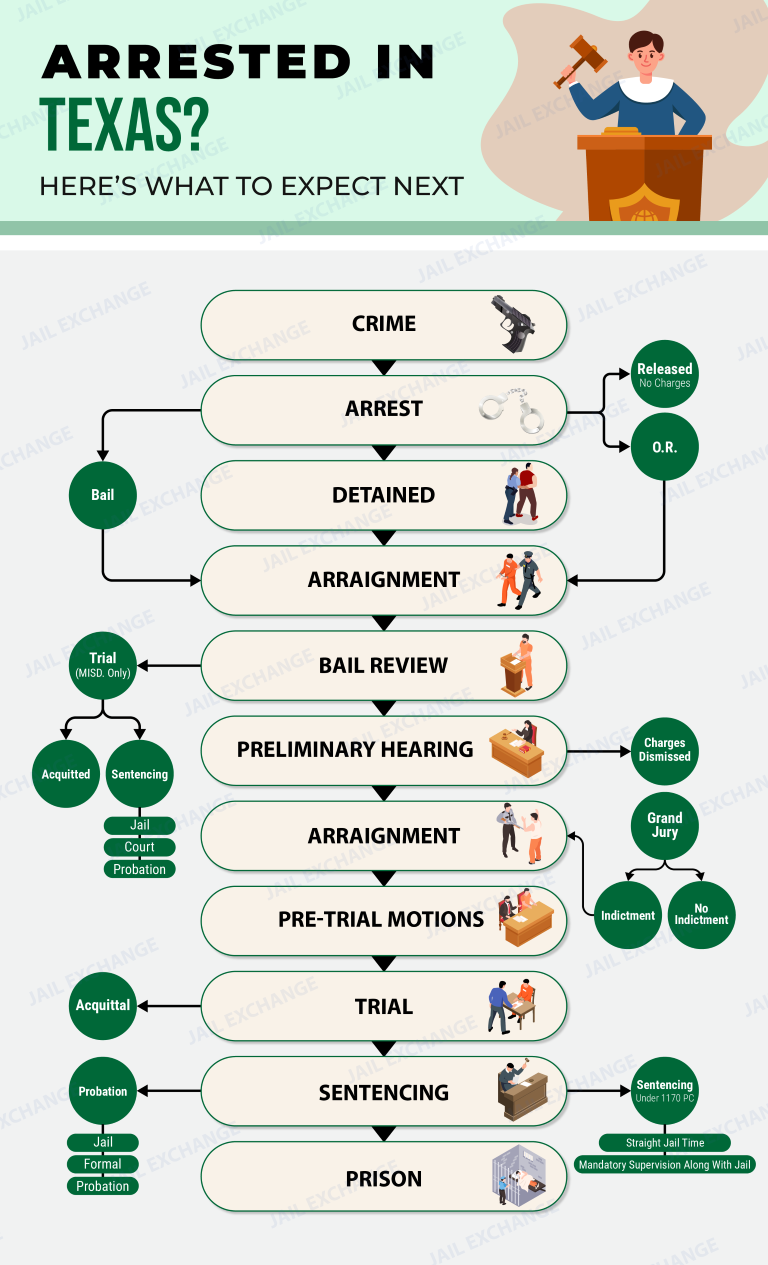
Step one happens before a magistrate, inside a 48-hour clock that starts at arrest (art. 15.17(a)). Your loved one learns the charge and is told about staying quiet and getting a lawyer. A Financial Assessment Form gets filled out, with help from jail staff, if they want a free lawyer. Bail is set here too.
After that, the path splits:
- Examining trial. Felony only, and optional. The defense asks; a judge weighs the proof early (art. 16.01).
- Charging. Felonies need grand jurors, nine of them minimum, saying yes (art. 20A.301). Lesser cases begin on a prosecutor's paper known as an information.
- Arraignment. In open court, the charge gets read aloud and your loved one pleads (art. 26.01).
- Pretrial settings. Evidence gets swapped, motions get argued, and plea offers float back and forth.
- Plea or trial. Got a deal? The judge reveals up front whether it'll be honored. A thumbs-down lets your loved one pull the plea back (art. 26.13).
Court dates come from the court coordinator. Felony dates go through the 12th or 506th District Court coordinator, and misdemeanor or youth dates through the County Court at Law coordinator at 936-873-4472.
↑ Back to the question list5. Step-by-step for Class A and B cases here
Think first DWI, a small theft, a simple assault or a little drug possession. Such Class A and B cases land in front of the County Court at Law judge, usually like so:
- The prosecutor files an information, the written charge.
- Your loved one appears, pleads and gets a court-appointed lawyer if they qualify.
- The two sides may agree on a plea. Otherwise the case is set for a judge or jury trial.
Many misdemeanors end without jail. Two outcomes worth knowing. Deferred adjudication parks the case with no conviction, and dismissal follows when every rule gets met (arts. 42A.101, 42A.111). Probation, which Texas calls community supervision, does carry a conviction. On the misdemeanor side, each one is capped at two years (arts. 42A.103, 42A.053).
Probation in this county is supervised through a Walker County-based department with an office here. The county lists its probation line as 936-873-4444. Texas also has specialty courts for drugs, veterans and mental health. Check the state specialty court list to see what serves this area.
↑ Back to the question list6. Indictment to sentencing in the 12th and 506th
Either the 12th or the 506th District Court takes each felony. A felony file opens at the District Clerk's office once a grand jury indicts. A typical path:
- Magistrate warning and bail at the jail.
- An optional early look at the proof, if the defense wants one (art. 16.01).
- Grand jurors decide, with nine yeses needed for a true bill (art. 20A.301).
- Arraignment, then pretrial hearings and plea talks.
- Either a plea bargain or a trial, followed by the sentence.
Felony probation, deferred or regular, can run a full decade (arts. 42A.103, 42A.053). Anyone sent away serves it with TDCJ.
Ask the District Clerk at 936-873-4433 for the cause number and next setting. The office sits at 270 FM 149 W., Anderson, TX 77830.
↑ Back to the question list7. Grimes County violent felony cases and no-bail hearings
Bail is where things shift hardest. A 2025 state constitutional amendment, Section 11d of Article I, allows holding a defendant without any bail amount on a short list of grave charges like murder or aggravated robbery. The state must win a hearing first, showing the person may run or poses real danger.
- Signature-only release mostly disappears once violence is alleged (art. 17.03).
- A prosecutor unhappy with a bail figure may push back, asking a district judge to look again, and sometimes appealing (arts. 17.029, 44.01).
- In family violence cases, a magistrate's emergency protective order may issue at the first appearance. It can stay in force about two to three months, longer still when a gun or serious injury was involved (art. 17.292).
- If the state seeks death, a regional capital defender office supplies the defense team.
The District Attorney's Office handles these prosecutions. Reach it at 270 FM 149 W, Anderson, TX 77830, 936-873-2137.
↑ Back to the question list8. Grimes County DA, County Attorney and free lawyers
District Attorney's Office: 270 FM 149 W, Anderson, TX 77830, 936-873-2137. Hours are 8 a.m. to noon and 1 to 5 p.m. on weekdays. It handles felonies and has staff assigned to the County Court at Law as well as both district courts. To learn which prosecutor has a misdemeanor, call this office.
County Attorney: Historic Courthouse, 100 S. Main St, Anderson, TX 77830, 936-873-6455. This office works on civil matters, mental health commitments, family and juvenile cases and protective orders. Hours run Monday through Thursday 8 a.m. to 5 p.m., and Friday 8 a.m. to noon.
Appointed defense lawyers: the county uses court-appointed private lawyers under a single plan covering felony and misdemeanor courts. Request forms come from the District Clerk or the Texas Indigent Defense Commission, and they go to the District Court Coordinator. Households near or under 150% of poverty level, or people already on aid like SNAP, usually qualify. Expect a name by the third workday, then a jail visit inside five days. Questions about the plan can go to the commission at 209 West 14th Street, Room 202, Austin, TX 78701, 512-936-6994.
↑ Back to the question list9. Finding a cause number, file or next court setting
- Felony files: use the District Clerk's public records search, or call 936-873-4433.
- Misdemeanor files: ask the County Clerk at 936-873-4410.
- Hearing dates: felony settings come from the district court coordinator, reached through the District Clerk. Misdemeanor and youth settings come from the County Court at Law coordinator at 936-873-4472.
- Statewide records: re:SearchTX lets you register free and read charges and judgments, though not hearing dates.
- Old convictions: the Texas DPS conviction name search charges a fee.
- Heads-up by phone: enroll a name on Texas IVSS-Counties, or dial 866-268-8959, and hearing changes come to you.
Keep the cause number nearby when phoning. It saves time.
↑ Back to the question list10. Warrant check in Anderson, and how to clear one
The Sheriff's Communications Division keeps warrant records. Checks happen in person only, for your own name, with a state ID or driver's license, at 382 FM 149 West, Anderson, TX 77830. The Sheriff's 24-hour line is 936-873-2151. Deputies, the county's constables and Navasota police (936-825-6475) serve warrants. Statewide manhunts appear on the DPS fugitive page, Texas 10 Most Wanted.
Got one hanging over you? Bring an attorney and walk in to the judge whose name sits on it. Some courts reset a missed date by phone, so ring them before you show up. Felony paperwork lives with the District Clerk: 270 FM 149 W., Anderson, TX 77830, 936-873-4433.
↑ Back to the question list11. Federal charges from Grimes County go to Houston
Federal cases from here go to Houston. The Southern District's Houston Division hears them in the Bob Casey United States Courthouse, 515 Rusk Avenue, Houston, TX 77002, 713-250-5500. The College Station court site is using that same Houston address for now.
- The U.S. Attorney's Office prosecutes, from 1000 Louisiana, Suite 2300, Houston, TX 77002, 713-567-9000.
- Free federal defense comes from the Public Defender office: 440 Louisiana Street, Room 1350, Houston, TX 77002, 713-718-4600.
- Pretrial freedom gets argued almost immediately, under 18 U.S.C. 3142.
- The U.S. Marshals hold those kept before trial: 515 Rusk Avenue, Room 10002, Houston, TX 77002, 713-718-4800.
- After a prison sentence, the Federal Bureau of Prisons locator shows the facility.
Docket sheets sit on PACER; pages cost a dime apiece.
↑ Back to the question list12. Immigration holds and the state case
Your loved one's state case continues as normal. Getting out is the hard part:
- The paperwork arrives first: an I-247A form, faxed or handed to Anderson jailers.
- Staff may then keep the person up to 48 hours after they would otherwise be released (8 CFR 287.7(d)).
- Because of a 2017 Texas law, local jails comply with ICE detainers, and proving lawful status ends the hold (art. 2A.060; Government Code 752.053).
- Lawmakers in 2025 went further. Each jail-running sheriff now has to request a 287(g) deal, the deadline being December 1, 2026. The Sheriff's Office (936-873-2151) can tell you the local status.
- Find someone ICE picked up on the ICE Online Detainee Locator, or call the Houston Field Office, 126 Northpoint Drive, Houston, TX 77060, 281-774-4816.
Green card holders and visa holders alike should quiz their lawyer about deportation risk before signing any plea paper.
↑ Back to the question list13. Leaving Anderson for a TDCJ unit
State jail time and penitentiary time both belong to TDCJ. Until it has room, the person stays in the Anderson jail, then moves through intake before being sent to a unit that fits the sentence.
- Track the transfer with TDCJ's online search. A last name plus first initial works, or a TDCJ or SID number. Data refreshes each workday.
- Each prison unit, with addresses, appears in our Texas state prisons directory.
14. Under 17 in Grimes County: juvenile court basics
Kids from age 10 up through 16 are tried as juveniles; a 17th birthday ends that (Family Code 51.02(2)). Locally, youth matters go before the County Court at Law judge.
- Expect a call promptly. Police owe parents prompt notice whenever a child gets taken in (Family Code 52.02).
- Locked in detention? A judge reviews it within about two working days, sooner after a weekend arrest. A lawyer comes first (Family Code 54.01).
- Older teens facing big charges might get transferred upward to the grown-up system. That step is called certification (Family Code 54.02).
Grimes County Juvenile Probation at 936-873-3921 can name the detention center and the hearing hour.
↑ Back to the question list15. Hurt by a crime here? Where to turn
The District Attorney's Office runs Crime Victim Services. Call 936-873-2137, or stop by 270 FM 149 W, Anderson, TX 77830.
- Rights: ask, and you'll be told hearing dates ahead of time. Bail must account for your safety. Before punishment, you can tell the judge what the crime cost you (art. 56A.051).
- Money help: the state can pay back hospital costs, therapy and lost wages through the Attorney General's Crime Victims' Compensation, with a $50,000 ceiling. Call 800-983-9933.
- Release alerts: register free at Texas IVSS-Counties or call 866-268-8959, any hour, in English or Spanish.
- State prison cases: TDCJ Victim Services answers at 800-848-4284.

Tiger Commissary provides specialized food service and commissary solutions for county jails and regional detention centers. The online ordering portal allows friends and family members to purchase pre-approved snack boxes, meat and seafood pouches, hygiene items, writing supplies, and clothing packages delivered directly to an incarcerated loved one.
Important: Package Cutoff Deadlines and Spending Limits Vary
Detention centers do not manage care package distribution under identical rules. While some facilities allow weekly web orders, others limit deliveries to bi-weekly or monthly windows, and spending limits vary from jail to jail. You should verify the facility's active cutoff schedule and order allowances by calling them directly. If an order is submitted after the weekly processing deadline, delivery will be held until the following cycle, leaving your loved one waiting an extra cycle for fresh supplies and personal toiletries.
Step-by-Step Instructions to Place a Tiger Commissary Order
- Obtain the inmate's legal first and last name, date of birth, and assigned facility booking ID number.
- Navigate to orders.tigercommissary.com on your computer or mobile device.
- Select your state and detention center from the facility directory.
- Search for the inmate to unlock the jail's approved product catalog and view active ordering balances.
- Select allowable food packs, snack items, personal hygiene products, and apparel up to the facility's order limit.
- Proceed to checkout, enter your debit or credit card billing information, and submit payment.
- Save your digital receipt and confirmation number for tracking purposes.
What the Inmate Needs to Do
The inmate does not need an internet account to receive care packages. Tiger Correctional Services fulfills the order in tamper-evident security packaging and delivers it directly to the jail commissary department. Facility staff inspect the shipment and deliver the items during regular housing unit distribution, where the inmate signs the delivery roster.
Official Provider: Tiger Commissary Official Website
Customer Service Telephone: 1-877-844-3726
Support Hours: Monday – Friday, 8:00 AM – 5:00 PM CST
Supported Languages: English and Spanish
Other Services Provided by Tiger Correctional Services
In addition to Package Ordering, Tiger Correctional Services operates electronic trust and banking solutions:
- Web Deposits & Inmate Trust: Send money directly into an inmate's jail trust account for independent canteen purchases.
• Learn more on our website: Inmate Trust Deposits Guide | • Visit official vendor page: Tiger Web Deposits
Buy Commissary for an Inmate in the Grimes County Jail
Grimes County Jail Inmate Commissary - Sending Money or Purchasing Commissary for an Inmate
Grimes County Jail allows inmates to purchase commissary. Ask the jail what its commissary sells; snacks and hygiene items are common.
You can buy commissary for an inmate using an online service called Tiger Services.

Call the facility at 936-873-6439 to ask whether there is a limit on how much an inmate can spend on commissary.
Tiger Commissary's site shows whether friends and family can order commissary for an inmate at this jail.
Scroll down for information on the Grimes County Jail's service they use for you being able to purchase commissary items online and have them shipped directly to the inmate.
You can also go to our Inmate Money page for information on how to send money to an inmate.
Tiger Correctional Web Deposits allow family members to send money directly into an incarcerated person's jail trust and commissary ledger. Deposited funds give your loved one the financial balance required to independently buy food items, hygiene supplies, writing materials, and medical copays from the facility store.
Important: Facility Deposit Rules and Window Intake Vary
Once a person is booked and moved to a housing unit, facilities do not always allow cash drop-offs or phone payments directly to the jail window. Some might and you should confirm this by calling the facility and asking. But if you do not register online and fund your loved one's trust account immediately, they may be forced to wait days or weeks for standard paper processing, leaving them without essential soap, clean undergarments, basic medical sundries or snacks.
Step-by-Step Instructions to Register and Deposit Funds
- Confirm the inmate's legal first and last name, date of birth, and assigned booking or inmate ID number.
- Visit orders.tigercommissary.com on your computer or phone.
- Select Deposit Money or Web Deposits from the service dashboard.
- Select the state and facility where the inmate is currently detained.
- Search for the inmate to confirm their active housing status matches the facility roster.
- Enter your deposit dollar amount and review the calculated transaction and convenience fees.
- Input your debit or credit card billing details, complete payment, and save your digital receipt.
What the Inmate Needs to Do
The inmate does not need an internet account to receive funds. Once the electronic transaction clears, the balance posts directly to their jail trust ledger according to facility accounting schedules. The inmate can review their updated balance at a dayroom pod kiosk or on their weekly trust statement and place orders on their regular commissary day.
Official Provider: Tiger Commissary Official Website
Customer Service Telephone: 1-877-844-3726
Support Hours: Monday – Friday, 8:00 AM – 5:00 PM CST
Supported Languages: English and Spanish
Other Services Provided by Tiger Correctional Services
In addition to Trust Web Deposits, Tiger Correctional Services provides direct care package delivery:
- Tiger Commissary Web Package Ordering: Order pre-approved snack boxes, food packages, and clothing directly to the jail.
• Learn more on our website: Commissary Package Ordering Guide | • Visit official vendor page: Tiger Commissary Packages
Deposit Money into an Inmate's Account
Your own name, address and phone number belong on any money order headed for the Grimes County Jail, in the sender spot the form gives you. An envelope with no return name and address can be destroyed. The jail is at 382 FM 149 West in Anderson, and a person's trust account there pays for commissary.
Paper is the only thing the mail can carry: a cashier's check or money order. To send one:
- Write "Inmate Trust Fund" as the payee.
- Print the person's full name on it.
- Fill in your sender details.
- Mail it, with no letter, to Grimes County Jail, 382 FM 149 West, Anderson, TX 77830.
Cash and personal checks that arrive by mail are refused.
Card deposits go through Tiger Commissary. At the jail, the lobby or visitation kiosk takes cash or a card. The window also takes drop-offs, but its hours and limits aren't posted anywhere public; 936-873-6439 is the number for those.
The Grimes County Jail on FM 149 West in Anderson is run by the Grimes County Sheriff's Office. Letters come in through the post office and are handed out on paper. Staff will not take a letter dropped off at the front desk, so mailing it is the only way in.
Letters, publications and money orders for a Grimes County inmate:
Inmate's Full Name & Inmate ID#
Grimes County Jail
382 FM 149 West
Anderson, TX 77830
- Name line: Begin the address with the inmate's full name, then their inmate ID number. The inmate lookup can help you find them.
- Money orders: The jail takes only money orders and cashier's checks by mail. Make them payable to "Inmate Trust Fund" rather than to the inmate, and write the inmate's name in another spot on the form. Fill in your own name, address and phone number where it asks for the sender, and mail it with no letter in the same envelope.
- Your address: Anderson jail staff need your full name and mailing address in the upper left corner, and an envelope without them can end up destroyed.
- Letters only: A letter is the one personal item family and friends may mail in.
- Books, magazines and newspapers: Softcover only, shipped by the publisher or an online bookseller. A hardcover book is refused.
- Writing it: Grimes County asks for blue or black pen from start to finish. Crayon, marker, colored ink, glitter, lipstick and perfume are not allowed, and nothing should be drawn on the envelope.
- No co-defendants: Inmates may hear from friends and relatives, but not from co-defendants, people locked up elsewhere or anyone named in a no-contact order.
Grimes County hands out mail on weekdays, and a person there can get as many letters as you care to send.
NCIC Inmate Communications provides telecommunications services that allow incarcerated individuals to place outbound voice calls from dayroom telephones to family and friends. Because correctional facilities do not permit incoming phone calls, establishing an NCIC prepaid calling account connects calls directly to your cell phone or landline without being blocked by wireless carriers.
Important: Mobile Phones Automatically Block Inmate Calls
Cellular phone carriers automatically reject standard collect calls originating from jail phone systems. While some residential landlines might permit direct monthly billing, mobile devices and internet-based telephone lines require an active prepaid calling balance, which you can verify by checking with your provider. If you do not register online and fund an NCIC account right away, your loved one will receive an automated disconnect announcement when attempting to call your number.
Step-by-Step Instructions to Register and Fund an Account
- Visit account.ncic.com or call NCIC customer care at 1-800-943-2189.
- Click Create Account and register using the primary 10-digit telephone number where you want to receive calls.
- Select the state and correctional facility where your loved one is currently detained.
- Search for and add the inmate using their full legal name or booking ID number.
- Select your deposit dollar amount and enter your debit or credit card billing details.
- Submit payment and ensure your mobile phone settings allow calls from automated or unfamiliar correctional numbers.
What the Inmate Needs to Do
The inmate dials your 10-digit number from any dayroom telephone and keys in their assigned PIN. The automated system verifies that your phone number has an active prepaid balance and prompts you to press a digit to accept the call. All personal telephone conversations are recorded and monitored by facility staff.
Official Provider: NCIC Official Website
Customer Service Telephone: 1-800-943-2189
Support Hours: 24 hours a day, 7 days a week, 365 days a year
Supported Languages: English and Spanish
Other Services Provided by NCIC Inmate Communications
In addition to Prepaid Phone Calling, NCIC provides several other digital communication and visitation services at participating facilities:
- Remote Video Visitation: Schedule and join live face-to-face video visits from home using your computer or smartphone.
• Learn more on our website: Video Visitation Guide | • Visit official vendor page: NCIC Video Visits - Inmate Messaging Services: Send electronic messages and photos directly to an inmate's housing unit terminal.
• Learn more on our website: Inmate Messaging Guide | • Visit official vendor page: NCIC Messaging
NCIC Inmate Messaging allows friends and family members to exchange electronic text messages and digital photos directly with an incarcerated loved one. Messages are delivered electronically to housing unit terminals and tablets within hours, avoiding the lengthy transit times associated with physical postal mail.
Important: Electronic Messaging Screening Rules Differ
Inmates cannot receive incoming phone calls, and traditional postal mail rules differ across correctional agencies. While some facilities still allow regular handwritten letters, many jails have transitioned to digital-only mail scanning or restrict postal delivery, which you can verify by checking facility rules. If you do not register online and purchase messaging credits immediately, your loved one may face lengthy periods without direct written contact from family.
Step-by-Step Instructions to Register and Send Messages
- Go to account.ncic.com and sign in or create a user profile.
- Select Messaging from your dashboard options.
- Select your state and detention center, then search for the inmate using their full legal name or booking ID.
- Purchase a messaging credit bundle using a debit or credit card.
- Type your message in the composition window and attach approved JPEG photos if permitted by the facility.
- Submit your message to the facility's screening queue.
What the Inmate Needs to Do
All electronic correspondence is screened by facility staff before delivery. Once approved, messages appear in the inmate's inbox on their housing unit terminal or tablet. The inmate opens the message, reads your note, and types an electronic reply using their available credits.
Official Provider: NCIC Official Website
Customer Service Telephone: 1-800-943-2189
Support Hours: 24 hours a day, 7 days a week, 365 days a year
Supported Languages: English and Spanish
Other Services Provided by NCIC Inmate Communications
In addition to Inmate Messaging, NCIC provides calling and video visitation services at participating facilities:
- Prepaid Phone Calling Accounts: Fund a calling balance tied directly to your phone number.
• Learn more on our website: Prepaid Calling Accounts Guide | • Visit official vendor page: NCIC Prepaid Calling - Remote Video Visitation: Schedule and join live face-to-face video visits from your computer or smartphone.
• Learn more on our website: Video Visitation Guide | • Visit official vendor page: NCIC Video Visits
NCIC Inmate Communications deploys secure, corrections-grade handheld tablets to incarcerated individuals in county detention centers. Operating on a secure internal wireless network, these devices allow inmates to conduct remote video visits, make voice telephone calls, send electronic messages, stream music, read eBooks, and access self-help and educational resources directly from their housing pods.
Important: Tablet Hardware Deployment and Rental Rules Vary
Detention centers do not manage tablet distribution identically. While some agencies issue individual personal tablets to every detainee at booking, others utilize shared pod docking stations or restrict tablet use to specific dayroom hours, which you should confirm with the facility directly. Although core educational and legal resources are generally provided free of charge, sending messages, listening to music, or making phone calls from the tablet requires an active balance funded by outside contacts.
Step-by-Step Instructions to Support and Fund NCIC Tablets
- Verify that NCIC handheld tablets are active at your loved one's specific detention facility.
- Navigate to account.ncic.com on your computer or mobile device.
- Sign into your verified user account and link the inmate's legal name and booking ID number.
- Select Tablet Media / Messaging or Inmate PIN Debit to add funds to their available balance.
- Specify your deposit dollar amount, review convenience fees, and enter your credit or debit card billing details.
- Submit payment, save your confirmation receipt, and notify your loved one that their device balance is available.
What the Inmate Needs to Do
The inmate unlocks their assigned tablet using their PIN or biometric login. Their available balance appears on the screen, allowing them to download songs, read digital books, write messages, and communicate with approved family members. Devices are returned to charging carts during quiet hours and shift counts for overnight recharging.
Official Provider: NCIC Official Website
Customer Service Telephone: 1-800-943-2189
Support Hours: 24 hours a day, 7 days a week, 365 days a year
Supported Languages: English and Spanish
Other Services Provided by NCIC Inmate Communications
In addition to Tablet Services, NCIC provides several other communication, financial, and visitation options:
- Prepaid Phone Calling Accounts: Prepay for phone calling credits so your loved one can call your telephone directly.
• Learn more on our website: Prepaid Calling Accounts Guide | • Visit official vendor page: NCIC Prepaid Calling - Remote Video Visitation: Schedule and join live face-to-face video visits from your computer or smartphone.
• Learn more on our website: Video Visitation Guide | • Visit official vendor page: NCIC Video Visits - Inmate Messaging Services: Send electronic messages and photos directly to an inmate's terminal or tablet.
• Learn more on our website: Inmate Messaging Guide | • Visit official vendor page: NCIC Messaging - Inmate Trust & Commissary Money Deposits: Send canteen funds directly into an incarcerated person's jail trust account.
• Learn more on our website: Trust Deposits Guide | • Visit official vendor page: NCIC Trust Deposits
- Jail (Main): 936-873-6439
- Sheriff: 936-873-2151
The Grimes County Jail serves the following cities and towns of Grimes County: Anderson, Bedias and Navasota.