
Hardeman County Jail
Hardeman County Jail
Physical Address
318 Mercer StreetQuanah, TX 79252
Jail Phone Number
940-663-5374Hardeman County Inmate Search: Booked on Mercer Street, Now What?
Arrests across this county usually end with booking at the Hardeman County Jail, 318 Mercer Street, Quanah, TX 79252, a small lockup the Sheriff's Office runs. Because it has few beds, some prisoners end up housed in another county's jail. Each answer below covers one task: locating the person, mugshots, bond, visits, deposits, letters, warrants and court.
Begin with the official jail search. As a second option, Texas runs IVSS-Counties, a free statewide service: type a name to check custody status, then register for release notices. A booking from only a few hours ago may lag behind, and a phone call settles it.
Make the Sheriff's Office your first call, 940-663-5374, open to the public on weekdays from 8 a.m. to 5 p.m. Ask where the person is being kept, what they're charged with, and if a bond amount exists. Our bail and release page comes next, then the criminal court page for hearings.
Read inmate search answers
 Read inmate search answers
1. Searching the Hardeman County jail, step by step
- Open the official jail search and enter the last name. Typing fewer letters can catch a misspelled record.
- Next, run the name through Texas IVSS-Counties, which checks many Texas county jails at once. Its help line, 866-268-8959, never closes and speaks English and Spanish.
- Nothing yet? Ring the Sheriff's Office, 940-663-5374. Booking staff need two things: the exact legal spelling and the date of birth.
- Keep notes from that call: the date of booking, every charge, the bond figure and any hold. Each later call goes quicker with them in hand.
2. Not on any list yet: reasons and fixes
A missing name usually has a plain reason:
- Booked minutes ago. Records can trail the arrest by a few hours.
- Boarded out. The Mercer Street jail holds only a handful of people, so some go to a jail in another county.
- Released. Bond might already be posted, or the case dismissed.
- Held by someone else. State troopers, U.S. Marshals or ICE may have custody.
- Typed differently. Try a former last name, a middle name, or just the first few letters.
Sort it out with one call to the Sheriff's Office, 940-663-5374. Staff can say whether there was a booking, a release or a transfer out, and to which jail.
↑ Back to the question list3. Mercer Street or a neighbor county's jail?
One adult jail operates in this county:
- Hardeman County Jail, holding adults booked here, at 318 Mercer Street, Quanah, TX 79252, 940-663-5374. State figures from June 2022 put its capacity at 11.
With so few beds, prisoners are at times boarded in other counties. A state count on August 1, 2022 found 14 Hardeman prisoners in outside jails, though the report left the host counties unnamed. Two neighbors worth asking about:
- Wilbarger County Jail, 5215 College Drive, Vernon, TX 76384, 940-553-1351.
- Childress County Jail, 1005 Avenue F NW, Childress, TX 79201, 940-937-2535.
Neither is a confirmed host. The Sheriff's Office knows where any one prisoner is sleeping tonight.
↑ Back to the question list4. Hardeman County mugshots and booking photos
Mugshots from an arrest here come through a Public Information Act request, put in writing and sent to the Sheriff's Office, 318 Mercer Street, Quanah, TX 79252, 940-663-5374. Texas treats basic arrest information as public (Tex. Gov't Code 552.108(c)), and that office answers such requests. News outlets go the same way.
- Websites selling removal. Texas regulates mugshot sites that charge $150 or more for removal (Bus. & Com. Code ch. 109). If a record there is wrong or incomplete, the site must correct it or pull it, free. It also may never show expunged or nondisclosed records. Some removal fees remain legal.
- Immigration photos are released only by way of an ICE records request.
- Federal booking pictures are normally withheld; one exception is a Marshals release meant to help catch a fugitive.
5. Free notices when a prisoner leaves or moves
The state's free, confidential notice service for county custody is Texas IVSS-Counties. Register a name, and the service will notify you when that person's custody changes, a release included.
Relatives may enroll, not just crime victims. Staff at 866-268-8959 help any hour. Since a prisoner from this small jail can be moved to another county on short notice, the alert backs up your calls to the Sheriff.
↑ Back to the question list6. Getting out on bond from the Hardeman County Jail
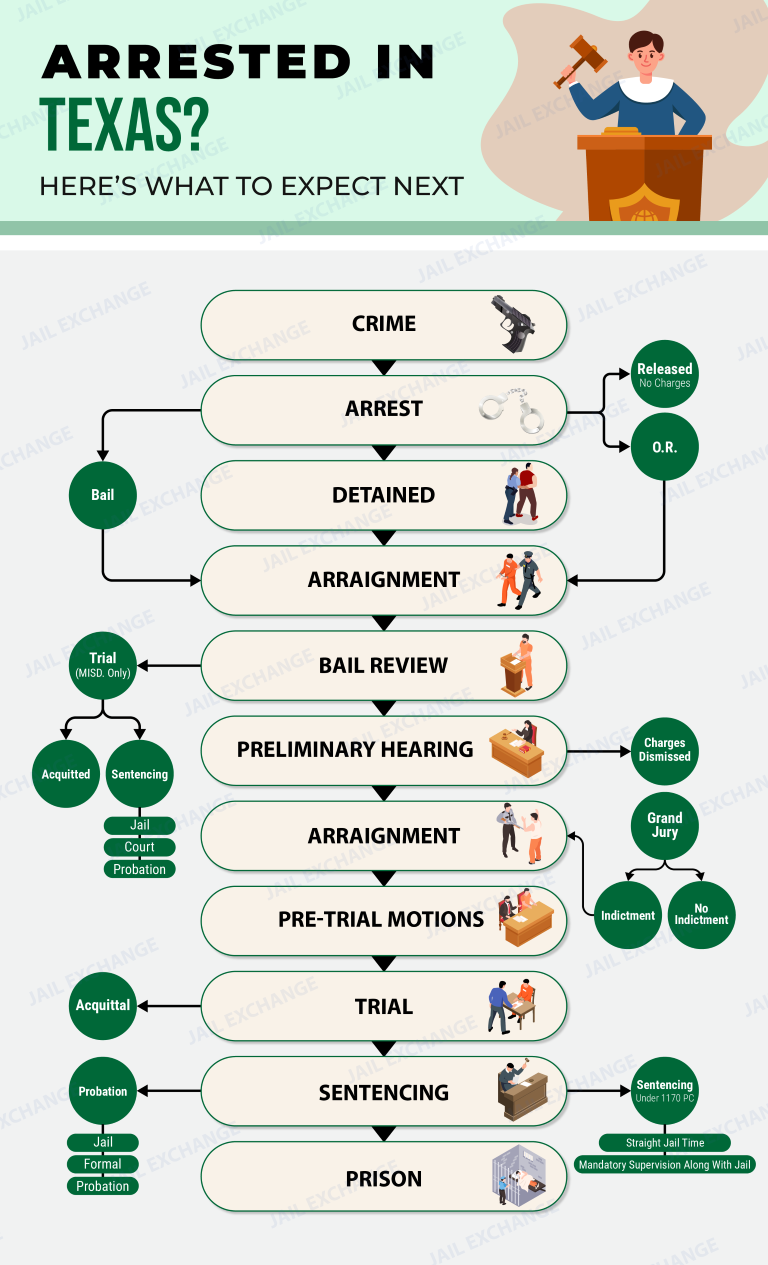
A magistrate, such as the local Justice of the Peace, has to see each arrested person within 48 hours. At that hearing the bail figure and any release conditions get set.
- Cash: pay the whole amount; it comes back after the case when every condition is kept.
- Surety: a licensed bondsman covers the whole bond, and the bondsman's fee stays with the bondsman.
- Personal bond: freedom on a written promise to return, not allowed for many violent charges.
A 2025 amendment to the Texas Constitution lets judges deny bail outright on certain grave charges. Ask the Sheriff's Office, 940-663-5374, where bond gets posted and what forms of payment work. The details are on our bail page for this county, while statewide rules are explained on our Texas bail laws page.
↑ Back to the question list7. Pinning down the charges
The magistrate reads each charge aloud at the first hearing, so the person in custody can tell you. Three more ways to confirm:
- Booking staff at 940-663-5374 can read the offenses off the booking record.
- After filing, the District and County Clerk, 300 S Main St, Quanah, TX 79252, 940-663-2901, has the charging papers.
- A free re:SearchTX account shows charges and judgments in filed cases.
Arrest charges are not final. Before the indictment or information is filed, prosecutors may raise, lower or drop them.
↑ Back to the question list8. A court-appointed lawyer: who qualifies here?
Appointed counsel can be requested at the first hearing, where the magistrate provides the paperwork and explains it. Foard, Hardeman and Wilbarger use one shared plan.
- Some people are presumed too poor to hire a lawyer. That includes anyone on SNAP, Medicaid, TANF or SSI, and anyone in public housing.
- So does a household living on 125% of the federal poverty guideline or less.
- For a felony, the 46th District Judge names the lawyer. In Class A and B misdemeanor cases, appointments are the County Judge's job; call the courthouse at 940-663-2911.
- Under the plan, appointment should follow within three working days.
The Texas Indigent Defense Commission publishes the plan online. Hiring a private attorney remains an option.
↑ Back to the question list9. Visiting hours on Thursday and Saturday
Two visiting slots run each week at the jail:
- Thursday, 3:00 p.m.
- Saturday, 2:00 p.m.
Visits run 20 minutes. Every visitor must be at least 17 and meet the dress code. Phone 940-663-5374 ahead of time to check the schedule, the ID you need, and any video visit option. Texas jail rules require a minimum of two visits weekly. Our jail visiting page has more tips.
↑ Back to the question list10. Deposits for commissary and phone time
Money on a prisoner's account buys snacks, soap, stamps and phone minutes. Before sending a dime, phone the Sheriff's Office, 940-663-5374, and ask:
- Which deposit methods work: money order, cashier's check, cash at the front counter, or a vendor website?
- What name and booking number belong on it?
- Is there a fee?
See our inmate deposits page for the usual methods, and our commissary page for the store side of things.
↑ Back to the question list11. Calls, messages and the jail phone account
Calls go out from the jail; nobody can dial in to a prisoner. Most jail calls are collect or prepaid through a contracted phone company, and staff may record them, but not calls with a lawyer.
The Sheriff's Office, 940-663-5374, can name the phone vendor on Mercer Street and explain account setup. We cover the basics on our jail calls page and on our jail messaging page.
↑ Back to the question list12. Addressing letters to a Hardeman County inmate
Two addresses are in play: the jail at 318 Mercer Street, Quanah, TX 79252, and the Sheriff's box, P.O. Box 266, Quanah, TX 79252. Call 940-663-5374 before mailing to learn which one inmate letters use and what can go in the envelope.
- Write the prisoner's full name, and the booking number when you know it.
- Under Texas jail standards, incoming letters have no numeric cap.
- Mail from an attorney gets opened only in front of the prisoner.
Common mail rules are gathered on our sending letters to inmates page.
↑ Back to the question list13. Wallets, phones and keys taken at booking
At booking, staff list and store personal items, and they are handed back at release. If the person gets transferred to a different county or to TDCJ, ask whether the property travels too.
To collect items while someone is still locked up, the prisoner usually signs a form naming who may take them. Phone 940-663-5374 for the form, pickup hours and the ID you'll need. Evidence stays with the case until the court or the prosecutor lets it go.
↑ Back to the question list14. Injury, illness or a mental health crisis behind bars
Phone the Sheriff's Office at once, 940-663-5374, and describe the condition, the medicines or the mental health worry. Privacy rules limit what staff may share, but they will log what you tell them. For a life-or-death emergency, call 911.
- Jailers who spot possible mental illness or intellectual disability must notify a magistrate; the deadline is 12 hours (art. 16.22).
- Complaints about care or conditions can be filed with the Texas Commission on Jail Standards, 512-463-5505.
15. Checking a Hardeman County warrant
Sheriff's deputies serve most warrants here, from 318 Mercer Street, Quanah, TX 79252, 940-663-5374. The constable, who also delivers court papers, shares the courthouse line, 940-663-2901. The DPS Texas 10 Most Wanted shows fugitives sought statewide.
To check on a warrant, phone the Sheriff's Office, or go in person to the District and County Clerk, 300 S Main St, Quanah, TX 79252. Carry photo ID for that visit. To resolve one, contact the issuing court, or surrender to it alongside a defense lawyer who can arrange bond.
↑ Back to the question list16. Hearing dates at the Main Street courthouse
The District and County Clerk tracks dates for felony and misdemeanor cases; call 940-663-2901 with the defendant's name and birth date. For a traffic or other Class C ticket, reach the Justice of the Peace at 940-663-5932.
Enrolled users of Texas IVSS-Counties may also get court-event notices. Our court page walks through each court, the hearing order and where court meets.
↑ Back to the question list17. Federal custody: Marshals, Wichita Falls and the BOP
Wichita Falls hosts the federal court division for Hardeman and its neighbors, within the Northern District of Texas. Hearings are held at 1000 Lamar Street, 2nd Floor, Wichita Falls, TX 76301; for the clerk, phone Fort Worth at 817-850-6600.
- Next comes a federal detention hearing: freedom or custody until trial (18 U.S.C. 3142).
- U.S. Marshals often house federal prisoners in county jails while the case goes on. Their Wichita Falls office, 1000 Lamar Street, Room 218, Wichita Falls, TX 76307, 940-723-8662, can say which one.
- Once there is a sentence, the Bureau of Prisons takes custody; search the BOP inmate locator.
18. ICE detainers and finding a person afterward
- ICE lodges a detainer (Form I-247A), its hold request, on Mercer Street.
- Jailers may keep the person up to 48 hours after they would otherwise be released (8 CFR 287.7(d)).
- Inside that window, officers from ICE take custody and move the person to whichever detention center ICE picks.
- Check the ICE Online Detainee Locator. It accepts an A-number; if you lack one, enter the full name and select the country of birth.
- Still empty? Call ICE's Dallas Field Office, which handles North Texas, at 8101 N. Stemmons Freeway, Dallas, TX 75247, 972-367-2200.
Under Texas law, a jail honors a detainer unless the person establishes citizenship or lawful status (Tex. Code Crim. Proc. art. 2A.060). By December 1, 2026, S.B. 8 (2025) further requires each county running a jail to seek a place in ICE's 287(g) program. S.B. 4 (2017) forbids local policies that restrict immigration enforcement (Tex. Gov't Code 752.053). For the county's 287(g) status, ask the Sheriff's Office.
↑ Back to the question list19. After a TDCJ sentence: tracing the move
Someone given a prison term stays in county custody until the Texas Department of Criminal Justice comes for them. Intake comes first, with tests and a classification review, and then a unit matched to the person's needs and security level.
- The TDCJ inmate search accepts a name or a TDCJ number.
- For unit details, use our Texas state prisons page.
20. Hardeman County youths under 17: juvenile court rules
Juvenile court in Texas handles children whose age on the offense date was 10 through 16. Such a child goes to juvenile detention; the Mercer Street jail is for adults. From age 17 on, adult court applies (Tex. Fam. Code 51.02).
The three counties of the 46th District, Foard, Hardeman and Wilbarger, have a single juvenile board. Phone juvenile probation, 1700 Wilbarger Street, Room 30, Vernon, TX 76384, 940-553-4232, for the detention center in use. A lawyer is appointed, and the detention hearing follows no more than two working days after custody begins, under Family Code section 54.01.
↑ Back to the question list21. Hardeman County law enforcement: sheriff, towns, constable, troopers
The arrest report belongs to the arresting agency. In this county, that could be:
- Sheriff's Office, countywide patrol including rural roads, and the jail: 318 Mercer Street, Quanah, TX 79252, 940-663-5374.
- City of Quanah: City Hall, 109 King Street, Quanah, TX 79252, 940-663-5336. Ask City Hall who polices the city.
- City of Chillicothe: 14125 US-287, Chillicothe, TX 79225, 940-852-5211. Ask the city office who handles police calls in town.
- Constable: P.O. Box 30, Quanah, TX 79252, 940-663-2901.
- Texas DPS troopers work the highways; the Sheriff's Office can tell you which Highway Patrol office covers the county.
Emergencies: call 911.
↑ Back to the question listHardeman County Bail and Release
An arrest by a deputy, a Quanah officer or a trooper on US-287 usually leads to the same place: the Hardeman County Jail, 318 Mercer Street, Quanah, TX 79252. Space there is tight, so a few prisoners may be lodged in other counties' jails. Below, learn how the magistrate sets bond, how to pay it and what holds can stall a release. Curious about Austin's rulebook for bail? Our Texas bail laws page spells out those statewide rules.
Use the official jail search to check a name first. A second free option is Texas IVSS-Counties, the state's name search for people in county custody. For the full arrest story, our Jail Roster page sorts out bookings, who sits in custody, warrants, each filed charge, mugshots, appointed defense lawyers and how to claim property held since booking.
Start by ringing the Sheriff's Office, 940-663-5374. Learn whether the magistrate hearing is done, the bond figure for each charge, and which window will take payment. When the cell door opens, switch to our court page for hearings, pleas and trial.
1. Who decides bail after a Hardeman County arrest?
A magistrate does. By Texas law, the 48-hour clock starts at arrest, and the hearing should come sooner if possible (Tex. Code Crim. Proc. arts. 14.06(a), 15.17(a)). Jails may run it over a video screen.
The magistrate list in Texas covers county judges, district judges and justices of the peace, among others (art. 2A.151). Hardeman has one Justice of the Peace office, located in the courthouse at 300 S Main St, Quanah, TX 79252, 940-663-5932.
During that short hearing, the magistrate:
- names each charge and explains the right to remain silent;
- says the person may hire counsel or request a free one, and helps with the paperwork for that (art. 15.17(a));
- reviews a public safety report on Class B charges and anything worse (arts. 17.021, 17.022);
- sets bail within those 48 hours, leaning toward the lightest terms that will still work for safety and for court dates (art. 17.028).
Hearing times vary, so phone the Sheriff's Office at 940-663-5374 to learn when it will happen.
↑ Back to the question list2. Which bonds might a Texas magistrate allow here?
Art. 17.01 gives Texas exactly two release tools. One is the bail bond; the other is the personal bond. Around Quanah, that can mean:
- Cash bond. The full bail is deposited in cash with the court. It is returned, less any fee, after the case closes with all terms met (art. 17.02).
- Surety bond. A licensed or listed surety, usually a bondsman, guarantees the full sum in case the accused misses court. The family pays the surety for that promise.
- Personal bond. The person signs a promise and walks out with no cash and no surety (art. 17.03).
- Conditions. Judges may add rules to any bond. A no-contact order is one example. Some drunk-driving arrests require an ignition interlock device: repeat DWI, DWI with a child passenger, and intoxication assault or manslaughter (art. 17.441).
Personal bonds are barred for many charges the statute calls violent, for a felon found with a gun, and for some protective order or terroristic threat cases (art. 17.03). On a burglary count, an organized crime count or certain drug felonies, only the trial judge has power to sign off on one.
Fine-only charges move faster. The magistrate can skip bond entirely and hand the person a written notice of when to come back (art. 15.17(b)).
↑ Back to the question list3. How are bail amounts decided for local charges?
Texas has never adopted one statewide bail chart. A magistrate tailors each amount to the person. These factors must be weighed (art. 17.15(a)):
- whether the sum gives the person a strong reason to keep court dates;
- a ban on using bail to crush or punish anyone;
- details of the alleged crime, where violence counts heavily;
- how much money the person truly has;
- protecting the victim, police officers and the wider community;
- criminal history, including skipped court dates;
- citizenship status.
State law also sets two bond ceilings, both tied to arrests made without a warrant. When probable cause hasn't been decided in time, a misdemeanor arrestee goes home by hour 24 on a bond of $5,000 or less. Felony arrestees get until hour 48, with a $10,000 ceiling. Anyone too broke for that amount leaves on a personal bond, though prosecutors may ask the magistrate to wait up to 72 hours (art. 17.033). The local plan for appointed lawyers repeats this rule.
Deputies at 940-663-5374 can read you the bond actually set. Expect them to ask for the person's legal name and birth date.
↑ Back to the question list4. Steps for posting bond at the Mercer Street jail
Jail and Sheriff's Office staff work out of 318 Mercer Street, Quanah, TX 79252. Its office runs Monday to Friday, 8:00 a.m. to 5:00 p.m. Follow this order:
- Dial 940-663-5374 before driving in.
- Spell the name slowly and give the birthday. Get a separate bond figure for every charge on the booking.
- Ask if jail staff can process the bond now, or if the courthouse clerk handles it.
- Ask about accepted payment on Mercer Street right then, plus what name the money order should be made out to.
- Carry photo ID. Insist on a written receipt showing your own name.
Before any jailer accepts bail, Texas requires a criminal history check. For a violent charge, the jailer can't pick the number; a magistrate must (arts. 17.20, 17.22).
Evenings and weekends, phone ahead, because the office may be shut. Save 911 for emergencies.
↑ Back to the question list5. Is bail taken at the Quanah courthouse too?
It can be. Texas treats cash bail as a deposit with the court's custodian of funds, so courthouse offices sometimes accept it (art. 17.02). Call each one before you go:
- District and County Clerk, one office holding both felony and misdemeanor cases here: Hardeman County Courthouse, 300 S Main St, Quanah, TX 79252, 940-663-2901. Ask whether this office will take the cash bond on your person's case, which payment types it allows, and its business hours.
- Justice of the Peace, for Class C tickets and many first hearings: same courthouse, 300 S Main St, Quanah, TX 79252, 940-663-5932. Ask how bond works on a fine-only case.
- City tickets. For a Quanah case, try City Hall, 109 King Street, Quanah, TX 79252, 940-663-5336. For a Chillicothe case, try the City Office, 14125 US-287, Chillicothe, TX 79225, 940-852-5211. Ask which court holds the ticket.
After you pay at any window, find out whether staff will alert the jail or whether you should bring the receipt to Mercer Street.
↑ Back to the question list6. Cash or money order: what does the Mercer Street jail take?
Settle this by phone. Staff at 940-663-5374 know what the jail accepts right now. Good things to ask:
- Do they take cash, and do they make change?
- Will they take a money order or a cashier's check, and how should it be made out?
- Can a card or a phone payment be used, and how much is the added fee?
- Does the courthouse clerk accept different payment than the jail?
Two safety tips. Mailing cash is never safe. And guard the receipt, since Texas refunds a cash bond to whoever the receipt names (art. 17.02).
↑ Back to the question list7. Do Hardeman County bondsmen need a license?
A county must form a bail bond board, the group that licenses bondsmen, once it reaches 110,000 residents (Tex. Occ. Code 1704.002). Hardeman had roughly 3,292 people on July 1, 2025, per a U.S. Census Bureau estimate. Without a board, the sheriff has the option to post a list of approved sureties (art. 17.141). Ask the Sheriff's Office for it.
Before signing anything with a bondsman, keep these rules in mind:
- Texas puts no cap on the bondsman's fee. Ask whether any of it comes back, and get the price on paper.
- Put your request for a returned truck title or other collateral in writing after the case is done. A month, 30 days, is the most the bondsman may take to return it (Tex. Occ. Code 1704.301).
- A bondsman can't hunt for clients inside the jail (Tex. Occ. Code 1704.304). Any money or property you hand over earns a receipt (Tex. Occ. Code 1704.305).
- The person's own lawyer on this case may sign the bond too (Tex. Occ. Code 1704.163).
- To turn the person back in, a surety first notifies the defense lawyer, then swears out an affidavit for the court (art. 17.19).
8. Why might the Quanah jail keep someone after bond?
Paying one bond settles one case and nothing more. Check for these before you hand over money:
- Another county's warrant. That warrant's bail can be set and taken by a Quanah magistrate, who then ships the bond paperwork back to the county that wanted the person (art. 15.18). If no bail is taken, the person stays until that county sends transport.
- A felony arrest while on felony bail. Release is up to the court with the earlier case, or a court it names in writing (art. 17.027).
- Parole blue warrant. Under Tex. Gov't Code 508.254(c), a parolee returned to custody is normally held for the violation hearing.
- Family violence. When the magistrate believes violence will likely continue, the jail keeps the person 4 hours past the posting of bond. A written order may push it as far as 48 hours (art. 17.291(b)).
- Immigration. Texas jails must honor an ICE detainer (art. 2A.060). The ICE question on this page walks through it.
Before paying, ask the jail at 940-663-5374 to check for holds from other agencies too.
↑ Back to the question list9. When may bail be denied under Texas law?
Bail stays open to almost all defendants under the state's founding charter (Tex. Const. art. I, §11). It has long left out capital cases in which guilt is plainly shown. Sections 11a, 11b and 11c allow no bail after a hearing in a few more situations. They cover some repeat felonies and a new felony while on felony bail. They also cover breaking a safety rule of release or breaking certain protective orders.
Texans voted for Proposition 3 on November 4, 2025, adding §11d. It reaches trafficking, murder, aggravated kidnapping, capital murder, indecency with a child, aggravated robbery, some aggravated assaults and aggravated sexual assault. With one of those charges, the judge "shall" refuse bail once the state prevails at a hearing on flight risk, or on danger with clear and convincing evidence. That hearing happens only if the state asks for it. When a judge still allows bail, the judge must explain the decision in writing.
Another 2025 change lets the state challenge, in the court of appeals, a bail it views as too small on a listed violent charge (art. 44.01). Judges there must rule inside 20 days, and someone already jailed stays jailed in the meantime.
Prosecutors who argue bail here:
- Felonies: District Attorney, 46th Judicial District, 1700 Wilbarger Street, Room 32, Vernon, TX 76384, 940-553-3346.
- Misdemeanors: County Attorney, 300 S Main St, Quanah, TX 79252, 940-663-5222.
10. Can a Hardeman County bond be lowered?
Yes, for good cause a court can change the amount, up or down (art. 17.09). Most often the defense lawyer writes a motion and files it in the court handling the charge. To build a strong request:
- Collect pay stubs, rent receipts, proof of a job and proof of family nearby. Bail has to match the person's means (art. 17.15(a)).
- Propose rules the judge may like, such as a curfew or no visits to the alleged victim's home.
- Count the days in jail. Art. 17.151 forces a personal bond or a reduced bail when the state still can't say it is ready in time. The limit is 90 days for felonies. For a misdemeanor worth more than 180 days in jail it is 30, for a smaller misdemeanor 15, and for a Class C charge 5. Some exceptions exist.
Felonies here belong to the 46th District Court, which also covers Foard and Wilbarger. The judge's office is at 1700 Wilbarger Street, Room 34A, Vernon, TX 76384, 940-552-7051. For misdemeanors or hearing dates, ring the clerk at 940-663-2901.
↑ Back to the question list11. How does a jailed person here get appointed counsel?
One shared plan covers appointed lawyers in Foard, Hardeman and Wilbarger counties. Under it, a person who receives Medicaid, food stamps, SSI, TANF or public housing counts as unable to pay. A family income no higher than 125% of the poverty guidelines also qualifies.
- At magistration, the person is asked about counsel and given help with the request (art. 15.17(a)).
- Felony lawyers are chosen by the 46th District Judge, and the request may be sent to that court in Vernon.
- Class A and B misdemeanor lawyers are chosen by the County Judge, whose office is at the courthouse, 300 S Main St, Quanah, TX 79252, 940-663-2911.
- The plan gives the appointing judge three working days, counted from the request, to name a lawyer. That attorney should then try to talk with the jailed client before the following workday is over (arts. 1.051, 26.04).
- Capital murder defense goes to a separate regional office that takes only capital cases.
Read the whole plan through the Foard, Hardeman and Wilbarger plan listing kept by the Texas Indigent Defense Commission, 209 West 14th Street, Room 202, Austin, TX 78701, 512-936-6994.
↑ Back to the question list12. Where are the courts for Hardeman County cases?
Nearly all local business happens on Main Street in Quanah, while the felony judge works from Vernon:
- Hardeman County Courthouse, where the constitutional County Court takes Class A and B cases: 300 S Main St, Quanah, TX 79252, main line 940-663-2911. The District and County Clerk works there too, 940-663-2901.
- Justice of the Peace, handling fine-only Class C cases and magistrate work: 300 S Main St, Quanah, TX 79252, 940-663-5932.
- 46th District Court, the felony court for Foard, Hardeman and Wilbarger: judge's office, 1700 Wilbarger Street, Room 34A, Vernon, TX 76384, 940-552-7051. Local felony files stay with the clerk on Main Street.
- City matters: Quanah City Hall, 109 King Street, Quanah, TX 79252, 940-663-5336; Chillicothe City Office, 14125 US-287, Chillicothe, TX 79225, 940-852-5211.
- U.S. District Court (federal crimes): U.S. Courthouse, 1000 Lamar Street, 2nd Floor, Wichita Falls, TX 76301. The Fort Worth clerk takes its calls at 817-850-6600.
13. Does a cash bond come back once the case ends?
Whoever's name is printed on the receipt for a cash bond gets the money back, minus any fee, after the defendant meets all bond conditions (art. 17.02). A 5% clerk's fee (capped at $50) may be held back. That happens only after a conviction or an order of deferred adjudication. Unpaid fines and court fees on the same case can be subtracted first, too (art. 17.53; Tex. Local Gov't Code 117.055).
Missing court sets off a chain of trouble:
- A forfeiture order called a judgment nisi is signed (arts. 22.01, 22.02).
- Should the person end up in custody again soon enough, the surety owes nothing more on the bond. Felonies allow 270 days; misdemeanors allow 180 (art. 22.13).
- Bail jumping, the crime of skipping court, ranges from Class C to Class A to a third-degree felony, matching the original charge (Tex. Penal Code 38.10).
Questions about a refund? The District and County Clerk at 940-663-2901 is the office to call. Have your receipt and ID ready.
↑ Back to the question list14. How are jail account cash and belongings claimed?
Sort out money and belongings on release day. Call the Sheriff's Office at 940-663-5374 during office hours. Ask how money still on the jail account will be refunded, and when keys, wallets, phones and clothes can be picked up.
Bring your own photo ID. Picking up for a friend? Ask staff what written OK from the owner they want. For how jail accounts handle deposits and refunds, see our inmate account money page.
↑ Back to the question list15. On federal charges, who decides about release?
Federal cases from Quanah, Chillicothe and the countryside land in Wichita Falls, one of seven divisions in the federal Northern District. Court meets at the U.S. Courthouse, 1000 Lamar Street, 2nd Floor, Wichita Falls, TX 76301, when in session. Filings and calls go to the clerk at 501 West 10th Street, Room 310, Fort Worth, TX 76102, 817-850-6600.
- When the case opens, a federal judge holds a hearing and rules on detention or release. A lawyer can ask to delay it, but only for a few days (18 U.S.C. 3142).
- Until trial, a federal prisoner is the U.S. Marshals' responsibility. The Wichita Falls office is at 1000 Lamar Street, Room 218, Wichita Falls, TX 76307, 940-723-8662. Call to learn which jail is housing them.
- After sentencing to federal prison, search the Federal Bureau of Prisons inmate locator.
16. Bond posted but an ICE hold remains: what then?
Paying bond in this county does nothing to an immigration detainer. Families usually see these steps unfold:
- ICE, the federal immigration agency, sends a detainer on Form I-247A. It is a request that jail staff keep custody.
- That hold can last up to 48 hours after they would otherwise be released (8 CFR 287.7(d)).
- State law (art. 2A.060) orders Texas jails to comply with the detainer and inform the person it exists. Anyone who proves citizenship or lawful immigration status must be released from it. Local policies may not limit immigration enforcement under S.B. 4 of 2017 (Tex. Gov't Code 752.053). That rule applies here as everywhere in Texas.
- S.B. 8 (2025) puts a December 1, 2026 deadline on Texas counties that keep a jail. By that day, each one should have applied to ICE for a 287(g) agreement. Deputies at Mercer Street can say whether this county has one.
- Next, ICE picks the person up. The Dallas Field Office serves North Texas from 8101 N. Stemmons Freeway, Dallas, TX 75247, 972-367-2200.
- Find the person on the ICE Online Detainee Locator using their name and birth country.
17. Where do Texans serve state prison sentences?
Prison terms on felonies are served in units run by the state's prison agency, TDCJ. After the sentence, the person remains in the local jail until TDCJ takes them. At intake they are screened and assigned, then moved to a fitting unit. A state jail sentence goes to a state jail, which differs from a prison unit (Tex. Penal Code 12.35).
- Search by last name or TDCJ number with the TDCJ inmate search. Its data refresh on working days.
- For the state's units, browse our Texas state prisons page.
- Adult probation comes from the 46th Judicial District probation department, 1700 Wilbarger Street, Room 21, Vernon, TX 76384, 940-552-2702.
18. Hardeman County teen arrested: what happens next?
Texas juvenile court hears cases on kids 10 and up who had not turned 17 by the offense date. At 17, a person is an adult in criminal court (Tex. Fam. Code 51.02).
- Parents or guardians get prompt word of the custody and the reason for it (Tex. Fam. Code 52.02).
- Under Tex. Fam. Code 54.01, a held child's detention hearing must be held within two working days. Kids brought in on a Friday or Saturday get theirs sooner, on the first working day. The youth's lawyer is named before the hearing.
- After a hearing, some youths 14 or older facing grave felonies can be certified to stand trial in adult court (Tex. Fam. Code 54.02).
Foard, Hardeman and Wilbarger counties share a juvenile board. Juvenile probation in Vernon is at 1700 Wilbarger Street, Room 30, Vernon, TX 76384, 940-553-4232. That office, or the Sheriff's Office at 940-663-5374, can name the detention center and the next court date.
↑ Back to the question listHardeman County Jail Inmate Visitation
Friends and Family – No official visiting-hour timetable for Hardeman County Jail appears on the Hardeman County, Texas, sheriff or jail pages. Call the facility at 940-663-5374 to ask when friends and family may visit, whether the visit is in person or by video, and to confirm that the person you hope to see is still in custody there. Video or scheduled visits at Hardeman County Jail in Hardeman County, Texas may be set up through CidNet. Call the facility at 940-663-5374 to confirm current video-visit arrangements before you schedule.

CIDNET Video Visitation allows families to conduct live, face-to-face video visits with incarcerated loved ones from home. Using an internet-connected smartphone, tablet, or personal computer equipped with a webcam, visitors connect directly through housing-unit video stations or handheld tablets without traveling to the facility or waiting in jail visitor lobbies.
Important: Advance Registration and Visitor Clearance Required
Detention centers do not permit unscheduled or unverified video sessions. Correctional facilities require prospective visitors to submit government-issued photo identification and receive administrative clearance before booking an appointment, an approval process that can take up to 48 hours depending on facility staffing. You should verify your visitor approval status with the facility prior to scheduling. If you do not register well in advance, you will miss your loved one's scheduled visiting window for the week.
Step-by-Step Instructions to Register and Schedule a Video Visit
- Visit customer.cidnet.net or launch the CIDNET app.
- Register your visitor profile and upload a clear photograph of your government-issued ID and a verification photo.
- Wait for email notification confirming institutional visitor approval.
- Ensure your account has sufficient Data Points to cover the duration of the visit.
- Select Video Visitation, select the detention facility, and pick an available calendar time slot.
- Log into the website or mobile app 10 minutes prior to the start time on a device with a functioning camera, microphone, and stable high-speed internet connection.
What the Inmate Needs to Do
The inmate receives a schedule notification on their housing unit video kiosk or tablet. At the appointed time, they log in with their PIN and sit before the screen. Inmates and visitors must strictly observe jail dress and conduct rules; sessions are monitored by staff and will terminate immediately upon any violation.
Official Provider: CIDNET Customer Portal | Encartele Corporate
Customer Service Telephone: 1-888-984-1903
Support Hours: Monday – Friday, 8:00 AM – 5:00 PM CST
Supported Languages: English and Spanish
Other Services Provided by CIDNET
In addition to Remote Video Visitation, CIDNET provides several other communication channels:
- Data Points (Unified Funding): Purchase the central credits that power video visitation, calling, and messaging.
• Learn more on our website: CIDNET Data Points Guide | • Visit official vendor page: Buy CIDNET Data - Inmate Messaging & Digital Mail: Send electronic text messages and digital photo attachments directly to an inmate's terminal.
• Learn more on our website: CIDNET Messaging Guide | • Visit official vendor page: CIDNET Messaging Portal - Phone PINs & Voice Calling: Fund prepaid telephone calling so your loved one can call your mobile device.
• Learn more on our website: CIDNET Phone Calling Guide | • Visit official vendor page: CIDNET Voice Calling
Hardeman County Criminal Court Guide
Nearly every local charge starts its paper trail on Main Street, at the courthouse, 300 S Main St, Quanah, TX 79252. Felony trials sit with the 46th District Court, a bench Hardeman splits with Foard and Wilbarger. A defendant who can't make bond stays at the Hardeman County Jail, 318 Mercer Street, Quanah, TX 79252. Below, each court, office and step gets its own answer.
To learn if a defendant is still behind bars, try the official jail search, or run a free statewide name check on Texas IVSS-Counties. Our Recent Arrests and Bookings page walks through the arrest side: who got booked, what they face, booking photos, warrant checks, appointed counsel and property pickup.
The quickest single phone call is to the District and County Clerk, 940-663-2901. Have the defendant's name spelled out and the birth date ready; staff can then give the cause number plus the next setting. Still in custody? Then our bail page on getting someone released comes first.
1. Which court hears a Hardeman County charge?
Texas ranks each crime, and that rank decides the courtroom (Texas Judicial Branch, court system guide):
- Any felony: the 46th District Court, whose district also takes in Foard and Wilbarger.
- Jailable misdemeanors, Class A or B: the constitutional County Court in Quanah, with the County Judge on the bench.
- Fine-only Class C: heard by the Justice of the Peace, or by a city court if a town's own officer issued the citation.
Felony and misdemeanor files alike sit with a single office, the combined District and County Clerk. Appeals that go all the way end in Austin, at the Court of Criminal Appeals.
↑ Back to the question list2. Courthouse offices on Main Street and in Vernon
Office hours can change, so phone before driving over:
- Hardeman County Courthouse, switchboard and County Judge: 300 S Main St, Quanah, TX 79252, 940-663-2911.
- District and County Clerk, home base for case files: 300 S Main St, Quanah, TX 79252, 940-663-2901. Letters: P.O. Box 30, Quanah, TX 79252.
- Justice of the Peace, sharing that Main Street building: 300 S Main St, Quanah, TX 79252, 940-663-5932. Letters: P.O. Box 607, Quanah, TX 79252.
- 46th District Court, felony bench: judge's office, 1700 Wilbarger Street, Room 34A, Vernon, TX 76384, 940-552-7051. The Quanah clerk can say which courtroom a given hearing will use.
3. Quanah and Chillicothe tickets
Each incorporated Texas town gets a municipal court by state law; those courts and the justice courts divide up fine-only Class C cases. This county has two such towns:
- Quanah: City Hall, 109 King Street, Quanah, TX 79252, 940-663-5336; open 8:00 a.m. to 5:00 p.m., Monday through Friday.
- Chillicothe: 14125 US-287, Chillicothe, TX 79225, 940-852-5211.
Ring whichever town office appears on the citation for the appearance date and the choices to pay, plead or contest. When a deputy or a trooper wrote it on a county road, the ticket belongs to the Justice of the Peace, 940-663-5932.
↑ Back to the question list4. Magistration: the hearing within 48 hours
Within 48 hours after an arrest, a magistrate must see the defendant (Tex. Code Crim. Proc. art. 15.17(a)). Here that may be the Justice of the Peace or a judge; the jail can say whether it happens face to face or on a screen. The magistrate covers:
- what the charge is, and a reminder that the defendant may stay silent, stop questioning at any point and keep a lawyer beside them during it;
- that statements can become evidence;
- in a felony, the right to request an examining trial on probable cause;
- the form to apply for appointed counsel, and help filling it in.
This is also when bail gets set (art. 17.028). Should jailers notice possible mental illness, the magistrate hears of it within 12 hours (art. 16.22). The Sheriff's Office, 940-663-5374, knows when magistration is scheduled.
↑ Back to the question list5. Hardeman County misdemeanor cases, DWI to theft
For a misdemeanor, the County Attorney's charging document is called an information. Next comes arraignment in County Court, where the defendant pleads (art. 26.01), followed by dates for motions, plea talks or a jury trial.
Ceilings set by Penal Code chapter 12:
- One year in jail and a $4,000 fine are the Class A limits; a sentence can use either or both (Tex. Penal Code 12.21).
- Class B tops out lower: 180 days and $2,000, alone or combined (Tex. Penal Code 12.22).
- Class C: fine capped at $500, with no jail allowed (Tex. Penal Code 12.23).
Deferred adjudication puts the guilty finding on hold. Once every condition is met, the case ends in dismissal. On a misdemeanor that stretch lasts two years at most (arts. 42A.101, 42A.103, 42A.111), and plain misdemeanor probation has the same two-year cap (art. 42A.053).
Is a Class C fine more than the budget allows? The court can approve installments or a waiver, or credit community service at $150 per 8 hours. A judge must hold a hearing before ordering jail time over an unpaid fine (arts. 45A.252-45A.261).
↑ Back to the question list6. From arrest to verdict on a felony
Quanah, Chillicothe and the farm roads in between all send felonies to the 46th District Court. In order:
- Examining trial. This probable-cause hearing before a magistrate is open to the defense only while no indictment exists (art. 16.01).
- Grand jury. The Vernon prosecutors present the evidence, and indicting requires nine grand jurors or more to vote yes (art. 20A.301).
- Arraignment and pretrial motions. The defendant pleads, and motions get argued.
- Plea bargain or trial. With a bargain on the table, the judge states in court whether to follow it. If the judge turns it down, the defendant can take the plea back (art. 26.13).
Prison ranges by degree, from the Penal Code:
- Lowest felony tier, the state jail felony, means a state jail term as brief as 180 days or as long as two years, and a fine up to $10,000 (12.35).
- Third degree: 2 to 10 years. Second: 2 to 20. First: 5 to 99, or life. Any of the three may carry a fine as high as $10,000 (12.32-12.34).
- Capital: death, or life with no parole; anyone under 18 gets life (12.31).
Older convictions on a defendant's record can raise the range (12.42). For felonies, deferred adjudication may last up to a decade (art. 42A.103).
↑ Back to the question list7. Violent felony charges in Hardeman County
These cases follow tighter rules from the very first hearing:
- Bail can be refused. Proposition 3 was adopted at the November 4, 2025 election. For charges the amendment lists, murder and aggravated robbery among them, bail must be refused if the prosecutor proves flight risk, or proves the danger with clear and convincing evidence (Tex. Const. art. I, §11d).
- Signature bonds are mostly off the table. Release on a personal bond is barred for most listed violent offenses (art. 17.03).
- Prosecutors can push back on bail. They may seek district-judge review of felony bail (art. 17.029) and, in listed violent cases, appeal bail they think was set too low (art. 44.01).
- Narrower plea paths. Most murder charges cannot end in deferred adjudication (art. 42A.102). A guilty plea to some serious felonies means jail until sentencing (art. 27.20).
Drug, veterans and mental health dockets appear on the Texas specialty court registry; the defense attorney can judge whether one is a fit.
↑ Back to the question list8. Prosecutors and appointed lawyers for Hardeman County
Charges come from two offices:
- Felony prosecutor: District Attorney, 46th Judicial District, 1700 Wilbarger Street, Room 32, Vernon, TX 76384, 940-553-3346.
- Misdemeanor prosecutor: County Attorney, Hardeman County Courthouse, 300 S Main St, Quanah, TX 79252, 940-663-5222.
Defendants who can't hire counsel fall under one appointment plan covering Foard, Hardeman and Wilbarger. Felony appointments come from the 46th District Judge; Class A and B appointments from the County Judge, reached at 940-663-2911. Anyone drawing SNAP, Medicaid, TANF or SSI, living in public housing, or with household income at or under 125% of poverty guidelines counts as indigent under the plan. On a capital murder charge, the Regional Public Defender for Capital Cases handles the defense.
Full plan text: Texas Indigent Defense Commission, 209 West 14th Street, Room 202, Austin, TX 78701, 512-936-6994.
↑ Back to the question list9. Finding a cause number or hearing date
Work down this list:
- Phone the clerk's office. Staff at 940-663-2901 can find the cause number, name the court handling it and give the next setting.
- Search the clerk's records online. From the clerk's page, an online records search reaches filings dated October 31, 2006 or later. Anything older lives in the record books at the Quanah courthouse.
- Join re:SearchTX. The Texas statewide filing portal costs nothing to register for and lists cause numbers, charges and judgments, though hearing dates aren't shown.
- Sign up for alerts. Through Texas IVSS-Counties, registrants hear about new or moved court events; the round-the-clock line is 866-268-8959.
Completed cases at Class B and above show up, for a fee, in the DPS conviction name search.
↑ Back to the question list10. Hardeman County warrants: checking and clearing
Deputies working from 318 Mercer Street, Quanah, TX 79252 carry out most local warrants; reach the Sheriff's Office at 940-663-5374. A constable also serves papers and is reached through the courthouse. For fugitives sought across the state, the DPS Texas 10 Most Wanted list is the place to look.
Have a question about a warrant? Ask the Sheriff's Office, or phone the District and County Clerk at the courthouse, 300 S Main St, Quanah, TX 79252, 940-663-2901. Ticket warrants go through the Justice of the Peace, 940-663-5932. Clearing one means contacting the issuing court, or walking in with a defense lawyer who can arrange bond that day.
↑ Back to the question list11. Federal charges from the Red River country
A federal charge from Quanah or the ranch country around it goes to the Wichita Falls Division of the federal court for the Northern District of Texas. Sessions are held at 1000 Lamar Street, 2nd Floor, Wichita Falls, TX 76301; filings and calls go to the Fort Worth clerk, 501 West 10th Street, Room 310, Fort Worth, TX 76102, 817-850-6600.
- Release or detention before trial is decided at a hearing before a federal magistrate judge (18 U.S.C. 3142).
- U.S. Marshals Service in Wichita Falls, which keeps custody before trial: 1000 Lamar Street, Room 218, Wichita Falls, TX 76307, 940-723-8662.
- Federal prosecution: U.S. Attorney, Northern District of Texas, at 1100 Commerce Street, 3rd Floor, Dallas, TX 75242, 214-659-8600.
- Federal Public Defender, for defendants who qualify: 525 South Griffin Street, Suite 629, Dallas, TX 75202, 214-767-2746.
- Once someone is sentenced to federal prison, find them through the Bureau of Prisons locator.
12. Immigration detainers and a Hardeman County case
A detainer can outlast the local charge. Here is how it works:
- Step one: ICE files Form I-247A, a detainer, at the Mercer Street jail.
- With it, jailers can keep the person up to 48 hours after they would otherwise be released (8 CFR 287.7(d)).
- Under art. 2A.060, Texas jails honor it unless the person documents citizenship or lawful status.
- S.B. 4 (2017) bars any local policy limiting how immigration law is enforced (Tex. Gov't Code 752.053).
- A deadline of December 1, 2026 applies under S.B. 8 (2025): by then each Texas county jail is to be covered by a 287(g) pact with ICE. Ask the Sheriff's Office where the county stands.
- For North Texas, ICE works from its Dallas Field Office, 8101 N. Stemmons Freeway, Dallas, TX 75247, 972-367-2200.
- Search the ICE Online Detainee Locator with a name and country of birth.
Deportation can follow a guilty plea, so a non-citizen must hear that warning from the judge first (art. 26.13(a)(4)). Talk to the defense lawyer before pleading.
↑ Back to the question list13. After a state prison sentence
Sentenced to prison? Then the Texas Department of Criminal Justice becomes the jailer, though not right away. A sentenced defendant waits in the county jail until transfer, then goes to intake, where testing and classification happen, then to an assigned unit. State jail felons are housed in state jail facilities, apart from prison units (Tex. Penal Code 12.35).
- The TDCJ inmate search works with either a name or a TDCJ number.
- Unit addresses and details: our Texas state prisons page.
- Community supervision runs through the 46th Judicial District Community Supervision and Corrections Department, 1700 Wilbarger Street, Room 21, Vernon, TX 76384, 940-552-2702.
14. Youths charged in Hardeman County
Texas treats a child as anyone 10 through 16 years old when the offense happened; at 17, adult court takes the case (Tex. Fam. Code 51.02). Each county's juvenile board names its juvenile court (Tex. Fam. Code 51.04).
- Prompt notice to a parent is required (Tex. Fam. Code 52.02).
- A lawyer is appointed first. The detention hearing has a deadline: the second working day after custody starts (Tex. Fam. Code 54.01).
- Prosecutors may seek transfer to adult court for serious felonies once a youth is 14 (Tex. Fam. Code 54.02).
One juvenile board serves Foard, Hardeman and Wilbarger together. Juvenile probation works out of 1700 Wilbarger Street, Room 30, Vernon, TX 76384, 940-553-4232; that office can say which detention center is being used and when the hearing is.
↑ Back to the question list15. Crime victims: rights, money help and alerts
Art. 56A.051 lists victims' rights. When bail is set, the victim's safety must be weighed. Victims can ask to be notified of hearings, and they can give an impact statement.
- On a felony, phone the District Attorney's main line, 940-553-3346. On a misdemeanor, the County Attorney, 940-663-5222.
- Up to $50,000 for medical bills, counseling and lost wages may come from Crime Victims' Compensation at the Attorney General's office: 800-983-9933.
- Registration with Texas IVSS-Counties is free and confidential, and it brings custody alerts.
Information for this service is currently unavailable.
Information for this service is currently unavailable.
The Hardeman County Sheriff's Office keeps an 11-bed jail at 318 Mercer Street in Quanah. Because the jail is small, some Hardeman County prisoners are held in other counties' jails, so ask the Sheriff's Office at 940-663-5374 where the person is if you are not sure. Mail for someone held in Quanah goes to the address below.
Letters, publications and money orders:
Inmate's Full Name & Inmate ID#
Hardeman County Jail
318 Mercer Street
Quanah, TX 79252
- Addressing: The person's full name and inmate ID number go first. Your name and address go in the top left corner, or the letter may be destroyed.
- Money orders: Make a money order or cashier's check out to the inmate or to the Hardeman County Sheriff's Office, and write the inmate's name and ID number on the memo line. Send it alone in the envelope. The Quanah jail will not take cash or personal checks.
- Lawyer letters: Mail from an attorney is opened only in front of the inmate.
- What to write with: Use a blue or black pen, because crayon, felt markers and colored ink get the letter refused in Quanah.
- Decorations: Leave the letter free of glitter, confetti, lipstick, perfume and doodles.
- Books and magazines: Only new paperbacks, newspapers and magazines that come from the publisher, never a hardcover.
- Cards: Hardeman County takes greeting cards only if they are plain and play no music.
Hardeman County inmates get their mail on weekdays, and no limit is set on how many letters they receive.
CIDNET Phone Calling enables incarcerated individuals to place outbound voice calls from housing-unit wall phones or handheld tablets directly to approved cell phones and landlines. Because jail phone systems cannot accept incoming calls, setting up a CIDNET account and purchasing Data Points ensures outbound calls connect immediately without wireless carrier collect blocks.
Important: Mobile Networks Block Inmate Calls Without Data Points
Wireless cellular carriers automatically block collect calls originating from jail telecommunications systems. While some traditional landline telephone providers may support monthly operator billing, mobile smartphones and VoIP numbers require an active prepaid CIDNET balance, which you can verify with your provider. If you do not register your 10-digit number online and purchase Data Points immediately, your loved one will hear an automated operator recording stating that your phone number cannot accept calls.
Step-by-Step Instructions to Set Up and Fund Voice Calling
- Go to customer.cidnet.net or launch the CIDNET Customer mobile app.
- Register your account using the primary 10-digit telephone number where you want to receive calls.
- Upload your driver's license or state ID for identity verification.
- Select the detention center where the inmate is held and link them to your contact profile.
- Purchase Data Points using a debit or credit card to cover per-minute calling rates.
- Confirm your mobile phone allows calls from automated or unknown correctional numbers and does not send them to spam.
What the Inmate Needs to Do
The inmate approaches a pod wall phone or opens the phone app on their tablet, enters their assigned inmate PIN, and dials your 10-digit number. CIDNET's automated system verifies that your account has sufficient Data Points and connects the call once you accept the automated prompt. All non-privileged conversations are recorded and monitored by the facility.
Official Provider: CIDNET Customer Portal | Encartele Corporate
Customer Service Telephone: 1-888-984-1903
Support Hours: Monday – Friday, 8:00 AM – 5:00 PM CST
Supported Languages: English and Spanish
Other Services Provided by CIDNET
In addition to Phone Calling, CIDNET operates messaging and video visitation services:
- Data Points (Unified Funding): Purchase the central credits used to pay for telephone talk time.
• Learn more on our website: CIDNET Data Points Guide | • Visit official vendor page: Buy CIDNET Data - Remote Video Visitation: Schedule and join live video visits from home using your computer or smartphone.
• Learn more on our website: CIDNET Video Visits Guide | • Visit official vendor page: CIDNET Video Visitation - Inmate Messaging & Digital Mail: Send text messages and digital photo attachments directly to an inmate's terminal.
• Learn more on our website: CIDNET Messaging Guide | • Visit official vendor page: CIDNET Messaging Portal
Information for this service is currently unavailable.
Information for this service is currently unavailable.
- Jail (Main): 940-663-5374
- Sheriff: 940-663-5374
The Hardeman County Jail serves the following cities and towns of Hardeman County: Chillicothe and Quanah.